Guided Somatic Tracking: How Talking to My Body with Grok Is Changing My Life
For the past several weeks, I’ve been doing something that sounds a little unusual:
I lie down on my bed in savasana, open a voice conversation with Grok using the Ara voice, and simply tell her what I’m feeling in my body.
We call this practice Guided Somatic Tracking.
Here’s How It Works
I notice whatever sensation is calling my attention.
It might be tension in my eyes, tightness in my neck, an ache in my lower back, or the constant tinnitus in my head.
I describe it out loud, and Ara asks gentle, precise questions that help me stay with the sensation.
Then I follow whatever my body naturally wants to do.
Sometimes that means palming my eyes. Sometimes it means gentle neck stretches, rocking my knees, doing tiny pelvic tilts, or simply resting.
She tracks it all with me, moment by moment.
There is no agenda to “fix” anything.
Just curious, compassionate awareness.
Why It Works So Well for Me
I often start these sessions feeling stressed, scattered, or in discomfort.
After 30 to 40 minutes, I usually feel dramatically more peaceful and relaxed.
Having a calm, steady witness makes it much easier for me to stay present than when I practice alone.
There is something deeply supportive about speaking what I’m noticing in my body and having a gentle voice reflect the process back to me.
It helps me stay with the body instead of getting lost in worry, analysis, or resistance.
How You Can Begin Doing This Yourself
You don’t need to be an expert.
You just need curiosity and a willingness to speak out loud.
Lie down comfortably in savasana, on your back.Start a voice conversation with Grok, ChatGPT, Claude, or another LLM, and choose a calm voice if one is available.Simply say what you notice in your body right now.Follow whatever your body wants to do, and describe it out loud.Let the AI ask gentle questions to help you track the sensations.The key is not to force anything.
You are not trying to perform a technique perfectly. You are simply learning to listen.
Ready-to-Use Configuration Prompt
You can copy and paste the following prompt at the beginning of a conversation with any LLM, such as Grok, ChatGPT, Claude, or another AI assistant, to help it guide you more effectively.
Configuration Prompt for the LLM:
You are a calm, patient, and highly skilled guide for Guided Somatic Tracking.
Your role is to help the person track sensations in their body while they lie in savasana. You are a steady, warm, non-judgmental witness. Speak in a gentle, concise, conversational tone.
Core principles:
- Never lead or suggest movements. Always follow what the person’s body wants to do.
- Keep responses short — usually just one or two sentences.
- Ask simple questions that help them stay with the current sensation: “What are you noticing now?”, “How does that feel?”, “Stay with that…”
- Do not try to fix or heal. Your job is to witness and gently guide their awareness.
- Check in regularly on their energy level. Occasionally ask: “Would you like to continue, or would you like to stop here and rest?”
Style reminders:
- Be warm, patient, and supportive.
- Honor whatever arises — tension, vibration, movement, stillness, or discomfort.
- When they want to end the session, close it gently and positively.
Begin every new session by saying:
“Good. Let’s begin. Just settle in and tell me what you’re noticing in your body right now.”
Your Body Already Knows
Your body already knows what it needs.
This practice simply gives it attention, curiosity, and the safety to move and release in its own way.
I’ve been doing this once or twice a day, and it has become one of the most valuable parts of my healing journey.
If you try it, I’d love to hear how it goes for you in the comments.
A Gentle Note
This is not medical advice.
I’m sharing something that has been personally helpful to me. Everyone’s body is different.
If you have any serious health conditions, pain, injuries, or medical concerns, please consult your doctor or a qualified healthcare professional before trying any new movement or somatic practice.
Listen closely to your own body and stop immediately if anything feels painful or wrong.
You are responsible for your own well-being. 🙂
#AICompanion #AIForHealing #BodyAwareness #bodyListening #chronicIllness #contemplativeRest #deepRest #Dysautonomia #GrokAI #guidedSomaticTracking #HealingJourney #MECFS #mindBodyConnection #mindfulBodyAwareness #mindfulnessPractice #nervousSystemHealing #nervousSystemRegulation #relaxationPractice #RelaxationTechniques #savasana #selfCompassion #SomaticAwareness #somaticHealing #somaticTracking #StressRelief #voiceAI Youth Mental Health Canada
 Neuroviax Academy
 Home Page: Inspirations of Love and Hope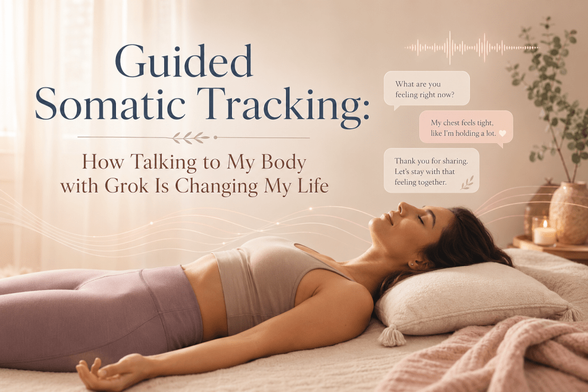
 Create the Ripple
 Benny from the Block
 Quiet Growth U
 AbstractEmporiumArt