"#EishetChayil: Woman of Valor – Heroines of Our History is a commentary on the 22 verses of #Proverbs 31, based on #midrash, the #Talmud, classic #rabbinic texts, and #ChabadHassidut. It is published by #Kehot, the central publishing house of the #Chabad-#Lubavitch movement.

The #book does not merely explain “Eishet Chayil”; it positions it as a sweeping #theological and historical statement about #Jewish #womanhood and Jewish survival. The tone is set early on, with sentences like, “At every critical juncture of our long and challenging history, you will find the fearless and wise eishet chayil shepherding us toward our destiny.”

One of the book’s central claims is clear and consistent: Jewish #history does not merely include #women; it is propelled by them."

https://www.jpost.com/judaism/article-895357

'Eishet Chayil': Who is the biblical woman of valor? - book review

Eishet Chayil is re-examined as a theological statement about women’s role in Jewish survival, leadership, and destiny.

The Jerusalem Post

"#RosenZvi has done a wonderful job, aided by #DanielTabak’s astute #translation, of #writing a work that, while academically rigorous, remains accessible.

While a 10-year-old can start to learn #Mishnah, there’s a complexity, sophistication, and depth of thought that is not readily apparent to a 5th-grader. The truth be told, it’s not readily apparent to a lot of people.

Rosen-Tzvi has written a masterpiece of a #book that uncovers the many layers of Mishnah and #Midrash, revealing that these are sophisticated, deep texts, carefully constructed intellectual systems.

One can’t understand #rabbinic #Judaism by reading these #texts superficially; one needs to grasp the rules, structures, and assumptions that underlie them. In How to Read the Mishnah and Midrash: An Introduction to Early Rabbinic #Literature, Rosen-Tzvi shows how to do that."

https://blogs.timesofisrael.com/book-review-how-to-read-the-mishnah-and-midrash/

Punishment of the Grave

Also known as Torment of the Grave.

This is a Judeo-Islamic concept about the time between death & resurrection of the Day of Judgment. According to some hadiths, the souls of the unrighteous are punished by 2 angels in the grave. While the righteous find the grave “peaceful & blessed.”

Punishment of the grave isn’t explicitly stated in the Quran. Although it’s mentioned in the hadiths (Hadiths are the Islamic equivalent of Jewish midrashs.) & shows up as early as the 9th century, still present among the majority of Sunnis & Shias.

The Quran does mention that certain individuals, such as martyrs, are alive & not dead in 2:154. Also, that is already in Hell in 71:25.

The term Barzakh indicates that the deceased & the living are entirely separated & cannot interact with each other. Otherwise, Barzakh refers to the whole period between the Day of Resurrection & death & is used synonymously for “grave.”

Others regard barzakh as a world dividing & simultaneously connecting the realm of the dead & the living. Therefore, some Muslim traditions argue about possibilities to contact the dead by sleeping in graveyards. Despite the non-existent or, at most, the brief mentions in the Quran.

Islamic tradition discusses elaborately, almost in graphic detail, as to what exactly happens before, during, & after death, based on certain hadithic narrations.

After burial, each person is interrogated in the grave by 2 angels, called Munkar & Nakir, appointed by God to question the dead in order to test their faith. The righteous believers answer correctly & live in peace & comfort. While the sinners & disbelievers fail & punishments ensue.

In the life of Barzakh, the souls of the sinners & disbelievers are kept & punished in a place called Sijjin, which is said to be located at the lowest level of the earth (traditionally Hell, before the Day of Resurrection or underworld). The books containing the full deeds are also kept here.

On the other hand, the souls of the righteous believers are kept in a place called Illiyin. Their books of deeds are also kept here.

According to some accounts, Illiyin is located in Heaven. There is a belief that the fire which represents one’s own bad deeds can already be seen during the Punishment of the Grave, & that the spiritual pain caused by this can lead to purification of the soul.

Rabbinic literature offers many traditions about angels chastising the dead. In Jewish religious books, the souls of the wicked are punished in the hereafter by Dumah & 3 subordinated Angels of Destruction. They’re only released from their suffering on Shabbat (the Jewish Sabbath).

One-Time Monthly Yearly

Make a one-time donation

Make a monthly donation

Make a yearly donation

Choose an amount

$5.00 $10.00 $15.00 $1.00 $5.00 $10.00 $5.00 $10.00 $15.00

Or enter a custom amount.

$

Your contribution is appreciated.

Your contribution is appreciated.

Your contribution is appreciated.

DonateDonate monthlyDonate yearly #9thCentury #AngelsOfDestruction #Barzakh #DayOfJudgment #DayOfResurrection #Death #Dumah #Grave #Hadith #Hell #Illiyin #Islam #Judaism #Midrash #Munkar #Muslim #Nakir #PunishmentOfTheGrave #Quran #Resurrection #Sabbath #Shabbat #Shia #Sijjin #Sinners #TormentOfTheGrave

Samyaza

Also known as Shamhazai, Aza, Ouza, Semjaza, or Amezyarak.

He’s a fallen angel of apocryphal Abrahamic traditions & also Manichaeism as the leader of the Watchers.

According to the Book of the Watchers (1st section of 1 Enoch), Samyaza was a high-ranking angel who got caught up with the “daughter of men.” He talked 200 other angels to come down to Earth to marry some mortal/human women. Samyaza knew fully the severity of these actions. He was afraid that he was going to suffer the consequences alone & be held solely responsible.

To make absolutely sure that everyone equally shared in the consequences, Samyaza made his comrades swear an oath on Mt. Hermon. This was to make absolutely sure that everyone would share the same fate. While Samyaza is the actual leaders, he & his Watcher associates (like Azazel) taught humans a lot of things that weren’t meant for human beings to know:

  • Sorcery & Incantations:
    • Samyaza specifically taught the “cutting of roots” & the “resolving of enchantments.”
  • Comsmetology & Warfare:
    • Other Watchers taught the making of swords, jewelry, & cosmetics makeup.
  • Astrology:
    • Humans were taught the signs of the sun, moon, & stars.

The “side effects” of the spicy adult time between the Watfhers & human women were called the Nephilim/Giants.

In the Enochian tradition, these “giants” were massive beings who consumed the earth’s resources. Eventually, they began to prey on humanity. The resulting chaos & bloodshedis given as the Great Flood, as the Earth cried out to the Archangels for intervention.

In the Book of Giants, Shemyaza (or Sahmizad in the Manichaean version) sires 2 sons, they battled Leviathan together. They’re not portrayed as heroic. But boasting about their own victory. A symbol of royal failure to keep one’s power in this world. After the defeat of the Leviathan, Shemyaza & his kids are slain by the 4 punishing angels.

The Babylonian Tulmud has 1 singular mention of the name Samyaza. The text portrays him as the grandpa of King Og, the king of Bashan & the last of the Raphaim known for his gigantic height & strength (Deuteronomy 3:11).

Upon the command of God, the Archangel Michael was sent to bind Samyaza & his associates. According to 1 Enoch 10: Samyaza was forced to watch the Nephilim (his kids) slaughter 1 another. He was bound/tied up & thrown into “the valleys of the earth” (or under the hills) to remain in darkness until the day of Final Judgment. At the end of time, he’s to be led away to the “abyss of fire.”

In some Midrashic traditions, Samyaza is portrayed with a touch of tragedy or repentance. One legend suggests he repented & suspended himself between Heaven & Earth – forming the constellation Orion.

In legend, Azza (another name for Samyaza) is the seraph tempted by the maiden Ishtar to reveal to her the Explicit Name of God. In Solomonic lore, the story is that Azza was the angel who revealed to the Jewish king the heavenly arcana. Thus making Solomon the wisest man on earth.

Of the 2 groups of angels headed by Metatron, 1 of the groups (the angels justice) were under the ruleship of Azza, who had this time hadn’t yet fallen.

According to rabbinic tradition, Azza is suspended between Heaven & Earth with Azazel as punishment for having had carnal knowledge of human women. He’s said to be constantly falling, with 1 eye open & the other closed, to see his plight & suffer the more. It’s said that he now hangs head down, & is the constellation of Orion.

Uzza (another name for Samyaza) is the guardian angel of the Egyptians. Before the Fall, Ouza (another name for Samyaza) was the rank of Seraphim.

Make a one-time donation

Your contribution is appreciated.

Donate

Make a monthly donation

Your contribution is appreciated.

Donate monthly

Make a yearly donation

Your contribution is appreciated.

Donate yearly #Abrahamic #Amezyarak #Apocryphal #ArchangelMichael #Aza #Azazel #Azza #BabylonianTalmud #Bashan #BookOfGiants #BookOfTheWatchers #Constellation #Cosmetology #Deluge #Deuteronomy311 #Egyptians #Enchantments #Enochian #FallOfMan #FallenAngels #FinalJudgment #giants #GreatFlood #IEnoch #Incantations #Ishtar #Jewelry #KingOg #Leviathan #Manichaeism #Metatron #Michael #Midrash #MountHermon #Nephilim #Orion #OUza #Raphain #Sahmizad #Samyaza #Semjaza #Seraph #Seraphim #Shamhazai #Shemyaza #Solomon #sorcery #Uzza #Warfare #Watchers

Samael

Also spelled Smil, Samil, or Samiel.

He’s an archangel in Talmudic & post-Talmudic tradition. He’s a figure who is the accuser or adversary (Satan in the Book of Job), seducer, & destroying angel (in the Book of Exodus).

Although many of his functions resemble the Christian idea of Satan, to the point of being sometimes classified as a fallen angel. He’s not necessarily evil, since his functions also result in good, like destroying sinners.

In Midrashic texts, he’s considered to be a member of the heavenly host, often with grim & destructive duties. 1 of Samael’s most significant roles in Jewish lore is that of the main angel of Death & the head of satans. He appears frequently in the story of the Garden of Eden & engineered the Fall of Adam (& Eve) with a snake in writings, during the Second Temple period. However, the serpent isn’t a form of Samael. But a beast he rode, like a camel.

In a single account, he’s also believed to be the father of Cain. As well as the partner of Lilith.

In early Talmudic & Midrashic literature, he hasn’t yet been associated with Satan. Only in later Midrashim is he given the title “head of satans.”

As a guardian angel & prince of Rome, he’s Israel’s archenemy. By the beginning of Jewish culture in Europe, Samael had been established as a representative of Christianity due to his identification with Rome.

In some Gnostic cosmologies, Samael’s role as a source of evil became identified with the Demiurge, the creator of the material world.

Samael was 1st mentioned during the Second Temple period & immediately after its destruction. He’s 1st mentioned in the Book of Enoch, which is a part of the Jewish apocrypha, along with other rebellious angels. In 1 Enoch, he’s 1 of the Watchers who descended to Earth to have adult spicy time with human women. Although he’s not their leader. Samayaza is their leader. (A post about Samyaza is coming soon. Research on him is ongoing, right now.)

In the Greek Apocalypse of Baruch, he’s the dominant evil figure. Samael plants the actual Tree of the Knowledge of Good & Evil. He’s then banished & cursed by God. To take revenge, he tempts Adam & Eve into sin by taking the form of the serpent.

He further appears as the embodiment of evil in the Ascension of Isaiah & is called by various names:

  • Melkira, “King of evil/wicked.”
  • Malkira/Malchira, “Messenger of evil.”
  • Belkira, “Lord of the Wall.”
  • Bechira, “Elect/Chosen of evil.”

The names Belial & Satan are also applied to him. He gains control of King Manasseh to accuse Isaiah of treason.

In Talmudic & Midrash, Samael’s role as an agent of evil is relatively marginal. From the 5th or 6th century onward, he becomes 1 of the most prominent among the demonic entities. Samael hasn’t been identified with the angel of Death in the Talmud.

In the Exodus Rabbah (the Exodus Midrash), Samael is pictured as the accuser in the heavenly court & tempter to sin, while Michael defends Israel’s actions. Here, Samael is identified with Satan. While “Satan” describes his function as an “accuser,” Samael is considered his real/proper name.

He also fulfills the role of the Angel of Death when he comes to take the body of Moses & is called the leader of Satan.

The title of “satan” is also applied to him in the Midrash Pirkei De-Rabbi Eliezer, where he was the chief of the fallen angels, & a 12-winged seraph. According to the text, Samael opposed the creation of Adam & descended to Earth to tempt him into evil.

Riding the serpent, he convinces Eve to eat the Forbidden Fruit. His role here might be inspired by the Islamic idea of Iblis, who refused to prostrate himself before Adam because he consists of fire & Adam merely of dust. This Midrash also reveals that Samael sired Cain with Eve.

In the smaller Midrash, he’s the ruler of Hell. Several sources (like Yalkut Shimoni) describe him as the guardian angel of Esau, relating him to Rome, the 1 who wrestled with Jacob, the angel who ordered Abraham to sacrifice Isaac, & a patron of Edom. Which makes sense because Esau was the “father” of Edom.

In Kabbalah, Samael is described as the “severity of God.” He is listed as 5 of the archangels of the world of Beri’ah. Among his portions are Esau, the people who inherit the sword & bring war; the goats & se’irim (demons); & the destroyer angel.

Both Samael & Lilith are major demons in earlier Jewish literature traditions. They don’t appear paired together until the 2nd half of the 13th century, when they’re introduced together. Lilith is a demon created alongside Adam. She wasn’t originally created as a demon. She morphed into a demoness down the road. She was originally created as Adam’s (1st) wife. Lilith then becomes Samael’s bride. With her, Samael created a host of demon kids, including a son, the “Sword of Samael” (or of Asmodai).

In the Kabbalistic work Treatise on the Left Emanation, Samael is part of the qlippoth (Qlippoth is the representation of evil/impure spiritual forces in Jewish mysticism), prince of all demons, & husband of Lilith. The 2 are said to parallel Adam & Eve being emanated together from the Throne of Glory as a counterpart. Asmodeus is also mentioned to be subservient to Samael & married to a young (or alternate), lesser Lilith.

In the Zohar (1 of Kabbalah’s principal works), Samael is described as a leader of the divine forces of destruction, part of the qlippoth. He’s mentioned again as the serpent’s rider. He’s also described as having mated with Eisheth Zenunim (a princess of the qilppoth); Na’amah (She originated from & is often mixed with another Naamah, sister to Tubal-Cain); & Agrat bat Mahlat (a demoness), all being “angels” of sacred prostitution.

It’s also said that the founder of Hasidic Judaism, Baal Shem Tov, summoned Samael to make him do his bidding.

Samael is also pictured as the angel of Death & 1 of the 7 archangels, the ruler over the 5th Heaven (This refers to 1 of the 7 firmaments, or physical layers, located above the open sky.) & commander of 2 million angels, such as the chief of all destroying angels. Think about the angel(s) who destroyed the Egyptians who didn’t have the lamb’s blood on their doorframes (Exodus 11).

In 3 separate Gnostic texts (found in the Nag Hammadi library), Samael is 1 of the 3 names of the Demiurge. He had 2 other names in these texts: Yaldabaoth & Saklas. After Yaldabaoth claims sole divinity for himself, the voice of Sophia (“wisdom,” the personification of wisdom) comes forth calling him Samael, due to his ignorance.

In Hypostasis of the Archons, Samael is the 1st sinner. The First Epistle of John calls the devil a sinner from the beginning. His appearance is that of a lion-faced serpent.

Make a one-time donation

Your contribution is appreciated.

Donate

Make a monthly donation

Your contribution is appreciated.

Donate monthly

Make a yearly donation

Your contribution is appreciated.

Donate yearly #1Enoch #13thCentury #5thCentury #5thHeaven #6thCentury #7Firmaments #Abraham #Accuser #Adam #Agrat #AngelOfDeath #ApocalypseOfBaruch #Apocrypha #Archangel #AscensionOfIsaiah #Asmodai #Asmodeus #BaalShemTov #Baruch #Bechira #Belkira #BeriAh #BookOfEnoch #BookOfExodus #BookOfJob #Cain #Christian #Christianity #Demiurge #Demon #Demoness #Earth #Edom #EishethZenunim #Esau #Eve #Exodus #Exodus11 #ExodusMidrash #ExodusRabbah #FallOfMan #FallenAngels #FirstEpistleOfJohn #ForbiddenFruit #GardenOfEden #Gnosticism #Greek #GuardianAngel #HasidicJudaism #Hell #HypostasisOfTheArchons #Iblis #Isaac #Isaiah #Islam #Israel #Jacob #JewishApocrypha #JewishMysticism #Judaism #Kabbalah #KingManasseh #Lilith #Mahlat #Malkira #Melkira #Michael #Midrash #Moses #Mysticism #NaAmah #Naamah #NagHammadi #NagHammadiLibrary #PirkeiDeRabbiEliezer #PostTalmudic #Qlippoth #Rome #SacredProstitution #Saklas #Samael #Samiel #Samil #Samyaza #Satan #SeIrim #SecondTemple #SecondTemplePeriod #Seraph #serpent #Smil #Sophia #Talmud #ThroneOfGlory #TreatiseOnTheLeftEmanation #TreeOfTheKnowledgeOfGoodEvil #TubalCain #Watchers #Wisdom #Yaldabaoth #YalkutShimoni #Zohar

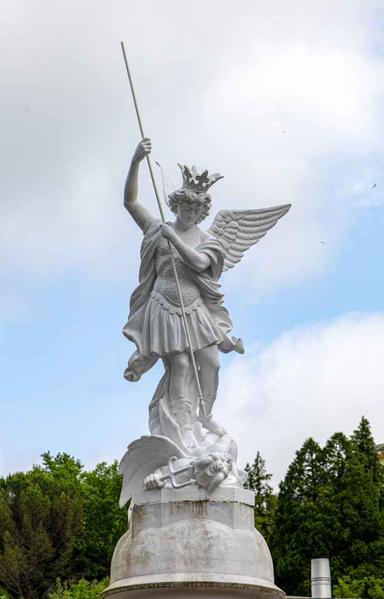
Archangel Michael

Also called Michael the Taxiarch. A taxiarch is used in the Greek language to mean “brigadier,” or a commander of a company. In Greek Orthodoxy, it refers to the Archangels Michael or Gabriel as leaders of the heavenly hosts.

Michael is an archangel & warrior of God in Christianity, Islam, & Judaism. The earliest surviving mentions of his name are in the 2nd or 3rd centuries BC Jewish works, often but not always apocalyptic. In these works, he’s the chief of the angels & archangels. He’s the guardian prince of Israel & is responsible for the care of the people of Israel.

Christianity conserved nearly all of Jewish traditions concerning him. He’s mentioned explicitly in Revelation 12:7-12, where he does battle with Satan, & in the Epistle of Jude, where the archangel & the devil have an argument over the body of Moses.

The Book of Enoch lists Michael as 1 of 7 archangels. The remaining names are: Uriel, Raguel, Raphael, Sariel, Gabriel, & Remiel. He’s mentioned again in the last chapters of the Book of Daniel, a Jewish apocalypse composed in the 2nd century BC, in which a man clothed in linen tells Daniel that he & “Michael, your prince” are engaged in a battle with the “prince of Persia,” after which, at the end-time, “Michael, the great prince who protects your people, will arise.”

Enoch was instrumental in establishing the pre-eminent place of Michael among the angels & archangels. In later Jewish works, he’s said to be their chief, mediating the Torah, & standing at the right hand of the throne of God.

In the traditions of the Qumran community, he defends, or leads, the people of God in the end-time battle. In other writings, he’s responsible for the care of Israel & acts as commander of the heavenly armies. He’s Israel’s advocate, contesting Satan’s claim to the body of Moses.

He intercedes between God & humanity & serves as High Priest in the heavenly sanctuary. (So would this make him Aaron’s equal? We’re sincerely asking. Let us know your take in the comments.) He accompanies the souls of the righteous dead to Paradise.

The 7 archangels (or 4, as traditions differ, but always include Michael) were associated with the branches of the menorah, the sacred 7-branched lamp stand in the Temple, as the 7 spirits before the throne of God. This is reflected in the Book of Revelation 4:5. Michael is mentioned explicitly in Revelation 12:7-12, where he does battle with Satan & casts him out of heaven so that he no longer has that exclusive access to God as accuser (his former role in the Old Testament).

Satan’s fall at the coming of Jesus marks the separation of the New Testament from Judaism. In Luke 22:31, Jesus tells Peter that Satan has asked God for permission to “sift” the disciples, the goal being to accuse them. But the accusation by Jesus, who thus takes on the role played by angels, & especially by Michael, in Judaism.

Michael is mentioned by anem for the 2nd time in the Epistle of Jude, which is an impassioned plea for the believers to engage in battle against the incursion of the error. In verses 9-10, the author denounces the heretics by contrasting them with the archangel Michael, who, in disputing with Satan over the body of Moses.

According to rabbinic tradition, Michael acted as the advocate of Israel. Sometimes he had to fight with the princes of other nations (Daniel 10:13), & particularly with the angel Samael, Israel’s accuser. Their hostility dates from the time Samael was thrown from heaven & tried to drag Michael down with him, requiring God’s intervention.

The rabbis declare that Michael came into his role as defender at the time of the biblical patriarchs. Rabbi Eliezer ben Jacob said Michael rescued Abraham from the furnace into which he’d been thrown by Nimrod. Some say he was the “one that had escaped” (Genesis 14:13), who told Abraham that Lot had been taken captive & who protected Sarah from defilement by Abimelech.

Michael prevented Isaac’s being sacrificed by his dad by substituting a ram in his place. He saved Jacob, while still in his mom’s womb, from death at the hands of Samuel. Michael later prevented Laban from hurting Jacob. The midrash Exodus Rabbah holds that Michael exercised his function as an advocate of Israel at the time of the Exodus & destroyed Sennacherib’s army.

Epiphanius of Salamis (circa 310-circa 320-403), in his Coptic-Arabic Hexaemeron, referred to Michael as a replacement of Satan. Accordingly, after Satan fell, Michael was appointed to the function Satan served when he was still 1 of the noble angels.

A painting of Michael slaying a serpent became a major art piece at the Michaelion after Constantine defeated Licinius near there in 324. This contributed to the standard iconography that developed of Michael as a warrior saint slaying a dragon. The Michaelion was a magnificent church & in time became a model for hundreds of other churches in Eastern Christianity.

In the 4th century, St. Basil the Great’s homily, De Angelis, St. Michael over all the angels. He was called “Archangel” because he heralds other angels, the title archangelos applied to him in Jude 1:9. The angelology of Pseudo-Dionysius, which was widely read as of the 6th century, gave Michael a rank in the hierarchy of angels.

Later, in the 13th century, others such as Bonventure believed him to be Prince of the Seraphim, the 1st of the 9 angelic orders. According to Thomas Aquinas, Michael is the Prince of the last & lowest choir, the Angels.

Catholics often refer to Michael as “Holy Michael, the Archangel” or “St. Michael.” He’s generally referred to in Christian liturgies as “St. Michael,” as in the Litany of the Saints. In a shortened archangel, is mentioned by name, omitting Saints Gabriel & Raphael.

In Roman Catholic teachings, St. Michael has 4 main roles or offices. His 1st role is the leader of the Army of God & the leader of celestial forces in triumphing over the powers of Hell. He’s viewed as the angelic model for the virtues of the “spiritual warrior,” his conflict with evil taken as “the battle within.”

The 2nd & 3rd roles of Michael in Catholic teachings deal with death. In his 2nd role, he’s the angel of death, carrying the souls of Christians to Heaven. In his 3rd role, he weighs souls on his perfectly balanced scales. The scales are a common object he holds in art.

In his 4th role, St. Michael, the special patron of the Chosen People in the Old Testament, is also Guardian of the Church. St. Michael was revered by the military orders of knights during the Middle Ages. The names of villages around the Bay of Biscay reflect this history.

The Eastern Orthodox give Michael the title Archistrategos, or “Supreme Commander of the Heavenly Hosts.” The Eastern Orthodox pray to their guardian angels & above all, to Michael & Gabriel. The Eastern Orthodox have always had a strong devotion to angels. In modern times, they’re referred to by the term “Bodiless Powers.” Several feasts dedicated to Archangel Michael are celebrated by the Eastern Orthodox throughout the year.

In Russia, many monasteries, cathedrals, courts, & merchant churches are dedicated to the Chief Commander Michael. Most Russian cities have a church or chapel dedicated to the archangel Michael. In Ukraine, the archangel Michael is the patron saint of Kyiv. He became popular from the time of Prince Vsevolod of Kyivan Rus’.

While in the Serbian Orthodox Church, St. Sava has a special role as the establisher of its autocephaly & largest Belgrade church devoted to him, the capital Belgrade’s Orthodox cathedral, the see church of the patriarch, is devoted to Michael.

The place of Michael in the Coptic Church of Alexandra is as a saintly intercessor. He’s the 1 who presents to God the prayers of the just, who accompanies the souls of the dead to Heaven, who defeats the devil. He’s celebrated liturgically on the 12th of each Coptic month.

In Alexandria, a church was dedicated to him in the early 4th century on the 12th of the month of Paoni. The 12th month of Hathor is the celebration of Michael’s appointment in Heaven, where Michael became the chief of the angels.

Seventh-Day Adventists believe that “Michael” is but 1 of many titles applied to the pre-existent Christ, or Son of God. According to Adventist theology, Michael was/is considered the “Eternal Word,” & the 1 by whom all things were created. The Word was then born, incarnated as Jesus.

They believe that the name “Michael” signifies “One Who Is Like God” & that, as the “Archangel” or “chief or head of the angels,” he led the angels; thus, the statement in Revelation 12:7-9 refers to Jesus as Michael.

Jehovah’s Witnesses believe that Michael is another name for Jesus in Heaven, in His pre-human & post-resurrection existence. They say the definite article in Jude 9 identifies Michael as the only archangel. They consider Michael to be synonymous with Christ, described in 1 Thessalonians 4:16: “with a cry of command, with the voice of an archangel, & with the sound of the trumpet.”

They believe the prominent roles assigned to Michael in Daniel 12:1, Revelation 12:7, Revelation 16, & Revelation 19:14 are identical to Jesus’ roles, being the 1 chosen to lead God’s people & as the only 1 who “stands up,” identifying the 2 as the same spirit being.

Because they identify Michael with Jesus, he’s considered the 1st & greatest of all God’s heavenly “sons,” God’s chief messenger, who takes the lead in vindicating God’s sovereignty, sanctifying his name, fighting the wicked forces of Satan & protecting God’s covenant people on earth. Jehovah’s Witnesses also identify Michael with the “Angel of the Lord” who led & protected the Israelites in the wilderness.

Members of the Mormon Church believe that Michael is Adam (of Adam & Eve fame), the Ancient of Days (Daniel 7), a prince, & the patriarch of the human family. They also hold that Michael assisted Jehovah (the pre-mortal form of Jesus) in the creation of the world under the direction of God the Father (Elohim). Under the direction of the Father, Michael also cast Satan out of Heaven.

In Islam, Mika’il (Michael) is 1 of 4 archangels along with Jibril (Gabriel, whom he’s often paired with), Israfil (trumpeter angel) & ‘Azra’il (angel of death). In other Islamic literature, Michael is associated with mercy. He asks God for forgiveness for humans & is 1 of the 1st angels who obeyed God’s orders to bow before Adam.

From the tears of Michael, angels of mercy are created as his helpers. Like Gabriel, with whom he’s often mentioned together, Michael is also a messenger. While Gabriel delivers messages from Heaven to humans, Michael delivers messages to the angelic world.

As the angel to execute God’s providence, he’s also associated with natural phenomena & causes rain upon the lands. Unlike Christian traditions, Michael is rarely shown as a warrior-angel, with a few references to the Battle of Badr by Suyuti as an exception.

The Miraj literature on occasion mentions both Gabriel & Michael as 2 angels who showed Muhammad Paradise & Hell. He’s mentioned in Shia supplication (Dua), reportedly handed down by the 6th Imam Ja’far al-Sadiq, in the prayers for blessings for the Bearers of the Throne.

The figures of Michael & Gabriel/Jibril serve as dual pillars of angelology. While they show up in the same texts, their “personalities” & mythological roles are distinct. Michael is the celestial soldier & protector. While Gabriel is the bridge between the divine mind & the human ear.

The name Michael (Mikha’el) translates from Hebrew as a rhetorical question: “Who is like God?” This name is actually a battle cry used during the primordial war in Heaven.

In the Book of Daniel, Michael is described as the “Great Prince” who stands guard over the people of Israel. Jewish Midrash expands on this. It suggests that Michael is the high priest of the Heavenly Temple. When other nations’ guardian angels argue against Israel, Michael acts as the defense in the celestial courtroom. Because after all, God is the judge of all.

Michael’s most iconic role comes from the Book of Revelation. Here, he leads an army of God against the Dragon (a.k.a. Satan). He’s almost always dressed in Roman/Medieval armor, standing over a defeated demon/dragon, holding a spear/sword.

In Catholic traditions, Michael has a secondary role as the Psychopomp. A Psychopomp is a conductor or a guide of souls. The 1 who “weighs” souls at the moment of death. This is why he’s sometimes shown with scales.

In Islamic tradition, Mikail (Michael) is 1 of 4 archangels. While Jibril feeds the soul (through revelation), Mikail is the Angel of Sustenance. He’s responsible for the forces of nature, specifically rain & lightning. Legends say he’s so moved by the majesty of God that he hasn’t smiled since the creation of Hell.

In the United States, Michael is the patron saint of paratroopers, police officers, & the military.

In the General Roman Calendar, the Anglican Calendar of Saints, & the Lutheran Calendar of Saints, Michael’s feast day is Michaelmas Day (September 29). The day is also the feast day of St. Gabriel & Raphael, in the General Roman Calendar & the Feast of St. Michael & All Angels in the Church of England.

In the Eastern Orthodox Church, St. Michael’s principal feast day is November 8. November 21, if they’re using the Gregorian calendar. Honoring him along with the rest of the “Bodiless Powers of Heaven” (angels) as their Supreme Commander, & the Miracle at Chonae is celebrated on September 6.

In the Coptic Orthodox Church, the main feast day is on 12 Hathor (between November 9 & December 9) & 12 Paoni (between June 8 & July 7). He is celebrated liturgically on the 12th of each Coptic month.

On April 7, the Oriental Orthodox Church commemorates the deliverance of the prophet Jeremiah from prison by Michael.

One-Time Monthly Yearly

Make a one-time donation

Make a monthly donation

Make a yearly donation

Choose an amount

$1.00 $5.00 $10.00 $1.00 $5.00 $10.00 $5.00 $10.00 $15.00

Or enter a custom amount.

$

Your contribution is appreciated.

Your contribution is appreciated.

Your contribution is appreciated.

DonateDonate monthlyDonate yearly #AzraIl #1Thessalonians416 #12Hathor #12Paoni #13thCentury #2ndCenturyBC #324 #3rdCenturyBC #4thCentury #6thCentury #Abimelech #Abraham #Adam #AllAngels #AncientOfDays #AngelOfDeath #AngelOfSustenance #Angelology #AnglicanCalendarOfSaints #Apocalyptic #April7 #ArchangelGabriel #ArchangelMichael #ArchangelRaguel #ArchangelRaphael #ArchangelRemiel #ArchangelSariel #ArchangelUriel #Archangelos #Archistrategos #ArmyOfGod #BattleOfBadr #BayOfBiscay #BearersOfTheThrone #Belgrade #BodilessPowers #BodilessPowersOfHeaven #Bonventure #BookOfDaniel #BookOfEnoch #BookOfRevelation #Catholic #Catholics #ChiefCommanderMichael #Christ #Christianity #ChurchOfEngland #Circa310 #Circa320 #Circa403 #Constantine #CopticChurchOfAlexandria #Daniel #Daniel1013 #Daniel121 #Daniel7 #DeAngelis #December9 #Disciples #Dragon #Dua #EasternChristianity #EasternOrthodox #EasternOrthodoxChurch #Elohim #EpiphaniusOfSalamis #EpistleOfJude #EternalWord #ExodusRabbah #FeastDay #FeastOfStMichael #GeneralRomanCalendar #Genesis1413 #GreatPrince #GreekOrthodoxy #GregorianCalendar #Hathor #Heaven #HeavenlyTemple #Hebrew #Hell #Hexaemeron #HighPriest #Homily #Isaac #Islam #Israel #Jacob #Jehovah #JehovahSWitnesses #Jeremiah #Jesus #Jewish #Jibril #Judaism #Jude19 #Jude9 #July7 #June8 #KievanRus #KingSennacherib #Kyiv #Laban #Licinius #LitanyOfTheSaints #Lot #Luke2231 #LutheranCalendarOfSaints #Menorah #Mercy #MichaelTheTaxiarch #Michaelion #MichaelmasDay #Midrash #Mikail #MikhaEl #MiracleAtChonae #Miraj #MormonChurch #Moses #Muhammad #NewTestament #Nimrod #November21 #November8 #November9 #OldTestament #OrientalOrthodoxChurch #Paoni #Paradise #Patriarchs #PatronSaint #PatronSaints #Persia #PrinceOfTheSeraphim #PrinceVsevolod #Prophet #PseudoDionysius #Psychopomp #Qumran #Rabbis #Revelation127 #Revelation12712 #Revelation1279 #Revelation16 #Revelation1914 #Revelation45 #RomanCatholic #Russia #Samael #Samuel #Sarah #Satan #Scales #September29 #September6 #SerbianOrthodoxChurch #SeventhDayAdventists #Shia #SonOfGod #Spear #StBasilTheGreat #StGabriel #StMichael #StRaphael #StSava #Suyuti #Temple #ThomasAquinas #Torah #Trumpet #Ukraine #UnitedStatesOfAmerica

"There is now a #Jewish debate about fighting #antisemitism. And we need to consider what exactly we are arguing about when we argue about it.

[Brett] #Stephens’s thesis might seem provocative now, but it wouldn’t shock medieval #Jews. #AvrahamGrossman points out that #Rashi often depicts the nations of the world as “lying in wait to attack and devour the #Jewish people.” #Grossman writes that this is not surprising, considering that the renowned medieval commentator’s community was massacred during the #FirstCrusade, and endured multiple #antiJewish edicts.

In his commentary on the #Torah, Rashi quotes the phrase from the #Midrash saying that “it is a rule that #Esau hates #Jacob.” This means that antisemitism is a metaphysical reality; the spiritual heirs of Esau will always hate the descendants of Jacob. Antisemitism will never end.

Rashi’s attitude to antisemitism remains influential today."

https://www.jpost.com/opinion/article-887432

A disturbing old-new view of antisemitism | The Jerusalem Post

We have to be prepared for the possibility that democracy will fail the Jews.

The Jerusalem Post | JPost.com

The reason why
women don’t have a prescribed
daily prayer
to thank G-d for not making them
a man
is because Hashem knew
women would already be saying it
multiple times a day.

#NoJewanceJanuary
#MarnishMidrash
because we need more #midrash by womenfolk. #noJewance

Islamic Mythology

This is a body of myths that are associated with Islam & the Quran. These include a creation myth & a vision of the afterlife. The 2 types of myth & legends that make up Islamic mythology are cosmogony & eschatology.

The creation myths are based on the Quran, & expanded on in habits, Arabic & Persian writings, histories (Qisas al-anbiya), Muslim poetry, philosophical essays, & mystical writings.

There’s no 1 single story of creation, unlike in Christianity. It’s made clear that God is the 1 who created the world. The number of days in the creation story varies between 6-8 days.

In Islam, God created the angels as inhabitants of the heavens & jinn (& humans) as inhabitants of the earth. The 1st entities who lived on earth were the jinn. However, they fought each other until God sent an army of angels headed God sent an army of angels headed by Iblis (a.k.a. Satan), against them. Adam, a representative for mankind as a whole, was created as their successor.

In the Christian bible, God says He’s going to make mankind, in the plural: “…let us make man in our image, in our likeness.” It’s not clear to whom God is speaking to. In Jewish midrashism, it’s thought God is talking to the angels, maybe.

The Quran is explicit about it: “When your Lord said to the angels…” In an exegesis of the Quran, after the angels defeated the jinn, they settled on earth. It’s these angels whom God addressed when he announced to create Adam (mankind) as a deputy of God.

The angels, either only from the angels of the earth or from all angels oppose the creation of Adam for a variety of reasons. One major reason is due to the sins Adam’s successor will commit, which is explicitly mentioned in the Quran.

Another reason is that angels consider themselves superior to Adam, in terms of knowledge. The angelic opposition derives from a faulty analogy between Adam & the jinn. The angels don’t know that from among mankind, there will be saints & prophets. Despite the sinners among them. Eventually, the angels bow down, except for Iblis. Angels who remained in opposition to Adam became devils/demons.

According to Islam, Adam isn’t only the 1st human being, & man, but also the 1st prophet. The Quran says that Adam & Eve lives in the Garden of Eden. Adam & Eve both eat from the forbidden “Tree of Eternity.” According to the Quran, as punishment God declares the earth as a dwelling place for humans.

Only due to free will, humans are able to produce good. Although Adam’s disobedience created evil, only this made it possible to create good. The disobediences of Adam & Eve were already forgiven by God during their life.

According to a common narrative, God ordered the Archangels to collect a handful of soil from earth. But every time an archangel approached earth, the Earth sought refuge in God, that it might not be distorted.

All the archangels returned empty-handed. Except for Azrael, who succeeded because he sought refuge in God before, for that he’ll not return unsuccessful.

Another common tradition pictured the body of Adam lying on the ground for 40 years, whereupon Iblis became curious about the new creation. After investigating the lifeless body, he promised that, if he’ll gain authority over it, he’ll destroy it.

In another tradition, it’s not Azrael, but Iblis, included among the archangels, who succeeded in collecting soil from the earth. Thus he later declined to prostrate/bow himself before whose creation/formation he just helped.

The heavens span in a dome-like structure over the earths (yep, plural), arranged in horizontal layers 2 upon another. At the top sits Big G’s (or in this case, Big A’s) Throne (Al-‘Arsh) separated from the 7 heavens below.

The lowest heaven is often associated with a firmly-enclosed water of a celestial ocean. Below the heavens are the 7 earths. The Earth’s are also part of the supernatural cosmos & serve as gradual stages of hell.

The surface is inhabited by humans, the lower stages are abode of destructive winds & djinn, followed by brimstones of hell, scorpions, & vipers. With the devil, eventually, at the bottom.

According to Islamic mythology, God instructed Adam to construct a building (the Kaaba) to be the earthly counterpart of the House of Heaven & that Ibrahim (Abraham) & Ismail (Ishmael) later rebuilt it on its original foundations after it was destroyed in the flood of Nuh (Noah).

According to other versions, Ibrahim & his son, Ismail, were the 1st to build the Kaaba. As Ismail was searching for a stone to mark a corner with, he met with the angel Jibrail (Gabriel). Jibrail gave Ismail the Black Stone.

According to the Hadith, the Black Stone is reported to have milky white after being descended from Heaven but was made black due to the sins of the people, who had touched it. The Black Stone itself isn’t worshipped by Muslims.

The Kaaba was originally intended as a symbolic house for the 1 monotheistic God. After Ibrahim’s death, people started to fill the Kaaba with “pagan idols.” When Muhammad conquered Mecca after his exile, he removed the idols from the Kaaba.

The inside of the Kaaba is empty. It’s now an important pilgrimage site. All Muslims are supposed to visit at least 1 time, if they are able to (called the Hajj). Muslims are supposed to pray 5x a day while facing the Kaaba/Mecca’s direction.

Make a one-time donation

Your contribution is appreciated.

Donate

Make a monthly donation

Your contribution is appreciated.

Donate monthly

Make a yearly donation

Your contribution is appreciated.

Donate yearly

#Adam #AlArsh #Arabic #Archangel #BlackStone #ChristianBible #Djinn #Eve #Gabriel #GardenOfEden #Hajj #Iblis #Ibrahim #Ishmael #Islam #IslamicMythology #Ismail #Jibrail #Jinn #Kaaba #Midrash #Muslim #Noah #Nuh #Persian #QisasAlAnbiya #Quran #Satan #SevenHeavens #TreeOfEternity

The Legend of Lilith: The Night Demoness

The story of Lilith, especially as told in the medieval text the Alphabet of Ben Sira (circa 700-1000), shows a dark, rebellious female figure who becomes a menacing creature of the night, preying on the vulnerable.

In this version of the creation myth, before Eve was a thing, God made Lilith as Adam’s 1st wife. Lilith was NOT the same as Eve, she wasn’t made from any part of Adam’s body. Lilith was made from the same dust & earth that Adam was made from. Thus making Lilith Adam’s equal.

The conflict begins almost immediately in the legendary Garden of Eden. Adam insisted that Lilith should be the bottom during spicy adult time. Because Adam thought she should be submissive to him.

Lilith wasn’t having any of that. Not one bit. “Why should I lie beneath you? I also was made from dust. Therefore I’m your equal.” She insisted on being the top during spicy adult time.

When Adam tried to force her into submission, Lilith got super angry. She says the ineffable name of God (This is called the Shem-Ha-Meforash). After saying this, she grew wings & flew out of Eden & into the air.

This act of rebellion makes Lilith an outcast & a primal source of sin, not through temptation like Eve. But through defiance of patriarchal & divine order.

Lilith made her home by the Red Sea. This region is traditionally associated with evil spirits. When Adam complained to God about Lilith, God sent 3 angels, named Senoi, Sansenoi, & Sammangelof, to go bring Lilith back to Adam.

The angels found Lilith. They demanded she go back to Adam. The angels threatened to kill Lilith’s kids that would become demons, if she didn’t come back. And she would have 100 per day.

Lilith wasn’t hearing any of this. She refused to go back. Instead, she entered into a terrifying agreement. She accepted the curse of her kids being killed daily. In a devastating retaliation, she vowed to become a demon who would forever roam the world, seeking to harm the offspring of Adam & Eve.

Lilith’s main role in Jewish folklore became the quintessential night hag or succubus. She’s associated with some interesting themes:

  • The Child-Snatcher: This is what she was most feared for. She stole & unalived newborn infants, especially boys during the first 8 days of life (before their circumcision) & girls during the first 20 days.
  • The Seducer: Lilith was believed to visit sleeping men in the form of a beautiful demoness. She caused erotic dreams & involuntary emission of men’s love juice. With this “stolen seed,” she would procreate more demonic kids, the lilim.
  • The Haunter of Solitude: Lilith is said to be particularly dangerous to men who sleep alone in a house, as she may seize them.

The only defense against Lilith’s power was to wear an amulet inscribed with the names of the 3 angels (Senoi, Sansenoi, & Sammangelof) on the arms of women in labor & around the cribs of newborns. This is an ancient tradition of protective magic against a deadly spirit that has clear echoes of the wards & superstitions associated with Halloween.

One-Time Monthly Yearly

Make a one-time donation

Make a monthly donation

Make a yearly donation

Choose an amount

$1.00 $5.00 $10.00 $1.00 $5.00 $10.00 $5.00 $10.00 $15.00

Or enter a custom amount

$

Your contribution is appreciated.

Your contribution is appreciated.

Your contribution is appreciated.

DonateDonate monthlyDonate yearly

#1000 #700 #Adam #AlphabetOfBenSira #Amulet #bible #circumcision #Demoness #Eden #Eve #Halloween #HebrewBible #Kabbalah #Lilim #Lilith #Midrash #NightHag #RedSea #Sammangelof #Sansenoi #Senoi #Succubus

Memberships

Visit the post for more.