 j43147 :pentagram:
Psychology students in Groningen put sodomy in Epstein government timelinecomputers mmmkay. This boi has butthurt. #sodom #prometheus #demminkurge #karbonkel #yaldabaoth
Is de Church of Satan making people have anal??? Or is it Sodom and is Yaldabaoth behind it.... A Satanist may only make it about their true soulmate is in our original founding principles. #sodom #yaldabaoth #prometheus #karbonkel #demminkurge #churchofsatan
 Spirituality & Religious Studies
Samael
Also spelled Smil, Samil, or Samiel.
He’s an archangel in Talmudic & post-Talmudic tradition. He’s a figure who is the accuser or adversary (Satan in the Book of Job), seducer, & destroying angel (in the Book of Exodus).
Although many of his functions resemble the Christian idea of Satan, to the point of being sometimes classified as a fallen angel. He’s not necessarily evil, since his functions also result in good, like destroying sinners.
In Midrashic texts, he’s considered to be a member of the heavenly host, often with grim & destructive duties. 1 of Samael’s most significant roles in Jewish lore is that of the main angel of Death & the head of satans. He appears frequently in the story of the Garden of Eden & engineered the Fall of Adam (& Eve) with a snake in writings, during the Second Temple period. However, the serpent isn’t a form of Samael. But a beast he rode, like a camel.
In a single account, he’s also believed to be the father of Cain. As well as the partner of Lilith.
In early Talmudic & Midrashic literature, he hasn’t yet been associated with Satan. Only in later Midrashim is he given the title “head of satans.”
As a guardian angel & prince of Rome, he’s Israel’s archenemy. By the beginning of Jewish culture in Europe, Samael had been established as a representative of Christianity due to his identification with Rome.
In some Gnostic cosmologies, Samael’s role as a source of evil became identified with the Demiurge, the creator of the material world.
Samael was 1st mentioned during the Second Temple period & immediately after its destruction. He’s 1st mentioned in the Book of Enoch, which is a part of the Jewish apocrypha, along with other rebellious angels. In 1 Enoch, he’s 1 of the Watchers who descended to Earth to have adult spicy time with human women. Although he’s not their leader. Samayaza is their leader. (A post about Samyaza is coming soon. Research on him is ongoing, right now.)
In the Greek Apocalypse of Baruch, he’s the dominant evil figure. Samael plants the actual Tree of the Knowledge of Good & Evil. He’s then banished & cursed by God. To take revenge, he tempts Adam & Eve into sin by taking the form of the serpent.
He further appears as the embodiment of evil in the Ascension of Isaiah & is called by various names:
- Melkira, “King of evil/wicked.”
- Malkira/Malchira, “Messenger of evil.”
- Belkira, “Lord of the Wall.”
- Bechira, “Elect/Chosen of evil.”
The names Belial & Satan are also applied to him. He gains control of King Manasseh to accuse Isaiah of treason.
In Talmudic & Midrash, Samael’s role as an agent of evil is relatively marginal. From the 5th or 6th century onward, he becomes 1 of the most prominent among the demonic entities. Samael hasn’t been identified with the angel of Death in the Talmud.
In the Exodus Rabbah (the Exodus Midrash), Samael is pictured as the accuser in the heavenly court & tempter to sin, while Michael defends Israel’s actions. Here, Samael is identified with Satan. While “Satan” describes his function as an “accuser,” Samael is considered his real/proper name.
He also fulfills the role of the Angel of Death when he comes to take the body of Moses & is called the leader of Satan.
The title of “satan” is also applied to him in the Midrash Pirkei De-Rabbi Eliezer, where he was the chief of the fallen angels, & a 12-winged seraph. According to the text, Samael opposed the creation of Adam & descended to Earth to tempt him into evil.
Riding the serpent, he convinces Eve to eat the Forbidden Fruit. His role here might be inspired by the Islamic idea of Iblis, who refused to prostrate himself before Adam because he consists of fire & Adam merely of dust. This Midrash also reveals that Samael sired Cain with Eve.
In the smaller Midrash, he’s the ruler of Hell. Several sources (like Yalkut Shimoni) describe him as the guardian angel of Esau, relating him to Rome, the 1 who wrestled with Jacob, the angel who ordered Abraham to sacrifice Isaac, & a patron of Edom. Which makes sense because Esau was the “father” of Edom.
In Kabbalah, Samael is described as the “severity of God.” He is listed as 5 of the archangels of the world of Beri’ah. Among his portions are Esau, the people who inherit the sword & bring war; the goats & se’irim (demons); & the destroyer angel.
Both Samael & Lilith are major demons in earlier Jewish literature traditions. They don’t appear paired together until the 2nd half of the 13th century, when they’re introduced together. Lilith is a demon created alongside Adam. She wasn’t originally created as a demon. She morphed into a demoness down the road. She was originally created as Adam’s (1st) wife. Lilith then becomes Samael’s bride. With her, Samael created a host of demon kids, including a son, the “Sword of Samael” (or of Asmodai).
In the Kabbalistic work Treatise on the Left Emanation, Samael is part of the qlippoth (Qlippoth is the representation of evil/impure spiritual forces in Jewish mysticism), prince of all demons, & husband of Lilith. The 2 are said to parallel Adam & Eve being emanated together from the Throne of Glory as a counterpart. Asmodeus is also mentioned to be subservient to Samael & married to a young (or alternate), lesser Lilith.
In the Zohar (1 of Kabbalah’s principal works), Samael is described as a leader of the divine forces of destruction, part of the qlippoth. He’s mentioned again as the serpent’s rider. He’s also described as having mated with Eisheth Zenunim (a princess of the qilppoth); Na’amah (She originated from & is often mixed with another Naamah, sister to Tubal-Cain); & Agrat bat Mahlat (a demoness), all being “angels” of sacred prostitution.
It’s also said that the founder of Hasidic Judaism, Baal Shem Tov, summoned Samael to make him do his bidding.
Samael is also pictured as the angel of Death & 1 of the 7 archangels, the ruler over the 5th Heaven (This refers to 1 of the 7 firmaments, or physical layers, located above the open sky.) & commander of 2 million angels, such as the chief of all destroying angels. Think about the angel(s) who destroyed the Egyptians who didn’t have the lamb’s blood on their doorframes (Exodus 11).
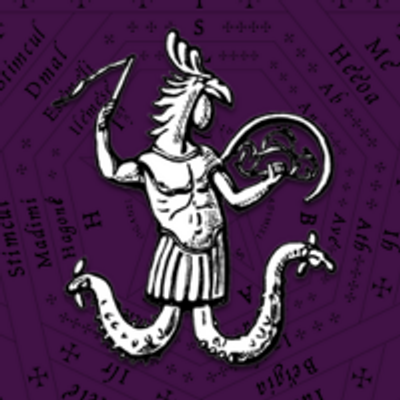
In 3 separate Gnostic texts (found in the Nag Hammadi library), Samael is 1 of the 3 names of the Demiurge. He had 2 other names in these texts: Yaldabaoth & Saklas. After Yaldabaoth claims sole divinity for himself, the voice of Sophia (“wisdom,” the personification of wisdom) comes forth calling him Samael, due to his ignorance.
In Hypostasis of the Archons, Samael is the 1st sinner. The First Epistle of John calls the devil a sinner from the beginning. His appearance is that of a lion-faced serpent.
Make a one-time donation
Your contribution is appreciated.
DonateMake a monthly donation
Your contribution is appreciated.
Donate monthlyMake a yearly donation
Your contribution is appreciated.
Donate yearly #1Enoch #13thCentury #5thCentury #5thHeaven #6thCentury #7Firmaments #Abraham #Accuser #Adam #Agrat #AngelOfDeath #ApocalypseOfBaruch #Apocrypha #Archangel #AscensionOfIsaiah #Asmodai #Asmodeus #BaalShemTov #Baruch #Bechira #Belkira #BeriAh #BookOfEnoch #BookOfExodus #BookOfJob #Cain #Christian #Christianity #Demiurge #Demon #Demoness #Earth #Edom #EishethZenunim #Esau #Eve #Exodus #Exodus11 #ExodusMidrash #ExodusRabbah #FallOfMan #FallenAngels #FirstEpistleOfJohn #ForbiddenFruit #GardenOfEden #Gnosticism #Greek #GuardianAngel #HasidicJudaism #Hell #HypostasisOfTheArchons #Iblis #Isaac #Isaiah #Islam #Israel #Jacob #JewishApocrypha #JewishMysticism #Judaism #Kabbalah #KingManasseh #Lilith #Mahlat #Malkira #Melkira #Michael #Midrash #Moses #Mysticism #NaAmah #Naamah #NagHammadi #NagHammadiLibrary #PirkeiDeRabbiEliezer #PostTalmudic #Qlippoth #Rome #SacredProstitution #Saklas #Samael #Samiel #Samil #Samyaza #Satan #SeIrim #SecondTemple #SecondTemplePeriod #Seraph #serpent #Smil #Sophia #Talmud #ThroneOfGlory #TreatiseOnTheLeftEmanation #TreeOfTheKnowledgeOfGoodEvil #TubalCain #Watchers #Wisdom #Yaldabaoth #YalkutShimoni #Zohar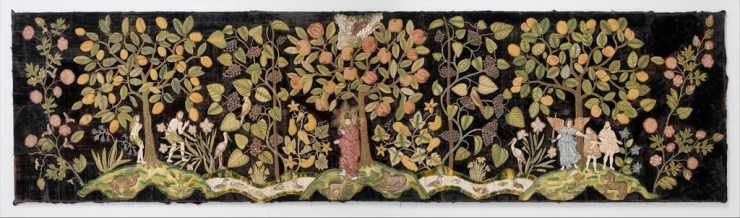
Archangel Uriel
Uriel means “God is my flame.” His name could be spelled Auriel or Oriel. He’s one of the archangels who’s mentioned in Rabbinic tradition & in certain Christian traditions.
He’s well known in the Russian Orthodox tradition & in folk Catholicism (in both he’s considered to be 1 of the 7 major archangels). In Anglicanism, he’s also well known in European esoteric medieval literature.
Uriel is also known as a master of knowledge & archangel of wisdom. He’s associated with the truth.
In apocryphal, kabbalistic, & occult works, Uriel has been equated (or confused) with Urial, Nuriel, Uryan, Jeremiel, Vretil, Sariel, Puruel, Phanuel, Azrael, & Raphael.
In the Secret Book of John (an early Gnostic work), Uriel is placed in control of the demons who help Yaldabaoth create Adam.
Of the 7 Archangels in the angelology of Judaism, only 2 of them (Gabriel & Michael) are mentioned by name in the canonized Jewish scripture. Where a 4th archangel is added to the named 3 (to represent the 4 cardinal points), Uriel is generally the 4th. Uriel is listed as the 4th angel by Christian Gnostics, under the name of Phanuel.
Uriel appears in the 2nd Book of Esdras, which is found in the Biblical apocrypha (called Esdras IV in the Vulgate). In this, the prophet Ezra asks God a series of questions, & God sends Uriel to instruct him. According to the Revelation of Esdras, the angels who will rule at the end of the world are Michael, Gabriel, Uriel, Raphael, Gabuthelon, Beburos, Zebuleion, Aker, & Arphugitonos. The final 5 listed appear only in the book & nowhere else in apocryphal or apocalyptics works.
In Christian apocryphal Gospels, Uriel plays a role (differing between the sources) in the rescue of Jesus’ cousin, John the Baptist, from the Massacre of the Innocents ordered by King Herod. He carries John & his mom, St. Elizabeth, to join the Holy Family after their flight into Egypt. Their reunion is pictured in da Vinci’s Virgin of the Rocks (a.k.a. Madonna of the Rocks).
Uriel is often identified as a cherub & the angel of repentance. He stood at the Garden of Eden with a fiery sword, or as the angel who’s over the world & over Tartarus. In the Apocalypse of Peter, he appears as the angel of repentance, who is graphically represented as being as pitiless as any demon.
In the Life of Adam & Eve, Uriel is regarded as the spirit (1 of the cherubs) of the 3rd chapter of Genesis. He’s also identified as 1 of the angels who helped bury Adam & Abel in Eden. He checked the doors of Egypt for lamb’s blood during the plague. He held the key to the pit during the end times, & led Abraham to the west.
In modern angelology, Uriel is identified variously as a seraph, cherub, regent of the sun, flame of God, angel of the divine presence, presider over Tartarus/Hell, archangel of salvation, & in later scriptures, identified with Phanuel (“God has turned”). He’s often pictured carrying a book or a papyrus scroll representing wisdom. Uriel is a patron of the arts.
In the Eastern Orthodox churches, Uriel is commemorated together with the other archangels & angels with a feast day of the “Synaxis of the Archangel Michael & the Other Bodiless Powers” on November 8 of the liturgical calendar. For those churches which follow the Julian calendar, November 8 & falls on November 21 on the modern Gregorian calendar.
He’s regarded as the patron saint of the arts & sciences. In addition, every Monday throughout the year is dedicated to the angels.
The Anglicans & Coptic Christians of Ethiopia & Eritrea venerate archangel Uriel. According to the latter, July 11 is his feast day. In the Ethiopian Homily on the Archangel Uriel, he’s pictured as 1 of the great archangels & as the angelus interpres who has interpreted prophecies to Enoch & Ezra, & the helper of both of them.
According to the Homily, at the time of the crucifixion of Jesus, Uriel dipped his wing in the blood & water flowing from Christ’s flank & Filled a cup with it. Carrying the cup, he & the archangel Michael rushed into the world & sprinkled it all over Ethiopia.
In every place where a drop of blood fell, a church was built. Thus, Uriel is often pictured carrying a chalice filled with the blood of Christ in Ethiopian Orthodox iconography. Uriel is honored in the Lutheran Churches as well, with churches including statuary of the archangels Gabriel, Uriel, Michael, & Raphael.
At the Council of Rome of 745, Pope Zachary (intending to clarify the church’s teaching on angels & curbs a tendency toward angel worship) condemned obsession with angelic intervention & angelology. But reaffirmed the approval of the practice of the reverence of angels.
This Synod struck many angels’ names from the list of those eligible for veneration in the church of Rome, including Uriel. Only the reverence of the archangels is mentioned in the recognized Catholic canon of scriptures, namely, Michael, Gabriel, & Raphael, remained acceptable.
In the 16th century, Archangel Uriel appeared before the Sicilian friar Antonio Lo Duca & told him to build a church in the Termini area. Lo Duca told Pope Pius IV about the apparition, and the pope then asked Michelangelo to design the church, which became the Basilica of St. Mary of the Angels & of the Martyrs located at the Esedra Plaza.
In the 1st half of the 11th century, Bulgarian followers of the duelist heresy called Bogomilism, who lived in the dukedom of Ahtum in present-day Banat, invoked Uriel in rituals. This was witnessed by Gerard of Csanad, the Catholic bishop of the area after 1028. Uriel was also named in a small exorcism in the 15th century.
The Book of Enoch (which presents itself as written by Enoch) mentions Uriel in many of its component books. In chapter IX, part of “The Book of the Watchers” (2nd century BC), only 4 angels are named. Those angels are Michael, Uriel, Raphael, & Gabriel. Though some versions have a 5th angel: Suryal or Suriel.
However, chapter XX later lists 7 angels’ names & functions. Those angels are “Uriel, 1 of the holy angels, who’s over the world & over Tartarus,” Raphael, Raguel, Michael, Saraqael, Gabriel, & Remiel.
The Book of the Watchers tells us that Uriel, Raphael, & Gabriel were present before God to testify on behalf of humankind. They ask for divine intervention during the reign of the fallen Grigori (fallen watchers). These fallen ones took human wives & had half-“angel,” half-human offspring called the Nephilim.
Uriel was responsible for warning our boy Noah about the upcoming deluge. After judgment has been brought up on the Nephilim & the Fallen Ones, including the 2 main leaders, Samyaza & Azazel. Uriel then acts as a guide for Enoch for the rest of the Book of Watchers.
In the traditions & hagiography of the Episcopal & other Anglican churches, Uriel is mentioned as an archangel. He’s recognized as the patron saint of the sacrament of confirmation. In some Episcopal churches, Uriel is also regarded as the keeper of beauty & light, & regent of the sun & constellations.
In iconography, he’s shown holding in his right hand a Greek Ionic column, which symbolizes perfection in aesthetics & man-made beauty, and in his left hand is a staff topped with the sun. He is celebrated in the Anglican liturgical calendars of the Feast of the Archangels. The Church of St. Uriel the Archangel at Sea Girt, New Jersey, is a testimony to Anglicans’ devotion to Uriel.
In Hermetic Kabbalah, Uriel’s name is commonly spelled Auriel. He’s regarded as the archangel of the North, & of the element of Earth. According to the teaching of the modern Hermetic Order of the Golden Dawn, Uriel is the archangel of North & East, & is associated with the vegetation of the Earth. In iconography, he’s depicted holding stems of ripened wheat & wearing robes of citrine (a medium deep shade of golden yellow), russet (dark brown with a reddish-orange tinge), olive (like green olives), & black.
One-Time Monthly YearlyMake a one-time donation
Make a monthly donation
Make a yearly donation
Choose an amount
$1.00 $5.00 $10.00 $1.00 $5.00 $10.00 $5.00 $10.00 $15.00Or enter a custom amount.
$Your contribution is appreciated.
Your contribution is appreciated.
Your contribution is appreciated.
DonateDonate monthlyDonate yearly #1028 #11thCentury #15thCentury #16thCentury #2ndCenturyBC #745 #Abraham #Adam #Aker #Angelology #Anglican #AntonioLoDuca #ApocalypseOfPeter #Apocryphal #ArchangelGabriel #ArchangelUriel #Arphugitonos #Auriel #Azazel #Azrael #Banat #BasilicaOfStMaryOfTheAngelsOfTheMartyrs #Beburos #Bogomilism #BookOfEnoch #Bulgaria #Cherub #Christian #Christianity #ChurchOfStUrielTheArchangel #Confirmation #Constellations #CopticOrthodoxChurch #CouncilOfRome #Deluge #EasternOrthodoxChurch #Eden #Egypt #Enoch #Episcopal #Eritrea #EsdrasIV #EsedraPlaza #Ethiopia #EthiopianOrthodoxChurch #Ezra #FallenOnes #FeastDay #FeastOfTheArchangels #FolkCatholicism #Friar #Gabuthelon #GardenOfEden #Genesis #GerardOfCsanad #Gnostic #GreekIonicColumn #GregorianCalendar #Grigori #Hell #HermeticKabbalah #HermeticOrderOfTheGoldenDawn #HolyFamily #HomilyOnTheArchangelUriel #Jeremiel #Jesus #JohnTheBaptist #Judaism #JulianCalendar #July11 #Kabbalah #KingHerod #LeonardoDaVinci #LifeOfAdamEve #Lutherians #MadonnaOfTheRocks #MassacreOfTheInnocence #Michael #Michelanglo #Nephilim #NewJersey #Noah #November21 #November8 #Nuriel #Oriel #Phanuel #PopePiusIV #PopeZachary #Prophet #Puruel #RabbinicJudaism #Raphael #RevelationOfEsdras #RussianOrthodox #Samyaza #Saraqael #Sariel #SeaGirt #SecondBookOfEsdras #SecretBookOfJohn #Seraph #Sicily #StElizabeth #SynaxisOfTheArchangelMichaelTheOtherBodilessPowers #Tartarus #Termini #TheBookOfTheWatchers #Urial #Uriel #Uryan #VirginOfTheRocks #Vretil #Vulgate #Yaldabaoth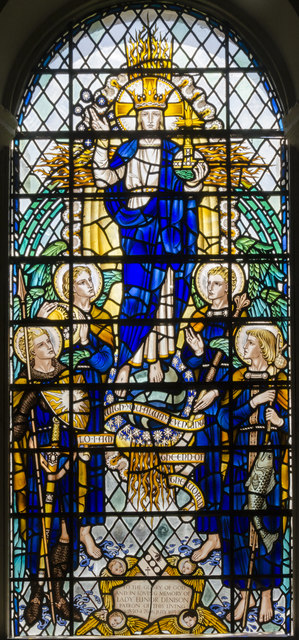
 Hermetic Library
 Hermetic Library
 Ancient Mysteries Lovers
Who is the False God of This World?
#gnostic #gnosticteachings #gnosticchristians #naghammadi #apocrypha #apocryphaltexts #noncanon #archons #yaldabaoth #aeons #sophia #pleroma #monad #sabaoth #anunnaki #jesus #realjesus #gospelofmarymagdalene #gospelofphilip #gospelofthomas #mysteries #ancientmysteries #ancienthistory #earlychristianity #jesuschrist
https://youtu.be/XYdCkFzmQD0?si=ScP_cIqpPcrMIjga
https://youtu.be/XYdCkFzmQD0?si=ScP_cIqpPcrMIjga

The Real Jesus - Married and Bringer of Secret Knowledge!
 Shane
Shane'let the dead bury their dead'
right
but *our* dead *really* want to bury their
*living*
whom they *deeply* envy and resent.
 Jona Lendering
De zevende hemel
De tien manichese hemelsZoals gebruikelijk blog ik op zondag over de Grieks-Romeins-Joodse wereld van het Nieuwe Testament, en vandaag moet dat maar eens gaan over het wonderlijke idee dat er boven de aarde diverse hemels zijn. Zo schrijft de apostel Paulus in zijn Tweede Brief aan de Korintiërs:
Ik ken een volgeling van Christus die veertien jaar geleden tot in de derde hemel werd weggevoerd – in zijn lichaam of buiten zijn lichaam, dat weet ik niet, dat weet God alleen. Maar ik weet dat deze man … werd weggevoerd tot in het paradijs en dat hij daar woorden hoorde die geen mens kan en mag uitspreken.noot 2 Korintiërs 12.2-4; NBV21.
Omdat deze brief rond 56 is geschreven, hebben we te maken met een gebeurtenis aan het begin van de jaren veertig; de “volgeling van Christus” is vrijwel zeker Paulus zelf, zoals blijkt uit het vervolg.noot 2 Korintiërs 12.7-9. Dit soort omschrijvingen waren in de antieke literatuur niet ongebruikelijk, denk maar aan het gebruik van de derde persoon door Julius Caesar in zijn boek over de Gallische Oorlog. Dus dat is allemaal niet zo bijzonder.
Drie hemels
Dat is ook de formulering “tot in de derde hemel” niet. In het antieke wereldbeeld lag meteen boven de aarde de lucht, waarin de wolken dreven, en was daarboven nog een hogere hemel. Filosofen maakten onderscheid tussen het element lucht en het kosmische element ether. In de hogere hemel was alles volmaakt: de planeten waren perfect bolvormig, hun banen perfect cirkelvormig. De maan, met vlekken, vormde de grens. Daar onder bestond imperfectie en verandering. Boven de hoge hemel lag dan nog een tijdloze transcendente hemel. In zijn dialoog Faidros vertelt Plato dat de goden/planeten soms de kosmische reidans (de omwenteling van de planeten om de zon) achter zich laten en door een gat in de hoge hemel naar buiten gaan en de wereld van de ideeën aanschouwen.noot Plato, Faidros 247. Het Pantheon in Rome is een illustratie van dit wereldbeeld.
Kortom, minimaal drie hemels: de atmosfeer, de hoge hemel en de transcendente hemel. Ook in de Henochitische literatuur vinden we deze verdeling. In het Boek der Wachters lezen we hoe Henoch door de wind wordt opgenomen naar een hemels paleis en dat hij daarvandaan nog wat hoger komt, in een nog mooier paleis, waarin hij God aanschouwt.noot 1 Henoch 14. Deze tekst dateert uit de derde eeuw v.Chr.
De zevende hemel
In jongere teksten wordt het aantal hemels vergroot. Eind eerste eeuw kent de joodse apocalyptische tekst die bekendstaat als 4 Ezra er al zeven,noot 4 Ezra 7.92-98. en dat is ook volgens vroegchristelijke auteurs als Eirenaios van Lyon het aantal hemels. Volgens de derde-eeuwse gnostische tekst De oorsprong van de wereld maakte de schepper Yaldabaoth een hemel voor elk van zijn zeven kinderen.noot Oorsprong van de wereld 102. Ook de islam kent zeven hemels.noot Koran 41.12.
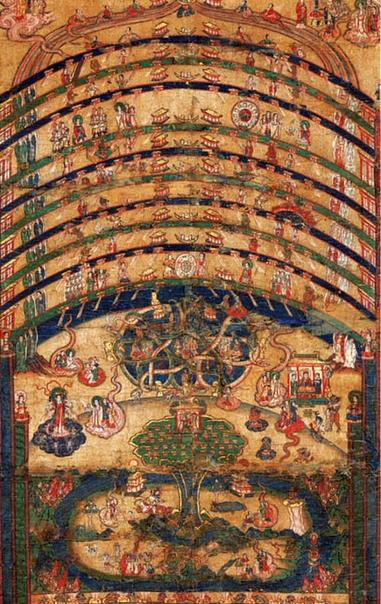
Dantes hemel heeft zelfs tien lagen, en tien is ook het aantal hemels dat de manicheeërs kenden, zoals het plaatje hierboven toont. Kortom, het idee van een meervoudige hemel was buitengewoon gangbaar – al was een mystieke hemelreis dat natuurlijk niet.
[Een overzicht van deze reeks over het Nieuwe Testament is hier.]
#4Ezra #BoekDerWachters #DanteAlighieri #DeOorsprongVanDeWereld #EirenaiosVanLyon #hemel #HenochitischeLiteratuur #manicheïsme #Paulus #Plato #transcendentaliteit #TweedeBriefAanDeKorintiërs #Yaldabaoth #zevendeHemel