【🎉Latest accepted article】
#ArbuscularMycorrhizalFungi Dictate Plant Responses to #WaterAvailability
【🎉Latest accepted article】
#ArbuscularMycorrhizalFungi Dictate Plant Responses to #WaterAvailability
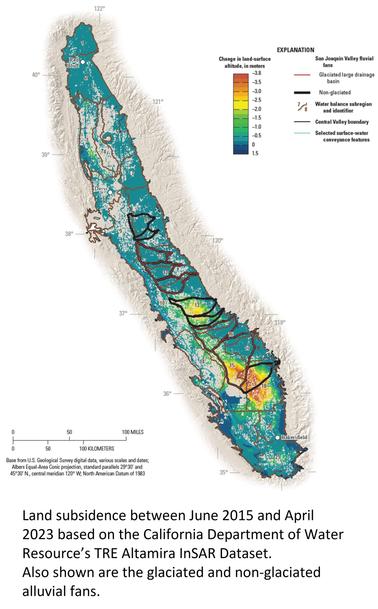
The Central Valley of California is one of the most prolific agricultural regions in the world. Agriculture is reliant on the conjunctive use of surface-water and groundwater. The lack of available surface-water and land-use changes have led to pumping-induced groundwater-level and storage declines, land subsidence, changes to streamflow and the environment, and the degradation of water quality. As a result, in part, the Sustainable Groundwater Management Act (SGMA) was developed. An examination of the components of SGMA and contextualizing regional model applications within the SGMA framework was undertaken to better understand and quantify many of the components of SGMA. Specifically, the U.S. Geological Survey (USGS) updated the Central Valley Hydrologic Model (CVHM) to assess hydrologic system responses to climatic variation, surface-water availability, land-use changes, and groundwater pumping. MODFLOW-OWHM has been enhanced to simulate the timing of land subsidence and attribute its inelastic and elastic portions. In addition to extending CVHM through 2019, the new version, CVHM2, includes several enhancements as follows: managed aquifer recharge (MAR), pumping with multi-aquifer wells, inflows from ungauged watersheds, and more detailed water-balance subregions, streamflow network, diversions, tile drains, land use, aquifer properties, and groundwater level and land subsidence observations. Combined with historical approximations, CVHM2 estimates approximately 158 km3 of storage loss in the Central Valley from pre-development to 2019. About 15% of the total storage loss is permanent loss of storage from subsidence that has caused damage to infrastructure. Climate extremes will likely complicate the efforts of water managers to store more water in the ground. CVHM2 can provide data in the form of aggregated input datasets, simulate climatic variations and changes, land-use changes or water management scenarios, and resulting changes in groundwater levels, storage, and land subsidence to assist decision-makers in the conjunctive management of water supplies.
Ana Silva, “Agua 028”, 2021, woven plastic bag, lace, embroidery, 138 × 185 cm ★ Angola/Portugal ★ https://www.magnin-a.com/en/artists/333-ana-silva/biography/ ⦾ https://www.artsy.net/artist/ana-silva #AnaSilva #contemporaryart #fiberart #embroidery #plasticbags #drinkingwater #wateravailability #waterresources #Angolanartists #2020s
У этой вышивки на полиэтиленовом пакете размеры и то больше.
Born in 1979 in Calulo, Angola. Lives and works in Lisbon, Portugal. As a child, Ana Silva expressed a great appetite for creation. Isolated twenty kilometers from the first village, on the farm where her father grew coffee, she used to read a lot and build what she calls "weird...
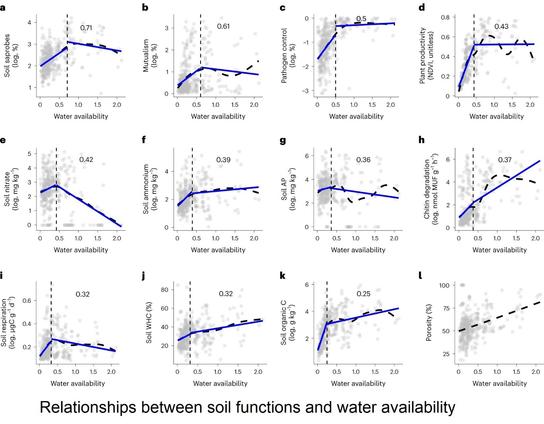
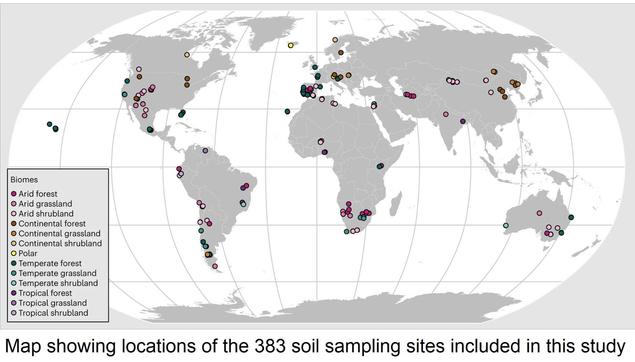
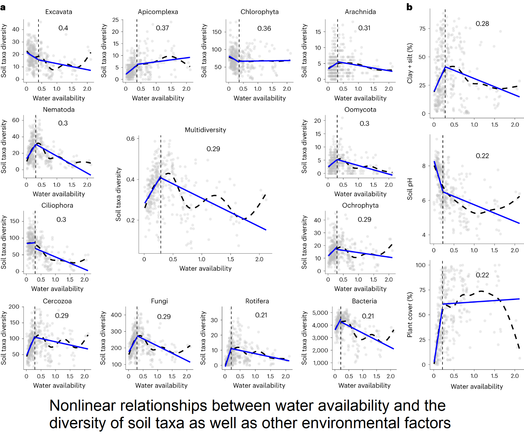
A global field survey of 383 sites with different vegetation types spanning an environmental gradient reveals that soil biodiversity and functions exhibit pervasive nonlinear behaviours worldwide and are mainly governed by water availability.
Referenced link: https://phys.org/news/2023-05-silicon-fertilization-shown-wheat-yields.html
Discuss on https://discu.eu/q/https://phys.org/news/2023-05-silicon-fertilization-shown-wheat-yields.html
Originally posted by Phys.org / @physorg_com: http://nitter.platypush.tech/physorg_com/status/1656314432945811459#m
#Silicon fertilization shown to increase wheat yields and #wateravailability https://linkinghub.elsevier.com/retrieve/pii/S0048969723026074 https://phys.org/news/2023-05-silicon-fertilization-shown-wheat-yields.html
For the first time, the effects of silicon fertilization on wheat yields were investigated for a study led by the Leibniz Center for Agricultural Landscape Research (ZALF) and published in the journal Science of the Total Environment.