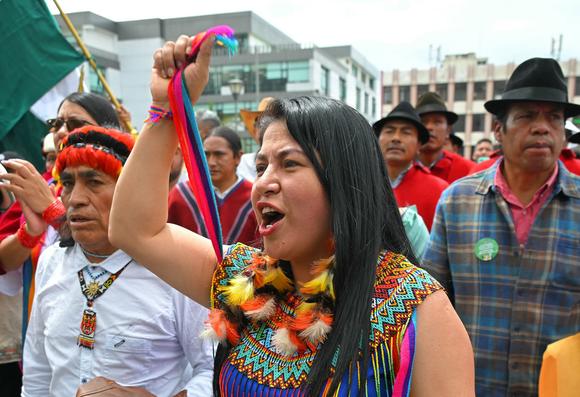
How communities in #SacrificeZones suffer environmental injustices in #Mexico, #Chile, #Nigeria and #Indonesia (analysis)

Daniela Sepulveda and Angélica Arellano, 9 Apr 2025

"Across continents, 'sacrifice zones' resemble wounds carved deep into the fabric of our planet. These are regions where ecosystems and livelihoods have been ravaged by fossil fuel and other industries that promise progress but leave devastation in their wake. These are places where big business and transnational corporations are contaminating the rivers, darkening the skies, and making the soil barren; where the toll of development is paid in human suffering and ecological destruction.

"What unites these 'sacrifice zones' is the shared story of areas where prosperity for the few is built on the suffering of many, and where communities fight to mend the fractures inflicted upon their land, health and dignity.

"Here are four case studies highlighting the experiences of communities and civil society organizations collaborating with us in the Coalition for Human Rights in Development’s Community Resource Exchange.

#Tula, #Mexico

"In the #TulaTepejiApaxco region, where the #Toltec plains once supported rich #biodiversity and #CulturalHeritage, the water and air are now saturated with pollution. This devastated landscape was declared both in 1975 and again in 2005 by the U.N. as one of the most polluted places on Earth, marking it as an #EnvironmentalDisaster zone. Since the early 20th century, the arrival of #CementPlants, #refineries, #ChemicalFactories, a #coal-fired power plant and #LimeKilns has transformed the region. Backed by all levels of government, these industries have destroyed the area’s ecological balance and ruined the health of its people, poisoning the water, air and soil with #ToxicWaste.

"Prominent among these polluters are cement giants like #Holcim, #CEMEX, #CementosFortaleza and #Clarimex, whose operations release harmful gases that exacerbate the region’s environmental and public health crises. One of the epicenters of this environmental catastrophe is the #TulaRiver, which receives 150,000 liters (nearly 40,000 gallons) of untreated wastewater every second from Mexico City and the Valley of Mexico. These 'black waters' are teeming with industrial and hospital waste plus sewage, overwhelming the river and its tributaries.

"The #EndhóDam, originally built to support local #agriculture, has become a toxic dumping ground, poisoning thousands of people who rely on wells for drinking water. Despite decades of warnings, local and national governments have allowed this contamination to persist. The poisoned waters have killed fish, flooded the land with toxic sludge, and led to a surge in cancer, leukemia, respiratory and gastrointestinal diseases among the 15,000 inhabitants living along its banks. In 2021, a devastating flood related to the overflowing Tula River left 17 dead and displaced thousands, a stark reminder of the ongoing risks of government inaction.

"The region now faces a massive public health crisis, and the recent declaration by the Ministry of Environment and Natural Resources to designate the area as an ecological restoration zone is a necessary but overdue step. This declaration covers municipalities such as #Atitalaquia,TepejiDelRío, #Tepetitlán and Tlahuelilpan, where 498 businesses have been identified as generators of hazardous waste, including 14 that produce hydrocarbons. The study, based on a water, air and soil analysis, could mark the beginning of recovery if it is implemented with urgency and seriousness.

"Over the years, organizations like #RedDeConcienciaAmbiental '#QueremosVivir' have resisted, bringing visibility to the devastation and fighting to halt deforestation and continued pollution. In the words of one of the leaders of Queremos Vivir ('We want to live'), 'There needs to be a legal solution, because it’s that urgent. We believe there is still a way to reverse it, and we have time to show the newly elected president #ClaudiaSheinbaum the dire situation we’re in.'

"Their demands include a reduction in the water flow of the Tula River through holistic water management solutions, and government accountability for decades of environmental neglect, calling for reparations for both industrial pollution and the catastrophic 2021 floods.

"While they welcome Sheinbaum’s promises to clean the river and launch a circular economy project, they emphasize that meaningful environmental justice must not be delayed any longer. After stating the communities’ demands through tears, the Queremos Vivir leader said, 'Are we really just going to be destined to be a sacrifice zone? The damage is so severe, the degradation we are in, that if we don’t protect it, don’t defend it, then what are we going to do?' "

Read more:
https://news.mongabay.com/2025/04/how-communities-in-sacrifice-zones-suffer-environmental-injustices-in-mexico-chile-nigeria-and-indonesia-analysis/

#SEZs #Antofagasta #Nigeria #Indonesia #HumanRights #HumanRightsFreeZone #CorporateColonialism
#Exploitation #RaceToTheBottom
#HumanRightsViolations
#Pollution #EnvironmentalDegradation
#EconomicSacrificZones
#ForcedRelocation #ForcedDisplacement #TraditionalLifestyles #AirIsLife #WaterIsLife #EnvironmentalRacism #Exploitation

How communities in sacrifice zones suffer environmental injustices in Mexico, Chile, Nigeria and Indonesia (analysis)

Across continents, “sacrifice zones” resemble wounds carved deep into the fabric of our planet. These are regions where ecosystems and livelihoods have been ravaged by fossil fuel and other industries that promise progress but leave devastation in their wake. These are places where big business and transnational corporations are contaminating the rivers, darkening the skies, […]

Mongabay Environmental News

#SEZs in #India: Balancing Economic Growth and #Environmental Concerns

July 27, 2024

"Picture this: vast stretches of industrial land buzzing with activity, modern factories producing goods for global markets, and thousands of job opportunities emerging overnight. This is the promise of Special Economic Zones (SEZs) in India. But behind this gleaming facade lies a complex web of environmental challenges and social concerns that demand our attention. SEZs represent one of India’s most ambitious economic policies, designed to accelerate industrial growth and boost exports, yet they often come at a significant cost to the environment and local communities.

[...]

"[T]he rapid expansion of SEZs has raised significant environmental red flags. The most pressing concern is land acquisition, which often involves converting fertile agricultural land into industrial zones. This conversion not only reduces the country’s agricultural capacity but also disrupts local ecosystems and biodiversity.

"The establishment of SEZs typically requires large tracts of land – sometimes spanning thousands of acres. Much of this land is acquired from agricultural areas, leading to the displacement of farming communities who have depended on these lands for generations. For instance, the proposed #RaigadSEZ in #Maharashtra would have required over 14,000 hectares of #agricultural land, leading to massive #protests from local farmers.

"The conversion of agricultural land to #IndustrialUse has long-term implications for #FoodSecurity. As India’s population continues to grow, the loss of productive #farmland could exacerbate food shortage issues in the future. Moreover, agricultural land often has better soil quality and water retention capacity compared to industrial land, making this conversion environmentally costly.

"Industrial activities within SEZs generate various forms of #pollution. Air pollution from #manufacturing processes, water #contamination from industrial effluents, and #SoilDegradation from chemical usage are common problems. The concentration of industries in SEZs can create pollution hotspots that affect air and water quality in surrounding areas.

"#WaterScarcity is another critical issue. SEZs require substantial water resources for industrial processes, often competing with local communities for this precious resource. In water-stressed regions, this competition can lead to conflicts and further environmental degradation.
Human rights and social displacement

"The human cost of SEZ development cannot be overlooked. Land acquisition for SEZs often involves displacing local communities, particularly small farmers and agricultural workers. These communities frequently receive inadequate compensation and struggle to find alternative livelihoods.

"The displacement process can be traumatic for local communities who have strong cultural and emotional ties to their land. Traditional occupations like #farming, #fishing, and #SmallScaleTrading are disrupted, forcing people to adapt to entirely new economic realities. The promised employment opportunities in SEZs often don’t materialize for displaced communities, as they may lack the required skills for industrial jobs.

"Women in these communities face particular challenges, as they often have limited access to alternative employment opportunities and may lose traditional income sources like kitchen gardening or small-scale agricultural activities. The social fabric of rural communities can be severely disrupted, leading to increased poverty and social inequality."

https://csr.education/urban-planning-development/sezs-india-economic-growth-environment/#environmental-concerns-the-hidden-costs

#HumanRights #HumanRightsFreeZone #CorporateColonialism
#IMFLoanSharks #Exploitation #WorldBank #RaceToTheBottom
#HumanRightsViolations
#Pollution #EnvironmentalDegradation
#EconomicSacrificZones
#ForcedRelocation #ForcedDisplacement #TraditionalLifestyles #EnvironmentalRacism #Exploitation
#CorporateColonialism

The #environmental burdens of #SpecialEconomicZones on the coastal and marine #environment: A remote sensing assessment in #Myanmar

Thiri Shwesin Aung, Indra Overland, Roman Vakulchuk, Yanhua Xie
November 2022

"Special economic zones (#SEZs) are unusual parts of the world economy in terms of law, institutions, and economic functions (Chaisse and Dimitropoulos 2021). SEZs are geographically delimited areas created to facilitate industrial activities through fiscal and regulatory incentives and infrastructure support (UNCTAD 2019). Such zones carve out jurisdiction as a subset of the overall state jurisdiction for the purposes of enacting different laws and regulations that are more trade and investment friendly (Zeng 2021). Since the year 2000, SEZs have mushroomed in developing countries to attract foreign direct investment (FDI), accelerate industrialization and create jobs (Aiyer 2017). There are 5400 SEZs in 147 economies around the world. Asia is home to three quarters of them (UNIDO 2015). They have been a core element of the economic development strategy of the Association of Southeast Asian Nations (ASEAN) and currently all ASEAN member states have SEZs (Aggarwal 2022).

"As part of an export-oriented development strategy, the zones commonly include industrial mega-areas that accommodate large-scale infrastructure, deep-sea ports, logistical infrastructure for oil and gas, hotels and tourism, and industrial complexes (Aggarwal 2022). They are primarily defined by a specific regulatory regime and a dedicated governance mechanism designed to relieve customs and tariffs and reduce the burden on businesses from permits, licenses, employment laws, and land access. In return, host governments expect investors to create positive spillover effects, such as facilitating innovation, boosting employment, raising exports, and diversifying the economy. The global experience of SEZs have been mixed, with some countries achieving successful economic outcomes, while others struggle to overcome market failures, institutional constraints, and social and environmental costs (Aggarwal 2022; Zeng 2021).

"The lax regulatory regimes of SEZs often raise concerns about environmental, social, and #HumanRights standards, as well as possible conflicts over #LandRights (Brussevich 2020). Several SEZs have failed to yield the expected economic benefits while having severe adverse impacts on the environment and local communities (Adunbi 2019; Aritenang and Chandramidi 2020; Chaisse and Ji 2020). On the other hand, while SEZs can be hotspots for environmental #mismanagement, they can also provide opportunities for implementing environmental policies specifically designed to regulate industries within the zones. Also, certain environmental advantages may ensue from the introduction of foreign financial resources and environmental technologies that are otherwise not readily available (Richardson 2004).

"However, according to the 'race to the bottom' literature, most SEZs have a net negative impact on the environment and local communities (Richardson 2004; UNIDO 2015; ZENG and DOUGLAS, 2012).

"Despite this contradiction, existing studies focusing on the direct and indirect impacts of SEZs have been rare (#WorldBank, 2017). Particularly, the magnitude and intensity of SEZ impacts on the environment remain understudied.
SEZs tend to be located in remote regions. As such, SEZ-related information and data are generally scarce, making it difficult to assess the environmental consequences of such zones. Many SEZs are also located in countries where there is limited scope for independent environmental assessment due to #authoritarian rule, #corruption, and/or #secrecy surrounding deals with foreign investors. Recent improvements in access to satellite data and computing platforms for machine learning have greatly improved the ability to comprehensively assess SEZs in any location in the world in near real time (Ali et al., 2020; Jensen et al., 2019). This article demonstrates how these technologies can be applied to provide evidence related to the environmental impacts of SEZs. The method is tried out on the Kyaukpyu SEZ in Myanmar. Myanmar is an authoritarian country and the #KyaukpyuSEZ is a flagship project of China's Belt and Road Initiative (#BRI) located in an inaccessible part of #Myanmar. This is precisely the type of case where independent access can be limited and a remote sensing approach can be useful.

"From 2010 onwards, Myanmar was navigating its economic transformation and a partial loosening of military rule. SEZ development was prioritized as a critical element of the country's industrialization (Oxfam 2017). The three most notable ongoing SEZ projects are the Kyaukpyu SEZ in the rural but strategically important Rakhine State, which is also the largest SEZ in Myanmar, the Thilawa SEZ on the outskirts of Myanmar's former capital Yangon, and the Dawei SEZ in the Tanintharyi Region. Tanintharyi is a long narrow southern territory of Myanmar bordering the Andaman Sea to the west and Thailand to the east.

"Although they are expected to encourage economic growth and reduce poverty, all three SEZ projects continue to face local opposition, particularly the Kyaukpyu and Dawei SEZs. The International Commission of Jurists (2017) has reported that SEZs in Myanmar are linked to human rights violations and environmental abuses (Donateo 2017). Although Myanmar's SEZ law adopted in 2014 reaffirms the applicability of environmental regulations to SEZ development, it does not clearly delineate responsibilities between developers and the state (DICA 2014). The law also does not conform with international human rights standards (MCRB 2018)."

Read more:
https://www.sciencedirect.com/science/article/pii/S2352938522001173

#RaceToTheBottom #HumanRightsViolations #Pollution #EnvironmentalDegradation #EconomicSacrificZones #ForcedRelocation #ForcedDisplacement #HumanRightsViolations #EnvironmentalDegradation #IndigenousPeoples #ForestPeoples #SaveTheForests #Exploitation #CorporateColonialism

Oh look… like Stalin did to the Mennonites (my grandparents family and relations in Zhaporizhia) and other Ukrainians 100 years ago.

#ukraine #russia #forcedrelocation #genocide #ukrainerussiawar #mennonites
https://mastodon.social/@MAKS23/115542800046690622

The loss of Kun’tewiktuk on Kings Road | The-14

Sydney officials forced the Mi’kmaq from Kun’tewiktuk on Kings Road, ending 40 years of resistance. By 1928, all families were relocated to Membertou.

The-14 Pictures

Dine' tell Navajo Council 'NO COAL!'

The Monster has returned, and it is even more grotesque than the one before. Dine' remember forced relocation, the loss of water and medicine plants, and the loss of loved ones. Navajos say 'No!; to Trump and Navajo President Nygren's push for coal.

By #BrendaNorrell, @bsnorrell.blogspot.com June 1, 2025

#ForestLake, #NavajoNation -- "Dine' told the #NavajoNationCouncil that the #CoalIndustry has cost them their aquifer water, and their health. Combined with #UraniumMining, they have lost their loved ones to widespread #cancer and #BlackLungDisease killing their people.

"Dine' remembered #ForcedRelocation and the stripping of the #forest by #PeabodyCoal, during a hearing on Friday. The Navajo Council was told to stand up for #FutureGenerations, or step aside.

" 'The Navajo Nation has provided coal to the big cities for decades, while the people of #BlackMesa have nothing to show for it," Dine' from Black Mesa told the Council.

" 'We are supposed to be the Protectors of the Earth.'

"#LouiseBenally [#KleeBenally's aunt] of Big Mountain told the hearing that you can't trust what #Trump is telling you because he'll change whatever he says in the next sentence. Louise said he has no concept of what being a human is.

" 'Keep your prayers and your language, those are the things that really matter for us #IndigenousPeople,' said Louise. She and her family spent their lives resisting forced relocation brought by Peabody Coal's mining on Black Mesa.

" 'Everyone was opposed to another #CoalMining, it's not good for anything, and it is causing #GreenhouseGases to continue to rise,' Louise told Censored News.

" 'Doctor Nygren doesn't know that. He needs a hogan level of education.'

" '#ClimateChange is so, important to every living thing, we need to be finding solutions not making things worse.' "

Read more:
https://bsnorrell.blogspot.com/2025/05/live-navajo-hearing-on-revitalizing.html

#EO14241 #Diné #Dineh #Dineteh #NavajoNation #WaterIsLife #DirtyCoal #TrumpSucks #AirIsLife #NoCoalMining
#BigCoal #USPol #NativeAmericanNews #CorporateColonialism #RememberKleeBenally
#BuuNygrenSoldOutHisPeople

LIVE! Navajo Hearing on Revitalizing Coal Industry, Forest Lake Chapter

Censored News is a service to grassroots Indigenous Peoples engaged in resistance and upholding human rights.

via @bsnorrell.blogspot.com

#NavajoNation Targeted Again for Sacrifice Zone: '#Energy Companies Preying on the People'

#Diné ask: Why is the Navajo Nation allowing energy companies to prey on communities and individuals?

By Brenda Norrell, Censored News, May 23, 2024

"Dine' on the Navajo Nation are now targeted with a push to revitalize dirty coal energy, and a hydropower project that would pump precious water from their aquifer. Dine' question why the Navajo Nation government is allowing energy companies to prey on the communities and individuals.

"#LouiseBenally of #BigMountain [#KleeBenally's aunt] said the bottom line is greed. 'They want to eat up everything but, don't know that even their lives depend on it too. Poisoning the natural cycle will come back and destroy them too.'

"The new stampede of parasitic energy companies to the Navajo Nation comes at the same time that #radioactive #uranium trucks, covered only with tarps, are traveling across the Navajo Nation, from the #GrandCanyon uranium mine to the mill in the #WhiteMesaUte community in Utah.

"At the same time, more than 500 #UraniumMines, and scattered radioactive debris, remain on the Navajo Nation, and was never cleaned up by the U.S. government. Dirty coal mines and power plants left the legacy of death and #ForcedRelocation.

Navajo Council Plans Meeting on Revitalizing Coal Industry

"Citing #Trump's push for new #CoalMining, the #NavajoNationCouncil plans to hold a public hearing on
revitalizing the coal industry.

"The Navajo Nation Council announced the public hearing, stating that on April 8 President Donald Trump issued an Executive Order entitled, 'Reinvigorating America’s #BeautifulCleanCoal Industry
and Amending Executive Order 14241' aimed at reversing past federal policies, to boost the coal industry and to strengthen the country’s national energy security, according to the White House.

"The public hearing is scheduled in Forest Lake Chapter on Friday, May 30. Louise Benally and her family spent their lives battling #PeabodyCoal and resisting forced relocation at Big Mountain on #BlackMesa. She said what Trump is doing is another chapter in the assault on the land and people.

" 'Pl 93-531 is a law created by #BarryGoldwater to target our rights to water and land base to be taken away. He developed that law so, with what Trump is trying to do is no different.'

" 'They want to eat up everything but, don't know that even their lives depend on it too. Poisoning the natural cycle will come back and destroy them too.'

" 'The American political system is not our government as traditional people which is where all our modern day problems come from in the form of an endless greed to keep eating up the earth and the natural resources.'

"Louise questioned Navajo Nation President #BuuNygren's support of Trump and coal mining in Washington, and Nygren's agreement for uranium trucks to cross the Navajo Nation. 'The Navajo Nation government is at a crossroads. Buu has been taken by Trump, and the people he is supposed to be responsible for are in question.'

" 'He has been taken into the bag of greed -- uranium and coal yet, there is no water. We want accountability.' "

Read more:
https://bsnorrell.blogspot.com/2025/05/navajo-nation-targeted-again-for.html

#Diné #Dineh #BuuNygrenSoldOutHisPeople
#WaterIsLife #LandIsLife #EnergyFuels
#Dineteh #NukingTheNavajo
#Havasupai #UraniumMines
#EnvironmentalRacism #WhiteMesaMill #NukingTheNavajo #NukingTheUte #Ute #Paiute #Hopi #BidiiRoots #DineCARE #Havasupai #PinyonPlainUraniumMine #AirIsLife #UraniumMine #UraniumTransport #RadioactiveDust #RememberKleeBenally #BigCoal #DishonoringTheMemoryOfKleeBenally
#HaulNo #NoMiningWithoutConsent

Navajo Nation Targeted Again for Sacrifice Zone: 'Energy Companies Preying on the People'

Censored News is a service to grassroots Indigenous Peoples engaged in resistance and upholding human rights.

#VoicesOfDecolonization - #Wabanaki #Sustenance and #SelfDetermination

by Jillian Kerr, 7 November 2024

"Before #colonization, the Wabanaki region was rich in food; Wabanaki Tribes had excellent knowledge of their environment and knew where to find each resource, when it was abundant, and in what quantities. They utilized natural resources and foods respectfully, creating little or no waste. This sustainable approach to food and natural resources made the Wabanaki among the healthiest people in the world. However, the arrival of Europeans disrupted this harmony, forcing the Wabanaki out of their homelands. Europeans imposed a different understanding of nature and harvesting, which led to unhealthy and unsustainable practices. The Wabanaki continue to strive for the restoration of their traditional foodways as a way to practice #FoodSovereignty.

"To develop food sovereignty and economic stability, the #Mikmaq Nation in Aroostook County constructed an indoor fish hatchery on the site of Micmac Farms in Caribou, Maine. This farm, which previously only grew and sold fresh or preserved fruits and vegetables, now receives Nesowadnehunk Brook Trout eggs from the Maine State Hatchery in Enfield, Maine. The grown fish are then sold back to Maine’s Soil and Water Conservation District for public consumption throughout the state. In addition, they generously donate food to the local food bank and provide discounts for Tribal members, demonstrating a sustainable model for food sovereignty for the Mi’kmaq Nation.

"The Houlton Band of #Maliseet Indians launched a food sovereignty initiative to increase access to nutritious food, improve food sovereignty, and strengthen connections to Wabanaki culture by sharing traditional food production, storage, and preparation approaches. The lessons learned add to current knowledge about developing, implementing, and evaluating a model rooted in the principles of food sovereignty. Opportunities to learn and share knowledge about traditional storage and recipes are provided to community members, and existing partnerships have been leveraged to develop a sustainable model. Additional community gardens were also created to increase food production capacity, increasing food sovereignty for the Maliseet.

"One way the #Passamaquoddy Tribe fights for food sovereignty is by restoring the watershed of the Skutik River, which was renamed the St. Croix River by colonists. The Skutik River is at the heart of the ancestral home of the Passamaquoddy Tribe.. This crucial watershed is the natural spawning ground and ancient homeland for many species of sea-run fish, including Atlantic salmon and sea-run alewife (river herring), a vital food source. Historically, the number of fish swimming up the Skutik River was massive and sustained the Passamaquoddy for thousands of years. Yet now, the alewife population is too small to feed or sustain the Tribe.

"The large amount of pollution produced by colonization upset the productivity and natural balance of the Skutik River and the life cycles of the native fishery, straining the river’s ecosystem. For many years, Maine law blocked sea-run alewives from accessing their natural and ancient spawning ground in the Skutik watershed, which diminished this important traditional sustenance food source and disturbed the cultural practices of Passamaquoddy Tribal members. The Passamaquoddy established the Skutik Watershed Strategic Sea-run Fish and River Restoration Plan to mitigate the damage and find a better way forward. They developed a collaborative of Skutik stewards, also known as the Skutik River Keepers, who work with various agencies to give the river the best chance at restoring the watershed, thereby giving the Passamaquoddy more access to traditional foods and strengthening their food sovereignty.

"The #PenobscotNation fights for food sovereignty in various ways, including rebuilding outlets on Tribal trust lands. The Penobscot ancestral homeland is located within the drainage area of the Penobscot River and its many tributaries, lakes, and ponds. The area was the fishing place for spearing and netting fish, like salmon and alewives. It was a primary nourishing source of food, medicine, connection, joy, and spirituality for the Penobscot during spring and early summer. The mills and mill dams built by colonizers upset the river's natural ecosystem, cutting off fish from places required to complete their life cycle. As a result, the river no longer contained the fish that had historically fed the Penobscot Tribe. The Penobscot successfully rebuilt outlets on Tribal trust lands in Mattamiscontis Stream, and they have completed many stream connectivity projects. This resulted in growing populations of alewives and blueback herring in the newly restored system, making more fish available as a food source for the Tribe.

"The land is a cornerstone of Native life. Before colonization, Wabanaki Tribes had developed an environmentally friendly and communal food system to protect the land and environment, using natural resources without harming the environment that provided bountiful food sources. However, centuries of colonization have separated the Wabanaki and other Native communities from their homelands and traditional foods. Natives were physically, culturally, and spiritually tied to their homelands, and forced relocation into unknown lands made it impossible to access traditional foods and harvest adequate nutrition from the land for survival. The lack of knowledge of unknown lands led to a dependence on government-issued rations and commodities. These rations and commodities consisted of dairy, processed wheat, sugars, etc., all foreign to the Native diet. The government's aim in providing these rations and commodities to Natives was not to provide nutrition but to prevent starvation.

"#ForcedRelocation and other federal policies devastated many Tribes’ food systems, disrupting their hunting, fishing, farming, and harvesting traditions. The disruption continues today as the federal government still decides what foods they will distribute to Native communities. The government also makes agreements with the producers, a system that favors large-scale vendors, leading to missed opportunities for Native farmers. Problems with food quality also still exist; many traditional foods are still unavailable, and it is not uncommon for produce to travel long distances and arrive spoiled. Despite this upheaval, the Wabanaki have shown remarkable resilience and are determined to restore their traditional food practices and reclaim their food sovereignty."

Source [includes references]:
https://www.wabanakireach.org/wabanaki_sustenance_and_self_determination_by_jillian_kerr

#WabanakiConfederacy #MaineFirstNations #LandBack #sovereignty #Wabanakik #WabanakiAlliance #Decolonize #IndigenousPeoplesDay #IndigenousFoodSovereignty

Boo hiss...! #Israel’s #Netanyahu signals he’s moving ahead with #Trump’s idea to transfer #Palestinians from #Gaza

By MATTHEW LEE and NATALIE MELZER
Updated 5:05 PM EST, February 16, 2025

JERUSALEM (AP) — "Israeli Prime Minister Benjamin Netanyahu on Sunday signaled that he was moving ahead with U.S. President Donald Trump’s proposal to transfer the Palestinian population out of Gaza, calling it 'the only viable plan to enable a different future' for the region." [BULLSHIT!!!]

https://apnews.com/article/israel-palestinians-hamas-war-news-ceasefire-hostages-02-15-2025-1cf8b3cb7622489c368c610f85e51e35?utm_source=firefox-newtab-en-us
#BibiIsAWarCriminal #Colonialism #FreePalestine #ForcedRelocation #Genocide #CorporateColonialism

Netanyahu signals he's moving ahead with Trump's idea to transfer Palestinians from Gaza

Israeli Prime Minister Benjamin Netanyahu has signaled that he's moving ahead with U.S. President Donald Trump’s proposal to transfer the Palestinian population out of Gaza. Netanyahu called it “the only viable plan to enable a different future” for the region. He discussed the plan on Sunday with U.S. Secretary of State Marco Rubio. The American diplomat was kicking off a visit to the Middle East. Rubio endorsed Israel’s war aims in Gaza and said that Hamas “must be eradicated.” That created further doubt around the shaky ceasefire as talks on its second phase are yet to begin. Rubio next visits regional heavyweights Saudi Arabia and the United Arab Emirates.

AP News

WTAF! "#Israel says it has begun preparations for the departure of #Palestinians from #Gaza despite international rejection of President Donald #Trump’s plan to empty the territory of its population. #Egypt has launched a diplomatic blitz behind the scenes against the proposal, warning it would put its peace deal with Israel at risk, officials said.

"The Trump administration has already dialed back aspects of the proposal after it was widely rejected internationally, saying the relocation of Palestinians would be temporary. U.S. officials have provided few details about how or when the plan would be carried out. "

https://apnews.com/article/israel-palestinians-hamas-war-egypt-trump-displacement-bc1c43f80655190824a5de4eb1d310cc
#SettlerColonialism #Genocide #ForcedRelocation #USPol #WorldPol #IsraeliWarCrimes #IsraeliSettlers #Colonialism #Palestine #FreePalestine

Israel prepares for Gaza exodus as per Trump's plan

Israel says it has begun preparations for the departure of large numbers of Palestinians from the Gaza Strip in line with President Donald Trump’s plan to empty the territory of its population. Meanwhile, Egypt has begun a diplomatic blitz behind the scenes to try and head off the plan. The Palestinians and much of the international community have rejected Trump’s proposal, fearing Israel will never allow the refugees to return and that it would destabilize the region. Egypt warned that efforts to move Palestinians out of Gaza could undermine its historic peace treaty with Israel, while waging a behind-the-scenes campaign against the proposal.

AP News