A special blessing

https://thehouseofvines.com/2019/12/15/the-essence-of-our-religion-is-beauty/?page_id=44017

I agree with this to a degree…beauty, devotion, sacrifice.

I have a fellowship at my university, the Jewish studies fellowship, and one of the things I learned this year is that it’s considered a special blessing to do your required action, use / wear your required items but *make them beautiful.* I forget what this is called in Hebrew, but to make religious things beautiful instead of just functional adds to the blessing.

Yesterday, I was listening to a lecture on St. Francis (he’s very, very popular amongst my students, even non-Catholic ones!) and while Francis reverenced his “lady Poverty,” he said that, to quote the lecture, “Poverty stops at the altar.” Religious items should be as lush and beautiful as we can make them.

As a Heathen, I also hold this to be particularly sacred. Even if one doesn’t have a lot of money or any disposable income, beauty can take many forms. This doesn’t mean spending a lot of money. It means taking care with one’s shrine, with prayer, with religious garb, with anything we do for our Gods. It’s a Platonic ideal that beauty elevates the soul to the Gods and I believe that 100%. When I see ugliness being elevated as popular or “good” in media, in our culture, I know that there evil moves in many forms. I know to be vigilant; and I know to turn to tradition and the beautiful all the more.

#Art #BacchicStuff #beauty #Community #devotion #Heathenry #HellenicStuff #houseOfVines #Interfaith #LivedPolytheism #NorthernTradition #Polytheism #reverence #Sannion #theology
The essence of our religion is Beauty

We live in a pluralistic and capitalistic society where the guiding philosophical principle seems to be the open market system. No one holds a monopoly on truth, and old ideologies which had taken …

The House of Vines

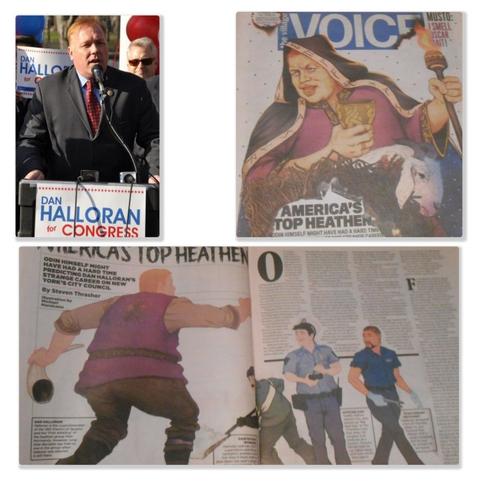
Dan Halloran – Arrested on Child Pornography

There is a German word, Backpfeifengesicht, essentially that someone has a punchable face.
The first time I met Dan Halloran that’s what my instinct said he needed. He wasn’t rude to me, merely a standard introduction, but my instincts were screaming at me. I avoided him as much as I could following that encounter, he was smarmy, oozing charm like a snake oil salesman. Standing up like a gracious lord in ritual sumble saying he was gifting amber to the women, but it was all cheap plastic. I recall the way he looked at certain women in attendance, the way creeps look lewdly at a woman. I wasn’t surprised he went into politics, nor for any of the scandals that followed.

For those unfamiliar with Halloran, he was a leader of a Theodish group revolving around Norman culture, and I attended various gatherings where he was also in attendance on multiple occasions.

New York’s Village Voice lampooned him for his religion when he ran and served 2010-2013 on New York City Council. He has been to date the highest placed heathen elected into public office in the United States, and one of the highest profile U.S. pagan politicians, too. He made an unsuccessful attempt to run for election for the U.S. Congress in 2012, he dragged heathenry through the muck as later controversies and criminal acts related to bribery and corruption , and at least one extramarital affair with a staffer (the stereotypical old politician with the age gapped relationship with a young adult woman). Plus, there was inappropriate behavior between him with a woman in his religious circle, that led to him being flogged in punishment by his group. He was convicted in 2014 in relation to the bribery scandal, and was still a felon in federal prison when he was released early during the pandemic, and in his temerity upon his release he updated his Facebook saying he was a “freed political prisoner”. He has now been arrested on child pornography charges.

https://wildhunt.org/2025/04/dan-halloran-disgraced-theodish-leader-and-nyc-councilman-found-with-child-pornography.html


He is a nithling. May justice find him, and may the Gods and Goddesses make a path to safety and healing for the children being exploited.

A Sampling of Past News Coverage

Dan Halloran photos from Village Voice “America’s Top Heathen” article, and photo from political rally during his congressional campaign. #arrested #asatru #childPornography #DanHalloran #felon #heathenry #NewYork #news #northernTradition #pagan #politics #polytheism #religion #Theodism

Exploring Our Gods and Goddesses – Coventina

Often times Heathens focus primarily on Viking Age Scandinavia, followed by Anglo-Saxon England, and more rarely continental Germanic Europe during the Migration Era, and the earlier Iron Age during contact with the Roman Empire. But they tend to overlook Roman occupied England for exploration. Yet there’s a wealth of information to be found that can show insights into who heathens were venerating. There is no such thing as a pure Germanic heathen religion, polytheism allows for deities from other traditions to be syncretized by others. Through war, trade, alliance, slavery, and personal interactions there’s always levels of blending and interaction. As such, to my mind, regardless of the origin of a deity, if they’re worshipped (especially on a documented scale by ancient Germanic heathens), those deities can and should become part of our heathen tradition too. With the understanding that to truly understand any power, learning as much as you can about the mysteries and cosmological nuance the deity had in his or her culture of origin is necessary to understand the deity.

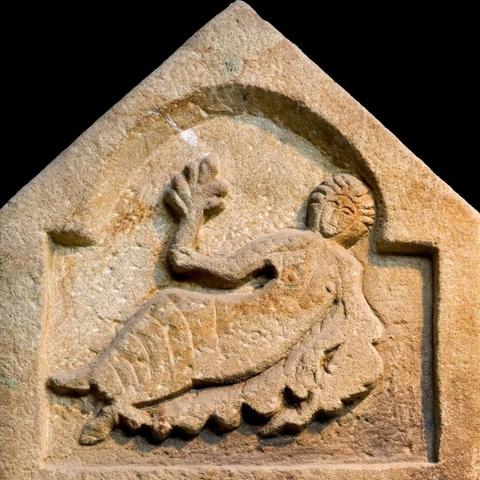
Depiction of the Goddess Coventina upon a votive altar to her. RIB 1534.

As part of my explorations into Roman era Britain, we see Germanic worship to Coventina, a local Romano-British Goddess. We know thanks to numerous inscriptions found in the archaeological record that she was worshipped by Roman military auxiliary units from specific Germanic tribes (Batavians, Frisiavones, Cuberni) as attested along Hadrian’s Wall. These were erected by Germanic soldiers serving in the Roman Army. We have other inscriptions to the Goddess that came from individuals, including a couple we know were also Germanic heathens (Maduhus, Crotus). While we only definitively know she was worshipped at Fort Brocolitia there are some other sites that have been theorized to be connected with her too.

Fort Brocolitia

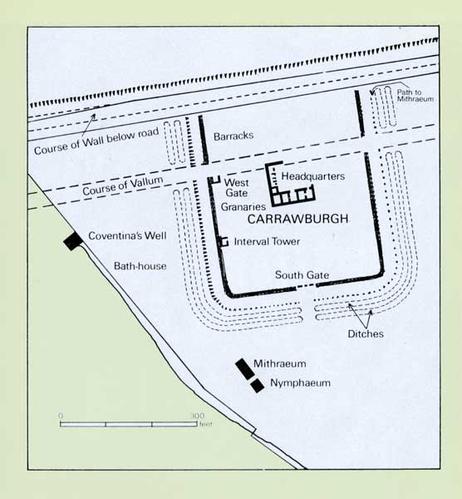
Fort Brocolitia ‘Badger Holes’ (now near Carrawburgh in Northumberland, England) was one of the Roman Empire’s forts along Hadrian’s Wall. The location is found between the major forts of Cilurnum (Chesters) and Vercovicium (Housesteads) on desolate seeming moorland, a bit west of Newcastle-on-the-Tyne.

Illustration of 1876 Clayton archaeological excavation

While there’s been some finds through the years, the key excavation began in 1876 by John Clayton. In addition to the eponymous fort to house military troops, there was also a vicus (small civil settlement), a bath house, and three key sacred sites: a Mithraeum (the best preserved one in all of England, with three altars found erected to Mithras), Coventina’s Sacred Well, and an open air Nymphaeum for local water spirits (including most likely Coventina as she is represented with iconography like a nymph, and some of the votive inscriptions literally address her as a nymph too). Nymphaeums were sanctuaries for water nymphs, and in communities they were often used as a wedding venue.

According to the website Roman Britain: “All three of these temples are associated with a small tributary stream of Meggie’s Dene Burn, which issues from a spring consecrated to Coventina and runs beside the fort past the Mithraeum and the Nymphaeum to the south-west, to empty into the River South Tyne near the Stanegate fort at Newbrough, three miles to the south.”

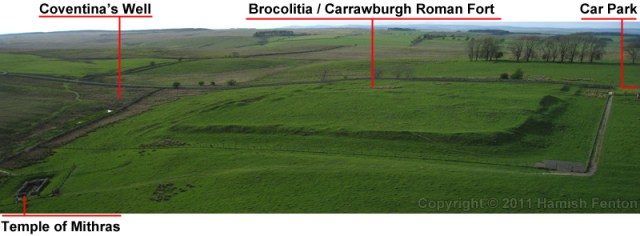
Fort Brocolitia Layout from Megalithic UK and user Hamish Fenton Fort Brocolitia Site Layout Schematic

Here is a photo from 2010 of the site where Coventina’s Well is located, the tall grassy brush shows the boggy area that had developed around it.

Coventina’s Well taken 2010 – from Megalithic UK and user PurpleEmperor

Since the above photo was taken in 2010, access to the Well has been improved upon with a stile granting easier access from the Mithraeum to the Well, a path added so visitors can approach the area near the well. Though it remains mostly overgrown and boggy, my understanding is that the well is on private owned land, not public land like the rest of the fort. Meaning English Heritage has not put up signs for the Well like they have elsewhere at the fort. Many a visitor has lost their shoes in the mud, and barb wire was set up along some of the walls around the Well. So take your time if you’re able to visit.

Coventina’s Well taken 2023 – from Megalithic UK and user Antonine

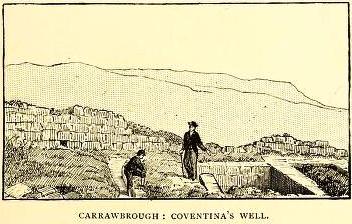
What you can’t see in these photos is the site layout of the sanctuary for Coventina’s Well.

19th century plan of Coventina’s Well,
from Berwickshire Naturalists, via Archive.org


Among the altars to Coventina we also see altars to Minerva in the area (RIB 1542 & 1543), Fortuna (RIB 1536 & 1537), and even a broken depiction of Aesculapius (plus votive dog figures we think were for him). Mercury (who we know was syncretized with Odin as exhibited elsewhere as Mercurius Cimbrianus, Mercurius Hranno) is on an inscription. The Germanic God Vheterus (aka Huiteribus RIB 1549, or Veteris RIB 1548) is mentioned. The Celtic God Belatucader is also represented in a found inscription. He appears to be a Romano-Celtic syncretization with the god Mars, as there are several inscriptions to Mars Belatucadrus found around England. We also see inscriptions to the Matraes, and the genius loci.

At the neighboring Fort Vercovicium (Housesteads) on the wall, we have inscriptions to the Germano-Celtic goddesses the Alaisiagae (comprised of the following Goddesses: Beda, Baudihille, Fimmilena, and Friagabis). Only two are named (Baudihillia and Friagabis) on the inscription (RIB 1576) erected by a Germanic mercenary unit known as Hnaudifridus. Another inscription refers to the Alaisiagae but not specific names for the Goddesses (RIB 1594) erected by Frisian soldiers. There’s also an inscription to Mars Thingso (RIB 1593) naming the Alaisiagae goddesses Beda and Fimmilena. Mars Thingso is believed to be a Romano-Germanic syncretization between the Roman God Mars and Germanic God *Thingaz/Tiwaz/Tyr and the Alaisaige seem to be connected to his cultus. Thingso is a theonym, most likely pointing to the God’s connection over oaths, legal proceedings and justice at Thing assemblies. All along the wall we have numerus inscriptions to the Mothers (MATRIBVS), which echoes similar practices to the more than 1000 documented votive stones erected to the Matronae (analogous to the idis/disir) in the Rhineland by Germanic and Celtic soldiers serving in the Roman Empire. I point these other examples out merely to showcase that there is a great deal of information proving archaeologically Germanic worship of deities in Roman era Britain. This is a wealth of information about Germanic worship between the two neighboring forts of Brocolitia and Vercovicium, less than 5 miles (8 km) apart.

Coventina’s Well

Coventina’s sacred site at Fort Brocolitia was an open air sanctuary, artifacts at the site suggest peak usage between the second and fourth centuries during the Iron Age. Researchers discovered intentional engineering that constructed a walled area (11.6m x 12.2m / 38ft x 40 ft) and in the center of the walled enclosure there is a rectangular basin pool (2.6m x 2.4m / 8.5 ft x 7.9 ft) that collected the spring water (which comes to the surface as a dolerite dyke in the carboniferous limestone connected to Meggie’s Dene Burn). It stands out for being a rare example of a west-facing door/entry at a Romano-Briton temple in Britain. This sacred pool, has been named Coventina’s Well.

Artist rendering of what Coventina’s Sanctuary looked like

Based on how objects were found in the well during the 1876 excavation by Clayton, we believe in the late Roman period (circa 388 CE) the well was sealed, with stones placed over it, and the holy site decommissioned with votive altars and other objects seemingly placed into the Well, added to the earlier votive offering deposits. The “sanctuary” may have been closed possibly due to the implementation of the Theodosian Code which began criminalizing polytheistic religious activity in the Roman Empire. During the Clayton excavations robbers came and took some of the artifacts (especially items like coins or made of metals that could be melted), most of the remaining found artifacts are housed and on display at the nearby museum at Chesters Fort.

For years Coventina’s Well has been a boggy area, the decommissioning of the holy site centuries ago, and later construction made the Roman-era well inaccessible and the area flooded under water, turning the area of land around it into a bog. The vegetation blocks much of the view, most of the site remains bogged today. According to visitor reports there’s wildflowers found around her Well: blue summer wildflowers known as brooklime (Veronica beccabunga) which loves bogs, and yellow wildflowers known as Blood-drop Emlets (formerly known as Mimulus luteus, but re-classified as Erythranthe lutea). This later flower originates from South America, but was introduced to Britain in the 19th Century. Some modern pagans and polytheists use those flowers (or some they find similar in their own areas) in offerings, and as design elements and accents in depictions of her.

Votive Sculpture found deposited in Coventina’s Well at Fort Brocolitia


At Coventina’s Well this triptych was discovered. In the triptych the depictions here seem to have the female figures holding a cup aloft, and in their other hand holding some sort of vessel with water streaming forth from the vessel. It is not explicitly inscribed with the Goddess Coventina’s name, leading to the theories that all 3 female figures are Coventina (which echoes threefold aspects of some other Celtic deities), or it’s her paired with two handmaidens/nymphs, or all three are nymphs, and thus it may have originally resided at the nearby nymphaeum but was deposited in Coventina’s Well when the religious sites were shut down. The imagery is similar to one of the votive altars (see below, RIB 1534) where we see a female figure understood thanks to an inscription to be the Goddess Coventina rendered in a style similar to nymphs found elsewhere in the Roman world. We also see 3 female figures/nymphs on a frescoe in Kent at the Roman Villa of Lullingstone that may be another site of possible worship to her (more on that further below in the “Coventina’s Cultic Reach” section).

Found Offerings to Coventina

Among the archaeological record we have found what we believe are the cultic offerings to the Goddess. Including brooches in the form of ‘discs, wheels, or solar symbols” scholar G.L. Irby-Massie suggests in his book, Military Religion in Roman Britain:

these wheels might connect Conventina to the solar wheel god, vanquisher of dark forces, possibly as his consort. The well itself probably linked Conventina to the underworld, a goddess of death, a vanquisher of death. The evidence points to a predominantly military cult: soldiers worshipped the goddess, and wheel votives imply a vanquishing deity.“ G. L. Irby-Massie, Military Religion in Roman Britain

Other deposited offerings appear to be a brooch of a running deer, rings & votive pin jewelry (jet, pearls, silver, gold), beads, over 13,000 coins (copper, silver, gold), ceramic vessels, a bronze mask, bronze heads, figures especially of horses (and occasionally some other animals), shoes, and two head-scratching outliers: a bronze age axe hammer and half a skull (the skull believed deposited after the holy sanctuary was shut down). I recommend reading Albion and Beyond‘s Coventina article, which is a well researched article from Romano-British polytheists including insights to Brittonic belief and cultic praxis with scholarly attributions. Something they point out is that at other sites nearby along Hadrian’s wall we find heads in wells, that in combination of the bronze heads and partial skull found in Coventina’s Well are perhaps related to the ancient Celtic head cult. Thus, the suggestion that Coventina’s cultus may also have ties to the dead, which may explain why the spring opens unusually to the west (the direction of the setting sun has long been generally connected to death).


Copper, likely a remnant of a statue to either an Emperor or Deity, 2nd-3rd C CEHeaded flagon/jar, possibly meant to depict Coventina.Copper & Enamel Brooch – deer motifStone Axe from the Bronze Age c.2000–1750 BCEMinerva & AesculapiusHorse Figure Votive Offering found in Coventina’s Well

In the ceramic jar deposited offering shown above with a head, there’s a possibility that is meant to be a depiction of the Goddess Coventina.

Budge & Clayton’s An Account of the Roman Antiquities Preserved in the Museum at Chesters, Northumberland Budge & Clayton’s An Account of the Roman Antiquities Preserved in the Museum at Chesters, Northumberland

Votive Inscriptions

The inscriptions to Coventina address her as “Sanc[ta]” (Holy, Sacred), “Augusta” (Revered), “Nymphae” (Nymph), “Deae” (Goddesses), and “Matribus” (Mothers). Augusta was most commonly used within the Roman Empire with the Goddesses in the Capitoline Triad, which are Juno and Minerva. The Goddess Fortuna also has some examples of being addressed as such too, and there are some other exceptions. The fact we have the term Augusta used with Coventina, is an unusual outlier of religious tradition (especially in Britain), thus it probably hints at the cultic importance for which she was treated among her worshippers in the area where she had influence. According to scholar Allason-Jones, she is the only Goddess not in the Capitoline Triad addressed as Sancta in all of the extant inscriptions found to date in Britain. The term Matribus would be similar to the Matronae/Idis/Disir of heathen cosmology. The Mothers had a major cultus in the Rhineland which we see especially among Celtic and German troops serving in the Roman military. We’ve discovered more than 1000 votive altars to the “Mothers” in the Rhineland. So Coventina being addressed as such, even if in England and not in the Rhineland, suggests (to me at least) the major cultic prevalence she had, even if only in select locale(s).

Within the Roman Empire, the empire often required those under their dominion to step up and fulfill a military need. They had several auxiliary units from different Germanic tribes serve in cohorts (of around 480 men) for a typical 20 year period. As it relates to the Goddess Coventina, we know that there were definitely Germanic troops from mainland Europe who were shipped across to England, then traveling to their assigned posting, in this case they were stationed at Fort Brocolitia along Hadrian’s Wall, with a cultic site to the Goddess Coventina just outside the fort and an incredibly short walk away.

RIB 1523


DE CONVETI VOT RETVLIT MAVS OPTIO CHO P FRIXIAV
to the goddess Convetina. Mausaeus, optio of the First Cohort of the Frixiavones, paid his vow“ [RIB 1523]

This would be the Germanic tribe we know of as the Frisiavones who we first encounter along the Gallia Belgica border in what we’d consider as southern areas of the Netherlands today. Roman sources talk about two similarly named tribes the Frisiavones and the Frisii, the later tribe known as the Frisians are more likely derived from the Frisii, but it’s a bit unclear.

Another altar stone made from sandstone has both an inscription and one of the most likely depictions of the Goddess Coventina. Here she is depicted reclining on a stream bank or perhaps a plant (like a water lily leaf, or oak leaf). Some look at the wildflowers that grows at her sacred site and may have been interpreted into a representation carved in the votive altar (as suggested by R. S. O.Tomlin in Britannia Romana Roman inscriptions and Roman Britain).

RIB 1534

DEAE COV{V}ENTINAE /T D COSCONIA /NVS PR COH /I BAT L M
“To the Goddess Coventina, Titus D[unclear, possibly Domitius] Cosconianus, Prefectus of the First Cohort of Batavians, freely and deservedly (dedicated this stone).” [RIB 1534]

There’s another Batavian inscription that has been found elsewhere nearby:

RIB 1535

COVVEN[ ̣ ̣ ̣] AELIVS TE[ ̣] TIVS P[ ̣ ̣ ̣] COH I BAT V S L M
To Coventina Aelius Tertius, prefect of the First Cohort of Batavians, willingly and deservedly fulfilled his vow.” [RIB 1535]

The Batavi are a Germanic tribe traditionally fond among the Dutch Rhine delta. Tacitus tells us the tribe were accomplished horseman and swimmers, a skill that Dio Cassius tells us was used during the Battle of the River Medway in 43 CE. I speculate, if they had such skill with swimming, that they may have had a special affinity for divinities tied to water, such as Coventina. We also have votive inscriptions from them (RIB 1544 & RIB 1545) proving they venerated Mithras while stationed at the fort, too.

Another inscription to the Goddess follows:

RIB 1524

DEAE COVENTINE COH I CVBERNORVM AVR CAMP ESTER V P L Ạ
To the goddess Coventina for the First Cohort of Cubernians Aurelius Campester joyously set up his votive offering.” [RIB 1524]

The Cuberni (or Cugerni) were a Germanic tribe that lived near Xanten (in modern eastern Germany), the tribe’s descendants most likely ended up among the Franks.

There are other inscriptions at the fort that show us what military units were present, we see other Germanic, Gallo-Germanic, or Gallic units represented in various inscriptions found around the area of the fort. Some of the inscriptions were funerary, some on votive altars, some of the inscriptions were about building or construction. While they do not specifically and definitively connect Coventina and these other tribal troops, (i.e. there’s no inscription connecting the goddess and tribe in the same item beside the afore mentioned inscriptions quoted above). The fact these other tribes are present, makes it likely those other Germanic troops troops from Tungrorum (Germania Inferior or what we think of as east Belgium and the south east Netherlands), the Germanic tribe of the Nervi from Northern Gaul, etc. probably also venerated Coventina while they were there.

As an aside, the Tungrians (one thousand strong) erected a votive stone (RIB 1580) to Hercules (who was syncretized with Donar/Thor) at the neighboring Fort Vercovicium. They also dedicated an inscription to Mars (RIB 1591), the site also had an inscription to Mars Thingsus (RIB 1593), who is believed to be a Romano-Germanic syncretization of Mars and *Thingsaz/Tiwaz/Tyr.

We also have an inscription to the Goddess we think comes from the Cohors Quintae Raetorum.

RIB 1529

DEAE COVENTINE P[…]ANVS ML CHO [.] [.] TTOIN […] [.] VOTVM […] BES ANIMO R ET POSIVIT
“To the goddess Coventina P[…]anus, soldier of the … Cohort, willingly paid his vow and set this up.” [RIB 1529]

This inscription is theorized to originate from an individual in an unit of Alpine soldiers from Raetia (areas that link to modern Austria, and eastern areas of Switzerland). The origins of the tribe are a bit unclear, but by the time they came into contact with Rome they are generally believed to have been Celtic. But there may have been some Germano-Celtic syncretization prior to Roman contact.

RIB 1538

GENIO HVVS LO CI TEXAND ET SVVE VEX COHOR II NERVIOR VM
To the Genius of this place the Texandri and Suvevae (?), members of a detachment from the Second Cohort of Nervians, (set this up).” [RIB 1538]

The Texandri were a Germanic people from between the Scheldt and Rhine rivers, which makes sense that they’re with the Nervii who came from Northern Gaul (areas in modern times we associate with Central and Eastern Belgium and North France). Tacitus and Strabo both describe the Nervians as being of Germanic descent. Suvevae must also be a tribal group, likely Germanic, and I can’t help but wonder if it’s supposed to be the Suebi. While this inscription wasn’t specifically to Coventina, it was on an altar dedicated to the Genius Loci, which may have meant her at that site.

D M D TRANQVIL A SEVERA PRO SE ET SVI S V S L M
“To the Goddess Mother of the Gods. Tranquila Severa for herself and her family willingly and deservedly fulfilled her vow.” [RIB 1539]

We don’t know if this was specifically meant for Coventina. Since it lacks her name, it could be meant for a Goddess like Cybele/Magna Mater, or point to something more Brittonic, or perhaps it was for Coventina and thus it may be a hint to an important role she held cosmologically. We have more generalized votive inscriptions for the Mothers (Matribvs, Matraes) found at the site too, such as:

MATRIBVS ALBINIVS QVART MIL D
To the Mother Goddesses. Albinius Quartus, a soldier, dedicated this.” [RIB 1540]

MATRIBVS COM MVN [ ̣ ̣ ̣]
To the Mother Goddesses everywhere abiding … ” [RIB 1541]

The Germanic Individuals With Worship To Coventina

In addition to inscriptions representative of Germanic auxiliary units in the Roman Army, we also have examples of named, individual Germanic heathens who are venerating Coventina: Maduhus, and Aurelius Crotus/Crotus. Maduhus is a self professed family man. In my mind’s eye I see a father carrying a child on their shoulders. It’s amazing sometimes how one word of description can bring a person to life beyond words to read. We have multiple inscriptions to Coventina from what appears to be the same German man, Crotus. It’s possible that we have a case of two soldiers with the same/similar name Aurelius Crotus and Crotus, but there’s also the chance that it shows repeat veneration by a Germanic heathen. We don’t know what the vows detailed, for any of these inscriptions, and yet it’s clear the Goddess was entreated and relied upon.

RIB 1526

DEAE NIMFAE COVENTINE MADVHVS GERMPOS PRO SE ET SV V S L M
To the goddess-nymph Coventina. Maduhus, a German, set this up for himself and his family, willingly and deservedly fulfilling his vow.” [RIB 1526]

RIB 1525

DIE COVENTINE AVRELIVS CROTVS GERMAN
To the goddess Coventina, Aurelius Crotus, a German, (fulfilled his vow).” [RIB 1525]

RIB 1532

DEAE COVETINE CROTVS VT LBES S[.]LVI PRO M SA
To the goddess Covetina I, Crotus, willingly fulfilled my vow for my welfare.” [RIB 1532]

Other Individuals With Worship To Coventina

DEAE SANC COVONTINE VINCENTIVS PRO SALVTE SVA V L L M D
To the holy goddess Covontina, Vincentius for his own welfare as a vow gladly, willingly, and deservedly dedicated this.” [RIB 1533]

[ ̣ ̣]MPHAE COVENTINAE [ ̣ ̣ ̣]TIANVS DEC[ ̣]RI [ ̣ ̣ ̣] SLE[ ̣]V [ ̣ ̣ ̣] M
To the Nymph Coventina …]tianus, decurion, … deservedly [fulfilled his vow].” [RIB 1527]

DEAE CONVENTINAE BELLICVS V S L M P
To the goddess Conventina, Bellicus set this up, willingly and deservedly fulfilling his vow.” [RIB 1522]

Thuribles dedicated to Covetina made by Saturninus Gabinius RIB 1530 & 1531

In addition to several votive altars and inscriptions to the Goddess, we have also found two ceramic thuribles or incense burners (RIB 1530 & 1531). Thurible 1530 merely bears the name of the maker: Saturninus Gabinius. Who we see made the other thurible 1531 too.

COVETINA AGVSTA VOTV MANIBVS SVISSATVRNINVS FECIT GABINIVS
For Covetina Augusta, Saturninus Gabinius made this votive offering with his own hands.” (RIB 1531)

Of particular note in this inscription is the fact Coventina is addressed as Augusta. A title usually not given to non-major Roman Goddesses. According to scholar Allason-Jones, she is the only Goddess not part of the Capitoline Triad (Juno, Minerva) addressed as either Augusta (RIB 1531), or Sancta (RIB 1533) in all of the inscriptions found to date in Britain.

Coventina’s Cultic Reach

The only definitively, 100% certain area we know had a cultus to the Goddess Coventina is at her sacred sanctuary at Fort Brocolitia along Hadrian’s Wall. However there is some suggestive speculation of multiple other possible areas with cultic importance to her: some from Britain, and others from mainland Europe.

Of particular interest in England as a potential secondary cultic site to Coventina is Vagniacis (or Springhead), near Dartford, Kent. The website Roman Britain provides context for the site:

At the heart of Springhead, at the head of the River Ebbsfleet, was a pool fed by eight natural springs, an unusually large number that made the site sacred to the Celts, who began settling there around 100BC. They called the site Vagniacis (‘the place of marshes’). Excavation revealed a 600-metre ceremonial way, sacred pits filled with animal remains and pots, as well as numerous coins.

Vagniacis Layout near Kent

Of particular interest is the similar layout from Fort Brocolitia’s sacred pool dedicated to the Goddess Coventina with Vagniacis‘ sacred pool at Temple Number Three. The Roman Britain website details the complex:

This rectangular structure with 3 ft. thick flint walls measures 29 ft. by 19 ft. 4 ins. across the outer edges and lies within the temenos just north of Temple#1. The construction date suggested by sealed pottery is sometime around 150-60AD. It is thought that this structure did not constitute a temple as such, but was perhaps a sacred pool. Thousands of pottery sherds including Antonine ‘samian’, 2nd-century Castor ware and early-3rd century coarse ware found scattered about the clay floor of the structure are thought to have been votive in nature.

Approximately 6.8 miles (11km) away from Vagniacis is the Roman villa of Lullingstone. The villa was built where it faced the river to the east, and may have been used as a palace for Governors. it is suspected that the busts of governors Pertinax, and Publius Helvius Successus were found at the site. The basement of the villa appears to have been originally used as a pagan shrine, whose layout and external access is suggestive of those outside the family having access to the cult space. It also contains a frescoe that may just hint about who was venerated there.

The frescoe appears to be of a trio of nymphs (evocatively similar to the stone carved votive stone with a trio of nymphs found at Coventina’s Well), one of them standing prominently (one mostly obscured due to damage, the other visible but damaged as well. Below we see the badly deteriorated original frescoe, paired with an oil painting recreation by A. J. Rook. Her head has what looks like some sort of plant behind her, perhaps (if it is a depiction of Coventina) it’s meant to evoke the plant she holds upright from the stone carving on her altar at Brocolitia, maybe one of the native wildflowers that grow by her waters. Plants can after all be a guide in nature to help people find water.


frescoe at Lullingstone Villaoil painting recreation by A. J. Rook

In the 4th century we see part of the space transition into being a Christian Chapel or home church, one of the earliest known in Britain. We see Christian paintings added, and early Christian symbols like the chi-rho monogram (☧).

Outside of the aforementioned sites in England (the undisputed site of veneration near Fort Brocolitia, and the possible cultic site near Kent), there’s some other interesting tidbits of information that may hint at her elsewhere within England & Scotland.

There’s some other hints in etymology of place names and local English folklore. There’s some speculation that her name may be connected to the place name of Coventry (a district within the area known as Coundon). Today the Sherbourne river runs through Coventry, but the older name for the body of water, was the Cune. The word couan, means “where the waters meet”, and may be a root connecting places with the documented Goddess Coventina of waters. There’s even speculation that the last part of the Goddess’ name may tie to the Tyne river too. We also have an interesting local legend:


“One local legend states that the Roman general Agricola stopped here, built an encampment on Barr’s Hill and named the nearby settlement Coventina. The interest of this legend lies in the fact that Coventina, a Celtic Romano water goddess, was virtually unknown in this country until her only shrine was discovered at Carrawburgh in Yorkshire in the 1890s. Coventina, being a water goddess, would have been at home in Coventry with its rivers, pools and springs: she was depicted naked or half naked holding a plant and pouring water from a jug or urn. An ancient coin-like object was discovered near the Priory Mill in New Buildings in the last century. This had on one side, a woman pouring water from a jug, and on the other a naked woman with a flower at her feet. It is possible that this has some connection with the legend.” David McGrory, Coventry History and Guide (1993).

Photo viked from tehomet.net of the Banff Museum Carving

According to tehomet.net, the preceding image is an oak wood carving homed in the collection at the Banff Museum in Scotland. The carved icon is believe to have once resided at Banff Monastery (1321-1559), and as such it predates the arson that destroyed the monastery in flames in 1559. There’s been some speculation it may be a representation of Coventina, but Nymph iconography and well or spring Goddesses exist beyond merely Coventina, so while it may be her, it could just as easily be another deity. Both among the Celts and Germans (and yes the Romans as well), there are many Goddesses who were often tied to water, especially at sacred wells and springs. Sulis was the Goddess tied to Aquae Sulis (or Bath, England), she was worshipped as the syncretized deity Sulis Minerva. We found a statuary depiction of Minerva in the deposits at Coventina’s Well, as well as two votive altars (RIB 1542 & 1543). Minerva had a water worship connection in Romano-Briton England, so seeing her present at Coventina’s Well isn’t surprising. Elsewhere we see Belisama through interpretatio romano tied to the Goddess Minerva. We also see the goddess Arnemetia (Arnomecta) worshipped at Aquae Arnemetiae, another town known for their baths. But while I’m not saying the above carved depiction is Sulis, Coventina, Arnemetia, or some other water related deity like Belisama, Ancasta, etc., I’m just pointing out the fact that we shouldn’t jump to conclusions about the female figure’s identity in the carving. I will say that it looks like she’s holding a vessel and perhaps some sort of plant. If so, that does seem somewhat familiar to the reclined carving on Coventina’s inscribed votive altar. Enough so, I can’t dismiss the possibility entirely either.

If we hop over the English channel and look to mainland Europe we do have 3 different sites around parts of historic Galicia where we might have votive inscriptions to Goddesses, theonyms we believe are a different variation of her name. The comparative study between the Galician and British inscriptions was established by S. Lambrino in La déesse Coventina de Parga (Galice)+ Revista de la Facultad de Letras and systematized by J. M. Blázquez in Religiones primitivas de Hispania (for anyone wanting to explore that more). When it comes to possible mentions to Coventina in Spain, we look to the book Inscriptions romaines de la province de Lugo (from Arias, F./Le Roux, P./Tranoy, A). According to the book we know that a granite altar was found in 1918 in a field in Os Curveiros near the Guitiriz spa, with the inscription: “Cohve/tene / er(—) n(—)” (IRL n157) and in the same provincial region of Lugo, Spain in 1929 at a vineyard in Santa Cruz de Loio there’s another granite altar bearing an inscription that was found: “Cuhve(tenae) / Berral/ogecu / ex voting / Flavius ​​/ Valeria/n[us]” (IRL n158). Both examples are now housed in the regional Lugo Museum. The speculation is that the theonyms of Cohvetene and Cuhvetenae, are Coventina.

There’s another theorized veneration to her mentioned in Ralph Häussler’s book, La religion en Bretagne . We think the theonym Convertina inscribed by the Celtic people of Narbo (now Narbonne) in southern France is another variant name for the water goddess Coventina of Fort Brocolitia.

Musings on Coventina

There is no doubt that Coventina is a Goddess of water, specifically fresh spring water. Springs would seem to ancient humans to be miracles bubbling up with life giving waters in a landscape for flora, fauna, and humanity. As such she is a Goddess of life as well. A Goddess of fresh spring water would also be tied to some extent to both agriculture as well as tied to civilization, because you would never think to cultivate even a small area for farmland, or build a home or community in an area lacking fresh water.

Albion and Beyond’s article summarizes the research on possible etymological explorations that tease at more than a place where waters meet, but also mercantilism. Their article also explores possible theorized connections with death beliefs. As I am not an expert on Celtic beliefs, I’d rather let the owners of the site, who are Brittonic and Romano-British polytheists speak to that. The authors of the site wrote of Coventina, “Mythically, Coventina may have welcomed souls within Her watery domain and transported them or held them until they were ready for their journey west. Perhaps Coventina looks through her west-facing door, out to the isle of the dead and defeats death; just as the sun setting in the west is swallowed by the ocean, Coventina may have been seen to swallow the dead and allowed them to be reborn from Her watery depths.” So, I highly recommend you hop to that article to read more.

If we look to the petroglyphs from the Nordic Bronze Age at places like Tanum in Sweden. Academic researcher and curator at the National Museum of Denmark, Flemming Kaul notes that many of the solar boat imagery in the boats (representative of an actual boat believed to have been part of a votive offering of weapons, tools, a sacrificed horse and more found in the bog at Hjortspring Mose), shows travel to the west interpreting it as the day, in the same way as we see the sun moves from east to west on the southern sky. The opposite movement is night. We can take that further and theorize that the left to right journey represents life from birth through death. 

Flemming Kaul has shown (1998; 2004) a convincing path to an evidence-based interpretation of the Bronze Age iconography of southern Scandinavia. In short, he has discovered how circle motifs on bronze razors in more than 50 instances appear in combination with ships sailing in a specific direction, towards the right, while they are never seen together with ships sailing towards the left – except in one case where both a ship sailing right and one sailing left are present (Kaul 2004, 242; Kaul 2020). Through this observation, and by including the Trundholm chariot, whose golden side is similarly visible when it is moving towards the right, he puts forward a direction-based thesis that offers to explain the Bronze Age people’s conception of the sun’s daily movement across the sky (ibid.) (fig. 2). The strength of this interpretation is that it goes beyond mental connections and gut-feelings, as the statistical testimony of the motifs on the razors, and the corresponding logic of the Trundholm chariot, serve as a foundation for Kaul’s reasoning. — Mikkel Christian Dam Hansen’s Interpreting a Bronze Age motif – Revisiting the hand signs of southern Scandinavia

Thinking of the offerings found in Coventina’s Well, the sheer number of coins evokes the concept we have today of tossing a coin into a wishing well. A practice I suspect is based off of when people used to gift coins in offering, like the more than 13,000 coins found in Coventina’s Well. In 2022 The Bavarian town of Germering announced they had found a 3,000 year old Bronze AgeWunschbrunnen” (Wishing Well) full of cult relics no doubt deposited in ritual offering. Included in it were ceramic vessels (bowls, cups, pots, i.e. items that could hold water), jewelry (amber beads, metal bracelets, cloak pins), animal tooth, wooden scoop, metal spirals, etc. Despite the distance between the sites and difference in time between the sites there are some similarities in the act and types of the offering deposits.

While I think it’s fairly clear Coventina is ultimately a Celtic Goddess, confirmed to be clearly part of Romano-Briton polytheism, the fact that we have so much confirmed veneration among Germanic tribal members as well, means that there had been some level of syncretization, and she should be considered as a Goddess beloved by some of those heathens who had been exposed to her. Based on the typical numbers for cohorts of German auxiliary units in the Roman Empire (approximately 480 in each cohort) and the 4 stone inscriptions informing us certain German cohort units had venerated her with a votive inscription, tells me we have a minimum of around 1,920 German soldiers clearly represented as being part of cultic acts to her. In all likelihood that number is probably over the centuries when the fort was active, representative of well over many thousands of German soldiers who probably had some praxis to her.

I am left wondering if maybe the Germanic cohorts saw her similarly to Nerthus. Nerthus is a Germanic Goddess attested in Tacitus’ Germania, who when talking about the Germanic tribes of the Reudingi, Aviones, Anglii, Varini, Eudoses, Suarini and Nuitones, describes them as being distinguished by their:

…common worship of Nerthus, that is, Mother Earth, and believes that she intervenes in human affairs and rides through their peoples. There is a sacred grove on an island in the Ocean, in which there is a consecrated chariot, draped with cloth, where the priest alone may touch. He perceives the presence of the goddess in the innermost shrine and with great reverence escorts her in her chariot, which is drawn by female cattle. There are days of rejoicing then and the countryside celebrates the festival, wherever she designs to visit and to accept hospitality. No one goes to war, no one takes up arms, all objects of iron are locked away, then and only then do they experience peace and quiet, only then do they prize them, until the goddess has had her fill of human society and the priest brings her back to her temple. Afterwards the chariot, the cloth, and, if one may believe it, the deity herself are washed in a hidden lake. The slaves who perform this office are immediately swallowed up in the same lake. Hence arises dread of the mysterious, and piety, which keeps them ignorant of what only those about to perish may see.
— A. R. Birley translation of Tacitus’ Germania

We don’t know if the other Germanic tribes venerated her or not. So we can’t directly link them to any tribal member we know who was at Fort Brocolitia. But holy processionals weren’t limited to just Nerthus, we also have late textual evidence in Flateyjarbok of processional wagons used in connection to other deities, like the Gods Freyr and Lytir. Ögmundar þáttr dytts (found within Óláfs saga Tryggvasonar en mesta) also tells us of a wagon processional where a priestess accompanied an idol of Freyr in a wagon. In the Vita Karoli Magni, we’re told that the Merovingian King Childeric III, every year went in an oxen drawn two wheeled wagon to the public assembly.

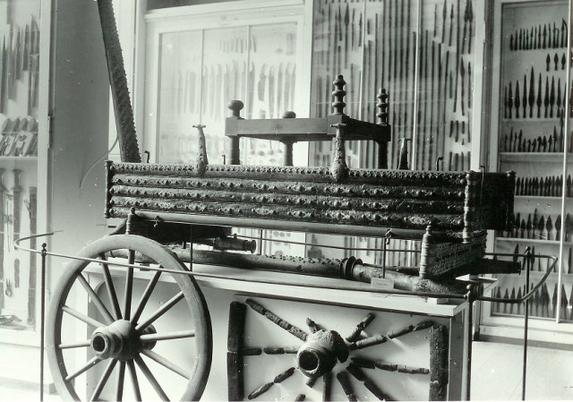
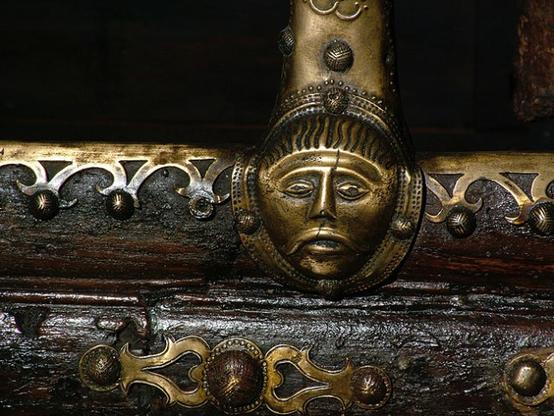
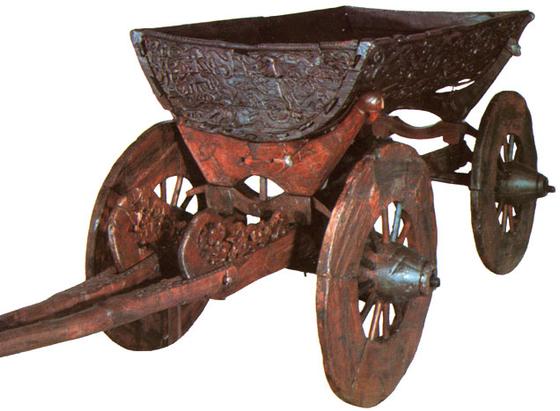
If we look back to the Nordic Bronze age there’s a number of wagon artifacts that have been found, such as the Trundholm Sun Chariot that depicts a horse drawn wagon carrying the sun, and ritual wagons. Denmark’s National Museum has a website with some information on the wagons, and includes examples on display in their museum in Copenhagen, such as the Dejbjerg wagons which were bogged in offering. There was also another recent discovery in the Karanovo grave find. There’s several such examples that have been found across the archaeological record in what we’d think of today as modern Denmark and Germany. These were not simple wagons, but rather were heavily ornamented, oftentimes with metal worked figures in iron or bronze. They were clearly special, and not a sort of everyday type of wagon. Lots of wagon wheels have been found in bogs even when the rest of the wagon is long since dissolved, and others were also included as part of the grave goods for important figures.

So could the solar themed brooches, sometimes represented in the way wagon wheels look on artifacts, point to a similar connection by the Germans and their love of Nerthus with this different Goddess? A sacred concept tying water to the cycle of life and death? Or did they see connections with other Goddesses? We see other watery connections among Germanic Goddesses in the lore. In Grímnismál, with Sökkvabekkr believed to mean sunken bank (possibly also alluded to as nes Ságu (or Saga’s Headland as referenced in Helgakviða Hundingsbana I), a place where cool waves flow, where Odin drinks with the Goddess Sága. We also see the Goddess Frigg connected with wetlands, as her dwelling is in Fensalir (sources: Völuspá & Gylfaginning), or Fen Hall. A fen is a marshy or boggy wetland with a peat ecosystem, sometimes also called a mire. In Heathen cosmology one of the most significant bodies of water (referenced in Völuspá, & Hávamál) is Urðarbrunnr, where the Norns (Urðr, Verðandi, and Skuld) reside, the waters nourish the world tree Yggdrasil.

Trundholm Sun Chariot Golden SideTrundholm Sun Chariot Dark Side


Aldhouse-Green suggests that Coventina and the west opening of her sanctuary (towards the direction of death) may have connections to death in the Goddess’ role and function, especially with the wheel symbolism in some of the votive offerings. Perhaps she transported the dead. I’m reminded of how in depictions of religious processionals, the Nordic Bronze Age objects like the solar wheeled Trundholm Sun Chariot (1400 BC) and Kivik’s King Grave petroglyphs both are theorized to represent death beliefs. On the Kivik’s King Grave we have petroglyphs that look like two omega Ω symbols turned on their sides, with the opening facing west like Coventina’s Well unusually faced west.

Petroglyphs from Kivik’s King Grave

In the archaeological record we have the Nordic Bronze Age item, we’ve called the Trundholm Sun Chariot, which was found in Odsherred (Denmark), alongside other offerings in a bog. The chariot’s wheels are solar crosses, which we find across the archaeological record (on some of the stones on the Kivik’s King Grave, on solar crosses found near Zurich, the Balkåkra Ritual Object (and the nearly identical counterpart the Hasfalva Disc), petroglyphs from Tanum in Sweden, and so many more). The item depicts a Sun in a horse drawn chariot. One side was clearly enhanced with gold adornments and gildings, and the other side was kept intentionally dark. Both sides feature swirls as a design element. Archaeologist Klavs Randsborg presents a theory that it represents an astronomical calendar of synodic months (as published in his article “SPIRALS! Calendars in the Bronze Age in Denmark” in the Adoranten journal).

There are different theories for the dual sided nature of the sun disc from the Trundholm Sun Chariot. One theory is the dark side represents a connection to the underworld. Another is that the dark side represents night, especially considering we have lore that the moon was also pulled in a horse-drawn chariot, or perhaps the dual nature of the sun disc is a division of the year into two seasons: summer and winter. Randsborg’s theory looks at the swirls as representative of a synodic calendar splits the sun disc sides into day and night. “The reference is to the Sun-calendar on the day-side, and to the Moon-calendar on the night-side of the Sun Chariot, which seems the perfect calculation.”

The story of Sunna driving a horse drawn chariot with the sun, appears to derive from the major solar Nordic Bronze Age cultus. I mention this because I could see how a Germanic heathen at Hadrian’s Wall might see some similarities with solar symbolism and life/death cycles to what already would be familiar to them. If we look to the petroglyphs from Tanum (Sweden) we see what appears to be a life/death cycle in boats during the Bronze Age (this may explain the origins of later boat burials, or graves outlined with stones in a boat shape we see later on in Scandinavia.

Wagons appear often in Norse myths (the Norse, being derived from Northern Germanic tribes). Thor travels in a wagon drawn by a pair of goats, Freyr has a boar pulled cart, Freya has a cart pulled by cats, Njord in the Codex Regius is called the God of the Wagon (vagna guð). One of the sacred symbols of Indo-European cultures is the swastika (understood to be a solar symbol, like a solar cross wheel). How does one symbol seemingly appear over so many cultures in the Northern Hemisphere? Well one theory posited is that it may have simply come from observation of the stars in the Northern Hemisphere. The North Star or Pole Star, also known as Polaris is visible year round from anywhere on earth North of the equator (assuming clear skies). The star (or the constellation it’s part of Ursa Minor) has been a key component for navigation by land and sea for multiple millennia. Near Polaris is the constellation of Ursa Major, written about by Ptolemy in 2nd Century CE. It’s main seven stars comprise what we call the Big Dipper today, and in other cultures was called the Plough, The Great Chariot, The Seven Seers (from the Hindu Sapta Rishi Mandal). As an aside, think of the Trundholm Sun Chariot and those solar cross wheels and now think of the name of some of these constellations: Chariot and Wagons have been found with solar cross wheels.

Like most cultures, the Germanic Tribes had their own star lore. One of the major constellations was the Wagon. We’re not precisely certain what stars it refers to, but the widely accepted supposition is it ties to the Big Dipper stars and thus the swastika symbol. Sometimes it’s called Thor’s wagon, but it is also called Odin’s Wagon in the Sigrdrífumál (Reið Rôgnis or Rognir’s Wagon, Rognir is a heiti for Odin), and Odin’s Wagon is referenced in kennings plus later recorded folklore. (To learn more on Germanic star lore, check out Eysteinn’s Lexicon of Kennings Analytical Glossary, Grimm’s Teutonic Mythology, as well as Cleasby & Vígfusson’s An Icelandic-English Dictionary).

Ancient peoples were definitely aware of our night sky. Elsewhere from areas in the Nordic Bronze Age, such as from archaeological finds from Bornholm (Denmark) we even find the star constellation of the Big Dipper (Ursa Major) rendered via carved cup marks inside the chamber of the passage grave Jættedal, and we find Orion rendered at Madsebakke (also on Bornholm).

Seasonal rotation of Ursa Major around Polaris

The constellation of Ursa Major when viewed in the Northern Hemisphere seemingly throughout the course of the year rotates around the pole star (or the North Star known as Polaris). The sense of this rotation is like a pinwheel being blown slowly over the course of a year.  Ursa Minor in it’s dipper like appearance similarly rotates around that center pole. So the swastika symbol as it appears globally is believed to derive from Ursa Major (Big Dipper) or possibly Ursa Minor (the Little Dipper).

Interpretation of the swastika symbol deriving from the Wagon Constellation, in conjunction with the Trundholm Sun Chariots (and its dual sides: one golden, one dark) gives us a concept of cyclical return and perhaps life and death. The sun sets in the west, but come morning it has returned to rise in the east. Celtic cultures and Germanic cultures both derive from Bronze Age sun cultuses. For Britons, living on an island, where both the west, and east is over water, might there be a concept of water tied to memory? Of keeping the souls till they moved on? In Germanic belief we have Mimir’s well (the well of memory and wisdom), Urd’s well (the well of life, as it waters the World Tree), and death’s well (rooted to the realm for the dead), all three wells rooted to the world tree and the 9 worlds of Heathen cosmology.

The story of Mimir’s Well is one of sacrifice for wisdom. Odin gives his eye to the well, and now those who drink from the well (including Mimr and Odin) are said to imbibe wisdom. During the Aesir (gods like Odin, Thor, Frigg) war with the Vanir (gods like Freyr, Freya, Njord), Mimir is beheaded. This results in Odin using ‘charms and herbs’ to prevent rot of the head, enabling Odin to carry Mimir’s head around to talk with Mimir for counsel. It is said that after being beheaded, Mimir now has the ability to divulge wisdom from other worlds. Mentions to aspects of this story can be found primarily in the Poetic Edda, and Heimskringla. So here in Germanic belief we have a God of Wisdom and Memory who has a well, and is beheaded. Might that have echoes of the Celtic head cult?

Sun Chariot & Boat Petroglyph from Bohuslän, Östergötland

We actually have a petroglyph from Bohuslän, Östergötland (Sweden) that combines solar wagon with solar ship imagery. We think the Germanic Migration Era & Viking Age tradition of boat shaped graves, and actual boat graves derives in part from Bronze Age life and death beliefs combining solar boats and solar chariots with life and death beliefs. Drunertos from Albion and Beyond mentions an article on death beliefs (and boats) for Gaulish and Proto-Germanic peoples at Jonas Jacobson’s article on the afterlife.


So in the Germanic areas, water and sun has long been tied. The famous Oseburg Ship Burial has a tapestry showing a religious, possibly funerary processional (which may echo some content from Kivik’s King Grave) with wagons, but found within a boat.

Oseburg Ship Burial TapestryOseburg Ship Burial Tapestry


Not only do myths tell us that horses pulled the sun chariot, but In the Germanic tradition, and seen also among the Scandinavian sources horses were incredibly sacred. Tacitus’ Germania describes them as being milk-white–and similar to the sanctuary we see centuries later at Thrandheim–the equines were housed in sacred groves where they were never used for the purposes of riding or working the land. Horses in Germania were described as being more sacredly close to the Gods then even their priests; somehow these horses were in the Gods’ confidence. For this reason horses were used to divine the will of the Gods. They were yoked to a special sort of chariot and their behavior observed. In the neighboring Slav culture we also see horses used in divination as well (but via a different method). We have even older evidence of an active cultic presence connected with horses in even the Bronze Age, and we see in the law codes in Europe (ex: Gragas) during the period of Christian conversion that the eating of horse-flesh was forbidden because it had ties to heathen religious tradition. We see in the Historia ecclesiasstica Islandiæ that Christian priests were forbidden from attending horse-fights as well (most likely for a similar reasoning). Horses had not only a divine connection, but also have a role in the agricultural cycle as well. In Norse Myth horses also pull the chariots that draw not only the Sun, but the Moon as well through the sky.


So from a perspective of Germanic belief and the preceding Bronze Age culture(s) we see ties of horses, solar cultus with wagon, boats, water, life and death. Celtic and Germanic peoples long had interaction. So might some of the Bronze Age solar cultus and Germanic belief be echoed in sweet ripples of reverberation at the Brythonic Coventina’s Well? (at least in part with the well water having received solar iconography offerings, as well as horse figure offerings)? I think this is grounds for food for thought, but something I’d like to see a perspective from a Celtic/Brythonic polytheist familiar with their cosmological world view and beliefs.

Modern Devotions to Coventina

On the off chance some sites I’ve linked to disappear in the future, I wanted to encapsulate some modern poems and prayers created by today’s pagans and polytheists who venerate the Goddess Coventina, they follow with attribution in quotation below.

From Albion & Beyond:

Rise O Western Queen,
Accompanied by your enduring attendants,
And yourself.
Pour out wisdom from your cups,
Break the drought we suffer under,
Let us taste the sweet streams,
And be divinely supplied.
We raise our cups to your Western Throne!
We pour out praise from our mouths,
Having tasted the sweet streams,
Our praise is divinely supplied.
You have given so that we may give.
Praise to you, Coventina, three and one, 
Western Queen and source of wisdom.

From Greg Hill:

For Coventina
Who brings us otherworld water
Budding through earth and stone
Into our world of dry words:
Liquid whispers of something deeper.

From Order of the White Moon, here is a modern pagan mini ritual written by Tranquility Fearn:

Needed:
Body of water such as fountain or even a bowl of water.
Coin

Cast your circle as you would normal do. Surround yourself with a protective circle of light. Feel the calm peace and protection of the circle. Close your eyes and picture yourself walking down to river where Coventina’s Shrine is. You are carrying your offering to Coventina. There is something you wish to ask of Coventina. Think of what this is. You are now at Coventina’s Shrine. Here you see a well and an altar to her. Say the following chant three times:

Coventina, Goddess of the River;
This I call to you.
I give now this offering;
For the magick that you do.

Toss in your offering to Coventina into the well (fountain or bowl of water).

From Paul Sandover of Druidry.org:

Ancient Coventina, sweet goddess
of  sacred springs and holy wells,
your waters emerge joyfully
from the dream of darkness.
Your pure and sparkling essence
manifests in the light of day.

Lady of the living waters,
I gladly welcome
your wonderful gifts
of refreshment and healing,
and your kind blessings.
Which grace both body and soul.

An offering is reverently placed
upon your flowing altar.
And my open heart
feels your loving magic,
sanctity and gentle inspiration.

May your waters always flow,
blessing the living land
with your abundant beauty.

I have also crafted an invocation and prayer to her:

Hail Coventina,
May you bless us with
percolating memories
arising from sweet,
fresh depths.

Cleansing,
healing,
calming,
nourishing,
in your murmuring ripples
which sustain us.

Thirst-quencher,
life-giver,
revive and
sustain us.

Coventina generated by META AI

Notes:


In antiquity spelling conventions were not necessarily standardized, so what we see in inscriptions reflects phonetic variation from dialect and culture, and thus a deity might have multiple attested ways of spelling their name. In this case with the Goddess Coventina we have what we believe is a Celtic theonym being translated into Latin (with different phonetics to Celtic, or Germanic languages) and rendered. Across the inscriptions to this water Goddess we see her name spelled: Covontine, Covetina, Coventinae, Conventinae, Conveti, Conventina, Covventinae, Covven… , Coventine, Covetine at the Fort Brocolitia site alone. At the possible Galicia sites we have examples of theonyms rendered as Cuhvetenae, Cohvetene near Lugo, Spain and as Convertina in Narbonne, France that we think refer to the same Goddess Coventina of Fort Brocolitia.  

Coventina is the popular way her name is rendered today, in part I think because the general pagan community likes the fact the word ‘coven’ appears in her name. Based on modern personal gnosis, some modern pagans treat her as the Goddess of the Covens. Scholars use a variety of the attested theonyms and their spellings.

Fort Brocolitia (sometimes rendered Procolitia) has a nearby car park/parking lot for visitors, the site is very much in ruins. Other areas of the fort have made an effort to be accessible and informational to visitors, but the Well has been left more scruffy, and quite boggy. I believe it’s because the land where the well is, is not owned by English Heritage, but privately owned. If you’d like to get an idea for how some of the buildings would have been like when in use, visit Vindolanda for reconstructions from the period.


Online Resources:

  • All translations for the inscriptions comes from the Roman Inscriptions of Britain database (RIB)
  • Albion and Beyond’s Coventina article (which is a well researched article with works cited from Romano-British polytheists spotlighting Celtic nuance and story, is also accompanied with a lovely modern prayer)
  • Eric Edward’s The Goddess Coventina of Northumbria
  • Paul Sandover has a brief entry on Coventina, of particular note is a modern prayer/poem for the Goddess.
  • Greg Hill has a blog entry from his visit, and a modern prayer to the Goddess.
  • Order of the White Moon is a modern pagan website, with modern prayers, and even a mini ritual to the Goddess.
  • Tehomet.net has a number of photos of artifacts and the fort site, links to devotional rites and prayers from modern pagan groups, maintained by a pagan, and a collection of other information.
  • Senobessus Bolgon is a website focused on the modern community surrounding Gaulish Polytheism, with in-depth, well-researched articles.
  • The Roman Britain website provides a great deal of well researched overview especially of the Roman military (including auxiliary units) in Britain.
  • The Megalithic UK website has photos of how the site appears in modern times
  • English Heritage oversees artifacts from the fort, many are on display via the Clayton Collection at Chesters Roman Fort & Museum
  • Heritage Gateway website which cross-references over 60 different research resources and databases for historic sites in England.
  • The National Museum of Denmark explains some Bronze Age petroglyphs solar boat symbolism with cyclical beliefs.
  • I wrote a deep dive on Sun Worship in Northern Europe to explore sun cultus in Nordic Bronze Age and among the Germanic/Norse. Including boats, horses, and more.
  • I also wrote on The Importance of the Religious Processional in the Northern Tradition, which dives into wagons.

For Further Reading:

These books were sourced among some of the above online resources, I copy/pasted them here in case the above links stop working at some point in the future. Plus added some other resources too of interest, including some for exploring Roman Galicia.

  • Aldhouse-Green, M., 2004. Gallo-British deities and their shrines. A Companion to Roman Britain, pp.193-219.
  • Aldhouse-Green, M.J. (2018). Sacred Britannia: the gods and rituals of Roman Britain. London; New York: Thames & Hudson.
  • Allason-Jones, L., 1996. Coventina’s Well. The Concept of the Goddess, pp.107-119.
  • Année Epigraphique, París. [Abbreviated AE above]
  • Archaeologia Aeliana.  4th Series.  XXVI.  21.
  • Archaeologia  Aeliana.  4th Series.  XXIX.  36.
  • Arias, F./Le Roux, P./Tranoy, A. Inscriptions romaines de la province de Lugo, París, 1979 [Abbreviated IRL above]
  • Blázquez, J.M. Religiones primitivas de Hispania. I. Fuentes literarias y epigráficas, Roma, 1962 [Abbreviated RPH]
  • Bourgeois, C. (1991): Divona I. Divinités et ex-voto du culte gallo-romain de l’eau, París.
  • Clayton, J. (1878): The Temple of the Goddess Coventina at Procolitia, London.
  • Collingwood, R. G. & Wright, R. P.  (1965).  The Roman Inscriptions of Britain. Clarendon Press, Oxford. [Abbreviated RIB]
  • Corbitt, J. H.  (1958).  The Goddess Coventina and her Well at Carrawburgh, Northumberland.  Archaeology News.  6 (5).
  • Corpus de Inscripcions romanas de Galicia II. Pontevedra, 1994. [Abbreviated CIRG II]
  • Dechelette, J. (1910): Manuel d’archéologie prehistorique, celtique et gallo-romaine. II,1. Age du bronze, París.
  • Diez de Velasco, F. (1987): Balnearios y divinidades de las aguas termales en la Península Ibérica en época romana, Madrid.
  • Diez de Velasco, F. (1997): Termalismo y religión. La sacralización del agua termal en la Península Ibérica y el norte de Africa en el mundo antiguo (en prensa).
  • Diodorus Siculus. Library of History (Books III – VIII), trans. C. H. Oldfather. Cambridge: Harvard University Press, 1935.
  • Dodge, E.J., 2020. ORPHEUS, ODIN, AND THE INDO-EUROPEAN UNDERWORLD: A RESPONSE TO BRUCE LINCOLN’S ARTICLE “WATERS OF MEMORY, WATERS OF FORGETFULNESS” (Doctoral dissertation, University of Houston).
  • Encarnação, J. d’, Divindades indígenas sob o dominio romano em Portugal, Lisboa, 1975. [Abbreviated DIP]
  • Espérandieu, E. Inscriptions latines de la Gaule Narbonnaise, París, 1929. [Abbreviated ILGN]
  • Ferris, I. (2021). Visions of the Roman North: Art and Identity in Northern Roman Britain. Oxford Archaeopress Publishing Ltd.
  • Gascou, J. Inscriptions latines de Narbonnaise III. Aix-en-Provence (Gallia supl. XLIV), París, 1995. [Abbreviated ILNIII ]
  • Garcia, J.M. Religiões antigas de Portugal. Fontes epigráficas, Lisboa, 1992 (citado por el número de la inscripción). [Abbreviated RAP]
  • Gómez Moreno, M. Catálogo monumental de España. Provincia de Salamanca, Madrid, 1967. [Abbreviated CMES]
  • Green, M. (1992): Dictionary of Celtic Myth and Legend, Londres
  • Green, M.  (1986).  The Gods of the Celts.  Bramley Books, Surrey.
  • Green, M.  (1995).  Celtic Goddesses, Virgins, Mothers.  British Museum Press, London.
  • Guyonvarc’h, C. (1959): *Notes d’étimologie et de lexicographie celtique et gauloise: le problème du Borvo gaulois, mot ligure ou celtique?+ Ogam XI, 164-170.
  • Hispania Antiqua Epigraphica, suplemento a AEA, Madrid, 1950-1969.
  • Iglesias, J.M. (1993): *Las fórmulas en las inscripciones latinas votivas de la Hispania Romana: ensayo lógico-estadístico+ HAnt 17, 279-320.
  • Lambrino, S. (1953): *La déesse Coventina de Parga (Galice)+ Revista de la Facultad de Letras (Lisboa) 18, 74-87
  • Monteagudo, L. (1947): *From Roman Galicia. Ara de Parga dedicated to Conventina+ AEA 20, 68-74 RAP 
  • Häussler, Ralph. La religion en Bretagne
  • Hutton, R. (2013). Pagan Britain. New Haven; London: Yale University Press.
  • Irby-Massie, G.L. (1999). Military religion in Roman Britain. Leiden; Boston: Brill.
  • Kaul, Flemming. The Sun, the Ship and the Horse in Nordic Bronze Age Iconography in Petroglyphs and on Bronze Objects.
  • Kaul, Flemming, 1987, Sandagergård. A late Bronze Age Cultic Building with Rock Engravings and Menhirs from Northern Zealand, Denmark. Acta Archaeologica vol. 56, 1985, pp. 31-54, Copenhagen.
  • Kaul, Flemming, 1998, Ships on bronzes: a study in Bronze Age religion and iconography. Text. National Museum of Denmark. Copenhagen.
    Kaul, Flemming, 2004, Bronzealderens religion. Studier af den nordiske bronzealders ikonografi. Det Kongelige Nordiske Oldskriftselskab. Copenhagen.
  • Kaul, Flemming, 2006, Kulthuset ved Sandagergård og andre kulthuse – betydning og tolkning. In: Kulthus & dödshus – det ritualiserede rummets teori og praktik, edited by M. Anglert, M. Artursson and F. Svanberg, pp. 99-111, Stockholm.
  • Kaul, Flemming, 2010, Hjulkorset – et enkelt, men mangetydigt symbol. Fund & Fortid 2010, nr. 2, pp. 34-39.
  • Kaul, Flemming, 2020, The Possibilities for an Afterlife. Souls and Cosmology in the Nordic Bronze Age. Ergänzungsbände zum Reallexikon der Germanischen Altertumskunde 118, pp. 185-202. Berlin/Boston.
  • Koch, J.T. (2006). Celtic culture: a historical encyclopedia. Oxford: Abc-Clio.
  • MacLeod, S.P., 2006, January. A Confluence of Wisdom: The Symbolism of Wells, Whirlpools, Waterfalls and Rivers in Early Celtic Sources. In Proceedings of the Harvard Celtic Colloquium (pp. 337-355). Dept. of Celtic Languages and Literatures, Faculty of Arts and Sciences, Harvard University.
  • Medrano, M.M./Díaz, A. (1987): *Las instalaciones balnearias romanas de Fitero+ Primer Congreso General de Historia de Navarra vol.2 (Príncipe de Viana, Anejo 7, 1987) 491-501.
  • Millán, I. (1965): *Conjeturas etimológicas sobre los teónimos galaicos: I EdovioAEA 38, 50-54.
  • Monteagudo, L. (1947): *De la Galicia romana. Ara de Parga dedicada a Conventina+ AEA 20, 68-74.
  • Palacios F F., Chapter 9 ‘The theonym *Conventina’ in R Haeussler and King, A. (2017). Celtic religions in the Roman period: personal, local, and global. Aberystwyth, Ceredigion, Wales; Havertown, Pa: Celtic Studies Publications.
  • Rebuffat, R. (1991): *Vocabulaire thermal. Documents sur le bain romain+ Les thermes romains. Actes de la table ronde organisée par l’EFR (1988), Roma, (Collection EFR n1142), 1-34.
  • Ross, Anne (1974). Pagan Celtic Britain: Studies in iconography and tradition. London, UK: Sphere Books Ltd. pp. 161–162.
  • Sigroni, C. (2022). (Apollo) Grannus: What’s in a Name? [online].
  • Simón, F.M., 2005. Religion and religious practices of the ancient Celts of the Iberian Peninsula. E-Keltoi: Journal of Interdisciplinary Celtic Studies, 6(1), p.6.
  • Tomlin, R.S.O. (2018). Britannia Romana Roman inscriptions and Roman Britain. Oxford Philadelphia Oxbow Books.
  • Peréx, M. J. (ed.) TERMALISMO ANTIGUO. I Congreso Peninsular, Actas (Arnedillo, 3-5 octubre 1996). de Velasco, Francisco Diez. “TERMALISMO Y RELIGIÓN: CONSIDERACIONES GENERALES pp. 95-103.
  • Valent, Dušan. “The Death-Sun and the Misidentified Bird-Barge: A Reappraisal of Bronze Age Solar Iconography and Indo-European Mythology”. Zborník Slovenského národného múzea – Archeológia. 2021.
  • Vázquez Saco, F./Vázquez Seijas, M. Inscripciones romanas de Galicia II. Provincia de Lugo, Santiago, 1954. [Inscriptions are listed as IRG II #.]
  • Vives, J. Inscripciones latinas de la España romana, Barcelona, 1971. [Abbreviated ILER]

UPDATED

  • May 11, 2024 with Mimir’s myth of his beheading and the well. added link to death beliefs (and boats) for Gaulish and Proto-Germanic peoples at Jonas Jacobson’s article on the afterlife.
  • July 5, 2025: Updated broken link to Greg Hill’s blog.


#Aesculapius #Alaisiagae #Anglii #asatru #Augusta #auxiliaryUnit #Aviones #ÓláfsSagaTryggvasonarEnMesta #ÖgmundarþáttrDytts #Banff #BarrSHill #Batavi #Batavians #Baudihille #Beda #Belatucader #Belisama #bog #Carrawburgh #CelticGod #CelticGoddess #Chesters #Cilurnum #cohort #Cohvetene #conventinae #Convertina #conveti #couan #CoventinaSWell #coventinae #coventine #Coventry #CoventryHistoryAndGuide #covetina #covetinaAugusta #covetine #covontine #covven #covventinae #Cuberni #Cuhvetenae #Cune #DavidMcGrory #deathBeliefs #DejbjergWagon #devotion #disir #Donar #England #Eudoses #Fimmilena #Flateyjarbok #FortBrocolitia #Fortuna #France #frescoe #Freyr #Friagabis #Frisiavones #Frisii #Frixiavones #Gail #Galicia #GeneralAgricola #geniusLoci #germania #Germanic #GermanoCeltic #Germering #Goddess #goddessWell #HadrianSWall #heathen #heathenry #Hercules #history #Housesteads #Huiteribus #Idis #InscriptionsRomainesDeLaProvinceDeLugo #invocation #JohnClayton #KaranovoGrave #Kent #KivikSKingGrave #Lugo #Lullingstone #Lytir #MarsBelatucadrus #MarsThingso #MarsThingsus #Matraes #Matronae #MeggieSDeneBurn #Mercury #MerovingianKingChildericIII #Mimir #MimulusLuteus #Minerva #Mithraeum #MotherGoddess #mythology #Narbo #Narbonne #nervian #Newbrough #NordicBronzeAge #northernTradition #Northumberland #Nuitones #Nymph #Nymphaeum #Odin #OsCurveiros #pagan #paganTemple #poem #polytheism #prayer #Procolitia #Raetia #ReligionesPrimitivasDeHispania #Reudingi #Rhineland #ritual #RomanEmpire #RomanFort #RomanVilla #RomanBritain #RomanoBritish #RomanoCeltic #sacredWell #Sancta #SantaCruzDeLoio #Scotland #Sherbourne #solarWheels #Spain #Stanegate #Suarini #Suebi #Sulis #suvevae #tacitus #Temple #texandri #Thingaz #Thor #tiwaz #travel #TrundholmSunChariot #Tyne #Tyr #Vagniacis #Varini #veneration #Vercovicium #VeronicaBeccabunga #Veteris #Vheterus #vicus #VitaKaroliMagni #votiveInscription #votiveOffering #waterGoddess
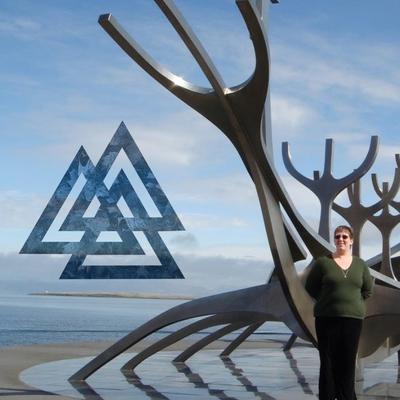
Murderers Don’t Go to Valhalla

In the wake of the tragic mass shooting at the Tops Market grocery store in Buffalo, New York on May 14, 2022 we have been learning more about the murdering criminal who had perpetrated the attack. He was wearing a sonnenrad (a swastika related symbol), the assault rifle and shotgun were adorned with the Othala rune, and the shotgun also featured a Celtic Cross (which is a variation of our solar cross symbol). He also had references on his assault rifle to five other mass shooters (who I am choosing not to name) behind the following attacks: 2011 Norwegian attacks in Oslo and Utøya, 2011 Tree of life Synagogue in Pittsburgh, the 2015 Emanuel AME Church in Charleston, the 2019 Chabad Congregation in Poway, and the 2019 Christchurch attack.

He signed off his manifesto with the words “Goodbye, God bless you all and I hope to see you in Valhalla.” Compare it to the manifesto from the shooter behind the 2019 Christchurch attack and there’s lots of similarities (basically plagiarized with slight rewordings) including the sign off “Goodbye, god bless you all and I will see you in Valhalla.”

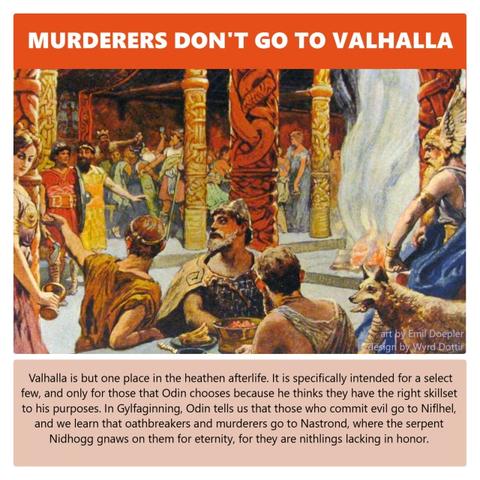
I’d like to say something for the hate spouting extremists in the back. Murderers don’t go to Valhalla. In fact in our lore we know murderers go somewhere else entirely. In Gylfaginning we are told by Odin (in his guise of Þriði) that those who commit evil go to Nifolhel (Misty Hel). In another section of Gylfaginning, and supported also in Völuspá, we learn that within Nifolhel we have Nástrǫnd (Corpse Shore), and that is where oathbreakers and murderers go in the afterlife. Nástrǫnd is home to the serpent Níðhöggr (Malice Striker) who gnaws for eternity on the corpses of murderers and oathbreakers that have been condemned to the serpent’s hall. We think that Nástrǫnd may correlate to the Old English Wyrmsele, which means serpent hall, it appears in the poem Judith found in the Nowell Codex (which is the manuscript source for Beowulf).

The heathen afterlife is first and foremost Hel. Hel, is more than just a name. Her name literally is not only the realm of the dead, but etymologically is the very earth where the dead are buried and reside, from the great cairns and graveyards. To speak of Hel is to speak of both the Goddess, Her realm, and all those who dwell there. Sooner or later we will traverse those halls, because as the Havamal states, “cattle die and kinsmen die” because the most fundamental truth of life is that sooner or later we die. From the sources we know that there were certain places or deities within the afterlife of Hel that played host to the dead: Odin’s Valhalla, Thor’s Bilskirnir within Valhalla, Freya’s Sessrumnir, the hall of Vingolf (mentioned three times: once connected to Odin, once to the Goddesses, and once just generally as a place for the dead), Gimlé where the just go, and then we know that the Goddesses Ran and Gefjon also play host to specific types of the dead (respectively those who died at sea and maidens).

One of the commonly misrepresented beliefs of our afterlife is that the end goal is for us all to go to Valhalla, it isn’t. Valhalla is specifically intended for a select few, and only for those that Odin thinks has the right skillset to his warrior purposes and thus chooses. Killing in self defense, or killing in the course of war is one thing. Gunning down a bunch of innocent people in a grocery store makes you only one thing: a murderer, a nīðing (nithling) which is one of the worst labels given to a person, as it means the person has no honor and is a villain.

This gunman doesn’t represent my religion nor my beliefs. In fact both he and the Q-Anon Shaman from the January 6, 2021 Insurrection in Washington DC use the singular Christian god in messaging, but combine it with some of our religion’s sacred symbols and places. This is sadly yet another despicable real world example of what should be sacred being profaned for the purposes of hate. Let me be clear, in the Northern Tradition these are the races that exist: the Giants, the Gods, the Dwarves, the Disir, the Alfar, other vaettir of land and sea, and the human race. That’s it. If you look at our creation story we see that as the Gods create the first people, Odin breathed life into them, Vili granted them intelligence, and Ve gave them their senses so they could see and hear. So whether an individual or any other cultural or religious group believes that or not, if someone believes and worships Odin then to my mind you should believe he is the All-Father of humanity, not the Father of only some.

You would think after decades of being a Heathen and seeing white supremacists pervert the sacred, I’d be used to this. But I’m not. I’m furious. Each time we’re here I’m just as outraged as the last time. So I had to do something, in this case I made a meme. Yes, it is but a small act, but maybe if we can educate there’d be fewer people misusing Valhalla. If we can burst the fantasy bubble around Valhalla, maybe we can start to dismantle part of the appeal in how white supremacists who don’t even worship our Gods use it to galvanize others to hate. Share it, spread it. Let’s make this go viral.

Murderers Don’t Go To Valhalla #asatru #Bilskirnir #Buffalo #Freya #gefjon #Gimle #Goddess #Gods #gylfaginning #havamal #heathen #heathenry #Hel #Hell #massShooter #Nastrond #NewYork #news #Nidhoggr #Nifohel #nithling #northernTradition #nowellCodex #Odin #othala #pagan #polytheism #QanonShaman #Ran #rune #Sessrumnir #SolarCross #sonnenrad #swastika #TopsMarket #Valhalla #Vingolf #volupsa #wyrmsele

The Importance of the Religious Processional within the Northern Tradition

All too often among modern worshippers of the ancient gods of Germania and Scandinavia, they focus on rites like blot (or the modern alternative faining), and traditions like sumble. But they tend to ignore other religious ritual customs we have ample evidence of in both historic textual accounts and archaeologic artifacts, especially including the religious processionals of yesteryear.


We know from Tacitus’ Germania, that the Germanic Goddess Nerthus was widely worshipped by a number of the Suebian Germanic tribes characterized as being bold warriors: Semnones, Langobardi, Reudigni, Aviones, Anglii, Varini, Eudoses, Suarines and Nuitones.

“There is nothing especially noteworthy about these states individually, but they are distinguished by a common worship of Nerthus, that is, Mother Earth, and believes that she intervenes in human affairs and rides through their peoples. There is a sacred grove on an island in the Ocean, in which there is a consecrated chariot, draped with cloth, where the priest alone may touch. He perceives the presence of the goddess in the innermost shrine and with great reverence escorts her in her chariot, which is drawn by female cattle. There are days of rejoicing then and the countryside celebrates the festival, wherever she designs to visit and to accept hospitality. No one goes to war, no one takes up arms, all objects of iron are locked away, then and only then do they experience peace and quiet, only then do they prize them, until the goddess has had her fill of human society and the priest brings her back to her temple. Afterwards the chariot, the cloth, and, if one may believe it, the deity herself are washed in a hidden lake. The slaves who perform this office are immediately swallowed up in the same lake. Hence arises dread of the mysterious, and piety, which keeps them ignorant of what only those about to perish may see.

A. R. Birley translation

A holy processional wasn’t limited to just Nerthus, we also have late textual evidence in Flateyjarbok of processional wagons used in connection to other deities, like the Gods Freyr and Lytir. Ögmundar þáttr dytts (found within Óláfs saga Tryggvasonar en mesta,) also tells us of a wagon processional where a priestess accompanied an idol of Freyr in a wagon. In the Vita Karoli Magni, we’re told that the Merovingian king Childeric III, every year went in an oxen drawn two wheeled wagon to the public assembly.

If we look back to the Nordic Bronze age there’s a number of wagon artifacts that have been found, such as the Trundholm Sun Chariot that depicts a horse drawn wagon carrying the sun, and ritual wagons. Denmark’s National Museum has a website with some information on the wagons, and includes examples on display in their museum in Copenhagen, such as the Dejbjerg wagons which were bogged in offering. There was also another recent discovery in the Karanovo grave find. There’s several such examples that have been found across the archaeological record in what we’d think of today as modern Denmark and Germany. These were not simple wagons, but rather were heavily ornamented, oftentimes with metal worked figures in iron or bronze. They were clearly special, and not a sort of everyday type of wagon. Lots of wagon wheels have been found in bogs even when the rest of the wagon is long since dissolved, and others were also included as part of the grave goods for important figures.

Dejbjerg WagonDejbjerg Wagon detailOseburg WagonWagon Decor, National Museum DenmarkWagon Decor, National Museum DenmarkTrundholm Sun ChariotKaranovo WagonDejbjerg Wagon

We see later on that tradition continues with a wood carved wagon featuring among the goods of the Oseburg Ship burial find. Within the Oseburg burial we not only have a beautiful example of a Viking age ship, the aforementioned wooden carved processional wagon, but also the Oseburg tapestries, which Professor Marianne Vedeler writes on extensively. Among the scenes depicted on the tapestries, we are shown a massive religious processional, a parade of people (men and women), some in wagons, some on horses, some walking, some carrying what surely were religious accoutrements.  The horned figured is probably a high priest or perhaps as some believe it may be representative of Odin since he is far bigger than any of the other humans, perhaps in his role as psychopomp. We see what may be horse drawn wagons with a priest/priestess and perhaps the idol of the God/dess they specifically serve, plus other wagons without a passenger that may be carrying offerings. We also have a horsed headed tree from a nearby badly surviving remnant (which is probably a visual reference to Yggdrasil being Odin’s Horse) with bodies hanging from it in sacrifice (and we know of sacrificial trees from an account from Adam of Bremen, so we have text and archaeology synching up).

Oseburg tapestry remnantOseburg tapestry remnantPeter Robinson’s black and white recreation of the sacrificial tree remnant of the Oseburg tapestryMary Storm recreation of the left panel of the Oseburg tapestry religious processionMary Storm recreation of the right panel of the Oseburg tapestry religious procession

We see large numbers of people, including some musicians probably playing the horn shaped Lur instrument, which are often found together in pairs in discovered bog offerings. We also find in the depictions things that might be drums. I also think bells may have been likely in some places too (just based on the fact we do have bells in the archaeological record though nothing specific that points to their use in these processionals).

The Oseburg tapestry is festooned with repeating symbols like the swastika 卍, a geometric seeming serpentine like squiggle (perhaps echoed in the Smiss Women with snakes picture stone), and the ⌘ (that also appears on the Havor Stone) which evokes the looped square found in some American indigenous cultures or found in certain forms of medieval European heraldry such as the bowen knot or the Norwegian valknute.

While difficult to fully decode what we’re seeing, the religious nature in the tapestry is quite clear. Plus, the tapestry’s depictions echo in part the descriptions from Tacitus, as well as other archaeological finds like the Garde Bote Stone from Gotland, and the Kivik’s King Grave petrogylphs. The Kivik’s King Grave was an example of a cairn, where the interior face of the walls of the grave feature petroglyphs which may very well detail religious custom and mortuary rites. Among the series of engraved stones, we find again what appears to be a religious processional.

One of the petroglyph stones from Kivik’s King Grave.

When there’s music (and the lurs are pretty distinctive as they appear in multiple examples across the archaeological record) we most likely also have dancers. In Nordic bronze age finds we have gylphs that show what looks like ritual leaping over what appears to be a boat processional, and even figurines in that same acrobatic pose too (perhaps showing some of the dancers in action).

Gylphs found in Grevensvænge, ZealandFigures from Grevensvænge, Zealand,

We also see with traditions like the Perchten or Krampus other types of processions too, those have survived in varying forms in folk practice into the present day.

These processions would have been the equivalent of a major parade in a community. Imagine a big cacophony of the gathered, and everyone joined into the parade. There was probably a hierarchy with religious officiants and leaders first, certain elders perhaps seeresses/shamans then everyone else fell in. We see in the archaeological record what appears to be musicians, and dancers. Perhaps they sung, played the lur and danced as they went to the site for the ritual. I was born in New Orleans and I can’t help but think of a Jazz funeral procession.

How radically different would our impression of ritual be if processionals were more common, if we all collectively knew of their importance and the religious cultural tradition? Was it a riot of sound? Or maybe it was reverentially solemn as they walked and the music and dancers happened at a certain moment in the ritual. Even if it was solemn in the procession to the ritual site, it wouldn’t have been silent. There’d still be the sound of footfalls, clothing rustling, the creak of the wagon, the hooves of the horses, cries of infants, etc. The nature of the rite to be performed may have changed things up too, with different codified formulas. Was it for a ritual in honor of a deity perhaps in thanks for a bountiful harvest, or an entreaty because there was famine? Was it a burial procession?

Processionals appear to be a very major component of ritual observance in the ancient past and yet they are so rarely mentioned or done in the modern era. Of the extremely small number of groups I know of that have done processionals, most of these don’t explain that this echoes back to prehistory and a established religious practice mentioned in textual sources and found in the archaeological record. Those hosting may know why the have structured things the way they have, but the knowledge isn’t for the most part being passed on to the assembled. I think in those cases the gathered participants do not perceive anything holy about it. Instead it reminds them of falling into line in elementary school as they walked with their class to go to the cafeteria or gym. Nothing more than a means to get people from point A to point B, without losing people along the way.

We are handicapped by the unclear structure of the processionals as we have to rely so heavily upon visual interpretations. Textual clues are very limited. In modern times we are further hampered when rituals are conducted in homes and within urban environments where space may be lacking. Most of us don’t have access to wagons, horses, or live in an area that could accommodate mixed use by pedestrians and horse drawn wagons. Even if someone has a yard and they summon the gathered out when it’s time it doesn’t feel like a processional since you’re only walking in most cases less than a hundred feet. Perhaps you booked an area in the local park, but those who came out for ritual feel awkward being in a public sphere among the general public. I also suspect since most of us are converts from Christianity, we’re used to a certain style of worship that doesn’t really prepare us for processionals, except perhaps examples of a ceremonial elite walking in, such as: in Catholicism the altar boys and incense bearers with the priest, or perhaps more generally the bride walking to the altar at a wedding and then the wedding party exiting together.

I was reminded recently of someone who had taken the ancient description of Nerthus’ processional and adapted it to the modern day. Back in 2011 Lone Star Kindred (which was if memory serves me correctly located in the general Houston area in Texas), loaded up with great ceremony an idol of Nerthus, lovingly veiled into our most ‘holy’ of Texas vehicles: a truck. ^_~ The goði drove all over the state heading to different participating kindreds who played host across multiple days. Along the way Nerthus was ceremonially unloaded from her automotive chariot at the various official stops of the processional tour. Rituals were conducted, invocations sung, prayers said, libations and offerings given. Per ancient custom no weapons or blades were to be worn among the worshippers. Some of the offerings were specially packed away to journey with the Goddess. At the end of the entirety of the procession around Texas, those final offerings (things that would not be toxic in the water, or pose a risk to wildlife) were bogged at the conclusion of the journey in lieu of the human sacrifices from antiquity.

May 21, 2011 – Nerthus Processional – White Sage Kindred hosted stop in the Dallas / Fort Worth area. Nerthus is seen veiled here on the altar.

While this was some genius inspiration, and a good example on how to be inspired by the past and adapt it to the modern era, we still didn’t really have that sense of people falling into the procession as part of the entourage. There was no impactful experience of journeying together (the Goddess in her ‘wagon’ with the worshippers in tow) towards the ritual site. Instead you had groups huddled at like little oases in the desert waiting for the Goddess to arrive, much like one might wait for a family member you’ve not seen to show up after a long time apart. This was undoubtedly a unique, and very positive experience. I have nothing to say but good things of the organizers. But I can’t help but wonder now, years on, what if it had been even more? This is in part what all modern practitioners are dealing with, in trying to reconstruct and establish a living faith we evolve, and we begin to notice things that we may not have realized were missing previously. Ways we can dial in the connection more, and enhance the experience.

Really think of those ancient heathen gatherings, of the people waiting for the priest to come with their beloved God or Goddess in their holy wagon. It wasn’t a mere statue, it wasn’t a hunk of stone or wood, that was the deity among them. It was a time of awe and joy and blessings. How do we bring back that awe of the holy, the celebratory joyful noise that happened if not during the procession itself, then at some part during the rite.

I think we dismiss the importance of the wagons within our religion. I personally have long theorized that the “pageant wagons” of 10th through 16th century Christianity was a re-branding of the old Germanic wagon processionals. Those Christian pageants, basically were little tableaus or re-enactments of key Biblical stories. In some ways they were like the living version of a Church’s stained glass windows. They were perfect to use to spread the gospel among a converting pagan population, and later among those who were illiterate. The church leadership most likely recognized that because of the inculturation of the wagon processionals, that the populace equated a sacred and holy mindset when a wagon was present. I speculate that the church took the vehicle of the wagon, but then started to strip away codified traditions that were too ‘heathen’ as part of their re-purposing.

We begin to see a parade like flotilla of the wagons come to towns meandering the streets, but the wagons in the processional stopped for performances at key spots. Think of it like the Macy’s Thanksgiving Day Parade. The floats stop at spots for musical performances, then move on. Those certain stopping points have a new float, band, etc. visit with a new performance. This cycle repeats until you reach the end of the parade. The wagons evolve into movable stages, over time the plays were no longer performed on the wagons but within the churches, and eventually we begin to see a true theater environment begin to emerge in Christian Europe. It’s no coincidence that the tradition dies out around the time Shakespeare and the Globe (and other theaters like it) are exploding throughout Europe. Though some remnants of that tradition still survive today, such as the living nativities many churches put on around Christmas.

Think how ubiquitous nativities (from statuary, to living re-enactments) are among Christianity. That should give you a sense for how much of a cultural touchstone those wagon processionals were to those ancient heathens. Yet in modernity I see this tendency among swathes of the community to use sumble as a crutch for ritual, and with it in some groups an inability even among the goði to speak more than “hail [name of deity here]”. I’m not surprised processions aren’t more widely embraced, but I do feel it’s a detriment to our religious culture of practice and tradition. I feel we collectively as a religious community need to face the challenge of trying to bring the relevance and practice of the processional back into the present day. I can’t help but think where is the joyful holy music, the ritual dancing, in addition to the prayers and offerings? What does bringing it back, and truly embracing it look like to you? Do you or your group already practice it? If so what are your traditions with it?

#Anglii #asatru #Aviones #ceremonialWagon #dance #DejbjergWagon #Eudoses #Flateyjarbok #Frey #Freyr #germania #GermanicIronAge #GermanicPaganism #GermanicTribes #Goddess #Gods #GrdeBoteStone #heathen #heathenry #hornedFigure #KaranovoWagon #krampus #Langobardi #Lur #Lytir #music #Nerthus #NordicBronzeAge #northernTradition #Nuitones #Odin #OseburgShipBurial #OseburgTapestry #pagan #pageantWagon #perchten #petroglyphs #polytheism #religiousProcessional #Reudigni #Semnones #Suarines #Suebi #swastika #theater #TrundholmSunChariot #Varini #wagonProcessional #wagons

Understanding the Sources of the Northern Tradition


So you want to learn about the Northern Tradition*, but don’t want to read scholarly analysis, or any ruminations from modern practitioners. You just want one source from the culture to learn everything that’s historically authentic to the culture but tells you about the cosmology, and the details of all the rituals? Well sorry to burst your bubble, but that doesn’t exist.  

There is an old joke, that ours is the religion with homework (and really, all religion has homework). There’s a lot you need to understand in the big picture before you can really start to tease out the details of pre-Christianity.

Before I go down the very nuanced rabbit hole, I want to make one thing abundantly clear: the history, the stories, the folk customs, the archaeology are all useful and important. But a faith is a living thing, and you have to live a religion, which means finding ways to practice it. How do you conduct rituals? What offerings do you give? What prayers do you say? What are your devotions? How do you live a religion? You can find helpful resources and inspiration from the past but at some point you have to venture out and find your own way of living the religion.

I also want to stress that you do not need to be a scholar to follow this religious path. The only thing standing between you developing a relationship with our Gods, the ancestors, and the vaettir is simply you. Some enjoy delving into the history, to immerse themselves and tease out nuances. Others don’t, and merely want a framework of understanding so they can then move onto living the religion through the customs that come with a living and ever evolving practice. But for those of you who want to delve into the vast knowledge from antiquity, the following should help define a helpful framework to have in mind before you start your own explorations of the sources. This is useful as well to read, even if you only ever plan to do a little bit of exploration into the ancient sources on your own.

We can find a lot of information if you’re patient by going through the old literary and archaeological sources, but it’s not easy. For those of us in the Northern Tradition we have the misfortune that so little has survived to us from ancient believers. Unlike some other major polytheisms, like the unbroken tradition of Hinduism, or other major polytheistic traditions that have a large corpus of work by believers from antiquity about their own religious culture that survives into the present day: Kemetic, Hellenic, and Cultus Deorum, etc.

First you have to understand the history, the various sources (and how they connect to the historical context). Then comes the harder element, the fact even when rituals are mentioned it’s usually in passing, or only in vague context. In order to obtain our creation story you have to look at five different sources: Völuspá, Grímnismál, Vafþrúðnismál, Gylfaginning, and Alvissmal.  So it’s very common that we have to take little puzzle pieces from a range of material to try to piece together specific details. This means to fill in the gaps many look at the entirety of the Northern Tradition umbrella from the lore (various literary sources including (but not limited to) the sagas, eddas, & skaldic poetry, various Anglo-Saxon sources, as well as Byzantium, Roman & Arab accounts, late appearing folk customs & tales, and even archaeological finds.

Approaching this material with an understanding of how this culture viewed the seasons, and drafted their calendar can help you tease apart the timing of some of the rituals too. While we can find commonalities in the over-arching shared worship to Odin/Woden, there were also unique traditions tied to specific settlements or tribal groups that to our knowledge did not appear elsewhere too. This has led in the modern movement to a range of different approaches, some are strictly reconstructionist from a specific area, and others may be more universal across the entirety of the umbrella, plus a range of other denominations in between.


Understanding Time and the Seasons

Across the Northern Tradition umbrella we see that they didn’t have a concept of four seasons, but only two: summer and winter. So the start of Summer is spring, and the start of Winter is fall. Failing to understand this can confuse you on the timing of certain celebrations. But to confuse matters further, unique regions would have their own timing based in part on local cues.

Also, we know the Germanic tribes viewed the day as beginning at sunset, we see this remain in the word fortnight, but also within the name of some of our holy tides: Mother’s Night, Winter Nights, Walpurgis Night, Gyro Night. Roman sources relate that the Germanic tribes held special relevance to nights of the new or full moon to gather for either ritual, or business. We know they used various versions of a lunisolar calendar. This meant they first and foremost followed the lunar phases, but also did something to try to align the year with the solar cycle as well. Prior to the adoption of the Julian Calendar, year keeping was super complicated, with extra intercalary weeks, days and even months added (as needed). What we know comes from either Tacitus’ Germania (which looked at customs on mainland Europe) and later Bede’s De Temporum Rationae (which looked at customs in what we think of as England today). In Bede we know that we have two months back to back one called Ærra Gēola (before yule) the other Æfterra Gēola (after yule), and another dual combination of Ærra Līþa (before litha) and Æftera Līþa (after litha)–plus a sometimes third month of litha, the intercalary Þrilīþa, which was sometimes shoehorned between the two other months of midsummer when needed. Giving us a sense today as we sift through these sources, that the solstices were definitely used as key factors in the solar portion of the calendar (but whether or not rites were timed specifically to the astronomical solstices across the umbrella of related Northern Tradition, we don’t know for certain, and there are clues that point to at least some observances happening at the full moon following the key astronomical markers.

Eventually in antiquity the Germanic tribes would in some areas start to adopt the Julian calendar (due to the influence of the Roman Empire in the region). The Julian Calendar recognized the length of a solar year (365.25 days) which added a leap day every 4 years. However the Julian Calendar wasn’t 100% accurate, because the true solar orbit is 365.2422 days. Over the years we began to have a drift of time happening so we were out of astronomical sync, which is what leads to the adoption of the calendar we use today: the Gregorian Calendar.

Some regions also adjusted their calendar because of local needs. In Iceland due to local meteorological and astronomical patterns related to weather and their latitude, lunar time keeping wasn’t really a good solution for them. The 930 Icelandic althing agreed to a defined misseri calendar (in part a sort of hybrid of lunisolar timekeeping with the inspiration of the Julian calendar): 52 week year, composed of 30 days a month, divided in half for summer (starting in spring) and winter (starting in autumn), but each month always starts on the same weekday (so the fourth month started on a Friday, always). But this still doesn’t fully account for all the time needed for a rotation around the earth, so they introduced a concept of extra leap days (however many necessary) added to the summer solstice every so often. This corresponds somewhat to the intercalary extra days (in the form of the month) being added post Summer Solstice as we see in Bede. After conversion we see in Norway and Sweden that the start of Summer was associated with April 14, and the start of winter was October 14 (Winter Nights). Eventually we see a runic calendar emerge with earliest surviving records from the 13th century (about two centuries after Christian conversion and well out of the Viking Age), which was a lunisolar calendar of key (by this time Christian) celebrations. But it points to what may have been some of the tradition of how time was kept in parts of Sweden from pre-Christian times.

In Sweden the celebration of Lussi’s Night was meant to be culturally connected with the winter solstice, and that is what we see with the older Julian calendar. We can tell this from the clue we have of the celebration’s name from parts of Norway, where it was called ‘Lussia Langnatte’ (or Lussi’s Long Night). In Sweden it’s usually referred to more simply as Lussinatta (Lussi’s Night). When a new calendar methodology was adopted, the Gregorian Calendar, we ended up with her celebration moving to December 13, and the astronomical solstice falling about a week later. So sometimes when we have surviving folk traditions carrying into the modern day things shifted because of the transition from the Julian calendar to the Gregorian calendar. Knowing this is important when trying to tease apart dates.

When we look at surviving traditions and celebrations today in Europe as we decipher ritual timing and surviving folk customs, we need to understand that we have several layers of syncretization to sift through. (1) Christian celebrations were in many cases originally syncretized to polytheistic holidays common in the Roman Empire, then (2) syncretized again to the local Northern Tradition holidays all while (3) calendars kept changing. So it’s very, very rare when we can definitively point to a certain rite occurring on a very specific date, usually at best we have an approximate period of the year we can identify.


Understanding the History of the Northern Tradition

What we talk of as the Northern Tradition (cultures with a common worship to Odin) spans over a millennia and quite a geographical reach, from Ancient Germania, into Viking Age Scandinavia and what we think of as Anglo-Saxon England, plus bits in-between. There is so much significant history happening in this period of time I could write an entire multi-volume historical reference series on it, but for now a very generalized overview shall suffice for our purposes. It should go without saying that during this entire time range that goes beyond a thousand years, that these tribes had high contact through trade, migration, and war (and with it slavery) with a range of other tribes and cultures. Human contact of that nature also meant various levels of blending, including the most personal form of all: DNA, as people left groups and joined others. All of this meant there wasn’t a ‘pure’ culture but layers of influence causing differences even as we examine them under their united worship of gods like Odin. We also have an array of syncretization happening where cultural blending was occurring.

We have communities that were Romano-Germanic and even had syncretized gods like Hercules Magusanus, Mercurius Cimbrianus, Mercurius Hranno, Mars Thingso. As an aside we also have other syncretizations like Germano-Celtic (see the Nemetes tribe) communities especially in areas of the Rhineland, Germano-Slavic (in select communities where Polabian Slavs settled, or like the Baltic Vikings: Curonians, and the Oesilians), Germano-Celtic-Iranian (see the Bastarnae people). 

Before we start with our look at Germania, we should understand that there would have been some influence from the earlier Nordic Bronze Age (1750 BCE – 500 BCE), and even influence from the other adjacent Iron Age cultures such as Jastorf Culture (6th C BCE – 1st C BCE) and La Tene Culture (450 BCE – 1 BCE). The Nordic Bronze Age was characterized by a significant sun cultus, many see in the Trundholm Sun Chariot archaeological find an echo to similar stories within the Indo-European umbrella, but what is more recognizable for Heathens is what appears to be an earlier iteration we later recognize as the story of Sunna and her chariot within Norse cosmological myths. So you can look even further back to try to trace certain threads of belief and praxis (such as examining the wagon processionals).

Germania included areas of Europe where various Germanic tribes existed during the Roman Iron Age (a few Celtic settlements too). The earliest written accounts will come from the Romans, including some in the 2nd Century BCE. Rome attempts to annex all of Germania, and while they do get some brief gains, they have a hard time holding onto them for long. Leading to a variety of military interactions between the Roman Empire and various Germanic tribes. Rome defines Germania into districts based on their military and political interactions in the region: what they control, what they don’t and how that evolves over time. This leads to several divisions of Germania–some defined by the Romans and others by more contemporary historians for the region–whose borders might be changing based on any given point in the historical timeline, such as: Magna Germania/Germania Barbaricum/Germania Libera, Roman Germania, Germania Inferior/Germania Secunda, Germania Superior, Germania Antiqua, etc. There were many Germanic troops serving as Auxiliaries (troops) throughout the Roman Empire.

When Rome starts to fall around the 4th Century CE with the collapse of their western empire we see high movement from some Germanic tribes as they ransack and raid areas of the empire starting the Germanic Iron Age and the era of Germanic migration throughout mainland Europe, and into what we think of as England and Scandinavia (to be clear, we already had Germanic tribes on the move, and in parts of Scandinavia). The Angles and Saxons begin invading what we think of today as England in the 5th Century CE. We see the Goths, then the Franks come to power in mainland Europe, eventually leading to Charlemagne and with it a big push for Christian conversion through warfare. Meanwhile we also see in mainland Europe the birth of the Byzantium Empire (out of what had been the Eastern segment of the Roman Empire).

While this is happening in mainland Europe, we also enter into a period known in Sweden as the Vendel Period. This is part of the big picture, but shows to my mind how the upheaval in the mainland of Europe, has caused a sort of unique regional development. The Vendel Period is characterized by very little precious metals among the items found, and instead a lot of works in copper alloys (perhaps due to interruptions in trade routes due to the turmoil on mainland Europe, but also there were a number of wars between the various tribes in the Scandinavian region too with assimilation happening through alliance or conquest). We also see the Elder Futhark runic alphabet abandoned, and the Younger Futhark adopted throughout Scandinavia. This appears to correlate to the time period of Beowulf, and seems to (at least in the burials) showcase elite warriors. The Odinic helmet found at Sutton Hoo comes from the Vendel armor tradition we see elsewhere. Eventually the northern Germanic tribes in Scandinavia start to spread out throughout Northwestern Europe. With that migration you also have Viking raids start, and with it we move into the Viking Age.

The Viking Age is characterized by the raids of the various Viking groups, starting with the attack at Lindisfarne in 793 CE until the Norman conquest of England in 1066 CE (some scholars will boost the range out until 1300 CE, but by 1066 most of the Northern Tradition cultures had officially converted to Christianity). At the peak of the Viking Age that meant a range of Scandinavian migration and new settlements from as far West as North America (L’anse aux Meadows in the Newfoundland area of modern day Canada), into Asia (portions of Russia), as well as settlements as far south as Northern Africa, and connections into the Byzantine Empire. There’s even known interactions in the Middle East (Palestine, Iran) too.


We have to be mindful and remember that Vikings were Pirates, composed of a multiplicity of religious cultures and ethnicities in their make-up. Some confuse Vikings with other geo-specific tribes (like some of the northern Germanic tribes like the Swedes), and it’s important to understand that difference as well when parsing through the sources. Many in modern vernacular conflate that term erroneously. Vikings were composed of a range of peoples from Northern Germanic tribes (and later converted Christians of those tribes), Gaelics, Christian Irish and British, plus other groups in between (most likely some members originally from a Caliphate too).

There were more connections too thanks to the vast Viking trade routes, including deep connections with the Abbasid Caliphate, as their silver dirham coins were highly sought after (and have been found in the thousands in the archaeological record across Northern Europe). Books like Dubois’ Nordic Religions in the Viking Age, Campbell’s The Viking World, Noonan’s Supply-Side Sustainability go into more depth of some of the cultural interactions. We’ve even found in grave goods ‘allah’ embroidered/woven into funerary clothes, plus a ring with the inscription as well across discoveries in both Birka and Gamma Uppsala in Sweden.

Viking Trade Routes (Specifically for the Volgas)

By the end of the Viking Age most of the leadership of these areas had converted to Christianity, and forced the people under their control (many times) to convert or die. We see this talked about in Heimskringla, especially in the heathen persecutions of King Olaf II (and in the martyr story of Olvir of Egg). So by the time that the Viking Age has come to an end, we’re very much in a time period of Christianity as we go into the later half of the Middle Ages. We can actually track some of the recorded additions/revisions to the legal codes (by year), and see how pre-Christian custom is being outlawed. There’s definitely some lingering pagan custom happening if they’re bothering to outlaw it. But one of the Church’s tactics of the period was to take pagan custom and rebrand it.  It was King Hakon of Norway, who as a Christian passed a law that the Christian Christmas Day (which was already a weird bastardization of the Christian story of the Nativity with some of the traditions tied to Saturnalia/Mithraic customs) AND the heathen yuletide celebrations were to henceforth be celebrated at the same time.

While this only specifically impacted Norway (and its territories), it illustrates an intentional combining of the holy-days into one celebration. We know as a rule the Church had a tendency to turn some pagan deities into saints (ex: Saint Brigid), and turn others into demons. They appropriated certain concepts: Hell was simply the place where the dead reside, the underworld of Germanic belief, embodied as the Goddess Hel, but they rebranded it and vilified it as the opposite of their Christian afterlife. They took the name of the heathen holy tide that would have been Easter/Eostre/Ostara and rebranded it as a Christian observance instead. We see in their Churches remnants of our deities: Norway’s Heddel Stave Church has Odin on one of the pillars, and various churches throughout Bavaria still have some of Walpurga‘s symbols and are dedicated to her. We see this rebranding reflected in the sources of ‘lore’ as an euherimistic process, where the old Gods are downplayed into somehow merely being political mortal figures (usually tied to royalty) in certain sagas (like some of the Danish sources).


Someone put together some histomap resources that provide a visual aid to some of the information I touched on above, illustrating that there was no pure culture, but rather one of contact and interaction with a variety of peoples (from allies, to enemies, and everything in between). This histomap traces Germanic languages from 500 BCE until the present day, this one traces a video map with timeline of the Germanic/Scandinavian tribes from 350 CE until 1066 CE in Northern Europe. Someone else did a similar overview of how the territory changed for different kingdoms, peoples and empires throughout Europe from 400 BCE until 2017 CE.


Understanding the Sources

Most of the sources were written by outside cultures and religions. We only have two instances of Germanic pagan belief preserved in the Germanic language (the Merseburg Charms, or die Merseburger Zaubersprüche which comes to us from the 9th century). While we have a variety of Anglo-Saxon sources, and continental sources (from scholars and chroniclers such as Magnus Aurelius Cassiodorus, Jordanes, Nestor*, etc.) most also come to us after Christianity. In the modern era, many pagans and polytheists focus on the Eddas and Sagas, most especially the sources from Iceland in particular (the Eddas, etc). and yet they were written by Christians, usually quite late or after the period of conversion. (Sometimes they do quote what we believe is older content that has not survived on its own). Yet despite this, the Eddas are one of our best repositories for cosmology, and the mythological stories of our Gods. So you can’t just ignore these sources. Respected scholar Gabriel Turville-Petre reminds us in writing about Njal’s Saga, to take the story with a grain of salt, “It was not the author’s purpose to write a work of history, but rather to use a historical subject for an epic in prose” and truly this can be understood as good words to keep in mind when approaching ANY of the sagas and eddas.

One of the famous scholars penning the tales was the very Christian Snorri Sturrlusson, who was known for writing whatever would gain him political favor. He was quite a political maneuver, to the point he’d eventually cross the wrong person, and be assassinated. While he is the skald behind Heimskringla it is his Edda (the Prose Edda, aka the Younger Edda) which remains one of the touchstones for many looking at this culture today. Snorri in part wrote his Edda because the old literature was heavy with poetic devices like kennings, and the knowledge of what those kennings meant were slipping out of the population.

Sagic accounts, like many literary accounts of oral traditions, combine fragments of historical fact with the author’s skill in fiction in crafting works that are representative rather than literal. So ingrained was the oral tradition amongst the Norse, that warriors were often judged on their ability to compose poetry extempore, as much as by their skill in battle. The great Sagic hero, Egil Skallagrimson even saved his life by the composition of a heroic poem honoring King Eirik. This reverence for poetic and rhetorical skill was ingrained in the saga tradition, where warriors celebrate their kills with finely crafted verses replete with masterful kennings.

But you also have to understand what those sources are. Sources don’t always agree on details when coming from different regions. Or sometimes we have accounts that point to a history, that other information we have from elsewhere completely contradicts. The account of King Domalde of Sweden is one such account that historians don’t believe actually happened. The story of Baldr’s demise varies depending on the source (more on that below).

You even have to take care with the sources, because sometimes what is presented as one collection to modern readers comes from a variety of different manuscripts. The Poetic Edda as we know it today, was comprised by scholars primarily from two different manuscripts. The first manuscript is the Codex Regius (GKS 2365 4to). This manuscript does NOT contain Baldrs draumar. This manuscript clearly shows that the eddic poems were placed into an intentional, narrative order. Placing events into mortal or linear time. In other words that there’s a past, present and future. However, this is usually not the case in many ancient religions and cultures. Time moves on a cosmic, mythical & immortal level, and isn’t necessarily linear. SO human time is a vast line, but in cosmic time the line of time can bend and fall back on itself and loop and skip around, like the theoretical warp ability featured so prominently in science-fiction.

The other manuscript is known as AM 748. This manuscript is not ordered in any way at all, and this is the one and only Eddic origin of Baldrs draumar. Interestingly enough AM 748 has absolutely no mention of the Lokasenna or Loki’s role in Ragnarok. But because it does have some overlap with poems in the Codex Regius (Grimnismal, Hymiskvida, etc.) scholars, centuries after these separate manuscripts were written, chose to combine the two together to form the Poetic Edda as we know it today. They decided that Baldrs draumar should go before the Lokasenna thus forcing it to a timeline of their choosing.

There are other versions of Baldrs demise, preserved in various Danish manuscripts such as Gesta Danorum, and in those Danish versions Loki isn’t mentioned at all. (And allow me to say that this version is actually older than Snorri’s Edda).

For quick reference:

  • Gesta Danorum – (with the tale about Baldrs death where Loki isn’t even mentioned) is believed to have been written in the late 12th Century
  • AM 748 where we get Baldrs draumar from (and Loki’s involved), was believed to be written in the late 14th Century

This is a gap of approximately 200 years between these sources, and the 14th Century firmly puts us into Christian Europe, whereas in the 12th Century while Christianity was the prevailing religion and the one in political power, the old religion and its adherents were still around though in increasing fringe marginalization.

The Lokasenna doesn’t appear to be derived from a pre-Christian tale, but rather appears to be an example of contemporary Christian Medieval Literature that mimics the ancient Greek satirist Lucian’s Assembly of the Gods, in much the way that Snorri uses other elements common of Christian Europe’s Medieval Literature by alluding to other great works (those Western “classics’ from Greece and Rome, or Biblical allusions), this is after all why he attests that the God Thor is descended from the Greek Agamemnon featured in Homer’s Iliad & Odyssey, and later mentioned in Virgil’s The Aeneid. It appears that the Lokasenna followed the formula set by Lucian, and just dropped in Norse Gods instead. So one has to be very aware of this cultural milieu of Christian Medieval Scholars and how that can muck up the waters too.

The reason I point this out is because many people assume when they read the Poetic Edda as we know it today, that Loki’s punishment is because of his role in Baldr’s demise because that is how the tales have been ordered for them. But to understand where the Poetic Edda comes from, and the questionable veracity of the Lokasenna as being authentic to a Germanic pre-Christian origin, let alone the understanding that our Eddic lore was written post-conversion by Christian scholars can dramatically alter someone’s opinion. Similarly, there’s variations among the manuscripts that survive of the Prose Edda, especially between Codex Upsaliensis (DG 11) and Codex Regius (GKS 2367 4°).

We have very few contemporary eye-witness accounts, they come to us primarily from (1) the Romans and occasionally Byzantium Scholars (2) Arab travelers (from the Abbasid Caliphate, Cordoba Caliphate, etc.) (3) the rare skald who was heathen in their lifetime or converted in their lifetime and 4) the archaeological record. (Yet, most people in modern Northern Tradition polytheism rarely reference these, and focus almost entirely on the Eddas and Sagas which are written some period removed from Heathen praxis and yet we have thousands of votive inscriptions in Latin erected by individual Germans or Germanic tribes to not only Germanic deities, but worship to other deities (such as Coventina) as well throughout the Roman Empire.

In the case of the Roman texts, at least they are written by fellow polytheists, but you have to be able to tease apart the sources. Because they talked of the Northern Tradition Gods by likening them to their familiar Roman pantheon. Sometimes only referring to the Norse Gods and Goddesses by the name of the Roman equivalent. This is known as Interpretatio Romana. An example of this can be seen in Tacitus’ Germania, where he informs us that the chief god for the Germanic peoples is Mercury. What is really being said here, is their chief most god is Odin/Woden. We see this understanding embodied in the days of the week.

Days of the weekRomanNorseSundaydies Solis (Sol’s Day)Sunnudagr (Sunna’s Day)Mondaydies Lunae (Luna’s Day)Manadagr (Mani’s Day)Tuesdaydies Martis (Mars’s Day)Tysdagr (Tyr’s Day)Wednesdaydies Mercurii (Mercury’s Day)Odinsdagr (Odin’s Day)Thursdaydies Jovis (Jupiter’s Day)Þórsdagr (Thor’s Day)Fridaydies Veneris (Venus’s Day)Frjadagr (Frigga or Freyja’s Day, it varies by source)Saturdaydies Saturni (Saturn’s Day)Laugardagr (Bathing Day)

As a polytheistic culture, the Romans did not always view other pantheons as being distinctly unique. Pliny the Elder referred to this as nomina alia aliis gentibus (different names to different peoples). The syncretized Romano-Germanic deity Mercurius Cimbrianus (Mercury of the Germanic Cimbri tribe) is understood to likely be the earlier Germanic equivalent of Odin.

While Tacitus’ Germania is a huge touchstone, we also have other sources like Julius Caesar, Sidonius, Ptolemy, Jordanes, Polybius, Procopius, Pliny the Elder, Pomponius Mela, Strabo, Titus Livy, Zosimus, etc. Some of the Byzantium sources can also be good (Agathias, Ionnes Scylitzes, Ammianus Marcellinus, Michael Psellos, Photius), but they tend to relate most specifically to war and battle, and less so with religious custom with typical focus on the Rus, or Varangian Guard. Most of those sources also come after the Empire had converted to Christianity, so we’re now dealing with Christian scholars writing about the ‘barbarian heathen’. 

In the case of the Arab accounts, these pose their own problems. There’s an obvious bias that their monotheism and culture is better. “They are the filthiest of God’s creatures… they are like wild asses.” (Ibn Fadlan, when referring to his travels among the Rus and Volga). Ibn Fadlan’s account is often overlooked because it deals with uncomfortable subject matter: the fact that a great male leader has died, and a slave supposedly has agreed to be ritually sacrificed for him. Before they send her to her death she has sex with various other male leaders, and we see a ritual description of how she is sacrificed as part of a ship burial. Some will hold up the prayer she says there, and use a version of that in our religion today, but we simply don’t know if that represents the beliefs of the tribe, or perhaps her own beliefs from whatever culture she came from.

(The prayer: “Behold, I see my father and mother. I see all my dead relatives seated. I see my master seated in Paradise, and Paradise is beautiful and green.” This historical poem was later used as inspiration for Michael Crichton’s own draft of a similar prayer in his fictional novel: Eaters of the Dead. The book would lead to an adaption with more creative liberties taken to the prayer in the film 13th Warrior (I mean that film is so farcical as it pertains to anything historical or authentic, for instance it combines Elizabethan Era Viking Warriors who come across Spanish Conquistadors and Roman Gladiators). Since then that later inspiration from the film entered into modern heathenry: “Lo, there do I see my father. Lo, there do I see my mother, my sisters and my brothers. Lo, there do I see the line of my people back to the beginning. Lo, they do call to me. They bid me take my place on Asgard in the halls of Valhalla, Where the brave may live forever.” This reference to Valhalla was never part of the original prayer from the Viking Age. This is why many will only acknowledge Sigdrifa’s Prayer as the sole remaining complete prayer we have from antiquity.)

One of the interesting accounts from the Arab travelers is from Al-Tartuschi (aka Ibrahim ibn Yaqub). There is some debate about whether he was a Jewish born Muslim, or perhaps a practicing Jew. He hailed from the Al-Andalus area, under control of the Cordoba Caliphate (which geographically relates to sections of modern Spain & Portugal) . The entirety of his work is lost, we only have excerpts of his work quoted in other documents. But he records seeing worship connected to the Sirius star in what is today Hedeby, Denmark. We don’t know who was being worshipped, but that star is known as Lokabrenna, (Loki’s Torch) so this may be evidence of Loki worship.

In the case of both of these accounts, while both were travelers with a travel journal, there are only a few pages of content related to Northern Tradition areas. So it’s a very small pool of information to draw from. Since this is an area far too often overlooked, I’m going to take the time to list many of the other accounts too: al-Ghazal, Al-Mas’udi, Al-Muqaddasi, Muhammad al-Idrisi, Ibn Battuta, Ibn Hauqual/Ibn Hawqal, Ibn Isfandiyar, Ibn Khurradadhbih/Ibn Khordadbeh, Ibn Rustah, Miskawayh, Ahmad al-Ya’qubi, Ibn Qutiya, Yaqut al-Rumi, Yahya Ibn Hakam al-Bakri, al-Maqqari, Ibn al-Athir, etc. According to The Encyclopaedia of Islam, Volume 8, Parts 139-140 by Hamilton Alexander Rosskeen Gibb (et al), many writers from the Islamic world referred to the “fair-haired, ruddy-complexioned population of Central, Eastern and North-Eastern Europe” as saqalibah, beginning as early as the 10th Century. So using that as a search term may help broaden your research too.

As mentioned previously, the Sagas and Eddas were penned primarily by Christian scholars usually centuries after conversion, which sadly the majority of what we know about the religion comes from these sources. It is only among the skaldic poetry that we occasionally find eye-witness accounts by individual skaldic authors who either were heathen or had converted from heathenism in their lifetime. The problem is the skaldic poetry rarely has the religious customs we crave. But here’s a list of those skalds who qualify: Auðunn illskælda, Bragi Boddason (Ragnarsdrápa), Egill Skalla-Grímsson  (Arinbjarnarkviða,  Höfuðlausn,  Sonatorrek), Eilífr Guðrúnarson (Þórsdrápa), Einarr skálaglamm, Erpr lútandi, Eyjólfr dáðaskáld, Eysteinn Valdason, Eyvindr skáldaspillir (Hákonarmál, Háleygjatal), Gamli gnævaðarskáld, Glúmr Geirason, Gunnlaugr ormstunga, Guthormr sindri (Hákonardrápa), Hallar-Steinn, Halldórr ókristni, Hallfreðr vandræðaskáld, Hrafn Önundarson, Jórunn skáldmær, Kormákr Ögmundarson, Skafti Þóroddsson, Skúli Þórsteinsson, Steinn Herdísarson, Steinunn Refsdóttir, Þjóðólfr of Hvinir (Haustlöng, Ynglingatal), Tindr Hallkelsson, Úlfr Sebbason, Úlfr Uggason (Húsdrápa), Vetrliði Sumarliðason, and Vigfúss Víga-Glúmsson.

The most direct touchstones we tend to have from antiquity are in what we have discovered in the archaeological record. Yet despite this, the information isn’t always easy to learn about for modern believers. A lot of the research and discoveries are blocked behind paywalls, in obscure and very expensive academic publications, and then scattered across years and resources making it hard to easily search for patterns. In some ways Europeans are fortunate with easy access to a number of Museums and exhibitions because it’s part of their regional history. We know that in antiquity there was a thriving matron cultus, with over a thousand found votive stones in the Germanic Rhineland, yet they are so rarely referenced by modern believers merely because most don’t know about them. The tapestry that comes to us from the Oseburg Ship burial find gives this amazing picture of a religious processional. The tapestry matches depictions from Tacitus, as well as other archaeological finds like the Kivik’s King Grave and the Garde Bote Stone. The problem is the significance is lost on most Heathens because frankly they don’t have a deep knowledge of known relevant archeology. The Danish National Museum has some amazing bog finds of found items that had been sacrificed from horse necked gold bowls, to even women’s braids. But you won’t find a description of that anywhere in historical written accounts. Plus navigating the archaeological record has it’s own things we must be mindful of, and that includes bias as we try to interpret what we find.

We’re discovering that grave sites attributed to males based solely on what was in the grave with them have been proven to be wrong on multiple occasions. The archaeologists saw something that equated to their preconceived notions of masculinity and gender roles and without examining the bones in detail (or when skeletal remains had long dissolved) labeled them as male. A study in England reexamined 14 graves and found six of them were really female remains. One of the sites in question was from the Repton Woods burial site, “(d)espite the remains of three swords being recovered from the site, all three burials that could be sexed osteologically were thought to be female, including one with a sword and shield,” says the study. Just recently one of the most famous warrior finds, the Birka Warrior from the Birka find in Sweden, has been re-identified as female. There’s also been other graves recently re-identified as female too. And there have been other known burials of women that have weapons with them as well: the Kaupang Burial in Norway, Gerdrup in Denmark, Nennesmo in Sweden, Klinta in Sweden, Bogovej in Denmark, Marem in Norway, Heslerton graves, North Yorkshire in England. For further reading, volume 8 of the Analecta Archaeologica Ressoviensia details many other such burials.

Now some scholars like Judith Jesch argue against these being representative of a female warrior presence. (As an aside, in Judith’s case with female warrior presence I think when we see the prevalence of fighting women from the numinous beings (Freyja, valkyries, etc.), archaeological artwork, burial graves, and textual accounts from a wide range of sources make me strongly suspect the warrior connection was very intentional in the grave. It makes me wonder if we have enough of the bones left to see if we can see very physical wear markers on the skeletal remains that do point to regular sword use). Jesch does bring up a valid point that yes we should not assume that a blade equates warrior status, and I will take it further and state we need to be mindful of automatic assumptions and our own biases when examining any archaeological item. We don’t know if the presence of something in a grave had a direct correlation to a domestic or warrior function. Could the item have been a gift, an offering to the Gods or ancestors, did it import a sign of rank or status. Were they killed by someone and that sword was really the blade of the one who killed them as an offering that justice was done so they can now rest easy. Were the scissors placed with a man there because he used them, or because they’d been a gift to his wife and she gave it as a token of their time together? We always have to look at a range of possible interpretations, the context of a given find in conjunction with the context of other finds and what we know from written accounts.

Among the archaeological record we also have major symbols that appear multiple times, like the valknut (which is a modern name for an ancient symbol). Despite the fact it has been found many times, we still aren’t precisely certain what it really means or indicates. It seems primarily in antiquity to be used in connection with the dead, and there’s a lot of scholarship connecting it with Odin. Today it is being used as a symbol of both Odin and a symbol of the modern Northern Tradition polytheisms. One of the most prevalent symbols from antiquity has been the mjolnir (Thor’s Hammers), found across rune stones and a number of jewelry pieces from a wide span of areas. We’ve been finding jewelry in the archaeological record for many, many years which we long suspected and theorized were Thor’s hammers, and for decades modern Heathens have been wearing their hammers in honor of Thor as such. A more than 1000 year old pendant was found in 2014 from Købelev in modern Denmark, which proved that this long held supposition was in fact accurate. The pendant bears an inscription that when translated states “this is a hammer”. Perhaps it’s unpoetic, but it is at least clear. The mjolnir remains the only symbol (ie. non figural) found in the archaeological record we know was worn as a representation to the religious faith in antiquity.

Then we have the most problematic sources of all, those that come from recorded folk custom. These are so much harder for us to pen down, as these customs traveled with human diaspora and migration, filtered through syncretization and time. We try to find the earliest references, but often times these come from traditions that existed for centuries before that first recorded appearance of the custom. One of the key resources is Jacob Grimm (yes one of the Brothers Grimm), who recorded a great deal of evidence of folk custom in his multi volume Teutonic Mythology. E.L. Rochholz’s 1870 folklore study, Drei Gaugtinen gives us a lot of information on Walpurga, as well as two other Germanic Goddesses. We can look to many modern customs in certain regions historic to the Northern Tradition culture, and we can start to peel back the years chasing those old customs. Simek in his Dictionary of Northern Mythology tells us that in Norway there’s a custom of feeding leftovers into the hearth/kitchen fire and the crackling of the hearth is associated with Loki, just as Thunder is associated with Thor. Traditions that survive of Krampus fetching naughty children on the night of December 5th is just one of many such examples that abound.

We also have a number of grimoires full of spells and magical staves. These manuscripts (normally Icelandic in origin) date to a period of a few centuries after the Viking Age. They were a collection of recorded magical customs and symbols influenced by continental European customs during the Renaissance, and perhaps some of the customs arising from the English Monastaries of the 14th century. The grimoires were penned down (depending on the manuscript) between 1600 and the late 19th Century. Found within these manuscripts are the symbol sources for the Ægishjálmur (of which there’s 14 variations), and the Vegvísir (with 10 known variants). While these two symbols are popular today by modern polytheists, to my knowledge we have no record of them from the archaeological record. We can see some influence by Christianity among the other magical staves (one of the symbols’ has a name rooted in the Biblical Solomon), so we cannot make any statements that they are authentic to what was used prior to the spread of Christianity.

Throughout the lore there are instances of magical charms used to affect the sight. In Eyrbyggja saga, Katla (a skilled seidhkonna) casts a form of magic upon her son Odd to hide him from his pursuers. Each time the men search the house, instead of seeing him they see some other object instead. Believing a trick is at play, or that ‘they have had a goatskin waved round our heads’ they bring in another magic worker, who puts a sealskin over Katla’s head to negate her magic making Odd visible. We see this again in Reykdoela saga as well as Njals saga as well, of goatskins being wrapped around the head for magical purposes.

By the time we begin to see the helm of awe mentioned as a physical helmet in the lore and history of this evolving culture, we see it most predominantly used in Medieval European manuscripts that can be as much as 300 years later than earlier manuscripts that only speak of types of magic used to trick the sight. It is for this reason that I personally believe that contemporary writers of the time in conjunction with milieu common in other types of Medieval Literature like various stories in the Arthurian mythos (Chretien’s stories were written in the 12th Century), were focusing on knightly warfare and were elaborating upon older occurrences and adjusting the meaning to suit their poetic license.

In the Völsunga saga (13th Century), Fafnir taunts Sigurd that he has used the Ægishjálmur. After Sigurd later kills both Fafnir and Reginn, he takes up the helm as a looted prize (to the victor goes the spoils). The Sorla þáttr (14th century) also speaks of the Ægishjálmur, Hogni is wearing the helm of awe, so Ivar should not look at him. The best we can say about these symbols, (specifically the Ægishjálmur in this case) is some of them may be coming from a very old concept, but have been reimagined through the years.

The most well known grimoires are the GaldrablodGaldrakver (Lbs 764-8vo), Galdrakver (Lbs 143-8vo), GaldrastafirGaldrabok, Huld Manuscript, Hvíta Galdrakver, Lækningakver, Leifar (volumes 1, 2, 3 & 4), Rún Galdrabok, and there’s still many more.

We also see in early medieval church writings other clues if you’re willing to wade through the writing of various early church leaders, church chronicles, hagiographies, homilies, and more.

The various geo-specific law codes also sometimes encapsulate aspects of religious tradition, and in some cases we see how that code changes through the years allowing one to thoughtfully interpret how culture has changed from heathen times to Christian.


You really have to immerse yourself for probably years of dedicated research in the area to make reasonable connections accurately. And a lot of what is there is very piece mail: a clue there, a clue here. Name of a blot in passing, but for the most part no significant details relating to religion.  

You also have to be very mindful with the sources and translations. Some translations try to preserve a sense of the original poetic meter, and therefore you lose a lot of the substance of meaning in the translation. Some translations simply run into words or concepts that have no cultural or language equivalent, or will be fueled by the biases of the translator. Most translations also come from a different cultural and historical perspective, and this is true as well for much of the academic scholarship that exists. You need to understand that academic analysis has been an ongoing conversation for centuries. Previous theories may later be disproved by later evidence. There was a period of time where there were many scholars who erroneously believed that the Vinland Saga was nothing more than fanciful poppycock, until a Viking settlement was discovered in Newfoundland, Canada proving portions of it at the very least are real. There was a time where scholars doubted some of the descriptions in Beowulf, until they began to find archaeological remains and burials that proved some of the details. Plus as previously discussed with the sources, religious views of the author can change analytical perspective too.

Having an awareness of the country of origin of a source can also give us further thoughts for rumination. Not just in consideration of human history, but by taking it a step further and thinking of what we know about it’s geography, weather, and other natural phenomenon. Then trying to extrapolate from all the resources we have at hand a deeper and more nuanced understanding. For instance, the Eddas which record stories relating to both the creation myth and Ragnarök survive to us from Icelandic sources. We see themes of a conflict between fire and ice in the Eddas, and this was most likely a reflection of Iceland’s very geography as it sits on the plate tectonics of the Mid-Atlantic Ridge, the island having both volcanoes and glaciers. One of the most important sites in all of Iceland, Thingvellir was the site of the old national assembly that started during the Viking Age where rituals to the Gods were performed. This site is quite directly divided by the Mid-Atlantic ridge. The island’s vulcanism has had other impacts as well. Shortly after the first settlers arrived to the island there was a major volcanic eruption around 900 CE, so major it was the most significant eruption in Northern Europe for a period of over 12,000 years. This is a religion that sees and deals with the powers and ties to them forces of nature. We’ve recently discovered a cultic site in a lavatube in Iceland, the place has long been known as Surtshellir, named in specific reference to the fire giant Surt. We see this connection further teased at in the ancient sources where the Landnámabók records that Thorvald ‘Hollow Throat’ Thordarson traveled to the cave to recite a special laudatory poem (in a ritual act) known as a drapa to the giant who lived there. [This also proves that even dangerous forces seen as enemies of human kind in Ragnarök were in fact given offerings in the heathen past, something many converts from monotheism struggle with in modern heathenry.]


Understanding the Magicoreligious Traditions

The magical practices are described in the sagas, and lore of ancient Heathenry, including seiðr, spá, galðr, runemal, and leechcraft. Within the modern Heathen communities, such practices arouse controversy: in part because some are more open to the experiential and ecstatic gnosis with the numinous, and others find it an uncertain and less tangible practice that makes them uncomfortable to accept. While these magicoreligious traditions can be used for sacred means, they can also be used for secular purposes too, and the practice of them is not something everyone is expected to incorporate as part of their living religious practice. Although each of these traditions may be practiced individually and exclusive of the others, they may also be united with any combination of the other practices and there are many places where these practices overlap. These are best understood as tools to be used as a situation might warrant it.

Unlike the basic religious rites of blöt, husel, and symbel there is a dearth of recorded work written by actual shamanic practitioners. (Please note, I’m using this term as a generalized gloss with a magic practitioner/spiritual specialist under a more general mainstream understanding, technically shamans originated as the spiritual/magical specialists from the neighboring Sami tribe. Norse specialists would be volvas, vitkis, seidhkonas, etc. but as those terms are less well known and this is intended as a rough introduction I opted to use what mainstream folks would be more familiar with.) The secretive and oral nature of shamanic practice means that very little definable evidence exists. In modern Heathenry, as in the past, however, the onus still lies upon the practitioner in uncovering the rites and symbols, charms, and incantations so necessary to his or her craft. Modern practitioners are charged with a unique task, unknown and unnecessary to shamans of the past: they must look to history, scholarly analysis, literary analysis, anthropology, comparative religious studies, and archaeological finds to augment their work which remains in the field of the experiential. Some may incorporate some or all of these practices, and others may instead opt to shun them in their own religious practice.

Leechcraft refers to the ancient art of healing, Anglo-Saxon sources such as rune poems, early charms, and the invaluable Old English texts: Bald’s Third Leechbook, the Old English Herbarium, and Lacnunga, are the primary sources for Heathen leechcraft (although at this point, the Anglo-Saxons were Christian, many Heathen concepts and beliefs survived within the now nominally Christian framework). Modern scholar Stephen Pollington’s Leechcraft examines these sources and his work can be a more accessible touchstone for modern readers when trying to understand those Old English texts. The liminal roles of words—whether spoken and/or written—and the usage of carriers in medicinal treatments, was essential to leechcraft, as was the ability of the healer to traverse the worlds as shaman and undo metaphysical wounds as well, such as elfshot. The early English certainly never seemed to make the distinction between what was magic, and what was medicine. So long as any cure is effective it was fully rational. According to modern scholar Stephen Glosecki, in his book Shamanism and Old English Poetry: “This is the therapeutic purpose implicit in Wid Faerstice 7-9: ecstatically the doctor travels to the source of the shot so he will know exactly whom to target in his counterattack.” Additionally, the Germanic Second Merseburg Charm gives to us a story of Baldr’s Horse that while lacking in specifics, ties to a tradition of healing as well. We also have a large number of Holy Powers connected to healing as found scattered across the lore and even in the archaeological record.

Practices of protection, and to an extent healing are associated with seiðr, which is an altering of the consciousness. The very term seiðr causes quite a bit of discourse within academic and Heathen sources. Oftentimes the term is used to encompass both seiðr and spá because they are so closely entwined. Spá, or oracular seiðr, is a speaking or a foretelling and is generally viewed to be more passive in nature because the oracular spá worker is reading the answers (usually by looking at the orlog). We see The best surviving reference to the shamanistic practice of spá can be found in the Saga of Eirik the Red. Seiðr, on the other hand, is considered to be more active and reflecting a wide range of forms. seiðr workers not only were associated with prophecy but with the casting and manipulation of the human mind and soul, as well as the metaphysical wounding cause by onflyge or elfshot which could manifest physically.

Some scholars have speculated about the distinction made between spá and seiðr in the lore because of the often dualistic polar opposition ascribed to them, where spá is benevolent and seiðr is construed as malevolent and attributed to the realm of evil witches. References elsewhere in the lore to seiðr put a far different spin on those who use such techniques, usually equating such practitioners as evil or in the case of men as being effeminate and labeled as ergi. Maligning the practice even if we have stories of Odin as practitioner. Icelandic lawspeakers—such as Þorgeirr—performed spá when they were described in lore as going under the cloak. (Þorgeirr’s account comes to us at a critical time, when Iceland was on the verge of civil war based on the religious divide between Christians and Heathens.) Yet these men who underwent the cloak were not considered to be performing seiðr, nor were those who participated in the “mound sitting” of kings. I suspect that as Christianity spread that what was probably once a cohesive practice was split into what was still tolerated and what wasn’t under the new mores and religious values.

We see intonations as a part of some of these aforementioned practices: the metrical healing charms of the Anglo-Saxons were chanted incantations to effect healing, the seiðrkona in Eirik the Red’s Saga cannot portend the future unless someone is willing to chant the necessary vardlokkur. This lends itself to the practice of galðr, which means “to croak” or “to crow” and originates from the old Norse verb ‘gala’. It can be understood as the singing, chanting, and/or incantation of spells and possibly runes with a range of notes towards a specific goal. It wasn’t necessarily meant to be musical, or pleasing to the ear.

The Roman General Tacitus refers to the women of the Germanic peoples standing about at the edge of a battlefield and fiercely wailing. This was most likely an example of women practicing galðr as a vocal charm to either strike fear in the enemy or to vocally intone magical workings for victory. We know from Julius Caesar’s war against the Germanic Suebi at the Battle of Vosges (58 BCE), or the earlier battles against the Germanic tribes of the Tencteri and Usipetes (in 55 BCE), and also from later battles between the Teutones and Ambrones at the Battle of Aquae Sextiae (102 BCE), as well as what Tacitus tells us that Germanic women went to war, and the children did too. The women might kill their own men if they ran, or if all was lost might murder-suicide their own family and self to avoid becoming slaves to Rome. In the First Merseburg Charm, we are told the women (Idis, a word coterminous to Disir or Matronae) helped to free the captured men. I suspect part of their screaming mentioned by Tacitus, was galdr magic to help their side, and foil the enemy. It may have been a function of the idis/disir/matronae. The Goddess Sigyn has a heiti meaning incantation fetter hinting possibly to some magic aspect combined with battle too. Galðr, may have also potentially had some influence on the singing used in seiðr/spá rituals as evidenced in the Saga of Eirik the Red, though this conclusion is highly speculative.

Whereas galðr is a purely oral working (possibly of the runes), runemal is the physical usage of the runes in magic, where runes are inscribed onto wood, stone, metal, other objects, or combined. Throughout Egil’s saga we have descriptions of runes being carved and blooded, and runic writings destroyed to help heal a sick woman. Although the tradition of runemal is primarily attributed to men in the surviving lore, there is a reference to the Norn Goddess Skuld in the Voluspa as the “scorer of runes.” (As Norns are tied to wyrd, this might be a suggestive hint of ties to divinatory use). Surviving references suggest runic charms and runic inscriptions may have been how runemal was used for protective magics such as amulets (such as the Ribe Skull Amulet), and may have been used in conjunction with healing such as recorded in the Canterbury Charm (preserved in the marginalia of the Anglo-Saxon manuscript Cotton Caligula A XV written in 1073 CE).

Runes were first and foremost letters in an alphabet with unique phonetic sounds for the language they represent.  The earliest extant writing of runes (elder futhark) was found on the Kylver Stone (in Sweden), dated to around 400 CE. While we have over a thousand votive altars to the Matronae in the Rhineland, they were rendered in the Roman style with Latin inscriptions. Our understanding of the runes comes heavily from the various Rune Poems: Anglo-Saxon Rune Poem, the Norwegian Rune Poem, and the Icelandic Rune Poem. Additionally, we have in the Runatal section of the Havamal the story of Odin hanging on the world tree Yggdrasil in order to learn the runes in a blood sacrifice and ordeal. Divinatory actions were known and attested in period texts, some using horses (as attested in Tacitus’ Germania where they were yoked to a special sort of chariot and how they behaved and moved was how the divination was interpreted.

There are some vague, unclear historical references that might be runes being used for divination. We see something like lots (possibly runes) being used in Ynglinga saga that portended a bad omen for Granmar. In Egils saga, specifically in chapters 7 & 48, we have mention of something like lots being cast for divination. They may (or may not) be a reference to runes being used in this manner. In Tacitus’ Germania, we learn in addition to divination by horse, there was also some sort of symbols, carved in groups of three in wood used for divination. This might be runes being used in this way, or some other symbology.

Yet the use of the runes for divinatory purpose is so ubiquitous in the religious community today it is accepted as always being the case from the heathen past. We also have a tradition of bindrunes (a runic symbol, usually composed of 3 runes laid upon one another for a specific purpose). (As an aside, there’s no such thing as a blank rune, so anytime you see reference to that in modern books, that’s a key way to know it’s a deeply flawed source. The blank or 25th rune was invented because it was cheaper to produce 25 runes, than 24 in molds a few decades ago in the 20th Century and so some publishers had their authors write to make a blank rune part of the practice, that then informed other modern books that came later, whose texts had been influenced by that earlier work.)

In Conclusion

I realize that all of this information can seem particularly overwhelming. There’s a reason why many modern believers will find some sort of introductory tome penned by a modern believer that takes them through the base structure of our beliefs: the fact we worship and give offerings to the numinous: our Gods & Goddesses, our ancestors, and the vaettir (spirits of land and water), and will also introduce them to the known holy tides and religious celebrations.


Large sections of the modern community will never read anything beyond perhaps the Eddas. But there’s so very much more out there too. So if you want to start doing a deeper dive on your own, specifically looking for texts that have any reference (even in passing) of religious custom you might try exploring the following historic sources: Bede’s De Temporum ratione, Tacitus’ Germania, Indiculus Superstitionum et paganiarum, Gylfaginning, Gesta Hammaburgensis Ecclesiae Pontificum, Mologium (we see Christianized rites), Svarfdaela Saga, Hervarar Saga, Viga-glums saga, Egils Saga, Austrfararvísur, Völsa þáttr, Heimskringla (multiple sections but especially Saga of Hakon the Good, Olafs Saga Helga, Ynglinga Saga, etc.), Óláfs saga Tryggvasonar en mesta, Sigrdrífumál, Þrymskvida, Sturlunga Saga, Vita Karoli Magni, Landnamabok, Kjalnesinga Saga, Flateyjarbok, Orkneyinga saga, Legal Codes (Grágás, Guta Lag, Frostathing, Gulathing, etc.), and the Æcerbot (from Lacnunga)– while Christianized, this is one of the most intact descriptions we have of a specific type of land related ritual. And of course there’s more sources too, but these are some of the more key ones.

Despite the fact we do have information available to us from antiquity I want to caution you not to fall into the trap of becoming a lore thumper (something I see a lot of with people converting to this belief path after years in Protestantism). Because our Gods are not fictional characters, they don’t exist merely within the confines of a book trapped between the front and back covers. You either believe they are real and still active forces with agency, or you don’t. If you don’t then this is not the religious pathway for you.

Question everything.

  • Who wrote this? What were their religious beliefs? How reliable are they as a source?
  • When was it written? How does that relate to the history at that moment when it was written (political, religious, etc.), and how far removed is it from the details it reports?
  • What biased attitudes or cultural milieu exist in the work? This can apply to everything from archaeological interpretation, translations, to even the original author’s own biases.
  • What manuscripts comprise this document? If multiple manuscripts, how do they differ? How are they the same? Where does the manuscript(s) originate?
  • How does this connect to other things in the Northern Tradition? From archaeology to lore to folk customs. Is there some similarity? Or does this appear to be geo-specifically unique to one specific tribe?
  • Are there possible similar themes elsewhere in the Indo-European tradition? I caution with this not to jump to conclusions especially in trying to smoosh into an amalgam of sameness between cultures, but it can sometimes help to tease out some nuances because Germanic Lnaguage and culture is classified by scholars as emerging out of Indo-European culture.
  • Can the etymology of this word, or name, or place help uncover more information? Sometimes the names are all we have left of some of the known Gods and Goddesses. Keep in mind with this you’ll eventually start running into theoretical languages proposed to show common roots from known offshoot languages, meant to follow human migration and diaspora backwards over time.
  • How does this connect to what came before, and what came after?
  • And the most important question of them all: How can I take the information I discover and learn about and use it as inspiration to develop my living faith and religious practice?

*Northern Tradition: this term was used by some academics, including the influential and well respected Hilda Roderick Ellis Davidson to refer to the cultures with a common worship to Odin. Among modern worshippers, the organization known as The Troth also used the term on their quarterly member publication, Idunna: A Journal of Northern Tradition. The Troth says of the journal that it “publishes material on all aspects of pre-Christian Germanic religion and culture. We cover both the ancient religions of the the Norse, Anglo-Saxons, Goths, and continental Germans, and the various modern revivals of these old ways, collectively known as Heathenry.”
 

#13thWarrior #AbbasidCaliphate #aecerbot #Aeneid #Africa #Agamemnon #alGhazal #AlMasUdi #AlMuqaddasi #althing #alvissmal #AmmianusMarcellinus #AnalectaArchaeologicaRessoviensia #Angles #asatru #AtTatuschi #Austrfararvísur #ÆfteraLīþa #ÆfterraGēola #Ægishjálmur #ÆrraGēola #ÆrraLīþa #ÓláfsSagaTryggvasonarEnMesta #Þorgeirr #Þrilīþa #Þrymskvida #BaldSThirdLeechbook #Baldr #BaldrsDraumar #BirkaWarrior #blot #ByzantiumEmpire #calendar #Caliphate #Calpiphate #Canada #Charlemagne #ChristianIrish #CodexRegius #CodexUpsaliensis #CordobaCaliphate #DeTemporumRatione #Denmark #dieMerseburgerZaubersprüche #DreiGaugtinen #ELRochholz #Easter #eddas #EgilSkallagrimson #EgilsSaga #elfshot #England #Eostre #Flateyjarbok #Franks #Freyja #Frostathing #GabrielTurvillePetre #Gaelics #galðr #GardeBoteStone #germania #GermaniaBarbaricum #GermanicIronAge #GermanicMigration #GermanicTribes #GestaDanorum #GestaHammaburgensisEcclesiaePontificum #Goths #gragas #GregorianCalendar #grimnismal #Gulathing #GutaLag #gylfaginning #heathen #heathenry #HeddelStaveChurch #Heimskringla #Hel #Hela #Hell #Hella #HelmOfAwe #HervararSaga #Homer #horse #husel #Hymiskvida #IbnBattuta #IbnFadlan #IbnHauqual #IbnIsfandiyar #IbrahimIbnYaqub #iceland #Iliad #indiculusSuperstitionumEtPaganiarum #intercalary #Iran #JacobGrimm #Jordanes #JudithJesch #JulianCalendar #JuliusCaesar #KingDomalde #KingEirik #KingHakon #KingOlafII #KivikSKingGrave #KjalnesingaSaga #Kobelev #Lacnunga #Landnamabok #leechcraft #Lindisfarne #litha #Lokabrenna #Lokasenna #lore #Lussinatta #magicalStave #magicoreligious #matrons #MersebergCharm #MichaelCrichton #misseriCalendar #Mjolnir #Modranaht #Mologium #MotherSNight #Newfoundland #NjalSSaga #NormanConquest #NorthYorkshireInEngland #northernTradition #Norway #Odin #Odyssey #OlafsSagaHelga #onflyge #OrkneyingaSaga #OseburgShipBurial #ostara #pagan #PaganSkalds #Palestine #Pliny #PlinyTheElder #PoeticEdda #Polybius #polytheism #PomponiusMela #prayer #Procopius #ProseEdda #ragnarok #RúnGaldrabok #Rhineland #RibeSkullFragment #RomanEmpire #runemal #SagaOfEirikTheRed #SagaOfHakonTheGood #sagas #Saxons #scandinavia #seasons #seiðr #ShamanismAndOldEnglishPoetry #Sidonius #SigdrifaSPrayer #Sigrdrífumál #Sirius #SkaldicPoetry #Skalds #SnorriSturrlson #spae #spá #StephenGlosecki #StephenPollington #Strabo #SturlungaSaga #Surt #Surtshellir #SvarfdælaSaga #sweden #symbel #tacitus #TeutonicMythology #theOldEnglishHerbarium #ThomasDubois #Thor #ThorSHammer #Thorvald #time #TitusLivy #vafthrudnismal #valknot #valknut #valkyries #VígaGlúmsSaga #vegvisir #VendelPeriod #VikingAge #VikingPrayer #Virgil #VitaKaroliMagni #VolsaThattr #volupsa #votiveStones #Walpurga #WalpurgisNight #Walpurgisnacht #WidFaerstice #WinterNights #Woden #YnglingaSaga #yule #Zosimus

An Invocation to the Norse God Odin

Unlike some other traditions, those of us within the Northern Tradition have a scant sampling of prayer that has survived to us from antiquity. Primarily Sigdrifa’s Prayer, and occasionally a snippet of an epithet. This no doubt is the reason why I have long seen within Heathenry that newcomers yearn for examples that they can be inspired by or use within their own religious practice. Newcomers, and sometimes even those who may have been within this sphere of influence for some time, forget or don’t know that even in antiquity offerings could be quite personal and beyond the mere scope of physical goods. Words were deeply valued.

Odin is a god of many things, and here is an invocation I’ve created and I sing in devotion to him.

https://www.instagram.com/p/CRV4r2dFwMM/

Ancient God of Wisdom,
Of Magic, and the Dead,
Of Warriors and Poets too,
All-Father we hail!

-Wyrd Dottir #asatru #heathen #heathenry #invocation #music #NorseGod #northernTradition #Odin #pagan #polytheism #polytheist #prayer #song #Woden
Wyrd Dottir on Instagram: "Here is an invocation I created, and I sing to the Norse God #Odin. 🎶 Be sure your volume is up to listen 👂, but don't expect me to have the vocal talent of Renee Fleming.  👩‍🎤 Anyone so inclined is more than welcome to use this in your own religious practice, I just ask for credit where appropriate, and that you do not commercialize this for profit or promotion.  --- #pagan #Woden #invocation #music #song #originalsound #asatru #heathenry #heathen #polytheist #prayer #NorthernTradition #paganmusic #heathenliving #religious #allpathsleadtoOdin #NorseGods #modern heathenry"

10 likes, 2 comments - wyrddottir on July 15, 2021: "Here is an invocation I created, and I sing to the Norse God #Odin. 🎶 Be sure your volume is up to listen 👂, but don't expect me to have the vocal talent of Renee Fleming.  👩‍🎤 Anyone so inclined is more than welcome to use this in your own religious practice, I just ask for credit where appropriate, and that you do not commercialize this for profit or promotion.  --- #pagan #Woden #invocation #music #song #originalsound #asatru #heathenry #heathen #polytheist #prayer #NorthernTradition #paganmusic #heathenliving #religious #allpathsleadtoOdin #NorseGods #modern heathenry".

Instagram

Netflix’s The Dig

“The Dig” has just debuted on Netflix, which is an adaptation of the novel by John Preston. The story is about the discovery of the Sutton Hoo ship grave, which is among the most significant archaeological finds ever found within the borders of modern England. The archaeological finds there remain among some of the most illuminating and important discoveries for their period of time for Anglo-Saxon culture. For the curious, a Hoo is a spur of land, in this case a parcel of land that overlooks the River Deben that is situated about 8-10 miles or so from the coastline in the Suffolk region of England (southeast coast). Today it’s part of Britain’s National Trust, while many of the artifacts (especially from the 1938-39 excavations) are housed in the British Museum in London, some artifacts (or replicas of the artifacts) are on display at Sutton Hoo.

The Dig – Netflix

So as a Heathen is the movie worth the watch?

Sadly, no—at least not for anything about the ancient culture. There’s very little emphasis placed on the unique discoveries themselves, nor any major discussion of Anglo Saxon history. The glimpses of the treasure are fleeting at best (seconds here, seconds there). It glosses over the archaeological work. You lose the fact that Basil Brown explored 4 mounds, over two years. It creates a love story that never happened (between archaeologist Peggy Piggott and the fictional Rory who never existed), implies that Stuart Piggott was in a homosexual relationship (and I find no evidence that he was queer), and invents a cave in that never happened to Basil Brown.

The film is very much a period character drama. The real events took place on the eve of Britain’s entry into World War II, and the looming war is very present in the film with constant reminders. The film becomes an encapsulation of life, that there is never enough time, and death ever looms. Yet for all of that it’s not a depressing film, just an ode to life. The script takes some biographical liberties with the characters to heighten that theme and the timeframe (right before WW2) in the film. While at the same time, seemingly pushing story elements for the modern consumer.

I enjoyed the film for what it was, an interesting insight into how this find came into being and the people behind ‘the dig’ albeit exaggerated for the purpose of a somewhat fictional narrative. But for the history buffs while it’s perhaps a pleasant diversion and tangential if not historically accurate supplemental, there’s so much more to dig into–pun intended.

The burial mounds at Sutton Hoo


The Real History

During its heyday the Roman Empire stretched from the British Isles, across Europe to Asia Minor and northern Africa. But the empire as it collapses offers opportunity. As the Empire’s power falls and it’s borders shrink, Germanic tribes begin their migration across Europe (taking advantage of the power vacuum and turmoil), including the Germanic tribes of the Angles and Saxons eventually migrating into England.

Source: British Museum

The finds at Sutton Hoo are exceedingly rare and precious, featuring superb craftmanship (some of the best in the time frame across all of Europe). The artifacts tell a story not only of wealth and art, but also of trade in the types of grave goods found. Some of the work was clearly created in the Byzantine Empire, as far away as Antioch (ancient Syria, modern Turkey), and others appear Celtic in origin. Character dialogue in the film have some statements along the lines of this was the end of the dark ages, because the art showed they weren’t just savages, or barbarians.  Keep in mind there was still something of a belief (thanks to how the Romans themselves thought of the Germanic and native Britons as barbarians) that when Rome fell, so too did culture and civilization. This leads to what is called the “Dark Ages” across Europe. When education was heavily classics based for the historians and scholars of the time, this meant Roman scholarship about these other cultures was also taught and the prevailing thought and bias persisted.

There wasn’t just one dig at Sutton Hoo, but a series of digs over the years.

Sutton Hoo – photo by Barbara Wagstaff


Britain’s National Trust has a great overview of the timeline of the ‘digs’ at the site through the centuries. In the 1600s you had treasure seekers (what they found was melted down to new purpose), and in the mid 1800s more treasure seekers, who had ship metal work reworked into horse shoes. Up until this point everyone was looking for profit, not so much for knowledge. Then comes 1938 where an exploration begins and finds some evidence that something good may lurk, but it’s not until 1939 we get the major ship burial discovery (the time in which this film takes place). More work would be done to the area of the original find, but it wasn’t really until the 1980s when significant work resumed at the site that would eventually lead to more burial graves including a woman of status. Currently the tally is at 18 mounds.

The prevailing theory is that King Rædwald of East Anglia’s grave was the one discovered in 1939. This was the ship burial that was so famously discovered with the accoutrements of a warrior: from the now famous helmet, to the shield and sword. The helmet gives to us what is most likely Odinic imagery. The eyes were rimmed with garnets. The right eye had gold foil behind the garnets to reflect the light back through the stone. The left eye did not. Scholars Neil Price and Paul Mortimer examining a reconstruction of the helmet both noted the very intentional difference. The effect by firelight or sunlight made the one eye very visible and the other dark. While much of the decorative paneling of the helmet hasn’t survived intact, some panels of what does remain mirrors Odinic imagery we find elsewhere on Vendel era helmets, with ties to Odin and a warrior cultus.

No bodies have been discovered on site, as the acidic soil decomposed them long ago. However, chemical markers in the soil are consistent with what would happen to a body decomposed in situ, and there have been ‘sand bodies’ found too. In the later case the soil has interacted with the decomposition and left us the form of their bodies in the soil. Wood hasn’t survived in the soil either due to the high acidity. The ribbing of the boat here is a result of the decomposition of the wood reacting with soil to give us this impression, which really gives you an idea of the carefully meticulous work necessary in the excavation NOT to destroy the find.


If after watching the film you’re left wanting to know what biographical details were accurate, and which ones were not, there’s some more factual, accurate historical biographical information on some of the real people depicted in the film at the National Trust website.

At the end of the film, as often occurs with some stories based on real events and people, they did have a little bit about what happened to the people after the timeframe depicted in the film. I feel it was a miss not to show at least at the end here the artifacts they found, or any information about the later discoveries at the site. So to make up for that lack, here are some photos highlighting some of what has been found at Sutton Hoo. (And even this pales in truly presenting the scope from the site and nearby areas). The Sutton Hoo Helmet, one of four Helmets from the period ever discovered, remains in many ways the star of the discoveries. Popularly used on various book covers to represent the Anglo-Saxon culture, and even some adaptations of the early English epic, Beowulf.

Some Sutton Hoo Artifacts

#AngloSaxon #AngloSaxonEngland #BasilBrown #EastAnglia #EdithPretty #film #heathen #heathenry #JohnPreston #KingRædwald #movie #NeilPrice #Netflix #NorseGod #NorsePaganism #northernTradition #Odin #Odinic #pagan #PaulMortimer #PeggyPiggot #polytheism #SuttonHoo #TheDig

Polytheism is the Reason for the Season

Today when we hear people talk about the so-called war on Christmas, it is a battlecry of Christians who feel they have a monopoly on the winter holidays. A common refrain being Christ is the reason for the season. But in Early America, Christmas was outlawed as a criminal act, or was viewed as having no consequence at all by some of our founding forefathers–especially those of Puritan background.


This image is from a real public notice from the Massachusetts Bay Colony, published 1659 in what will later become Boston. It states: “The observation of Christmas having been deemed a Sacrilege, the exchanging of Gifts and Greetings, dressing in Fine Clothes, Feasting and similar Satanical Practices are hereby FORBIDDEN with the offender liable to a fine of five shillings.” [I transcribed this with modern spellings of the words].


To understand why this notice even existed, first a bit of a history lesson is necessary.


In colonial America, the Puritanical leaders (for this article I am including the Pilgrims in this group) felt that Christmas was indeed a ‘Pagan’ celebration (as explained by Puritan leadership including the minister Increase Mather of the Massachusetts Colony, such festivities were rooted in the practices of Saturnalia) and the observance of the holiday was heretical and had no part of building the Godly society they had fled Europe to create. In addition to the umbrage they took to those “Satanical” practices, the Puritans were also anti-Christmas because the Bible did not talk about celebrating the nativity, nor being clear on when it was, therefore the Puritans viewed it as not being a part of their religious observation. Their attitude created the original American ‘War on Christmas’, of course they preferred to call Christmas ‘Foolstide’, in part because only the ungodly fools would celebrate such ‘Satanical Practices’, and no doubt as a further scathing reference to the ‘Lord of Misrule’ seen in some Christmas traditions found in parts of Europe, including England.


The very first Christmas in Colonial America at the Plymouth Colony in 1620 went unobserved. In fact there’s an account from 1621 in the colony, that governor William Bradford yelled and chastised people he caught at merriment on Christmas Day. The Puritans in the Massachusetts Bay Colony went one step further and actually outlawed the celebration of Christmas beginning in 1659 and anyone caught celebrating it was monetarily penalized. Christmas Day was so insignificant to our founding forefathers that Congress was in session during Christmas, and on occasion they did actually meet for business: the earliest occurrences being first in 1797 when the House of Representatives met, and 1802 when the Senate also met on Christmas Day. It wasn’t until the 1850s that Congress began to have formal recesses for Christmas.


In Early America it was common to find in parts of the country that people were expected to work or attend school on Christmas Day, many churches didn’t hold any observance on the day at all. In some areas, particularly in parts of New England, Christmas celebrations continued to be criminalized until it became a National holiday in 1870.


I for one, am glad we’ve got our festivities now, and I like today’s growing climate of greater inclusiveness, there are dozens of special religious observances and festivities in this time frame. Tis the season to be merry and bright!


To understand the ‘pagan connections’ (or rather we should say origins) that the Puritans had such criticism about, only takes an exploration of human history and world religions.


In the earliest days of the Christian Church, Pagan Romans were the elite powerhouses of that ancient world, and most Christians numbered among the lowest of the social classes in the empire. So when the Roman Empire celebrated their festivals, the Christians in the Empire got a bit of a break as well.

Many Pagan cultures have had various forms of celebrations around this time of year. In Ancient Rome, the celebration of Saturnalia spread in popularity. Saturnalia was a time to eat, drink, and be merry while honoring the Roman God Saturn. Just as Christians might use Merry Christmas as the seasonal greeting, for those ancient Romans the common greeting during the festival was, io Saturnalia. The festival was characterized with a modest type of role reversal where slaves could get a little taste of what it might be like to be at the other end of the social ladder. The one-day festival spread into a multi-day affair lasting for about a week, roughly correlating to our December 17-23 [Gregorian Calendar]. While work was still being carried out, this was a festival that the slaves and servants really loved as they were able to have a break, and their masters got a bit of a glancing lesson about the work the servants did for them. In the revelry gambling occurred, and gifts were given. Most gifts were specially made for the day and were called sigillaria, these were inexpensive gifts, or what we might think of as gag-gifts. We have records that children were given toys during such observances, too. We see from Roman poet Marcus Valerius Martialis vast writings into Saturnalia and gift-giving, he even has some verses that appear to be meant to go with gifts, as like a modern precursor to the greeting card tradition we have today.


Overtime the celebration of Saturnalia appears to have expanded from one day to many, and a tradition develops with the Ruler of Saturnalia (Saturnalicius princeps), which is somewhat analogous to the Lord(s) of Misrule we see develop in other areas around Europe. Tacitus records some details about the practice. We know he was chosen by lottery, those present had to obey, and their might be commands like “sing naked”.

In addition to Saturnalia, there were other festivities as well in polytheistic Rome. Roman Emperor Aurelian declared the 25th of December as the birthdate (or nativity) of Sol Invictus, a sun deity very popular with soldiers. It is so popular that Christians like Augustine were still preaching against the cultic practices against Sol in the 6th century. It should be noted that known records point this as a rather late development compared to the much older practice of Saturnalia. Sol seemingly appears at a banquet in shrines connected with the Mithraic Mysteries, and so some will also connect the date of December 25th to Mithras and his cultic practices as well. What I find fascinating about Mithraism is that it began in Persia, was transported by Alexander the Great’s Greek soldiers, and then was spread even wider by the Roman Empire itself. But how much changed between Persian practices and the cultic practices we see within Rome may be very different, adding to the confusion. While we have a lot of records to Mithraism in the archaeological record, no known writings really describe with clarity the practices, so theories about Mithras related to any celebrations around the winter solstice is much debated in academia.

Mithraic relief from Fiano Romano, 2nd to 3rd century CE, on display at the Louvre Museum in Paris, France.


Favored by Roman Emperor Commodus (161-192 C.E.), Mithraism certainly had widespread influence. Of course, everything changed when Emperor Constantine converted in 313 C.E. and Christianity suddenly went from a marginalized religion of the minority to a mainstream religion. While the tide of destruction that Christianity brought to Pagan practices and temples was briefly halted during the reign of Emperor Julian (who tried to restore polytheistic practices and issued an edict for religious freedom), after his death the machine of destruction continued.

Yet despite early Christianity’s attempts to wipe out the Pagan celebration, the people enjoyed it too much and kept practicing it. While some early Christian leaders (such as Gregory of Nazainzus) fought against the combining of the Pagan practice with Christianity, eventually the church decided that instead of fighting it, it would be smarter to assume power over the festival and slowly Christianize it, leading to the Papal Decree by Pope Julius I in 350 AD formalizing December 25th as the date for Christ’s birth. It should be noted that the various Christian denominations do not have a consensus about the time of Christ’s birth. While some do believe it was in the Winter, other groups do not. For instance, the American Presbyterian Church puts Christ’s birthday sometime in the autumn.

The following comes from an unknown Syrian Writer, colloquially referred to as ‘Scriptor Syrus’, the comment appears in marginalia ,which the 12th Century Syrian Bishop Dionysius Bar-Salibi, quoted. Which in turn was quoted again in Latin by G. S. Assemani in his Bibliotheca orientalis Clementino-Vaticanae (specifically volume 2, p 164).

“The reason, then, why the fathers of the church moved the January 6th celebration [of Epiphany] to December 25th was this, they say: it was the custom of the pagans to celebrate on this same December 25th the birthday of the Sun, and they lit lights then to exalt the day, and invited and admitted the Christians to these rites. When, therefore, the teachers of the church saw that Christians inclined to this custom, figuring out a strategy, they set the celebration of the true Sunrise on this day, and ordered Epiphany to be celebrated on January 6th; and this usage they maintain to the present day along with the lighting of lights.

— translation from Ramsay MacMullen, Christianity and Paganism in the Fourth to Eighth Centuries, Yale (1997), p.155

Thus we see an intentional rebranding of pagan custom into newly forming Christian tradition. Emperor Justinian in 529 AD made it a civic holiday, and then in 567 AD the Council of Tours officially proclaimed Advent a period of fasting for the 12 days from Christmas to the Epiphany, (thus why it’s 12 Days of Christmas, of course many Pagan observances were multi day too). Through the years various Popes instructed various Church leaders to further the rebranding of Paganism into Christian significance, such as when Pope Gregory I sent instructions for Augustine, the First Archbishop of Canterbury (England). While the original letter is lost, the letter was preserved in quotation by Bede:


To his most beloved son, the Abbot Mellitus; Gregory, the servant of the servants of God. We have been much concerned, since the departure of our congregation that is with you, because we have received no account of the success of your journey. When, therefore, Almighty God shall bring you to the most reverend Bishop Augustine, our brother, tell him what I have, upon mature deliberation on the affair of the English, determined upon, viz., that the temples of the idols in that nation ought not to be destroyed; but let the idols that are in them be destroyed; let holy water be made and sprinkled in the said temples, let altars be erected, and relics placed.

For if those temples are well built, it is requisite that they be converted from the worship of devils to the service of the true God; that the nation, seeing that their temples are not destroyed, may remove error from their hearts, and knowing and adoring the true God, may the more familiarly resort to the places to which they have been accustomed. And because they have been used to slaughter many oxen in the sacrifices to devils, some solemnity must be exchanged for them on this account, as that on the day of the dedication, or the nativities of the holy martyrs, whose relics are there deposited, they may build themselves huts of the boughs of trees, about those churches which have been turned to that use from temples, and celebrate the solemnity with religious feasting, and no more offer beasts to the Devil, but kill cattle to the praise of God in their eating, and return thanks to the Giver of all things for their sustenance; to the end that, whilst some gratifications are outwardly permitted them, they may the more easily consent to the inward consolations of the grace of God.

For there is no doubt that it is impossible to efface everything at once from their obdurate minds; because he who endeavours to ascend to the highest place, rises by degrees or steps, and not by leaps. Thus the Lord made Himself known to the people of Israel in Egypt; and yet He allowed them the use of the sacrifices which they were wont to offer to the Devil, in his own worship; so as to command them in his sacrifice to kill beasts, to the end that, changing their hearts, they might lay aside one part of the sacrifice, whilst they retained another; that whilst they offered the same beasts which they were wont to offer, they should offer them to God, and not to idols; and thus they would no longer be the same sacrifices. This it behooves your affection to communicate to our aforesaid brother, that he, being there present, may consider how he is to order all things. God preserve you in safety, most beloved son.


There is ample evidence through the centuries of this institutionalized conspiracy to slowly Christianize the old Pagan ways. With Christianity coming into existence within the confines of the Roman Empire, it’s been only natural that we’ve looked at the interaction between Christianity and Roman polytheism. But as Christianity spread, that also meant it spread into other areas of Europe, such as Northern Europe where entirely different Gods held sway with the populace. We see again that as Christianity comes into contact with those new polytheistic religions it begins to start to force a merging of traditions. King Hakon of Norway, who as a Christian passed a law that the Christian Christmas Day (which was already a weird bastardization of the Christian story of the Nativity and Saturnalia/Mithraic customs) AND the Northern Tradition polytheistic yuletide celebrations were to henceforth be celebrated at the same time. While this only specifically impacted Norway (and its territories), it illustrates an intentional combining of the holy-days into one celebration.

In this case the above church edict from Pope Gregory I is ironically against the dictates found in Biblical passages. Christians should be familiar with prohibitions against Pagan practices. The Bible states:


Hear what the LORD says to you, people of Israel. This is what the LORD says: Do not learn the ways of the nations or be terrified by signs in the heavens, though the nations are terrified by them. For the practices of the peoples are worthless; they cut a tree out of the forest, and a craftsman shapes it with his chisel. They adorn it with silver and gold; they fasten it with hammer and nails so it will not totter. Like a scarecrow in a cucumber field, their idols cannot speak; they must be carried because they cannot walk. Do not fear them; they can do no harm nor can they do any good” (Jer 10:1-5).


One of the biggest hallmarks of Christmas celebrations today is that of Santa Claus, caroling (or wassailing), and the decoration of homes and businesses with evergreens and trees, which specifically come to us from polytheistic cultures found throughout Northern Europe. And I expand upon that in this other article: Yuletide Origins and Traditions – The Santa Claus Mythos.

In the skaldic poem Óðins nöfn we see the God Odin called Jolnir (Yule Figure), Jölfuðr (Yule Father), and Oski (God of Wishes). For this reason some pagans see Odin as the foundation of the Santa Claus tradition.

Eventually, the church did try to crack down on these Christianized Pagan elements. During medieval times they banned gift-giving because of its Pagan origins. But Pope Paul II revived some of the most depraved customs of the ancient Pagan festival and spun them with a Christian anti-semitic tradition. Those traditions were now used to target the Jews who were forced to run naked for Christian entertainment, and to the laughter of the pope. By the time we reach the 18th and 19th centuries, the Roman Catholic Church forced rabbis to wear clownish outfits while they were force-marched as the Catholic crowd pelted them. In 1881, Polish church authorities riled up the masses to anti-semitic riots across the country leading to the racist murders of Jews, as well as other physical and sexual assaults against others. The riots were so severe that property losses in the millions were suffered, but worst of all lives were lost too.


Puritans in particular took great umbrage with the pagan origins of Christmas, and actively begin to revolt against it. Both in England and later in the American colonies they continued to fight against it.


So Puritan Christians for nearly the first hundred years of “American” history combated Christmas. So here’s some food for thought: To those early Puritan leaders, the sheer fact offended Christians are wasting time on rhetoric on the ‘War on Christmas’ today would mean that those modern practitioners are to their way of thinking, ungodly.


Most of the Christmas traditions that exist — gift-giving, the hanging of the evergreens, “Christmas” trees, gift-giving, feasting, Santa, caroling/wassailing — all originated from a variety of polytheistic practices. While I can understand that to some Christians this is a holy time of reflection as they celebrate their Christ, let us remember we were here first. And Christ is not the reason for the season. He’s just a latecomer to the party.


There are numerous religious observances during the ‘holiday’ season: Channukah, Mawlid el-Nabi, Rohatsu, Zarathosht Diso, Kwanzaa, Pancha Ganapati, Solstice, etc. In fact stating ‘Solstice’ is really misleading as it is one umbrella term encompassing dozens upon dozens if not hundreds of unique celebrations worldwide such as the celebrations from various Native American tribes, Aboriginal peoples, as well as Pagan and Polytheistic observances (both the unbroken traditions and the modern reconstructed ones).


So, to the Christians, who do claim that Christ is the reason for the season, I’m not saying you can’t enjoy this time of year for your own religious reasons. Please enjoy your holiday season. But would you do the rest of us the courtesy, and please consider the history and context before you get upset the next time when someone doesn’t wish you a Merry Christmas. If you as a Christian want to wish Merry Christmas, that’s fine, but don’t be surprised when I wish you a Joyful Yule back, or someone else wishes you a Merry Solstice, Happy Chanukah, the politically correct Season’s Greetings, its alternative Happy Holidays, or some other cheery salutation for some other happy festival. But to expect by default you will always be greeted at retail with a Merry Christmas is hubris.

#12DaysOfChristmas #AlexanderTheGreat #antiSemitism #asatru #Augustine #Aurelian #bede #caroling #ChristIsNotTheReasonForTheSeason #ChristIsTheReasonForTheSeason #christmas #ChristmasTree #Commodus #CouncilOfTours #December #EmperorJulian #EmperorJustinian #England #Epiphany #FirstArchbishopOfCanterbury #Foolstide #foundingForefathers #heathen #heathenry #history #holiday #holyTide #KingHakon #KingOfSaturnalia #LordOfMisrule #MarcusValeriusMartialis #MassachusettsBayColony #Mithraism #mithras #mythos #nativity #northernTradition #Norway #Odin #pagan #Pilgrim #PlymouthColony #polytheism #PopeGregoryII #PopeJuliusI #PopePaulII #Puritan #SantaClaus #Saturn #saturnalia #SaturnaliciusPrinceps #sigillaria #Sol #SolInvuctus #solstice #tacitus #UnitedStatesCongress #UnitedStatesSenate #WarOnChristmas #wassailing #WilliamBradford #Winter #yule #yuletide

Valkyries aren’t your “babes”

Women are sadly accustomed to being sexualized to ridiculous extremes, seemingly everywhere. For those of us who (aren’t imbecilic womanizing wannabes that) identify with the religious practices surrounding Northern Tradition Polytheism, we know that women held (and should still hold) power and respect.

Despite such a rich background, it never ceases to amaze me the ridiculous attitudes that propagate within our religion, carry-overs of bigotry and sexism from the culture at broad. Some will refer to these men as Bro-satru, typically characterized by those who play fight and talk of being warriors and being waited on hand and foot by valkyries who are little more in their minds than mead-bearing tavern wenches around for eye-candy and pleasure toys. (insert heavy sarcasm and eye-rolling here): Like they’re so amazed by your warrior prowess they’ll just fuck you right there: Hardcore! In the mead-hall.

A prime example is a “valkyrie decor plaque” I recently stumbled upon in an ecommerce shop online. Since I think it’s pretty reprehensible, ignorant, and just plain tacky, I am NOT publicizing where I found it, let alone the name of the artisan behind it. Clearly we see a dehumanized woman, her only worth is in her breasts and between her thighs. She can’t have a face or head because then that means she has a brain and she starts to become a real representation of a human being with arms and legs. Limbs she can use to avoid or fight the warrior-wanna-bes who have no idea what it means to sacrifice a limb, let alone a life to protect their community including the women who they should have been raised to respect as far more than sex objects. This plaque is nothing more than a masturbatory visual aid for use.

Not only is that an insult to women, it’s an insult to the valkyrie, and an insult to the religion. While we might have a few references to marriage rites where a hammer was used to help bless a woman for fertility in the marriage, the valkyrie are not connected to Thor, nor were they connected to fertility in women. Yet incongruously in this depiction,there’s a giant mjollnir right there on the form.

And while this plaque doesn’t depict it, another depiction of valkyries in art that shows up often is that of female warriors wearing “boob armor” which would kill them with one good blow: a solid thunk to the boob armor would force the metal divet between their breasts to impact the sternum most likely causing it to fracture, and bone splinters would then pierce the heart and lung. Good armor is designed to not just block penetration of a weapon or minimize the impact of a crushing blow, but also is designed to redirect the blow. Boob armor essentially redirects the blade to a perfect kill shot. They weren’t going around in mid-riff exposing skimpy chainmail bikinis either. And of course horned or winged helmets would throw off a person’s balance, so they’re impractical in combat. I grow so weary of seeing them as accoutrements in artistic depictions. They would simply put be dressed like the men. In clothing functional to the task at hand and weather, in armor equally functional.

The artist here is straight up doing fantasy (that outfit is so impractical), unlike the artisan of the valkyrie plaque that based on the rest of their ecommerce site was very specifically selling to those with interests in Norse themes (and therefore most likely those who identify with the religion).

The word valkyrie is composed of two Old Norse words. The first valr means ‘corpses on the battlefield’ and the second kjosa means ‘to choose,’ thus the word valkyrie means ‘those who choose the slain.’ Most of the valkyrie are named for various weapons and accessories of warfare. These aren’t ‘babes’ these are female powers who very much could kill you. They are specifically connected to Odin (and as such are religious figures), though as part of their function they delivered chosen battle slain to both Odin and Freyja. One of the Valkyrie is identified as Eir. We’re not 100% sure if this is the same Eir identified as a Goddess of healing elsewhere, many modern-day practitioners have had personal gnosis that put her in the role of a battlefield medic who administers triage in a crisis. She might be able to save you, or she may just grant you mercy in your suffering at the end of your life, which on a battlefield could have been the coup de grâce thus connecting her to functions a Valkyrie might be connected with related to the battle-slain, or in a more modern setting this might point to some of her function also tied to things like the palliative administration of painkillers to ease suffering for the dying. Again, not really a Goddess I’d want feeling disrespected if I found myself grievously injured on a battle field.

Please note there is nothing, anywhere that says all the battle-slain go to Odin or Freyja. We don’t really know Their criteria for accepting warriors to their halls, but when Freya gets half the slain who are chosen for the halls, do you really want a reputation of not respecting women and then finding yourself facing a Goddess? Whether you end up with her, Odin, or one of the other deities (many of which are Goddesses) that we know of who plays host to the dead (Ran, Gefjon, Hel, etc.)

In addition to Freya’s roles in connection to both warriors and skill with magic, we also have other female figures doing non-typical “female gender roles”: the Goddesses of Hlin and Syn who guard: the former the guests, the later the hall. Two female Powers do this, not males. Skadhi is fiercely independent, a skilled archer who has no problem standing before the Holy Powers and demanding Her due. There’s the Goddess Sigyn whose name etymologically renders as victory girlfriend and who has a kenning of incantation-fetter. Plus there’s the Friisian battle Goddess Baduhenna (attested in Tacitus), and then the Germanic Goddess Sandraudiga, whose name is suggested to mean “she who dyes the sands red”. She is attested by a stone inscription near the site of a temple found in what today is near the village of Rijsbergen, in the North Brandt region of the Netherlands. Also in the area of the Rhine delta we have a votive stone dedicated to Vagdavercustis, whose name is suggested to mean “Proctectress of War-Dancers.” There’s also the goddess Hariassa, attested on a since lost votive stone dated to the 2nd century in Cologne, Germany. Analysis on the etymology of her name yields possible connections to war.

Skjaldmær or shield-maidens, pop up from time to time in the lore. These are not religious figures, merely women tied to warfare. In Saxo Grammaticus’ Gesta Danorum we have a description of Viking women who “dressed themselves to look like men, and devoted almost every instant of their lives to the pursuit of war…” these fierce women “offered war rather than kisses” and “assailed men with their spears whom they could have melted with their looks.” He liked to liken these to the Amazon warriors of Greek Myth. Scholar Birgit Strand discusses Saxo Grammaticus’ fascination in depth in her book “Women in Gesta Danorum”. Adam of Bremen recounts as he chronicles the Hamburg-Bremen archdiocese that an area near lake Malaren in a northern region of Sweden was inhabited by war-like women. Unfortunately he doesn’t expand upon that rather brief mention.

If we look to the archaeological finds of this culture we find numerous iconographic representations of what appear to be female figures depicted with weapons and armor: swords, shields, spears, helmets. These icons have been found on textiles, brooches, and even as figurines. Below is one such female figure with sword and shield discovered in 2012 in modern-day Harby, Denmark.

We’re discovering that grave sites attributed to males based solely on what was in the grave with them have been proven to be wrong on multiple occasions. The archaeologists saw something that equated to their preconceived notions of masculinity and gender roles and without examining the bones in detail labeled them as male. A study in England reexamined 14 graves and found six of them were really female remains. One of the sites in question was from the Repton Woods burial site, “(d)espite the remains of three swords being recovered from the site, all three burials that could be sexed osteologically were thought to be female, including one with a sword and shield,” says the study. Just recently one of the most famous warrior finds, the Birka Warrior from the Birka find in Sweden, has been re-identified as female. There’s also been other graves recently re-identified as female too. And there have been other known burials of women that have weapons with them as well: the Kaupang Burial in Norway, Gerdrup in Denmark, Nennesmo in Sweden, Klinta in Sweden, Bogovej in Denmark, Marem in Norway, Heslerton graves, North Yorkshire in England. For further reading, volume 8 of the Analecta Archaeologica Ressoviensia details many other such burials.

Now some scholars like Judith Jesch vehemently argue against these being representative of a female warrior presence, and that the weapons may have signified something other. While this is true, I think it’s a disservice to assume that there was no fighting women when presented with what we find across the numinous beings (Freya, valkyries, etc.), archaeological artwork, burial graves, and textual accounts in lore that yes women fought. Well respected scholar Neil Price also argues in support of there having been shield-maidens. The question is simply, we don’t know how widespread it was, and we need to be careful not to equate every weapon in a grave as meaning automatically that the interred dead (whether male or female) was a warrior.

It is an unfortunate truth, that most of the “lore” that speaks of this culture was penned by Christians, who have long been known to have a prejudiced view against women (thanks to their religious beliefs involving Eve), and they’d be far less likely to write about women in their tales. That being said the sagas are full of accounts of women taking up arms. In the Greenland Saga Leif Erickson’s pregnant half-sister Freydis took up a blade to fight off skraelings (the term used to describe the indigenous peoples of North America & Greenland). Now while there is no attestation she was a shield-maiden in the tale, the fact remains we have a woman who defended herself and family with a blade. Saxo Grammaticus’ Gesta Danorum describes how women were part of the fighting force mustered by the Danes at the Battle of Bravellir. An Irish tenth century text describes a Viking fleet led by the female warrior Inghen Ruaidh. In the late 960s the Rus under leadership of Sviatoslav I of Kiev waged war in the Balkans (Bulgaria) at the encouragement of the Byzantine Empire. After the Kievan Rus controlled the area for a couple of years, the once allies ended up fighting one another. The historian Ionnes Scylitzes (aka John Skylitzes) records that women fought in the battles, and that among the defeated Varangians at the Siege of Dorostolon in 971, a number of armed women were found among the slain, much to the shock of the victorious Byzantine forces. In Procopius’ History of the Gothic War of 535-552 AD, there’s the tale of the “Island Girl” (unfortunately her name does not survive in the account, but we know she was an Anglian princess), who after being jilted post betrothal led a fleet of 400 ships and 100,000 men against her ex-fiancée King Radigis of Jutland, and won. Some other women who we see fighting: Aethelflaed (also known as “The Lady of Mercia”) daughter of Alfred the Great, Gurith daughter of Alvid, Hervor (who later adopts the name Hervardr while seeking vengeance for her father), Hethna, Kahula, Olga widow of Igor of Russia, Queen Aethelburgh the destroyer of Taunton, Queen Gudit, Rusilla, Salaym Bint Malham, Sela, Stikla, Thordis, Thyra the Queen of Denmark, Vebiorg, Visna, & Wafeira.


There’s more references in some of the heroic sagas, or fornaldarsogur: Bósa saga ok Herrauðs, Hrólfs saga Gautrekssonar, Sigurds Saga, Volsung Saga, etc. In Hervarar saga ok Heiðreks, the female warrior Hervor who seeks to reclaim an ancestral sword of her line. “May your ribs writhe with worms, may your barrow be an anthill where you rot, unless you speak with me, sons of Arngrim, all girt with battle-gear, keen blades at your sides and bright spears stained with blood. Death has made you cowards, but I have kin-right here. I come for the sword made by Dvalin. Why should dead hands hold the blade?” She led her own fleet, and was a major influence of Tolkien’s in the creation of his character of Eowyn. Now while the heroic sagas are factually inaccurate, I find it hard to believe these tales were invented wholesale without some sort of pre-existing cultural reference to fighting women. In Hrolfs saga Gautrekssonar, we meet Thornbjorg, who “spends her girlhood pursuing the martial arts”. Her father, King Eirikr of Sweden provides her with men and lands. She changes her name to the masculine Thorbergr, adopts male dress and is even called a king. While some may latch onto this as perhaps an example of transgenderism, we need to be careful how we analyze and assign modern labels to the historical context of a different culture.

In the old lawbook Grágás, one of the six sections of code was known as the “Wergild Ring List” and it included reference for the payment of wergild to Skjoldmø (shield maidens) in 840 CE.  The Grágás as a legal code, would be revised as attitudes changed, led in part by the cultural clash from Christianity. By the time of the late 13th Century the Grágás would have rules where women were specifically barred from becoming chieftains, barred from carrying weapons, and they couldn’t appear like a man (i.e. dressed in men’s clothes, or with shaven, short hair). Now it seems to me, to make a law against something, you first had instances of the very things you’re barring. Case in point certain things like the eating of horse flesh was outlawed because it had been a pre-Christian custom of heathen religious rites. One interesting note in the Grágás there was another lawcode allowing for a mandatory exception for a “ring-woman” an unmarried woman who has to take up the tasks of a man because she lacks a father, brother, son to do so. Of course as soon as she was wed, her husband would be expected to take on those “manly” duties she’d been managing. This suggests to me, in the combined context of everything else, that culturally there was a tradition of women fighting. Plus it echoes some aspects of Thornbjorg/Thorbergr’s story.

There appear to be other references to shield-maidens as mentioned in the encyclopedia Nordisk familjebok among some of the other Germanic peoples: including the tribes of the Goths, Cimbri and Marcomanni.

We also have the valkyrie Hildr (whose name means battle), who has the power to resurrect the dead in the never-ending battle of never ending battle of Hjaðningavíg, a tale found in these sources:  Gesta Danorum, Ragnarsdrápa, and in Skáldskaparmál, Skíðaríma, and Sörla þáttr. It may possibly be alluded to in the poems Deor (Old English), Háttalykill inn forni (Old Norse), Kudrun (Middle High German), and Widsið (Old English). There’s even a late medieval alternate version seemingly preserved in the Judeo-German poem Dukus Horant. There’s even an 18th century folk ballad called Hildina, that comes to us from the Shetland Islands that seems to allde to it as well. We also think it’s depicted in the archaeological record on the image stones found in Gotland (Sweden): the Smiss (I) Stone, and the Stora Hammars I stone.

Just as we have stories of the einherjar in Valhalla battling daily to be revived, and to repeat the cycle. we have the story of Hjadningavíg (an eternal combat of warriors) where there is a battle, the dead are revived, and it repeats. But usually the central figure is feminine, a chieftain’s daughter, or possibly Freya.

Now, valkyries do seem to have some aspects in the lore that appear to be part of the much greater disir tradition (which were the numinous ‘Matrons’ and who had specific rites dedicated to them), of which other roles such as the Norns and the weaving of fates, fylgja, seeresses (volvas which were magicoreligious figures in a community) and prophecy interconnect. To my mind all this points back to how women were revered by the Northern Tradition peoples as being holy, imbued with magical power, and with a special ability to prophecy, a reverence which endured from ancient Germania and through history into Scandinavia until the rise of Christianity. So while the nuances of the complete role of the valkyries, and the exact nature and prevalence of shield-maidens may be long contested by scholars, it doesn’t negate the fact that women were respected. And sexualizing them as headless torsos is absolutely abhorrent. So when you see such ridiculousness call it out. This is not normal, but rather harmful. Nor should we ever find the attitude women are only good for brewing and serving the mead, or to be sexualized objects only ever acceptable within our religious traditions.

P.S. For those guys out there that don’t need this education, but have common sense and treat women with respect: Thank you.

#archaeologicalEvidence #asatru #BattleOfBravellir #Brosatru #disir #Eowyn #femaleWarriors #Freya #Freydis #Freyja #Fylgja #Goddess #heathen #heathenry #Hervor #Hlin #InghenRuaidh #norn #northernTradition #pagan #polytheism #sagas #sexualized #shieldMaiden #shieldmaiden #SiegeOfDorostolon #Skadhi #Skjaldmær #Syn #Tolkien #valkyrie #volva #warriors #weapons #women