 Wyrd Designs
Polytheism is the Reason for the Season
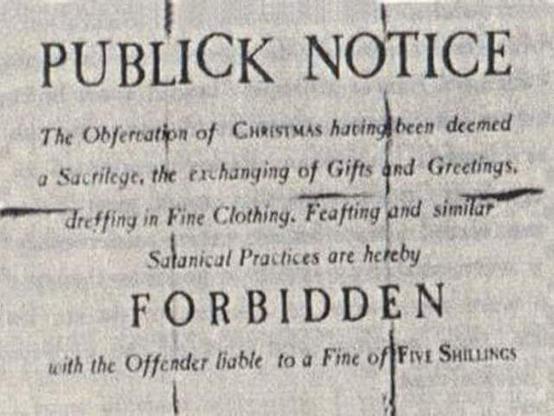
Today when we hear people talk about the so-called war on Christmas, it is a battlecry of Christians who feel they have a monopoly on the winter holidays. A common refrain being Christ is the reason for the season. But in Early America, Christmas was outlawed as a criminal act, or was viewed as having no consequence at all by some of our founding forefathers–especially those of Puritan background.
To understand why this notice even existed, first a bit of a history lesson is necessary.
In colonial America, the Puritanical leaders (for this article I am including the Pilgrims in this group) felt that Christmas was indeed a ‘Pagan’ celebration (as explained by Puritan leadership including the minister Increase Mather of the Massachusetts Colony, such festivities were rooted in the practices of Saturnalia) and the observance of the holiday was heretical and had no part of building the Godly society they had fled Europe to create. In addition to the umbrage they took to those “Satanical” practices, the Puritans were also anti-Christmas because the Bible did not talk about celebrating the nativity, nor being clear on when it was, therefore the Puritans viewed it as not being a part of their religious observation. Their attitude created the original American ‘War on Christmas’, of course they preferred to call Christmas ‘Foolstide’, in part because only the ungodly fools would celebrate such ‘Satanical Practices’, and no doubt as a further scathing reference to the ‘Lord of Misrule’ seen in some Christmas traditions found in parts of Europe, including England.
The very first Christmas in Colonial America at the Plymouth Colony in 1620 went unobserved. In fact there’s an account from 1621 in the colony, that governor William Bradford yelled and chastised people he caught at merriment on Christmas Day. The Puritans in the Massachusetts Bay Colony went one step further and actually outlawed the celebration of Christmas beginning in 1659 and anyone caught celebrating it was monetarily penalized. Christmas Day was so insignificant to our founding forefathers that Congress was in session during Christmas, and on occasion they did actually meet for business: the earliest occurrences being first in 1797 when the House of Representatives met, and 1802 when the Senate also met on Christmas Day. It wasn’t until the 1850s that Congress began to have formal recesses for Christmas.
In Early America it was common to find in parts of the country that people were expected to work or attend school on Christmas Day, many churches didn’t hold any observance on the day at all. In some areas, particularly in parts of New England, Christmas celebrations continued to be criminalized until it became a National holiday in 1870.
I for one, am glad we’ve got our festivities now, and I like today’s growing climate of greater inclusiveness, there are dozens of special religious observances and festivities in this time frame. Tis the season to be merry and bright!
To understand the ‘pagan connections’ (or rather we should say origins) that the Puritans had such criticism about, only takes an exploration of human history and world religions.
In the earliest days of the Christian Church, Pagan Romans were the elite powerhouses of that ancient world, and most Christians numbered among the lowest of the social classes in the empire. So when the Roman Empire celebrated their festivals, the Christians in the Empire got a bit of a break as well.
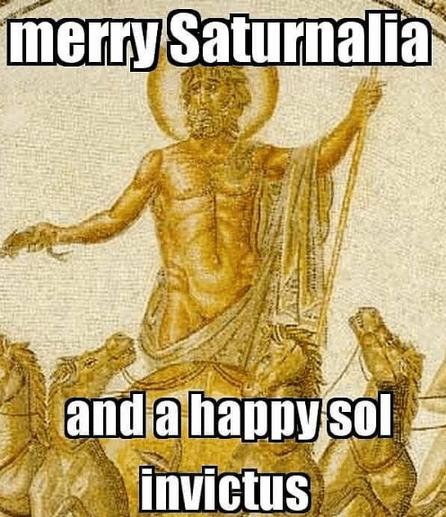
Many Pagan cultures have had various forms of celebrations around this time of year. In Ancient Rome, the celebration of Saturnalia spread in popularity. Saturnalia was a time to eat, drink, and be merry while honoring the Roman God Saturn. Just as Christians might use Merry Christmas as the seasonal greeting, for those ancient Romans the common greeting during the festival was, io Saturnalia. The festival was characterized with a modest type of role reversal where slaves could get a little taste of what it might be like to be at the other end of the social ladder. The one-day festival spread into a multi-day affair lasting for about a week, roughly correlating to our December 17-23 [Gregorian Calendar]. While work was still being carried out, this was a festival that the slaves and servants really loved as they were able to have a break, and their masters got a bit of a glancing lesson about the work the servants did for them. In the revelry gambling occurred, and gifts were given. Most gifts were specially made for the day and were called sigillaria, these were inexpensive gifts, or what we might think of as gag-gifts. We have records that children were given toys during such observances, too. We see from Roman poet Marcus Valerius Martialis vast writings into Saturnalia and gift-giving, he even has some verses that appear to be meant to go with gifts, as like a modern precursor to the greeting card tradition we have today.
Overtime the celebration of Saturnalia appears to have expanded from one day to many, and a tradition develops with the Ruler of Saturnalia (Saturnalicius princeps), which is somewhat analogous to the Lord(s) of Misrule we see develop in other areas around Europe. Tacitus records some details about the practice. We know he was chosen by lottery, those present had to obey, and their might be commands like “sing naked”.
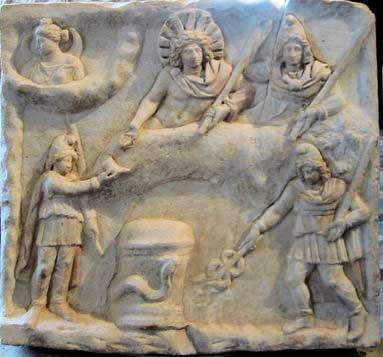
In addition to Saturnalia, there were other festivities as well in polytheistic Rome. Roman Emperor Aurelian declared the 25th of December as the birthdate (or nativity) of Sol Invictus, a sun deity very popular with soldiers. It is so popular that Christians like Augustine were still preaching against the cultic practices against Sol in the 6th century. It should be noted that known records point this as a rather late development compared to the much older practice of Saturnalia. Sol seemingly appears at a banquet in shrines connected with the Mithraic Mysteries, and so some will also connect the date of December 25th to Mithras and his cultic practices as well. What I find fascinating about Mithraism is that it began in Persia, was transported by Alexander the Great’s Greek soldiers, and then was spread even wider by the Roman Empire itself. But how much changed between Persian practices and the cultic practices we see within Rome may be very different, adding to the confusion. While we have a lot of records to Mithraism in the archaeological record, no known writings really describe with clarity the practices, so theories about Mithras related to any celebrations around the winter solstice is much debated in academia.
Favored by Roman Emperor Commodus (161-192 C.E.), Mithraism certainly had widespread influence. Of course, everything changed when Emperor Constantine converted in 313 C.E. and Christianity suddenly went from a marginalized religion of the minority to a mainstream religion. While the tide of destruction that Christianity brought to Pagan practices and temples was briefly halted during the reign of Emperor Julian (who tried to restore polytheistic practices and issued an edict for religious freedom), after his death the machine of destruction continued.
Yet despite early Christianity’s attempts to wipe out the Pagan celebration, the people enjoyed it too much and kept practicing it. While some early Christian leaders (such as Gregory of Nazainzus) fought against the combining of the Pagan practice with Christianity, eventually the church decided that instead of fighting it, it would be smarter to assume power over the festival and slowly Christianize it, leading to the Papal Decree by Pope Julius I in 350 AD formalizing December 25th as the date for Christ’s birth. It should be noted that the various Christian denominations do not have a consensus about the time of Christ’s birth. While some do believe it was in the Winter, other groups do not. For instance, the American Presbyterian Church puts Christ’s birthday sometime in the autumn.
The following comes from an unknown Syrian Writer, colloquially referred to as ‘Scriptor Syrus’, the comment appears in marginalia ,which the 12th Century Syrian Bishop Dionysius Bar-Salibi, quoted. Which in turn was quoted again in Latin by G. S. Assemani in his Bibliotheca orientalis Clementino-Vaticanae (specifically volume 2, p 164).
“The reason, then, why the fathers of the church moved the January 6th celebration [of Epiphany] to December 25th was this, they say: it was the custom of the pagans to celebrate on this same December 25th the birthday of the Sun, and they lit lights then to exalt the day, and invited and admitted the Christians to these rites. When, therefore, the teachers of the church saw that Christians inclined to this custom, figuring out a strategy, they set the celebration of the true Sunrise on this day, and ordered Epiphany to be celebrated on January 6th; and this usage they maintain to the present day along with the lighting of lights.
— translation from Ramsay MacMullen, Christianity and Paganism in the Fourth to Eighth Centuries, Yale (1997), p.155
Thus we see an intentional rebranding of pagan custom into newly forming Christian tradition. Emperor Justinian in 529 AD made it a civic holiday, and then in 567 AD the Council of Tours officially proclaimed Advent a period of fasting for the 12 days from Christmas to the Epiphany, (thus why it’s 12 Days of Christmas, of course many Pagan observances were multi day too). Through the years various Popes instructed various Church leaders to further the rebranding of Paganism into Christian significance, such as when Pope Gregory I sent instructions for Augustine, the First Archbishop of Canterbury (England). While the original letter is lost, the letter was preserved in quotation by Bede:
To his most beloved son, the Abbot Mellitus; Gregory, the servant of the servants of God. We have been much concerned, since the departure of our congregation that is with you, because we have received no account of the success of your journey. When, therefore, Almighty God shall bring you to the most reverend Bishop Augustine, our brother, tell him what I have, upon mature deliberation on the affair of the English, determined upon, viz., that the temples of the idols in that nation ought not to be destroyed; but let the idols that are in them be destroyed; let holy water be made and sprinkled in the said temples, let altars be erected, and relics placed.
For if those temples are well built, it is requisite that they be converted from the worship of devils to the service of the true God; that the nation, seeing that their temples are not destroyed, may remove error from their hearts, and knowing and adoring the true God, may the more familiarly resort to the places to which they have been accustomed. And because they have been used to slaughter many oxen in the sacrifices to devils, some solemnity must be exchanged for them on this account, as that on the day of the dedication, or the nativities of the holy martyrs, whose relics are there deposited, they may build themselves huts of the boughs of trees, about those churches which have been turned to that use from temples, and celebrate the solemnity with religious feasting, and no more offer beasts to the Devil, but kill cattle to the praise of God in their eating, and return thanks to the Giver of all things for their sustenance; to the end that, whilst some gratifications are outwardly permitted them, they may the more easily consent to the inward consolations of the grace of God.
For there is no doubt that it is impossible to efface everything at once from their obdurate minds; because he who endeavours to ascend to the highest place, rises by degrees or steps, and not by leaps. Thus the Lord made Himself known to the people of Israel in Egypt; and yet He allowed them the use of the sacrifices which they were wont to offer to the Devil, in his own worship; so as to command them in his sacrifice to kill beasts, to the end that, changing their hearts, they might lay aside one part of the sacrifice, whilst they retained another; that whilst they offered the same beasts which they were wont to offer, they should offer them to God, and not to idols; and thus they would no longer be the same sacrifices. This it behooves your affection to communicate to our aforesaid brother, that he, being there present, may consider how he is to order all things. God preserve you in safety, most beloved son.
There is ample evidence through the centuries of this institutionalized conspiracy to slowly Christianize the old Pagan ways. With Christianity coming into existence within the confines of the Roman Empire, it’s been only natural that we’ve looked at the interaction between Christianity and Roman polytheism. But as Christianity spread, that also meant it spread into other areas of Europe, such as Northern Europe where entirely different Gods held sway with the populace. We see again that as Christianity comes into contact with those new polytheistic religions it begins to start to force a merging of traditions. King Hakon of Norway, who as a Christian passed a law that the Christian Christmas Day (which was already a weird bastardization of the Christian story of the Nativity and Saturnalia/Mithraic customs) AND the Northern Tradition polytheistic yuletide celebrations were to henceforth be celebrated at the same time. While this only specifically impacted Norway (and its territories), it illustrates an intentional combining of the holy-days into one celebration.
In this case the above church edict from Pope Gregory I is ironically against the dictates found in Biblical passages. Christians should be familiar with prohibitions against Pagan practices. The Bible states:
Hear what the LORD says to you, people of Israel. This is what the LORD says: Do not learn the ways of the nations or be terrified by signs in the heavens, though the nations are terrified by them. For the practices of the peoples are worthless; they cut a tree out of the forest, and a craftsman shapes it with his chisel. They adorn it with silver and gold; they fasten it with hammer and nails so it will not totter. Like a scarecrow in a cucumber field, their idols cannot speak; they must be carried because they cannot walk. Do not fear them; they can do no harm nor can they do any good” (Jer 10:1-5).
One of the biggest hallmarks of Christmas celebrations today is that of Santa Claus, caroling (or wassailing), and the decoration of homes and businesses with evergreens and trees, which specifically come to us from polytheistic cultures found throughout Northern Europe. And I expand upon that in this other article: Yuletide Origins and Traditions – The Santa Claus Mythos.
Eventually, the church did try to crack down on these Christianized Pagan elements. During medieval times they banned gift-giving because of its Pagan origins. But Pope Paul II revived some of the most depraved customs of the ancient Pagan festival and spun them with a Christian anti-semitic tradition. Those traditions were now used to target the Jews who were forced to run naked for Christian entertainment, and to the laughter of the pope. By the time we reach the 18th and 19th centuries, the Roman Catholic Church forced rabbis to wear clownish outfits while they were force-marched as the Catholic crowd pelted them. In 1881, Polish church authorities riled up the masses to anti-semitic riots across the country leading to the racist murders of Jews, as well as other physical and sexual assaults against others. The riots were so severe that property losses in the millions were suffered, but worst of all lives were lost too.
Puritans in particular took great umbrage with the pagan origins of Christmas, and actively begin to revolt against it. Both in England and later in the American colonies they continued to fight against it.
So Puritan Christians for nearly the first hundred years of “American” history combated Christmas. So here’s some food for thought: To those early Puritan leaders, the sheer fact offended Christians are wasting time on rhetoric on the ‘War on Christmas’ today would mean that those modern practitioners are to their way of thinking, ungodly.
Most of the Christmas traditions that exist — gift-giving, the hanging of the evergreens, “Christmas” trees, gift-giving, feasting, Santa, caroling/wassailing — all originated from a variety of polytheistic practices. While I can understand that to some Christians this is a holy time of reflection as they celebrate their Christ, let us remember we were here first. And Christ is not the reason for the season. He’s just a latecomer to the party.
There are numerous religious observances during the ‘holiday’ season: Channukah, Mawlid el-Nabi, Rohatsu, Zarathosht Diso, Kwanzaa, Pancha Ganapati, Solstice, etc. In fact stating ‘Solstice’ is really misleading as it is one umbrella term encompassing dozens upon dozens if not hundreds of unique celebrations worldwide such as the celebrations from various Native American tribes, Aboriginal peoples, as well as Pagan and Polytheistic observances (both the unbroken traditions and the modern reconstructed ones).
So, to the Christians, who do claim that Christ is the reason for the season, I’m not saying you can’t enjoy this time of year for your own religious reasons. Please enjoy your holiday season. But would you do the rest of us the courtesy, and please consider the history and context before you get upset the next time when someone doesn’t wish you a Merry Christmas. If you as a Christian want to wish Merry Christmas, that’s fine, but don’t be surprised when I wish you a Joyful Yule back, or someone else wishes you a Merry Solstice, Happy Chanukah, the politically correct Season’s Greetings, its alternative Happy Holidays, or some other cheery salutation for some other happy festival. But to expect by default you will always be greeted at retail with a Merry Christmas is hubris.