 Wyrd Designs
Exploring Our Gods and Goddesses – Coventina
Often times Heathens focus primarily on Viking Age Scandinavia, followed by Anglo-Saxon England, and more rarely continental Germanic Europe during the Migration Era, and the earlier Iron Age during contact with the Roman Empire. But they tend to overlook Roman occupied England for exploration. Yet there’s a wealth of information to be found that can show insights into who heathens were venerating. There is no such thing as a pure Germanic heathen religion, polytheism allows for deities from other traditions to be syncretized by others. Through war, trade, alliance, slavery, and personal interactions there’s always levels of blending and interaction. As such, to my mind, regardless of the origin of a deity, if they’re worshipped (especially on a documented scale by ancient Germanic heathens), those deities can and should become part of our heathen tradition too. With the understanding that to truly understand any power, learning as much as you can about the mysteries and cosmological nuance the deity had in his or her culture of origin is necessary to understand the deity.
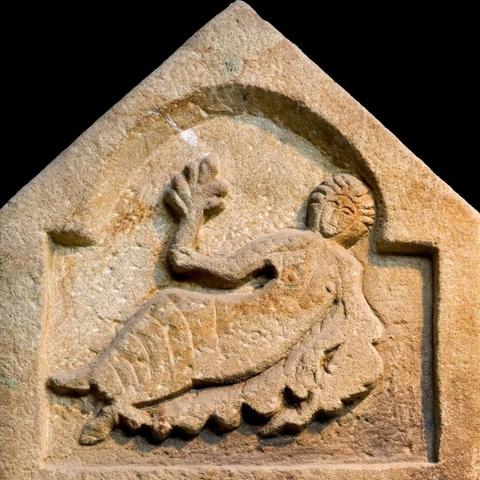
Depiction of the Goddess Coventina upon a votive altar to her. RIB 1534.As part of my explorations into Roman era Britain, we see Germanic worship to Coventina, a local Romano-British Goddess. We know thanks to numerous inscriptions found in the archaeological record that she was worshipped by Roman military auxiliary units from specific Germanic tribes (Batavians, Frisiavones, Cuberni) as attested along Hadrian’s Wall. These were erected by Germanic soldiers serving in the Roman Army. We have other inscriptions to the Goddess that came from individuals, including a couple we know were also Germanic heathens (Maduhus, Crotus). While we only definitively know she was worshipped at Fort Brocolitia there are some other sites that have been theorized to be connected with her too.
Fort Brocolitia
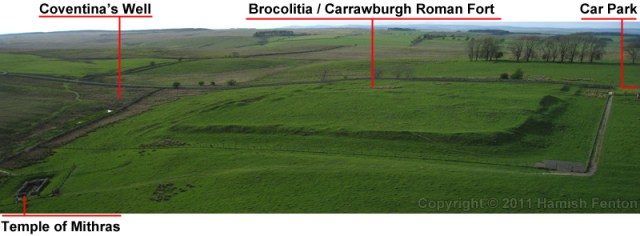
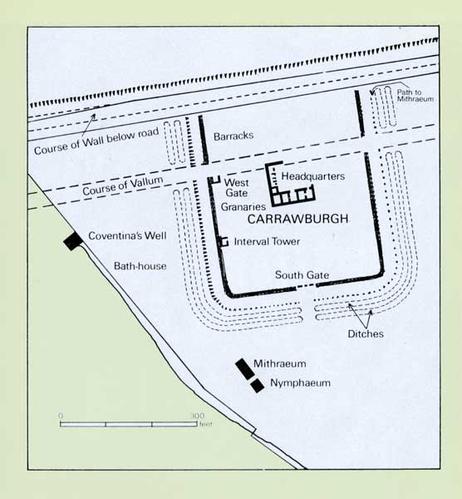
Fort Brocolitia ‘Badger Holes’ (now near Carrawburgh in Northumberland, England) was one of the Roman Empire’s forts along Hadrian’s Wall. The location is found between the major forts of Cilurnum (Chesters) and Vercovicium (Housesteads) on desolate seeming moorland, a bit west of Newcastle-on-the-Tyne.
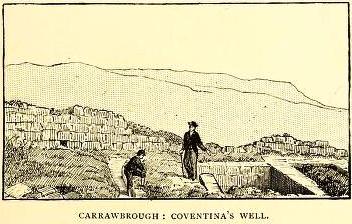
Illustration of 1876 Clayton archaeological excavationWhile there’s been some finds through the years, the key excavation began in 1876 by John Clayton. In addition to the eponymous fort to house military troops, there was also a vicus (small civil settlement), a bath house, and three key sacred sites: a Mithraeum (the best preserved one in all of England, with three altars found erected to Mithras), Coventina’s Sacred Well, and an open air Nymphaeum for local water spirits (including most likely Coventina as she is represented with iconography like a nymph, and some of the votive inscriptions literally address her as a nymph too). Nymphaeums were sanctuaries for water nymphs, and in communities they were often used as a wedding venue.
According to the website Roman Britain: “All three of these temples are associated with a small tributary stream of Meggie’s Dene Burn, which issues from a spring consecrated to Coventina and runs beside the fort past the Mithraeum and the Nymphaeum to the south-west, to empty into the River South Tyne near the Stanegate fort at Newbrough, three miles to the south.”
Here is a photo from 2010 of the site where Coventina’s Well is located, the tall grassy brush shows the boggy area that had developed around it.
Coventina’s Well taken 2010 – from Megalithic UK and user PurpleEmperorSince the above photo was taken in 2010, access to the Well has been improved upon with a stile granting easier access from the Mithraeum to the Well, a path added so visitors can approach the area near the well. Though it remains mostly overgrown and boggy, my understanding is that the well is on private owned land, not public land like the rest of the fort. Meaning English Heritage has not put up signs for the Well like they have elsewhere at the fort. Many a visitor has lost their shoes in the mud, and barb wire was set up along some of the walls around the Well. So take your time if you’re able to visit.
Coventina’s Well taken 2023 – from Megalithic UK and user AntonineWhat you can’t see in these photos is the site layout of the sanctuary for Coventina’s Well.
19th century plan of Coventina’s Well,from Berwickshire Naturalists, via Archive.org
Among the altars to Coventina we also see altars to Minerva in the area (RIB 1542 & 1543), Fortuna (RIB 1536 & 1537), and even a broken depiction of Aesculapius (plus votive dog figures we think were for him). Mercury (who we know was syncretized with Odin as exhibited elsewhere as Mercurius Cimbrianus, Mercurius Hranno) is on an inscription. The Germanic God Vheterus (aka Huiteribus RIB 1549, or Veteris RIB 1548) is mentioned. The Celtic God Belatucader is also represented in a found inscription. He appears to be a Romano-Celtic syncretization with the god Mars, as there are several inscriptions to Mars Belatucadrus found around England. We also see inscriptions to the Matraes, and the genius loci.
At the neighboring Fort Vercovicium (Housesteads) on the wall, we have inscriptions to the Germano-Celtic goddesses the Alaisiagae (comprised of the following Goddesses: Beda, Baudihille, Fimmilena, and Friagabis). Only two are named (Baudihillia and Friagabis) on the inscription (RIB 1576) erected by a Germanic mercenary unit known as Hnaudifridus. Another inscription refers to the Alaisiagae but not specific names for the Goddesses (RIB 1594) erected by Frisian soldiers. There’s also an inscription to Mars Thingso (RIB 1593) naming the Alaisiagae goddesses Beda and Fimmilena. Mars Thingso is believed to be a Romano-Germanic syncretization between the Roman God Mars and Germanic God *Thingaz/Tiwaz/Tyr and the Alaisaige seem to be connected to his cultus. Thingso is a theonym, most likely pointing to the God’s connection over oaths, legal proceedings and justice at Thing assemblies. All along the wall we have numerus inscriptions to the Mothers (MATRIBVS), which echoes similar practices to the more than 1000 documented votive stones erected to the Matronae (analogous to the idis/disir) in the Rhineland by Germanic and Celtic soldiers serving in the Roman Empire. I point these other examples out merely to showcase that there is a great deal of information proving archaeologically Germanic worship of deities in Roman era Britain. This is a wealth of information about Germanic worship between the two neighboring forts of Brocolitia and Vercovicium, less than 5 miles (8 km) apart.
Coventina’s Well
Coventina’s sacred site at Fort Brocolitia was an open air sanctuary, artifacts at the site suggest peak usage between the second and fourth centuries during the Iron Age. Researchers discovered intentional engineering that constructed a walled area (11.6m x 12.2m / 38ft x 40 ft) and in the center of the walled enclosure there is a rectangular basin pool (2.6m x 2.4m / 8.5 ft x 7.9 ft) that collected the spring water (which comes to the surface as a dolerite dyke in the carboniferous limestone connected to Meggie’s Dene Burn). It stands out for being a rare example of a west-facing door/entry at a Romano-Briton temple in Britain. This sacred pool, has been named Coventina’s Well.
Artist rendering of what Coventina’s Sanctuary looked likeBased on how objects were found in the well during the 1876 excavation by Clayton, we believe in the late Roman period (circa 388 CE) the well was sealed, with stones placed over it, and the holy site decommissioned with votive altars and other objects seemingly placed into the Well, added to the earlier votive offering deposits. The “sanctuary” may have been closed possibly due to the implementation of the Theodosian Code which began criminalizing polytheistic religious activity in the Roman Empire. During the Clayton excavations robbers came and took some of the artifacts (especially items like coins or made of metals that could be melted), most of the remaining found artifacts are housed and on display at the nearby museum at Chesters Fort.
For years Coventina’s Well has been a boggy area, the decommissioning of the holy site centuries ago, and later construction made the Roman-era well inaccessible and the area flooded under water, turning the area of land around it into a bog. The vegetation blocks much of the view, most of the site remains bogged today. According to visitor reports there’s wildflowers found around her Well: blue summer wildflowers known as brooklime (Veronica beccabunga) which loves bogs, and yellow wildflowers known as Blood-drop Emlets (formerly known as Mimulus luteus, but re-classified as Erythranthe lutea). This later flower originates from South America, but was introduced to Britain in the 19th Century. Some modern pagans and polytheists use those flowers (or some they find similar in their own areas) in offerings, and as design elements and accents in depictions of her.
At Coventina’s Well this triptych was discovered. In the triptych the depictions here seem to have the female figures holding a cup aloft, and in their other hand holding some sort of vessel with water streaming forth from the vessel. It is not explicitly inscribed with the Goddess Coventina’s name, leading to the theories that all 3 female figures are Coventina (which echoes threefold aspects of some other Celtic deities), or it’s her paired with two handmaidens/nymphs, or all three are nymphs, and thus it may have originally resided at the nearby nymphaeum but was deposited in Coventina’s Well when the religious sites were shut down. The imagery is similar to one of the votive altars (see below, RIB 1534) where we see a female figure understood thanks to an inscription to be the Goddess Coventina rendered in a style similar to nymphs found elsewhere in the Roman world. We also see 3 female figures/nymphs on a frescoe in Kent at the Roman Villa of Lullingstone that may be another site of possible worship to her (more on that further below in the “Coventina’s Cultic Reach” section).
Found Offerings to Coventina
Among the archaeological record we have found what we believe are the cultic offerings to the Goddess. Including brooches in the form of ‘discs, wheels, or solar symbols” scholar G.L. Irby-Massie suggests in his book, Military Religion in Roman Britain:
“these wheels might connect Conventina to the solar wheel god, vanquisher of dark forces, possibly as his consort. The well itself probably linked Conventina to the underworld, a goddess of death, a vanquisher of death. The evidence points to a predominantly military cult: soldiers worshipped the goddess, and wheel votives imply a vanquishing deity.“ G. L. Irby-Massie, Military Religion in Roman Britain
Other deposited offerings appear to be a brooch of a running deer, rings & votive pin jewelry (jet, pearls, silver, gold), beads, over 13,000 coins (copper, silver, gold), ceramic vessels, a bronze mask, bronze heads, figures especially of horses (and occasionally some other animals), shoes, and two head-scratching outliers: a bronze age axe hammer and half a skull (the skull believed deposited after the holy sanctuary was shut down). I recommend reading Albion and Beyond‘s Coventina article, which is a well researched article from Romano-British polytheists including insights to Brittonic belief and cultic praxis with scholarly attributions. Something they point out is that at other sites nearby along Hadrian’s wall we find heads in wells, that in combination of the bronze heads and partial skull found in Coventina’s Well are perhaps related to the ancient Celtic head cult. Thus, the suggestion that Coventina’s cultus may also have ties to the dead, which may explain why the spring opens unusually to the west (the direction of the setting sun has long been generally connected to death).
In the ceramic jar deposited offering shown above with a head, there’s a possibility that is meant to be a depiction of the Goddess Coventina.
Budge & Clayton’s An Account of the Roman Antiquities Preserved in the Museum at Chesters, Northumberland Budge & Clayton’s An Account of the Roman Antiquities Preserved in the Museum at Chesters, NorthumberlandVotive Inscriptions
The inscriptions to Coventina address her as “Sanc[ta]” (Holy, Sacred), “Augusta” (Revered), “Nymphae” (Nymph), “Deae” (Goddesses), and “Matribus” (Mothers). Augusta was most commonly used within the Roman Empire with the Goddesses in the Capitoline Triad, which are Juno and Minerva. The Goddess Fortuna also has some examples of being addressed as such too, and there are some other exceptions. The fact we have the term Augusta used with Coventina, is an unusual outlier of religious tradition (especially in Britain), thus it probably hints at the cultic importance for which she was treated among her worshippers in the area where she had influence. According to scholar Allason-Jones, she is the only Goddess not in the Capitoline Triad addressed as Sancta in all of the extant inscriptions found to date in Britain. The term Matribus would be similar to the Matronae/Idis/Disir of heathen cosmology. The Mothers had a major cultus in the Rhineland which we see especially among Celtic and German troops serving in the Roman military. We’ve discovered more than 1000 votive altars to the “Mothers” in the Rhineland. So Coventina being addressed as such, even if in England and not in the Rhineland, suggests (to me at least) the major cultic prevalence she had, even if only in select locale(s).
Within the Roman Empire, the empire often required those under their dominion to step up and fulfill a military need. They had several auxiliary units from different Germanic tribes serve in cohorts (of around 480 men) for a typical 20 year period. As it relates to the Goddess Coventina, we know that there were definitely Germanic troops from mainland Europe who were shipped across to England, then traveling to their assigned posting, in this case they were stationed at Fort Brocolitia along Hadrian’s Wall, with a cultic site to the Goddess Coventina just outside the fort and an incredibly short walk away.
RIB 1523
DE CONVETI VOT RETVLIT MAVS OPTIO CHO P FRIXIAV
“to the goddess Convetina. Mausaeus, optio of the First Cohort of the Frixiavones, paid his vow“ [RIB 1523]
This would be the Germanic tribe we know of as the Frisiavones who we first encounter along the Gallia Belgica border in what we’d consider as southern areas of the Netherlands today. Roman sources talk about two similarly named tribes the Frisiavones and the Frisii, the later tribe known as the Frisians are more likely derived from the Frisii, but it’s a bit unclear.
Another altar stone made from sandstone has both an inscription and one of the most likely depictions of the Goddess Coventina. Here she is depicted reclining on a stream bank or perhaps a plant (like a water lily leaf, or oak leaf). Some look at the wildflowers that grows at her sacred site and may have been interpreted into a representation carved in the votive altar (as suggested by R. S. O.Tomlin in Britannia Romana Roman inscriptions and Roman Britain).
DEAE COV{V}ENTINAE /T D COSCONIA /NVS PR COH /I BAT L M
“To the Goddess Coventina, Titus D[unclear, possibly Domitius] Cosconianus, Prefectus of the First Cohort of Batavians, freely and deservedly (dedicated this stone).” [RIB 1534]
There’s another Batavian inscription that has been found elsewhere nearby:
COVVEN[ ̣ ̣ ̣] AELIVS TE[ ̣] TIVS P[ ̣ ̣ ̣] COH I BAT V S L M
“To Coventina Aelius Tertius, prefect of the First Cohort of Batavians, willingly and deservedly fulfilled his vow.” [RIB 1535]
The Batavi are a Germanic tribe traditionally fond among the Dutch Rhine delta. Tacitus tells us the tribe were accomplished horseman and swimmers, a skill that Dio Cassius tells us was used during the Battle of the River Medway in 43 CE. I speculate, if they had such skill with swimming, that they may have had a special affinity for divinities tied to water, such as Coventina. We also have votive inscriptions from them (RIB 1544 & RIB 1545) proving they venerated Mithras while stationed at the fort, too.
Another inscription to the Goddess follows:
RIB 1524DEAE COVENTINE COH I CVBERNORVM AVR CAMP ESTER V P L Ạ
“To the goddess Coventina for the First Cohort of Cubernians Aurelius Campester joyously set up his votive offering.” [RIB 1524]
The Cuberni (or Cugerni) were a Germanic tribe that lived near Xanten (in modern eastern Germany), the tribe’s descendants most likely ended up among the Franks.
There are other inscriptions at the fort that show us what military units were present, we see other Germanic, Gallo-Germanic, or Gallic units represented in various inscriptions found around the area of the fort. Some of the inscriptions were funerary, some on votive altars, some of the inscriptions were about building or construction. While they do not specifically and definitively connect Coventina and these other tribal troops, (i.e. there’s no inscription connecting the goddess and tribe in the same item beside the afore mentioned inscriptions quoted above). The fact these other tribes are present, makes it likely those other Germanic troops troops from Tungrorum (Germania Inferior or what we think of as east Belgium and the south east Netherlands), the Germanic tribe of the Nervi from Northern Gaul, etc. probably also venerated Coventina while they were there.
As an aside, the Tungrians (one thousand strong) erected a votive stone (RIB 1580) to Hercules (who was syncretized with Donar/Thor) at the neighboring Fort Vercovicium. They also dedicated an inscription to Mars (RIB 1591), the site also had an inscription to Mars Thingsus (RIB 1593), who is believed to be a Romano-Germanic syncretization of Mars and *Thingsaz/Tiwaz/Tyr.
We also have an inscription to the Goddess we think comes from the Cohors Quintae Raetorum.
RIB 1529DEAE COVENTINE P[…]ANVS ML CHO [.] [.] TTOIN […] [.] VOTVM […] BES ANIMO R ET POSIVIT
“To the goddess Coventina P[…]anus, soldier of the … Cohort, willingly paid his vow and set this up.” [RIB 1529]
This inscription is theorized to originate from an individual in an unit of Alpine soldiers from Raetia (areas that link to modern Austria, and eastern areas of Switzerland). The origins of the tribe are a bit unclear, but by the time they came into contact with Rome they are generally believed to have been Celtic. But there may have been some Germano-Celtic syncretization prior to Roman contact.
RIB 1538GENIO HVVS LO CI TEXAND ET SVVE VEX COHOR II NERVIOR VM
“To the Genius of this place the Texandri and Suvevae (?), members of a detachment from the Second Cohort of Nervians, (set this up).” [RIB 1538]
The Texandri were a Germanic people from between the Scheldt and Rhine rivers, which makes sense that they’re with the Nervii who came from Northern Gaul (areas in modern times we associate with Central and Eastern Belgium and North France). Tacitus and Strabo both describe the Nervians as being of Germanic descent. Suvevae must also be a tribal group, likely Germanic, and I can’t help but wonder if it’s supposed to be the Suebi. While this inscription wasn’t specifically to Coventina, it was on an altar dedicated to the Genius Loci, which may have meant her at that site.
D M D TRANQVIL A SEVERA PRO SE ET SVI S V S L M
“To the Goddess Mother of the Gods. Tranquila Severa for herself and her family willingly and deservedly fulfilled her vow.” [RIB 1539]
We don’t know if this was specifically meant for Coventina. Since it lacks her name, it could be meant for a Goddess like Cybele/Magna Mater, or point to something more Brittonic, or perhaps it was for Coventina and thus it may be a hint to an important role she held cosmologically. We have more generalized votive inscriptions for the Mothers (Matribvs, Matraes) found at the site too, such as:
MATRIBVS ALBINIVS QVART MIL D
“To the Mother Goddesses. Albinius Quartus, a soldier, dedicated this.” [RIB 1540]
MATRIBVS COM MVN [ ̣ ̣ ̣]
“To the Mother Goddesses everywhere abiding … ” [RIB 1541]
The Germanic Individuals With Worship To Coventina
In addition to inscriptions representative of Germanic auxiliary units in the Roman Army, we also have examples of named, individual Germanic heathens who are venerating Coventina: Maduhus, and Aurelius Crotus/Crotus. Maduhus is a self professed family man. In my mind’s eye I see a father carrying a child on their shoulders. It’s amazing sometimes how one word of description can bring a person to life beyond words to read. We have multiple inscriptions to Coventina from what appears to be the same German man, Crotus. It’s possible that we have a case of two soldiers with the same/similar name Aurelius Crotus and Crotus, but there’s also the chance that it shows repeat veneration by a Germanic heathen. We don’t know what the vows detailed, for any of these inscriptions, and yet it’s clear the Goddess was entreated and relied upon.
RIB 1526DEAE NIMFAE COVENTINE MADVHVS GERMPOS PRO SE ET SV V S L M
“To the goddess-nymph Coventina. Maduhus, a German, set this up for himself and his family, willingly and deservedly fulfilling his vow.” [RIB 1526]
DIE COVENTINE AVRELIVS CROTVS GERMAN
“To the goddess Coventina, Aurelius Crotus, a German, (fulfilled his vow).” [RIB 1525]
DEAE COVETINE CROTVS VT LBES S[.]LVI PRO M SA
“To the goddess Covetina I, Crotus, willingly fulfilled my vow for my welfare.” [RIB 1532]
Other Individuals With Worship To Coventina
DEAE SANC COVONTINE VINCENTIVS PRO SALVTE SVA V L L M D
“To the holy goddess Covontina, Vincentius for his own welfare as a vow gladly, willingly, and deservedly dedicated this.” [RIB 1533]
[ ̣ ̣]MPHAE COVENTINAE [ ̣ ̣ ̣]TIANVS DEC[ ̣]RI [ ̣ ̣ ̣] SLE[ ̣]V [ ̣ ̣ ̣] M
“To the Nymph Coventina …]tianus, decurion, … deservedly [fulfilled his vow].” [RIB 1527]
DEAE CONVENTINAE BELLICVS V S L M P
“To the goddess Conventina, Bellicus set this up, willingly and deservedly fulfilling his vow.” [RIB 1522]
In addition to several votive altars and inscriptions to the Goddess, we have also found two ceramic thuribles or incense burners (RIB 1530 & 1531). Thurible 1530 merely bears the name of the maker: Saturninus Gabinius. Who we see made the other thurible 1531 too.
COVETINA AGVSTA VOTV MANIBVS SVISSATVRNINVS FECIT GABINIVS
“For Covetina Augusta, Saturninus Gabinius made this votive offering with his own hands.” (RIB 1531)
Of particular note in this inscription is the fact Coventina is addressed as Augusta. A title usually not given to non-major Roman Goddesses. According to scholar Allason-Jones, she is the only Goddess not part of the Capitoline Triad (Juno, Minerva) addressed as either Augusta (RIB 1531), or Sancta (RIB 1533) in all of the inscriptions found to date in Britain.
Coventina’s Cultic Reach
The only definitively, 100% certain area we know had a cultus to the Goddess Coventina is at her sacred sanctuary at Fort Brocolitia along Hadrian’s Wall. However there is some suggestive speculation of multiple other possible areas with cultic importance to her: some from Britain, and others from mainland Europe.
Of particular interest in England as a potential secondary cultic site to Coventina is Vagniacis (or Springhead), near Dartford, Kent. The website Roman Britain provides context for the site:
At the heart of Springhead, at the head of the River Ebbsfleet, was a pool fed by eight natural springs, an unusually large number that made the site sacred to the Celts, who began settling there around 100BC. They called the site Vagniacis (‘the place of marshes’). Excavation revealed a 600-metre ceremonial way, sacred pits filled with animal remains and pots, as well as numerous coins.
Vagniacis Layout near KentOf particular interest is the similar layout from Fort Brocolitia’s sacred pool dedicated to the Goddess Coventina with Vagniacis‘ sacred pool at Temple Number Three. The Roman Britain website details the complex:
This rectangular structure with 3 ft. thick flint walls measures 29 ft. by 19 ft. 4 ins. across the outer edges and lies within the temenos just north of Temple#1. The construction date suggested by sealed pottery is sometime around 150-60AD. It is thought that this structure did not constitute a temple as such, but was perhaps a sacred pool. Thousands of pottery sherds including Antonine ‘samian’, 2nd-century Castor ware and early-3rd century coarse ware found scattered about the clay floor of the structure are thought to have been votive in nature.
Approximately 6.8 miles (11km) away from Vagniacis is the Roman villa of Lullingstone. The villa was built where it faced the river to the east, and may have been used as a palace for Governors. it is suspected that the busts of governors Pertinax, and Publius Helvius Successus were found at the site. The basement of the villa appears to have been originally used as a pagan shrine, whose layout and external access is suggestive of those outside the family having access to the cult space. It also contains a frescoe that may just hint about who was venerated there.
The frescoe appears to be of a trio of nymphs (evocatively similar to the stone carved votive stone with a trio of nymphs found at Coventina’s Well), one of them standing prominently (one mostly obscured due to damage, the other visible but damaged as well. Below we see the badly deteriorated original frescoe, paired with an oil painting recreation by A. J. Rook. Her head has what looks like some sort of plant behind her, perhaps (if it is a depiction of Coventina) it’s meant to evoke the plant she holds upright from the stone carving on her altar at Brocolitia, maybe one of the native wildflowers that grow by her waters. Plants can after all be a guide in nature to help people find water.
In the 4th century we see part of the space transition into being a Christian Chapel or home church, one of the earliest known in Britain. We see Christian paintings added, and early Christian symbols like the chi-rho monogram (☧).
Outside of the aforementioned sites in England (the undisputed site of veneration near Fort Brocolitia, and the possible cultic site near Kent), there’s some other interesting tidbits of information that may hint at her elsewhere within England & Scotland.
There’s some other hints in etymology of place names and local English folklore. There’s some speculation that her name may be connected to the place name of Coventry (a district within the area known as Coundon). Today the Sherbourne river runs through Coventry, but the older name for the body of water, was the Cune. The word couan, means “where the waters meet”, and may be a root connecting places with the documented Goddess Coventina of waters. There’s even speculation that the last part of the Goddess’ name may tie to the Tyne river too. We also have an interesting local legend:
“One local legend states that the Roman general Agricola stopped here, built an encampment on Barr’s Hill and named the nearby settlement Coventina. The interest of this legend lies in the fact that Coventina, a Celtic Romano water goddess, was virtually unknown in this country until her only shrine was discovered at Carrawburgh in Yorkshire in the 1890s. Coventina, being a water goddess, would have been at home in Coventry with its rivers, pools and springs: she was depicted naked or half naked holding a plant and pouring water from a jug or urn. An ancient coin-like object was discovered near the Priory Mill in New Buildings in the last century. This had on one side, a woman pouring water from a jug, and on the other a naked woman with a flower at her feet. It is possible that this has some connection with the legend.” David McGrory, Coventry History and Guide (1993).
According to tehomet.net, the preceding image is an oak wood carving homed in the collection at the Banff Museum in Scotland. The carved icon is believe to have once resided at Banff Monastery (1321-1559), and as such it predates the arson that destroyed the monastery in flames in 1559. There’s been some speculation it may be a representation of Coventina, but Nymph iconography and well or spring Goddesses exist beyond merely Coventina, so while it may be her, it could just as easily be another deity. Both among the Celts and Germans (and yes the Romans as well), there are many Goddesses who were often tied to water, especially at sacred wells and springs. Sulis was the Goddess tied to Aquae Sulis (or Bath, England), she was worshipped as the syncretized deity Sulis Minerva. We found a statuary depiction of Minerva in the deposits at Coventina’s Well, as well as two votive altars (RIB 1542 & 1543). Minerva had a water worship connection in Romano-Briton England, so seeing her present at Coventina’s Well isn’t surprising. Elsewhere we see Belisama through interpretatio romano tied to the Goddess Minerva. We also see the goddess Arnemetia (Arnomecta) worshipped at Aquae Arnemetiae, another town known for their baths. But while I’m not saying the above carved depiction is Sulis, Coventina, Arnemetia, or some other water related deity like Belisama, Ancasta, etc., I’m just pointing out the fact that we shouldn’t jump to conclusions about the female figure’s identity in the carving. I will say that it looks like she’s holding a vessel and perhaps some sort of plant. If so, that does seem somewhat familiar to the reclined carving on Coventina’s inscribed votive altar. Enough so, I can’t dismiss the possibility entirely either.
If we hop over the English channel and look to mainland Europe we do have 3 different sites around parts of historic Galicia where we might have votive inscriptions to Goddesses, theonyms we believe are a different variation of her name. The comparative study between the Galician and British inscriptions was established by S. Lambrino in La déesse Coventina de Parga (Galice)+ Revista de la Facultad de Letras and systematized by J. M. Blázquez in Religiones primitivas de Hispania (for anyone wanting to explore that more). When it comes to possible mentions to Coventina in Spain, we look to the book Inscriptions romaines de la province de Lugo (from Arias, F./Le Roux, P./Tranoy, A). According to the book we know that a granite altar was found in 1918 in a field in Os Curveiros near the Guitiriz spa, with the inscription: “Cohve/tene / er(—) n(—)” (IRL n157) and in the same provincial region of Lugo, Spain in 1929 at a vineyard in Santa Cruz de Loio there’s another granite altar bearing an inscription that was found: “Cuhve(tenae) / Berral/ogecu / ex voting / Flavius / Valeria/n[us]” (IRL n158). Both examples are now housed in the regional Lugo Museum. The speculation is that the theonyms of Cohvetene and Cuhvetenae, are Coventina.
There’s another theorized veneration to her mentioned in Ralph Häussler’s book, La religion en Bretagne . We think the theonym Convertina inscribed by the Celtic people of Narbo (now Narbonne) in southern France is another variant name for the water goddess Coventina of Fort Brocolitia.
Musings on Coventina
There is no doubt that Coventina is a Goddess of water, specifically fresh spring water. Springs would seem to ancient humans to be miracles bubbling up with life giving waters in a landscape for flora, fauna, and humanity. As such she is a Goddess of life as well. A Goddess of fresh spring water would also be tied to some extent to both agriculture as well as tied to civilization, because you would never think to cultivate even a small area for farmland, or build a home or community in an area lacking fresh water.
Albion and Beyond’s article summarizes the research on possible etymological explorations that tease at more than a place where waters meet, but also mercantilism. Their article also explores possible theorized connections with death beliefs. As I am not an expert on Celtic beliefs, I’d rather let the owners of the site, who are Brittonic and Romano-British polytheists speak to that. The authors of the site wrote of Coventina, “Mythically, Coventina may have welcomed souls within Her watery domain and transported them or held them until they were ready for their journey west. Perhaps Coventina looks through her west-facing door, out to the isle of the dead and defeats death; just as the sun setting in the west is swallowed by the ocean, Coventina may have been seen to swallow the dead and allowed them to be reborn from Her watery depths.” So, I highly recommend you hop to that article to read more.
If we look to the petroglyphs from the Nordic Bronze Age at places like Tanum in Sweden. Academic researcher and curator at the National Museum of Denmark, Flemming Kaul notes that many of the solar boat imagery in the boats (representative of an actual boat believed to have been part of a votive offering of weapons, tools, a sacrificed horse and more found in the bog at Hjortspring Mose), shows travel to the west interpreting it as the day, in the same way as we see the sun moves from east to west on the southern sky. The opposite movement is night. We can take that further and theorize that the left to right journey represents life from birth through death.
Flemming Kaul has shown (1998; 2004) a convincing path to an evidence-based interpretation of the Bronze Age iconography of southern Scandinavia. In short, he has discovered how circle motifs on bronze razors in more than 50 instances appear in combination with ships sailing in a specific direction, towards the right, while they are never seen together with ships sailing towards the left – except in one case where both a ship sailing right and one sailing left are present (Kaul 2004, 242; Kaul 2020). Through this observation, and by including the Trundholm chariot, whose golden side is similarly visible when it is moving towards the right, he puts forward a direction-based thesis that offers to explain the Bronze Age people’s conception of the sun’s daily movement across the sky (ibid.) (fig. 2). The strength of this interpretation is that it goes beyond mental connections and gut-feelings, as the statistical testimony of the motifs on the razors, and the corresponding logic of the Trundholm chariot, serve as a foundation for Kaul’s reasoning. — Mikkel Christian Dam Hansen’s Interpreting a Bronze Age motif – Revisiting the hand signs of southern Scandinavia
Thinking of the offerings found in Coventina’s Well, the sheer number of coins evokes the concept we have today of tossing a coin into a wishing well. A practice I suspect is based off of when people used to gift coins in offering, like the more than 13,000 coins found in Coventina’s Well. In 2022 The Bavarian town of Germering announced they had found a 3,000 year old Bronze Age “Wunschbrunnen” (Wishing Well) full of cult relics no doubt deposited in ritual offering. Included in it were ceramic vessels (bowls, cups, pots, i.e. items that could hold water), jewelry (amber beads, metal bracelets, cloak pins), animal tooth, wooden scoop, metal spirals, etc. Despite the distance between the sites and difference in time between the sites there are some similarities in the act and types of the offering deposits.
While I think it’s fairly clear Coventina is ultimately a Celtic Goddess, confirmed to be clearly part of Romano-Briton polytheism, the fact that we have so much confirmed veneration among Germanic tribal members as well, means that there had been some level of syncretization, and she should be considered as a Goddess beloved by some of those heathens who had been exposed to her. Based on the typical numbers for cohorts of German auxiliary units in the Roman Empire (approximately 480 in each cohort) and the 4 stone inscriptions informing us certain German cohort units had venerated her with a votive inscription, tells me we have a minimum of around 1,920 German soldiers clearly represented as being part of cultic acts to her. In all likelihood that number is probably over the centuries when the fort was active, representative of well over many thousands of German soldiers who probably had some praxis to her.
I am left wondering if maybe the Germanic cohorts saw her similarly to Nerthus. Nerthus is a Germanic Goddess attested in Tacitus’ Germania, who when talking about the Germanic tribes of the Reudingi, Aviones, Anglii, Varini, Eudoses, Suarini and Nuitones, describes them as being distinguished by their:
…common worship of Nerthus, that is, Mother Earth, and believes that she intervenes in human affairs and rides through their peoples. There is a sacred grove on an island in the Ocean, in which there is a consecrated chariot, draped with cloth, where the priest alone may touch. He perceives the presence of the goddess in the innermost shrine and with great reverence escorts her in her chariot, which is drawn by female cattle. There are days of rejoicing then and the countryside celebrates the festival, wherever she designs to visit and to accept hospitality. No one goes to war, no one takes up arms, all objects of iron are locked away, then and only then do they experience peace and quiet, only then do they prize them, until the goddess has had her fill of human society and the priest brings her back to her temple. Afterwards the chariot, the cloth, and, if one may believe it, the deity herself are washed in a hidden lake. The slaves who perform this office are immediately swallowed up in the same lake. Hence arises dread of the mysterious, and piety, which keeps them ignorant of what only those about to perish may see.
— A. R. Birley translation of Tacitus’ Germania
We don’t know if the other Germanic tribes venerated her or not. So we can’t directly link them to any tribal member we know who was at Fort Brocolitia. But holy processionals weren’t limited to just Nerthus, we also have late textual evidence in Flateyjarbok of processional wagons used in connection to other deities, like the Gods Freyr and Lytir. Ögmundar þáttr dytts (found within Óláfs saga Tryggvasonar en mesta) also tells us of a wagon processional where a priestess accompanied an idol of Freyr in a wagon. In the Vita Karoli Magni, we’re told that the Merovingian King Childeric III, every year went in an oxen drawn two wheeled wagon to the public assembly.
If we look back to the Nordic Bronze age there’s a number of wagon artifacts that have been found, such as the Trundholm Sun Chariot that depicts a horse drawn wagon carrying the sun, and ritual wagons. Denmark’s National Museum has a website with some information on the wagons, and includes examples on display in their museum in Copenhagen, such as the Dejbjerg wagons which were bogged in offering. There was also another recent discovery in the Karanovo grave find. There’s several such examples that have been found across the archaeological record in what we’d think of today as modern Denmark and Germany. These were not simple wagons, but rather were heavily ornamented, oftentimes with metal worked figures in iron or bronze. They were clearly special, and not a sort of everyday type of wagon. Lots of wagon wheels have been found in bogs even when the rest of the wagon is long since dissolved, and others were also included as part of the grave goods for important figures.
So could the solar themed brooches, sometimes represented in the way wagon wheels look on artifacts, point to a similar connection by the Germans and their love of Nerthus with this different Goddess? A sacred concept tying water to the cycle of life and death? Or did they see connections with other Goddesses? We see other watery connections among Germanic Goddesses in the lore. In Grímnismál, with Sökkvabekkr believed to mean sunken bank (possibly also alluded to as nes Ságu (or Saga’s Headland as referenced in Helgakviða Hundingsbana I), a place where cool waves flow, where Odin drinks with the Goddess Sága. We also see the Goddess Frigg connected with wetlands, as her dwelling is in Fensalir (sources: Völuspá & Gylfaginning), or Fen Hall. A fen is a marshy or boggy wetland with a peat ecosystem, sometimes also called a mire. In Heathen cosmology one of the most significant bodies of water (referenced in Völuspá, & Hávamál) is Urðarbrunnr, where the Norns (Urðr, Verðandi, and Skuld) reside, the waters nourish the world tree Yggdrasil.
Trundholm Sun Chariot Golden SideTrundholm Sun Chariot Dark Side
Aldhouse-Green suggests that Coventina and the west opening of her sanctuary (towards the direction of death) may have connections to death in the Goddess’ role and function, especially with the wheel symbolism in some of the votive offerings. Perhaps she transported the dead. I’m reminded of how in depictions of religious processionals, the Nordic Bronze Age objects like the solar wheeled Trundholm Sun Chariot (1400 BC) and Kivik’s King Grave petroglyphs both are theorized to represent death beliefs. On the Kivik’s King Grave we have petroglyphs that look like two omega Ω symbols turned on their sides, with the opening facing west like Coventina’s Well unusually faced west.
In the archaeological record we have the Nordic Bronze Age item, we’ve called the Trundholm Sun Chariot, which was found in Odsherred (Denmark), alongside other offerings in a bog. The chariot’s wheels are solar crosses, which we find across the archaeological record (on some of the stones on the Kivik’s King Grave, on solar crosses found near Zurich, the Balkåkra Ritual Object (and the nearly identical counterpart the Hasfalva Disc), petroglyphs from Tanum in Sweden, and so many more). The item depicts a Sun in a horse drawn chariot. One side was clearly enhanced with gold adornments and gildings, and the other side was kept intentionally dark. Both sides feature swirls as a design element. Archaeologist Klavs Randsborg presents a theory that it represents an astronomical calendar of synodic months (as published in his article “SPIRALS! Calendars in the Bronze Age in Denmark” in the Adoranten journal).
There are different theories for the dual sided nature of the sun disc from the Trundholm Sun Chariot. One theory is the dark side represents a connection to the underworld. Another is that the dark side represents night, especially considering we have lore that the moon was also pulled in a horse-drawn chariot, or perhaps the dual nature of the sun disc is a division of the year into two seasons: summer and winter. Randsborg’s theory looks at the swirls as representative of a synodic calendar splits the sun disc sides into day and night. “The reference is to the Sun-calendar on the day-side, and to the Moon-calendar on the night-side of the Sun Chariot, which seems the perfect calculation.”
The story of Sunna driving a horse drawn chariot with the sun, appears to derive from the major solar Nordic Bronze Age cultus. I mention this because I could see how a Germanic heathen at Hadrian’s Wall might see some similarities with solar symbolism and life/death cycles to what already would be familiar to them. If we look to the petroglyphs from Tanum (Sweden) we see what appears to be a life/death cycle in boats during the Bronze Age (this may explain the origins of later boat burials, or graves outlined with stones in a boat shape we see later on in Scandinavia.
Wagons appear often in Norse myths (the Norse, being derived from Northern Germanic tribes). Thor travels in a wagon drawn by a pair of goats, Freyr has a boar pulled cart, Freya has a cart pulled by cats, Njord in the Codex Regius is called the God of the Wagon (vagna guð). One of the sacred symbols of Indo-European cultures is the swastika (understood to be a solar symbol, like a solar cross wheel). How does one symbol seemingly appear over so many cultures in the Northern Hemisphere? Well one theory posited is that it may have simply come from observation of the stars in the Northern Hemisphere. The North Star or Pole Star, also known as Polaris is visible year round from anywhere on earth North of the equator (assuming clear skies). The star (or the constellation it’s part of Ursa Minor) has been a key component for navigation by land and sea for multiple millennia. Near Polaris is the constellation of Ursa Major, written about by Ptolemy in 2nd Century CE. It’s main seven stars comprise what we call the Big Dipper today, and in other cultures was called the Plough, The Great Chariot, The Seven Seers (from the Hindu Sapta Rishi Mandal). As an aside, think of the Trundholm Sun Chariot and those solar cross wheels and now think of the name of some of these constellations: Chariot and Wagons have been found with solar cross wheels.
Like most cultures, the Germanic Tribes had their own star lore. One of the major constellations was the Wagon. We’re not precisely certain what stars it refers to, but the widely accepted supposition is it ties to the Big Dipper stars and thus the swastika symbol. Sometimes it’s called Thor’s wagon, but it is also called Odin’s Wagon in the Sigrdrífumál (Reið Rôgnis or Rognir’s Wagon, Rognir is a heiti for Odin), and Odin’s Wagon is referenced in kennings plus later recorded folklore. (To learn more on Germanic star lore, check out Eysteinn’s Lexicon of Kennings Analytical Glossary, Grimm’s Teutonic Mythology, as well as Cleasby & Vígfusson’s An Icelandic-English Dictionary).
Ancient peoples were definitely aware of our night sky. Elsewhere from areas in the Nordic Bronze Age, such as from archaeological finds from Bornholm (Denmark) we even find the star constellation of the Big Dipper (Ursa Major) rendered via carved cup marks inside the chamber of the passage grave Jættedal, and we find Orion rendered at Madsebakke (also on Bornholm).
Seasonal rotation of Ursa Major around PolarisThe constellation of Ursa Major when viewed in the Northern Hemisphere seemingly throughout the course of the year rotates around the pole star (or the North Star known as Polaris). The sense of this rotation is like a pinwheel being blown slowly over the course of a year. Ursa Minor in it’s dipper like appearance similarly rotates around that center pole. So the swastika symbol as it appears globally is believed to derive from Ursa Major (Big Dipper) or possibly Ursa Minor (the Little Dipper).
Interpretation of the swastika symbol deriving from the Wagon Constellation, in conjunction with the Trundholm Sun Chariots (and its dual sides: one golden, one dark) gives us a concept of cyclical return and perhaps life and death. The sun sets in the west, but come morning it has returned to rise in the east. Celtic cultures and Germanic cultures both derive from Bronze Age sun cultuses. For Britons, living on an island, where both the west, and east is over water, might there be a concept of water tied to memory? Of keeping the souls till they moved on? In Germanic belief we have Mimir’s well (the well of memory and wisdom), Urd’s well (the well of life, as it waters the World Tree), and death’s well (rooted to the realm for the dead), all three wells rooted to the world tree and the 9 worlds of Heathen cosmology.
The story of Mimir’s Well is one of sacrifice for wisdom. Odin gives his eye to the well, and now those who drink from the well (including Mimr and Odin) are said to imbibe wisdom. During the Aesir (gods like Odin, Thor, Frigg) war with the Vanir (gods like Freyr, Freya, Njord), Mimir is beheaded. This results in Odin using ‘charms and herbs’ to prevent rot of the head, enabling Odin to carry Mimir’s head around to talk with Mimir for counsel. It is said that after being beheaded, Mimir now has the ability to divulge wisdom from other worlds. Mentions to aspects of this story can be found primarily in the Poetic Edda, and Heimskringla. So here in Germanic belief we have a God of Wisdom and Memory who has a well, and is beheaded. Might that have echoes of the Celtic head cult?
Sun Chariot & Boat Petroglyph from Bohuslän, ÖstergötlandWe actually have a petroglyph from Bohuslän, Östergötland (Sweden) that combines solar wagon with solar ship imagery. We think the Germanic Migration Era & Viking Age tradition of boat shaped graves, and actual boat graves derives in part from Bronze Age life and death beliefs combining solar boats and solar chariots with life and death beliefs. Drunertos from Albion and Beyond mentions an article on death beliefs (and boats) for Gaulish and Proto-Germanic peoples at Jonas Jacobson’s article on the afterlife.
So in the Germanic areas, water and sun has long been tied. The famous Oseburg Ship Burial has a tapestry showing a religious, possibly funerary processional (which may echo some content from Kivik’s King Grave) with wagons, but found within a boat.
Not only do myths tell us that horses pulled the sun chariot, but In the Germanic tradition, and seen also among the Scandinavian sources horses were incredibly sacred. Tacitus’ Germania describes them as being milk-white–and similar to the sanctuary we see centuries later at Thrandheim–the equines were housed in sacred groves where they were never used for the purposes of riding or working the land. Horses in Germania were described as being more sacredly close to the Gods then even their priests; somehow these horses were in the Gods’ confidence. For this reason horses were used to divine the will of the Gods. They were yoked to a special sort of chariot and their behavior observed. In the neighboring Slav culture we also see horses used in divination as well (but via a different method). We have even older evidence of an active cultic presence connected with horses in even the Bronze Age, and we see in the law codes in Europe (ex: Gragas) during the period of Christian conversion that the eating of horse-flesh was forbidden because it had ties to heathen religious tradition. We see in the Historia ecclesiasstica Islandiæ that Christian priests were forbidden from attending horse-fights as well (most likely for a similar reasoning). Horses had not only a divine connection, but also have a role in the agricultural cycle as well. In Norse Myth horses also pull the chariots that draw not only the Sun, but the Moon as well through the sky.
So from a perspective of Germanic belief and the preceding Bronze Age culture(s) we see ties of horses, solar cultus with wagon, boats, water, life and death. Celtic and Germanic peoples long had interaction. So might some of the Bronze Age solar cultus and Germanic belief be echoed in sweet ripples of reverberation at the Brythonic Coventina’s Well? (at least in part with the well water having received solar iconography offerings, as well as horse figure offerings)? I think this is grounds for food for thought, but something I’d like to see a perspective from a Celtic/Brythonic polytheist familiar with their cosmological world view and beliefs.
Modern Devotions to Coventina
On the off chance some sites I’ve linked to disappear in the future, I wanted to encapsulate some modern poems and prayers created by today’s pagans and polytheists who venerate the Goddess Coventina, they follow with attribution in quotation below.
From Albion & Beyond:
Rise O Western Queen,
Accompanied by your enduring attendants,
And yourself.
Pour out wisdom from your cups,
Break the drought we suffer under,
Let us taste the sweet streams,
And be divinely supplied.
We raise our cups to your Western Throne!
We pour out praise from our mouths,
Having tasted the sweet streams,
Our praise is divinely supplied.
You have given so that we may give.
Praise to you, Coventina, three and one,
Western Queen and source of wisdom.
From Greg Hill:
For Coventina
Who brings us otherworld water
Budding through earth and stone
Into our world of dry words:
Liquid whispers of something deeper.
From Order of the White Moon, here is a modern pagan mini ritual written by Tranquility Fearn:
Needed:
Body of water such as fountain or even a bowl of water.
Coin
Cast your circle as you would normal do. Surround yourself with a protective circle of light. Feel the calm peace and protection of the circle. Close your eyes and picture yourself walking down to river where Coventina’s Shrine is. You are carrying your offering to Coventina. There is something you wish to ask of Coventina. Think of what this is. You are now at Coventina’s Shrine. Here you see a well and an altar to her. Say the following chant three times:
Coventina, Goddess of the River;
This I call to you.
I give now this offering;
For the magick that you do.
Toss in your offering to Coventina into the well (fountain or bowl of water).
From Paul Sandover of Druidry.org:
Ancient Coventina, sweet goddess
of sacred springs and holy wells,
your waters emerge joyfully
from the dream of darkness.
Your pure and sparkling essence
manifests in the light of day.
Lady of the living waters,
I gladly welcome
your wonderful gifts
of refreshment and healing,
and your kind blessings.
Which grace both body and soul.
An offering is reverently placed
upon your flowing altar.
And my open heart
feels your loving magic,
sanctity and gentle inspiration.
May your waters always flow,
blessing the living land
with your abundant beauty.
I have also crafted an invocation and prayer to her:
Hail Coventina,
May you bless us with
percolating memories
arising from sweet,
fresh depths.
Cleansing,
healing,
calming,
nourishing,
in your murmuring ripples
which sustain us.
Thirst-quencher,
life-giver,
revive and
sustain us.
Notes:
In antiquity spelling conventions were not necessarily standardized, so what we see in inscriptions reflects phonetic variation from dialect and culture, and thus a deity might have multiple attested ways of spelling their name. In this case with the Goddess Coventina we have what we believe is a Celtic theonym being translated into Latin (with different phonetics to Celtic, or Germanic languages) and rendered. Across the inscriptions to this water Goddess we see her name spelled: Covontine, Covetina, Coventinae, Conventinae, Conveti, Conventina, Covventinae, Covven… , Coventine, Covetine at the Fort Brocolitia site alone. At the possible Galicia sites we have examples of theonyms rendered as Cuhvetenae, Cohvetene near Lugo, Spain and as Convertina in Narbonne, France that we think refer to the same Goddess Coventina of Fort Brocolitia.
Coventina is the popular way her name is rendered today, in part I think because the general pagan community likes the fact the word ‘coven’ appears in her name. Based on modern personal gnosis, some modern pagans treat her as the Goddess of the Covens. Scholars use a variety of the attested theonyms and their spellings.
Fort Brocolitia (sometimes rendered Procolitia) has a nearby car park/parking lot for visitors, the site is very much in ruins. Other areas of the fort have made an effort to be accessible and informational to visitors, but the Well has been left more scruffy, and quite boggy. I believe it’s because the land where the well is, is not owned by English Heritage, but privately owned. If you’d like to get an idea for how some of the buildings would have been like when in use, visit Vindolanda for reconstructions from the period.
Online Resources:
- All translations for the inscriptions comes from the Roman Inscriptions of Britain database (RIB)
- Albion and Beyond’s Coventina article (which is a well researched article with works cited from Romano-British polytheists spotlighting Celtic nuance and story, is also accompanied with a lovely modern prayer)
- Eric Edward’s The Goddess Coventina of Northumbria
- Paul Sandover has a brief entry on Coventina, of particular note is a modern prayer/poem for the Goddess.
- Greg Hill has a blog entry from his visit, and a modern prayer to the Goddess.
- Order of the White Moon is a modern pagan website, with modern prayers, and even a mini ritual to the Goddess.
- Tehomet.net has a number of photos of artifacts and the fort site, links to devotional rites and prayers from modern pagan groups, maintained by a pagan, and a collection of other information.
- Senobessus Bolgon is a website focused on the modern community surrounding Gaulish Polytheism, with in-depth, well-researched articles.
- The Roman Britain website provides a great deal of well researched overview especially of the Roman military (including auxiliary units) in Britain.
- The Megalithic UK website has photos of how the site appears in modern times
- English Heritage oversees artifacts from the fort, many are on display via the Clayton Collection at Chesters Roman Fort & Museum
- Heritage Gateway website which cross-references over 60 different research resources and databases for historic sites in England.
- The National Museum of Denmark explains some Bronze Age petroglyphs solar boat symbolism with cyclical beliefs.
- I wrote a deep dive on Sun Worship in Northern Europe to explore sun cultus in Nordic Bronze Age and among the Germanic/Norse. Including boats, horses, and more.
- I also wrote on The Importance of the Religious Processional in the Northern Tradition, which dives into wagons.
For Further Reading:
These books were sourced among some of the above online resources, I copy/pasted them here in case the above links stop working at some point in the future. Plus added some other resources too of interest, including some for exploring Roman Galicia.
- Aldhouse-Green, M., 2004. Gallo-British deities and their shrines. A Companion to Roman Britain, pp.193-219.
- Aldhouse-Green, M.J. (2018). Sacred Britannia: the gods and rituals of Roman Britain. London; New York: Thames & Hudson.
- Allason-Jones, L., 1996. Coventina’s Well. The Concept of the Goddess, pp.107-119.
- Année Epigraphique, París. [Abbreviated AE above]
- Archaeologia Aeliana. 4th Series. XXVI. 21.
- Archaeologia Aeliana. 4th Series. XXIX. 36.
- Arias, F./Le Roux, P./Tranoy, A. Inscriptions romaines de la province de Lugo, París, 1979 [Abbreviated IRL above]
- Blázquez, J.M. Religiones primitivas de Hispania. I. Fuentes literarias y epigráficas, Roma, 1962 [Abbreviated RPH]
- Bourgeois, C. (1991): Divona I. Divinités et ex-voto du culte gallo-romain de l’eau, París.
- Clayton, J. (1878): The Temple of the Goddess Coventina at Procolitia, London.
- Collingwood, R. G. & Wright, R. P. (1965). The Roman Inscriptions of Britain. Clarendon Press, Oxford. [Abbreviated RIB]
- Corbitt, J. H. (1958). The Goddess Coventina and her Well at Carrawburgh, Northumberland. Archaeology News. 6 (5).
- Corpus de Inscripcions romanas de Galicia II. Pontevedra, 1994. [Abbreviated CIRG II]
- Dechelette, J. (1910): Manuel d’archéologie prehistorique, celtique et gallo-romaine. II,1. Age du bronze, París.
- Diez de Velasco, F. (1987): Balnearios y divinidades de las aguas termales en la Península Ibérica en época romana, Madrid.
- Diez de Velasco, F. (1997): Termalismo y religión. La sacralización del agua termal en la Península Ibérica y el norte de Africa en el mundo antiguo (en prensa).
- Diodorus Siculus. Library of History (Books III – VIII), trans. C. H. Oldfather. Cambridge: Harvard University Press, 1935.
- Dodge, E.J., 2020. ORPHEUS, ODIN, AND THE INDO-EUROPEAN UNDERWORLD: A RESPONSE TO BRUCE LINCOLN’S ARTICLE “WATERS OF MEMORY, WATERS OF FORGETFULNESS” (Doctoral dissertation, University of Houston).
- Encarnação, J. d’, Divindades indígenas sob o dominio romano em Portugal, Lisboa, 1975. [Abbreviated DIP]
- Espérandieu, E. Inscriptions latines de la Gaule Narbonnaise, París, 1929. [Abbreviated ILGN]
- Ferris, I. (2021). Visions of the Roman North: Art and Identity in Northern Roman Britain. Oxford Archaeopress Publishing Ltd.
- Gascou, J. Inscriptions latines de Narbonnaise III. Aix-en-Provence (Gallia supl. XLIV), París, 1995. [Abbreviated ILNIII ]
- Garcia, J.M. Religiões antigas de Portugal. Fontes epigráficas, Lisboa, 1992 (citado por el número de la inscripción). [Abbreviated RAP]
- Gómez Moreno, M. Catálogo monumental de España. Provincia de Salamanca, Madrid, 1967. [Abbreviated CMES]
- Green, M. (1992): Dictionary of Celtic Myth and Legend, Londres
- Green, M. (1986). The Gods of the Celts. Bramley Books, Surrey.
- Green, M. (1995). Celtic Goddesses, Virgins, Mothers. British Museum Press, London.
- Guyonvarc’h, C. (1959): *Notes d’étimologie et de lexicographie celtique et gauloise: le problème du Borvo gaulois, mot ligure ou celtique?+ Ogam XI, 164-170.
- Hispania Antiqua Epigraphica, suplemento a AEA, Madrid, 1950-1969.
- Iglesias, J.M. (1993): *Las fórmulas en las inscripciones latinas votivas de la Hispania Romana: ensayo lógico-estadístico+ HAnt 17, 279-320.
- Lambrino, S. (1953): *La déesse Coventina de Parga (Galice)+ Revista de la Facultad de Letras (Lisboa) 18, 74-87
- Monteagudo, L. (1947): *From Roman Galicia. Ara de Parga dedicated to Conventina+ AEA 20, 68-74 RAP
- Häussler, Ralph. La religion en Bretagne
- Hutton, R. (2013). Pagan Britain. New Haven; London: Yale University Press.
- Irby-Massie, G.L. (1999). Military religion in Roman Britain. Leiden; Boston: Brill.
- Kaul, Flemming. The Sun, the Ship and the Horse in Nordic Bronze Age Iconography in Petroglyphs and on Bronze Objects.
- Kaul, Flemming, 1987, Sandagergård. A late Bronze Age Cultic Building with Rock Engravings and Menhirs from Northern Zealand, Denmark. Acta Archaeologica vol. 56, 1985, pp. 31-54, Copenhagen.
- Kaul, Flemming, 1998, Ships on bronzes: a study in Bronze Age religion and iconography. Text. National Museum of Denmark. Copenhagen.
Kaul, Flemming, 2004, Bronzealderens religion. Studier af den nordiske bronzealders ikonografi. Det Kongelige Nordiske Oldskriftselskab. Copenhagen. - Kaul, Flemming, 2006, Kulthuset ved Sandagergård og andre kulthuse – betydning og tolkning. In: Kulthus & dödshus – det ritualiserede rummets teori og praktik, edited by M. Anglert, M. Artursson and F. Svanberg, pp. 99-111, Stockholm.
- Kaul, Flemming, 2010, Hjulkorset – et enkelt, men mangetydigt symbol. Fund & Fortid 2010, nr. 2, pp. 34-39.
- Kaul, Flemming, 2020, The Possibilities for an Afterlife. Souls and Cosmology in the Nordic Bronze Age. Ergänzungsbände zum Reallexikon der Germanischen Altertumskunde 118, pp. 185-202. Berlin/Boston.
- Koch, J.T. (2006). Celtic culture: a historical encyclopedia. Oxford: Abc-Clio.
- MacLeod, S.P., 2006, January. A Confluence of Wisdom: The Symbolism of Wells, Whirlpools, Waterfalls and Rivers in Early Celtic Sources. In Proceedings of the Harvard Celtic Colloquium (pp. 337-355). Dept. of Celtic Languages and Literatures, Faculty of Arts and Sciences, Harvard University.
- Medrano, M.M./Díaz, A. (1987): *Las instalaciones balnearias romanas de Fitero+ Primer Congreso General de Historia de Navarra vol.2 (Príncipe de Viana, Anejo 7, 1987) 491-501.
- Millán, I. (1965): *Conjeturas etimológicas sobre los teónimos galaicos: I Edovio+ AEA 38, 50-54.
- Monteagudo, L. (1947): *De la Galicia romana. Ara de Parga dedicada a Conventina+ AEA 20, 68-74.
- Palacios F F., Chapter 9 ‘The theonym *Conventina’ in R Haeussler and King, A. (2017). Celtic religions in the Roman period: personal, local, and global. Aberystwyth, Ceredigion, Wales; Havertown, Pa: Celtic Studies Publications.
- Rebuffat, R. (1991): *Vocabulaire thermal. Documents sur le bain romain+ Les thermes romains. Actes de la table ronde organisée par l’EFR (1988), Roma, (Collection EFR n1142), 1-34.
- Ross, Anne (1974). Pagan Celtic Britain: Studies in iconography and tradition. London, UK: Sphere Books Ltd. pp. 161–162.
- Sigroni, C. (2022). (Apollo) Grannus: What’s in a Name? [online].
- Simón, F.M., 2005. Religion and religious practices of the ancient Celts of the Iberian Peninsula. E-Keltoi: Journal of Interdisciplinary Celtic Studies, 6(1), p.6.
- Tomlin, R.S.O. (2018). Britannia Romana Roman inscriptions and Roman Britain. Oxford Philadelphia Oxbow Books.
- Peréx, M. J. (ed.) TERMALISMO ANTIGUO. I Congreso Peninsular, Actas (Arnedillo, 3-5 octubre 1996). de Velasco, Francisco Diez. “TERMALISMO Y RELIGIÓN: CONSIDERACIONES GENERALES“ pp. 95-103.
- Valent, Dušan. “The Death-Sun and the Misidentified Bird-Barge: A Reappraisal of Bronze Age Solar Iconography and Indo-European Mythology”. Zborník Slovenského národného múzea – Archeológia. 2021.
- Vázquez Saco, F./Vázquez Seijas, M. Inscripciones romanas de Galicia II. Provincia de Lugo, Santiago, 1954. [Inscriptions are listed as IRG II #.]
- Vives, J. Inscripciones latinas de la España romana, Barcelona, 1971. [Abbreviated ILER]
UPDATED
- May 11, 2024 with Mimir’s myth of his beheading and the well. added link to death beliefs (and boats) for Gaulish and Proto-Germanic peoples at Jonas Jacobson’s article on the afterlife.
- July 5, 2025: Updated broken link to Greg Hill’s blog.
 Your Mythic Life
 Inked Goddess Creations®