Understanding the Sources of the Northern Tradition
So you want to learn about the Northern Tradition*, but don’t want to read scholarly analysis, or any ruminations from modern practitioners. You just want one source from the culture to learn everything that’s historically authentic to the culture but tells you about the cosmology, and the details of all the rituals? Well sorry to burst your bubble, but that doesn’t exist.
There is an old joke, that ours is the religion with homework (and really, all religion has homework). There’s a lot you need to understand in the big picture before you can really start to tease out the details of pre-Christianity.
Before I go down the very nuanced rabbit hole, I want to make one thing abundantly clear: the history, the stories, the folk customs, the archaeology are all useful and important. But a faith is a living thing, and you have to live a religion, which means finding ways to practice it. How do you conduct rituals? What offerings do you give? What prayers do you say? What are your devotions? How do you live a religion? You can find helpful resources and inspiration from the past but at some point you have to venture out and find your own way of living the religion.
I also want to stress that you do not need to be a scholar to follow this religious path. The only thing standing between you developing a relationship with our Gods, the ancestors, and the vaettir is simply you. Some enjoy delving into the history, to immerse themselves and tease out nuances. Others don’t, and merely want a framework of understanding so they can then move onto living the religion through the customs that come with a living and ever evolving practice. But for those of you who want to delve into the vast knowledge from antiquity, the following should help define a helpful framework to have in mind before you start your own explorations of the sources. This is useful as well to read, even if you only ever plan to do a little bit of exploration into the ancient sources on your own.
We can find a lot of information if you’re patient by going through the old literary and archaeological sources, but it’s not easy. For those of us in the Northern Tradition we have the misfortune that so little has survived to us from ancient believers. Unlike some other major polytheisms, like the unbroken tradition of Hinduism, or other major polytheistic traditions that have a large corpus of work by believers from antiquity about their own religious culture that survives into the present day: Kemetic, Hellenic, and Cultus Deorum, etc.
First you have to understand the history, the various sources (and how they connect to the historical context). Then comes the harder element, the fact even when rituals are mentioned it’s usually in passing, or only in vague context. In order to obtain our creation story you have to look at five different sources: Völuspá, Grímnismál, Vafþrúðnismál, Gylfaginning, and Alvissmal. So it’s very common that we have to take little puzzle pieces from a range of material to try to piece together specific details. This means to fill in the gaps many look at the entirety of the Northern Tradition umbrella from the lore (various literary sources including (but not limited to) the sagas, eddas, & skaldic poetry, various Anglo-Saxon sources, as well as Byzantium, Roman & Arab accounts, late appearing folk customs & tales, and even archaeological finds.
Approaching this material with an understanding of how this culture viewed the seasons, and drafted their calendar can help you tease apart the timing of some of the rituals too. While we can find commonalities in the over-arching shared worship to Odin/Woden, there were also unique traditions tied to specific settlements or tribal groups that to our knowledge did not appear elsewhere too. This has led in the modern movement to a range of different approaches, some are strictly reconstructionist from a specific area, and others may be more universal across the entirety of the umbrella, plus a range of other denominations in between.
Understanding Time and the Seasons
Across the Northern Tradition umbrella we see that they didn’t have a concept of four seasons, but only two: summer and winter. So the start of Summer is spring, and the start of Winter is fall. Failing to understand this can confuse you on the timing of certain celebrations. But to confuse matters further, unique regions would have their own timing based in part on local cues.
Also, we know the Germanic tribes viewed the day as beginning at sunset, we see this remain in the word fortnight, but also within the name of some of our holy tides: Mother’s Night, Winter Nights, Walpurgis Night, Gyro Night. Roman sources relate that the Germanic tribes held special relevance to nights of the new or full moon to gather for either ritual, or business. We know they used various versions of a lunisolar calendar. This meant they first and foremost followed the lunar phases, but also did something to try to align the year with the solar cycle as well. Prior to the adoption of the Julian Calendar, year keeping was super complicated, with extra intercalary weeks, days and even months added (as needed). What we know comes from either Tacitus’ Germania (which looked at customs on mainland Europe) and later Bede’s De Temporum Rationae (which looked at customs in what we think of as England today). In Bede we know that we have two months back to back one called Ærra Gēola (before yule) the other Æfterra Gēola (after yule), and another dual combination of Ærra Līþa (before litha) and Æftera Līþa (after litha)–plus a sometimes third month of litha, the intercalary Þrilīþa, which was sometimes shoehorned between the two other months of midsummer when needed. Giving us a sense today as we sift through these sources, that the solstices were definitely used as key factors in the solar portion of the calendar (but whether or not rites were timed specifically to the astronomical solstices across the umbrella of related Northern Tradition, we don’t know for certain, and there are clues that point to at least some observances happening at the full moon following the key astronomical markers.
Eventually in antiquity the Germanic tribes would in some areas start to adopt the Julian calendar (due to the influence of the Roman Empire in the region). The Julian Calendar recognized the length of a solar year (365.25 days) which added a leap day every 4 years. However the Julian Calendar wasn’t 100% accurate, because the true solar orbit is 365.2422 days. Over the years we began to have a drift of time happening so we were out of astronomical sync, which is what leads to the adoption of the calendar we use today: the Gregorian Calendar.
Some regions also adjusted their calendar because of local needs. In Iceland due to local meteorological and astronomical patterns related to weather and their latitude, lunar time keeping wasn’t really a good solution for them. The 930 Icelandic althing agreed to a defined misseri calendar (in part a sort of hybrid of lunisolar timekeeping with the inspiration of the Julian calendar): 52 week year, composed of 30 days a month, divided in half for summer (starting in spring) and winter (starting in autumn), but each month always starts on the same weekday (so the fourth month started on a Friday, always). But this still doesn’t fully account for all the time needed for a rotation around the earth, so they introduced a concept of extra leap days (however many necessary) added to the summer solstice every so often. This corresponds somewhat to the intercalary extra days (in the form of the month) being added post Summer Solstice as we see in Bede. After conversion we see in Norway and Sweden that the start of Summer was associated with April 14, and the start of winter was October 14 (Winter Nights). Eventually we see a runic calendar emerge with earliest surviving records from the 13th century (about two centuries after Christian conversion and well out of the Viking Age), which was a lunisolar calendar of key (by this time Christian) celebrations. But it points to what may have been some of the tradition of how time was kept in parts of Sweden from pre-Christian times.
In Sweden the celebration of Lussi’s Night was meant to be culturally connected with the winter solstice, and that is what we see with the older Julian calendar. We can tell this from the clue we have of the celebration’s name from parts of Norway, where it was called ‘Lussia Langnatte’ (or Lussi’s Long Night). In Sweden it’s usually referred to more simply as Lussinatta (Lussi’s Night). When a new calendar methodology was adopted, the Gregorian Calendar, we ended up with her celebration moving to December 13, and the astronomical solstice falling about a week later. So sometimes when we have surviving folk traditions carrying into the modern day things shifted because of the transition from the Julian calendar to the Gregorian calendar. Knowing this is important when trying to tease apart dates.
When we look at surviving traditions and celebrations today in Europe as we decipher ritual timing and surviving folk customs, we need to understand that we have several layers of syncretization to sift through. (1) Christian celebrations were in many cases originally syncretized to polytheistic holidays common in the Roman Empire, then (2) syncretized again to the local Northern Tradition holidays all while (3) calendars kept changing. So it’s very, very rare when we can definitively point to a certain rite occurring on a very specific date, usually at best we have an approximate period of the year we can identify.
Understanding the History of the Northern Tradition
What we talk of as the Northern Tradition (cultures with a common worship to Odin) spans over a millennia and quite a geographical reach, from Ancient Germania, into Viking Age Scandinavia and what we think of as Anglo-Saxon England, plus bits in-between. There is so much significant history happening in this period of time I could write an entire multi-volume historical reference series on it, but for now a very generalized overview shall suffice for our purposes. It should go without saying that during this entire time range that goes beyond a thousand years, that these tribes had high contact through trade, migration, and war (and with it slavery) with a range of other tribes and cultures. Human contact of that nature also meant various levels of blending, including the most personal form of all: DNA, as people left groups and joined others. All of this meant there wasn’t a ‘pure’ culture but layers of influence causing differences even as we examine them under their united worship of gods like Odin. We also have an array of syncretization happening where cultural blending was occurring.
We have communities that were Romano-Germanic and even had syncretized gods like Hercules Magusanus, Mercurius Cimbrianus, Mercurius Hranno, Mars Thingso. As an aside we also have other syncretizations like Germano-Celtic (see the Nemetes tribe) communities especially in areas of the Rhineland, Germano-Slavic (in select communities where Polabian Slavs settled, or like the Baltic Vikings: Curonians, and the Oesilians), Germano-Celtic-Iranian (see the Bastarnae people).
Before we start with our look at Germania, we should understand that there would have been some influence from the earlier Nordic Bronze Age (1750 BCE – 500 BCE), and even influence from the other adjacent Iron Age cultures such as Jastorf Culture (6th C BCE – 1st C BCE) and La Tene Culture (450 BCE – 1 BCE). The Nordic Bronze Age was characterized by a significant sun cultus, many see in the Trundholm Sun Chariot archaeological find an echo to similar stories within the Indo-European umbrella, but what is more recognizable for Heathens is what appears to be an earlier iteration we later recognize as the story of Sunna and her chariot within Norse cosmological myths. So you can look even further back to try to trace certain threads of belief and praxis (such as examining the wagon processionals).
Germania included areas of Europe where various Germanic tribes existed during the Roman Iron Age (a few Celtic settlements too). The earliest written accounts will come from the Romans, including some in the 2nd Century BCE. Rome attempts to annex all of Germania, and while they do get some brief gains, they have a hard time holding onto them for long. Leading to a variety of military interactions between the Roman Empire and various Germanic tribes. Rome defines Germania into districts based on their military and political interactions in the region: what they control, what they don’t and how that evolves over time. This leads to several divisions of Germania–some defined by the Romans and others by more contemporary historians for the region–whose borders might be changing based on any given point in the historical timeline, such as: Magna Germania/Germania Barbaricum/Germania Libera, Roman Germania, Germania Inferior/Germania Secunda, Germania Superior, Germania Antiqua, etc. There were many Germanic troops serving as Auxiliaries (troops) throughout the Roman Empire.
When Rome starts to fall around the 4th Century CE with the collapse of their western empire we see high movement from some Germanic tribes as they ransack and raid areas of the empire starting the Germanic Iron Age and the era of Germanic migration throughout mainland Europe, and into what we think of as England and Scandinavia (to be clear, we already had Germanic tribes on the move, and in parts of Scandinavia). The Angles and Saxons begin invading what we think of today as England in the 5th Century CE. We see the Goths, then the Franks come to power in mainland Europe, eventually leading to Charlemagne and with it a big push for Christian conversion through warfare. Meanwhile we also see in mainland Europe the birth of the Byzantium Empire (out of what had been the Eastern segment of the Roman Empire).
While this is happening in mainland Europe, we also enter into a period known in Sweden as the Vendel Period. This is part of the big picture, but shows to my mind how the upheaval in the mainland of Europe, has caused a sort of unique regional development. The Vendel Period is characterized by very little precious metals among the items found, and instead a lot of works in copper alloys (perhaps due to interruptions in trade routes due to the turmoil on mainland Europe, but also there were a number of wars between the various tribes in the Scandinavian region too with assimilation happening through alliance or conquest). We also see the Elder Futhark runic alphabet abandoned, and the Younger Futhark adopted throughout Scandinavia. This appears to correlate to the time period of Beowulf, and seems to (at least in the burials) showcase elite warriors. The Odinic helmet found at Sutton Hoo comes from the Vendel armor tradition we see elsewhere. Eventually the northern Germanic tribes in Scandinavia start to spread out throughout Northwestern Europe. With that migration you also have Viking raids start, and with it we move into the Viking Age.
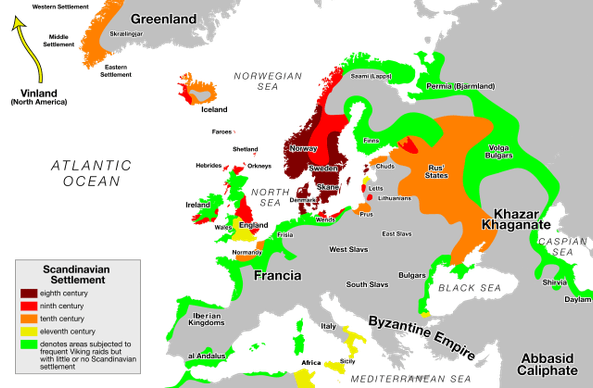
The Viking Age is characterized by the raids of the various Viking groups, starting with the attack at Lindisfarne in 793 CE until the Norman conquest of England in 1066 CE (some scholars will boost the range out until 1300 CE, but by 1066 most of the Northern Tradition cultures had officially converted to Christianity). At the peak of the Viking Age that meant a range of Scandinavian migration and new settlements from as far West as North America (L’anse aux Meadows in the Newfoundland area of modern day Canada), into Asia (portions of Russia), as well as settlements as far south as Northern Africa, and connections into the Byzantine Empire. There’s even known interactions in the Middle East (Palestine, Iran) too.
We have to be mindful and remember that Vikings were Pirates, composed of a multiplicity of religious cultures and ethnicities in their make-up. Some confuse Vikings with other geo-specific tribes (like some of the northern Germanic tribes like the Swedes), and it’s important to understand that difference as well when parsing through the sources. Many in modern vernacular conflate that term erroneously. Vikings were composed of a range of peoples from Northern Germanic tribes (and later converted Christians of those tribes), Gaelics, Christian Irish and British, plus other groups in between (most likely some members originally from a Caliphate too).
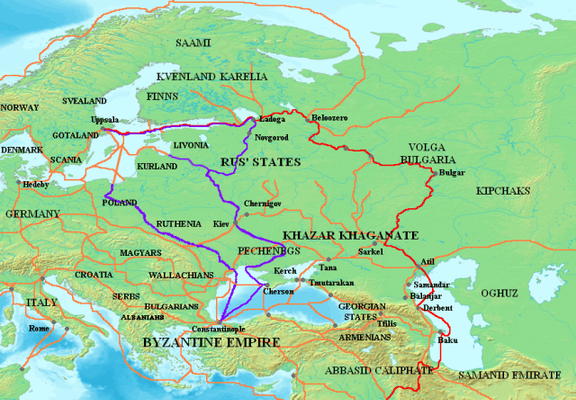
There were more connections too thanks to the vast Viking trade routes, including deep connections with the Abbasid Caliphate, as their silver dirham coins were highly sought after (and have been found in the thousands in the archaeological record across Northern Europe). Books like Dubois’ Nordic Religions in the Viking Age, Campbell’s The Viking World, Noonan’s Supply-Side Sustainability go into more depth of some of the cultural interactions. We’ve even found in grave goods ‘allah’ embroidered/woven into funerary clothes, plus a ring with the inscription as well across discoveries in both Birka and Gamma Uppsala in Sweden.
Viking Trade Routes (Specifically for the Volgas)
By the end of the Viking Age most of the leadership of these areas had converted to Christianity, and forced the people under their control (many times) to convert or die. We see this talked about in Heimskringla, especially in the heathen persecutions of King Olaf II (and in the martyr story of Olvir of Egg). So by the time that the Viking Age has come to an end, we’re very much in a time period of Christianity as we go into the later half of the Middle Ages. We can actually track some of the recorded additions/revisions to the legal codes (by year), and see how pre-Christian custom is being outlawed. There’s definitely some lingering pagan custom happening if they’re bothering to outlaw it. But one of the Church’s tactics of the period was to take pagan custom and rebrand it. It was King Hakon of Norway, who as a Christian passed a law that the Christian Christmas Day (which was already a weird bastardization of the Christian story of the Nativity with some of the traditions tied to Saturnalia/Mithraic customs) AND the heathen yuletide celebrations were to henceforth be celebrated at the same time.
While this only specifically impacted Norway (and its territories), it illustrates an intentional combining of the holy-days into one celebration. We know as a rule the Church had a tendency to turn some pagan deities into saints (ex: Saint Brigid), and turn others into demons. They appropriated certain concepts: Hell was simply the place where the dead reside, the underworld of Germanic belief, embodied as the Goddess Hel, but they rebranded it and vilified it as the opposite of their Christian afterlife. They took the name of the heathen holy tide that would have been Easter/Eostre/Ostara and rebranded it as a Christian observance instead. We see in their Churches remnants of our deities: Norway’s Heddel Stave Church has Odin on one of the pillars, and various churches throughout Bavaria still have some of Walpurga‘s symbols and are dedicated to her. We see this rebranding reflected in the sources of ‘lore’ as an euherimistic process, where the old Gods are downplayed into somehow merely being political mortal figures (usually tied to royalty) in certain sagas (like some of the Danish sources).
Someone put together some histomap resources that provide a visual aid to some of the information I touched on above, illustrating that there was no pure culture, but rather one of contact and interaction with a variety of peoples (from allies, to enemies, and everything in between). This histomap traces Germanic languages from 500 BCE until the present day, this one traces a video map with timeline of the Germanic/Scandinavian tribes from 350 CE until 1066 CE in Northern Europe. Someone else did a similar overview of how the territory changed for different kingdoms, peoples and empires throughout Europe from 400 BCE until 2017 CE.
Understanding the Sources
Most of the sources were written by outside cultures and religions. We only have two instances of Germanic pagan belief preserved in the Germanic language (the Merseburg Charms, or die Merseburger Zaubersprüche which comes to us from the 9th century). While we have a variety of Anglo-Saxon sources, and continental sources (from scholars and chroniclers such as Magnus Aurelius Cassiodorus, Jordanes, Nestor*, etc.) most also come to us after Christianity. In the modern era, many pagans and polytheists focus on the Eddas and Sagas, most especially the sources from Iceland in particular (the Eddas, etc). and yet they were written by Christians, usually quite late or after the period of conversion. (Sometimes they do quote what we believe is older content that has not survived on its own). Yet despite this, the Eddas are one of our best repositories for cosmology, and the mythological stories of our Gods. So you can’t just ignore these sources. Respected scholar Gabriel Turville-Petre reminds us in writing about Njal’s Saga, to take the story with a grain of salt, “It was not the author’s purpose to write a work of history, but rather to use a historical subject for an epic in prose” and truly this can be understood as good words to keep in mind when approaching ANY of the sagas and eddas.
One of the famous scholars penning the tales was the very Christian Snorri Sturrlusson, who was known for writing whatever would gain him political favor. He was quite a political maneuver, to the point he’d eventually cross the wrong person, and be assassinated. While he is the skald behind Heimskringla it is his Edda (the Prose Edda, aka the Younger Edda) which remains one of the touchstones for many looking at this culture today. Snorri in part wrote his Edda because the old literature was heavy with poetic devices like kennings, and the knowledge of what those kennings meant were slipping out of the population.
Sagic accounts, like many literary accounts of oral traditions, combine fragments of historical fact with the author’s skill in fiction in crafting works that are representative rather than literal. So ingrained was the oral tradition amongst the Norse, that warriors were often judged on their ability to compose poetry extempore, as much as by their skill in battle. The great Sagic hero, Egil Skallagrimson even saved his life by the composition of a heroic poem honoring King Eirik. This reverence for poetic and rhetorical skill was ingrained in the saga tradition, where warriors celebrate their kills with finely crafted verses replete with masterful kennings.
But you also have to understand what those sources are. Sources don’t always agree on details when coming from different regions. Or sometimes we have accounts that point to a history, that other information we have from elsewhere completely contradicts. The account of King Domalde of Sweden is one such account that historians don’t believe actually happened. The story of Baldr’s demise varies depending on the source (more on that below).
You even have to take care with the sources, because sometimes what is presented as one collection to modern readers comes from a variety of different manuscripts. The Poetic Edda as we know it today, was comprised by scholars primarily from two different manuscripts. The first manuscript is the Codex Regius (GKS 2365 4to). This manuscript does NOT contain Baldrs draumar. This manuscript clearly shows that the eddic poems were placed into an intentional, narrative order. Placing events into mortal or linear time. In other words that there’s a past, present and future. However, this is usually not the case in many ancient religions and cultures. Time moves on a cosmic, mythical & immortal level, and isn’t necessarily linear. SO human time is a vast line, but in cosmic time the line of time can bend and fall back on itself and loop and skip around, like the theoretical warp ability featured so prominently in science-fiction.
The other manuscript is known as AM 748. This manuscript is not ordered in any way at all, and this is the one and only Eddic origin of Baldrs draumar. Interestingly enough AM 748 has absolutely no mention of the Lokasenna or Loki’s role in Ragnarok. But because it does have some overlap with poems in the Codex Regius (Grimnismal, Hymiskvida, etc.) scholars, centuries after these separate manuscripts were written, chose to combine the two together to form the Poetic Edda as we know it today. They decided that Baldrs draumar should go before the Lokasenna thus forcing it to a timeline of their choosing.
There are other versions of Baldrs demise, preserved in various Danish manuscripts such as Gesta Danorum, and in those Danish versions Loki isn’t mentioned at all. (And allow me to say that this version is actually older than Snorri’s Edda).
For quick reference:
- Gesta Danorum – (with the tale about Baldrs death where Loki isn’t even mentioned) is believed to have been written in the late 12th Century
- AM 748 where we get Baldrs draumar from (and Loki’s involved), was believed to be written in the late 14th Century
This is a gap of approximately 200 years between these sources, and the 14th Century firmly puts us into Christian Europe, whereas in the 12th Century while Christianity was the prevailing religion and the one in political power, the old religion and its adherents were still around though in increasing fringe marginalization.
The Lokasenna doesn’t appear to be derived from a pre-Christian tale, but rather appears to be an example of contemporary Christian Medieval Literature that mimics the ancient Greek satirist Lucian’s Assembly of the Gods, in much the way that Snorri uses other elements common of Christian Europe’s Medieval Literature by alluding to other great works (those Western “classics’ from Greece and Rome, or Biblical allusions), this is after all why he attests that the God Thor is descended from the Greek Agamemnon featured in Homer’s Iliad & Odyssey, and later mentioned in Virgil’s The Aeneid. It appears that the Lokasenna followed the formula set by Lucian, and just dropped in Norse Gods instead. So one has to be very aware of this cultural milieu of Christian Medieval Scholars and how that can muck up the waters too.
The reason I point this out is because many people assume when they read the Poetic Edda as we know it today, that Loki’s punishment is because of his role in Baldr’s demise because that is how the tales have been ordered for them. But to understand where the Poetic Edda comes from, and the questionable veracity of the Lokasenna as being authentic to a Germanic pre-Christian origin, let alone the understanding that our Eddic lore was written post-conversion by Christian scholars can dramatically alter someone’s opinion. Similarly, there’s variations among the manuscripts that survive of the Prose Edda, especially between Codex Upsaliensis (DG 11) and Codex Regius (GKS 2367 4°).
We have very few contemporary eye-witness accounts, they come to us primarily from (1) the Romans and occasionally Byzantium Scholars (2) Arab travelers (from the Abbasid Caliphate, Cordoba Caliphate, etc.) (3) the rare skald who was heathen in their lifetime or converted in their lifetime and 4) the archaeological record. (Yet, most people in modern Northern Tradition polytheism rarely reference these, and focus almost entirely on the Eddas and Sagas which are written some period removed from Heathen praxis and yet we have thousands of votive inscriptions in Latin erected by individual Germans or Germanic tribes to not only Germanic deities, but worship to other deities (such as Coventina) as well throughout the Roman Empire.
In the case of the Roman texts, at least they are written by fellow polytheists, but you have to be able to tease apart the sources. Because they talked of the Northern Tradition Gods by likening them to their familiar Roman pantheon. Sometimes only referring to the Norse Gods and Goddesses by the name of the Roman equivalent. This is known as Interpretatio Romana. An example of this can be seen in Tacitus’ Germania, where he informs us that the chief god for the Germanic peoples is Mercury. What is really being said here, is their chief most god is Odin/Woden. We see this understanding embodied in the days of the week.
Days of the weekRomanNorseSunday
dies Solis (Sol’s Day)
Sunnudagr (Sunna’s Day)
Monday
dies Lunae (Luna’s Day)
Manadagr (Mani’s Day)Tuesday
dies Martis (Mars’s Day)
Tysdagr (Tyr’s Day)Wednesday
dies Mercurii (Mercury’s Day)
Odinsdagr (Odin’s Day)Thursday
dies Jovis (Jupiter’s Day)
Þórsdagr (Thor’s Day)Friday
dies Veneris (Venus’s Day)
Frjadagr (Frigga or Freyja’s Day, it varies by source)Saturday
dies Saturni (Saturn’s Day)
Laugardagr (Bathing Day)
As a polytheistic culture, the Romans did not always view other pantheons as being distinctly unique. Pliny the Elder referred to this as nomina alia aliis gentibus (different names to different peoples). The syncretized Romano-Germanic deity Mercurius Cimbrianus (Mercury of the Germanic Cimbri tribe) is understood to likely be the earlier Germanic equivalent of Odin.
While Tacitus’ Germania is a huge touchstone, we also have other sources like Julius Caesar, Sidonius, Ptolemy, Jordanes, Polybius, Procopius, Pliny the Elder, Pomponius Mela, Strabo, Titus Livy, Zosimus, etc. Some of the Byzantium sources can also be good (Agathias, Ionnes Scylitzes, Ammianus Marcellinus, Michael Psellos, Photius), but they tend to relate most specifically to war and battle, and less so with religious custom with typical focus on the Rus, or Varangian Guard. Most of those sources also come after the Empire had converted to Christianity, so we’re now dealing with Christian scholars writing about the ‘barbarian heathen’.
In the case of the Arab accounts, these pose their own problems. There’s an obvious bias that their monotheism and culture is better. “They are the filthiest of God’s creatures… they are like wild asses.” (Ibn Fadlan, when referring to his travels among the Rus and Volga). Ibn Fadlan’s account is often overlooked because it deals with uncomfortable subject matter: the fact that a great male leader has died, and a slave supposedly has agreed to be ritually sacrificed for him. Before they send her to her death she has sex with various other male leaders, and we see a ritual description of how she is sacrificed as part of a ship burial. Some will hold up the prayer she says there, and use a version of that in our religion today, but we simply don’t know if that represents the beliefs of the tribe, or perhaps her own beliefs from whatever culture she came from.
(The prayer: “Behold, I see my father and mother. I see all my dead relatives seated. I see my master seated in Paradise, and Paradise is beautiful and green.” This historical poem was later used as inspiration for Michael Crichton’s own draft of a similar prayer in his fictional novel: Eaters of the Dead. The book would lead to an adaption with more creative liberties taken to the prayer in the film 13th Warrior (I mean that film is so farcical as it pertains to anything historical or authentic, for instance it combines Elizabethan Era Viking Warriors who come across Spanish Conquistadors and Roman Gladiators). Since then that later inspiration from the film entered into modern heathenry: “Lo, there do I see my father. Lo, there do I see my mother, my sisters and my brothers. Lo, there do I see the line of my people back to the beginning. Lo, they do call to me. They bid me take my place on Asgard in the halls of Valhalla, Where the brave may live forever.” This reference to Valhalla was never part of the original prayer from the Viking Age. This is why many will only acknowledge Sigdrifa’s Prayer as the sole remaining complete prayer we have from antiquity.)
One of the interesting accounts from the Arab travelers is from Al-Tartuschi (aka Ibrahim ibn Yaqub). There is some debate about whether he was a Jewish born Muslim, or perhaps a practicing Jew. He hailed from the Al-Andalus area, under control of the Cordoba Caliphate (which geographically relates to sections of modern Spain & Portugal) . The entirety of his work is lost, we only have excerpts of his work quoted in other documents. But he records seeing worship connected to the Sirius star in what is today Hedeby, Denmark. We don’t know who was being worshipped, but that star is known as Lokabrenna, (Loki’s Torch) so this may be evidence of Loki worship.
In the case of both of these accounts, while both were travelers with a travel journal, there are only a few pages of content related to Northern Tradition areas. So it’s a very small pool of information to draw from. Since this is an area far too often overlooked, I’m going to take the time to list many of the other accounts too: al-Ghazal, Al-Mas’udi, Al-Muqaddasi, Muhammad al-Idrisi, Ibn Battuta, Ibn Hauqual/Ibn Hawqal, Ibn Isfandiyar, Ibn Khurradadhbih/Ibn Khordadbeh, Ibn Rustah, Miskawayh, Ahmad al-Ya’qubi, Ibn Qutiya, Yaqut al-Rumi, Yahya Ibn Hakam al-Bakri, al-Maqqari, Ibn al-Athir, etc. According to The Encyclopaedia of Islam, Volume 8, Parts 139-140 by Hamilton Alexander Rosskeen Gibb (et al), many writers from the Islamic world referred to the “fair-haired, ruddy-complexioned population of Central, Eastern and North-Eastern Europe” as saqalibah, beginning as early as the 10th Century. So using that as a search term may help broaden your research too.
As mentioned previously, the Sagas and Eddas were penned primarily by Christian scholars usually centuries after conversion, which sadly the majority of what we know about the religion comes from these sources. It is only among the skaldic poetry that we occasionally find eye-witness accounts by individual skaldic authors who either were heathen or had converted from heathenism in their lifetime. The problem is the skaldic poetry rarely has the religious customs we crave. But here’s a list of those skalds who qualify: Auðunn illskælda, Bragi Boddason (Ragnarsdrápa), Egill Skalla-Grímsson (Arinbjarnarkviða, Höfuðlausn, Sonatorrek), Eilífr Guðrúnarson (Þórsdrápa), Einarr skálaglamm, Erpr lútandi, Eyjólfr dáðaskáld, Eysteinn Valdason, Eyvindr skáldaspillir (Hákonarmál, Háleygjatal), Gamli gnævaðarskáld, Glúmr Geirason, Gunnlaugr ormstunga, Guthormr sindri (Hákonardrápa), Hallar-Steinn, Halldórr ókristni, Hallfreðr vandræðaskáld, Hrafn Önundarson, Jórunn skáldmær, Kormákr Ögmundarson, Skafti Þóroddsson, Skúli Þórsteinsson, Steinn Herdísarson, Steinunn Refsdóttir, Þjóðólfr of Hvinir (Haustlöng, Ynglingatal), Tindr Hallkelsson, Úlfr Sebbason, Úlfr Uggason (Húsdrápa), Vetrliði Sumarliðason, and Vigfúss Víga-Glúmsson.
The most direct touchstones we tend to have from antiquity are in what we have discovered in the archaeological record. Yet despite this, the information isn’t always easy to learn about for modern believers. A lot of the research and discoveries are blocked behind paywalls, in obscure and very expensive academic publications, and then scattered across years and resources making it hard to easily search for patterns. In some ways Europeans are fortunate with easy access to a number of Museums and exhibitions because it’s part of their regional history. We know that in antiquity there was a thriving matron cultus, with over a thousand found votive stones in the Germanic Rhineland, yet they are so rarely referenced by modern believers merely because most don’t know about them. The tapestry that comes to us from the Oseburg Ship burial find gives this amazing picture of a religious processional. The tapestry matches depictions from Tacitus, as well as other archaeological finds like the Kivik’s King Grave and the Garde Bote Stone. The problem is the significance is lost on most Heathens because frankly they don’t have a deep knowledge of known relevant archeology. The Danish National Museum has some amazing bog finds of found items that had been sacrificed from horse necked gold bowls, to even women’s braids. But you won’t find a description of that anywhere in historical written accounts. Plus navigating the archaeological record has it’s own things we must be mindful of, and that includes bias as we try to interpret what we find.
We’re discovering that grave sites attributed to males based solely on what was in the grave with them have been proven to be wrong on multiple occasions. The archaeologists saw something that equated to their preconceived notions of masculinity and gender roles and without examining the bones in detail (or when skeletal remains had long dissolved) labeled them as male. A study in England reexamined 14 graves and found six of them were really female remains. One of the sites in question was from the Repton Woods burial site, “(d)espite the remains of three swords being recovered from the site, all three burials that could be sexed osteologically were thought to be female, including one with a sword and shield,” says the study. Just recently one of the most famous warrior finds, the Birka Warrior from the Birka find in Sweden, has been re-identified as female. There’s also been other graves recently re-identified as female too. And there have been other known burials of women that have weapons with them as well: the Kaupang Burial in Norway, Gerdrup in Denmark, Nennesmo in Sweden, Klinta in Sweden, Bogovej in Denmark, Marem in Norway, Heslerton graves, North Yorkshire in England. For further reading, volume 8 of the Analecta Archaeologica Ressoviensia details many other such burials.
Now some scholars like Judith Jesch argue against these being representative of a female warrior presence. (As an aside, in Judith’s case with female warrior presence I think when we see the prevalence of fighting women from the numinous beings (Freyja, valkyries, etc.), archaeological artwork, burial graves, and textual accounts from a wide range of sources make me strongly suspect the warrior connection was very intentional in the grave. It makes me wonder if we have enough of the bones left to see if we can see very physical wear markers on the skeletal remains that do point to regular sword use). Jesch does bring up a valid point that yes we should not assume that a blade equates warrior status, and I will take it further and state we need to be mindful of automatic assumptions and our own biases when examining any archaeological item. We don’t know if the presence of something in a grave had a direct correlation to a domestic or warrior function. Could the item have been a gift, an offering to the Gods or ancestors, did it import a sign of rank or status. Were they killed by someone and that sword was really the blade of the one who killed them as an offering that justice was done so they can now rest easy. Were the scissors placed with a man there because he used them, or because they’d been a gift to his wife and she gave it as a token of their time together? We always have to look at a range of possible interpretations, the context of a given find in conjunction with the context of other finds and what we know from written accounts.
Among the archaeological record we also have major symbols that appear multiple times, like the valknut (which is a modern name for an ancient symbol). Despite the fact it has been found many times, we still aren’t precisely certain what it really means or indicates. It seems primarily in antiquity to be used in connection with the dead, and there’s a lot of scholarship connecting it with Odin. Today it is being used as a symbol of both Odin and a symbol of the modern Northern Tradition polytheisms. One of the most prevalent symbols from antiquity has been the mjolnir (Thor’s Hammers), found across rune stones and a number of jewelry pieces from a wide span of areas. We’ve been finding jewelry in the archaeological record for many, many years which we long suspected and theorized were Thor’s hammers, and for decades modern Heathens have been wearing their hammers in honor of Thor as such. A more than 1000 year old pendant was found in 2014 from Købelev in modern Denmark, which proved that this long held supposition was in fact accurate. The pendant bears an inscription that when translated states “this is a hammer”. Perhaps it’s unpoetic, but it is at least clear. The mjolnir remains the only symbol (ie. non figural) found in the archaeological record we know was worn as a representation to the religious faith in antiquity.
Then we have the most problematic sources of all, those that come from recorded folk custom. These are so much harder for us to pen down, as these customs traveled with human diaspora and migration, filtered through syncretization and time. We try to find the earliest references, but often times these come from traditions that existed for centuries before that first recorded appearance of the custom. One of the key resources is Jacob Grimm (yes one of the Brothers Grimm), who recorded a great deal of evidence of folk custom in his multi volume Teutonic Mythology. E.L. Rochholz’s 1870 folklore study, Drei Gaugtinen gives us a lot of information on Walpurga, as well as two other Germanic Goddesses. We can look to many modern customs in certain regions historic to the Northern Tradition culture, and we can start to peel back the years chasing those old customs. Simek in his Dictionary of Northern Mythology tells us that in Norway there’s a custom of feeding leftovers into the hearth/kitchen fire and the crackling of the hearth is associated with Loki, just as Thunder is associated with Thor. Traditions that survive of Krampus fetching naughty children on the night of December 5th is just one of many such examples that abound.
We also have a number of grimoires full of spells and magical staves. These manuscripts (normally Icelandic in origin) date to a period of a few centuries after the Viking Age. They were a collection of recorded magical customs and symbols influenced by continental European customs during the Renaissance, and perhaps some of the customs arising from the English Monastaries of the 14th century. The grimoires were penned down (depending on the manuscript) between 1600 and the late 19th Century. Found within these manuscripts are the symbol sources for the Ægishjálmur (of which there’s 14 variations), and the Vegvísir (with 10 known variants). While these two symbols are popular today by modern polytheists, to my knowledge we have no record of them from the archaeological record. We can see some influence by Christianity among the other magical staves (one of the symbols’ has a name rooted in the Biblical Solomon), so we cannot make any statements that they are authentic to what was used prior to the spread of Christianity.
Throughout the lore there are instances of magical charms used to affect the sight. In Eyrbyggja saga, Katla (a skilled seidhkonna) casts a form of magic upon her son Odd to hide him from his pursuers. Each time the men search the house, instead of seeing him they see some other object instead. Believing a trick is at play, or that ‘they have had a goatskin waved round our heads’ they bring in another magic worker, who puts a sealskin over Katla’s head to negate her magic making Odd visible. We see this again in Reykdoela saga as well as Njals saga as well, of goatskins being wrapped around the head for magical purposes.
By the time we begin to see the helm of awe mentioned as a physical helmet in the lore and history of this evolving culture, we see it most predominantly used in Medieval European manuscripts that can be as much as 300 years later than earlier manuscripts that only speak of types of magic used to trick the sight. It is for this reason that I personally believe that contemporary writers of the time in conjunction with milieu common in other types of Medieval Literature like various stories in the Arthurian mythos (Chretien’s stories were written in the 12th Century), were focusing on knightly warfare and were elaborating upon older occurrences and adjusting the meaning to suit their poetic license.
In the Völsunga saga (13th Century), Fafnir taunts Sigurd that he has used the Ægishjálmur. After Sigurd later kills both Fafnir and Reginn, he takes up the helm as a looted prize (to the victor goes the spoils). The Sorla þáttr (14th century) also speaks of the Ægishjálmur, Hogni is wearing the helm of awe, so Ivar should not look at him. The best we can say about these symbols, (specifically the Ægishjálmur in this case) is some of them may be coming from a very old concept, but have been reimagined through the years.
The most well known grimoires are the Galdrablod, Galdrakver (Lbs 764-8vo), Galdrakver (Lbs 143-8vo), Galdrastafir, Galdrabok, Huld Manuscript, Hvíta Galdrakver, Lækningakver, Leifar (volumes 1, 2, 3 & 4), Rún Galdrabok, and there’s still many more.
We also see in early medieval church writings other clues if you’re willing to wade through the writing of various early church leaders, church chronicles, hagiographies, homilies, and more.
The various geo-specific law codes also sometimes encapsulate aspects of religious tradition, and in some cases we see how that code changes through the years allowing one to thoughtfully interpret how culture has changed from heathen times to Christian.
You really have to immerse yourself for probably years of dedicated research in the area to make reasonable connections accurately. And a lot of what is there is very piece mail: a clue there, a clue here. Name of a blot in passing, but for the most part no significant details relating to religion.
You also have to be very mindful with the sources and translations. Some translations try to preserve a sense of the original poetic meter, and therefore you lose a lot of the substance of meaning in the translation. Some translations simply run into words or concepts that have no cultural or language equivalent, or will be fueled by the biases of the translator. Most translations also come from a different cultural and historical perspective, and this is true as well for much of the academic scholarship that exists. You need to understand that academic analysis has been an ongoing conversation for centuries. Previous theories may later be disproved by later evidence. There was a period of time where there were many scholars who erroneously believed that the Vinland Saga was nothing more than fanciful poppycock, until a Viking settlement was discovered in Newfoundland, Canada proving portions of it at the very least are real. There was a time where scholars doubted some of the descriptions in Beowulf, until they began to find archaeological remains and burials that proved some of the details. Plus as previously discussed with the sources, religious views of the author can change analytical perspective too.
Having an awareness of the country of origin of a source can also give us further thoughts for rumination. Not just in consideration of human history, but by taking it a step further and thinking of what we know about it’s geography, weather, and other natural phenomenon. Then trying to extrapolate from all the resources we have at hand a deeper and more nuanced understanding. For instance, the Eddas which record stories relating to both the creation myth and Ragnarök survive to us from Icelandic sources. We see themes of a conflict between fire and ice in the Eddas, and this was most likely a reflection of Iceland’s very geography as it sits on the plate tectonics of the Mid-Atlantic Ridge, the island having both volcanoes and glaciers. One of the most important sites in all of Iceland, Thingvellir was the site of the old national assembly that started during the Viking Age where rituals to the Gods were performed. This site is quite directly divided by the Mid-Atlantic ridge. The island’s vulcanism has had other impacts as well. Shortly after the first settlers arrived to the island there was a major volcanic eruption around 900 CE, so major it was the most significant eruption in Northern Europe for a period of over 12,000 years. This is a religion that sees and deals with the powers and ties to them forces of nature. We’ve recently discovered a cultic site in a lavatube in Iceland, the place has long been known as Surtshellir, named in specific reference to the fire giant Surt. We see this connection further teased at in the ancient sources where the Landnámabók records that Thorvald ‘Hollow Throat’ Thordarson traveled to the cave to recite a special laudatory poem (in a ritual act) known as a drapa to the giant who lived there. [This also proves that even dangerous forces seen as enemies of human kind in Ragnarök were in fact given offerings in the heathen past, something many converts from monotheism struggle with in modern heathenry.]
Understanding the Magicoreligious Traditions
The magical practices are described in the sagas, and lore of ancient Heathenry, including seiðr, spá, galðr, runemal, and leechcraft. Within the modern Heathen communities, such practices arouse controversy: in part because some are more open to the experiential and ecstatic gnosis with the numinous, and others find it an uncertain and less tangible practice that makes them uncomfortable to accept. While these magicoreligious traditions can be used for sacred means, they can also be used for secular purposes too, and the practice of them is not something everyone is expected to incorporate as part of their living religious practice. Although each of these traditions may be practiced individually and exclusive of the others, they may also be united with any combination of the other practices and there are many places where these practices overlap. These are best understood as tools to be used as a situation might warrant it.
Unlike the basic religious rites of blöt, husel, and symbel there is a dearth of recorded work written by actual shamanic practitioners. (Please note, I’m using this term as a generalized gloss with a magic practitioner/spiritual specialist under a more general mainstream understanding, technically shamans originated as the spiritual/magical specialists from the neighboring Sami tribe. Norse specialists would be volvas, vitkis, seidhkonas, etc. but as those terms are less well known and this is intended as a rough introduction I opted to use what mainstream folks would be more familiar with.) The secretive and oral nature of shamanic practice means that very little definable evidence exists. In modern Heathenry, as in the past, however, the onus still lies upon the practitioner in uncovering the rites and symbols, charms, and incantations so necessary to his or her craft. Modern practitioners are charged with a unique task, unknown and unnecessary to shamans of the past: they must look to history, scholarly analysis, literary analysis, anthropology, comparative religious studies, and archaeological finds to augment their work which remains in the field of the experiential. Some may incorporate some or all of these practices, and others may instead opt to shun them in their own religious practice.
Leechcraft refers to the ancient art of healing, Anglo-Saxon sources such as rune poems, early charms, and the invaluable Old English texts: Bald’s Third Leechbook, the Old English Herbarium, and Lacnunga, are the primary sources for Heathen leechcraft (although at this point, the Anglo-Saxons were Christian, many Heathen concepts and beliefs survived within the now nominally Christian framework). Modern scholar Stephen Pollington’s Leechcraft examines these sources and his work can be a more accessible touchstone for modern readers when trying to understand those Old English texts. The liminal roles of words—whether spoken and/or written—and the usage of carriers in medicinal treatments, was essential to leechcraft, as was the ability of the healer to traverse the worlds as shaman and undo metaphysical wounds as well, such as elfshot. The early English certainly never seemed to make the distinction between what was magic, and what was medicine. So long as any cure is effective it was fully rational. According to modern scholar Stephen Glosecki, in his book Shamanism and Old English Poetry: “This is the therapeutic purpose implicit in Wid Faerstice 7-9: ecstatically the doctor travels to the source of the shot so he will know exactly whom to target in his counterattack.” Additionally, the Germanic Second Merseburg Charm gives to us a story of Baldr’s Horse that while lacking in specifics, ties to a tradition of healing as well. We also have a large number of Holy Powers connected to healing as found scattered across the lore and even in the archaeological record.
Practices of protection, and to an extent healing are associated with seiðr, which is an altering of the consciousness. The very term seiðr causes quite a bit of discourse within academic and Heathen sources. Oftentimes the term is used to encompass both seiðr and spá because they are so closely entwined. Spá, or oracular seiðr, is a speaking or a foretelling and is generally viewed to be more passive in nature because the oracular spá worker is reading the answers (usually by looking at the orlog). We see The best surviving reference to the shamanistic practice of spá can be found in the Saga of Eirik the Red. Seiðr, on the other hand, is considered to be more active and reflecting a wide range of forms. seiðr workers not only were associated with prophecy but with the casting and manipulation of the human mind and soul, as well as the metaphysical wounding cause by onflyge or elfshot which could manifest physically.
Some scholars have speculated about the distinction made between spá and seiðr in the lore because of the often dualistic polar opposition ascribed to them, where spá is benevolent and seiðr is construed as malevolent and attributed to the realm of evil witches. References elsewhere in the lore to seiðr put a far different spin on those who use such techniques, usually equating such practitioners as evil or in the case of men as being effeminate and labeled as ergi. Maligning the practice even if we have stories of Odin as practitioner. Icelandic lawspeakers—such as Þorgeirr—performed spá when they were described in lore as going under the cloak. (Þorgeirr’s account comes to us at a critical time, when Iceland was on the verge of civil war based on the religious divide between Christians and Heathens.) Yet these men who underwent the cloak were not considered to be performing seiðr, nor were those who participated in the “mound sitting” of kings. I suspect that as Christianity spread that what was probably once a cohesive practice was split into what was still tolerated and what wasn’t under the new mores and religious values.
We see intonations as a part of some of these aforementioned practices: the metrical healing charms of the Anglo-Saxons were chanted incantations to effect healing, the seiðrkona in Eirik the Red’s Saga cannot portend the future unless someone is willing to chant the necessary vardlokkur. This lends itself to the practice of galðr, which means “to croak” or “to crow” and originates from the old Norse verb ‘gala’. It can be understood as the singing, chanting, and/or incantation of spells and possibly runes with a range of notes towards a specific goal. It wasn’t necessarily meant to be musical, or pleasing to the ear.
The Roman General Tacitus refers to the women of the Germanic peoples standing about at the edge of a battlefield and fiercely wailing. This was most likely an example of women practicing galðr as a vocal charm to either strike fear in the enemy or to vocally intone magical workings for victory. We know from Julius Caesar’s war against the Germanic Suebi at the Battle of Vosges (58 BCE), or the earlier battles against the Germanic tribes of the Tencteri and Usipetes (in 55 BCE), and also from later battles between the Teutones and Ambrones at the Battle of Aquae Sextiae (102 BCE), as well as what Tacitus tells us that Germanic women went to war, and the children did too. The women might kill their own men if they ran, or if all was lost might murder-suicide their own family and self to avoid becoming slaves to Rome. In the First Merseburg Charm, we are told the women (Idis, a word coterminous to Disir or Matronae) helped to free the captured men. I suspect part of their screaming mentioned by Tacitus, was galdr magic to help their side, and foil the enemy. It may have been a function of the idis/disir/matronae. The Goddess Sigyn has a heiti meaning incantation fetter hinting possibly to some magic aspect combined with battle too. Galðr, may have also potentially had some influence on the singing used in seiðr/spá rituals as evidenced in the Saga of Eirik the Red, though this conclusion is highly speculative.
Whereas galðr is a purely oral working (possibly of the runes), runemal is the physical usage of the runes in magic, where runes are inscribed onto wood, stone, metal, other objects, or combined. Throughout Egil’s saga we have descriptions of runes being carved and blooded, and runic writings destroyed to help heal a sick woman. Although the tradition of runemal is primarily attributed to men in the surviving lore, there is a reference to the Norn Goddess Skuld in the Voluspa as the “scorer of runes.” (As Norns are tied to wyrd, this might be a suggestive hint of ties to divinatory use). Surviving references suggest runic charms and runic inscriptions may have been how runemal was used for protective magics such as amulets (such as the Ribe Skull Amulet), and may have been used in conjunction with healing such as recorded in the Canterbury Charm (preserved in the marginalia of the Anglo-Saxon manuscript Cotton Caligula A XV written in 1073 CE).
Runes were first and foremost letters in an alphabet with unique phonetic sounds for the language they represent. The earliest extant writing of runes (elder futhark) was found on the Kylver Stone (in Sweden), dated to around 400 CE. While we have over a thousand votive altars to the Matronae in the Rhineland, they were rendered in the Roman style with Latin inscriptions. Our understanding of the runes comes heavily from the various Rune Poems: Anglo-Saxon Rune Poem, the Norwegian Rune Poem, and the Icelandic Rune Poem. Additionally, we have in the Runatal section of the Havamal the story of Odin hanging on the world tree Yggdrasil in order to learn the runes in a blood sacrifice and ordeal. Divinatory actions were known and attested in period texts, some using horses (as attested in Tacitus’ Germania where they were yoked to a special sort of chariot and how they behaved and moved was how the divination was interpreted.
There are some vague, unclear historical references that might be runes being used for divination. We see something like lots (possibly runes) being used in Ynglinga saga that portended a bad omen for Granmar. In Egils saga, specifically in chapters 7 & 48, we have mention of something like lots being cast for divination. They may (or may not) be a reference to runes being used in this manner. In Tacitus’ Germania, we learn in addition to divination by horse, there was also some sort of symbols, carved in groups of three in wood used for divination. This might be runes being used in this way, or some other symbology.
Yet the use of the runes for divinatory purpose is so ubiquitous in the religious community today it is accepted as always being the case from the heathen past. We also have a tradition of bindrunes (a runic symbol, usually composed of 3 runes laid upon one another for a specific purpose). (As an aside, there’s no such thing as a blank rune, so anytime you see reference to that in modern books, that’s a key way to know it’s a deeply flawed source. The blank or 25th rune was invented because it was cheaper to produce 25 runes, than 24 in molds a few decades ago in the 20th Century and so some publishers had their authors write to make a blank rune part of the practice, that then informed other modern books that came later, whose texts had been influenced by that earlier work.)
In Conclusion
I realize that all of this information can seem particularly overwhelming. There’s a reason why many modern believers will find some sort of introductory tome penned by a modern believer that takes them through the base structure of our beliefs: the fact we worship and give offerings to the numinous: our Gods & Goddesses, our ancestors, and the vaettir (spirits of land and water), and will also introduce them to the known holy tides and religious celebrations.
Large sections of the modern community will never read anything beyond perhaps the Eddas. But there’s so very much more out there too. So if you want to start doing a deeper dive on your own, specifically looking for texts that have any reference (even in passing) of religious custom you might try exploring the following historic sources: Bede’s De Temporum ratione, Tacitus’ Germania, Indiculus Superstitionum et paganiarum, Gylfaginning, Gesta Hammaburgensis Ecclesiae Pontificum, Mologium (we see Christianized rites), Svarfdaela Saga, Hervarar Saga, Viga-glums saga, Egils Saga, Austrfararvísur, Völsa þáttr, Heimskringla (multiple sections but especially Saga of Hakon the Good, Olafs Saga Helga, Ynglinga Saga, etc.), Óláfs saga Tryggvasonar en mesta, Sigrdrífumál, Þrymskvida, Sturlunga Saga, Vita Karoli Magni, Landnamabok, Kjalnesinga Saga, Flateyjarbok, Orkneyinga saga, Legal Codes (Grágás, Guta Lag, Frostathing, Gulathing, etc.), and the Æcerbot (from Lacnunga)– while Christianized, this is one of the most intact descriptions we have of a specific type of land related ritual. And of course there’s more sources too, but these are some of the more key ones.
Despite the fact we do have information available to us from antiquity I want to caution you not to fall into the trap of becoming a lore thumper (something I see a lot of with people converting to this belief path after years in Protestantism). Because our Gods are not fictional characters, they don’t exist merely within the confines of a book trapped between the front and back covers. You either believe they are real and still active forces with agency, or you don’t. If you don’t then this is not the religious pathway for you.
Question everything.
- Who wrote this? What were their religious beliefs? How reliable are they as a source?
- When was it written? How does that relate to the history at that moment when it was written (political, religious, etc.), and how far removed is it from the details it reports?
- What biased attitudes or cultural milieu exist in the work? This can apply to everything from archaeological interpretation, translations, to even the original author’s own biases.
- What manuscripts comprise this document? If multiple manuscripts, how do they differ? How are they the same? Where does the manuscript(s) originate?
- How does this connect to other things in the Northern Tradition? From archaeology to lore to folk customs. Is there some similarity? Or does this appear to be geo-specifically unique to one specific tribe?
- Are there possible similar themes elsewhere in the Indo-European tradition? I caution with this not to jump to conclusions especially in trying to smoosh into an amalgam of sameness between cultures, but it can sometimes help to tease out some nuances because Germanic Lnaguage and culture is classified by scholars as emerging out of Indo-European culture.
- Can the etymology of this word, or name, or place help uncover more information? Sometimes the names are all we have left of some of the known Gods and Goddesses. Keep in mind with this you’ll eventually start running into theoretical languages proposed to show common roots from known offshoot languages, meant to follow human migration and diaspora backwards over time.
- How does this connect to what came before, and what came after?
- And the most important question of them all: How can I take the information I discover and learn about and use it as inspiration to develop my living faith and religious practice?
*Northern Tradition: this term was used by some academics, including the influential and well respected Hilda Roderick Ellis Davidson to refer to the cultures with a common worship to Odin. Among modern worshippers, the organization known as The Troth also used the term on their quarterly member publication, Idunna: A Journal of Northern Tradition. The Troth says of the journal that it “publishes material on all aspects of pre-Christian Germanic religion and culture. We cover both the ancient religions of the the Norse, Anglo-Saxons, Goths, and continental Germans, and the various modern revivals of these old ways, collectively known as Heathenry.”
#13thWarrior #AbbasidCaliphate #aecerbot #Aeneid #Africa #Agamemnon #alGhazal #AlMasUdi #AlMuqaddasi #althing #alvissmal #AmmianusMarcellinus #AnalectaArchaeologicaRessoviensia #Angles #asatru #AtTatuschi #Austrfararvísur #ÆfteraLīþa #ÆfterraGēola #Ægishjálmur #ÆrraGēola #ÆrraLīþa #ÓláfsSagaTryggvasonarEnMesta #Þorgeirr #Þrilīþa #Þrymskvida #BaldSThirdLeechbook #Baldr #BaldrsDraumar #BirkaWarrior #blot #ByzantiumEmpire #calendar #Caliphate #Calpiphate #Canada #Charlemagne #ChristianIrish #CodexRegius #CodexUpsaliensis #CordobaCaliphate #DeTemporumRatione #Denmark #dieMerseburgerZaubersprüche #DreiGaugtinen #ELRochholz #Easter #eddas #EgilSkallagrimson #EgilsSaga #elfshot #England #Eostre #Flateyjarbok #Franks #Freyja #Frostathing #GabrielTurvillePetre #Gaelics #galðr #GardeBoteStone #germania #GermaniaBarbaricum #GermanicIronAge #GermanicMigration #GermanicTribes #GestaDanorum #GestaHammaburgensisEcclesiaePontificum #Goths #gragas #GregorianCalendar #grimnismal #Gulathing #GutaLag #gylfaginning #heathen #heathenry #HeddelStaveChurch #Heimskringla #Hel #Hela #Hell #Hella #HelmOfAwe #HervararSaga #Homer #horse #husel #Hymiskvida #IbnBattuta #IbnFadlan #IbnHauqual #IbnIsfandiyar #IbrahimIbnYaqub #iceland #Iliad #indiculusSuperstitionumEtPaganiarum #intercalary #Iran #JacobGrimm #Jordanes #JudithJesch #JulianCalendar #JuliusCaesar #KingDomalde #KingEirik #KingHakon #KingOlafII #KivikSKingGrave #KjalnesingaSaga #Kobelev #Lacnunga #Landnamabok #leechcraft #Lindisfarne #litha #Lokabrenna #Lokasenna #lore #Lussinatta #magicalStave #magicoreligious #matrons #MersebergCharm #MichaelCrichton #misseriCalendar #Mjolnir #Modranaht #Mologium #MotherSNight #Newfoundland #NjalSSaga #NormanConquest #NorthYorkshireInEngland #northernTradition #Norway #Odin #Odyssey #OlafsSagaHelga #onflyge #OrkneyingaSaga #OseburgShipBurial #ostara #pagan #PaganSkalds #Palestine #Pliny #PlinyTheElder #PoeticEdda #Polybius #polytheism #PomponiusMela #prayer #Procopius #ProseEdda #ragnarok #RúnGaldrabok #Rhineland #RibeSkullFragment #RomanEmpire #runemal #SagaOfEirikTheRed #SagaOfHakonTheGood #sagas #Saxons #scandinavia #seasons #seiðr #ShamanismAndOldEnglishPoetry #Sidonius #SigdrifaSPrayer #Sigrdrífumál #Sirius #SkaldicPoetry #Skalds #SnorriSturrlson #spae #spá #StephenGlosecki #StephenPollington #Strabo #SturlungaSaga #Surt #Surtshellir #SvarfdælaSaga #sweden #symbel #tacitus #TeutonicMythology #theOldEnglishHerbarium #ThomasDubois #Thor #ThorSHammer #Thorvald #time #TitusLivy #vafthrudnismal #valknot #valknut #valkyries #VígaGlúmsSaga #vegvisir #VendelPeriod #VikingAge #VikingPrayer #Virgil #VitaKaroliMagni #VolsaThattr #volupsa #votiveStones #Walpurga #WalpurgisNight #Walpurgisnacht #WidFaerstice #WinterNights #Woden #YnglingaSaga #yule #Zosimus Zephyr 🍂
 Wyrd Designs