 Wyrd Designs
The Importance of the Religious Processional within the Northern Tradition
All too often among modern worshippers of the ancient gods of Germania and Scandinavia, they focus on rites like blot (or the modern alternative faining), and traditions like sumble. But they tend to ignore other religious ritual customs we have ample evidence of in both historic textual accounts and archaeologic artifacts, especially including the religious processionals of yesteryear.
We know from Tacitus’ Germania, that the Germanic Goddess Nerthus was widely worshipped by a number of the Suebian Germanic tribes characterized as being bold warriors: Semnones, Langobardi, Reudigni, Aviones, Anglii, Varini, Eudoses, Suarines and Nuitones.
“There is nothing especially noteworthy about these states individually, but they are distinguished by a common worship of Nerthus, that is, Mother Earth, and believes that she intervenes in human affairs and rides through their peoples. There is a sacred grove on an island in the Ocean, in which there is a consecrated chariot, draped with cloth, where the priest alone may touch. He perceives the presence of the goddess in the innermost shrine and with great reverence escorts her in her chariot, which is drawn by female cattle. There are days of rejoicing then and the countryside celebrates the festival, wherever she designs to visit and to accept hospitality. No one goes to war, no one takes up arms, all objects of iron are locked away, then and only then do they experience peace and quiet, only then do they prize them, until the goddess has had her fill of human society and the priest brings her back to her temple. Afterwards the chariot, the cloth, and, if one may believe it, the deity herself are washed in a hidden lake. The slaves who perform this office are immediately swallowed up in the same lake. Hence arises dread of the mysterious, and piety, which keeps them ignorant of what only those about to perish may see.”
– A. R. Birley translationA holy processional wasn’t limited to just Nerthus, we also have late textual evidence in Flateyjarbok of processional wagons used in connection to other deities, like the Gods Freyr and Lytir. Ögmundar þáttr dytts (found within Óláfs saga Tryggvasonar en mesta,) also tells us of a wagon processional where a priestess accompanied an idol of Freyr in a wagon. In the Vita Karoli Magni, we’re told that the Merovingian king Childeric III, every year went in an oxen drawn two wheeled wagon to the public assembly.
If we look back to the Nordic Bronze age there’s a number of wagon artifacts that have been found, such as the Trundholm Sun Chariot that depicts a horse drawn wagon carrying the sun, and ritual wagons. Denmark’s National Museum has a website with some information on the wagons, and includes examples on display in their museum in Copenhagen, such as the Dejbjerg wagons which were bogged in offering. There was also another recent discovery in the Karanovo grave find. There’s several such examples that have been found across the archaeological record in what we’d think of today as modern Denmark and Germany. These were not simple wagons, but rather were heavily ornamented, oftentimes with metal worked figures in iron or bronze. They were clearly special, and not a sort of everyday type of wagon. Lots of wagon wheels have been found in bogs even when the rest of the wagon is long since dissolved, and others were also included as part of the grave goods for important figures.
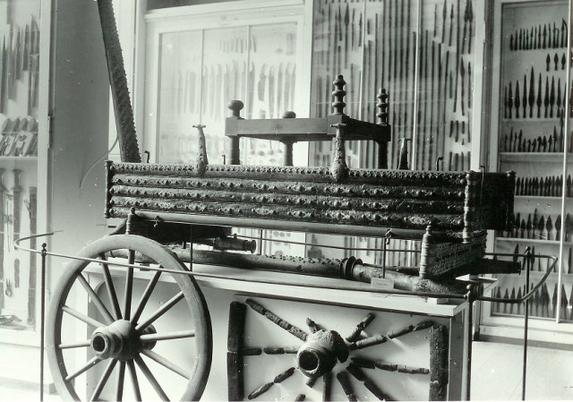
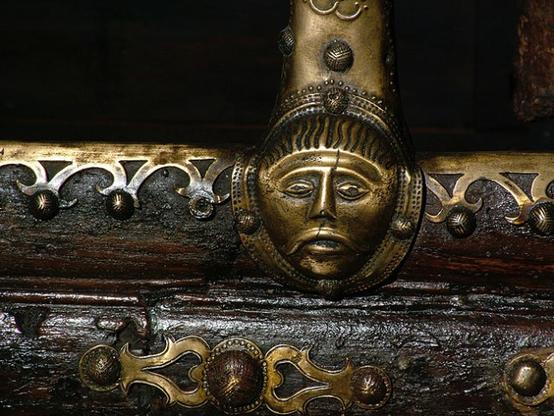
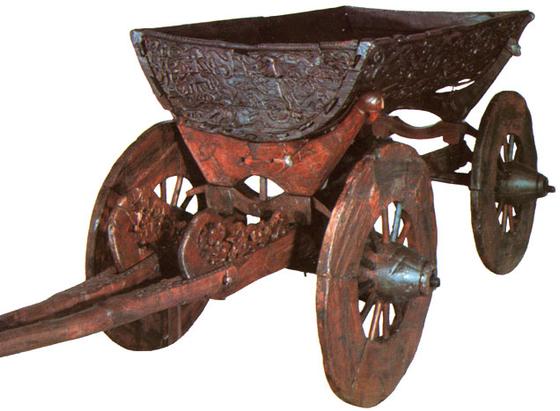
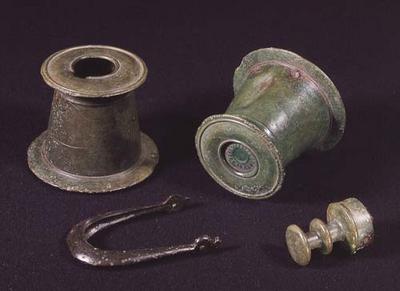
We see later on that tradition continues with a wood carved wagon featuring among the goods of the Oseburg Ship burial find. Within the Oseburg burial we not only have a beautiful example of a Viking age ship, the aforementioned wooden carved processional wagon, but also the Oseburg tapestries, which Professor Marianne Vedeler writes on extensively. Among the scenes depicted on the tapestries, we are shown a massive religious processional, a parade of people (men and women), some in wagons, some on horses, some walking, some carrying what surely were religious accoutrements. The horned figured is probably a high priest or perhaps as some believe it may be representative of Odin since he is far bigger than any of the other humans, perhaps in his role as psychopomp. We see what may be horse drawn wagons with a priest/priestess and perhaps the idol of the God/dess they specifically serve, plus other wagons without a passenger that may be carrying offerings. We also have a horsed headed tree from a nearby badly surviving remnant (which is probably a visual reference to Yggdrasil being Odin’s Horse) with bodies hanging from it in sacrifice (and we know of sacrificial trees from an account from Adam of Bremen, so we have text and archaeology synching up).
Oseburg tapestry remnantOseburg tapestry remnantPeter Robinson’s black and white recreation of the sacrificial tree remnant of the Oseburg tapestryMary Storm recreation of the left panel of the Oseburg tapestry religious processionMary Storm recreation of the right panel of the Oseburg tapestry religious processionWe see large numbers of people, including some musicians probably playing the horn shaped Lur instrument, which are often found together in pairs in discovered bog offerings. We also find in the depictions things that might be drums. I also think bells may have been likely in some places too (just based on the fact we do have bells in the archaeological record though nothing specific that points to their use in these processionals).
The Oseburg tapestry is festooned with repeating symbols like the swastika 卍, a geometric seeming serpentine like squiggle (perhaps echoed in the Smiss Women with snakes picture stone), and the ⌘ (that also appears on the Havor Stone) which evokes the looped square found in some American indigenous cultures or found in certain forms of medieval European heraldry such as the bowen knot or the Norwegian valknute.
While difficult to fully decode what we’re seeing, the religious nature in the tapestry is quite clear. Plus, the tapestry’s depictions echo in part the descriptions from Tacitus, as well as other archaeological finds like the Garde Bote Stone from Gotland, and the Kivik’s King Grave petrogylphs. The Kivik’s King Grave was an example of a cairn, where the interior face of the walls of the grave feature petroglyphs which may very well detail religious custom and mortuary rites. Among the series of engraved stones, we find again what appears to be a religious processional.
One of the petroglyph stones from Kivik’s King Grave.When there’s music (and the lurs are pretty distinctive as they appear in multiple examples across the archaeological record) we most likely also have dancers. In Nordic bronze age finds we have gylphs that show what looks like ritual leaping over what appears to be a boat processional, and even figurines in that same acrobatic pose too (perhaps showing some of the dancers in action).
Gylphs found in Grevensvænge, ZealandFigures from Grevensvænge, Zealand,We also see with traditions like the Perchten or Krampus other types of processions too, those have survived in varying forms in folk practice into the present day.
These processions would have been the equivalent of a major parade in a community. Imagine a big cacophony of the gathered, and everyone joined into the parade. There was probably a hierarchy with religious officiants and leaders first, certain elders perhaps seeresses/shamans then everyone else fell in. We see in the archaeological record what appears to be musicians, and dancers. Perhaps they sung, played the lur and danced as they went to the site for the ritual. I was born in New Orleans and I can’t help but think of a Jazz funeral procession.
How radically different would our impression of ritual be if processionals were more common, if we all collectively knew of their importance and the religious cultural tradition? Was it a riot of sound? Or maybe it was reverentially solemn as they walked and the music and dancers happened at a certain moment in the ritual. Even if it was solemn in the procession to the ritual site, it wouldn’t have been silent. There’d still be the sound of footfalls, clothing rustling, the creak of the wagon, the hooves of the horses, cries of infants, etc. The nature of the rite to be performed may have changed things up too, with different codified formulas. Was it for a ritual in honor of a deity perhaps in thanks for a bountiful harvest, or an entreaty because there was famine? Was it a burial procession?
Processionals appear to be a very major component of ritual observance in the ancient past and yet they are so rarely mentioned or done in the modern era. Of the extremely small number of groups I know of that have done processionals, most of these don’t explain that this echoes back to prehistory and a established religious practice mentioned in textual sources and found in the archaeological record. Those hosting may know why the have structured things the way they have, but the knowledge isn’t for the most part being passed on to the assembled. I think in those cases the gathered participants do not perceive anything holy about it. Instead it reminds them of falling into line in elementary school as they walked with their class to go to the cafeteria or gym. Nothing more than a means to get people from point A to point B, without losing people along the way.
We are handicapped by the unclear structure of the processionals as we have to rely so heavily upon visual interpretations. Textual clues are very limited. In modern times we are further hampered when rituals are conducted in homes and within urban environments where space may be lacking. Most of us don’t have access to wagons, horses, or live in an area that could accommodate mixed use by pedestrians and horse drawn wagons. Even if someone has a yard and they summon the gathered out when it’s time it doesn’t feel like a processional since you’re only walking in most cases less than a hundred feet. Perhaps you booked an area in the local park, but those who came out for ritual feel awkward being in a public sphere among the general public. I also suspect since most of us are converts from Christianity, we’re used to a certain style of worship that doesn’t really prepare us for processionals, except perhaps examples of a ceremonial elite walking in, such as: in Catholicism the altar boys and incense bearers with the priest, or perhaps more generally the bride walking to the altar at a wedding and then the wedding party exiting together.
I was reminded recently of someone who had taken the ancient description of Nerthus’ processional and adapted it to the modern day. Back in 2011 Lone Star Kindred (which was if memory serves me correctly located in the general Houston area in Texas), loaded up with great ceremony an idol of Nerthus, lovingly veiled into our most ‘holy’ of Texas vehicles: a truck. ^_~ The goði drove all over the state heading to different participating kindreds who played host across multiple days. Along the way Nerthus was ceremonially unloaded from her automotive chariot at the various official stops of the processional tour. Rituals were conducted, invocations sung, prayers said, libations and offerings given. Per ancient custom no weapons or blades were to be worn among the worshippers. Some of the offerings were specially packed away to journey with the Goddess. At the end of the entirety of the procession around Texas, those final offerings (things that would not be toxic in the water, or pose a risk to wildlife) were bogged at the conclusion of the journey in lieu of the human sacrifices from antiquity.
May 21, 2011 – Nerthus Processional – White Sage Kindred hosted stop in the Dallas / Fort Worth area. Nerthus is seen veiled here on the altar.While this was some genius inspiration, and a good example on how to be inspired by the past and adapt it to the modern era, we still didn’t really have that sense of people falling into the procession as part of the entourage. There was no impactful experience of journeying together (the Goddess in her ‘wagon’ with the worshippers in tow) towards the ritual site. Instead you had groups huddled at like little oases in the desert waiting for the Goddess to arrive, much like one might wait for a family member you’ve not seen to show up after a long time apart. This was undoubtedly a unique, and very positive experience. I have nothing to say but good things of the organizers. But I can’t help but wonder now, years on, what if it had been even more? This is in part what all modern practitioners are dealing with, in trying to reconstruct and establish a living faith we evolve, and we begin to notice things that we may not have realized were missing previously. Ways we can dial in the connection more, and enhance the experience.
Really think of those ancient heathen gatherings, of the people waiting for the priest to come with their beloved God or Goddess in their holy wagon. It wasn’t a mere statue, it wasn’t a hunk of stone or wood, that was the deity among them. It was a time of awe and joy and blessings. How do we bring back that awe of the holy, the celebratory joyful noise that happened if not during the procession itself, then at some part during the rite.
I think we dismiss the importance of the wagons within our religion. I personally have long theorized that the “pageant wagons” of 10th through 16th century Christianity was a re-branding of the old Germanic wagon processionals. Those Christian pageants, basically were little tableaus or re-enactments of key Biblical stories. In some ways they were like the living version of a Church’s stained glass windows. They were perfect to use to spread the gospel among a converting pagan population, and later among those who were illiterate. The church leadership most likely recognized that because of the inculturation of the wagon processionals, that the populace equated a sacred and holy mindset when a wagon was present. I speculate that the church took the vehicle of the wagon, but then started to strip away codified traditions that were too ‘heathen’ as part of their re-purposing.
We begin to see a parade like flotilla of the wagons come to towns meandering the streets, but the wagons in the processional stopped for performances at key spots. Think of it like the Macy’s Thanksgiving Day Parade. The floats stop at spots for musical performances, then move on. Those certain stopping points have a new float, band, etc. visit with a new performance. This cycle repeats until you reach the end of the parade. The wagons evolve into movable stages, over time the plays were no longer performed on the wagons but within the churches, and eventually we begin to see a true theater environment begin to emerge in Christian Europe. It’s no coincidence that the tradition dies out around the time Shakespeare and the Globe (and other theaters like it) are exploding throughout Europe. Though some remnants of that tradition still survive today, such as the living nativities many churches put on around Christmas.
Think how ubiquitous nativities (from statuary, to living re-enactments) are among Christianity. That should give you a sense for how much of a cultural touchstone those wagon processionals were to those ancient heathens. Yet in modernity I see this tendency among swathes of the community to use sumble as a crutch for ritual, and with it in some groups an inability even among the goði to speak more than “hail [name of deity here]”. I’m not surprised processions aren’t more widely embraced, but I do feel it’s a detriment to our religious culture of practice and tradition. I feel we collectively as a religious community need to face the challenge of trying to bring the relevance and practice of the processional back into the present day. I can’t help but think where is the joyful holy music, the ritual dancing, in addition to the prayers and offerings? What does bringing it back, and truly embracing it look like to you? Do you or your group already practice it? If so what are your traditions with it?
#Anglii #asatru #Aviones #ceremonialWagon #dance #DejbjergWagon #Eudoses #Flateyjarbok #Frey #Freyr #germania #GermanicIronAge #GermanicPaganism #GermanicTribes #Goddess #Gods #GrdeBoteStone #heathen #heathenry #hornedFigure #KaranovoWagon #krampus #Langobardi #Lur #Lytir #music #Nerthus #NordicBronzeAge #northernTradition #Nuitones #Odin #OseburgShipBurial #OseburgTapestry #pagan #pageantWagon #perchten #petroglyphs #polytheism #religiousProcessional #Reudigni #Semnones #Suarines #Suebi #swastika #theater #TrundholmSunChariot #Varini #wagonProcessional #wagons