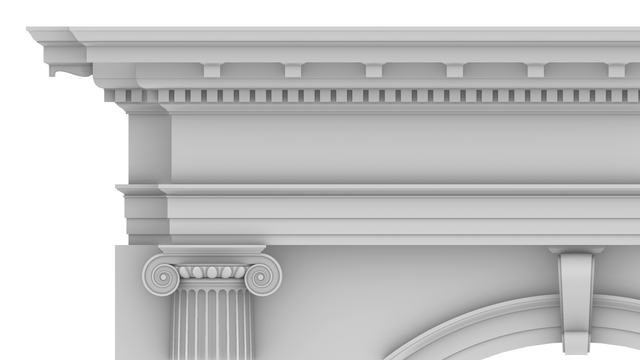
#ModernIonicEntablature with #modillions and #dentils adapted for #arcadeIntercolumnation.

This image shows modillions across the top of the entablature, including modillions visible on the side wall. The dentils are below the modillions and are a bit shorter than in the classic variant.

As with dentils, a #modillion must be centered on a column axis. In the front, there are two modillions directly above the two columns and eight other modillions equally spaced between them. The number is always 10. So the spacing is different for an #arch with no #pedestals.

This image also shows a skinnier #keystone. Its thickness is half that of the one shown in https://pixelfed.social/p/Splines/804548474524642209 but all other measurements remain the same. There is never a modillion directly above the keystone.

The #cymaReversa and #fillet above the keystone have #profileCurves identical to those in the #capital but the top is a square that is only µ x µ units. The top slab is centered front to back on the face of the arch.

In this image, the modern entablature is shown with the classic capital, but it goes really well with the #modernIonicCapital. As I mentioned in https://pixelfed.social/p/Splines/791065657488081419, the classic variant of the column capital has parallel flat #volute slabs only visible from the front and back, but not from the sides. Because of its lack of radial symmetry, the capital does not look as satisfying when viewed from the side, especially in a #colonnade, as seen in https://pixelfed.social/p/Splines/803089629244302486.

The modern variant has curved volute faces on all four sides with pointed ends at all corners and optimized for use in a corner column, but not limited to that. The modern #IonicCapital is the last remaining piece in our systematic look at the complete #IonicOrder.

This concludes our look at the entablature, both classic and modern, and both for #simpleIntercolumniation, or #Architravato, and #arcadeIntercolumniation.
Splines (@[email protected])

#Arch with #Ionic #Entablature and #Keystone Detail The #dentils arrangement we saw in https://pixelfed.social/p/Splines/791013152244518907 goes well with the classic entablature #profile we saw in https://pixelfed.social/p/Splines/790888454384861893, and they both go well with #simpleIntercolumniation, also known as #architravato. However, with arches, the entablature profile has to be adjusted a bit so that the dentils arrangement is as shown here. The shape, size, and gap between individual dentils remains the same, but a crucial difference is that the dentils at the #outer corners touch each other. As I mentioned in https://pixelfed.social/p/Splines/803615973439041638, in #arcadeIntercolumniation, the entablature is repeated on the wall behind the half-column. It doesn't end at the columns and has two "outside" corners and one "inside" corner. While the dentils at the outer corners touch each other, there is a single dentil in the inside corner that is shared by both walls. A bedrock principle of dentils (like that with #flutes and with eggs in the #EggsAndDarts motif) is that when viewed directly from the front or the sides, a dentil must be centered on the column axis. It is this principle that forces us to adjust the profile of the entablature in arcade intercolumniation giving us the arrangement shown here. The image also shows the detail of the decoration in front of the #keystone. The most easily recognizable component of that is the large #volute, which is the exact same size as the ones on the #capital. The smaller volute is exactly half the size of the larger one. It is mirrored, rotated and put within a bounding rectangle whose height is exactly 2µ (288 units). The channels of both volutes are bridged with #sinusoids derived from half turn of #helix curves that have been flattened. This motif in the keystone, where volutes of different sizes are combined with sinusoids is very common. It will be seen in the #modillions of the #modernEntablature.
Pixelfed
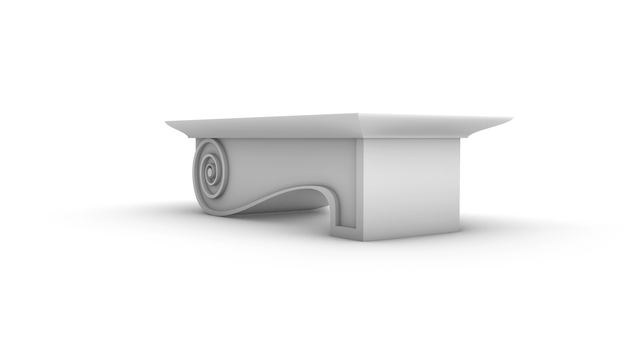
#Modillion for the #ModernIonicEntablature

In https://pixelfed.social/p/Splines/790782316675150160 , I mentioned that there are two variations of the #IonicEntablature — a classic version that we saw in https://pixelfed.social/p/Splines/804548474524642209, and a modern version that has a new feature called #modillions, which are projecting brackets under the #corona of the #cornice. Note that, "modern" is a relative term. For designs that are more than 2000 years old, even an alteration hundreds of years ago would qualify as modern.

The modillion design continues a similar pattern but not identical to that of a #keystone. The measurements can be found in https://babel.hathitrust.org/cgi/pt?id=mdp.39015031201190&view=1up&seq=45 from which you can surmise that the length is 130 units (based on µ = 144) and the height is 36 units excluding the flamboyant #cymaReversa. The depth is not given, but can be derived from the sketch in https://babel.hathitrust.org/cgi/pt?id=mdp.39015031201190&view=1up&seq=141.

The measurements for the cymaReversa are listed between the corona and medallions, but its #profileCurve is attached to the modillion, not to the corona. Like #dentils, we attach modillions separately to the entablature. The dentils are still there with the same square footprint and same interdental spacing, but they are shorter to make room for the modillions above.

The original #volute that forms the basis of the modillion design is µ = 144 wide (including #arcZero) and 128 tall. Since the modillion height divides evenly into µ, I used that orientation for constructing the modillion, creating a box 144 units wide and 520 units tall. After construction, I scaled it to 1/4 to get 36 x 130 units, and then rotated it 90°.

The length of 520 was divided into 128*3.5 = 448 for the curved portion (which aligns with the wall) and 72 for the straight portion, which faces the front. Try to recreate it on your own first, and if you need help, just ask me.
Splines (@[email protected])

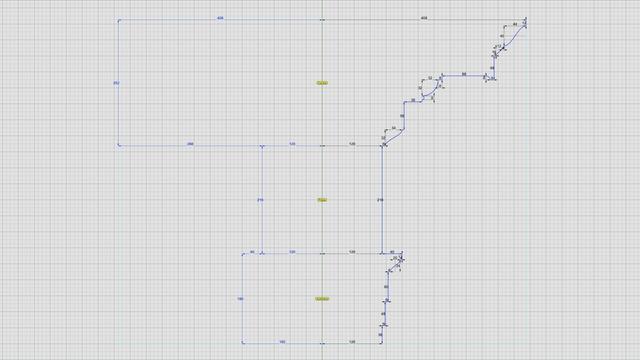
There are two variations of the #IonicEntablature. The classic variation has #dentils, which are teeth-like structures shown here above the #frieze. The modern version has #modillions, which are projecting brackets under the #corona of the #cornice. Well, "modern" is a relative term. For designs that are more than 2000 years old, even an alteration 1000 years ago would qualify as modern. Although the sketch shows the #entablature with a square footprint, in practice, it runs the entire length of a #colonnade (multiple columns) or an #arcade (multiple arches). #CAD construction of the entablature is very similar to that of a #pedestal. The first step is to consult #Vignola's #RegolaArchitettura for the visual appearance, and then consult #Scarlata's #PracticalArchitecture for #VignolaProportions in tabular form. It is convenient to create a spreadsheet to convert the measurements given in Scarlata's book from module "parts" to your own model units based on your choice of value for the module parameter µ. Armed with these measurements, it is time to plot the points and draw the #primaryProfileCurves on our standard 2D grid with minor grid lines 8 units apart and major grid lines 32 units apart. In the first pass, skip the dentils and draw the profile curves for the rest of the moldings. Just as with the pedestal, I will show the macro-level plan as well as the detail plan. So, you don't have to go to Scarlata's book, but you know it's there if you want to. I will show the dentil arrangement in a subsequent post. Based on µ = 144, the classic Ionic entablature is 648 units (36 parts, or 4.5*µ) tall. Of this, the #architrave at the bottom is 180 units (10 parts, or 1.25*µ) tall, the frieze in the middle is 216 units (12 parts, or 1.5*µ) tall, and the cornice at the top is 252 units (14 parts, or 1.75*µ) tall.

Pixelfed
UPDATE: Alignment of various elements in the classic #IonicCapital

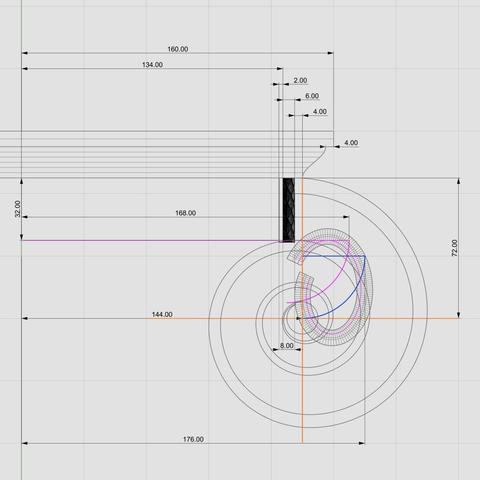
There is an error in the measurements for arc AD in https://pixelfed.social/p/Splines/792124787573855518 where it is shown concentric to the arc BC, with AD having a bigger radius than BC.

The two arcs are not concentric. Arc AD is shifted down and to the right by 1 part or 8 units and has the same radius as arc BC.

When revolved around the column axis, arc AD yields the #virtual surface that encloses #decorativeElements resting on the #tectonicSurface of the #ovolo. Revolving arc BC around the column axis gives the tectonic surface of the Ovolo.

The #eye of the #volute is centered exactly at µ = 144 away from the column axis and 1/2 µ, or 72 units directly below the #cymaReversa as shown by the orange crosshairs.

The top of the Ovolo's tectonic surface (shown in magenta) is tangential to the top of the tectonic surface of the curved #braids assembly. That latter surface is also shown in magenta.

The outer surface of the vertical braids assembly is 4 units inset from the cyma reversa and is also tangential to the outer surface of the curved braids assembly near the bottom of the Ovolo's tectonic surface.

The vertical braids assembly is 33 units tall, as described in https://pixelfed.social/p/Splines/799340150182400358. The bottom portion of it is shown buried 1 unit under the Ovolo surface.
Splines (@[email protected])

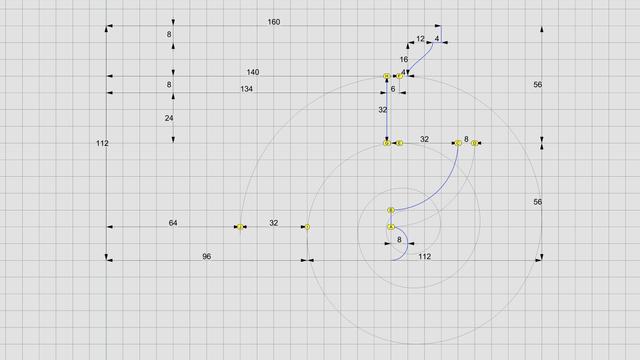
Classic #IonicCapital #Tectonic Surfaces Plan We already made the 8 unit tall #fillet at the bottom of the #capital a part of the #shaft in https://pixelfed.social/p/Splines/791794072490907090. So, excluding that, the remainder of the capital is 14 parts or 112 units tall, for the bottom half of which we use the #revolve operation (like the #columnBase and #columnShaft), and for the top half we use the #extrude operation (like the #pedestal, #entablature, and #plinth). Starting at the bottom, we have an #astragal that is 2 parts or 16 units tall and has the same profile as a #reed and #torus, falling in between the two in terms of size. The arc AD is shown in gray because it is an invisible #virtualSurface that envelops the decorations like #eggsAndDarts on the #ovolo. This is the measurement that is given in #Scarlata's #PracticalArchitecture, but it makes no mention of the #decorative and #tectonic surfaces. Arc BC with a radius of 4 parts or 32 units is the tectonic surface on which the Ovolo decorations rest. Such decorations have a variable or uneven surface which may not exceed 1 part or 8 units. Points E and F mark the horizontal tangent or maxima of the second spiral and the first (outermost) spiral, respectively. The gap between them is exactly 4 parts or 32 units. GH is the profile for the vertical side surface on which part of the #ribbon and #braid lie flat, protruding exactly 6 units to coincide with the invisible virtual flat surface through EF. The #cymaReversa is 2 parts or 16 units tall and 1.5 parts or 12 units wide. It starts 4 units to the right of F and stops 4 units short of the top fillet, which is one part or 8 units tall and 20 parts or 160 units from the #columnAxis. Of the 4 parts or 32 units between G and H, the lower 3 parts or 24 units are part of the #voluteChannel groove and the top 1 part or 8 units is a fillet that follows the curve of the #volute and progressively gets narrower until it converges with the #eye of the volute.

Pixelfed
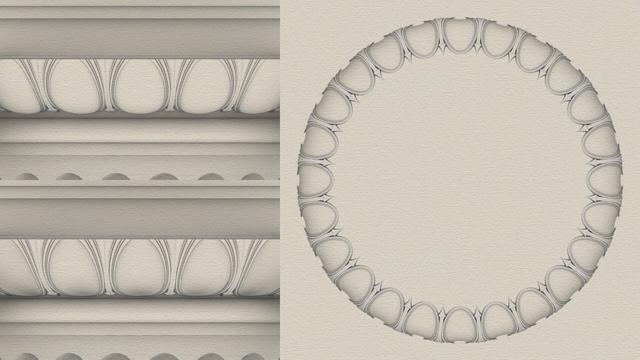
#EggsAndDarts is a common classical design motif with endless variations, two of which are shown here — the top-left variant has convex eggs and the bottom-left variant has concave eggs. The sketch on the right shows the bottom view of the concave variant.

This motif is neither specific to the #IonicOrder, nor limited to the #ovolo of the capital. It is common to find it laid on linear #moldings like #cymaRecta or #cymaReversa of a #cornice.

The egg shape, the dart shape, the degree of convexity or concavity, and so on, are infinitely variable from subtle to pronounced. Designers are not limited to convex or concave, and it is possible to combine both in a single design. Also, it is not necessary to use the eggs and dart motif at all. There are infinite possibilities. However, when the eggs and darts motif is used, it is almost invariably sliced off at the top, as the bottom view of concave variant on the right reveals.

The concave version here is quite subtle, but a more pronounced version can be really eye-popping. I will show how to construct one using just straight lines and circular/elliptical arcs exclusively as I originally promised in https://pixelfed.social/p/Splines/789956327130679640.

As usual, we start with a flat 2-dimensional plan with lines and ovals to use as #sweepingRails. Then, we add circles and arcs as #sweepingCurves to define the cross-sections. After sweeping the cross section curves on the rails, we create the eggs.

Simply #revolve an ellipse on its major axis to get the convex version of an egg. To get the concave version of an egg, simply create a flat slab and perform a #booleanDifference on that slab using a convex egg.

Once we have all of this preparatory work done, we have to transfer the 3-dimensional design from the flat surface it was originally created on to the #doublyCurved surface of the Ovolo. This requires some elementary calculations using circle geometry.

Previous— https://pixelfed.social/p/Splines/795361973789834465
Splines (@[email protected])

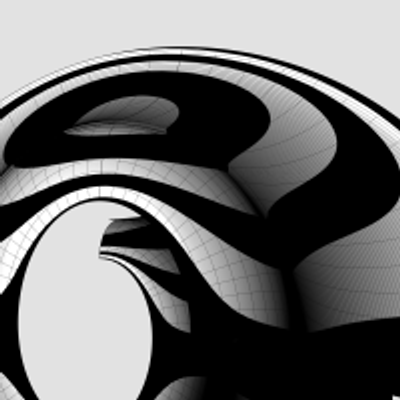
This sweeping shape is a timeless design that first appeared in the scrolls of the #IonicCapital as the most distinctive part of the #IonicOrder in classical Greco-Roman architecture more than 2500 years ago. Shown here with a zebra pattern on the wireframe of a CAD model to accentuate its features and attest to the smoothness of its 3-dimensional surface, the design has been refined many times since the original version over the last two millennia. The two most remarkable things about this design are that: — It can be recreated with modern CAD tools by drawing simple 2-dimensional straight lines and circular arcs exclusively. The end result is truly breathtaking and makes one wonder how architects visualized the result and put theory into practice. In the CAD model, the ultimate surface is a #NURBS surface that uses #BSplines extensively, but none of the B-splines or surfaces need to be created "by hand." One only has to draw straight lines and circular arcs with accurate measurements snapped to grids. — For a design that has survived the ages, it is lamentable how few authoritative sources that accurately describe fine details and exact reconstruction methodology remain accessible to the general public in the age of Internet. The most comprehensive is the 10-volume tome that Marcus #Vitruvius Pollio, a Roman architect and engineer, wrote for #JuliusCaesar and his successor Emperor #CaesarAugustus. [https://www.gutenberg.org/files/20239/20239-h/20239-h.htm] I frequently use two more authoritative sources: — "Regola delli cinque ordini d' architettura," or simply #RegolaArchitettura by Giacomo Barozzi da #Vignola [https://archive.org/details/gri_33125008229458/page/n3/mode/2up], and — "A Course in Theoretical and Practical Architecture," or simply #PracticalArchitecture by Francisco Salvatore #Scarlata (#Bordonaro), which documents #VignolaProportions in tabular form [https://babel.hathitrust.org/cgi/pt?id=mdp.39015031201190&view=1up&seq=5]

Pixelfed
Classic #IonicCapital #Tectonic Surfaces Plan

We already made the 8 unit tall #fillet at the bottom of the #capital a part of the #shaft in https://pixelfed.social/p/Splines/791794072490907090. So, excluding that, the remainder of the capital is 14 parts or 112 units tall, for the bottom half of which we use the #revolve operation (like the #columnBase and #columnShaft), and for the top half we use the #extrude operation (like the #pedestal, #entablature, and #plinth).

Starting at the bottom, we have an #astragal that is 2 parts or 16 units tall and has the same profile as a #reed and #torus, falling in between the two in terms of size. The arc AD is shown in gray because it is an invisible #virtualSurface that envelops the decorations like #eggsAndDarts on the #ovolo. This is the measurement that is given in #Scarlata's #PracticalArchitecture, but it makes no mention of the #decorative and #tectonic surfaces. Arc BC with a radius of 4 parts or 32 units is the tectonic surface on which the Ovolo decorations rest. Such decorations have a variable or uneven surface which may not exceed 1 part or 8 units.

Points E and F mark the horizontal tangent or maxima of the second spiral and the first (outermost) spiral, respectively. The gap between them is exactly 4 parts or 32 units. GH is the profile for the vertical side surface on which part of the #ribbon and #braid lie flat, protruding exactly 6 units to coincide with the invisible virtual flat surface through EF.

The #cymaReversa is 2 parts or 16 units tall and 1.5 parts or 12 units wide. It starts 4 units to the right of F and stops 4 units short of the top fillet, which is one part or 8 units tall and 20 parts or 160 units from the #columnAxis.

Of the 4 parts or 32 units between G and H, the lower 3 parts or 24 units are part of the #voluteChannel groove and the top 1 part or 8 units is a fillet that follows the curve of the #volute and progressively gets narrower until it converges with the #eye of the volute.
Splines (@[email protected])

The bottom 1/3 of the #columnShaft for an #IonicColumn is a perfect cylinder. So the line below point B is a straight line. In https://pixelfed.social/p/Splines/791723063470910081, we blended the bottom end of the 60° arc and the top end of the long interpolated curve between points J and K. Now blend the bottom end of the interpolated curve and the top end of the straight line between points B and C to obtain the 3rd and final #NURBS segment for the #primaryProfileCurve of the shaft. Just like there's a #cavetto and #fillet near the #neck of the shaft, there is a fillet and cavetto near the foot of the shaft. However, there is a subtle difference between the two. The cavetto near the neck is tangential to the blended #NURBS curve that is not a straight line. The profile curve for the cavetto near the foot is tangential to a straight line. There is a special name for a cavetto that is tangential to a straight line or flat surface, like the two cavetto moldings in the #dado of the #pedestal. It's called a #conge. Another alternate name for the cavetto molding is #cove, which is evocative of "cave" because of its concave profile curve. Above the neck is a fillet 8 units tall and an #astragal 16 units tall that #Scarlata puts in braces in the column shaft section within his tables of #VignolaProportions, with a note saying they are not counted as part of the shaft but are accounted for as part of the #capital. I decided to include the top fillet as part of the shaft and keep the astragal with the capital. It does not change the design or alter the proportions in any way, but the inclusion of the fillet makes it more practical for #3DPrinting and #CNCMilling of the neck. This concludes the profile curve for the shaft with a height of 291 parts or 2328 units + 8 for fillet. The column shaft is tapered in the upper 2/3 due to #entasis whose purpose is to make optical corrections to the shape of the column which, without correction, appeared concave near the top.

Pixelfed
The #Capital is the last essential component of the complete #IonicOrder. The column #flutes remain, but they are #decorativeElements, and I will cover them later when I cover the decorative elements of the capital like the #EggsAndDarts motif on the #ovolo and the #3StrandBraid on the ribbon or belt around the middle of the smooth #scrolls.

The Ionic capital is complex, but not unapproachable. We will systematically construct everything in this draft rendering using just straight lines and arcs as promised in https://pixelfed.social/p/Splines/789956327130679640, with the exception of the #cymaReversa near the top and the 3-strand braid on the ribbon.

In this rendering, the cyma reversa near the top is made using a flattened half-turn of a #helix, but it can also be constructed using elliptical arcs as I described in earlier posts.

The braid is a #periodic shape with infinite variety and is also based on a helix. You can vary the number of strands, their thickness, pitch, and so on, none of which are essential to the Ionic Order itself. They're only a jumping point for further exploration.

The eggs in the 'eggs and darts' motif can have different shapes. They can be convex like real eggs or concave as shown here, but the top is almost always sliced off. The total depth of the convex or concave shapes can vary, but only within a range of 1 part, or 8 units.

The #volutes in the front and back of the capital are based on #spiral shapes, of which there are many different kinds. Some have #continuous curvature changes, while some do it in #discrete steps, like #fibonacci spirals that can approximate #logarithmic spirals seen in nature, e.g., nautilus. When curvature changes are discrete, the spiral arms can diverge in #arithmetic, #geometric, or some other sequence.

We will construct all of these, and most notably the smooth, sweeping surface of the scrolls using just straight lines and arcs, and let the #CAD software deal with delicate #NURBS curves and surfaces.
Splines (@[email protected])

This sweeping shape is a timeless design that first appeared in the scrolls of the #IonicCapital as the most distinctive part of the #IonicOrder in classical Greco-Roman architecture more than 2500 years ago. Shown here with a zebra pattern on the wireframe of a CAD model to accentuate its features and attest to the smoothness of its 3-dimensional surface, the design has been refined many times since the original version over the last two millennia. The two most remarkable things about this design are that: — It can be recreated with modern CAD tools by drawing simple 2-dimensional straight lines and circular arcs exclusively. The end result is truly breathtaking and makes one wonder how architects visualized the result and put theory into practice. In the CAD model, the ultimate surface is a #NURBS surface that uses #BSplines extensively, but none of the B-splines or surfaces need to be created "by hand." One only has to draw straight lines and circular arcs with accurate measurements snapped to grids. — For a design that has survived the ages, it is lamentable how few authoritative sources that accurately describe fine details and exact reconstruction methodology remain accessible to the general public in the age of Internet. The most comprehensive is the 10-volume tome that Marcus #Vitruvius Pollio, a Roman architect and engineer, wrote for #JuliusCaesar and his successor Emperor #CaesarAugustus. [https://www.gutenberg.org/files/20239/20239-h/20239-h.htm] I frequently use two more authoritative sources: — "Regola delli cinque ordini d' architettura," or simply #RegolaArchitettura by Giacomo Barozzi da #Vignola [https://archive.org/details/gri_33125008229458/page/n3/mode/2up], and — "A Course in Theoretical and Practical Architecture," or simply #PracticalArchitecture by Francisco Salvatore #Scarlata (#Bordonaro), which documents #VignolaProportions in tabular form [https://babel.hathitrust.org/cgi/pt?id=mdp.39015031201190&view=1up&seq=5]

Pixelfed
Classic variation of the #IonicEntablature. Left side shows the macro-level plan. Right side shows the detailed plan for the #moldings.

All moldings should be familiar from the #IonicPedestal, except the #fascia — flat bands, of which there are 3, at the bottom of the #Architrave. The fascias grow progressively taller, starting at 36 units at the bottom, to 48 in the middle, and 60 at the top, with each successive one offset horizontally by 6 units from the previous one.

Above the fascia, we have a #cymaReversa which is 24 units tall and 20 units wide. Here we are using half turn of a helix with a vertical axis. Either helix or elliptical arcs are acceptable, but the choice must be consistent across the entire order. You cannot use ellipses in the pedestal and helices in the entablature, for example.

If you do use a helix, remember that it is a 3D shape like a round coil. To use it as a #profileCurve, it must be flattened to a 2D shape by #projecting it to the #constructionPlane. I will describe this technique in detail later.

The #frieze is a flat surface with no moldings. It is meant as a blank space on which to put custom decorative 3D #ReliefCarvings or sculptures.

There are no new moldings in the #cornice. Note that the order of #cymaRecta and cyma reversa are reversed from that of the #pedestal, with cyma recta at the top and cyma reversa at the bottom. The only difference between the two is that the recta has a horizontal axis and reversa has a vertical axis. Rotating either one 90° yields the other.

So, the bottom of the cornice starts with a cyma reversa 32 units tall and 34 wide. This is followed by a fascia 56 units tall on which the #dentils will appear later on. The 36 unit horizontal offset for the 4-unit thick fillet above it is to leave room for the dentils.

This is followed by a #reed (8 units), #ovolo (32 units), #corona (48 units), cyma reversa (16 x 12 units), fillet (4 units), cyma recta (40 x 44 units), and fillet 12 units
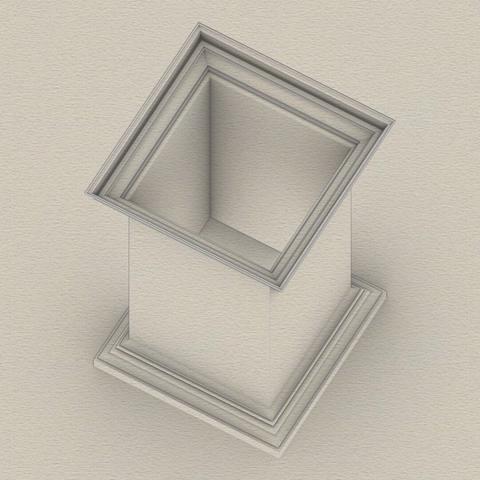
From https://pixelfed.social/p/Splines/790645054230337543, we now have an open surface for the #IonicPedestal. To finish this, close the #planarHoles at the top and bottom with flat caps and join everything. And just like that, we have finished 1/3 of the complete #IonicOrder with very little work.

To ensure that your finished object is amenable to #3DPrinting or #CNCMilling, always check the edges of your object after all surfaces have been joined. Do this EVERY time you join surfaces to create a closed object.

Most CAD programs will offer edge analysis tools that let you detect #nakedEdges or #nonManifoldEdges. If you have either of those, your object is not #airtight, and you will not be able to physically realize it.

This version of the pedestal uses the classic variation of #CymaRecta and #CymaReversa. If you want to remain faithful to the original, then you are done.

However, designs are rarely static and they continue to evolve. There is an opportunity for a slight refinement at the top and bottom of the pedestal without compromising the integrity of the order, but it requires the introduction of a new kind of curve — a #helix, which is a coil-shaped 3D curve.

I will discuss the #helixVariation later. For now, look closely at the #basement and notice how pronounced the turns of the cyma recta are. Instead of using elliptical arcs in the #primaryProfileCurves of the cyma recta and cyma reversa, it is possible to substitute a half-turn of a helix that has been flattened to a 2D shape. The result is a softer, more gradual profile curve that produces a very refined shape.
Splines (@[email protected])

If you've been longing for some 3D adventure, your wait is over. We have here some of the most basic 3D operations that you will use over and over. First #join all #primaryProfileCurves into a single curve that has both straight lines and arcs. If you are unable to join them, look closely at the bottom #fillet of the #dado where it meets the top of the #reed of the #basement. There is a gap of 2 units between the fillet and the arc of the reed. Close the gap with a straight line and join the curves. Switch from the front view to the right view, and #extrude the joined profile curves on both sides of the profile curve so that the full extrusion is a little over the total width of the pedestal. A good rule of thumb is to extrude at least 1/8th extra on both sides of the joined profile curve. This extrusion is shown in the attached image as the gray surface in perspective view. Switch back to the front view and centered on the #columnAxis, draw a rectangle that is somewhat taller than the total pedestal height so that it extends past both the top and bottom of the pedestal extrusion from the previous step. The total width of this rectangle should be about 1.5 times the width of the pedestal. This is because we will create a cutting surface with this rectangle and rotate it 45° in the top view, and then rotate a copy of that another 90°, as shown by the flat red surfaces. The reason the width must be approximately 1.5 times (or larger) is because #Pythagoras told us that the hypotenuse of a unit square is 1.414 units. So 1.5 times should be enough. Use the two cutting planes to cut, split, or trim the extruded surface (depending on the terminology of your CAD program). This is called #mitering. Discard the excess of the extruded surface from both ends. Also discard or hide the red mitering surfaces. Switch to the top view and rotate the #mitered extrusion repeatedly at 90° about the column axis until you have all four sides, and join them all into a hollow shape.

Pixelfed
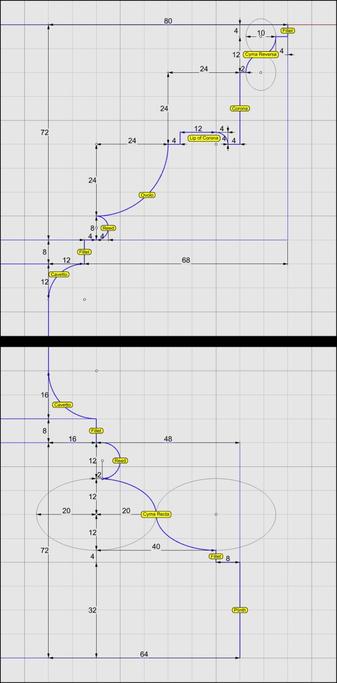
This shows the detailed measurements of the top and bottom portions of the #IonicPedestal. For macro-level measurements, see https://pixelfed.social/p/Splines/790571135473463588

Each of the blue curve segments (lines and arcs) that are marked with a yellow bubble is the #profileCurve for a #molding whose name is inside the bubble.

Starting at the bottom, we have a #plinth, a #fillet, a #cymaRecta, and a #reed as part of the #basement of an Ionic pedestal.

Next up, we have a #fillet and a #cavetto at the bottom of the #dado, and another cavetto and fillet at the top of the dado.

Moving higher up, a reed, an #ovolo, a #corona, a #cymaReversa, and a final fillet top off the cap of the pedestal.

They are called profile curves because each is the outline or silhouette of a 3D molding as seen from one side or in a cross section. In the case of a pedestal, these curves can be used directly to recreate the 3D shape of the pedestal. For this reason and in this case, I call them #primaryProfileCurves.

This is not always the case. For more complex shapes, such as the #scroll surface of an #IonicCapital shown in https://pixelfed.social/p/Splines/789956327130679640, the profile curves recovered by #reverseEngineering the image scans in #Vignola's book cannot be used directly to sweep the scroll surface because the scroll shape is not cylindrical. Like the inside of a rose, the scroll surface follows the outlines of spiral #volutes in the front and back, neither of which are circular. So, additional steps are necessary to derive the curves that we can actually use to reconstruct the surface.

In the case of the scroll surface, the derivation of these curves is not trivial and not obvious, but it is not difficult to understand, and no math is involved. There are multiple sets of curves, and each successive set is derived from a previous set. I call them secondary, tertiary, and quaternary curves.

For now, we stick with the primary profile curves for the pedestal.
Splines (@[email protected])

This shows macro-level measurements for the #IonicPedestal. The key to #effectiveModeling is to simplify a complex shape into elementary components. Sometimes, this involves mentally flattening and reducing 3D shapes to 2D shapes, extracting elementary curves from them, and then recreating the 3D shapes from the extracted 2D curves. This is not always easy for organic shapes (which can still be approximated by Bézier curves). I extracted the #primaryCurves for the #IonicScroll surface in https://pixelfed.social/p/Splines/789956327130679640 after a lengthy trial-and-error process that involved #curveFitting images from #Vignola’s book, #RegolaArchitettura. I had to reverse engineer the details because the measurements have either been lost, or are locked away in some library. Web search yields no details on these measurements. Fortunately, for geometrical shapes like pedestals, this is very easy. Because of its square footprint, mentally slicing it through the middle from top to bottom, it is easy to “see” the outline. Another way to think about #curveExtraction is to shine an imaginary bright light on an object from behind in a dark room to reveal its silhouette. For the pedestal, even this silhouette or outline can be further reduced because the shape is symmetrical about the #columnAxis. With this realization, we only need to focus on one half of the outline, and methodically proceed from bottom to top, marking every kink and inflection point on the outline. Fortunately, the other authoritative book, #Scarlata’s #PracticalArchitecture, I mentioned in my introductory post already documents #VignolaProportions in tabular form. So we can skip everything else and go directly to that. Total height of #IonicPedestal is 864 units (108 parts, or 6*µ) of which the #PedestalBasement and #PedestalCap are each 72 units (9 parts, or µ/2) and the #Dado is 720 units (90 parts, or µ*5) tall.

Pixelfed