#Revolve 入れてみた
一点だけ要望するならば、タップしただけでファボってしまうのだけオフにできれば良いなと
#Revolve 入れてみた
一点だけ要望するならば、タップしただけでファボってしまうのだけオフにできれば良いなと
Los Angeles Lakers Land Revolve Sponsorship Deal
#Lifestyle #LifestyleNews #LosAngelesLakers #Revolve
掲載日 2025年5月23日 米国のeコマース・ファッション大手リボルブ・グループが、ディオン・リーの知的財産関連資産を買収したと報じられています。コレクションを見るDion Lee - 2024年春夏 - ウィメンズ - アメリカ合衆国 - ニューヨーク - © Launchmetricsオーストラリアのメディアの報道によると、ロサンゼルスを拠点とし、高級マルチブランドのeコマースプラットフォームRevolveとFwrdを運営するRevolve Groupが、シドニーで設立されたブランドの資産を買収したとのことです。ただし、この取引の金額は公表されていませんが、あるメディアはその金額が100万ドル未満と報じています。昨年から、オーストラリアの倒産処理会社DVT GroupのAntony Resnickは、現在ニューヨークに拠点を移しているこのファッションブランドを救う買い手を探していました。同ブランドは、主要投資家であるCue Clothingが事業への出資を取りやめたことを受け、昨年5月に破産を申請しました。破産当時、同ブランドはCue Clothingからの2000万ドルの融資を含む3500万ドルの負債を抱えていました。報道によると、管財人は2024年後半に4万点以上のディオン・リーの商品を大幅割引で売却し、900万ドルの負債を回収しました。11月、Resnickは、救世主となる買い手も投資家も見つからず、ディオン・リーは2024年末までに閉店すると発表しました。コレクションを見るDion Lee - 2024年春夏 - ウィメンズ - アメリカ合衆国 - ニューヨーク - © LaunchmetricsRevolveが救済したことで、デザイナーのディオン・リーはブランドのクリエイティブ・ディレクターとして留まると見られています。ディオン・リーとリボルブの両社は、このニュースをまだ確認していません。ディオン・リーは2009年に自身の名を冠したファッションブランドを設立しました。2013年には、オーストラリアのブランドであり小売業者でもあるCueがDion Leeの主要株を取得し、その1年後にはニューヨーク・ファッション・ウィークの一部としてショーを行い、2024年春夏シーズンまで同ブランドの主力となっていました。今月初め、Dion Leeの親会社であるRevolve Groupは、すべてのブランドチャネルと地域にわたる成長により、第1四半期の売上が10%増の2億9670万ドルになったと発表しました。
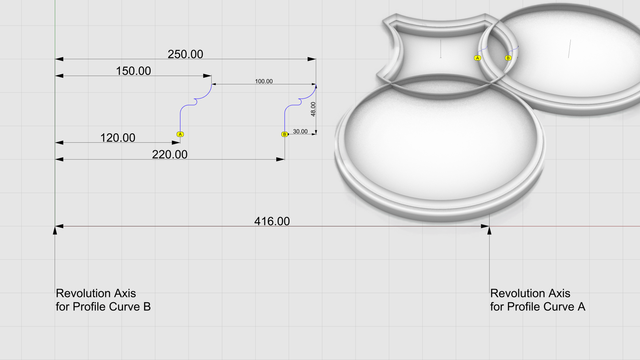
Plan for the #ModernIonicCapital If the design in https://pixelfed.social/p/Splines/807569519962747338 looks daunting, let me assure you it is far simpler than the work that went into the reconstruction of just the #scroll for the #classicIonicCapital. Be sure to check out #MileStone4 at https://pixelfed.social/p/Splines/795361973789834465. With the modern #IonicCapital, the designers went back to the basics of using just straight lines and circular arcs to define the geometry of the essential elements of the capital. No #braids, #keystones, or #modillions, and no #helix curves or #sinusoids. We start the floorplan for the modern ionic capital with a circle of radius 5/6 of µ (120 when µ = 144) which marks the neck of the #columnShaft. Tangent to this circle is a large circle of radius 296 units centered on the X axis exactly 416 units from the column axis. This is the circle that marks the curve of the #abacus, which is always tangential to the column shaft at the neck. This circle also marks the curved faces of the interior portion of the #volute wedge. Without the raised volute spirals, the interior wedge appears flush with the abacus as they follow the same circular arc. Concentric to this large circle is another circle with a radius of 280 units to mark the extent of the raised volute spirals which are 16 units thick. Another concentric circle of radius 266 units marks the outer edge of the top of the capital. The gap between the outermost large circle and the innermost concentric circle is 30 units, and that is reflected in another pair of circles centered on the column axis with radius of 250 units and 220 units to define the four corners. The capital footprint fits in a square 396 units wide — or 24.75 parts horizontally from axis, per #Scarlata in https://babel.hathitrust.org/cgi/pt?id=mdp.39015031201190&view=1up&seq=45. Use this with the sketch in https://babel.hathitrust.org/cgi/pt?id=mdp.39015031201190&view=1up&seq=142
#EggsAndDarts continuation from https://pixelfed.social/p/Splines/796961505955555432 The slab height depends on the roundness of the egg and whether we have a concave design or not. If we are using a concave base, then top half of the egg is eliminated. For a fully round egg, that means the concave variant must scoop out up to 16 units deep. The dart slab will match the egg slab in depth. To create the 3-dimensional shape of the dart, first #rotate the fin profile 90° in 3D space along the straight line at the bottom of the fin so that the rotated profile is perpendicular to the two #sweepRails for the dart. Using the two sweep rails and the perpendicular fin profile, #sweepTwoRails to develop the surface of the dart. Remember to close the planar hole at the end of the fin to get a solid #airtight object. As always, check for #nakedEdges and #nonmanifoldEdges to stave off problems later. #Extrude the bottom of the dart until it is flush with the bottom of the oval slab. Two details worth noting in the dart design are: 1. The most exaggerated portions of the dart fin are sliced off when the eggs are sliced. After slicing, the size of the fin is roughly in proportion to the rims of the eggs on both sides. 2. There is a gap between the dart arrow and the oval slab. See the gap between points R and T in https://pixelfed.social/p/Splines/796961505955555432. This gap is necessary and will automatically close when we transfer the egg and dart to the #doublyCurved surface of the #ovolo on the #capital of the #IonicColumn. That is because the Ovolo is shaped like a bowl whose top has a bigger radius than the bottom. As a result, the motif will be warped, and its bottom will be condensed to fit the smaller radius at the bottom, closing the gap in the process. If you plan to use the eggs and darts motif on a linear surface where there is no warping, experiment with the arrow and tip for a pleasing result.
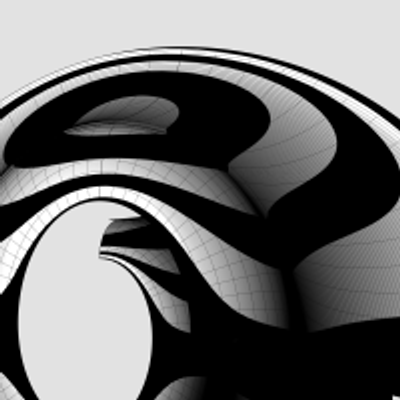
This sweeping shape is a timeless design that first appeared in the scrolls of the #IonicCapital as the most distinctive part of the #IonicOrder in classical Greco-Roman architecture more than 2500 years ago. Shown here with a zebra pattern on the wireframe of a CAD model to accentuate its features and attest to the smoothness of its 3-dimensional surface, the design has been refined many times since the original version over the last two millennia. The two most remarkable things about this design are that: — It can be recreated with modern CAD tools by drawing simple 2-dimensional straight lines and circular arcs exclusively. The end result is truly breathtaking and makes one wonder how architects visualized the result and put theory into practice. In the CAD model, the ultimate surface is a #NURBS surface that uses #BSplines extensively, but none of the B-splines or surfaces need to be created "by hand." One only has to draw straight lines and circular arcs with accurate measurements snapped to grids. — For a design that has survived the ages, it is lamentable how few authoritative sources that accurately describe fine details and exact reconstruction methodology remain accessible to the general public in the age of Internet. The most comprehensive is the 10-volume tome that Marcus #Vitruvius Pollio, a Roman architect and engineer, wrote for #JuliusCaesar and his successor Emperor #CaesarAugustus. [https://www.gutenberg.org/files/20239/20239-h/20239-h.htm] I frequently use two more authoritative sources: — "Regola delli cinque ordini d' architettura," or simply #RegolaArchitettura by Giacomo Barozzi da #Vignola [https://archive.org/details/gri_33125008229458/page/n3/mode/2up], and — "A Course in Theoretical and Practical Architecture," or simply #PracticalArchitecture by Francisco Salvatore #Scarlata (#Bordonaro), which documents #VignolaProportions in tabular form [https://babel.hathitrust.org/cgi/pt?id=mdp.39015031201190&view=1up&seq=5]
The bottom 1/3 of the #columnShaft for an #IonicColumn is a perfect cylinder. So the line below point B is a straight line. In https://pixelfed.social/p/Splines/791723063470910081, we blended the bottom end of the 60° arc and the top end of the long interpolated curve between points J and K. Now blend the bottom end of the interpolated curve and the top end of the straight line between points B and C to obtain the 3rd and final #NURBS segment for the #primaryProfileCurve of the shaft. Just like there's a #cavetto and #fillet near the #neck of the shaft, there is a fillet and cavetto near the foot of the shaft. However, there is a subtle difference between the two. The cavetto near the neck is tangential to the blended #NURBS curve that is not a straight line. The profile curve for the cavetto near the foot is tangential to a straight line. There is a special name for a cavetto that is tangential to a straight line or flat surface, like the two cavetto moldings in the #dado of the #pedestal. It's called a #conge. Another alternate name for the cavetto molding is #cove, which is evocative of "cave" because of its concave profile curve. Above the neck is a fillet 8 units tall and an #astragal 16 units tall that #Scarlata puts in braces in the column shaft section within his tables of #VignolaProportions, with a note saying they are not counted as part of the shaft but are accounted for as part of the #capital. I decided to include the top fillet as part of the shaft and keep the astragal with the capital. It does not change the design or alter the proportions in any way, but the inclusion of the fillet makes it more practical for #3DPrinting and #CNCMilling of the neck. This concludes the profile curve for the shaft with a height of 291 parts or 2328 units + 8 for fillet. The column shaft is tapered in the upper 2/3 due to #entasis whose purpose is to make optical corrections to the shape of the column which, without correction, appeared concave near the top.
This sketch shows the arrangement of #dentils in the classic variation of the #IonicEntablature. It shows the full layout, but most of the top is obscured by the top portion of the #cornice. Only the outside square shapes are actually visible. Each #dentil has a square "footprint" that is 4 parts by 4 parts (32*32 units) and is 6 parts (48 units) tall. The spacing between each dentil is 2 parts (16 units). Dentils project 4 parts (or 32 units) from the face of the #fascia on which they rest. Each face of the fascia has 7 dentils with the middle dentil laterally centered and directly in front of the column axis. The 2 side dentils are on side faces, and that is apparent in the darker shading in the sketch at https://pixelfed.social/i/web/post/790782316675150160. Take the time to reconcile this with the numbers listed in #Scarlata's #PracticalArchitecture. The 3D reconstruction from the #primaryProfileCurves is very similar to that of the #IonicPedestal, with #extrusion, #mitering, #joining, and #capping planar holes as described in https://pixelfed.social/i/web/post/790645054230337543 — just set the dentils aside, for now. Once you have capped the #planarHoles to get a solid, analyze the edges of the solid in the #CAD program for #nakedEdges and #nonManifoldEdges. Then, extrude the dentils outline (in the top view) to a height of 48 units (in the front view). Now perform a #booleanUnion of the two solid shapes to get the complete #entablature. Finally, check the edges of the solid in the #CAD program AGAIN for #nakedEdges and #nonManifoldEdges. With this, we have finished two of the three main components of the #IonicOrder. There's a modern version of the Ionic entablature with #modillions, which I will describe later. Next, we move on to the biggest, most conspicuous part of the order — the #IonicColumn.
37 #Funny And #Relatable #Comics About #Life’s #Quirks #Illustrated By 5ish.art on #Instagram
Most of the #comics #revolve around her #life as an #artist, a #mom, and a #wife, topics to which a lot of #people can #relate.
#Women #Transgender #LGBTQ #LGBTQIA #Entertainment #TheArts #Comics #Family #Relationships #Representation #Culture
This illustrator, who goes by 5ish.art on Instagram, finds joy in drawing mostly female cartoon characters in a slightly spicy way. In addition to these illustrations, J. Findlay also creates lighthearted and funny comics. Most of the comics revolve around life as an artist, a mom, and a wife, topics to which a lot of people can relate.