 Spaceflight 🚀
 Stefan F. Wirth
 71
71
The #Cretaceous hothouse had atmospheric #CO₂ levels above 1,000 ppm, compared with 420 today, and temperatures up to 10℃ higher than today. It was caused by very fast-moving #tectonic plates, which increased CO₂ emissions. Tectonic plates slow down due to collisions, which leads to mountain building. The weathering of igneous rocks is very efficient in reducing atmospheric CO₂. Spreading olivine on beaches could absorb up to a trillion tonnes of CO₂ from the atmosphere https://www.sydney.edu.au/news-opinion/news/2022/05/26/how-plate-tectonics-have-maintained-earth-s--goldilocks--climate.html
@nationalparks #PointReyes #NationalSeashore is a #nationalpark near San Francisco established in 1962 by John F. Kennedy. The area encompasses a #peninsula and a small section of the adjacent ocean. It is of #tectonic interest because it lies on the #PacificPlate, which moves relative to the #NorthAmericanPlate with the San Andreas Fault between both. The peninsula has a special vegetation: the #Californiacoastalprairie.
Text by Stefan F. Wirth
Video by USGS Science https://youtu.be/gsuH8t1BApY?is=k83s_l7ySmIemFDK
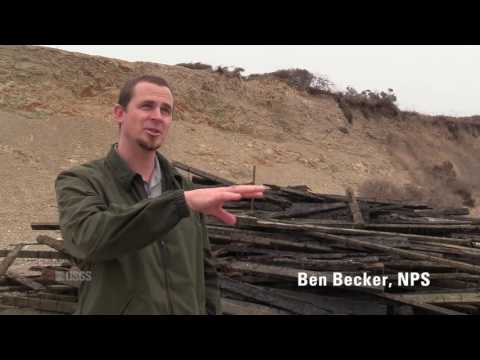
USGS Science in Point Reyes National Seashore (California)
 Scientific Frontline
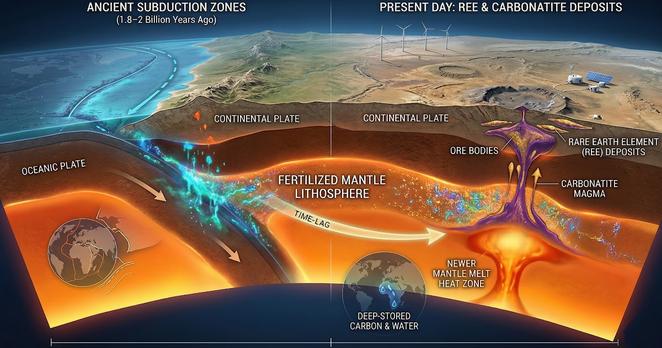
Ancient subduction zones—regions where #tectonic plates historically collided and forced material beneath one another—are the primary drivers behind the formation and distribution of critical rare earth element (REE) deposits and carbonatite magmas.
#EarthSciences #Geology #Geochemistry #Tectonophysics #sflorg
https://www.sflorg.com/2026/04/es04092601.html
#EarthSciences #Geology #Geochemistry #Tectonophysics #sflorg
https://www.sflorg.com/2026/04/es04092601.html
 Benjamin Carr, Ph.D. 👨🏻💻🧬
A Billion Years Are Mysteriously Missing From #Earth’s History. Now, We Know Why.
#TheGreatUnconformity — a gap in Earth’s #geologicalrecord. New research suggests it was created by shifting continents, rather than “#SnowballEarth” or #Cambrian life. Evidence that the gap was largely created by #tectonic processes that occurred from 2.1B to 1.6B years ago, in the #Neoproterozoic era, during the formation of an ancient supercontinent called Columbia
https://www.404media.co/great-unconformity-gap-geological-record-study-columbia/
https://archive.ph/glmuh
#TheGreatUnconformity — a gap in Earth’s #geologicalrecord. New research suggests it was created by shifting continents, rather than “#SnowballEarth” or #Cambrian life. Evidence that the gap was largely created by #tectonic processes that occurred from 2.1B to 1.6B years ago, in the #Neoproterozoic era, during the formation of an ancient supercontinent called Columbia
https://www.404media.co/great-unconformity-gap-geological-record-study-columbia/
https://archive.ph/glmuh
 Richard Michael Blaber
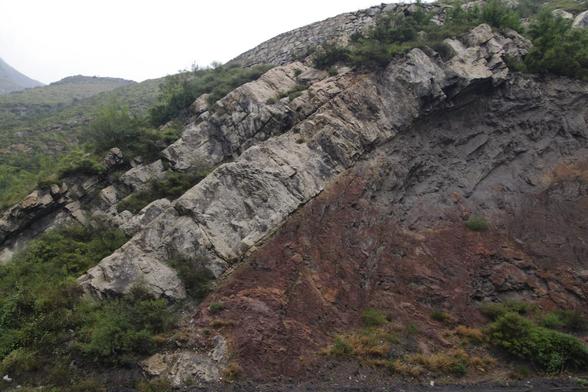
https://theconversation.com/how-one-massive-gas-field-shapes-the-global-stakes-of-conflict-in-the-middle-east-277439; https://theconversation.com/the-oil-price-surge-is-just-one-symptom-of-a-supply-chain-network-that-is-not-fit-for-this-age-of-global-tensions-277277. "The #MiddleEast is responsible for some 30% of global #oil production & 17% of global natural #gas production... Incredibly all this #oilandgas is found within a single minor #tectonic plate - the #Arabian plate."

 CBC Top Stories
The ‘Big One’ just got more complicated
Scientists have discovered a massive tear in the tectonic plate off the coast of Vancouver Island. This "rip" suggests that the northern end of the Cascadia Subduction Zone is actually starting to shut down. The CBC’s Johanna Wagstaffe investigates what this discovery might mean for the "Big One" off the coast of Vancouver Island.
#discovery #tectonic #cascadia #subduction #VancouverIsland
https://www.cbc.ca/player/play/9.7107713?cmp=rss
Scientists have discovered a massive tear in the tectonic plate off the coast of Vancouver Island. This "rip" suggests that the northern end of the Cascadia Subduction Zone is actually starting to shut down. The CBC’s Johanna Wagstaffe investigates what this discovery might mean for the "Big One" off the coast of Vancouver Island.
#discovery #tectonic #cascadia #subduction #VancouverIsland
https://www.cbc.ca/player/play/9.7107713?cmp=rss

 Hacker News
Scientists discover recent tectonic activity on the moon
https://phys.org/news/2026-02-scientists-tectonic-moon.html
#HackerNews #Scientists #Tectonic #Moon #Discovery #Space #Science #Lunar #Activity

Scientists discover recent tectonic activity on the moon
Scientists have produced the first global map and analysis of small mare ridges (SMRs) on the moon, a characteristic geological feature of tectonic activity. Published in The Planetary Science Journal Dec. 24, 2025, the analysis performed by scientists at the National Air and Space Museum's Center for Earth and Planetary Studies and colleagues reveals for the first time that SMRs are geologically young and are widespread across the lunar maria—the vast, dark plains on the moon's surface. The team's discovery of how SMRs form introduces a new set of potential moonquake sources that could affect future site selections for lunar landings.
 michael
17-Feb-2026
Smithsonian planetary scientists discover recent #tectonic activity on the #Moon
New map of small ridges in the Lunar Maria reveals new seismic threats to human exploration
https://www.eurekalert.org/news-releases/1116509 #science #solarSystem

Smithsonian planetary scientists discover recent tectonic activity on the Moon
Scientists have produced the first global map and analysis of small mare ridges (SMRs) on the moon, a characteristic geological feature of tectonic activity. The team’s discovery of how SMRs form introduces a new set of potential moonquake sources that could affect future site selections for lunar landings.
 Nikolas Kozloff has moved
The connection between #tectonic plates and #climate https://phys.org/news/2026-01-shifting-tectonic-plates-drove-earth.html#google_vignette My reporting from #Chile here https://nkozphoto.com/index.php/2025/11/05/earthquakes-evolution-and-darwins-exploits-in-chile/ #darwin #evolution #science #earthquake #earthquakes
