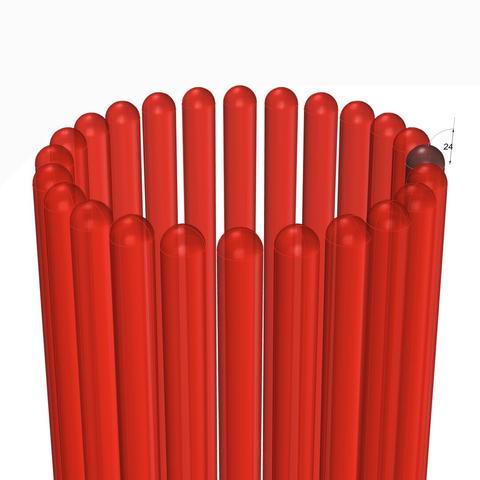
#ModernIonicCapital sketch

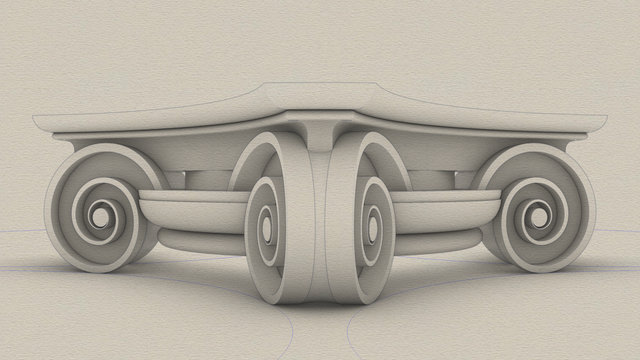
The modern #IonicCapital with curved faces and radial symmetry is a drop-in replacement for the classic Ionic capital with flat faces.

Unlike the classic variant, which has a rectangular footprint, the modern variant has a footprint that fits in a square. In the classic variant, the volutes and scrolls project out so that they are visible from the top. In the modern variant, there are no scrolls, the volutes have a curved face, and they are completely nestled under the top.

The sketch omits the #fillet at the bottom because we added that to the column #shaft in https://pixelfed.social/p/Splines/791794072490907090.

So, we start at the bottom with an #astragal which is exactly the same size as in the classic variant.

Next up from the bottom is the #ovolo which is shorter than in the classic variant. It still has a #tectonicSurface on which #decorativeElements rest, and a #virtualSurface that envelops the decorative elements. In this case, I chose a minimalist design with no #eggsAndDarts. Instead, I use another plain ovolo as a substitute that is offset from the tectonic surface by 1 part (or 8 units, when µ = 144).

Above the ovolo is the #channel, which in this case is a round slab whose surface matches the neck of the column with a radius equal to 5/6 of µ (120 units).

Above the channel is the #abacus which has a curved face that is repeated on all four sides. There is an abacus with flat sides in the classic variant as well, but it is not visible from the front because it is hidden behind the #volute slab. In fact, the vertical #braidsAssembly in the classic variant is attached to the abacus.

Above the abacus is a #reed, and above that, another small Ovolo that tops the modern capital.

The curved volutes follow the blue circular arcs at the bottom of the sketch. The volutes are shaped like a wedge, as can be seen more clearly in the corner facing the front. The portion of the wedge between the outer rims has a concave surface.
Splines (@[email protected])

The bottom 1/3 of the #columnShaft for an #IonicColumn is a perfect cylinder. So the line below point B is a straight line. In https://pixelfed.social/p/Splines/791723063470910081, we blended the bottom end of the 60° arc and the top end of the long interpolated curve between points J and K. Now blend the bottom end of the interpolated curve and the top end of the straight line between points B and C to obtain the 3rd and final #NURBS segment for the #primaryProfileCurve of the shaft. Just like there's a #cavetto and #fillet near the #neck of the shaft, there is a fillet and cavetto near the foot of the shaft. However, there is a subtle difference between the two. The cavetto near the neck is tangential to the blended #NURBS curve that is not a straight line. The profile curve for the cavetto near the foot is tangential to a straight line. There is a special name for a cavetto that is tangential to a straight line or flat surface, like the two cavetto moldings in the #dado of the #pedestal. It's called a #conge. Another alternate name for the cavetto molding is #cove, which is evocative of "cave" because of its concave profile curve. Above the neck is a fillet 8 units tall and an #astragal 16 units tall that #Scarlata puts in braces in the column shaft section within his tables of #VignolaProportions, with a note saying they are not counted as part of the shaft but are accounted for as part of the #capital. I decided to include the top fillet as part of the shaft and keep the astragal with the capital. It does not change the design or alter the proportions in any way, but the inclusion of the fillet makes it more practical for #3DPrinting and #CNCMilling of the neck. This concludes the profile curve for the shaft with a height of 291 parts or 2328 units + 8 for fillet. The column shaft is tapered in the upper 2/3 due to #entasis whose purpose is to make optical corrections to the shape of the column which, without correction, appeared concave near the top.

Pixelfed
UPDATE: Alignment of various elements in the classic #IonicCapital

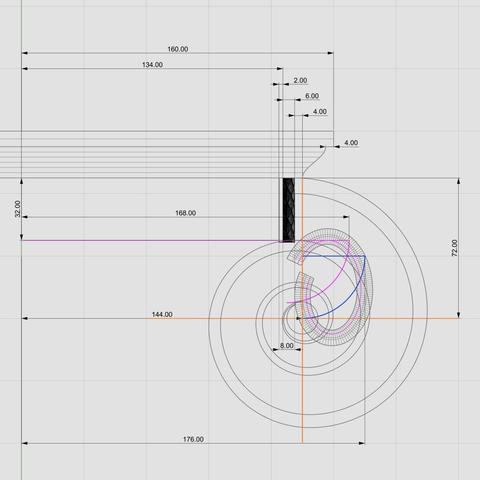
There is an error in the measurements for arc AD in https://pixelfed.social/p/Splines/792124787573855518 where it is shown concentric to the arc BC, with AD having a bigger radius than BC.

The two arcs are not concentric. Arc AD is shifted down and to the right by 1 part or 8 units and has the same radius as arc BC.

When revolved around the column axis, arc AD yields the #virtual surface that encloses #decorativeElements resting on the #tectonicSurface of the #ovolo. Revolving arc BC around the column axis gives the tectonic surface of the Ovolo.

The #eye of the #volute is centered exactly at µ = 144 away from the column axis and 1/2 µ, or 72 units directly below the #cymaReversa as shown by the orange crosshairs.

The top of the Ovolo's tectonic surface (shown in magenta) is tangential to the top of the tectonic surface of the curved #braids assembly. That latter surface is also shown in magenta.

The outer surface of the vertical braids assembly is 4 units inset from the cyma reversa and is also tangential to the outer surface of the curved braids assembly near the bottom of the Ovolo's tectonic surface.

The vertical braids assembly is 33 units tall, as described in https://pixelfed.social/p/Splines/799340150182400358. The bottom portion of it is shown buried 1 unit under the Ovolo surface.
Splines (@[email protected])

Classic #IonicCapital #Tectonic Surfaces Plan We already made the 8 unit tall #fillet at the bottom of the #capital a part of the #shaft in https://pixelfed.social/p/Splines/791794072490907090. So, excluding that, the remainder of the capital is 14 parts or 112 units tall, for the bottom half of which we use the #revolve operation (like the #columnBase and #columnShaft), and for the top half we use the #extrude operation (like the #pedestal, #entablature, and #plinth). Starting at the bottom, we have an #astragal that is 2 parts or 16 units tall and has the same profile as a #reed and #torus, falling in between the two in terms of size. The arc AD is shown in gray because it is an invisible #virtualSurface that envelops the decorations like #eggsAndDarts on the #ovolo. This is the measurement that is given in #Scarlata's #PracticalArchitecture, but it makes no mention of the #decorative and #tectonic surfaces. Arc BC with a radius of 4 parts or 32 units is the tectonic surface on which the Ovolo decorations rest. Such decorations have a variable or uneven surface which may not exceed 1 part or 8 units. Points E and F mark the horizontal tangent or maxima of the second spiral and the first (outermost) spiral, respectively. The gap between them is exactly 4 parts or 32 units. GH is the profile for the vertical side surface on which part of the #ribbon and #braid lie flat, protruding exactly 6 units to coincide with the invisible virtual flat surface through EF. The #cymaReversa is 2 parts or 16 units tall and 1.5 parts or 12 units wide. It starts 4 units to the right of F and stops 4 units short of the top fillet, which is one part or 8 units tall and 20 parts or 160 units from the #columnAxis. Of the 4 parts or 32 units between G and H, the lower 3 parts or 24 units are part of the #voluteChannel groove and the top 1 part or 8 units is a fillet that follows the curve of the #volute and progressively gets narrower until it converges with the #eye of the volute.

Pixelfed
Splines (@[email protected])

#Milestone 6 — #Braids #3StrandBraids #Sinusoid from #Helix https://pixelfed.social/p/Splines/797893262102038801 Braid Geometry https://pixelfed.social/p/Splines/797916882329430160 Braid Strand https://pixelfed.social/p/Splines/798252244743520392 Braid Assembly https://pixelfed.social/p/Splines/799340150182400358 Braid #FlowOnSurface https://pixelfed.social/p/Splines/799514176049543252 #Milestone 5 — #EggsAndDarts https://pixelfed.social/p/Splines/797069447808333887 #Milestone 4 — #IonicScroll https://pixelfed.social/p/Splines/795361973789834465 #Milestone 3 — #IonicColumn https://pixelfed.social/p/Splines/792803978865652429 Milestone 2 — Classic #IonicEntablature https://pixelfed.social/p/Splines/791021871062069787 Milestone 1 — #IonicPedestal https://pixelfed.social/p/Splines/790752092700055739

Pixelfed
#IonicColumn #Flutes

In https://pixelfed.social/p/Splines/799864068250003272 I mentioned rounding off the radius of the bottom circle, but you don't have to. #CAD tools are perfectly happy working with 15.0728 or even higher precision as they are with 15.

After placing the two circles as described in that post, use the full #primaryProfileCurve of the shaft from https://pixelfed.social/p/Splines/791794072490907090 as a #sweepingRail and the two circles for the flutes as the #sweepingCurves, and #sweepOneRail for the body of a single flute. Close #planarHoles on both ends to get an #airtight solid.

Then draw a sphere at the center of the top circle using the same radius as the circle, and perform a #booleanUnion between the sphere and the flute body.

If you want a round bottom for the flute, repeat the sphere at the center of the larger circle using the same radius (15.0 or 15.0728) and perform another boolean union to get one flute.

Switch to the top view and make 24 copies of the flute (including the original) centered at the column axis and #group the 24 flutes.

Finally, perform a #booleanDifference with the flutes group on a copy of the solid #unadornedShaft to get a fluted variant.

The result is a column shaft with flutes carved out. Save the flutes separately for future reuse.

This concludes the entire #IonicOrder, including all #decorativeElements.

Now we pause and reflect: The whole exercise seemed like one of #art and #sculpture. Where is the #architecture in all of this?

Without a ceiling or a roof, there is no building. Without additional columns or walls, there is no ceiling. So, while we have completed the Ionic Order itself, we only have the first #buildingBlock — a single column.

Next step is to repeat the columns to create a #colonnade, which together with supporting walls or additional colonnades can support a ceiling.

Just like with everything else in design, there are rules of proportion for #intercolumniation, or space between columns.
Splines (@[email protected])

#IonicColumn #Flutes This diagram shows the 2D geometry of an #Ionic #flute. The larger blue circle shows the flute outline near the #base of the #column. The smaller blue circle shows the flute outline near the #neck of the #shaft. Both subtend a 12° angle at the center of the column. Like an egg in the #EggsAndDarts motif, a flute must be centered on the column axis when viewed directly from the front, back, or the sides. This is why the 12° are split into 6° on either side of the X axis. The center of the larger circle is µ = 144 units from the origin on the X axis. The center of the smaller circle is 5/6 of µ, or 120 units from the origin. In https://pixelfed.social/p/Splines/799340150182400358, I mentioned working at sub-micron precision, and you might wonder where that came from when we have been using abstract units like µ without specifying any physical units. My apologies for not making it clear that I had assumed 1 unit was equal to 1 mm. If that assumption holds, then µ = 144 mm gives a total order height of 4104 mm, that is 13.46 ft. At smaller scales, the precision is even higher than 1/10 of a micron. With that said, here the radius of the larger circle is 15.0728 units and that of the smaller circle is 12.5606 units, with sub-micron precision if 1 unit = 1 mm. Refer to https://pixelfed.social/p/Splines/791399680747885646 and place the center of the smaller circle exactly at point J on the neck line. Later we will draw a sphere at the same location with the same radius. If you want a flat bottom for flutes, place the center of the larger circle at exactly 28 units (12 for the #fillet and 16 for the #cavetto or #conge) above point A in that figure. If you want a round bottom, then further move the larger circle up by the size of its radius. Nobody would quibble if you used a radius of 15 units instead of 15.0728 units, but it would make it easier to switch from flat to round bottom or vice-versa by simply moving the circle up or down 15 units.

Pixelfed
#3StrandBraids #FlowOnSurface

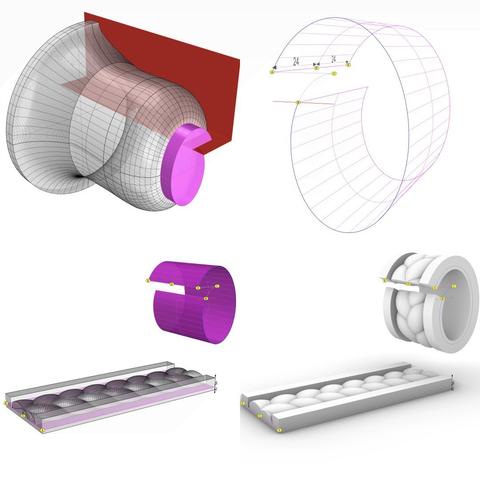
In the top-left, the highlighted magenta portion shows the interface between the #braids assembly and the #IonicScroll from https://pixelfed.social/p/Splines/795276076797088402.

Extract the #profileCurve shown as ABC in the top-right where the interface meets the scroll.

In https://pixelfed.social/p/Splines/794199123072358090, we rebuilt curves from 2nd-degree arcs to 3rd-degree NURBS for smoothness and swept the scroll surface one set of arcs at a time.

Now we have to flow braids on a single surface in one operation. So we need to combine the separate segments into a single NURBS curve. To do that, #explode the profile curve into individual segments, discard the straight portion, and join the curved portions.

Curves and surfaces have a #direction that you can change in the #CAD tool. Check that the direction of the joined curve is A to C, not C to A, and flip it if necessary. Then divide the curve at 120 units starting at A. This is marked by point B. Split the curve AC at B so that AB is 120 units long.

At this point AB is still made up of 5 segments, and exploding it would again decompose the curve into separate segments. So #rebuild AB as a single NURBS curve with 32 sections.

#Extrude AB to get a 48 units wide surface shown in magenta in the top-right. Point D is at the midpoint of AE and lies on the XZ plane.

Slice the channel assembly so that it is 8 units tall, 6 of which will be above the #tectonicSurface for the braid and 2 below. The tectonic surface is shown in the bottom-left as the flat magenta surface on the channel and the curved magenta surface for the scroll neck.

Flow the entire braid and channel assembly along the curved surface lining up points A, D, and E. For the vertical part on the side of the capital, just use the 33 unit tall block from https://pixelfed.social/p/Splines/799340150182400358 and bury 1 unit inside the #ovolo.

This concludes 3-strand braids. Only the non-essential #column #flutes remain.
Splines (@[email protected])

After ensuring that the object in https://pixelfed.social/p/Splines/795271266191779399 is #airtight, extrude the front and rear planar surfaces by 1 part (8 units) on each end. At the end of this step, you should have a solid #scroll object with a smooth surface except for the flat parts that will butt against the head of the unadorned #capital. We have now concluded the #tectonic portions of the entire #IonicOrder. All that remains are decorative #eggsAndDarts that go on the #ovolo of the capital and the #3StrandBraid that goes on the scroll.

Pixelfed
#3DPrinting

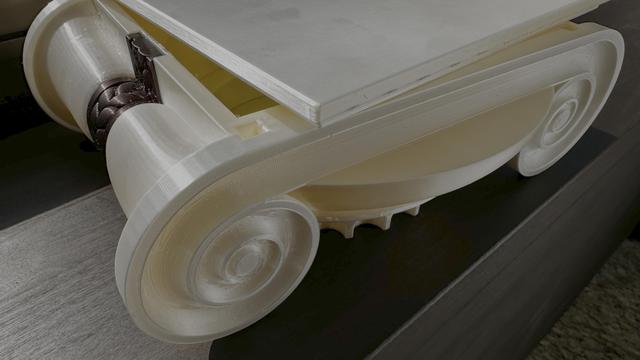
Early #3DPrinted prototype of #Classic #IonicCapital from a few years back using a #Prusa #MK4S #3DPrinter.

The length of the #volute from end-to-end is more than 10". I rotated the #voluteSlab 45° on the printer bed, and by the grace of #Pythagoras, I was able to print it inside the 8" build envelope of the MK4S.

This prototype has many imperfections, and some elements are just plain "wrong" -- like the curved inside of the volute channel (instead of flat).

The #ovolo is lacking #eggsAndDarts because I had not yet made the distinction between a #tectonicSurface on which the #decorativeElements rest, and a #virtualSurface that encloses the decorative elements. My calculations at the time always seemed to differ from those in #Scarlata's book. But as the physical #3DPrint shows, it is perfectly OK to go for a minimalistic look — even if it means a ribbon shorn of #braids. It's the distinctive design of the core tectonic elements that has the greatest impact.

I used brown silk filament for the braids, because, why not? For this prototype, I printed them separately and glued them to the #scroll.

Also, the scrolls are misshapen because I had not yet figured out the correct geometry. It would be another 4 years of tinkering with my #CAD design to finally get my #Eureka moment — and that's when I decided to start this series.
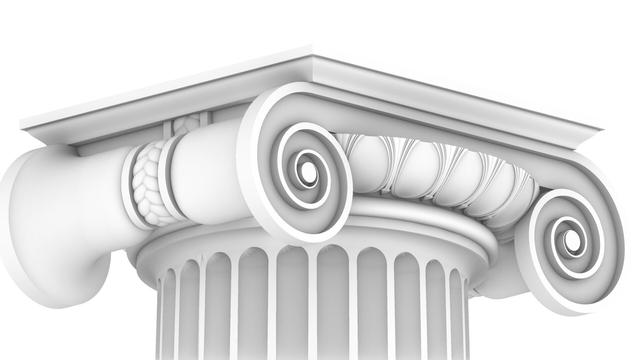
The #Capital is the last essential component of the complete #IonicOrder. The column #flutes remain, but they are #decorativeElements, and I will cover them later when I cover the decorative elements of the capital like the #EggsAndDarts motif on the #ovolo and the #3StrandBraid on the ribbon or belt around the middle of the smooth #scrolls.

The Ionic capital is complex, but not unapproachable. We will systematically construct everything in this draft rendering using just straight lines and arcs as promised in https://pixelfed.social/p/Splines/789956327130679640, with the exception of the #cymaReversa near the top and the 3-strand braid on the ribbon.

In this rendering, the cyma reversa near the top is made using a flattened half-turn of a #helix, but it can also be constructed using elliptical arcs as I described in earlier posts.

The braid is a #periodic shape with infinite variety and is also based on a helix. You can vary the number of strands, their thickness, pitch, and so on, none of which are essential to the Ionic Order itself. They're only a jumping point for further exploration.

The eggs in the 'eggs and darts' motif can have different shapes. They can be convex like real eggs or concave as shown here, but the top is almost always sliced off. The total depth of the convex or concave shapes can vary, but only within a range of 1 part, or 8 units.

The #volutes in the front and back of the capital are based on #spiral shapes, of which there are many different kinds. Some have #continuous curvature changes, while some do it in #discrete steps, like #fibonacci spirals that can approximate #logarithmic spirals seen in nature, e.g., nautilus. When curvature changes are discrete, the spiral arms can diverge in #arithmetic, #geometric, or some other sequence.

We will construct all of these, and most notably the smooth, sweeping surface of the scrolls using just straight lines and arcs, and let the #CAD software deal with delicate #NURBS curves and surfaces.

Splines (@[email protected])

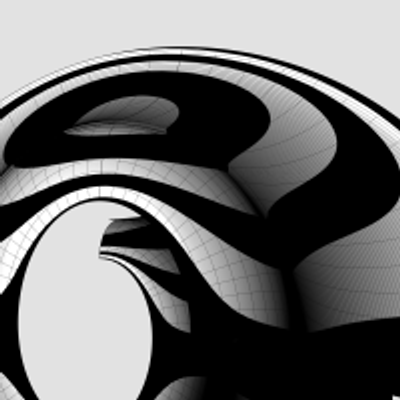
This sweeping shape is a timeless design that first appeared in the scrolls of the #IonicCapital as the most distinctive part of the #IonicOrder in classical Greco-Roman architecture more than 2500 years ago. Shown here with a zebra pattern on the wireframe of a CAD model to accentuate its features and attest to the smoothness of its 3-dimensional surface, the design has been refined many times since the original version over the last two millennia. The two most remarkable things about this design are that: — It can be recreated with modern CAD tools by drawing simple 2-dimensional straight lines and circular arcs exclusively. The end result is truly breathtaking and makes one wonder how architects visualized the result and put theory into practice. In the CAD model, the ultimate surface is a #NURBS surface that uses #BSplines extensively, but none of the B-splines or surfaces need to be created "by hand." One only has to draw straight lines and circular arcs with accurate measurements snapped to grids. — For a design that has survived the ages, it is lamentable how few authoritative sources that accurately describe fine details and exact reconstruction methodology remain accessible to the general public in the age of Internet. The most comprehensive is the 10-volume tome that Marcus #Vitruvius Pollio, a Roman architect and engineer, wrote for #JuliusCaesar and his successor Emperor #CaesarAugustus. [https://www.gutenberg.org/files/20239/20239-h/20239-h.htm] I frequently use two more authoritative sources: — "Regola delli cinque ordini d' architettura," or simply #RegolaArchitettura by Giacomo Barozzi da #Vignola [https://archive.org/details/gri_33125008229458/page/n3/mode/2up], and — "A Course in Theoretical and Practical Architecture," or simply #PracticalArchitecture by Francisco Salvatore #Scarlata (#Bordonaro), which documents #VignolaProportions in tabular form [https://babel.hathitrust.org/cgi/pt?id=mdp.39015031201190&view=1up&seq=5]

Pixelfed
The #column is the most complex component — not least because of the beautiful #capital at the top. It also offers the most opportunities for creative expression, as long as designers differentiate in the #decorativeElements, not #tectonicElements.

There are 3 subcomponents of a column — the #columnBase, #columnShaft, and #columnCapital. In the #IonicOrder, there are variants for each of these components, not just in the tectonic portions, but also in the decorative portions, and it is equally acceptable to mix and match them.

Classic variant of the column #base bears #Vignola's signature in a new #molding called #scotia. There's a "modern" version that has a newer Scotia. I am trying hard to resist the urge to call it #NovaScotia.

The column #shaft is not perfectly cylindrical. It gradually tapers off in the upper 2/3, has a plain unadorned variant, and a #fluted variant.

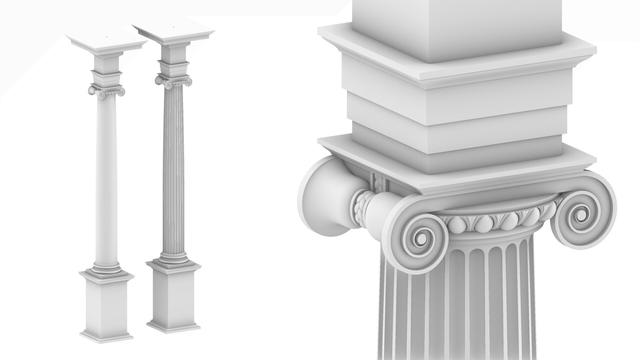
Classic variant of the column #capital has parallel flat #volute slabs only visible from the front and back, but not from the sides. There's also a modern variant that has curved volute faces on all four sides with pointed ends at all corners and optimized for use in a corner column, but not limited to that.

These variants can be freely intermixed in any combination of base, shaft, and capital. The sketch shows an Ionic column with a modern base, fluted shaft, and classic capital, but any other combination would be equally acceptable as long as all are internally consistent in a single #colonnade or #arcade.

Beyond these tectonic elements, there are decorative elements like the #eggsAndDarts motif in the #ovolo of the capital. The eggs can be convex or concave, the eggs and arrows can look different, or the Ovolo could have a completely different motif, or none at all.

The bell-shaped #scrolls between volute slabs are separated by a ribbon or belt with a 3-strand braid not seen in this sketch. If you design fashion accessories, experiment with other designs while maintaining proportions.
They Don't Build 'Em by Eris And AI

They Don't Build 'Em by Eris And AI

Eris And AI - Artist Website