NOTE: As someone pointed out, this is a DANGEROUS process and requires a lot of safety precautions. I would refer to other instructions with more safety measures. I posted this more for the uses of #Lime (as opposed to using tons of chemicals).

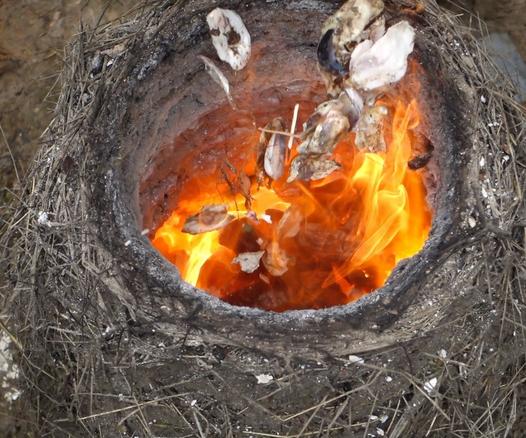
Burn #Seashell #Lime in a Primitive Straw/Clay #Kiln!

By skillcult

"In this project we use Earth, Water, Fire, Air, Animal, Vegetable and Mineral to make something with a multitude of practical uses. The text is detailed and stands alone, but the videos are very useful and entertaining. Video #1, the Quicky version, is the 7 minute general interest, entertainment version. Video #2, buildcult, is the long educational 20 minute version. I'd recommend watching the short version first, before reading this instructable, so that you have a visual reference. I did my best to make it worth 7 minutes of your life. I conceived this project for the Brave the Elements contest, which you can vote in here, hint hint.

"The goal is to build a kiln from natural materials in order to burn and slake #lime for #seashells. Lime is immensely valuable! If lime disappeared tomorrow, civilization would fall hard! It is the main ingredient in cement and can be used to make #mortar and #plaster. It can also be used in the arts for #limewash and fresco, in #Soapmaking, mixed with casein (milk protein) to make #PreIndustrial waterproof #glue and #paint, for smelting and refining metal, and to remove hair and prepare skins for rawhide, hide glue or tanning. Ever read the ingredients on your tortillas or tortilla chips and seen 'traces of lime'? That’s because lime is used in processing #corn kernels to make tortillas, hominy and grits, which is easy to do at home. Not only does it make corn more nutritious and digestible, but it also lends to the unique flavor of those products. Beet sugar is processed with lime too. Lime is also used to potentiate certain drug substances such as betel nut and coca leaves, a small bit of lime being chewed with the plant material to activate it. So, yeah, wow, lime is one of the most useful substances ever!

"A WORD ON SAFETY: A lot of people think that lime is some deadly scary chemical that will burn you face off. It’s not… not really... well, maybe. #QuickLime is dangerous, but that is a brief transient state. During #slaking, the quicklime will give off heat and boil vigorously, so that is dangerous since the stuff can splatter around and is not only hot, but also highly alkaline. So, yeah, okay, maybe doing a face plant in a boiling tub of quicklime may burn your face off. Don’t do that! Otherwise, the stuff is not that horrible, and people have been making #tortillas, mixing mortar, plastering walls and tanning leather without goggles and hazmat suits for a very long time. It is also non-toxic. You definitely don’t want your pets drinking lime water or your kids playing with lime, but that is due to it’s concentration mostly, and not to inherent toxicity. When diluted, it becomes less and less caustic and is at some point completely harmless. Once converted to #CalciumCarbonate by drying, it’s just like egg shells, sea shells or stone, not only non-toxic, but actually used as a #calcium supplement. So, don’t get it in your eyes, keep it away from children and pets, be careful when slaking and use common sense and everything will be fine. It will temporarily dry skin though skin though, so be aware of that.

"Before we get to the fun stuff, let me explain how this works. Don’t be intimidated by the chemistry terms, they aren’t important. The changes lime goes through have a name, The Lime Cycle. By heating stone or shells red hot, about 900 Celcius (called calcining), we can change lime from it’s stable inert form, calcium carbonate, into #Calciumxide. Calcium oxide, aka Qucklime, is the most unstable and highly reactive form of lime. Quicklime reacts violently with water, giving off tremendous heat and boiling vigorously. This reaction with water makes it into #CalciumHydroxide, which is similar to #lye, but not as strong. This is the form that is used the most in the arts and industries mentioned above. If the lime is kept under a layer of water, it will not only keep forever, but it improves with age! This stuff is called lime putty. You may be more familiar with the dry lime you can buy in a bag, which is dry calcium hydroxide. This bagged powdered #HydratedLime is widely available, but inferior to wet #SlakedLime putty. You can hardly buy lime putty, and it is very expensive, but you can make it! For more on the forms of lime see my article, Understanding Lime.

"Basically, #LimePutty is like liquid rocks. Once it is allowed to dry with exposure to air, it absorbs carbon from the atmosphere and turns back into a hard rock (or shell, which is pretty much the same thing). Think about that for a second. That is awesome!

"And thus the lime cycle is completed from rock or shell, to quicklime, to lime putty, and back to rock/shell.

"In my book, it doesn't get much funner than burning and slaking lime, so lets get this party started!"

Learn more:
https://www.instructables.com/Burn-Seashell-Lime-in-a-Primitive-StrawClay-Kiln/

#SolarPunkSunday #OldTech #LowTech #LoTech #DIY #TraditionalTechnology
#AncientTechnology #CalciumCarbonate #TraditionalMortar #History #HistoricalMethods #OldTech #SeashellLime
Burn Seashell Lime in a Primitive Straw/Clay Kiln!

Burn Seashell Lime in a Primitive Straw/Clay Kiln!: In this project we use Earth, Water, Fire, Air, Animal, Vegetable and Mineral to make something with a multitude of practical uses. The text is detailed and stands alone, but the videos are very useful and entertaining. Video #1, the Quicky version,…
Instructables

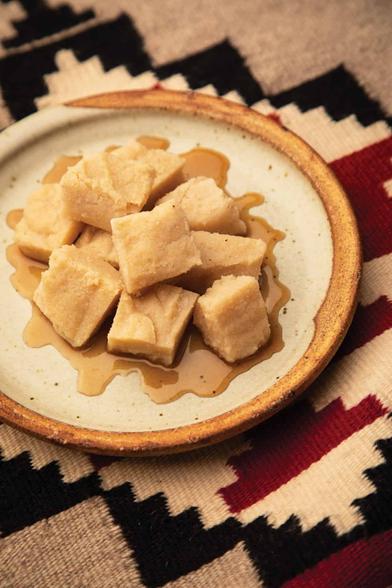
I've seen recipes for #ChamisaAsh (#CulinaryAsh) that involve wood chips, mountain sage, #juniper, and epazote herbs, burned to fine white ashes. I also found this from a #Navajo recipe for Corn Ice (Da’yis tiin).

"A Note on Culinary Ash

Culinary ash dates back thousands of years and has been used by Native communities throughout the Americas for millennia. It is primarily made from shrubs and trees growing near or around the Native communities that use it. The Navajo primarily use juniper ash. Chef Walter Whitewater and his family have been using juniper ash in their traditional dishes since he was a little boy.

"Juanita Tiger Kavena, author of Hopi Cookery, who has since passed, talks in her cookbook about the #Hopi using the ash from #corncobs, #CornSilk, and #CornHusks, as well as the #FourWingSaltbush (#AtriplexCanescens), which is also called #chamisa. Her son, Wilmer Kavena Jr., whom I know as Chibbon (which is Creek for 'little boy'), says that the four-wing saltbush is the preferred bush for the Hopi but that ash can be made from burning any bushes. He prefers to make ash from the four-wing saltbush since these bushes are more #alkaline and work better with the #corn. And Brandon Baugh from San Felipe Pueblo, my student from the Indigenous Concepts of Native American Food class at the Institute of American Indian Arts, researched the use of ash in his community and at San Felipe Pueblo for his final paper and presentation, and found that in his community they use juniper, four-wing saltbush, and onion ash. Other Native communities all over the United States use various materials, including the ash from certain types of #wood.

Culinary ash can be sourced from Shimà of Navajoland and Blue Corn Custom Designs, among others."

https://www.ediblenm.com/graces-corn-ice-dayis-tiin/

#SolarPunkSunday #TraditionalFoods
#TraditionalRecipes #HopiRecipes
#NavajoRecipes #PlantAshes

Grace’s Corn Ice (Da’yis tiin)

Plant-based Navajo cook Grace Tracy shared her version of this corn dish with me and said that it was a variation of a popsicle she likes.

Edible New Mexico

#Nixtamalization

From Wikipedia, the free encyclopedia

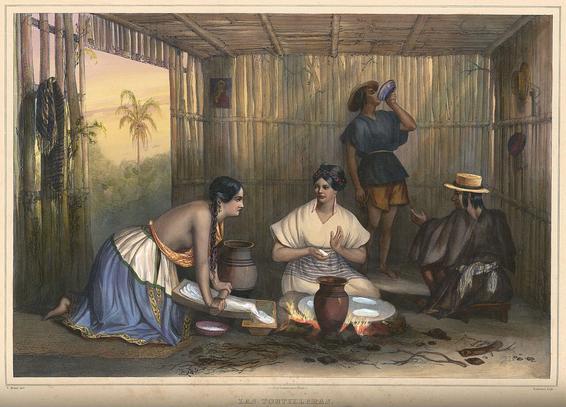
"Nixtamalization (/ˌnɪʃtəməlɪˈzeɪʃən, ˌnɪks-/ nish-tə-mə-lih-ZAY-shən) is a process for the preparation of maize (corn), or other grain, in which the grain is soaked and cooked in an alkaline solution, usually limewater (but sometimes aqueous alkali metal carbonates),washed, and then hulled. The term can also refer to the removal via an alkali process of the pericarp from other grains such as sorghum.

"#NixtamalizedCorn has several benefits over unprocessed grain: It is more easily ground, its nutritional value is increased, flavor and aroma are improved, and mycotoxins are reduced by up to 97–100% (for aflatoxins).

"Lime and #ash are highly alkaline: the alkalinity helps the dissolution of hemicellulose, the major glue-like component of the maize cell walls, and loosens the hulls from the kernels and softens the #maize. The tryptophan in corn proteins is made more available for human absorption, thus helping to prevent niacin deficiency (pellagra).  Tryptophan is the metabolic precursor of endogenous niacin (Vitamin B3).

"Some of the corn oil is broken down into emulsifying agents (monoglycerides and diglycerides), while bonding of the maize proteins to each other is also facilitated. The divalent calcium in lime acts as a cross-linking agent for protein and polysaccharide acidic side chains.

"While cornmeal made from untreated ground maize is unable by itself to form a dough on addition of water, nixtamalized cornmeal will form a dough, called #masa. These benefits make nixtamalization a crucial preliminary step for further processing of maize into food products, and the process is employed using both traditional and industrial methods in the production of #tortillas and #TortillaChips (but not corn chips), #tamales, #hominy, and many other foodstuffs.

Etymology

"In the #Aztec language Nahuatl, the word for the product of this procedure is #nixtamalli or #nextamalli (pronounced [niʃtaˈmalːi] or [neʃtaˈmalːi]), which in turn has yielded Mexican Spanish #nixtamal ([nistaˈmal]). The Nahuatl word is a compound of nextli "lime ashes" and tamalli "unformed/cooked corn dough, tamal". The term #nixtamalization can also be used to describe the removal of the pericarp from any grain by an #alkali process, including maize, #sorghum, and others. When the unaltered Spanish spelling nixtamalización is used in written English, however, it almost exclusively refers to maize.

"The labels on packages of commercially sold tortillas prepared with nixtamalized maize usually list corn treated with #lime as an ingredient in English, while the Spanish versions list maíz nixtamalizado.

Impact on health

"The primary nutritional benefits of nixtamalization arise from the alkaline processing involved. The processing renders the protein more digestible, allowing tryptophan to be absorbed by humans. Humans can convert tryptophan into niacin, thus helping to prevent pellagra. Other measures of protein quality are also improved.  It was originally thought that the anti-pellagra action stems from increased availability of niacin (compared to a hemicellulose-bound form called "niacytin"), but multiple experiments have disproven this theory.

"Secondary benefits can arise from the grain's absorption of minerals from the alkali used or from the vessels used in preparation. These effects can increase #calcium (by 750%, with 85% available for absorption), iron, copper, and zinc.[4]

"Nixtamalization significantly deactivates #mycotoxins which are putative carcinogens. #Aflatoxins are reduced by 90–94%. Fumonisins are reduced by 82%."

Source:
https://en.wikipedia.org/wiki/Nixtamalization

#SolarPunkSunday #NativeAmericanFoods #NativeAmericanHistory #Corn #BlueCorn #MesoAmerica #TraditionalFoods #CulinaryAsh #CalciumCarbonate #History #FoodHistory #Corn #PlantAshes

Nixtamalization - Wikipedia

This round of numbers done for the corn & wheat, I've pretty definitely enough space between the house & storage shed for the corn & winter wheat.... especially so if, as is a very real possibility- I alternate between them.

#GrowYourOwn #Gardening #Wheat #Corn

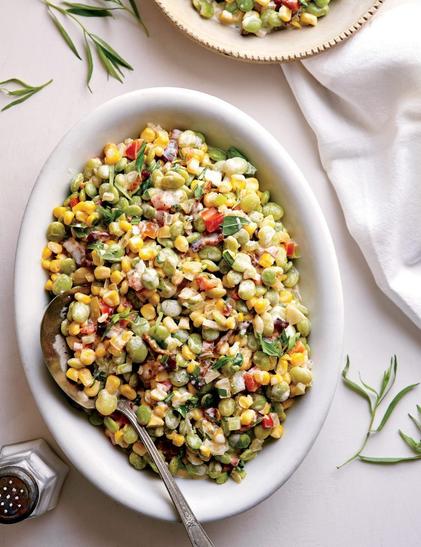
French-Style Succotash – Garden & Gun

Jennifer Hill Booker cooks in the place where the South meets France. She arrived there on a trail that took her from a Mississippi Delta farm to culinary school in Oklahoma and then, by virtue of her marriage to a …
#dining #cooking #diet #food #Frenchrecipes #AnatomyofaClassic #Bacon #Corn #francais #france #French #frenchfoodrecipes #frenchrecipes #Georgia #Recipes #summerrecipes
https://www.diningandcooking.com/2662558/french-style-succotash-garden-gun/

What occurs to me as I'm nearly finished, just possibly needing to categorize & gather the numbers on fruits/berries for drinks, crumble fillings & pie fillings, is that one proto/psedograin has me remaining very confused on likely used rates.... which is to say corn, more specifically flour #corn, because sometimes when I have a wrap/tortilla centered meal I'll have 1 & others 6 ....and I always buy the same size tortillas so I'm really not sure what that future use rate will be....

Every other meal & recipe set I'm pretty consistent with so even as I've a number now to put in, that goes near the higher end of that, especially when I put this onto a computer- I want to sort of set it aside- maybe change the font on it or make it italics ....

Granted as soon as I've the kitchen at least somewhat reset & I thusly begin these recipes more solidly in a rotation I'll be tracking my estimates in comparison to the realities of what'll become chicken feed, and it will take at least a year or 2, to get things back into a full gardening schedule but for now I think that 1 number remains the likely largest one of possibly "off" that I've got.

For now though...I'll get that list setup & then get the areas of the plants calculated from there (hopefully finishing that on Friday, if not Monday).

#gardening #GrowYourOwn #Cooking

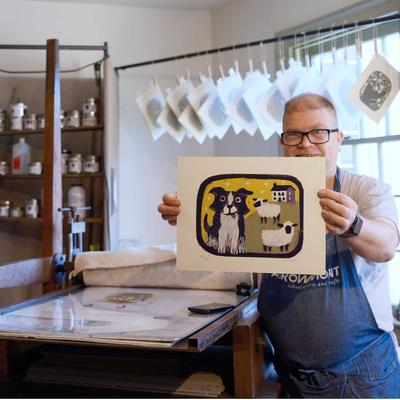
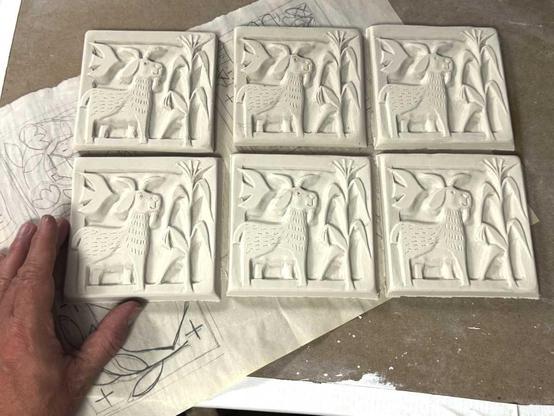
I 'should' give my goat mould more time to cure, but I couldn't resist casting a few tiles--just to see how they will look. I'm excited about these!!!

#pottery #sculpture #art #goat #corn #birds #handmade #mastoArt #kentucky

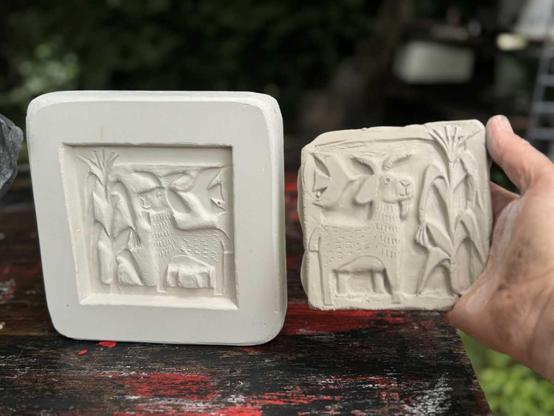
I just finished making a mould for my new tile design---it's a goat 'admiring' a corn plant.

Mould on the left-sloppy test press with clay on the right.

other than one pesky air bubbly under the bird's wing (easy to fix) i'm happy with my casting!!! Hope you all are having a great day!

#art #clay #pottery #tile #goat #corn #kentucky #handmade #mastoArt #craft