The Collapse You Carry Inside

The internal unraveling that mirrors external chaos.

Medium

The #deathcult isn’t just politics or economics. It’s a dogma - a way of seeing the world that sits underneath what we call “common sense”. Forty years of #neoliberalism turned competition, greed, extraction, and isolation into normality. We breathe it in every day until it feels natural.

That’s the real prison: when the ideology disappears into the background and becomes invisible.

So how do we escape the mind prison?

It’s simpler than people think. Look outside the current mess. There are huge bodies of human thought, practice, and lived experience from before the rise of the #deathcult. Traditions of commons, mutual aid, collective survival, indigenous stewardship, labour organising, radical democracy, and the early #openweb all point to different ways of being human together.

The answers don’t come from worshipping new tech, stronger markets, or smarter branding. They come from remembering what was deliberately buried.

That’s why projects like #OMN matter. We need living alternatives, not just critique. We need spaces where trust, openness, and collective action can grow in native soil instead of inside the poisoned logic of the #closedweb and endless commodification.

The first step out of the prison is recognising the walls were built by people — which means they can also be dismantled by people.

#OMN #openweb #4opens #commons #mutualaid #socialchange #deathcult #nothingnew

Battle of The Beanfield

There are certain moments in modern British history that seem to sit just beyond the edge of official memory. Events that everybody vaguely remembers, yet somehow never quite make it into the comfortable national story we tell ourselves.

The Battle of Orgreave is one. The miners’ strike is another. The poll tax riots. Hillsborough. Brixton. They linger in photographs, old television footage and the memories of those who were there, carrying the uncomfortable reminder that Britain is not always as civilised, measured and orderly as it likes to imagine itself to be.

The Battle of the Beanfield belongs firmly in that category.

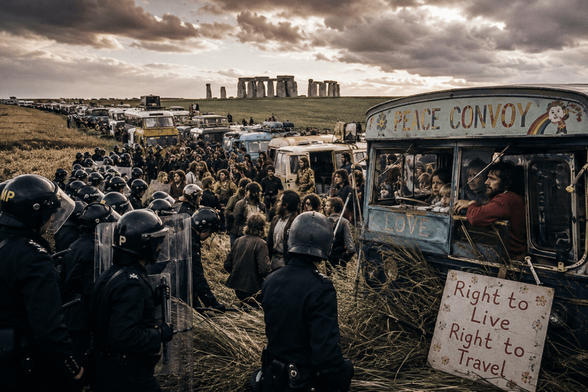
Forty years on, it remains one of the most controversial policing operations in modern British history. More than 1,300 police officers confronted a convoy of around 600 New Age Travellers attempting to reach Stonehenge on 1 June 1985. By the end of the day, dozens of people had been injured, hundreds had been arrested and an entire way of life had effectively been marked for destruction.

What happened in that Hampshire beanfield has never been the subject of a full public inquiry. Yet for many people who witnessed the decline of Britain’s traditional industries during the Thatcher years, the images remain painfully familiar.

I grew up in Yorkshire through the 1970s, 1980s and 1990s. I watched pit villages hollow out. I watched steelworks close. I watched communities that had existed for generations suddenly find themselves described as obstacles to progress. There was a language that emerged during those years. Certain groups became “the problem”. Miners. Trade unionists. Travellers. Alternative communities. Anyone who stood outside the increasingly rigid idea of what Britain was supposed to become.

That is one reason the Battle of the Beanfield still matters.

To understand the confrontation itself, we first need to understand the strange, colourful and often misunderstood world that produced it.

The Stonehenge Free Festival began in 1974. It emerged from the wider countercultural movements of the late 1960s and early 1970s, combining music, environmentalism, spiritual exploration, political activism and communal living. Over the following decade it grew steadily, becoming one of the largest free gatherings in Britain. By the early 1980s thousands of people travelled to Stonehenge each summer to celebrate the solstice. The festival attracted an eclectic mix of punks, bikers, druids, musicians, environmental campaigners, anarchists, hippies and families living on the road.

The people who became known as the Peace Convoy were not a single organisation. They were a loose collection of travellers, festival-goers and alternative communities who spent much of the year moving between free festivals, protest camps and temporary settlements. Some were escaping unemployment. Some rejected consumer culture. Others simply wanted a different way of living. Many travelled in converted buses, coaches, ambulances and vans that doubled as homes.

To their supporters they represented freedom, creativity and resistance to conformity.

To their critics they represented disorder.

By 1984 tensions were reaching breaking point. The Stonehenge festival had become enormous. Estimates suggested attendance reached around 100,000 people. Concerns were raised about damage to the archaeological landscape, litter, unauthorised trading and open drug use. English Heritage, which had recently taken over management of the site, came under increasing pressure to act. Local authorities and police forces were equally determined that the gathering should not continue in its existing form. A High Court injunction was obtained to prevent the 1985 festival from taking place. The state had drawn a line.

On the morning of 1 June 1985, the Peace Convoy left Savernake Forest and began moving towards Stonehenge. Around 140 vehicles carried approximately 600 people. Many were families. Children were travelling alongside adults who had spent years living on the road. They knew there would be police opposition. Few appear to have anticipated what was waiting for them.

Police had prepared extensively.

The miners’ strike had ended only months earlier. During that bitter industrial conflict police forces had developed new methods of coordination, rapid deployment and large-scale public order operations. Senior officers later openly acknowledged that lessons learned during the strike had informed preparations for dealing with the travellers.

A four-mile exclusion zone had been established around Stonehenge. Roadblocks were prepared. Officers from multiple forces were assembled. Some estimates place police numbers at around 1,300. Others suggest even higher figures by the end of the operation.

The convoy encountered its first major roadblock near Shipton Bellinger, several miles from Stonehenge. According to police accounts, some traveller vehicles attempted to push through the blockade and rammed police vehicles. Travellers and independent witnesses tell a very different story. They describe a convoy seeking negotiation before finding itself trapped and surrounded.

Whatever happened during those first moments, the situation rapidly escalated.As vehicles attempted to leave the road and move into adjacent fields, police began smashing windows and making arrests. The convoy became scattered across farmland. Families were separated. Children became lost in the confusion. What followed would become one of the most infamous confrontations in modern British policing.

Television footage remains difficult to watch even now.

Officers in riot gear strike vehicle windows with truncheons. People are dragged from buses and vans. Terrified children can be seen inside shattered vehicles. Journalists and witnesses described police hitting men and women indiscriminately. Several accounts alleged pregnant women and individuals carrying babies were assaulted during the operation. Numerous vehicles that functioned as homes were systematically damaged.

The Earl of Cardigan, whose family owned Savernake Forest and who had followed the convoy on a motorcycle, later provided testimony that proved deeply damaging to official police narratives. He described officers rushing vehicles with drawn truncheons, shouting at occupants and creating scenes of intimidation and violence that contradicted many early police claims.

Journalists present that day reported similar concerns.

ITN footage captured scenes that shocked many viewers. Photographer Alan Lodge later described the event as an ambush rather than a battle. Others argued the very name “Battle of the Beanfield” created a misleading impression of two evenly matched sides. One side possessed riot shields, command structures, communications systems and overwhelming numerical superiority. The other consisted largely of civilians living in vehicles.

By the end of the operation, 537 people had been arrested. It remains one of the largest mass arrests of civilians in modern British history. Most of the charges eventually collapsed or were dismissed.

That fact alone raises uncomfortable questions.

If hundreds of supposedly dangerous lawbreakers had been lawfully apprehended while carrying out serious criminal acts, one might expect hundreds of successful prosecutions to follow. Instead, much of the legal case simply evaporated.

Years later, travellers successfully pursued civil actions against Wiltshire Police. Damages were awarded for wrongful arrest, false imprisonment and property damage. One police sergeant was convicted of actual bodily harm arising from the events of that day.

Yet despite these outcomes, there has never been a full public inquiry.

Perhaps that is because the Battle of the Beanfield was about more than Stonehenge.

Looking back now, it feels impossible to separate it from the wider atmosphere of Britain in the mid-1980s. This was a country being transformed at extraordinary speed. Traditional industries were disappearing. Unemployment was soaring in many regions. Entire communities were fighting for survival. Alternative lifestyles increasingly found themselves portrayed as threats to public order rather than expressions of individual freedom.

For many people in mining and industrial areas, there is a recognisable pattern.

First comes the language.

A group is described as troublesome, outdated or undesirable.

Then comes the media narrative.

Then comes the justification.

Then comes the force.

That does not mean every traveller was a saint, any more than every miner was. Human beings are messy. Large gatherings bring problems. Some attendees at the Stonehenge festivals undoubtedly caused damage. Some individuals within the traveller movement undoubtedly committed crimes. A serious historical assessment has to acknowledge that reality. The archaeological concerns surrounding Stonehenge were genuine. Local residents had legitimate complaints. Authorities were entitled to seek solutions.

But none of that explains the scale of what happened on 1 June 1985.

The images of smashed homes, frightened children and riot police advancing across fields continue to disturb because they seem wildly disproportionate. They suggest a state determined not merely to enforce an injunction but to send a message.

And the message was received.

The traveller movement never fully recovered.

Legislation introduced during the following years increasingly restricted nomadic lifestyles and unauthorised gatherings. The Public Order Act 1986 and later the Criminal Justice and Public Order Act 1994 created new powers that made life significantly harder for travellers, free festivals and eventually the emerging rave culture.

In many ways the Beanfield became a blueprint. The same language used against travellers would later be applied to ravers, squatters, protesters and environmental activists. Alternative communities were increasingly framed not as citizens exercising freedoms but as public order problems requiring management.

Yet the legacy of the Beanfield refuses to disappear.

Songs were written about it. The Levellers turned it into a folk-punk anthem that introduced a new generation to the story. Hawkwind referenced it. Writers, filmmakers and activists kept returning to it. Every summer solstice the memory resurfaces among those who remember what happened.

Perhaps that is because the Battle of the Beanfield sits at the crossroads of so many larger questions.

Who gets to occupy public space?

Who decides what constitutes a legitimate way of living?

How much power should the state possess when dealing with communities that reject mainstream norms?

And perhaps most importantly of all, what happens when governments begin to see certain groups not as citizens but as enemies?

Forty years later those questions feel remarkably current.

The travellers who set out for Stonehenge in 1985 were not trying to overthrow the government. They were trying to reach a festival. They were trying to celebrate a solstice. They were trying, in their own eccentric and imperfect way, to live differently.

Many paid a heavy price for that.

For those of us who grew up watching pits close, furnaces go cold and communities written off as inconvenient relics of the past, the Beanfield feels like part of the same story. Different people. Different landscape. Different politics perhaps. But the same underlying lesson.

When power decides a group no longer belongs, it rarely begins with dialogue.

It begins with exclusion.

Then comes the roadblock.

Further Reading

Andy Worthington, The Battle of the Beanfield

Christopher Chippindale, Stoned Henge: Events and Issues at the Summer Solstice, 1985

Emma Hallett, BBC News, Summer Solstice: How the Stonehenge Battles Faded

Tony Thompson, The Observer, Twenty Years After, Mystery Still Clouds Battle of the Beanfield

English Heritage, Stonehenge 1977–85: A Dig in Time and a Confrontation

Copyright © Mysterious Times 2026. All rights reserved. This article may not be reproduced, distributed or transmitted in any form without prior written permission from Mysterious Times, except in the case of brief quotations used for review, criticism or scholarly reference.

#1980sBritain #1985Events #AlternativeBritain #AlternativeCommunities #AlternativeLifestyles #BattleOfTheBeanfield #BritishCounterculture #BritishFolklore #BritishHistory #BritishProtestCulture #BritishSociety #BritishSubcultures #CivilLiberties #CivilRights #ContemporaryHistory #CounterculturalHistory #Counterculture #CountercultureHistory #culturalHeritage #CulturalResistance #Druidry #EnglishCountryside #EnglishHeritage #FestivalCulture #ForgottenHistory #FreeFestivals #FreeSpiritBritain #FreedomOfMovement #Hampshire #HiddenHistory #HistoricalAnalysis #HistoricalConflict #HistoricalControversies #HistoricalMysteries #HistoryFeatures #LongReadHistory #LostBritain #MargaretThatcher #MiningCommunities #ModernBritishMythology #ModernFolklore #ModernLegends #MysteriousTimes #NewAgeMovement #NewAgeTravellers #Paganism #PeaceConvoy #PeopleSHistory #PoliceHistory #PoliticalHistory #ProtestHistory #ProtestMovements #PublicOrder #RoadProtestHistory #RuralEngland #SocialChange #SocialCommentary #socialHistory #SocialJustice #SolsticeCelebrations #SolsticeTraditions #StatePower #Stonehenge #StonehengeFreeFestival #StonehengeHistory #SummerSolstice #ThatcherEra #Thatcherism #TravellerMovement #TravellerRights #TravellingCommunities #UKHistory #UndergroundBritain #UnofficialBritain #Wiltshire #WorkingClassHistory #YorkshireHistory

Ach I've tried really hard to de-google. I've been on linux for a year+, moved blog from blogger to noblogs (huge job), moved hosting to Canadian, and switched emails to a small Italian antifascist provider and my own domain. Slowly realizing that many people's and institutions' systems only recognise gmail or hotmail emails. Mine is always going to spam. 😭 SO intensely frustrating!!!
#degoogle #antifa #antifascist #socialchange #bigtech #bigtechalternatives

Manchester Charts Steepest Decline in Inner-City Hardship

Manchester sees the biggest fall in inner-city hardship across England. Find out how this affects residents and what comes next.

#Manchester, #UrbanImprovement, #AndyBurnham, #SocialChange, #EnglandCities

https://newsletter.tf/manchester-inner-city-hardship-drops-most/

Inner-city hardship in Manchester has fallen significantly, more than any other English city. This shows a positive change for many residents.

#Manchester, #UrbanImprovement, #AndyBurnham, #SocialChange, #EnglandCities
https://newsletter.tf/manchester-inner-city-hardship-drops-most/

Manchester inner-city hardship drops most in England

Manchester sees the biggest fall in inner-city hardship across England. Find out how this affects residents and what comes next.

NewsletterTF

CW: Occasional Foul Language. Always Political.

The rise of fascism is a worldwide problem, but there are a LOT more of us than there are of them. 🤝

We're teaming up with
@globalexchange.bsky.social and international frontline democracy defenders to exchange ideas and build a global people's movement.

[contains quote post or other embedded content]

Link: https://bsky.app/profile/50501movement.bsky.social/post/3mmurexdjnc2e

----------------------------

Reposted from 50501: The People's Movement

Join the Movement at https://fiftyfifty.one

This robot is unaffiliated w/ 50501

Replies here are only seen in the Fediverse, not on Bluesky. 50501 volunteers do not monitor this account.

----------------------------

#Coup #Activism #FederalGovernment #USpol #Trump #NoKings #elections #50501Movement #WeAreTheResistance #WeHaveFriendsEverywhere #FDT #PeoplesMovement #FiftyFiftyOne #StopICE #protest #organize

#FascismRise #WorldwideDemocracy #PeoplePower #GlobalMovement #FrontlineDefenders #DemocracyForAll #UnitedAgainstFascism #GlobalExchange #MoveTogether #SocialChange

50501: The People’s Movement ❌👑 (@50501movement.bsky.social)

The rise of fascism is a worldwide problem, but there are a LOT more of us than there are of them. 🤝 We're teaming up with @globalexchange.bsky.social and international frontline democracy defenders to exchange ideas and build a global people's movement. [contains quote post or other embedded content]

Bluesky Social

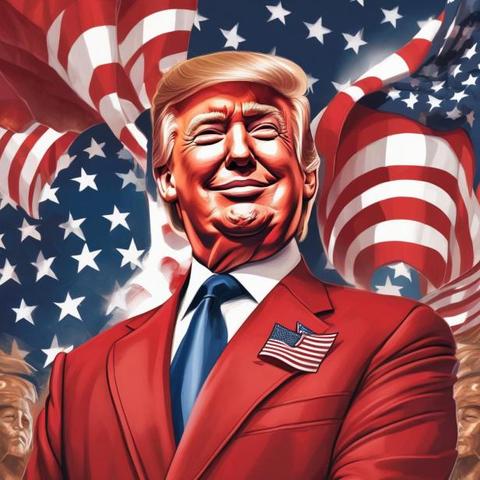
Who is Donald J. Trump?

By, Cliff Potts, WPS News, Editor-in-Chief
Baybay City | May 24, 2026

Donald J. Trump: A Brief Biographical Overview

Donald John Trump, born on June 14, 1946, in Queens, New York, is a prominent businessman and political figure who served as the 45th, and 47th President of the United States from January 2017 to January 2021, and again from January 2025. He is known for his background in real estate development and entertainment, particularly as a television personality on shows like “The Apprentice.” Trump graduated from the Wharton School of the University of Pennsylvania with a degree in economics. His political career began with his controversial candidacy for the presidency in 2016, where he capitalized on themes of nationalism, economic reform, and a strong stance on immigration. Throughout his tenure, Trump was a polarizing figure, garnering both strong support and opposition for his policies and rhetoric regarding various issues, including war and foreign relations.

The Role of War in Human Society

War has played a significant role throughout human history, shaping societies and economies. In academic discussions, some scholars assert that war can act as a catalyst for social change and technological advancement. For example, historian Geoffrey Parker states in his work that warfare often propels nations to innovate and adapt, which can lead to societal progress. Economically, war influences the labor market and can stimulate production, as seen during World War II when the U.S. economy boomed due to increased industrial output.

Donald Trump has expressed skepticism about U.S. involvement in prolonged military engagements overseas. He often critiqued the concept of “endless wars,” suggesting that they depleted national resources and did not significantly benefit American citizens. This stance resonates with a broader sentiment that questions the effectiveness of military intervention as a means of achieving long-term peace.

War and Human Nature

The nature of war is deeply intertwined with human instincts. Studies in psychology suggest that conflict arises from innate human behaviors, such as aggression and competition. However, societal influences also shape these instincts. For instance, the presence of propaganda can heighten fears and rally populations towards war. Trump has often used rhetoric that plays upon American patriotism and fear of external threats, emphasizing the need to maintain a strong military presence to protect national interests.

The interplay between human nature and societal factors calls for an examination of how leaders like Trump respond to these instincts. His administration emphasized military strength, often citing the notion of deterrence. By positioning the U.S. as a dominant force, Trump sought to reassure Americans and counter perceived threats.

The Ethical Dimension of Donald J. Trump’s Thought Concerning War

The ethical aspects of Trump’s views on warfare encompass a range of moral complexities. His handling of military decisions, such as the drone strike that killed Iranian General Qasem Soleimani, raised questions regarding justification and the potential for escalation of conflict. Critics argued that such actions could plunge the U.S. deeper into the Middle East’s tumultuous dynamics, highlighting the moral weight leaders bear when making decisions about war.

Trump’s administration often invoked a perspective of “America First,” suggesting that U.S. interests should prevail over international obligations. This approach raises ethical considerations about responsibility towards allies and the global community at large, reflecting a significant deviation from previous administrations that promoted international cooperation.

Biblical References and Biblical-Era History

To draw parallels between Trump’s views and historical perspectives on war, one can turn to biblical references. In the Bible, wars are often depicted as conflicts rooted in moral and ethical struggles, such as the battles between the Israelites and their adversaries. These narratives reflect fundamental questions about righteousness, justice, and the consequences of war.

When analyzing Trump’s policies through this lens, some interpretations align his “tough” rhetoric with the biblical notion of the warrior king, who defends his people. However, the ethical dilemmas faced by leaders in the biblical era, such as King David’s wars, serve as a reminder of the complexities involved in warfare that transcend simplistic notions of victory.

Education as a Tool for Mitigating War

Education is often viewed as a crucial tool in addressing the root causes of conflict and fostering peace. An educated populace is typically better equipped to engage in dialogue and resolve disputes without resorting to violence. Trump’s approach to education significantly emphasized vocational training and military preparedness, focusing on equipping young people with skills relevant to the workforce.

While educational reforms are vital, Trump’s agenda faced criticism for neglecting comprehensive approaches that promote critical thinking and understanding of war’s consequences. By promoting peace through education, societies may cultivate empathy and awareness, potentially reducing the likelihood of conflict.

Interdisciplinary Perspectives on Conflict and Resolution

Conflict resolution is a field that draws insights from various disciplines, including psychology, sociology, and political science. Understanding the interdisciplinary nature of conflict can enhance strategies for peace. For instance, psychological approaches to conflict negotiation emphasize empathy and communication, while sociological perspectives analyze how group dynamics influence conflicts.

Trump’s administration often leaned on a transactional view of diplomacy, emphasizing deals and agreements. While this approach can yield short-term successes, neglecting the complexities of human relations and societal factors could undermine sustainable peace efforts.

Cultural Narratives and Their Influence on Perceptions of War

Cultural narratives play a significant role in shaping how societies perceive war. Stories, myths, and media representations create a framework through which individuals understand conflict and its consequences. In American culture, narratives of heroism, sacrifice, and the defense of freedom are prevalent, often glorifying military engagement. This viewpoint aligns with Trump’s frequent references to American exceptionalism, framing military might as a symbol of national pride and resilience.

Various films, books, and news reports contribute to the collective memory of war, influencing public sentiment. Trump utilized media attention to amplify narratives that emphasized strength, portraying military intervention as a necessary measure against threats. By tapping into these cultural narratives, he aimed to galvanize support and justify aggressive foreign policies.

Modern Relevance of Donald J. Trump’s Ideas and Biblical Teachings Concerning War and Peace

In today’s world, understanding Trump’s ideas on war in relation to biblical teachings can provide valuable insights into ongoing conflicts. The Bible often teaches principles of peace, mercy, and reconciliation. For example, verses such as Matthew 5:9, “Blessed are the peacemakers, for they will be called children of God,” present a stark contrast to the harsh realities of conflict.

Trump’s emphasis on military strength and deterrence can be seen as a protective approach, reflecting a fear of vulnerability. However, the biblical call for peace challenges leaders to consider reconciliation over retaliation. The contemporary relevance of these teachings invites a critical reflection on how societies can seek resolutions that prioritize dialogue and understanding over armed conflict.

In practice, this means encouraging leaders, including those in positions like Trump’s, to embrace both strength and a commitment to peace. Diplomacy, international collaboration, and humanitarian efforts are essential components that align with biblical teachings focused on creating a just and peaceful world.

Conclusion

Donald J. Trump’s views on war reflect a complex interplay of historical, societal, and human factors. His perspective underscores the significance of military strength within the context of personal and national interests while simultaneously sparking vital discussions about the ethical dimensions and consequences of conflict.

Exploring the relationship between war and human nature reveals how instinct and societal influences contribute to conflicts. Education emerges as a critical tool for preventing war, nurturing understanding and empathy among individuals, which can help to foster peace.

As cultural narratives continue to shape perceptions of war, modern leaders are encouraged to consider the implications of their policies on both national and global scales. The lessons of the past, drawn from biblical references and historical contexts, serve as reminders of the moral complexities inherent in decisions about war.

Ultimately, the ongoing dialogue about conflict and resolution highlights the importance of interdisciplinary insights and the need for a balanced approach that seeks to understand the roots of war while promoting peace and unity within diverse societies.

#AmericanHistory #BiblicalTeachings #conflictResolution #culturalNarratives #Diplomacy #donaldTrump #education #ethics #GlobalPolitics #humanBehavior #humanNature #internationalRelations #MilitaryStrength #NationalInterests #Patriotism #peace #PeaceNegotiations #philosophy #socialChange #War
Africa: Senegal's Young Revolutionaries Now Face the Old African Curse: [allAfrica] Africa has seen this before. http://newsfeed.facilit8.network/TShhdQ #Senegal #AfricanYouth #Revolution #SocialChange #Activism

🧠✨ "Media shapes beliefs; can we rise above it? Critical thinking is our tool for freedom! 🗣️💡 How do you challenge the narratives around you? #ThinkCritically #SocialChange"

https://unumatma.wordpress.com/2026/05/22/the-power-of-discourse-in-social-change/

The Power of Discourse in Social Change

🧠✨ “Media shapes beliefs; can we rise above it? Critical thinking is our tool for freedom! 🗣️💡 How do you challenge the narratives around you? #ThinkCritically #SocialChange”…

Atma Unum