 Stride
New blog post: Investigating SPIR-V for the shader system - Part 4
https://www.stride3d.net/blog/investigating-spirv-for-the-shader-system-part-4/
New blog post: Investigating SPIR-V for the shader system - Part 4
https://www.stride3d.net/blog/investigating-spirv-for-the-shader-system-part-4/
OpenCL 3.1 is here.
The Khronos Group has moved several capabilities into the core spec, including SPIR-V kernels, subgroups, and integer dot products.
Also includes improvements to the memory model and synchronization, plus better alignment with Vulkan via device UUID queries.
Implementations are already underway across major vendors and open source projects.
- Full Blog: https://www.khronos.org/blog/opencl-3.1-is-here?utm_medium=social&utm_source=mastodon&utm_campaign=OpenCL_3.1_is_here&utm_content=blog
- OpenCL specification GitHub
- Khronos Discord

On the eve of IWOCL 2026, the Khronos® OpenCL Working Group has released OpenCL™ 3.1, bringing widely deployed, field-proven capabilities into the core specification to expand functionality, including SPIR-V ingestion, that developers will be able to rely on across conformant implementations. The new specification arrives into a growing OpenCL ecosystem, with implementations from multiple silicon vendors, particularly in mobile and embedded
The OpenCL Working Group has published the first in a series of cooperative matrix extensions — and your feedback can help shape them before finalization.
cl_khr_cooperative_matrix brings cooperative matrix load, store, and multiply-add to OpenCL, developed with Arm, Intel, and Qualcomm. A companion OpenCL C language extension is also in RFC.
Review and comment:
🔗 Spec draft: https://github.com/KhronosGroup/OpenCL-Docs/pull/1533
🔗 Clang RFC: https://discourse.llvm.org/t/rfc-clang-frontend-changes-for-opencl-c-cooperative-matrix-extension/90148
🔗 Full blog: https://www.khronos.org/blog/opencl-cooperative-matrix-extensions-are-here
#OpenCL #SPIRV
The IWOCL 2026 program is live!
The 14th International Workshop on OpenCL and SYCL is coming to Heilbronn, Germany this May 6–8, and the full conference program has just been published at iwocl.org.
This year's lineup is packed. Whether you're working on heterogeneous HPC, GPU portability, or the future of open compute standards, this is the event for you.
Explore the program at https://www.iwocl.org/iwocl-2026/conference-program/
#SYCL #OpenCL #Khronos #SPIRV #IWOCL2026 #HighPerformanceComputing #HPC #GPU

The SPIR-V Working Group has issued a Request for Comment on a new extension proposal called SPV_KHR_poison_freeze. This extension proposes a method to provide tighter undefined values and require that instructions performing simple data transformations do not result in undefined behavior in common cases.
Learn more and give us your feedback!
https://github.com/KhronosGroup/SPIRV-Registry/pull/391
#SPIRV #programming #developers
SPIR-V 1.6 Revision 7 has been released.
See change log: https://registry.khronos.org/SPIR-V/specs/unified1/SPIRV.html#_changes_from_version_1_6_revision_6?utm_medium=social&utm_source=mastodon&utm_campaign=SPIR-V_1.6.7_Release&utm_content=blog
#SPIRV #vulkan #GPUProgramming #GPU #GraphicsProgramming

We're excited to announce that the slides and videos from the inaugural Shading Languages Symposium are now available! Catch up on all the proceedings and join us next year!
https://www.khronos.org/events/shading-languages-symposium-2026
#shading #shaders #programming #Slang #GLSL #HLSL #SPIRV #glslang #WESL #WGSL #OSL #Gigi #vkDuck

A journal article about chipStar is finally published! https://doi.org/10.1177/10943420261423001
chipStar is a compilation tool/runtime for porting CUDA/HIP applications on OpenCL/SPIR-V-capable platforms. Its origin is in the HIPCL "prototype" developed within my research group mainly by Michal Babej. Then refined to chipStar in close collab with Argonne, Intel and Paulius Velesko (PGLC) among others. #opencl #spirv #cuda #ijhpca
The code is here: https://github.com/CHIP-SPV/chipStar
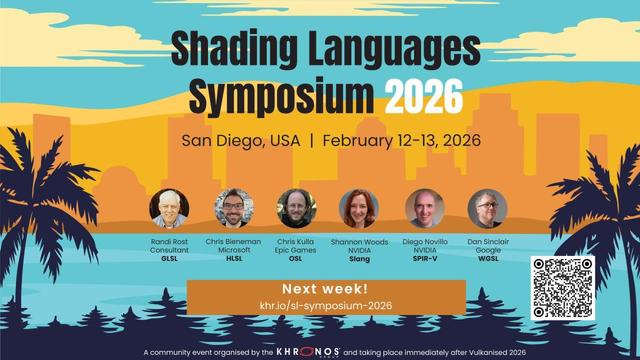
We are very excited for next week's Shading Language Symposium in San Diego!
This event will bring together graphics and computer shader programmers, researchers and technical artists with shading language implementers to explore the landscape of shading languages, their future development, and the role how new techniques such as neural graphics will play in shaping the future of real-time rendering.
Learn more: https://www.khronos.org/events/shading-languages-symposium-2026
#glsl #hlsl #osl #slang #spirv #wgsl
New blog post: Investigating SPIR-V for the shader system - Part 3
https://www.stride3d.net/blog/investigating-spirv-for-the-shader-system-part-3/

 Khronos Group
 Pekka Jääskeläinen