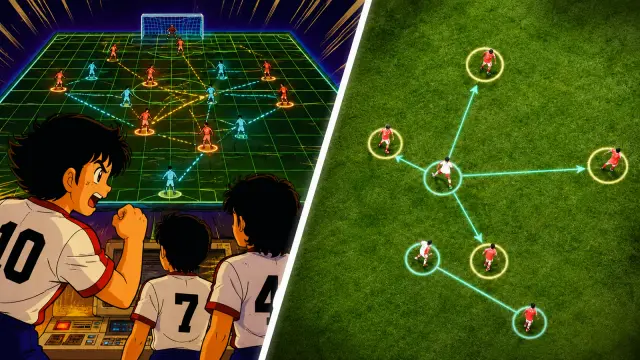
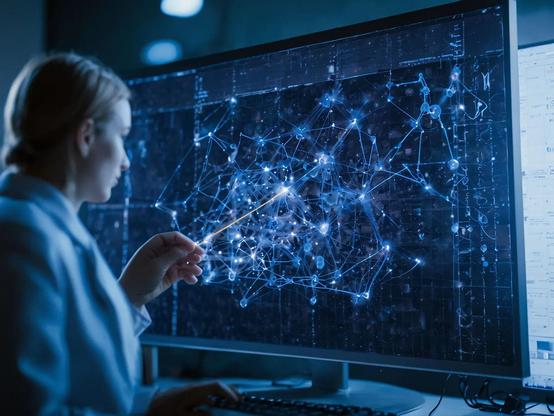
Der brasilianische Club Palmeiras nutzt Google DeepMinds TacticAI zur prädiktiven Echtzeit-Analyse von Spielverläufen.

Das KI-Modell basiert auf Graph Neural Networks und berechnet alle 22 Akteure als individuelle Knotenpunkte. Dynamische Interaktionen lassen sich so bis zu acht Sekunden im Voraus simulieren. Die Architektur zielt auf komplexe räumliche Probleme der Robotik ab.

#GoogleDeepMind #TacticAI #GraphNeuralNetworks #Fussball #AIGeneratedImage

https://www.all-ai.de/news/news26top/google-deepmind-fussball-ki

Google DeepMind berechnet Fußball-Spielzüge voraus

Der Verein Palmeiras testet TacticAI auf dem Rasen. Das Modell simuliert echte Spielzüge acht Sekunden in die Zukunft.

all-ai.de

🚀 Excited to share that a survey paper from our RCLN team has been accepted at IJCAI 2026! This work has been done in collaboration with CentraleSupélec.
"Graph Rewiring in GNNs to Mitigate Over-Squashing and Over-Smoothing: A Survey" By Hugo Attali, Nathalie Pernelle, Davide Buscaldi, and Fragkiskos D. Malliaros.

📎 https://arxiv.org/abs/2411.17429

Graph Neural Networks are powerful models for learning from graph-structured data, yet their effectiveness is often limited by two critical challenges: over-squashing, where information from distant nodes is excessively compressed, and over-smoothing, where repeated propagation makes node representations indistinguishable. Both phenomena stem from the interaction between message passing and the input topology, ultimately degrading information flow and limiting the performance of GNNs.Our survey also opens a broader discussion on the limits and open questions of graph rewiring: when is modifying the topology truly necessary? How can observed improvements be properly attributed to connectivity changes rather than feature-driven effects? We argue that progress in this area will require clearer problem formulations, more explicit assumptions, and evaluation protocols that make results robust and comparable across settings positioning graph rewiring as a principled structural intervention to better understand how topology shapes learning in GNNs.

Looking forward to presenting our work at IJCAI 2026 at Bremen!

#GNN #MachineLearning #IJCAI2026 #GraphNeuralNetworks #AI #DeepLearning #Research #LIPN

Graph Rewiring in GNNs to Mitigate Over-Squashing and Over-Smoothing: A Survey

Graph Neural Networks are powerful models for learning from graph-structured data, yet their effectiveness is often limited by two critical challenges: over-squashing, where information from distant nodes is excessively compressed, and over-smoothing, where repeated propagation makes node representations indistinguishable. Both phenomena stem from the interaction between message passing and the input topology, ultimately degrading information flow and limiting the performance of GNNs. In this survey, we examine graph rewiring techniques, a class of methods designed to modify the graph topology to enhance information propagation in GNNs. We provide a comprehensive review of state-of-the-art rewiring approaches, delving into their theoretical underpinnings, practical implementations, and performance trade-offs.

arXiv.org

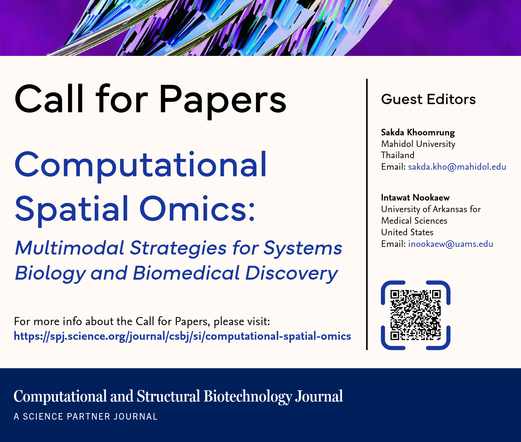
📢 Call for Papers: Computational Spatial Omics - Multimodal Strategies for Systems Biology and Biomedical Discovery

⏳ Submission Deadline: 31 December 2026

🔗 Submit your work: https://spj.science.org/journal/csbj/si/computational-spatial-omics

#CallForPapers #SpatialOmics #SpatialTranscriptomics #SpatialProteomics #Metabolomics #Lipidomics #Multiomics #ComputationalBiology #SystemsBiology #Bioinformatics #AIinHealthcare #DigitalPathology #GraphNeuralNetworks #PrecisionMedicine

A new AI method uses Graphical Mutual Information to learn powerful graph embeddings without labels, outperforming top unsupervised models. https://hackernoon.com/a-new-way-to-train-ai-on-graph-data-without-supervision #graphneuralnetworks
A New Way to Train AI on Graph Data Without Supervision | HackerNoon

A new AI method uses Graphical Mutual Information to learn powerful graph embeddings without labels, outperforming top unsupervised models.

2026 marks the turning point: adaptive Graph Neural Networks are finally joining forces with Large Language Models beyond the lab, powering context‑aware AI in real‑world enterprises. Discover how GNN‑LLM integration reshapes AI pipelines, boosts adaptability, and delivers open‑source‑friendly solutions for businesses. #GraphNeuralNetworks #LargeLanguageModels #AdaptiveAI #EnterpriseAI

🔗 https://aidailypost.com/news/2026-marks-shift-adaptive-gnnllm-integration-from-labs-enterprise

Neo4j’s new graph‑neural fraud detector hits a solid ROC AUC, but its default threshold flags every transaction as suspicious. The paper walks through the confusion matrix, real‑time constraints, and how tweaking thresholds can restore balance. Open‑source fans will love the dive into practical GNN tuning. Curious? Read on for the full breakdown. #Neo4j #GraphNeuralNetworks #FraudDetection #ROCcurve

🔗 https://aidailypost.com/news/neo4j-graph-neural-fraud-detector-shows-strong-roc-yet-labels-all

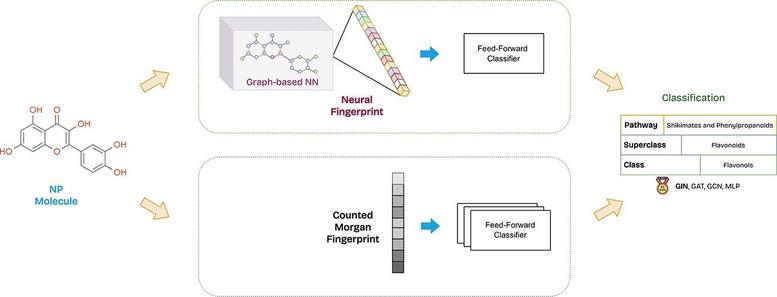
🌿 Can graph neural networks be taught to think in the language of chemistry?

🔗 Leveraging molecular graphs for natural product classification. Computational and Structural Biotechnology Journal, DOI: https://doi.org/10.1016/j.csbj.2025.08.031

📚 CSBJ: https://www.csbj.org/

#AI #DrugDiscovery #GraphNeuralNetworks #NaturalProducts #DeepLearning #Cheminformatics

'GraphNeuralNetworks.jl: Deep Learning on Graphs with Julia', by Carlo Lucibello, Aurora Rossi.

http://jmlr.org/papers/v26/24-2130.html

#graphneuralnetworks #graphs #graph

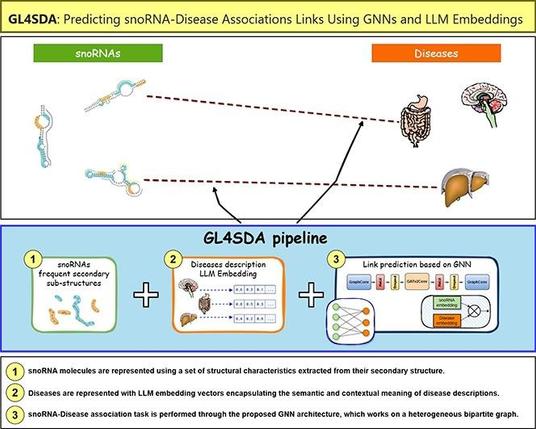
🧬 Ready for AI to crack the RNA-disease code?

🔗 GL4SDA: Predicting snoRNA-disease associations using GNNs and LLM embeddings. Computational and Structural Biotechnology Journal, DOI: https://doi.org/10.1016/j.csbj.2025.03.014

📚 CSBJ: https://www.csbj.org/

#AIinBiomedicine #GraphNeuralNetworks #LLM #ncRNA #snoRNA #CancerResearch #Bioinformatics #PrecisionMedicine #XAI #Genomics