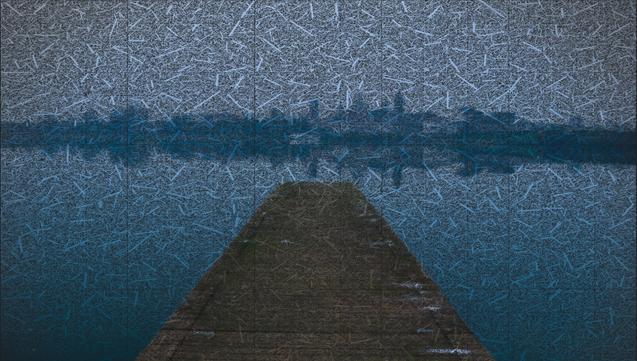
I'm so confused right now. Doing some compute shader work with 2 passes. One draws dots and the other copies the previous frame and decays its value (so that you have trails). The values do decay, but for some reason they don't decay all the way to 0 (or very near 0) πŸ˜΅β€πŸ’« #ComputeShader #GodotEngine
Water Caustics Effect for URP v2 | VFX Shaders | Unity Asset Store

Add depth to your next project with Water Caustics Effect for URP v2 from Masataka Hakozaki. Find this & more VFX Shaders on the Unity Asset Store.

Ah, yes, another groundbreaking revelation: using a compute shader to render flame fractals. πŸ”₯πŸ’» Because who wouldn't want to harness the full #power of their #GPU for... decorative math scribbles? 🎨 Maybe next we'll solve world hunger with pixel shaders. πŸ½οΈπŸ™„
https://wrighter.xyz/blog/2023_08_17_flame_fractals_in_comp_shader #computeShader #flameFractals #decorativeMath #pixelShaders #HackerNews #ngated
Rendering flame fractals with a compute shader

Using GPU atomics to render flame fractals and IFSs.

"Rotational Force"

Tooll3 Tutorial on how to create your own HLSL Compute Shader Particle Force:

https://youtu.be/j95VZXGAbwE

In this video I show you how to create your own HLSL compute shader particle force in Tooll3 and the complete workflow on how to set up the operator interface, create parameters and dropdowns with defaults and useful input ranges, re-order parameters ( ;-) ), rename inputs, sort out the compute shader input buffer slots, get useful error messages, write documentation, create examples and presets and also guide you through the code and the simple example scene I created.

I talk a bit about GPU threading and [numthreads] and I found this video very helpful to understand the inner workings of GPUs and compute shaders:
https://www.youtube.com/watch?v=eDLilzy2mq0

Tooll3 is open source and ATM available on Windows only (although one user reported having it running on Linux in a Bottle).
You should have a decent GPU for good performance.

Download it here:
https://tooll.io

I did several animations with the force already:
https://youtu.be/HCY5tdhlcMU
https://youtu.be/H41QNp9ghWk
https://youtu.be/v25vCSL967Y

#Tooll3 #realtime #tutorial #operator #force #particle #radial #rotational #generativeart #particles #livingpainting #creativecoding #hlsl #csharp #gpu #nodes #shader #computeshader #generative #procedural #visualart

- YouTube

Enjoy the videos and music you love, upload original content, and share it all with friends, family, and the world on YouTube.

Hypothetically, if you, for whatever reason, ended up with some #audio data in the #gpu memory, is there a way to play it out directly through the HDMI/displayport sound card included in the graphics card, or would you need to copy it back to the CPU memory in order to play it? πŸ€”

#programming #showerthoughts #computeshader #cuda

I already got some kind of bug in my WGPU compute shader code that causes the whole system to freeze. It's a simple particle simulation with the nannou framework. If anyone is curious to take a look: https://gist.github.com/somecho/0ce97a911dad2e6141daa0003730ea08

#webgpu #wgpu #nannou #rust #graphics #graphicsprogramming #gfx #computeshader

WGPU Compute Shader Particles in Nannou

WGPU Compute Shader Particles in Nannou. GitHub Gist: instantly share code, notes, and snippets.

Gist

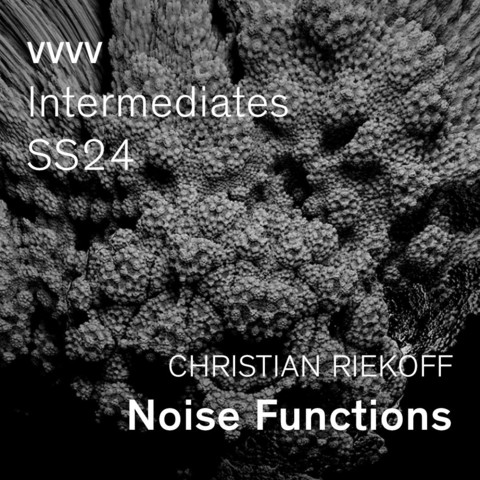
THURSDAY June 6th Live Online

Noise functions are fundamental tools for generating textures, patterns, and simulations. In this session, we’ll explore the diverse range of noise functions available in FUSE and demonstrate how they can be utilized to enhance complexity and detail in your projects. Led by FUSE developer Christian Riekoff

https://thenodeinstitute.org/courses/ss24-vvvv-all-about-noise-functions-with-fuse/

#vvvv @vvvv #visualdesign #programming #creativecomputation #generative #visualprogramming #creativecoding #computeshader #nodes

SS24 – VVVV – All about noise functions with FUSE – The NODE Institute

It doesnt look like much, its a "virtual pipes" based version of a fluid simulation. The win here is that it took me 2 days instead of a few weeks to get JFA working. This also has lot more futzing around with compute stages and differen buffers. This time I tried using a hacked up version of wgsl_to_wgpu to update the bindings. Big win there keeping everything in line for sure. Next up, hooking the two stages together so that I can use JFA to calculate the distance to water.

The original repo: https://github.com/ScanMountGoat/wgsl_to_wgpu

My hacked up version (please forgive me!) https://github.com/00alia00/wgsl_to_wgpu_bevy

#bevy #rust #rustlang #gamedev #compute #computeshader #simulation #fluids #rendering

GitHub - ScanMountGoat/wgsl_to_wgpu: Generate typesafe Rust bindings from WGSL shaders to wgpu

Generate typesafe Rust bindings from WGSL shaders to wgpu - ScanMountGoat/wgsl_to_wgpu

GitHub
Wahooo! Finally got #gpu #compute working with #Bevy. I'm using Jumpflood to calculate distance (right) from the seed points (left)
I couldnt get hlsl to spirv working so after much head+desk decided to deal with wgsl. It hasnt been super straight forward but getting renderdoc working yesterday was the magic sauce :D #rust #rustlang #rendering #indie #computeshader #ScreenshotSaturday p.s I miss hlsl, its so pretty compared to glsl/wgsl!

Playing with enhancements to the #GodotEngine #ComputeShader water demo by rewriting it to be closer to demo by Matthias MΓΌller, which is a bit more physically accurate. The point was to add two-way coupling with rigid bodies, as he does in his demo, but I'm not sure I'll get there. I think have already painted myself into a corner with errors.

This also uses a vertex shader to give real vertical displacement. (The stock demo was designed for performance, not realism.)

https://matthias-research.github.io/pages/tenMinutePhysics/index.html

Ten Minute Physics