Predicting survival of
#ectotherms in stressful & variable
#thermal environments is important in a time of rapid
#ClimateChange. This study shows that a parametric model, including temperature-dependent variance, improves predictions of cumulative
#survival curves
@PLOSBiology https://plos.io/4nFOVnaGoldilocks and the Queen Bee: Finding the ideal soilscape temperature for an important pollinator
Summary & Analysis by Haleigh Yang of “Soilscapes of Mortality Risk Suggest a Goldilocks Effect for Overwintering Ectotherms” by Waybright et al.
Read now!
https://www.amnat.org/an/newpapers/Jan-2025-Waybright.html
#queenBee #bee #soilscape #pollinator #temperature #ectotherms
Goldilocks and the Queen Bee: Finding the ideal soilscape temperature for an important pollinator
<p>Read about “Soilscapes of Mortality Risk Suggest a Goldilocks Effect for Overwintering Ectotherms” by Sarah A. Waybright and Michael E. Dillon (Jan 2025)</p><br/>
Deconninck et al. provides a refreshed view of how plasticity in temperature preference can inform us about the thermoregulatory strategies of ectotherms. An all-new framework that they apply to Drosophila melanogaster.
Read now ahead of print!
https://www.journals.uchicago.edu/doi/10.1086/736575
#Plasticity #Thermoregulation #Ectotherms #EEB
Waybright & Dillon combine new data on physiology with continental scale ground temperature data to develop landscapes of mortality risk for overwintering ectotherms, and apply the approach to predict mortality risk for overwintering bumble bee queens.
https://www.journals.uchicago.edu/doi/10.1086/733183
#temperature #mortality #overwintering #bee #mortalityRisk #ectotherms
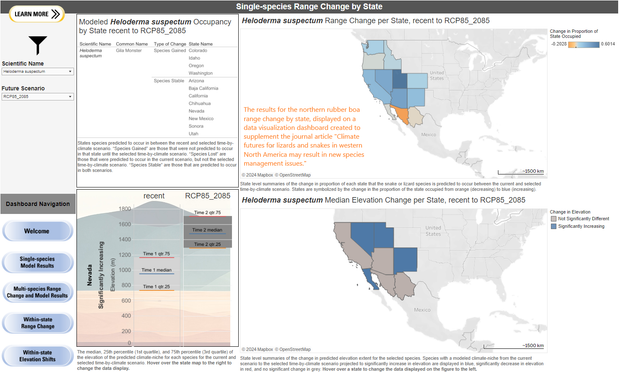
Climate futures for lizards and snakes | U.S. Geological Survey
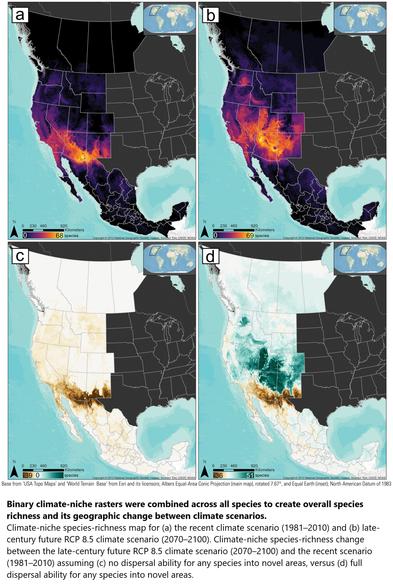
Scientists used climate projections to predict which parts of western North America may be habitable for 130 lizard and snake species later in the century. They found that for many, the future may be North. That could mean big changes for agencies that manage these species and their habitats.

No universal mathematical model for thermal performance curves across traits and taxonomic groups - Nature Communications
Thermal performance models support metabolic modeling in diverse contexts. Here, the authors compare 83 existing models with 2739 thermal performance datasets, finding that model performance doesn’t necessarily depend on the trait type, sampling resolution, or taxon being studied.
In their #JEB100 Commentary, @sammiefontaine & @KevinDKohl discuss how #microbiomes can influence the #thermaltolerance of #ectotherms, although questions remain regarding the role that microbes play in the thermal ecology & evolution of their hosts
https://journals.biologists.com/jeb/article/226/12/jeb245761/316644
#comparativephysiology #climatechange

Ectotherm heat tolerance and the microbiome: current understanding, future directions and potential applications
Summary: Microbiomes can influence the thermal tolerance of ectothermic animals; however, many questions remain regarding the role that microbes play in the thermal ecology and evolution of their hosts.
A new
#preprint #OpenScience #PeerReview by @PCI_Ecology: Bazin, S. et al. Distinct impacts of food restriction and warming on life history traits affect population fitness in vertebrate
#ectotherms.
#HAL #Ecology.
https://hal.inrae.fr/hal-03738584v3
Distinct impacts of food restriction and warming on life history traits affect population fitness in vertebrate ectotherms
The reduction of body size with warming has been proposed as the third universal response to global warming, besides geographical and phenological shifts. Observed body size shifts in ectotherms are mostly attributed to the temperature size rule (TSR) stating that warming speeds up initial growth rate but leads to smaller size when food availability does not limit growth. Nevertheless, climate warming can decrease food availability by modifying biochemical cycles and primary production. Food availability can also influence growth, fecundity and survival and thus potentially modulate the effect of temperature on life history strategies and fitness. However, the interactive effects of temperature and food availability on life history traits have been mostly studied in small invertebrate species where life history traits have been mainly considered in isolation. In contrast, we have limited information on (1) how temperature and food availability jointly influence life history traits in vertebrate predators and (2) how changes in different life history traits combines to influence fitness and population growth. To fill this gap, we investigated under laboratory conditions the independent and interactive effects of temperature (20 or 30 °C) and food availability (restricted or ad libitum) on the growth, fecundity and survival of the medaka fish Oryzias latipes. We next used our empirical estimates of vital rates as input parameters of an Integral Projection model (IPM) to predict how modifications in vital rates translate into generation time and population growth rate (i.e. mean fitness). Our results confirm that warming leads to a higher initial growth rate and lower size leading to crossed growth curves between the two temperatures. Food-restricted fish were smaller than ad libitum fed fish throughout the experiment, leading to nested growth curves. Fish reared at 30 °C matured younger, had smaller size at maturity, had a higher fecundity but had a shorter life span than fish reared at 20 °C. Food restriction increased survival probabilities under both temperature conditions corresponding to a "eat little die old" strategy. According to the IPM, warming reduces generation time and increases mean fitness in comparison to the cold treatments. Food restriction increased generation time and fitness in the cold treatment but had no effect in the warm treatment. Our results highlight the importance of accounting for the interaction between temperature and food availability to understand how body size shifts can affects vital rates and population demography. This is of importance in the context of global warming as resources (e.g., phytoplankton and zooplankton communities in aquatic ecosystems) are predicted to change in size structure and total abundance with increasing temperatures. Interestingly, our results suggest that food restriction has a weaker effect on fish mean fitness under warming.
I am ecophysiologist, with a focus on the effect of various environmental factors on the oxidative status of ectotherms. Special interest on amphibians and their ability to adapt to environmental changes, but I also examine the oxidative costs of interspecific hybridization. Open for cooperation and productive discussion write at
[email protected]#zoology #amphibians #introduction #physiology #ectotherms #climatechange #hybridization #oxidativestress #pollution #stress #herpetology PLOS Biology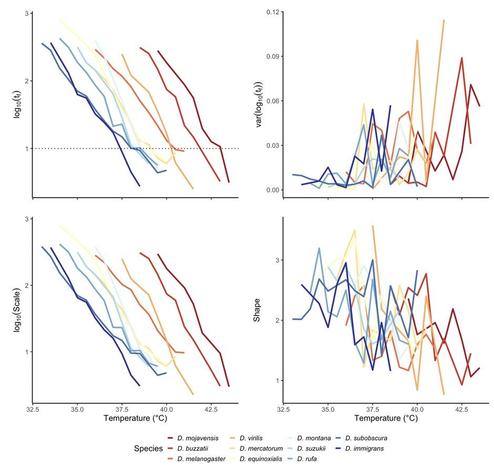
 American Naturalist
 💧🌏 Greg Cocks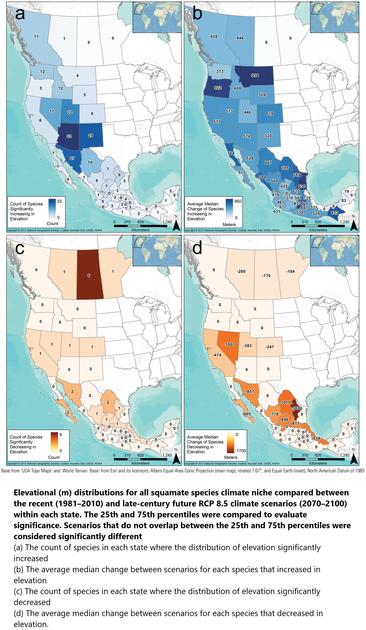
 Dimitris Kontopoulos
 Journal of Exp Biol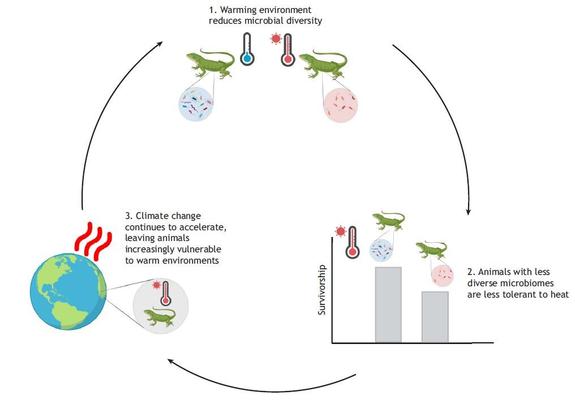
 Peer Community In
 Marko Prokic