NVIDIA Warp는 Python 기반 GPU 네이티브 프레임워크로, 요소별 제어흐름과 SIMT 병렬성을 활용해 고성능·미분 가능한 시뮬레이션 커널을 ML 워크플로에 직접 통합합니다. 글은 FFT 기반 Poisson 솔버와 SSP-RK3로 구현한 2D Navier-Stokes 예제, 자동미분(순·역모드) 지원, PyTorch/JAX 연동 및 산업 적용(Autodesk, DeepMind 등)과 수백배 속도 향상 사례를 다룹니다.
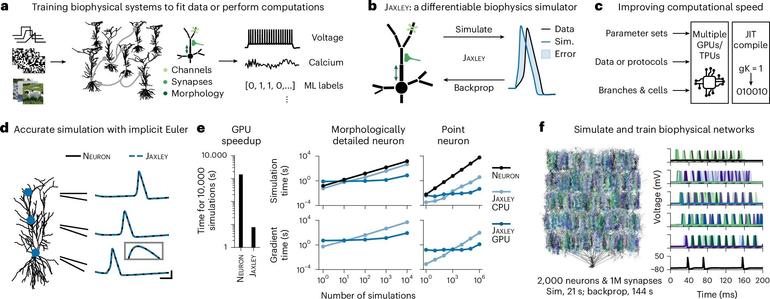
🧠 New paper by Deistler et al: #JAXLEY: differentiable #simulation for large-scale training of detailed #biophysical #models of #NeuralDynamics.
They present a #differentiable #GPU accelerated #simulator that trains #morphologically detailed biophysical #neuron models with #GradientDescent. JAXLEY fits intracellular #voltage and #calcium data, scales to 1000s of compartments, trains biophys. #RNNs on #WorkingMemory tasks & even solves #MNIST.
Neural networks surround us, in the form of large language models, speech transcription systems, molecular discovery algorithms, robotics, and much more. Stripped of anything else, neural networks are compositions of differentiable primitives, and studying them means learning how to program and how to interact with these models, a particular example of what is called differentiable programming. This primer is an introduction to this fascinating field imagined for someone, like Alice, who has just ventured into this strange differentiable wonderland. I overview the basics of optimizing a function via automatic differentiation, and a selection of the most common designs for handling sequences, graphs, texts, and audios. The focus is on a intuitive, self-contained introduction to the most important design techniques, including convolutional, attentional, and recurrent blocks, hoping to bridge the gap between theory and code (PyTorch and JAX) and leaving the reader capable of understanding some of the most advanced models out there, such as large language models (LLMs) and multimodal architectures.
Alice's Adventures in a Differentiable Wonderland
https://arxiv.org/abs/2404.17625
#HackerNews #Alice #Adventures #Differentiable #Wonderland #AI #Research
Neural networks surround us, in the form of large language models, speech transcription systems, molecular discovery algorithms, robotics, and much more. Stripped of anything else, neural networks are compositions of differentiable primitives, and studying them means learning how to program and how to interact with these models, a particular example of what is called differentiable programming. This primer is an introduction to this fascinating field imagined for someone, like Alice, who has just ventured into this strange differentiable wonderland. I overview the basics of optimizing a function via automatic differentiation, and a selection of the most common designs for handling sequences, graphs, texts, and audios. The focus is on a intuitive, self-contained introduction to the most important design techniques, including convolutional, attentional, and recurrent blocks, hoping to bridge the gap between theory and code (PyTorch and JAX) and leaving the reader capable of understanding some of the most advanced models out there, such as large language models (LLMs) and multimodal architectures.
Accelerate deep learning and other number-intensive tasks with JAX, Google’s awesome high-performance numerical computing library.</b> The JAX numerical computing library tackles the core performance challenges at the heart of deep learning and other scientific computing tasks. By combining Google’s Accelerated Linear Algebra platform (XLA) with a hyper-optimized version of NumPy and a variety of other high-performance features, JAX delivers a huge performance boost in low-level computations and transformations. In Deep Learning with JAX</i> you will learn how to: Use JAX for numerical calculations</li> Build differentiable models with JAX primitives</li> Run distributed and parallelized computations with JAX</li> Use high-level neural network libraries such as Flax</li> Leverage libraries and modules from the JAX ecosystem</li> </ul> Deep Learning with JAX</i> is a hands-on guide to using JAX for deep learning and other mathematically-intensive applications. Google Developer Expert Grigory Sapunov steadily builds your understanding of JAX’s concepts. The engaging examples introduce the fundamental concepts on which JAX relies and then show you how to apply them to real-world tasks. You’ll learn how to use JAX’s ecosystem of high-level libraries and modules, and also how to combine TensorFlow and PyTorch with JAX for data loading and deployment.
The #Zhukovsky #Aerofoil (sometimes transliterated as #Joukowsky from #Russian), is a 2D model of #streamlined #Airflow past a #wing. It uses #ComplexVariable and is an #AnalyticFunction (i.e. #Differentiable everywhere, save at isolated #Singularities). Take a circle in the #ComplexPlane which is not quite centred at the #origin but passes through the #coordinate (1,0) or (z=1+0i).
#MyWork #CCBYSA #AppliedMathematics #WxMaxima #FreeSoftware #Aeronautics #Aerodynamics #LaminarFlow
Whenever I walk to/from home, I have to walk up/down an inclined street; I noticed that the asphalt floor has different curvatures depending on how near it is of a bend, and I try to find a less steep incline while walking.
This got me inspiration for the few questions below. Any simple explanations, and related links, are welcome.
Given a #differentiable surface within R^3, and two distinct points in it, there are infinitely many differentiable paths from one point to another, remaining on the surface. At each point of the #path, one can find the path's local #curvature. Then:
- Find a path that minimizes the supreme of the curvature. In other words, find the "flattest" path.
- Find a path that minimizes the variation of the curvature. In other words, find a path that "most resembles" a circle arc.
Are these tasks always possible within the given conditions? Are any stronger conditions needed? Are there cases with an #analytic solution, or are they possible only with numerical approximations?
#Analysis #DifferentialGeometry #Calculus #DifferentialEquations #NumericalMethods