#Engineering #Physics #ComputerScience #sflorg
https://www.sflorg.com/2026/01/eng01292601.html
#Development #Approaches
CSS performance for websites · A high-level strategy for managing CSS performance https://ilo.im/1673ix
_____
#CSS #Webpages #Websites #Animations #Computations #Specificity #WebComponents #WebPerf #WebDev #Frontend
The eleventh day of the Konstanz School of Collective Behaviour 2025 (#KSCB2025) starts with a #keynote by Aneta Koseska on the dynamical basis of natural #computations across biological scales.
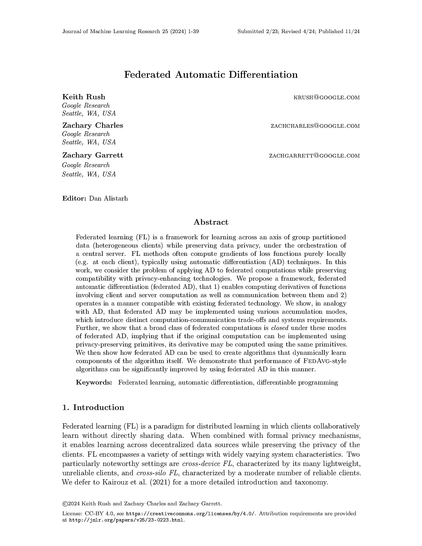
'Federated Automatic Differentiation', by Keith Rush, Zachary Charles, Zachary Garrett.
http://jmlr.org/papers/v25/23-0223.html
#federated #privacy #computations
Accelerate deep learning and other number-intensive tasks with JAX, Google’s awesome high-performance numerical computing library.</b> The JAX numerical computing library tackles the core performance challenges at the heart of deep learning and other scientific computing tasks. By combining Google’s Accelerated Linear Algebra platform (XLA) with a hyper-optimized version of NumPy and a variety of other high-performance features, JAX delivers a huge performance boost in low-level computations and transformations. In Deep Learning with JAX</i> you will learn how to: Use JAX for numerical calculations</li> Build differentiable models with JAX primitives</li> Run distributed and parallelized computations with JAX</li> Use high-level neural network libraries such as Flax</li> Leverage libraries and modules from the JAX ecosystem</li> </ul> Deep Learning with JAX</i> is a hands-on guide to using JAX for deep learning and other mathematically-intensive applications. Google Developer Expert Grigory Sapunov steadily builds your understanding of JAX’s concepts. The engaging examples introduce the fundamental concepts on which JAX relies and then show you how to apply them to real-world tasks. You’ll learn how to use JAX’s ecosystem of high-level libraries and modules, and also how to combine TensorFlow and PyTorch with JAX for data loading and deployment.
2 rather informal definitions have been offered:
• 1 Knill & Pouget 2004
“Bayesian coding hypothesis:
Brain represents sensory information probabilistically, in the form of probability distributions”
• 2 Friston 2012
“Bayesian brain says that we are trying to infer the causes of our sensations based on a generative model of the world.”
Neither even mentions #Bayesian #computations
What then is exactly meant by #BayesianBrain ?
Swarming #microrobots self-organize into diverse patterns: research 👇🧫🤔
https://techxplore.com/news/2023-06-swarming-microrobots-self-organize-diverse-patterns.amp
A research collaboration between Cornell and the Max Planck Institute for Intelligent Systems has found an efficient way to expand the collective behavior of swarming microrobots: Mixing different sizes of the micron-scale 'bots enables them to self-organize into diverse patterns that can be manipulated when a magnetic field is applied. The technique even allows the swarm to "cage" passive objects and then expel them.
GLACIATION keeps working to capitalise on European #researchandinnovation made possible thanks to #HorizonEurope 🇪🇺
GLACIATION consortium looks at MOSAICrOWN #softwarearchitecture, in particular tools for #dataownership and #datasharing for #privacy aware collaborative #computations
Huge thanks again to @AidanOMahony and #Dell for this workshop 💻
#glaciationprojectEU #HorizonEU #EOSC #datamanagement #energyefficiency #edge#dataprivacy #datasovereignty #energyefficient #artificialintelligence