As a political idea, social mobility is based on an acceptance of hierarchical depiction of society.... which builds into its politics almost inevitable resistance.

In a hierarchy, for people to move up (upwards social mobility), others must by definition move down (relative downwards social mobility) to make 'room' for those rising.

People & families have always moved downwards in such hierarchies, but resistance to an accelerated (forced) fall can hardly be unexpected!

#SocialMobility

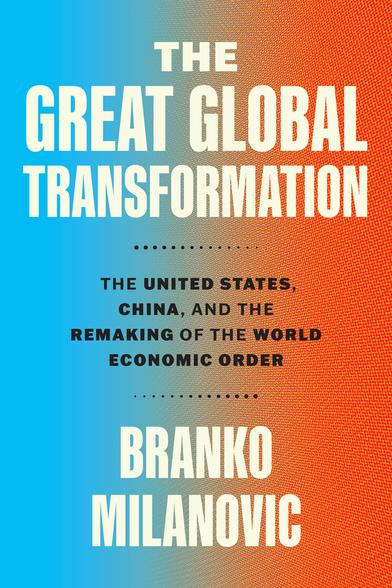
* The Great Global Transformation
The United States, China, and the Remaking of the World Economic Order, Branko Milanovic >>
https://press.uchicago.edu/ucp/books/book/chicago/G/bo269830239.html

* The U.S., China, and the Remaking of the World Economic Order
"After unprecedented economic growth during the 20th century, is the U.S. losing its place as a world power? How have China’s economic rise and its growing class of uber-wealthy elites shaken up its society? How are the seismic changes to both countries reshuffling the global economic order?" >>
https://www.youtube.com/watch?v=xr1zscNHeYI
#geopolitics #USChinaRelations #WorldEconomicOrder #SeismicShifts #US #China #growth #elites #UberWealthy #plutocracy #nationalism #NationalMarketLiberalism #degeneration #protectionism #inequality #SocialMobility #homoploutia #book

The Great Global Transformation

From the essential chronicler of the world economy, a portrait of the Great Powers in transition. The world’s two great economic powers are on opposite trajectories. In the United States, decades of neoliberal policies produced a small class of rich elites and gutted the middle class. In China, the same global forces have created a massive new upper class. The result is the greatest reshuffling of global incomes since the Industrial Revolution—a dramatic shakeup of each country’s political order. As the two powers retreat from one another, the implications for their futures, and for the world economy, are uncertain. In The Great Global Transformation, acclaimed economist Branko Milanovic draws on original research to chart how these seismic shifts will shape the next century of the global economy. As both the US and China retreat into protectionism, Milanovic shows how a new and multipolar world order will follow—and how rising nationalism will have dramatically different effects on the two countries. And he shows us the fight ahead: as plutocracy returns, global war threatens, and a new system silently shapes our nations, driving populist discontent to the breaking point. A worthy successor to Capitalism, Alone and his other landmark works, Milanovic’s new book announces the arrival of a new era he terms “national market liberalism,” in which liberalism survives in domestic economies, but not necessarily in the social arena. The Great Global Transformation is Milanovic’s indispensable account of the new twenty-first century now underway.  

University of Chicago Press

You were not stupid for believing the promise. But the promise may have been false. An essay on hard work, broken systems, and the devastating moment when both personal and institutional maps collapse.

Read Essay 👇
https://reviewsrantsandraves.substack.com/p/the-double-bind-personal-category

#TheDoubleBind
#StructuralBetrayal
#SystemicFailure
#PersonalFailure
#MiddleClassCollapse
#MeritocracyMyth
#CredentialInflation
#Precarity
#HousingCrisis
#Immigration
#SocialMobility
#InstitutionalTrust
#PoliticalEconomy
#SystemsThinking
#Longform

The Double Bind: Personal Category Errors, Systemic Delusions, and the Compounding of Collapse

Why do people who work hard, follow the rules, and trust institutions still end up dispossessed? This essay examines the double bind between personal misdirection and systemic betrayal.

Reviews, Rants & Raves
📄 The programme for the upcoming CPC-CG Symposium at the #UniversityofStAndrews is now available!

On 23-24 June, the symposium will bring together researchers from the #UK, #Europe, and beyond to explore #intergenerational change and support across a range of themes, including:

#Household and #housing
#Migration and #socialmobility
#Community, #segregation, and #socialcohesion
#Family and #fertility
#Intergenerationalexchange

More info: https://www.cpc.ac.uk/activities/event_calendar/1002/Centre_for_Population_Change__Connecting_Generations_Symposium_on_Intergenerational_Change_and_Support
A third of Britons believe they have changed social class, survey finds

‘Polyclass’ of 6 million people consider themselves to belong to more than one social category, researchers say

The Guardian

The Guardian | Privately educated CEOs seen as ‘safer bet’ by investors, study finds by Joanna Partridge

AI generated summary, Read the full article for complete information.

A University of Surrey study shows that investors treat chief executives who attended private schools as a “safer bet,” resulting in roughly 5 % lower stock‑market volatility for those firms, even though the privately‑educated CEOs do not outperform, take fewer risks, make better decisions, or handle crises more effectively than their state‑educated peers. The perceived lower risk diminishes over time as more information about a leader’s performance becomes available and disappears in companies subject to greater analyst scrutiny or higher institutional ownership, indicating that market participants often confuse elite background with competence despite no measurable impact on corporate outcomes.

Read more: https://www.theguardian.com/education/2026/may/14/privately-educated-ceos-safer-bet-investors-class-bias-study

#ChristosMavrovitis #UniversityofSurrey #SuttonTrust #FTSE100 #business #classissues #corporategovernance #education #financialsector #ftse #inequality #investing #privateschools #schools #secondaryschools #socialmobility #society #sociology #stockmarkets

Privately educated CEOs seen as ‘safer bet’ by investors, study finds

Privilege being mistaken for competence as study reveals no evidence to suggest companies run by state-educated peers underperform

The Guardian
Privately educated CEOs seen as ‘safer bet’ by investors, study finds

Privilege being mistaken for competence as study reveals no evidence to suggest companies run by state-educated peers underperform

The Guardian

2/4 These are fields - media and cultural studies and cultural theory - that are increasingly being framed as problematic, both ideologically and instrumentally. Yet they have played an important role in challenging the elitist tendencies of the mainstream, including those surrounding #socialmobility. If only either Seddon or Rajan had attended one of these institutions instead of having the disadvantage of studying for an undergraduate degree at #Oxford and #cambridge.

Still, we shouldn’t be surprised. This is, after all, a conversation on the #BBC between two Oxbridge-educated figures – albeit one is from South London the other West Yorkshire – taking about how social mobility might be used to include more people from #workingclass backgrounds in the system as it currently exists. It’s a social and educational system that was constructed in advance, although not by working-class people themselves, of course. A system that has in fact historically exploited and marginalised them.

The sandpile metaphor matters because collapse often looks sudden from the outside.

But inside the system, pressure has been accumulating for a long time.

The crisis is not always the failure. Sometimes it is the correction.
👇
https://reviewsrantsandraves.substack.com/p/what-the-sandpile-knows-a-foreword

#SystemsThinking #Essays #Precarity #Philosophy #Sociology #PersonalEconomy #ComplexSystems
#Precarity #Economics #PersonalFinance #InstitutionalFailure
#SocialMobility
#ModernLife
#Resilience
#MeaningMaking
#StructuralInequality
#HumanSystems

What the Sandpile Knows: A foreword on systems, survival, crisis, and the search for a more accurate map.

A foreword to What the Sandpile Knows: a series on wrong maps, category errors, structural betrayal, personal economy, crisis, and renewal.

Reviews, Rants & Raves
Calls for ‘student premium’ to support disadvantaged young people after GCSEs

Social mobility groups say post-16 funding gap risks young people falling out of education, work and training

The Guardian