
Who REALLY Watches Porn? 4 Surprising Truths

Originally Published on November 4th, 2025 at 08:00 am

When we think about who watches pornography, stereotypes often paint a simple, one-dimensional picture.

These assumptions, however, are largely based on older research that relied on self-report surveys, a method notoriously prone to bias when dealing with a stigmatized topic. What happens when you set aside what people say they do and instead look at what they actually do online? 

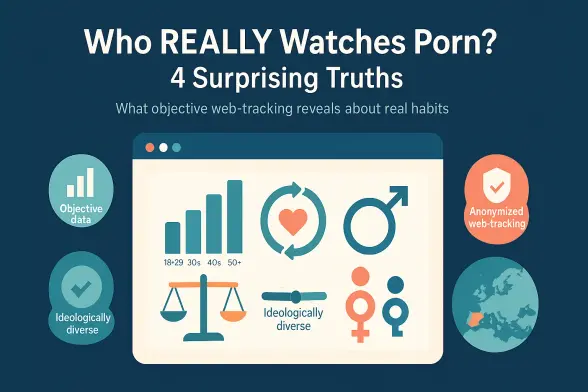
A massive new study did just that. Using objective, anonymized web-tracking data from 1,933 individuals across five countries, researchers identified 392 pornography consumers, providing one of the most accurate and nuanced portraits of this group to date.

The results challenge many deeply held beliefs about age, gender, politics, and online behavior. 

This article distills the four most counter-intuitive truths from this groundbreaking research, revealing a reality that is far more complex and fascinating than the stereotypes suggest.

1. Viewers Are Creatures of Habit, Not Explorers

The internet seems to offer an endless buffet of adult content, leading to the belief that pornography use is a relentless quest for novelty. The data, however, paints a picture not of explorers, but of creatures of habit.

The study found that consumption is highly concentrated on a few dominant platforms, such as Pornhub, Xvideos, and Xhamster. 

The most surprising statistic revealed a strong sense of brand loyalty and routine. Approximately 46% of users visited only a single, unique adult website during the entire three-month study period.

This behavior suggests that for nearly half of all viewers, pornography is less about exploration and more about visiting a familiar, trusted source. 

As the researchers note: 

This suggests that pornography consumption is not as exploratory as assumed but rather characterized by routine engagement with familiar providers. 

This finding is significant because it reframes consumption as a routine online habit, much like checking a favorite news site or social media platform, rather than a relentless quest for new stimulation. 

2. It’s Not Just a Young Person’s Game 

Conventional wisdom says porn is a young person’s fixation, a habit that fades with age.

The data shows this is simply not true.

Objective tracking reveals that pornography consumption is common across all age groups. It goes from young adulthood well into the 60s and beyond. 

The data shows a clear trend, with consumption peaking among people in their 30s before seeing its most pronounced decline after age 60.

However, the study’s key takeaway is that these variations between most adult age groups aren’t large enough to be statistically significant. This means, for the most part, engagement remains remarkably stable throughout adulthood. 

Licensed Professional Counselors, do you need continuing education hours?

Look no further!

If you find this article interesting, Dr. Weeks’ course Sexual Education and Porn Use in Women, and her other unique courses, will engage and educate!

Pornography isn’t just a phenomenon of the “digitally native” youth. It’s an integrated part of online habits for a wide and diverse range of adults.

3. Political Ideology is Surprisingly Irrelevant 

In a hyper-partisan world, it’s easy to assume our media habits, even private ones, fall along political lines. But when it comes to pornography, a person’s political ideology is surprisingly irrelevant.

When researchers compared who watches porn and non-watchers based on their self-reported political ideology on a scale from left to right, they found no statistically significant difference between the two groups.

In simple terms, knowing a person’s political leaning gives you no predictive power in guessing whether or not they consume pornography. The user base is ideologically diverse and spans the entire political spectrum. 

But the research did uncover an interesting twist. While personal ideology didn’t matter, media consumption habits showed a small but statistically significant difference. The study found pornography users tended to have slightly more centrist and balanced partisan media diets compared to non-users.

Do you believe you have an online pornography addiction? Take the free Cyber Pornography Addiction Test (CYPAT) and have the results to speak with your therapist.

4. The Gender Gap is More Complicated Than You Think

One stereotype the data confirms is men are the primary consumer of pornography.

But that’s where the simplicity ends.

Digging into the web-tracking data revealed crucial nuances, showing female engagement is “more substantial than previously estimated” and challenging the idea of pornography as an exclusively male domain. This was especially clear when looking at cross-country variations.

In Spain, for example, women constitute nearly 30% of pornography users.

The study hypothesizes this may be linked to the country’s significant progress in gender equality, such as being the first nation to create a Ministry of Equality in 2004 and the third to legalize same-sex marriage in 2005, suggesting cultural shifts can directly influence female consumption patterns.

The study also produced fascinating data on same-sex content.

It found that 16.5% of male users watched gay pornography. A figure significantly higher than the 5-10% of men who typically identify as gay or bisexual in surveys.

This complexity extends to lesbian content, which the study found was consumed by a higher percentage of male users (15.4%) than female users (9.4%), further challenging simple assumptions about consumption, gender, and sexual orientation.

Conclusion

The objective, behavioral data from this study makes one thing clear: the reality of pornography consumption is far more complex, habitual, and ideologically diverse than common stereotypes suggest.

It is a widespread digital behavior that cuts across demographics in ways we are only just beginning to understand.

As objective data continues to pull back the curtain on our private digital lives, what other deeply held assumptions about human behavior will be the next to fall?

Are you a Licensed Professional Counselor seeking engaging, unique Continuing Education courses? Dr. Weeks offers accredited courses on her practice website on the effects of Pornography Abstinence and other unique topics!

Have you found yourself in legal trouble due to your sexual behavior? Seek assistance before the court mandates it, with Sexual Addiction Treatment Services.

Are you looking for more reputable, data-backed information on sexual addiction? The Mitigation Aide Research Archive is an excellent source for executive summaries of research studies.

#genderAndProblematicPornographyUse #genderEquity #habits #politicalIdeology #politics #porn #pornAddiction #pornography #research #researchArticle #researchStudy #sexualRolesByGender #sexuality #sexualityAndAging #stereotypes #study
4 Surprising Ways Cannabis Use Disorder Impacts the Brain

Originally Published on October 28th, 2025 at 08:00 am

More Than a Buzz, According to a Major New Study

As cannabis continues to be legalized for recreational and medical use across North America, public debate often centers on its benefits, risks, and social implications. This has become a public health priority. It’s sparking discussions about everything from tax revenue to addiction potential. Lost in the noise, however, is a more nuanced and critical question: what are the lasting, residual effects on the brain not just from using cannabis, but from developing a Cannabis Use Disorder (CUD)? 

For years, research has been muddled by controversy. Some studies suggest significant cognitive decline. Others finding only minimal effects.

A major reason for this confusion is many studies lump together recreational users with those who have a clinical disorder. A new, large-scale meta-analysis published in the journal Addictive Behaviors cuts through this ambiguity by focusing specifically on individuals diagnosed with CUD. 

This article distills the four most important takeaways from this major review. Here’s some clear, evidence-based answers on how Cannabis Use Disorder leaves a measurable mark on our cognitive abilities.

1. Cannabis Use Disorder Isn’t Just a Label—It’s a Critical Distinction 

Much of the confusion around cannabis’s long-term cognitive effects comes from studies that don’t distinguish between recreational use and a clinical disorder. This new meta-analysis makes that distinction its central focus, and the results are revealing. 

The core finding is that while recreational use may be associated with minimal or small deficits, Cannabis Use Disorder is linked to clear, moderate cognitive impairments.

The researchers draw a parallel to alcohol consumption. The cognitive impact seen in individuals with alcohol use disorder is significantly larger than what is observed in those who drink recreationally. 

This distinction is the key that unlocks the rest of the study’s findings. Now that we’ve isolated the CUD population, the next question is: what exactly does this impairment look like? 

Do you have enough hours for your LPC renewal? Are you in need of continuing education, but bored with the current offerings? Check out Dr. Weeks’ course on Cannabis Use Disorder, and other unique courses on her practice website.

Sexual Addiction Treatment Services has been approved by NBCC as an Approved Continuing Education Provider, ACEP No. 7250. Programs that do not qualify for NBCC credit are clearly identified. Sexual Addiction Treatment Services is solely responsible for all aspects of the programs.

2. The Damage Is Specific, Not Widespread

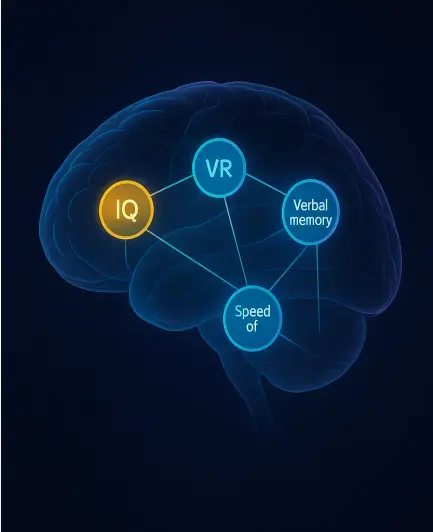
The cognitive impact of CUD isn’t a blunt, uniform fog across the entire brain. Instead, the meta-analysis shows that the impairments are concentrated in specific domains. The study found “small-to-moderate” impairments across several areas, with the largest deficits observed in five key domains: 

  • IQ: The most significant deficit found. It reflects a moderate impairment in overall cognitive reasoning and problem-solving abilities. 
  • Verbal Learning: The ability to learn and absorb new information presented through words. It manifests as an impairment making it harder to retain material from a lecture or meeting. 
  • Verbal Memory: The capacity to recall that learned verbal information later. A deficit can manifest as struggling to remember conversations or key details from something you’ve read. 
  • Working Memory: The mental “scratchpad” used for holding and manipulating information for short-term tasks. Impairment here makes it harder to follow multi-step instructions or perform mental calculations. 
  • Speed of Processing: How quickly you can perceive, process, and respond to information. A deficit can slow down reaction times and the ability to keep up in fast-paced conversations or environments.

To emphasize this specificity, the study also identified the cognitive domains that were least affected.

Among them were attention and verbal fluency; the ability to retrieve words from your mind. This targeted impact suggests a more complex mechanism than simple, widespread damage.

3. The Impact of Cannabis Use Disorder Is Comparable to “Harder” Drugs

In a finding that challenges longstanding public perception, the study reveals how the cognitive deficits from CUD stack up against those from other substance use disorders.

The research shows that the magnitude of the impairments in verbal memory and working memory for individuals with CUD is in a similar range to the deficits seen in people with alcohol, cocaine, and methamphetamine use disorders. 

However, a critical distinction adds another layer of complexity.

One important difference is that CUD is associated with less diffuse cognitive deficits. While the depth of impairment in those specific memory-related areas is comparable to other substance use disorders, the overall breadth of cognitive damage appears to be narrower. 

This directly challenges the common perception of cannabis as a relatively benign substance. Especially when its use escalates to the level of a disorder. The researchers highlight the importance of this finding for how the scientific and medical communities view the substance. 

“The similitude of findings between substances confirms the importance of paying attention to individuals with a CUD when studying the residual cognitive effects of cannabis.”

Are you exploring your trauma? Do you feel your childhood experiences were detrimental to your current mental or physical health? Utilize this free, validated, self-report questionnaire to find out.

Take the Adverse Childhood Experience (ACE) Questionnaire

4. It Presents a Surprising Scientific Mystery

The targeted nature of these cognitive deficits presents a fascinating paradox for neuroscientists.

The primary psychoactive compound in cannabis, Δ9-THC, acts on the brain’s CB1 receptors. From a biological standpoint, this is significant because, as the paper notes, CB1 receptors are “among the most abundant throughout the brain.” 

Based on that fact, scientists would expect that chronic, heavy cannabis use would cause diffuse, widespread cognitive effects across many domains.

Yet, as this meta-analysis confirms, the effects are actually quite specific.

This discrepancy suggests the full story is more complex than we currently understand. The authors propose this paradox “indirectly suggests that other cannabinoid receptors than CB1 receptors are mediating the cognitive effects of cannabis,” pointing toward an important new direction for future research.

Conclusion: A Sobering Reminder in the Age of Legalization

This comprehensive meta-analysis sends a clear message: Cannabis Use Disorder is not a trivial condition.

It is linked to real, measurable, and moderate cognitive deficits in crucial areas like memory, processing speed, and overall IQ.

Furthermore, these deficits are not insignificant when compared to those associated with other well-known substance use disorders. 

The study’s authors point to a pressing public health concern, noting that “the perceived risk associated with regular cannabis use has been declining in youths since the legalization of the substance.”

While the policy debates will surely continue, this research provides a sobering reminder that the conversation must include a clear-eyed view of the consequences that arise when use crosses the line into a disorder. 

As the perception of risk declines, the critical public health challenge becomes clear: how do we effectively communicate the line between casual use and the measurable cognitive costs of a disorder?

Are you a professional looking to stay up-to-date with the latest information on, sex addiction, trauma, and mental health news and research? Or maybe you’re looking for continuing education courses? Then you should stay up-to-date with all of Dr. Jen’s work through her practice’s newsletter!

Are you looking for more reputable, data-backed information on sexual addiction? The Mitigation Aide Research Archive is an excellent source for executive summaries of research studies.

#cannabinoid #cannabinoids #cannabis #cannabisEffectsOnLearning #cannabisUseDisorder #drugAbuse #drugAddiction #drugAddictionRecovery #drugUse #effectsOfCannabis #effectsOfDrugUse #longTermCannabisEffects #longTermCannabisUse #mentalHealth #research #researchArticle #researchStudy #study #THC

www.pnas.org/doi/10.1073/... Social tipping dynamics for stabilizing Earth’s climate by 2050 Ilona M. Otto et. al. 21 JANUARY 2020 #SustainabilityScience #ResearchArticle SIGNIFICANCE

Social tipping dynamics for st...

“Best” NBA Playoff Teams With Losing Records

https://thenewleafjournal.com/best-nba-playoff-teams-with-losing-records/

The strange profile of the 2024-25 Miami Heat inspired me to examine every team to make the NBA Playoffs since 1983-84 with a losing record and positive SRS and/or Net Rating.

“Best” NBA Playoff Teams With Losing Records

The Miami Heat made the NBA Playoffs with a 37-45 record but positive SRS and Net Rating. I go back to 1983-84 to look at every NBA playoff team with a losing record and positive SRS.

The New Leaf Journal

#WorldDevelopment #population #industrialOutput #FoodProduction #NonRenewableResources #pollution #LimitedResources #LimitsToGrowth #degrowth #overshoot #collapse #researcharticle #EmpiricalData #simulation #learning

"Recalibration of limits to growth: An update of the World3 model"

You can see on the results section that the food production is estimated to peak around 2024.

https://onlinelibrary.wiley.com/doi/full/10.1111/jiec.13442

Get the latest research articles from our journals, direct to your inbox. Sign up for content alerts at https://journals.biologists.com/my-account/alerts
#biology #biologicalsciences #researchpaper #journals #scienceresearch #researcharticle

Eager to Index Research articles in Google Scholar? Then, check this blog for all crucial tips on how to do so.

https://www.ardaconference.com/blog/how-to-index-articles-in-google-scholar/

#google #googlescholar #research #researcharticle #index #researchers #education #academics #students #journals

How to Index Journals in Google Scholar?

Check out How to Index Journals in Google Scholar

ARDA Conference
Next #ResearchArticle comes from Heidi Koester, Susan Fager, Erik Jakobs, & Tabatha Sorenson on "Desigining an app for alternative access assessments: using interviews to uncover and define user needs." Check it out at https://doi.org/10.1080/10400435.2023.2213749
#AssistiveTechnology #ATech #technology #RESNA
Revenue diversification strategies of online news organisations: subscriptions and memberships | Profesional de la información

16p11.2 microdeletions increase variability in #neurodevelopment

A Research Highlight showcasing new work from Rana Fetit, David Price & colleagues
https://journals.biologists.com/dev/article/150/4/e150_e0403/292573/16p11-2-microdeletions-increase-variability-in

Read the #ResearchArticle, '16p11.2 deletion accelerates subpallial maturation and increases variability in human iPSC-derived ventral telencephalic #organoids' in our #HumanDev section
https://journals.biologists.com/dev/article/150/4/dev201227/288407/16p11-2-deletion-accelerates-subpallial-maturation

'The people behind the papers' interview series
https://journals.biologists.com/dev/article/150/4/dev201685/288408/The-people-behind-the-papers-Rana-Fetit-and-David

#devbio #devbiol #stemcells

16p11.2 microdeletions increase variability in neurodevelopment

Advances in genome editing and induced pluripotent stem cell-derived organoids has made it possible for researchers to recapitulate patient mutations and dissect complex neurodevelopmental disorders, such as autism spectrum disorder (ASD), in vitro. In this issue, Rana Fetit and colleagues model 16p11.2 microdeletions, one of the most common genetic linkages to ASD, in ventral telencephalic organoids. They find that the deletion organoids are not consistently different in size compared with control, but they do show a greater variation in growth rate. They observe larger and more abundant neural rosettes in the 16p11.2 deletion organoids but detect no difference in progenitor proliferation. The authors discover that the cell cycle is longer in the mutant organoids, primarily due to a prolonged G1 phase. The increase in G1 phase is associated with increased expression of TUJI and GAD67, markers of interneuron differentiation, suggesting that neurogenic cell divisions are beginning earlier in the 16p11.2 deletion organoids. Together, these data show that 16p11.2 microdeletions lead to increase variability in neurodevelopment and support a link between premature differentiation into interneurons and ASD.

The Company of Biologists