I am thinking about an interesting problem right now.

Suppose I have a DAG of objects. Every object contains three data points:

* A list of parents (via Content-address hashes)
* A pointer to some content (almost irrelevant for this thought process)
* A version number (irrelevant for this thought process)

I have a limited but unknown number of peers that are allowed to "post" to that DAG. Once a peer discovers that another node has posted to the DAG, they either fast-foward or merge (which is trivial here) and go on.
All peers gossip all the time, so fast-forwarding is expected to be the "normal case" when all peers are online - but in case of network split there is no issue.

Now, suppose I want to allow "rewriting" the DAG.
That means, one node decides that deep down in the DAG, they want to change a node. That would change all other nodes that come after it.

How would the other peers know that the node was rewritten?

Two ideas:

* All peers keep track of "this other peer points to this hash right now". Once a peer rewrites their DAG, other peers can see that rather easily. That would involve some tricky logic, but I guess would be possible πŸ€” The other peers can then update their stuff to that new DAG (and if needed even "rebase" changes that they have done between the rewrite and now, if there was a network split during that time)
* The second option would involve adding timestamps to the DAG nodes, so other nodes can see that a portion of the DAG was rewritten

The second option would add more fields to the DAG nodes, which I would like to not do, because they should be as light as possible.

What do you think?  

#algorithms #softwaredevelopment #dag #distributedsystems #graphdata #datatypes

I am looking for a PhD student in graph data management and analysis.

Application deadline:
December 19, 2024.

More details:
https://jobs.tuwien.ac.at/Job/243871

#hiring #PhDposition #knowledgegraphs #graphData

University Assistant Prae-Doc (all genders)

I am looking for a postdoc in graph data management and analysis.

Application deadline: December 1st, 2024.

More details on the website:
https://www.dbai.tuwien.ac.at/staff/khose/Postdoc.html

#hiring #postdoc #knowledgegraphs #graphData #health

Postdoc

Since http://onodo.org/ is shutting down:
https://flourish.studio/visualisations/network-charts/ is a nice tool for visualizing network graphs.
#graphdata #dataviz
Onodo

Todas las redes cuentan una historia

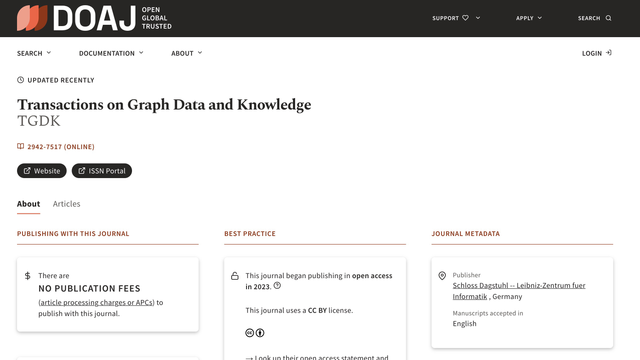
Transactions on Graph Data & Knowledge (TGDK) is indexed now in the
Directory of Open Access Journals (DOAJ)
https://doaj.org/toc/2942-7517

#knowledgegraphs #semanticweb #graphdata #knowledge @tgdkjournal

Transactions on Graph Data and Knowledge – DOAJ

A peer-reviewed, open access journal in graph algorithms, graph databases, graph representation learning, knowledge graphs, knowledge representation & linked data.

I can't believe I spent 20 minutes watching this, but if you have a spare 20 minutes do. Its exceptional.

#GraphData #DataScience

https://youtu.be/JheGL6uSF-4?si=BUUG3l4dmYycMT7N

I Made a Graph of Wikipedia... This Is What I Found

YouTube

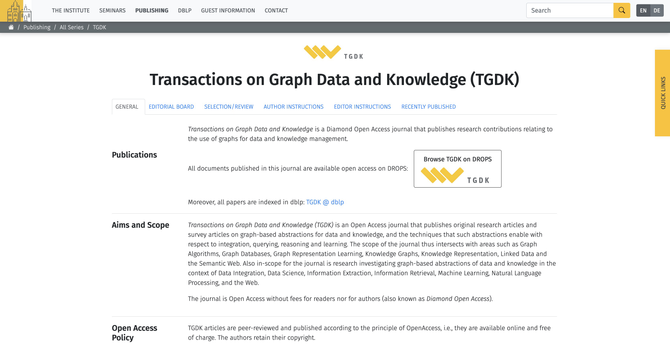
The new TGDK website in online via our new publisher Dagstuhl. Transactions on Graph Data and Knowledge (TGDK) is a Diamond #OpenAccess journal that publishes research contributions relating to the use of graphs for data and knowledge management.

https://www.dagstuhl.de/en/publishing/series/details/TGDK

#knowledgegraphs #ontologies #knowledgegraph #semanticweb #graphdata #ontologicalengineering #llms #knowledgeextraction #knowledgemining ##tgdk @gdm @katjahose @ejimenez_ruiz @keet @catiapesquita @AxelPolleres @juan

Transactions on Graph Data and Knowledge (TGDK)

Quite happy with how my little side-project has turned out so far.

It started off as an itch I wanted to scratch about named entity recognition, took me through #lstm to #transformer to #graphdata etc. Been a lot of fun and I've learnt a lot.

https://syracuse.1145.am

`This work examines the problem of learning a network graph from signals emitted by the network nodes, according to a diffusion model ruled by a Laplacian combination policy. The challenging regime of partial observability is considered, where signals are collected from a limited subset of nodes, and we wish to estimate the subgraph of connections between these probed nodes`

https://ieeexplore.ieee.org/abstract/document/10097221

#signalProcessing #graphData #dataAnalysis #dataScience #graphLaplacian #machineLearning

Learning Dynamic Graphs under Partial Observability

This work examines the problem of learning a network graph from signals emitted by the network nodes, according to a diffusion model ruled by a Laplacian combination policy. The challenging regime of partial observability is considered, where signals are collected from a limited subset of nodes, and we wish to estimate the subgraph of connections between these probed nodes. For the static setting where the network graph is fixed during the estimation process, we examine the sample complexity (number of time samples necessary to achieve consistent learning as the network size grows) of ErdΕ‘s-RΓ©nyi and BollobΓ‘s-Riordan graphs. This complexity is almost quadratic for the former and almost linear for the latter class of graphs. We then examine the dynamic graph setting where the graph of latent nodes grows over time, while the probed subset remains fixed. We show that in this case the sample complexity can be reduced, implying the unexpected conclusion that dynamic graphs might help topology inference under partial observability.