 Lobsters
Introducing RadixAttention to Trellis
 InfoQ
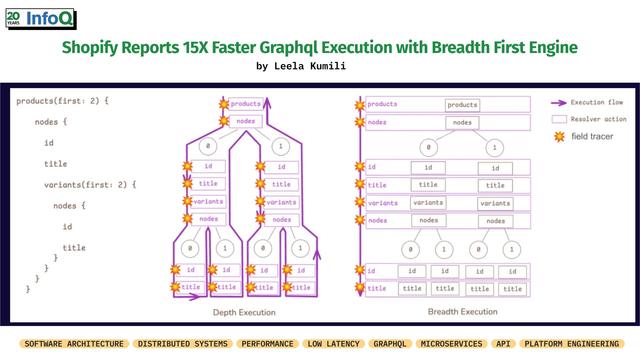
InfoQShopify has unveiled GraphQL Cardinal, a new execution engine replacing depth-first traversal with breadth-first execution.
Cardinal delivers performance improvements:
⚡ Up to 15× faster field execution
⚡ 6× lower garbage collection overhead
⚡ More than 4 seconds improvement in P50 latency
🔗 Learn more about the engineering behind GraphQL Cardinal: https://bit.ly/3RHwvXm
#InfoQ #SoftwareArchitecture #DistributedSystems #Performance #LowLatency #GraphQL #Microservices
 David Mankins
Inductive Deductive Synthesis: Enabling AI to
Generate Formally Verified Systems
https://arxiv.org/pdf/2605.23109
This paper is pretty cool.
They more-or-less use a proof checker (Rocq, a successor to Coq) as a tool in their agent loop during implementation, instead of turning to verification only at the end. The proof-checker generates structured output clarifying bugs in each stage of the implemenation (rather like a compiler in an ordinary coding assistant), which gets fed back into the prompt for the next stage of the agent-loop.
They use an analogy to chain-of-thought, except the intermediate states are formally verified, with “holes/need to fill this gap” output from the proof assistant rather than just plausible-sounding text inserted into the prompt for the next pass.
One still has to generate a Rocq spec as input — abstract data types, operation signatures, and axioms that specify the behavior of those operations (post-conditions, basically), but then the system produces a verified implementation prototype in Ocaml.
They are looking at using Verus, instead of Rocq as the proof assistant back end, which would produce Rust instead of Ocaml.
#formalverification
#distributedsystems
#rocq #ai #codeassistant
 Habr
HabrКак избежать 7 критических ошибок при переходе на микросервисы
Микросервисы обещают масштабирование и независимость команд, но чаще ломают систему медленнее монолита. Почему? В статье разбираем семь архитектурных ошибок, которые можно встретить в реальных системах: выбор по моде, shared database, игнорирование network latency, операционная сложность на потом, слишком мелкая декомпозиция, отсутствие стратегии consistency, недооценка сроков миграции. Разобрать ошибки
https://habr.com/ru/companies/otus/articles/1031278/
#микросервисы #архитектура #backend #distributedsystems #designpatterns #javakotlin #масштабирование

 Jeff Bailey
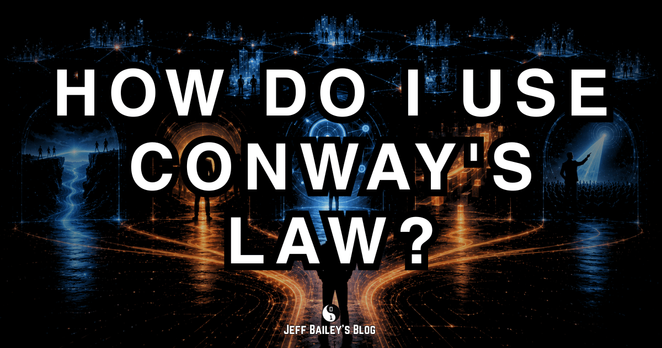
Your org chart may be designing your software more than your architects are.
Learn how to help teams diagnose architecture at the source.
https://jeffbailey.us/blog/2026/05/13/how-do-i-use-conways-law/
#SoftwareArchitecture #ConwaysLaw #TechnicalLeadership #SystemsThinking #TeamTopologies #DistributedSystems #Architecture
Stragglers vs. Failures - Do you know the difference?
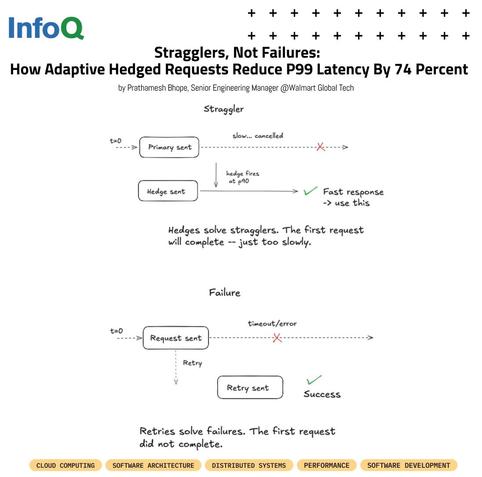
➤ A failure is a request that doesn't complete.
➤ A straggler is a request that completes but takes too long - often caused by a backend garbage collection (GC) pause, a hot partition, or a kernel scheduling blip.
From the caller's perspective, both damage p99. However, they require fundamentally different architectural solutions.
Read Prathamesh Bhope's #InfoQ article for a deeper dive: https://bit.ly/4uDWKg1
#DistributedSystems #CloudComputing #SoftwareEngineering #Performance
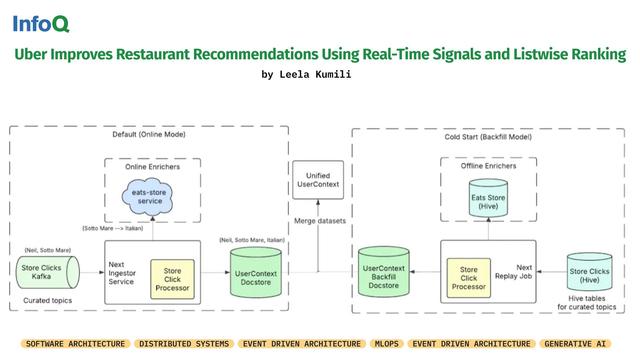
#Uber updated its Uber Eats Home Feed recommendation system using near real-time user sequence features and a Generative Recommender model.
By moving from hand-crafted features to a transformer-based sequence model, the system reduces feature freshness latency from ~24 hours to seconds.
🔗 Learn more about the update and the architecture behind it on #InfoQ ⇨ https://bit.ly/4dCly1K
#SoftwareArchitecture #DistributedSystems #MachineLearning #MLOps
 HackerNoon
Agent memory is not magic. It is distributed state with caches, logs, consistency windows, synchronization, and memory curation. https://hackernoon.com/agent-memory-is-just-distributed-state-with-a-better-name #distributedsystems

 Hacker News
Raft Consensus with a Minority of Nodes
https://padhye.org/raft-minority/
#HackerNews #Raft #Consensus #DistributedSystems #ConsensusAlgorithms #NodeMinority
 Caria Giovanni - Harpocrates
Working on something outside the usual AI paradigm sharing a preliminary note, not a "Eurkea".
The project (Aleph) explores whether biological organizational principles can replace neural architectures for embedded AI. No weights, no pre-training, no LLM. The core question: do the same solutions biology found over billions of years: specialization, quiescence, emergent coordination translate to digital systems?
Methodology follows Telesio's empirical approach: observation before theory, measurement before assertion. Every behavior in this post has a log file and a timestamp.
One verified result worth sharing:
Three independent components: a health monitor, a kernel, and an audio output organ — have no knowledge of each other. No shared state, no direct communication. When the watchdog process dies, the system emits a 220Hz tone. No explicit rule produces this. It emerges from composition.
This is weak emergence: predictable by reading the code. Not strong emergence. The distinction matters and we're not overstating it.
Current stack: Rust, Alpine Linux, SQLite, Unix sockets. Hardware: Dell Inspiron i5, 3.7GB RAM. ~452KB binary binary. ~39°C at rest.
What we don't know yet: whether this approach scales, whether the Bayesian learning converges usefully, whether the biological clock model holds across real day/night cycles.