ZX Spectrums – Part 2
In my previous post, ZX Spectrums, I listed my Spectrum inventory, some key resources for getting Spectrums back running, and started a visual inspection of my two Issue 2 machines, including a deep dive into the memory configurations and mandatory modifications to expect.
In this post, I’ve started to perform the pre-power up tests of my 48K machines.
Equipment Required
For the pre-powerup tests, really I only need a multimeter, but I can also recommend a cheap LCR meter. I have a FNIRSI LCR-ST1 “smart tweezer” that seems to be working well for me.
When it comes to power-on tests, I’m using the following:
- My Basic (and cheap) Benchtop Power Supply providing current limited centre-negative 9V.
- Diagnostic ROM card (see later).
- External composite mod lead (see later).
- Miniature VGA/composite/HDMI display. This was <£40 online and called some variation of “7 Inch Portable Display IPS 1024×600 LCD HDMI VGA AV”.
Pre-Powerup Tests
In the previous post I listed some references and key measurements that can be taken before power on a ZX Spectrum. Here are the results for my 48K machines. Results in bold seem to be out of what I’m expecting to see.
TestIdealIss 2 (D01)Iss 2 (plus)Iss 3 (045)Iss 6A (112)Iss 6A (122)Reg INRise >100KYYY
5K2openReg OUT700-800Ω720/800Ω1K11K780Ω790ΩCoilV: short
H: openY
YY
YY
YY
YY
YRAM 1 (-5V)Rise >10KYYY
1K2YRAM 8 (12V) Iss2
RAM 8 (12V) Iss3+800-900Ω
2K5-2K8850Ω
840Ω
2K6
23Ω2K5RAM 9 (+5V)300-500Ω800Ω1K1K800Ω750ΩRAM 16GNDYYYYYTR4 C-B (B+)0.6-0.90.650.650.63
1.30.64TR4 E-B (B+)0.6-0.90.650.650.63
0.870.64TR4 B-C (B-)openYYYYYTR4 B-E (B-)openYYYYYTR5 C-B (B+)1.0-1.20.770.870.920.720.82TR5 E-B (B+)openYYYYYTR5 B-C (B-)0.6-0.90.680.680.680.680.68TR5 B-E (B-)0.6-0.90.680.680.680.680.68C2522uF31.5u/3.5Ω32u/3.2Ω61u/3.7Ω34u/3.0Ω30u/2.9ΩC271uF1.1u/26Ω0.9u/28Ω
<0.7u/102Ω1.1u/14Ω1.0u/10ΩC2822uF49u/1.5Ω58u/1.0Ω68u/2.0Ω52u/1.6Ω57u/1.1ΩC3422uF49u/1.5Ω58u/1.2Ω68u/2.1Ω52u/1.6Ω57u/1.6ΩC44100uF114u/0.7Ω111u/0.8Ω130u/0.7Ω106u/2.3Ω71u/1.3ΩC45100uF95u/1.2Ω104u/1.0Ω106u/0.7Ω142u/1.2Ω80u/1.8ΩC461uF1.0uF/21.5Ω0.9u/18Ω1.3u/14Ω1.0u/23Ω1.1u/12ΩC47 (Iss2)22uF22u/1.7Ω20u/2.0Ω–––C5022uF22.3u/1.9Ω17u/2.3Ω28u/2.6Ω23u/2.4Ω23u/1.9ΩC6522uF25u/1.6Ω22u/1.9Ω31u/3.5Ω20u/1.9Ω23u/2.0ΩC74 (Iss3, 6A)4.7uF––4.2u/7.8Ω
3.2u/63Ω4.6u/6.0ΩC79 (Iss6A)1uF–––1.1u/16Ω1.2u/13ΩC80 (Iss6A)22uF–––10u/9.6Ω12u/8ΩMod (Iss2)4.7uF5.8u/4.9Ω4.4u/5.6Ω–––Speaker202Ω200Ω40Ω40Ω31Ω
So in summary, I’m concluding:
- Both Issue 6A seem to have a issue with the power regulator.
- Issue 6A (112) seems to have a TR4 problem, and some question about the RAM readings for -5V and 12V.
- Issue 3 has a dodgy 1uF C27.
- Issue 6A (112) has a dodgy 4.7uF (C74).
Surprisingly though, most of the capacitors seem to be fairly sensible. I think my conclusion is that either of the Issue 2 boards ought to be fine to power up, so I’m going to go with the upgraded one in plus case. You may recall from part 1, that the other has some uncertainly over its memory at the moment.
Diagnostics ROM Card
Having some confidence that I can now power at least one of these motherboards up, what is most useful to be running? The best thing to use is a diagnostics card. These will usually have a ROM onboard that will boot in place of the original ZX Spectrum ROM and can put the machine through a series of tests.
I’d really like to have a SteamCard Pro as it is constantly referenced by Lee from MoreFunFixingIt (he puts it through its paces here), but these only seem available by special request in a Facebook group, and my request has not been acknowledged, so that avenue might not be available to most people (including me).
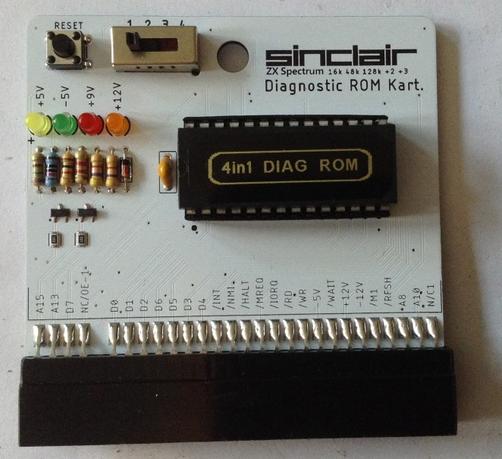
But there are a number of more basic cards available, so I’ve got one like this, which is usually described with some variation of “ZX Spectrum Diagnostic Test Cartridge 4in1” which I picked up for around £15 from cece_mods.
I’m guessing there is probably some common, open design somewhere, although I’ve not found the original with my searching so far. Sites and designs I’ve seen referenced that may be relevant are:
But these seem a fair bit more complex. And to be sure, there are more complex ones out there that can be bought. At some point I’ll take a proper look, but investigating them is probably a task for another day. I might also look into designing my own just to figure out how they work…
But this is a relatively simple card that gets me going. It has the following features:
- Power rail indicators: +5V, -5V, +9V, +12V.
- Four diagnostic ROMs to choose from.
- Replaceable EEPROM (W27C512 for 4x 16K images).
- Edge connector, RESET switch, ROM selection switch.
One of the ROMs is the Retroleum diagnostic ROM which is described here: https://blog.retroleum.co.uk/electronics-articles/a-diagnostic-rom-image-for-the-zx-spectrum/
The full set of included ROMs is:
- Retroleum Diagnostic ROM, v1.71
- Sinclair ZX 48K Spectrum Test ROM, Dr. Logan
- Smith and Alford Diagnostics, 0.37D
- ZX Spectrum 128K 128K-2 Test ROM, v1.00, Dr. Logan
It claims compatibility with all ZX Spectrum Models from 16K through to grey and back 128K versions.
Composite Mod
Assuming a spectrum passes at least the “can I see some voltage on the rails” test, and I think the diagnostic card will also beep if it passes a memory test, really we need some output.
Almost everyone these days will perform a simple mod to turn the original RF (TV signal) output into a composite video signal. This is relatively straight forward as the Spectrum provides a composite signal already to the TV modular on the PCB so it is just a case of bypassing the modulator. It can even be done in a way that is easily reversable.
But I don’t want to do that yet, as I’m keen to keep the number of variables (and mods) to a minimum. But there is an alternative. Again Lee from MoreFunFixingIt has a special lead that he calls his “Henry composite mod lead” that can be used on an unmodded PCB to get the composite video out.
I’ve not been able to find any details online so far, but from reading how the usual mods work, and seeing how Lee uses it, I’m fairly certain it basically disconnects the core signal from a video lead from the Spectrum’s connector and instead brings it out to a crocodile clip which can be clipped onto the composite signal as it enters the modulator. This is only useful when the case is removed as the clip has to be on the inside. But otherwise it will implement the mod for a completely unmodded board.
Here are some details of how I’ve made some of these.
Bill of Materials to make two leads (simply because I’ll be cutting cables in half!):
- 1x Composite/AV (single phono to phono) lead.
- 1x Crocodile clip lead.
- 2x Phono plug.
- 2x 100uF electrolytic capacitor.
- Heatshrink.
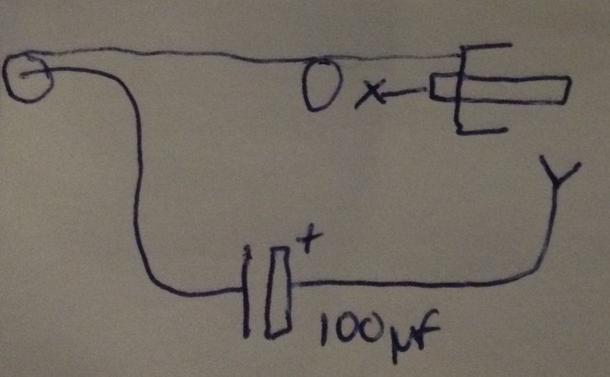
The aim is to achieve the following:
The basic procedure:
- Cut the video lead in half.
- Cut the crocodile clip lead in half.
- After threading the wires through the appropriate connector covers and heatshrink…
- Solder the video cable shield/GND to the shield of the phono plug.
- Bend the phono plug inner solder tab out of the way – it is not required.
- Solder the inner core (signal) of the video lead to the crocodile clip lead.
- Cover the soldered joint with some heatshrink or other insulating material.
- Assemble the phono plug.
This would now work for some monitors, but it is recommended that an additional 100uF capacitor is added to the crocodile clip lead to remove the bias that the Spectrum puts on its composite signal. To do this, do the following:
- Cut the crocodile clip lead somewhere convenient.
- After threading heatshrink as required, do the following:
- Solder the +ve lead of the 100uF capacitor to the crocodile clip end of the lead.
- Solder the -ve lead of the 100uF capacitor to the phono plug end of the lead.
- Cover the whole assembly with heatshrink or other strengthening and insulating material.
Hopefully these photos show what I’m taking about in how to make the mod.
To use the mod lead connect it to the composite video signal as it enters the modulator as shown below. The other lead that enters the modulator is the 5V power.
Running the Diagnostics
At this point I can power up the Issue 2 board from the Plus case and see what it does.
WARNING: I’m using a current limiting (limit to around 800mA), 9V, CENTRE NEGATIVE power supply to test this out at this point.
Success! My Plus Issue 2 board is working and passing initial diagnostics, including a full RAM test. At this point I need a keyboard to take things further and explore the other options from the diagnostic card.
Now, if I reboot without the card, I get the expected “(c) 1982 Sinclair Research” line on a white(ish) display, the nothing else.
Unfortunately, the keyboard ribbon for this one has broken and I need to look into replacing it, but plugging in another keyboard temporarily does appear to show that the machine is generally working. The video colours are well off though, so it will need some adjustments at the very least. I believe with many Issue 2 boards, there are video replacement circuits that can be explored.
But that is all work for another day.
This is a really pleasing point to get to, and feels like quite a milestone 🙂
And I’ve now been able to plug in my PDS Spectrum target and show that it at least doesn’t destroy the machine! If I can get a keyboard working, then I should be able to poke the Z80 PIO and make sure it works.
Kevin
#compositeVideo #diagnostics #zxSpectrum Robot Talk

 nf-core
 Politico.eu (Unofficial RSS)
 Mohamed Samy Abousenna
 HeikeJanka
 Kevin's Blog