The #depaving groups reclaiming #UrbanGreenSpace

by Jennifer Cole, Mar 21, 2026

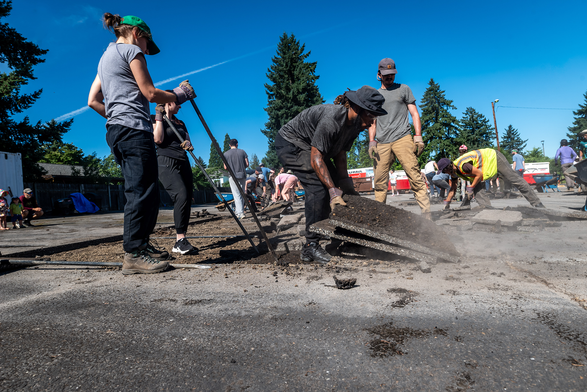
"It took two years, but finally, in 2025, Jean Norwood’s dream of turning the parking lot at #MorningstarMissionary Baptist Church in #PortlandOR, into a play area for children and a #FoodGarden with #FruitTrees came true. Working with Norwood to bring her vision to reality was #DepavePortland. Since 2008, the Portland-based nonprofit has been digging up paved surfaces, freeing the trapped soil underneath and #regreening the newly reclaimed space.

"There are an estimated 2 billion parking places in the United States, an area comparable in size to the entire state of Vermont. That figure does not include #sidewalks, schoolyards or other paved surfaces, which, along with #CarParks, trap heat, intensifying the urban #HeatIsland effect in some cases by up to 10 degrees Fahrenheit compared with surrounding areas. '#Asphalt makes your space hotter in the summertime, and colder in the wintertime,' Norwood says.

"When asphalt is removed and the soil beneath is exposed, those dynamics begin to reverse. The ground can absorb and store #carbon, and #rainwater is able to filter into the soil rather than running off into sewers. #Trees and #gardens can be planted that provide shade and a #habitat is created for #birds, #insects and other #wildlife.

"This was Norwood’s dream for the parking lot at Morningstar. Going from concrete to fruit trees, though, takes patience. 'First,' she says, 'there was about six months of planning and submitting requests for permitting.'

"Depave guided Norwood and the church through all of it, even seeking out grants to help cover costs. When it came time to depave the parking lot, volunteers recruited by Depave used crowbars, shovels, bare hands and wheelbarrows to lift out the pavement and daylight the soil beneath. Depave also worked with Morningstar on finding contractors to build the play area and raised #GardenBeds, and on choosing the plants for each newly #regreened space. It’s a process Depave has perfected at more than 82 sites across Portland."

https://www.rewildingmag.com/the-depaving-groups-reclaiming-urban-green-space/

#SolarPunkSunday #MoreGreenCities #GreenerCities #RewildingCities #MoreParksLessParkingLots #WildlifeHabitat
The Depaving Groups Reclaiming Urban Green Space

These forward-thinking organizations have depaved parking lots – and turned them into paradise.

Rewilding Magazine
Locations - GrowNYC

GrowNYC

Related link: #NYC - The First Comprehensive #UrbanAgriculture Map

"One of MOUA’s first priorities was building a complete picture of urban agriculture across the city, and making that information available to the public. The office created the Urban Agriculture Data Explorer Hub, an interactive platform that maps food production across all five boroughs. The tool has cataloged 2,580 sites so far: #SchoolGardens, #UrbanFarms, #CommunityGardens, #IndoorAgriculture businesses, and underutilized city-owned land. Users can sort by borough, zip code, land management type, and food production status, then click on individual locations for more detail. The platform will eventually also track wellness programs, commercial activity, and climate mitigation efforts. Its crowdsourced design allows community members to contribute information that official records miss, creating a more complete picture over time."

https://www.arcgis.com/apps/dashboards/7d3e668dfcdd4bce93275dae44fcd3dd

#SolarPunkSunday #GreenerCities #UrbanFarms #UrbanGardens #FarmersMarkets #FarmToTable #FoodSecurity #NYC

ArcGIS Dashboards

ArcGIS Dashboards

Alrighty then... I'll be boosting and re-posting a few SPS posts from yesterday, but I wanted to leave you all with this very #SolarPunk story. TY to @MaQuest and @BrambleBearSnoring and everyone else who used the hashtag. We'll be back at it next #SolarPunkSunday!

Three Years In, New York’s #UrbanAgriculture Office Has Delivered

by Haley Schusterman, January 20, 2026

"Three years in, the office is delivering on its full mandate. It built its own relationships with community leaders and advocates, launched education programs connecting students to working #farms, opened pathways for #SmallFarmers to sell to city institutions, mapped the city’s urban agriculture landscape, and pushed for procurement reform that could redirect how the city spends its food dollars. The office is working to change how eight million #NewYorkers grow, buy, and think about food, using urban agriculture as a lever for #ClimateAction, #EnvironmentalJustice, #FoodAccess, workforce development, and economic #resilience."

Read more:
https://www.nycfoodpolicy.org/three-years-in-new-yorks-urban-agriculture-office-has-delivered/

#GreenerCities #UrbanFarms #UrbanGardens #FarmersMarkets #FarmToTable #FoodSecurity #NYC

Three Years In, New York's Urban Agriculture Office Has Delivered - NYC Food Policy Center (Hunter College)

The Mayor’s Office of Urban Agriculture (MOUA) isn’t a household name. Given what it’s…

NYC Food Policy Center (Hunter College)

Why #WildlifeCorridors are Essential for #Biodiversity and #Ecosystem Health

November 12, 2024

"Wildlife corridors serve as lifelines for biodiversity and ecosystem health. By providing a unique way to balance human development with #NatureConservation; connecting #FragmentedHabitats and allowing wildlife to move freely. So what exactly are wildlife corridors and why are they so important?

Wildlife corridors are strips of natural habitat that connect fragmented landscapes. They enable wildlife to move between isolated areas, aiding #migration, #GeneticDiversity, and survival. These corridors help mitigate the negative impacts of human development, such as #roads and #urbanisation, on animal populations.

Wildlife corridors serve many purposes, all stemming from their ability to reconnect isolated populations. By preventing habitat fragmentation, they enhance survival rates through increased food sources, cover, and reduced predation. On top of this, they protect biodiversity by enabling animals to move freely between habitat patches, reducing the risk to both wildlife and humans posed by human-made barriers.

Wildlife corridors are crucial for the survival of landscape species, which are wildlife species that need expansive areas to survive, such as tigers in India or grizzly bears in the United States. They are also vital in maintaining safe passage for birds, fish, and mammals, especially as new roads and developments create barriers to traditional feeding and breeding grounds.

These corridors can take various forms, ideally spanning 50 to 200 feet in width, providing sufficient habitat for species using them to travel, forage or nest. They offer a diverse range of habitats, enhancing the opportunities for various wildlife to thrive. Corridors can take the shape of #shelterbelts, #FieldBorders, #RiparianBuffers, and #RoadsideHabitats, each playing a unique role in providing sustenance, shelter, and travel lanes for different species.

Wildlife corridors highlight the possibility of a peaceful coexistence between humans and wildlife. Wildlife corridors help direct animals away from human settlements, reducing conflicts and minimising damage to crops and property, while ensuring the surviving and well-being of various species. Raising public awareness of these corridors is crucial for maintaining functioning natural systems on which humans also depend."

https://www.evergreening.org/why-wildlife-corridors-are-essential-for-biodiversity-and-ecosystem-health/

#SolarPunkSunday #Nature #Wildlife #UrbanAreas #GreenerCities

Why Wildlife Corridors are Essential for Biodiversity and Ecosystem Health - Global EverGreening Alliance

Wildlife corridors serve as lifelines for biodiversity and ecosystem health. By providing a unique way to balance human development with nature conservation; connecting fragmented habitats and allowing wildlife to move freely. So what exactly are wildlife corridors and why are they so important? Wildlife corridors are strips of natural habitat that connect fragmented landscapes. They…

Global EverGreening Alliance

Best #GreenCities: 12 Greenest Cities In The World And Why - #UnityEnvironmentalUniversity (formerly #UnityCollege)

March 6, 2024

"What Makes A City Green?

"What are green cities? A green city is a city that actively works to foster the health and #WellBeing of its people and the #NaturalEnvironment. Often, we look at government policies, community practices, and infrastructure to determine whether a city is 'green' or not.

"However, the greenness of a city actually exists on a spectrum and is multi-faceted. There is no such thing as the greenest city. The greenest cities in the world are those that are doing more to be sustainable when compared to other cities. The greenness of a city includes the following factors and more:

- The availability of #GreenSpaces
- #PublicTransportation options
- #Bikeability
- #RenewableEnergy options
- #CarbonFootprint
- #Recycling programs

"What Makes A University Green?

"An #EcoFriendly city and an eco-friendly university have a lot in common, including #sustainable buildings, #CommunityFarms and #gardens, and #EthicallySourced goods. For Unity Environmental University, an essential part of going green was completely divesting from #FossilFuels and investing in renewable clean energy instead. Ultimately, being a green university is about prioritizing sustainability as a core value and guiding principle for the institution.

"12 Greenest Cities In The World

"#Urban areas around the world are striving to become more environmentally friendly as we continue to grapple with the negative effects of climate change. Many of the world’s greenest cities focus on mitigating those effects by minimizing their carbon footprint, shifting to renewable sources for energy, and improving public transportation. Other cities are taking innovative approaches to integrating green spaces and urban farming.

"This list of the top 12 greenest cities is the result of a holistic review of the most environmentally friendly urban areas in the world. They are not listed in any particular order."

Read more:
https://unity.edu/articles/greenest-cities-in-the-world/

#SolarPunkSunday #GreenCities #UrbanFarming #Gardens #Trees #GreenSpace #GreenerCities

Best Green Cities: 12 Greenest Cities In The World And Why

Explore the world's top green cities, exploring what makes them leaders in sustainability and the innovative practices setting them apart.

Unity Environmental University

Six Cities Making Room for #Nature

By Sharon Gosling, 2021

"How do you turn a city green? Stand back and let the plants in!

From #beehives on rooftops to #ForestChannels pulling cool air into city centres, innovative ideas are bringing nature into urban areas, all around the world. Here are six cities that have found ways to incorporate #greenery into their #cityscapes – to the benefit of their populations and the environment."

Read more:
https://www.bbcearth.com/news/six-cities-making-room-for-nature

#SolarPunkSunday #GreenCities #GreenerCities #GreenSpace #Gardens #Liverpool #CuritibaBrazil #Singapore #Izmir #Seoul #NewYorkCity

Urban Greening: Six Cities Making Room for Nature | BBC Earth

How do you turn a city green? Stand back and let the plants in!