Is there anyone on here whose brains I can pick about altimetry #SLA products? I'm particular the difference between L2P and L3 products?
#altimetry #oceanography #EarthObservation #aviso #cmems #eumetsat
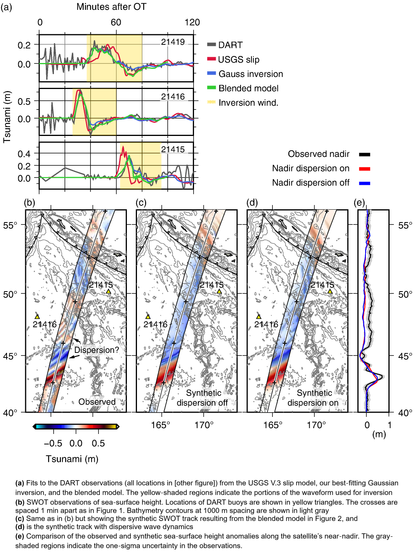
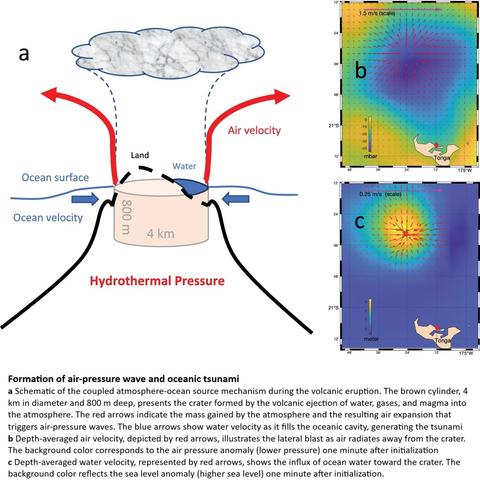
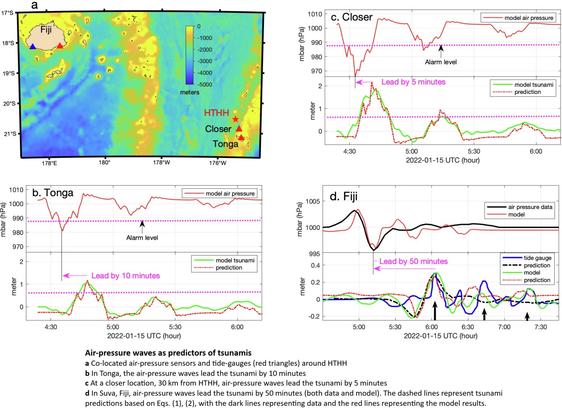
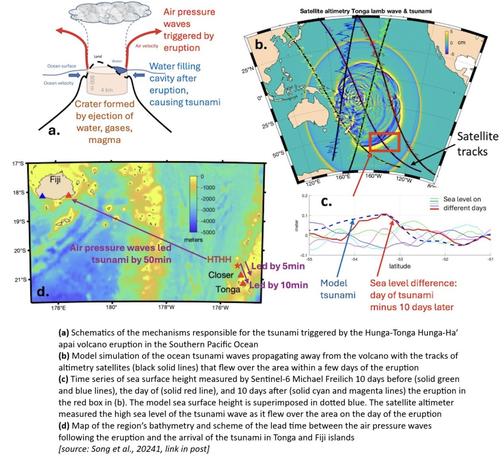
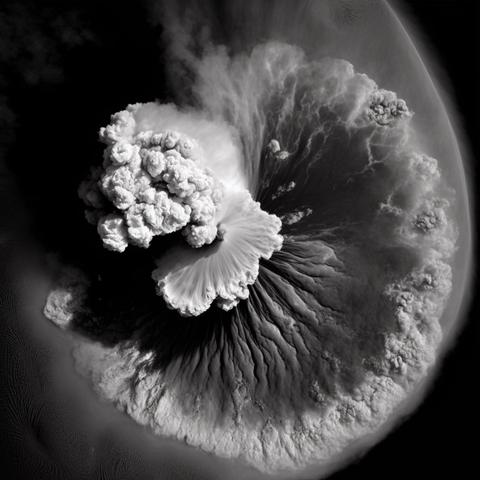
Data in Action: The 2022 Hunga-Tonga Hunga-Ha′apai eruption - Altimetry data and models help us understand how a volcanic eruption generated a tsunami | PO.DAAC / JPL / NASA

Volcanic eruptions can trigger tsunamis that pose significant threats to nearby coastal communities. The mechanisms responsible for the formation of tsunamis after volcanic eruptions are still poorly understood. Some possibilities include submarine landslides, pyroclastic flows (fast-moving current of hot gas and volcanic matter that flows in the ocean), caldera column collapses (massive blocks of rock near the top of the volcano sliding down into the volcano), deep-ocean explosions, volcano-tectonic earthquakes, or atmospheric air-pressure waves. More research is needed to better understand these mechanisms so that better early warning systems can be developed. The Hunga-Tonga Hunga-Ha′apai volcano is situated in the South Pacific Ocean about 1000 km south of Fiji and Samoa islands

Physical Oceanography Distributed Active Archive Center (PO.DAAC)
Satellites reveal stunningly detailed maps of Earth's seafloors

A newly-deployed satellite has created the most-detailed map yet of the ocean floor, finding hundreds of hills and underwater volcanoes that were previously missed.

Live Science
Our Very Strange Search for “Sea Level”

Brooke Jarvis considers the history behind the search for sea level, as described in a new book by Wilko Graf von Hardenberg, and probes what it tells us about science, global warming, and life on our changeable planet.

The New Yorker
Global Seafloor Topography – measured & estimated from gravity data derived from satellite altimetry and shipboard depth soundings. (noaa.gov)
This image is so beautiful, but not yet entirely accurate in detail https://gogeomatics.ca/mapping-the-deep-our-map-of-the-ocean-remains-a-work-in-progress/ #oceanography #seafloor #altimetry #sonar
2023年の海洋表面トポグラフィーサイエンスチーム会議の要約
https://science.nasa.gov/uncategorized/summary-of-the-2023-ocean-surface-topography-science-team-meeting/

2023年11月にプエルトリコのサンフアンで開催されたOcean Surface Topography Science Team Meetingについて。衛星ミッションの技術問題や将来のミッションについて議論が行われた。

S6MFやJason-3などのミッションの状況も報告された。
#NASA #JPL #altimetry
Summary of the 2023 Ocean Surface Topography Science Team Meeting - NASA Science

Severine Fournier, NASA/Jet Propulsion Laboratory, [email protected] Willis, NASA/Jet Propulsion Laboratory, [email protected] Introduction The annual Ocean Surface Topography (OST) Science Team Meeting (STM) provides a forum for the international altimetry community to foster collaboration, address specific issues, and highlight scientific results and applications every year. The meeting location alternates between Europe and the U.S. The 2023 meeting […]

Read the European Space Agency's story about how Tero Water Level methodology developed by @isardsat, @smhi & @lobeliaearth helped reveal hundreds of previously undetectable small lakes in the #Arctic

This method uses #altimetry data to detect small water bodies anywhere in the 🌍

https://sentinel.esa.int/web/success-stories/-/new-data-analysis-technology-delivers-unprecedented-arctic-insights

New data analysis technology delivers unprecedented Arctic insights - Sentinel Success Stories - Sentinel Online

Sentinel Success Stories
We have developed a novel #AI based approach for tracking radar #altimetry measurements over ice sheets. This new AWI-ICENet1 retracker reduces the effect of signal penetration and outperforms current retracking methods. Preprint now open for discussion: https://doi.org/10.5194/tc-2023-80
AWI-ICENet1: A convolutional neural network retracker for ice altimetry

Abstract. The Greenlandic and Antarctic Ice Sheet are important indicators of climate change and major contributors to sea level rise. Hence, precise, long-term observations of surface elevation change are required to assess changes and their contribution to sea level rise. Satellite radar altimetry has been used by various missions to measure surface elevation change since 1992. It has been shown that, next to the surface slope and complex topography, one of the most challenging issues is the spatial and temporal variability of radar pulse penetration into the snow pack, especially over the vast East Antarctic plateau. This results in an inaccurate measurement of the true surface elevation and consequently affects surface elevation change (SEC) estimates. To increase the accuracy of surface elevations retrieved by retracking the radar return waveform and thus reduce the uncertainty in SEC, we developed a deep convolutional neural network architecture (AWI-ICENet1). The AWI-ICENet1 is trained using a simulated reference data set with 3.8 million waveforms, taking into account different surface slopes, topography, and attenuation. The successfully trained network is finally applied as AWI-ICENet1-retracker to the full time series of CryoSat-2 Low Resolution Mode (LRM) waveforms over both ice sheets. We compare the AWI-ICENet1 retrieved SEC with estimates of conventional retrackers like TFMRA and ESA ICE1 and ESA ICE2 products. Our results show less uncertainty and a greatly diminished effect of time variable radar penetration, reducing the need to apply corrections based on a close relationship with backscatter- and/or leading edge width, as typically done in SEC processing. This technique provides new opportunities to utilize convolutional neural networks in altimetry, waveform retracking, and processing of satellite altimetry data, which can be applied to historical, recent, and future missions.