 ᶻ 𝗓 𐰁 Мнимость ᶻ 𝗓 𐰁
Which one should I research about for public speaking classes
DID, OSDD ( and the diff stages), dpdr, dissociative amnesia 

 Moriel 🏳️⚧️
Random thoughts on a Saturday morning.
I was reading the Wikipedia article on atypical antipsychotic medications. I take one - lurasidone - for my bipolar disorder. At the end of the article it mentions that some doctors don't use the term antipsychotics when describing the drugs to their patients, because they are commonly used to treat things other than psychosis, and there is stigma attached to the term. And I thought to myself that I just don't feel any stigma around any mental health disorders. I mean consider:
I am bipolar, have social anxiety, grew up with major depression, am probably autistic, and have enough trauma in my past that I need therapy for it and should probably also be diagnosed with CPTSD. On top of that my best friend has schizoaffective disorder, meaning she has schizophrenia on top of bipolar disorder, and she has dissociative identity disorder too (what used to be called multiple personality disorder). And as far as I'm aware all but one person that I know in real life has at least one diagnosis, with ADHD and borderline personality disorder being the most common, as well as tons of autism.
Stigma? Nope! Mental disorders for me are just a normal, every day aspect of life.
I wish everyone else would realize that different mental health states (and I really wish they were called "states" rather than "disorders") are common and many people live their lives with these conditions and have perfectly routine and ordinary lives in most respects. We aren't freaks that need to be stigmatized. We are just people, like everyone else.
#MentalHealth #bipolar #schizophrenia #adhd #ActuallyAutistic #autism #borderline #DID #dissociative #ptsd #depression #anxiety
 Vayl Larkin (they/them)
Ugh. I have just gone through my follow list and discovered Exactly how long it's been since I did that. To everyone who followed me at the dawn of time, and just today got followed back, my entire bad. Object Permanence is for those who don't have Better things to remember. *sigh* #AA #AutisticLife also #ADHD and #PTSD and #Dissociative Life.
 Xamanismo Coletivo
What a story! He could only be a professor of #philosophy.
"Dunne’s transformation sounds like a fairytale in reverse: one kiss, and his life turned into a nightmare. Seventeen years have passed since that night, and he still mostly explains the change in himself in metaphors and similes.
It would take Dunne three-and-a-half years to learn that what he had experienced was the onset of #depersonalisation disorder, a #dissociative disorder believed to affect about 1.3 million people in the UK, a similar number to those with #bipolar disorder, though the condition is far less known."
 RoadToDusk || Dream Ushers
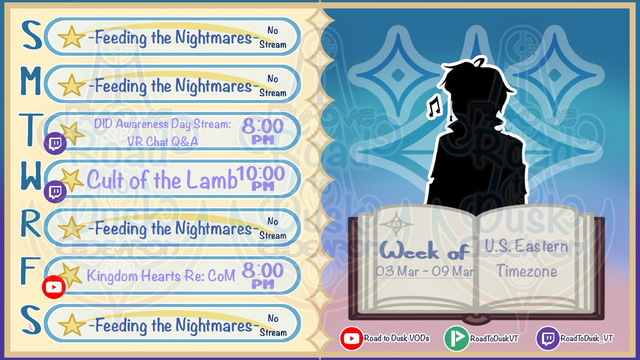
We’re slow on putting out the schedule while we prioritise our mental health. We got some plans for a DID Awareness Day collab with the Nukter’s later in the month, but we still got something this week! :D
#vtuber #livestream #twitchstreamer #youtuber #dissociativesystem #pngtuber #livestreamer #twitchaffiliate #smallyoutuber #dissociative
 Unassuming Plural System
Have a blood and guts post about the work my therapists and I did this week to identify that I'm on the #dissociative spectrum.
#depersonalization #derealization
https://www.jessicabkelly.com/2023/10/28/the-dissociation-of-the-artist/
 PlanetMedicines
“Dissociation in human beings is a self-reported state of mind, and no experimental technique in rodents or in humans can currently define this subjective experience in full. However, the clinically guided paradigm reported here could provide a framework of behavioural, optical and physiological tools to enable exploration of the neural activity that underlies dissociative states.” (Vesuna, et, al 2020) — https://www.nature.com/articles/s41586-020-2731-9 #ketamine #dissociative #psychedelic

 Eph (they/them)
 Usagineko, Catgirl of Battle
Conversation between my DI alters this morning:
Vanessa: I'm awake!
Michael: Good for you.
Vanessa: So go buy us Yor Forger's assassination dress from "Spy X Family".
Michael: What? No. That's not in the budget.
Vanessa: And get it made in satin-lined PVC.
#cosplay #dissociative #money #gender #genderqueer
Vanessa: I'm awake!
Michael: Good for you.
Vanessa: So go buy us Yor Forger's assassination dress from "Spy X Family".
Michael: What? No. That's not in the budget.
Vanessa: And get it made in satin-lined PVC.
#cosplay #dissociative #money #gender #genderqueer

 Michael Reeder LCPC
TITLE: DiD, Vestibular Balance Issues, Brainscans, and Neurology
I'm a mental health clinician looking for resources and research papers
on the intersection of #DiD ( #Dissociative Identity Disorder),
#vestibular anomalies, and #neurology . I am familiar with most of the
counseling theory around DiD -- but what does it look like from a
#brainscan ( #CTscan #MRI ) point of view? Do the #subpersonalities
exhibit different brain activity when activated?
So say that a patient with DiD ( #MultiplePersonality ) was undergoing
treatment for vestibular balance disorders and switching some between
alters as the exercises were done. Is anything known on what this
medically would look like in the brain? How a neurologist would be
likely to view the behaviors witnessed?
Thanks,
Michael Reeder LCPC
Baltimore, MD
#psychology #psychiatry #mentalhealth @psychology
@psychiatry @socialwork #psychotherapy
@psychotherapists