The Power of the Whisper: How WSPR and WSJT-X are Redefining Long-Distance Radio

1,250 words, 7 minutes read time.

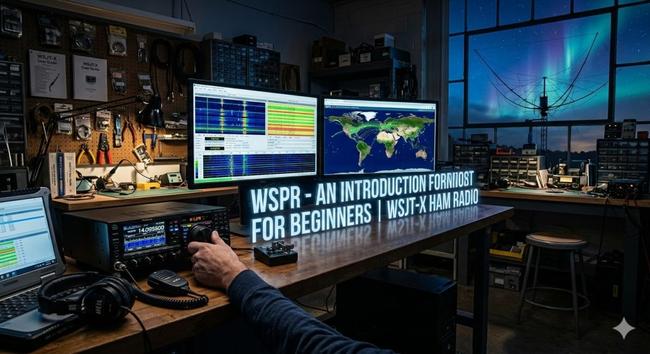
Amateur radio operators and technology enthusiasts are currently utilizing the Weak Signal Propagation Reporter, commonly known as WSPR, and the WSJT-X software suite to achieve global communication using minimal power. Developed by Nobel laureate Joe Taylor, K1JT, this digital protocol allows stations to send and receive signals that are often completely buried in background noise, making it possible to map atmospheric conditions and radio propagation in real-time. This technology serves as a critical entry point for men looking to understand the mechanics of the ionosphere and the efficiency of modern digital signal processing. By leveraging advanced mathematical algorithms, WSPR proves that high-power amplifiers and massive antenna towers are no longer the only way to reach across the ocean, offering a technical challenge that rewards precision and patience over brute force.

The core of this system lies in the software known as WSJT-X. This program implements several digital protocols designed specifically for making reliable communication under extreme conditions where traditional voice or Morse code signals would fail. While WSPR is not a conversational mode, it acts as a global beacon system. A station transmits a brief packet containing its callsign, location grid square, and power level. Thousands of other stations around the world, running the same software, listen for these signals and automatically report any successful decodes to a central internet database called WSPRnet. This creates a living, breathing map of how radio waves are traveling across the planet at any given second, providing invaluable data for anyone interested in the science of communication.

Understanding the physics behind this process is what separates a casual observer from a true radio technician. The Earth’s ionosphere, a layer of the atmosphere ionized by solar radiation, acts as a mirror for certain radio frequencies. Depending on the time of day, solar flare activity, and the season, these signals can skip off the sky and land thousands of miles away. In the past, confirming these paths required luck and high-power transmissions. Joe Taylor once noted that the goal of these modes is to utilize the information-theoretic limits of the channel. This means squeezing every bit of data through the smallest amount of bandwidth possible, allowing a station running only one watt of power to be heard in Antarctica from a backyard in Michigan.

For the man standing on the threshold of earning his amateur radio license, WSPR is the ultimate proof of concept. It removes the intimidation factor of “talking” to strangers and replaces it with a pure engineering objective: How far can my signal go with the least amount of effort? Setting up a WSPR station requires a computer, a transceiver, and a simple wire antenna. The software handles the heavy lifting of Forward Error Correction and narrow-band filtering. This process teaches the fundamentals of station grounding, signal-to-noise ratios, and frequency stability—skills that are mandatory for passing the licensing exam and, more importantly, for operating a professional-grade station.

The hardware requirements are surprisingly modest, which appeals to the practical, DIY-oriented mind. Many enthusiasts use a Raspberry Pi or an older laptop dedicated to the task. The interface between the radio and the computer is the critical link, ensuring that the audio generated by the software is cleanly injected into the radio’s transmitter. If the audio levels are too high, the signal becomes distorted, “splattering” across the band and becoming unreadable. This level of technical discipline is exactly what is required in high-stakes fields like aviation or telecommunications. Mastering the “clean” signal is a badge of honor in the ham radio community, signifying a man who knows his equipment inside and out.

As we look at the data generated by WSPR, we see more than just dots on a map; we see the pulse of the sun. Because radio propagation is tied directly to solar activity, WSPR users are often the first to notice a solar storm or a sudden ionospheric disturbance. When the sun emits a massive burst of energy, the higher frequency bands might “open up,” allowing for incredible distances to be covered on low power. Conversely, a solar blackout can shut down communication entirely. Being able to read these signs and adjust one’s strategy accordingly is a core component of the hobby. It turns a simple radio into a scientific instrument used for environmental monitoring.

The community surrounding WSJT-X is one of rigorous peer review and constant improvement. The software is open-source, meaning the code is available for anyone to inspect and refine. This transparency has led to a rapid evolution of the protocols. While WSPR is for propagation reporting, other modes within the suite like FT8 or FST4 are used for rapid-fire contacts. However, WSPR remains the gold standard for testing antennas. If a man builds a new wire antenna in his yard, he doesn’t have to wait for someone to answer his call to know if it works. He can run WSPR for an hour, check the online map, and see exactly where his signal landed. It provides immediate, objective feedback that is essential for any technical project.

The future of this technology points toward even more robust communication in the face of increasing electronic noise. As our cities become more crowded with Wi-Fi, power lines, and electronics, the “noise floor” of the radio spectrum is rising. Traditional modes are struggling to compete. Digital modes like those found in WSJT-X are the solution, using digital signal processing to “dig” signals out of the static. This represents the next frontier of amateur radio—the transition from analog heritage to digital mastery. For those looking to get involved, the barrier to entry has never been lower, and the potential for discovery has never been higher.

In the broader context of emergency preparedness and global infrastructure, the lessons learned from WSPR are invaluable. In a scenario where satellites or internet backbones fail, the ability to bounce low-power signals off the atmosphere remains one of the only viable long-distance communication methods. A man who understands how to deploy a WSPR-capable station is a man who can provide data and connectivity when everything else goes dark. This sense of utility and self-reliance is a driving force for many who pursue their license. It is not just about a hobby; it is about mastering a fundamental force of nature to ensure that the lines of communication stay open, no matter the circumstances.

Call to Action

If this story caught your attention, don’t just scroll past. Join the community—men sharing skills, stories, and experiences. Subscribe for more posts like this, drop a comment about your projects or lessons learned, or reach out and tell me what you’re building or experimenting with. Let’s grow together.

D. Bryan King

Sources

  • WSJT-X Main Page: physics.princeton.edu/pulsar/k1jt/wsjtx.html
  • WSPRnet Official Site: wsprnet.org/drupal/
  • ARRL – What is WSPR?: arrl.org/wspr
  • K1JT’s WSPR Implementation Guide: physics.princeton.edu/pulsar/k1jt/WSPR_Instructions.pdf
  • WSPR on Raspberry Pi – GitHub: github.com/JamesP6000/WsprryPi
  • Make Magazine – Ham Radio for Beginners: makezine.com/projects/ham-radio-for-beginners/
  • Introduction to Digital Modes – OnAllBands: onallbands.com/digital-modes-101-wspr/
  • DX Engineering – WSPR Equipment: dxengineering.com/search/product-line/wsjt-x-interfaces
  • Radio Society of Great Britain – WSPR Intro: rsgb.org/main/get-started-in-ham-radio/digital-modes/wspr/
  • Ham Radio School – Digital Mode Basics: hamradioschool.com/digital-modes-introduction/
  • The History of WSJT-X – Princeton University: princeton.edu/news/2017/10/18/nobel-prize-winner-taylor-channels-passion-radio
  • WSPR Rocks – Real-time Database: wspr.rocks
  • Antenna Theory for Digital Modes: antenna-theory.com
  • HF Propagation Basics – NOAA: swpc.noaa.gov/phenomena/hf-radio-propagation
  • Digital Radio Mondiale and WSPR – IEEE: ieee.org/publications/wspr-technical-overview

Disclaimer:

The views and opinions expressed in this post are solely those of the author. The information provided is based on personal research, experience, and understanding of the subject matter at the time of writing. Readers should consult relevant experts or authorities for specific guidance related to their unique situations.

#amateurRadioCommunity #amateurRadioForBeginners #amateurRadioLicense #antennaTesting #AtmosphericScience #AtomicClock #Balun #bandwidth #CATControl #dataModes #Decibel #digitalModes #digitalSignalProcessing #dipoleAntenna #DIYRadio #DXing #ElectronicEngineering #Elmers #EmergencyCommunication #ExtraClass #forwardErrorCorrection #frequencyHopping #FrequencyStability #FT8 #GeneralClass #GlobalRadioMap #GPSTime #GridDownRadio #GridSquares #Grounding #hamRadio #hamRadioExamPrep #hamRadioGear #HamRadioMentoring #hamRadioProjects #hamRadioSkills #hamRadioSoftware #hfAntenna #HFRadio #HighFrequency #impedanceMatching #ionosphere #JoeTaylorK1JT #LongDistanceRadio #LowPowerRadio #MagneticLoopAntenna #MaidenheadLocator #NarrowbandCommunication #NetworkTimeProtocol #NoiseFloor #OpenSourceRadio #PCToRadioInterface #QRP #RadioAstronomy #RadioBenchmarking #radioCommunication #radioFrequency #RadioInterfacing #RadioNetworking #radioPropagation #RadioScience #radioSignals #radioSpectrum #radioTechnician #radioTroubleshooting #RadioWavePhysics #RaspberryPiRadio #RealTimeTracking #RFInterference #RigControl #SDR #shortwaveRadio #SignalDecoding #SignalReporting #SignalToNoiseRatio #softwareDefinedRadio #solarActivity #solarCycle #SolarFlareImpacts #SoundcardPacket #SpaceWeather #StandingWaveRatio #SurvivalCommunication #SWR #TechHobbiesForMen #TechnicalSelfReliance #technicianClass #telecommunications #timeSync #TransceiverSetup #Unun #verticalAntenna #VOXControl #WeakSignalPropagationReporter #wireAntenna #wirelessTechnology #wsjtX #wsjtXTutorial #WSPR #WSPRTutorial #WSPRnet

What really determines the efficiency of an antenna?

Is it Standing Wave Ratio (SWR)?

It is common knowledge that when an antenna has high SWR some of our transmitted power is wasted instead of being transmitted. But is this really true? The trouble with “common knowledge” is that it spreads without further scrutiny. “It must be true because that’s what everybody thinks”. But let’s consider another perspective.

What happens to our signal when it meets an antenna with high SWR? Some of the signal is radiated while the rest is reflected back down the transmission line to its source – the transceiver. What happens to the reflected signal when it reaches the transceiver? It is re-reflected back towards the antenna and the cycle repeats.

So does all the signal eventually get radiated? No. Energy is lost (RED ALERT from the physics department: Energy can neither be created nor destroyed, only converted from one form to another). Ok, my apologies to the physics department, some of the energy is converted to heat as our signal passes along the transmission line and through any ununs, baluns, impedance transformers or other devices en route. Further energy is converted to heat due to the resistance of the wires and the impedance of the transmission line itself.

Thus, on every trip between the transceiver and the antenna, some of our transmitted RF is converted to heat. If the antenna has a high SWR some of our signal travels back and forth between the transceiver and the antenna multiple times and becomes further attenuated on each trip. Therefore, if we can reduce the loss of RF (due to conversion to heat) as it passes through any devices along the journey between the source (transceiver) and load (antenna) we will improve the efficiency of our antenna system.

How can we do that?

One simple way to achieve that is to correct for the high SWR right at the antenna. A remote tuner can do that. A loading coil will compensate for the high capacitive reactance of a short antenna, but loading coils can be inefficient because of wire resistance. This is especially true in the case of base-loading coils on a quarter-wave vertical antenna. The current is highest at the base of the antenna so more RF energy will be lost to heat (P=I^2*R) than with a center-loading or top-loading coil.

So the real culprit is not SWR, but the insertion loss of ununs, baluns, impedance transformers, loading coils, transmatches and any other “energy conversion” devices, including the transmission line itself, through which our signal has to pass.

Insertion loss of Ham Radio Outside the Box’s 4:1 ununs

In the previous post I reported on my build of field test versions of a 4:1 unun and a 4:1 balun to compare how each would handle the task assigned to them. Now the job I set myself was to transform what might be called the “Ugly Sisters” builds into something with the good looks of Cinderella. And Cinderella had to be an unun tough enough to withstand rough treatment out in the Big Blue Sky Shack through all four Canadian seasons (Late Winter, Brief Summer, Early Winter, Deep Winter).

QRP 4:1 unun

I built two versions of a 4:1 unun; one for QRP and another for what I like to call QROp. “QROp” is an unofficial label I have adopted to mean about 20 watts or so. Twenty watts will give a 1 S-unit advantage over 5 watts – maybe just enough for our signal to poke its nose above the noise floor when propagation conditions are not so good.

QROp unun

There are 2 main differences between the QRP and the QROp versions: The QRP unun uses a BNC connector and a 4:1 transformer wound on a tiny FT82-43 toroid. The QROp version uses an SO-239 connector and a 4:1 transformer wound on an FT140-43 toroid.

If we look at the tables below, we can see that the QRP version may have a little too much insertion loss. When we are trying to do as much as we can with as little as possible every milliwatt is wanted. As the wonderful friendly folks on the big Canadian island of Newfoundland like to say: “A little’s a lot if it’s all you’ve got”.

Insertion Loss effects of the Ham Radio Outside the Box QRP unun

BandQRP (5 watts) UNUN Insertion Loss (dB)RF Power Lost (watts)% RF Power Lost10m0.390.438.612m0.370.418.215m0.350.397.817m0.340.387.614m0.330.377.430m0.320.367.240m0.350.397.880m0.730.7715.4

Insertion Loss effects of the Ham Radio Outside the Box QROp unun

BandQROp (20 watts) UNUN Insertion Loss (dB)RF Power Lost (watts)% RF Power Lost10m0.241.085.4012m0.231.035.1515m0.220.994.9517m0.210.944.7014m0.200.904.5030m0.200.904.5040m0.200.904.5080m0.220.994.95

A little extra heat in winter

You would think Canadians wouldn’t mind a little extra heat in winter. It’s true, but not when the source of that heat is our precious transmitted RF. In case you were wondering, the amount of RF converted to heat by inefficient devices is mostly undetectable. If it can be easily detected the “magic smoke” can’t be far behind. When it’s 253 Kelvins outside you just ain’t gonna notice when the temperature rises to 254 Kelvins (note: the physics department advised me to use Kelvins to avoid confusion between degrees Fahrenheit and degrees Celsius).

Oh no! There’s more?

Yes indeed. An unun does not attenuate Common Mode Current (CMC). For that we need a Common Mode Current Choke (CMCC). CMC is the current on the outer surface of a coax braid. Differential mode current is carried on the core and inner surface of the coax braid. Does a CMCC also have insertion loss? Yes, but how much? Let’s take a look.

Insertion Loss of a QRP (5 watts) Common Mode Current Choke (CMCC)

BandQRP (5 watts) CMCC Insertion Loss (dB)RF Power Lost (watts)% RF Power Lost10m0.250.285.612m0.220.255.015m0.210.244.817m0.190.214.214m0.170.193.830m0.150.173.440m0.140.163.280m0.130.153.0 QRP CMCC

Insertion Loss of a QROp (20 watts) Common Mode Current Choke (CMCC)

BandQRP (5 watts) CMCC Insertion Loss (dB)RF Power Lost (watts)% RF Power Lost10m0.180.814.0512m0.160.723.6015m0.150.683.4017m0.130.592.9514m0.110.502.5030m0.100.462.3040m0.090.412.0580m0.080.371.85 QROp CMCC

The (not so) grand total of RF going up the chimney

BandTotal QRP (5W) % RF power lost to heatTotal QROp (20W) % RF power lost to heat10m14.29.0912m13.28.7515m12.68.3517m11.87.6514m11.27.0030m10.66.8040m10.06.5580m18.46.80

The white bearded man in the red suit and his flying reindeer might be grateful for a few watts of heat going up the chimney at this time of year, but those of us in the frozen barren tundra of the northern states and provinces, as well as licensed ham dwellers in other cold lands, may not see things the same way.

What can we conclude?

If we only consider the insertion loss – in this example – of the 4:1 voltage unun and the Common Mode Current Choke and ignore resistive losses in the transmission line, and possibly insertion loss in a transmatch (“tuner”), we can determine the potential efficiency of our antenna system.

  • For our QRP devices the efficiency varies between 81.6% and 90% across the bands
  • For our QRO devices the efficiency varies between 90.9% and 93.5% across the bands

This conclusion is based on the assumption that there is no loss in the antenna itself. We are treating the antenna, the transmission line, unun and CMCC as the “antenna system”. I have made no allowance for SWR losses for the reasons stated in the introduction to this post.

What a load of old codswallop!

I am an expert in the sense that “X” is an unknown quantity and “spurt” is a drip under pressure. I may be completely wrong; I may have fallen off my horse and bumped my head on a rock. I may have come to a fork in the road and taken it as Yogi Berra once famously said. If you would like to correct me on any wrong assumptions please do so. I receive a lot of direct emails from readers and, while they are most welcome, if you write a comment to this post instead it may trigger an interesting technical discussion here.

A big thank you to all the new and many existing subscribers to Ham Radio Outside the Box. It is people like you who make writing these posts so worthwhile. I appreciate every one of you.

Help support HamRadioOutsidetheBox

No “tip-jar”, “buy me a coffee”, Patreon, or Amazon links here. I enjoy my hobby and I enjoy writing about it. If you would like to support this blog please follow/subscribe using the link at the bottom of my home page, or like, comment (links at the bottom of each post), repost or share links to my posts on social media. If you would like to email me directly you will find my email address on my QRZ.com page. Thank you!

The following copyright notice applies to all content on this blog.


This work is licensed under a Creative Commons Attribution-NonCommercial-NoDerivatives 4.0 International License.

#amateurRadio2 #antennas #cw #outdoorOps #unun

Due to weather I made a 40 - 10 Meter #EFHW with Walt #NE4TN #QRP #TennTennas #UNUN specifically for portable use with my #Heathkit #HW8 and got a #HWA7 Power Supply for QTH from one of the BEST Brick & Mortar Ham Radio Stores #r_lelectronics
Made an #Unun for HF (64:1 impedance ratio). Still needs a bypass capacitor (on order) to deal with the leakage-inductance of the transformer winding. But the VSWR of 1.09 (according to #NanoVNA) at 5.5MHz into a 3.9k load looks promising. #Hamradio #AmatuerRadio
🎣📡 ENDFED Antenna
🌍📻 Intercontinental reception with the antenna!
QSO between Australia VK2LS and La Palma, Canary Islands EA8CVZ, perfectly received with the fishing rod setup.
Distance: ~18,000 km
Band: 20m, 14.260MHz
Very clear signals on reception 📡
Portable antenna receiving perfectly! 🎣
#HamRadio #Ham #ENDFED #QRP #PortableAntennas #uSDR #UnUn #SOTA #POTA #FieldActivations #DIY #AmateurRadio

🎣📡 ENDFED Antenna - SWR testing with uSDR

SWR results across different bands using the built-in analyzer. In the video you can see real-time measurements and how the antenna performs at different frequencies.

Results have been quite promising!

#HamRadio #Ham #ENDFED #QRP #PortableAntennas #uSDR #UnUn #SOTA #POTA #FieldActivations #DIY #AmateurRadio

🎣📡 ENDFED antenna mounted on 7m fishing rod!
Configuration:
UnUn 49:1
Radiator ~20.5m
8m coaxial RG58
Radio: uSDR QRP
Perfect portable solution for field activations. Complete setup in the video.
#HamRadio #Ham #ENDFED #QRP #PortableAntennas #uSDR #UnUn #SOTA #POTA #FieldActivations #DIY #AmateurRadio

🎣📡 Antena ENDFED

🌍📻 ¡Escucha intercontinental con la antena!

QSO entre Australia VK2LS y La Palma, Canarias EA8CVZ, captado perfectamente con la configuración de caña de pescar.

Distancia: ~18.000 km
Banda: 20m, 14.260mhz

Señales muy claras en recepción 📡

¡La antena portátil recibiendo a la perfección! 🎣

#RadioAficionado #Ham #HamRadio #ENDFED #QRP #AntenasPortatiles #uSDR #EA #UnUn #sota #pota #ActivacionesDeCampo

🎣📡 Antena ENDFED - Pruebas de estacionarias con uSDR
Resultados de SWR en diferentes bandas con el analizador integrado. En el vídeo podéis ver las mediciones en tiempo real y cómo se comporta la antena en las distintas frecuencias.
¡Los resultados han sido bastante prometedores!
#RadioAficionado #Ham #HamRadio #ENDFED #QRP #AntenasPortatiles #uSDR #EA #UnUn #sota #pota #ActivacionesDeCampo

🎣📡 Antena ENDFED montada en caña de pescar de 7m!
Configuración:

UnUn 49:1
Radiante ~20.5m
8m coaxial RG58
Emisora: uSDR QRP

Solución portátil perfecta para activaciones de campo. En el vídeo el montaje completo.

#RadioAficionado #Ham #HamRadio #ENDFED #QRP #AntenasPortatiles #uSDR #EA #UnUn #sota #pota #ActivacionesDeCampo