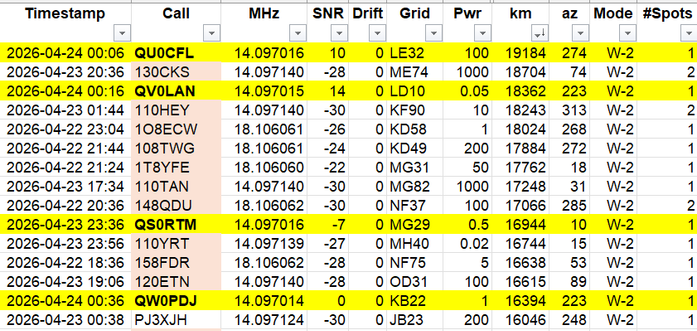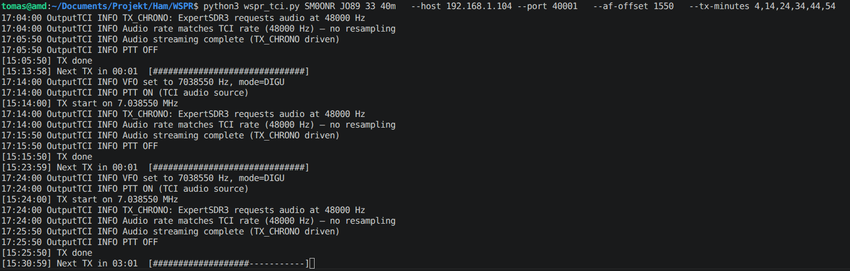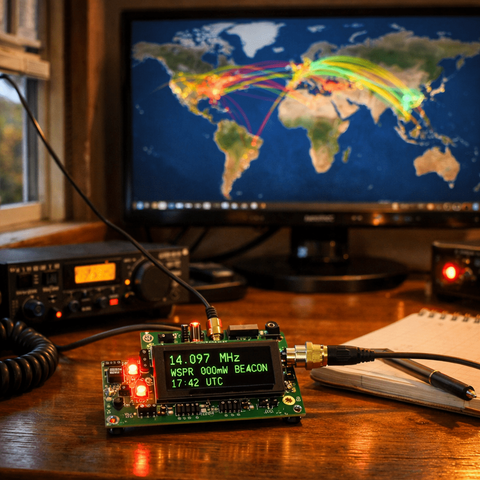
#WSPR on 20-meter pushing about 1W ERP through an EFHW antenna hanging from a tree limb in our apartment complex parking lot

#AmateurRadio

Have you ever considered one of the capacitive hats for your #ma12, #jpc12 or similar whip based antenna? I've done some tests with and without using #WSPR: https://www.youtube.com/watch?v=zayHBhak8Kc #hamradio #portableradio
Capacitive Hats: Magic or Snake Oil?

YouTube

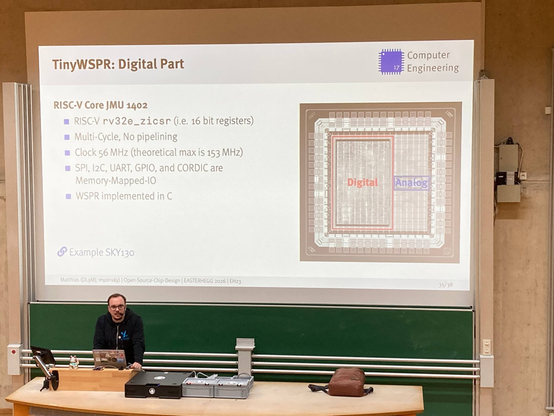
📡 TinyWSPR – Erzeugung von Kurzwellensignalen auf Open-Source-Silizium

Der Weak Signal Propagation Reporter (#WSPR, ausgesprochen „whisper“) ist ein im Amateurfunk bekanntes Werkzeug zur Analyse der Ausbreitung von Kurzwellensignalen. Diese Signale werden an der Ionosphäre gebrochen, wodurch sie bemerkenswerte Entfernungen rund um den Globus zurücklegen können – und das mit sehr geringen Sendeleistungen von nur wenigen Milliwatt.

Das von Nobelpreisträger Joe Taylor (K1JT) entwickelte Tool erfordert normalerweise einen PC mit spezieller Software sowie einen Kurzwellensender. Während in der Vergangenheit zahlreiche Embedded-Lösungen entwickelt wurden – unter Verwendung von Mikrocontrollern oder #FPGAs –, gab es bisher keinen integrierten Schaltkreis, der native #WSPR-Funktionalität bietet.

Bis jetzt! In einer Zusammenarbeit zwischen der JKU Linz (Simon Dorrer, OE3SDE und Harald Pretl) und der Julius-Maximilians-Universität Würzburg (Jonathan Hager, DK7JH und Matthias Jung, DL9MJ) haben wir einen vollständig WSPR-fähigen Sender im TT-Sky25b-Prozess implementiert – realisiert als 130-nm-Analog-Mixed-Signal-Design via Tiny Tapeout.

Das Design besteht aus zwei Hauptkomponenten: einem digitalen Subsystem, das die Sendesymbole aus den Nachrichteninformationen (Rufzeichen des Operators, Leistungspegel und Standort) generiert, und einem analogen Subsystem, das die eigentliche HF-Modulation durchführt. Der digitale Teil verwendet einen CORDIC-IP-Block und einen Sigma-Delta-Modulator, um ein komplexes analoges Basisbandsignal zu erzeugen. Dieses Signal wird anschließend von einem IQ-Modulator moduliert, gefiltert und von einer vollständig analogen HF-Kette verstärkt.

Nun müssen wir nur noch warten, bis der Chip aus der Fertigung (Fab) zurückkehrt, bevor wir ihn endlich „on air“ bringen können.

In der Zwischenzeit haben wir Prototypen mehrerer IP-Blöcke des Chips auf FPGAs getestet, und die Ergebnisse sind bemerkenswert: Mit nur ~10 mW Sendeleistung kann unser Signal auf dem 40-m-Amateurband in ganz Mitteleuropa empfangen werden. Sobald der gefertigte #TinyTapeout-Chip eintrifft, werden wir die ersten Übertragungstests durchführen.
Informationen zum analogen Teil (in englischer Sprache): https://tinytapeout.com/chips/ttsky25b/tt_um_TinyWhisper
Informationen zum digitalen Teil (in englischer Sprache): https://tinytapeout.com/chips/ttsky25b/tt_um_cejmu_wspr

Quelle: Englischer Linkedin-Post von Prof. Dr. Matthias Jung DL9MJ

#OpenSource #ChipDesign #CDG TinyTapeout #ASIC #HAMRADIO #Amateurfunk Amateurradio #Radio #K1JT #DARC

Ok #HiveMind, I'm pulling my hair out trying to figure out #PipeWire.

Is there an idiots guide to "connect the audio output of program X to the input of program Y?"

I used to know how to do it with pacmd, but PipeWire is the shiny object du jour for the linux dev crows and so I have to learn a new thing. :eyeroll:

I just want to take the sound output of the #SDR program I'm using (SDR++) and pipe it into #wsjtx for decoding #WSPR signals (assuming I can get them XD )

#AskFedi #AmateurRadio

@brainofdane

Thank you!

I'm trying to get my RTL-#SDR set up to monitor #WSPR, just for starters.

Then I'll try raising some local repeaters, see if I can get on a net.

I really wish I had a friend who lived in a high-rise apartment in #Dallas or something. Imagine chilling out there and yakkin' at folks on the 2m calling frequency all day, ha!

I think #HF will be out of my price range, and #MorseCode will be beyond my skill set for some time.

This weekend I joined the diy weekend of my radio club. It were nice two days, everyone working in their projects and radio kits. It was great to have some time for tinkering. I build my wsprry-pi kit from OARC. Here is the result of my first test on 40m with 20mW:

#wspr #amateurradio

Radio Propagation

WSPR and FT8 are incredible modes for plotting radio propagation.

Today I'm receiving 10mW WSPR beacon transmissions on 14 MHz from amateur balloon SP6MPL in mid-Atlantic and at 13,680m altitude. My receiver is an Airspy HF+ Discovery with the basic Youloop antenna at 2m above ground.

Also on the map is Polish station SQ3XZ on 21 MHz running only 1mW! Offscreen, I'm also receiving VK3QN near Melbourne running 5W. WSPR is a low-power data mode which takes 2 minutes to send a message, usually consisting of just a callsign, locator and power level information.

I'm currently decoding all WSPR and FT8 bands using two instances of WSJT-X v3, using the HF+ for WSPR and a Yaesu FT857D for FT8, feeding data to https://wspr.aprsinfo.com/ for WSPR and https://shorturl.at/ENYjH (PSK Reporter) for FT8. All HF bands are scanned several times per hour.

For offline mapping I'm using Hamclock and Grid Tracker.

#radiopropagation
#amateurradio
#g7izu
#wspr
#ft8

Work in progress. A two band QRSS/WSPR beacon with a RPi Zero 2 W as the controller, two Si570 (I have too many of them left to buy any of those new Si5351 etc.), a LVDS to TTL converter (yes, those Si570s are the LVDS version), some BSS138 (class E PA a la G0UPL) and LPFs. Everything fits into the same nice 10cm x 10cm enclosure I used for my last project (SO2R Mini+). #hamradio #qrss #wspr

Nice surprise: the German research vessel Polarstern, currently somewhere between Greenland and the north pole received my #WSPR signal on 20 m.

https://www.meereisportal.de/en/where-is-rv-polarstern

#hamradio #amateurradio #amateurfunk

In the breaks when @siwli was using the 2m station, I was active as #POTA station on 20 m with my QCX-mini and a lambda/4 vertical and made 36 contacts including some park-to-park and some #SOTA chasing. I also did some #WSPR and my signals reached North America and even Australia. (2/2)

#hamradio #amateurradio #amateurfunk