Another thought-provoking #MedChem #SciComm story by Stan Van Boeckel. On the example of Sitagliptin, he explains the power of minimizing molecules and looking for the highest ligand efficiency in #DrugDiscovery. www.linkedin.com/posts/stan-v... #ChemSky #ChemBio #SmallMolecules #Science #Medicines

Part 29 — Sometimes “smaller i...
Part 29 — Sometimes “smaller is elegant” in drug discovery.   In early discovery, medicinal chemists often chase potency by making molecules larger and more lipophilic. Yet potency should always be… | Stan Van Boeckel

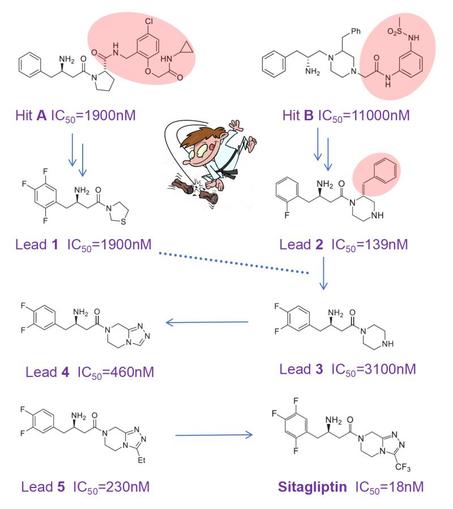
Part 29 — Sometimes “smaller is elegant” in drug discovery.   In early discovery, medicinal chemists often chase potency by making molecules larger and more lipophilic. Yet potency should always be interpreted in the context of molecular weight and lipophilicity. Ligand‑efficiency metrics normalize potency to size and logP, helping chemists distinguish truly efficient hits and leads from bulky or greasy molecules that only appear potent but usually bring ADMET liabilities. The real challenge is to think broadly, so consider to make your hit or lead smaller during optimization, or 'just do it'. The discovery of sitagliptin illustrates this beautifully: a blockbuster drug that is smaller than the original screening hits. Sitagliptin (approved 2006) is the first DPP‑4 inhibitor that slows the rapid degradation of GLP‑1 and GIP, thereby lowering plasma glucose. In Merck’s HTS campaign, compounds A and B emerged as low‑potency hits. Here comes the twist: instead of growing these hits, the team chopped off large moieties and explored whether the resulting fragments could be optimized with small substituents such as fluorines. Surprisingly, this yielded compact leads 1 and 2 with improved potency, while selectivity across DPP family members and oral bioavailability in rat were continuously monitored. Lead 2 was then chopped again-taking inspiration from lead 1, which lacked its extra phenyl ring-to give weak lead 3. Accepting a 20‑fold drop in IC₅₀ seems counterintuitive, but it opened the door to expand the piperazine and create a new heterocycle. This delivered more potent lead 4, followed by lead 5. Further fluorination of 5 improved oral exposure and ultimately delivered the blockbuster sitagliptin. This small, well‑balanced molecule (MW 407; IC₅₀ 18 nM; oral bioavailability 87%; t½ 12 h; rapid absorption; logP 1.5; high selectivity; medium solubility; 5 rotatable bonds; HA/HD 4/1; non‑toxic) is a superb example of optimizing property space without molecular obesity. A remarkable achievement by Malcolm MacCoss, Ph.D., FRSC and his team at Merck.

LinkedIn
Part 29 — Sometimes “smaller is elegant” in drug discovery.   In early discovery, medicinal chemists often chase potency by making molecules larger and more lipophilic. Yet potency should always be… | Stan Van Boeckel

Part 29 — Sometimes “smaller is elegant” in drug discovery.   In early discovery, medicinal chemists often chase potency by making molecules larger and more lipophilic. Yet potency should always be interpreted in the context of molecular weight and lipophilicity. Ligand‑efficiency metrics normalize potency to size and logP, helping chemists distinguish truly efficient hits and leads from bulky or greasy molecules that only appear potent but usually bring ADMET liabilities. The real challenge is to think broadly, so consider to make your hit or lead smaller during optimization, or 'just do it'. The discovery of sitagliptin illustrates this beautifully: a blockbuster drug that is smaller than the original screening hits. Sitagliptin (approved 2006) is the first DPP‑4 inhibitor that slows the rapid degradation of GLP‑1 and GIP, thereby lowering plasma glucose. In Merck’s HTS campaign, compounds A and B emerged as low‑potency hits. Here comes the twist: instead of growing these hits, the team chopped off large moieties and explored whether the resulting fragments could be optimized with small substituents such as fluorines. Surprisingly, this yielded compact leads 1 and 2 with improved potency, while selectivity across DPP family members and oral bioavailability in rat were continuously monitored. Lead 2 was then chopped again-taking inspiration from lead 1, which lacked its extra phenyl ring-to give weak lead 3. Accepting a 20‑fold drop in IC₅₀ seems counterintuitive, but it opened the door to expand the piperazine and create a new heterocycle. This delivered more potent lead 4, followed by lead 5. Further fluorination of 5 improved oral exposure and ultimately delivered the blockbuster sitagliptin. This small, well‑balanced molecule (MW 407; IC₅₀ 18 nM; oral bioavailability 87%; t½ 12 h; rapid absorption; logP 1.5; high selectivity; medium solubility; 5 rotatable bonds; HA/HD 4/1; non‑toxic) is a superb example of optimizing property space without molecular obesity. A remarkable achievement by Malcolm MacCoss, Ph.D., FRSC and his team at Merck.

LinkedIn
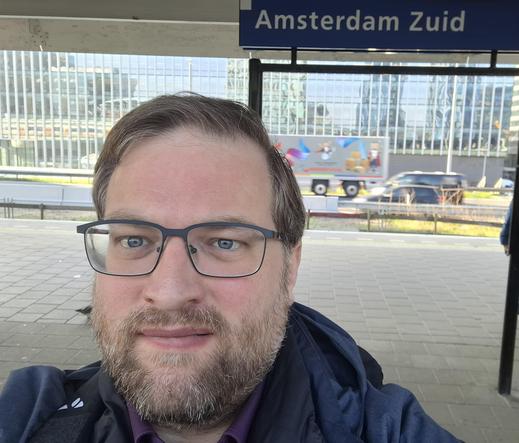
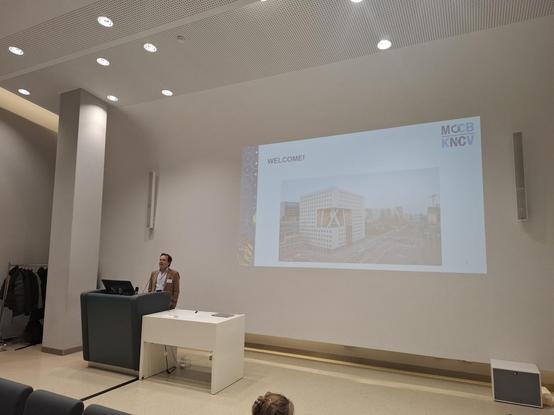
The final stage of my #conference tour is today in Amsterdam at the spring meeting of the #MedChem and #ChemBio division of #KNCV in Amsterdam #KNCVMCCB2026. Looking forward to a full day of exciting Medicinal Chemistry and Chemical Biology #research. (1/2) mccb.kncv.nl/activities/f...

The final stage of my #conference tour is today in Amsterdam at the spring meeting of the #MedChem and #ChemBio division of #KNCV in Amsterdam #KNCVMCCB2026.

Looking forward to a full day of exciting Medicinal Chemistry and Chemical Biology #research

The meeting was just opened by Iwan de Esch and the president of the KNCV MCCB division, Ingrid Dijkgraaf.

https://mccb.kncv.nl/activities/farmacochemie-detailpagina/1529/spring-meeting-medicinal-chemistry-chemical-biology

Interesting talk by Clemens Richert at #Biochemistry2026. He talked about "Nucleoside Phosporamidates with Roles in Chemical Biology and Medicinal Chemistry".

#Virus #RNA #Nucleotides #Biochemistry #Chemistry #ChemBio #MedChem #MedicinalChemistry
CC: @gdch

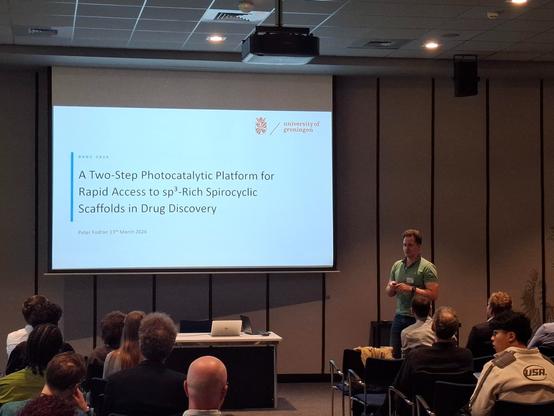
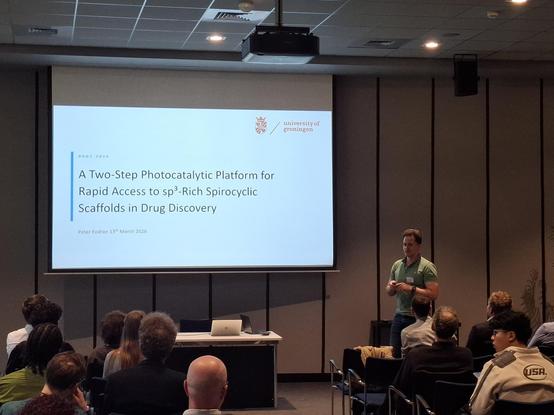
Interesting talk by Peter Fodran from the University of Groningen at #Lunteren2026. He talked about his group's work on the efficient and #MedChem friendly synthesis of privileged scaffolds for drug discovery. www.fodranlab.com #ChemSky #ChemBio #DrugDiscovery #Synthesis

Interesting talk by Peter Fodran from the University of Groningen at #Lunteren2026. He talked about his group's work on the efficient and #MedChem friendly synthesis of privileged scaffolds for drug discovery.

https://www.fodranlab.com/
#Chemistry #ChemBio #DrugDiscovery #Synthesis

A very good read about computational chemistry and how it helps in drug discovery, and more importantly, what should be done so that it would be even more efficient.

https://medium.com/@dapscience/ai-drug-discovery-grand-challenges-benchmarks-be495dfb5ce4

#compchem #academicChatter #chemistry #medchem #drugDiscovery #drugDevelopment

A (New) Child’s Guide to Computational Chemistry

The ‘Grand Challenges’ paper finally gives drug discovery its shared language. Here’s what it says — and what it still needs to answer.

Medium

New Blog Post: Prioritizing Drug-Like 💊 ChEMBL Compounds Within Target 🎯 Profiles

In this post, I go through how to use the #Python #ChEMBL #API and #SQLite to:
• Retrieve compound and target activity data programmatically
• Build a local database of molecules and their associated targets
• Rank compounds based on Lipinski Rule of Five violations

Read it at https://bertiewooster.github.io/2026/01/05/ChEBML-database.html. Marimo and Jupyter notebooks too!

#cheminformatics #drugDiscovery #chemistry #medChem #medicinalChemistry

Prioritizing Drug-Like ChEMBL Compounds Within Target Profiles

When reviewing data to find pharma compounds for virtual screening, we might want to check what their target profiles and rank candidates by how many Lipinski’s rule of five violations they have–the fewer the better. Here, a target profile refers to the set of targets a compound is known to be active against. This post uses the ChEMBL API and a SQLite database to do that.

Jeremy Monat, PhD

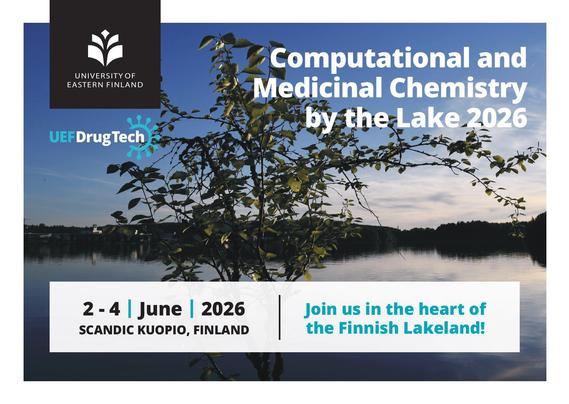
We’re excited to invite you to Computational and Medicinal Chemistry by the Lake 2026, happening June 2–4 in beautiful Kuopio, Finland.

This three-day symposium brings together researchers from academia and industry to explore the latest in drug discovery — from PROTACs to AI-driven screening, molecular dynamics, and more.

We’d love to see you too there — let’s talk science by the lake!

https://sites.uef.fi/cmcl-2026/

#medchem #compchem #science #kuopio #AcademicChatter #drugdiscovery #chemistry