Prevalence of #EBV, #HHV6, #HCMV, #HAdV, #SARS-CoV-2, and #Autoantibodies to Type I #Interferon in #Sputum from Myalgic Encephalomyelitis / #CFS Patients

Prusty Lab, the laboratory and team of ME/CFS researcher Bhupesh Prusty has a new website. Prusty is currently Professor of Science at Rīga Stradiņš University in Latvia.

https://www.prustylab.org/

#HHV6 #MEcfs #CFS #PwME
@mecfs

#MyalgicEncephalomyelitis #ChronicFatigueSyndrome @longcovid
#LongCovid #PwLC #PostCovidSyndrome #LC #PASC #postcovid

Prusty Lab - Scientific Research

Discover cutting-edge scientific research at Prusty Lab, focusing on host-virus interactions and the biology of viral infections. Explore our work.

New:
From Viral Infection to #Autoimmune Reaction: Exploring the Link between Human Herpesvirus 6 & Autoimmune Diseases

https://www.mdpi.com/2076-2607/12/2/362

#HHV6 #autoimmunity #autoimmune #multiplesclerosis #systemicsclerosis #inflammatoryboweldisease #autoimmunethyroiditis #MEcfs #CFS

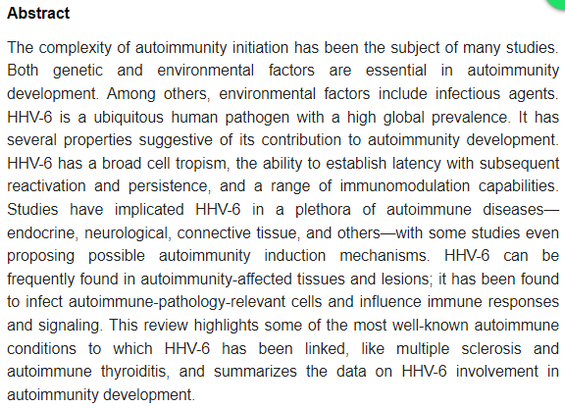
From Viral Infection to Autoimmune Reaction: Exploring the Link between Human Herpesvirus 6 and Autoimmune Diseases

The complexity of autoimmunity initiation has been the subject of many studies. Both genetic and environmental factors are essential in autoimmunity development. Among others, environmental factors include infectious agents. HHV-6 is a ubiquitous human pathogen with a high global prevalence. It has several properties suggestive of its contribution to autoimmunity development. HHV-6 has a broad cell tropism, the ability to establish latency with subsequent reactivation and persistence, and a range of immunomodulation capabilities. Studies have implicated HHV-6 in a plethora of autoimmune diseases—endocrine, neurological, connective tissue, and others—with some studies even proposing possible autoimmunity induction mechanisms. HHV-6 can be frequently found in autoimmunity-affected tissues and lesions; it has been found to infect autoimmune-pathology-relevant cells and influence immune responses and signaling. This review highlights some of the most well-known autoimmune conditions to which HHV-6 has been linked, like multiple sclerosis and autoimmune thyroiditis, and summarizes the data on HHV-6 involvement in autoimmunity development.

MDPI

Long time researcher Dharam Ablashi has sadly passed away

Full tribute here:
https://hhv-6foundation.org/all/a-tribute-to-dharam-ablashi

ME-pedia entry here:
https://me-pedia.org/wiki/Dharam_Ablashi

Among other things, he co-founded the IACFS/ME

May he rest in peace

#HHV6 #MyalgicEncephalomyelitis #MEcfs #CFS #PwME @mecfs

A tribute to Dharam Ablashi | HHV-6 Foundation | HHV-6 Disease Information for Patients, Clinicians, and Researchers | Apply for a Grant

HHV-6 infection in ME/CFS https://buff.ly/3Qcd8Rl

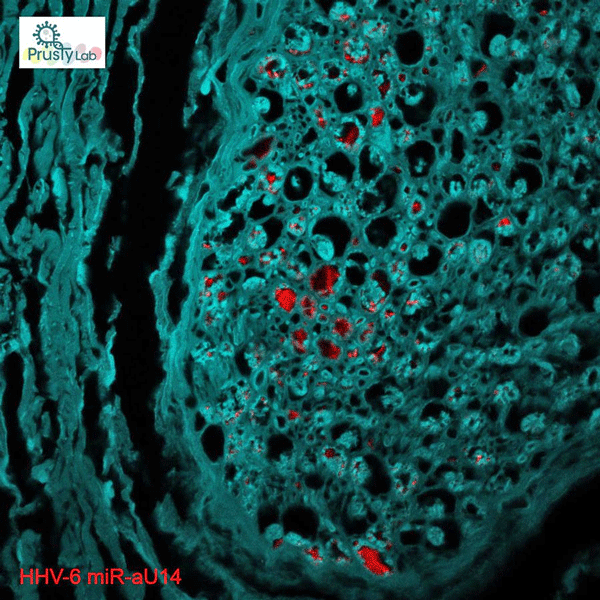
Abundant HHV-6 miRNA found in brain frontal lobe, basal ganglia, and in spinal cord of MECFS pts.

#EBV co-infection noted too.

n =3 ME/CFS pts, n = 24 controls

⭐️Reactivated HHV-6 within spinal nerves, possibly explains ANS dysfunction associated with ME/CFS.

Photo: Bhupesh K Prusty
#LongCOVID #MECFS #HHV6 #dysautotomia #POTS

Tissue specific signature of HHV-6 infection in ME/CFS

First exposure to various human herpesviruses (HHVs) including HHV-6, HCMV and EBV does not cause a life-threatening disease. In fact, most individuals are frequently unaware of their first exposure to such pathogens. These herpesviruses acquire lifelong latency in the human body where they show minimal genomic activity required for their survival. We hypothesized that it is not the latency itself but a timely, regionally restricted viral reactivation in a sub-set of host cells that plays a key role in disease development. HHV-6 (HHV-6A and HHV-6B) and HHV-7 are unique HHVs that acquire latency by integration of the viral genome into sub-telomeric region of human chromosomes. HHV-6 reactivation has been linked to Alzheimer’s Disease, Chronic Fatigue Syndrome, and many other diseases. However, lack of viral activity in commonly tested biological materials including blood or serum strongly suggests tissue specific localization of active HHV-6 genome. Here in this paper, we attempted to analyze active HHV-6 transcripts in postmortem tissue biopsies from a small cohort of ME/CFS patients and matched controls by fluorescence in situ hybridization using a probe against HHV-6 microRNA (miRNA), miR-aU14. Our results show abundant viral miRNA in various regions of the human brain and associated neuronal tissues including the spinal cord that is only detected in ME/CFS patients and not in controls. Our findings provide evidence of tissue-specific active HHV-6 and EBV infection in ME...

Frontiers

#LongCOVID #MECFS:
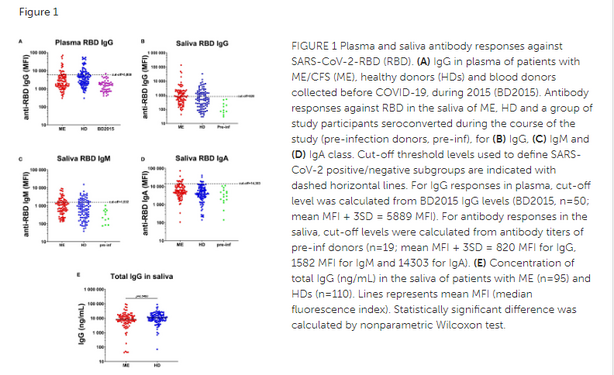
Saliva antibody-fingerprint of reactivated latent viruses after mild/asx COVID is unique in patients w/MECFS https://buff.ly/3I10umf

Mild SARS-CoV-2 can trigger reactivation of #EBV, #HHV6, and #HERV-K, seen by antibody fingerprints locally in #saliva but not detected in blood samples.

Saliva antibody-fingerprint of reactivated latent viruses after mild/asymptomatic COVID-19 is unique in patients with myalgic-encephalomyelitis/chronic fatigue syndrome

BackgroundMyalgic encephalomyelitis/chronic fatigue syndrome (ME/CFS) is a chronic disease considered to be triggered by viral infections in a majority of cases. Symptoms overlap largely with those of post-acute sequelae of COVID-19/long-COVID implying common pathogenetic mechanisms. SARS-CoV-2 infection is risk factor for sustained latent virus reactivation that may account for the symptoms of post-viral fatigue syndromes. The aim of this study was first to investigate whether patients with ME/CFS and healthy donors (HDs) differed in their antibody response to mild/asymptomatic SARS-CoV-2 infection. Secondly, to analyze whether COVID-19 imposes latent virus reactivation in the cohorts.MethodsAnti-SARS-CoV-2 antibodies were analyzed in plasma and saliva from non-vaccinated ME/CFS (n=95) and HDs (n=110) using soluble multiplex immunoassay. Reactivation of human herpesviruses 1-6 (HSV1, HSV2, VZV, EBV, CMV, HHV6), and human endogenous retrovirus K (HERV-K) was detected by anti-viral antibody fingerprints in saliva.ResultsAt 3-6 months after mild/asymptomatic SARS-CoV-2 infection, virus-specific antibodies in saliva were substantially induced signifying a strong reactivation of latent viruses (EBV, HHV6 and HERV-K) in both cohorts. In patients with ME/CFS, antibody responses were significantly stronger, in particular EBV-encoded nuclear antigen-1 (EBNA1) IgG were elevated in patients with ME/CFS, but not in HDs. EBV-VCA IgG was also elevated at baseline prior to SARS-infectio...

Frontiers

“The many more signs of HHV-6 (human herpesvirus-6) and EBV (Epstein-Barr virus) found spread across the brains of the 3 #MECFS patients suggested that something of a different nature was going on.

The finding possibly placed #MECFS in the same general basket – at least with regard to #HHV6 – as other diseases such as #MultipleSclerosis, where HHV-6 activation in the brain has been found."

https://www.healthrising.org/blog/2022/12/15/prusty-hhv-6-brains-chronic-fatigue-syndrome/

#MS #pwME

The Prusty Files: HHV-6 Found in the Brains of ME/CFS Patients - Health Rising

Bhupesh Prusty’s goal seems to be to upend what we know about the herpesviruses, in particular, human herpesvirus-6 (HHV-6), and their relationship to chronic fatigue syndrome (ME/CFS). His Twitter handle calls him “a passionate molecular virologist who believes in patient-oriented scientific research… Science is for society.” Thus far, Prusty has […]

Health Rising
Human herpesvirus 6 - MEpedia

Human herpesvirus 6 - Wikipedia