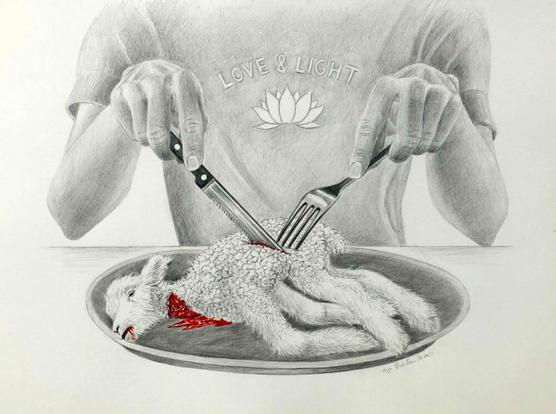
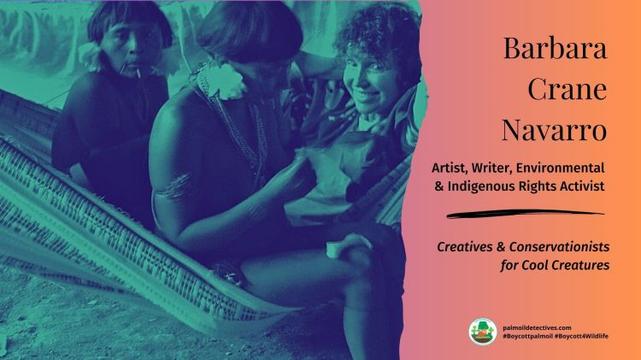
Artist and Indigenous Rights Advocate Barbara Crane Navarro

Barbara Crane Navarro: In Her Own Words

Artist, Writer, Environmental & Indigenous Rights Activist

Bio: Barbara Crane Navarro

Barbara Crane Navarro is a French-American artist, writer, Indigenous and animal activist who lives near Paris. From 1968 to 1973 she studied at Rhode Island School of Design, then she went on to study at the San Francisco Art Institute in San Francisco, California, for a BFA.

Her work over many decades has been informed and inspired by time spent with indigenous communities. She took various study trips devoted to the exploration of techniques and natural pigments of different indigenous communities including the Dogon of Mali, West Africa, and the Yanomami communities in Venezuela and Brazil.

Over many years, during the winters, she studied the techniques of traditional Bogolan painting. Hand woven fabric is dyed with boiled bark from the Wolo tree or crushed leaves from other trees, then painted with mud from the Niger river which oxidizes in contact with the dye. Through the Dogon and the Yanomami, her interest in the multiplicity of techniques and supports for aesthetic expression influenced her artistic practice.

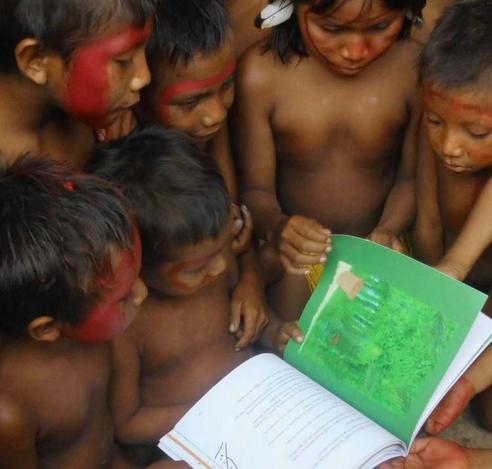
Her voyages to the Amazon Rainforest have informed several series of paintings created while living among the Yanomami. The support used is roughly woven canvas prepared with acrylic medium then textured with a mixture of sand from the river bank and lava. This supple canvas is then rolled and transported on expeditions into the forest. These are then painted using a mixture of acrylic colors and Achiote and Genipap, the vegetal pigments used by the Yanomami for their ritual body paintings and on practical and shamanic implements. Barbara is deeply concerned about the ongoing devastation of the Amazon Rainforest and this has inspired many of her films, installation projects and children’s books.

Palm Oil Detectives is honoured to interview to Barbara Crane Navarro about her fascinating work, indigenous activism, the devastation of deforestation and land-grabbing from gold mining on the Indigenous Yanomami people

Great Green Macaw Ara ambiguus

Behind the insatiable appetite for buying #gold is a dark secret of money laundering, illegal #mining, #ecocide, sex #slavery and human misery for the #Yanomami people of #Venezuela & #Brazil. @BarbaraNavarro #BoycottGold4Yanomami

Tweet

Read more: Illegal gold mining and the Yanomami’s fight for their land

‘Illegal mining in the Amazon hits record high amid Indigenous protests’, Jeff Tollerson, Nature 2021.

FinCEN Files investigations into the gold trade from around the world. Kyra Guerny, International Consortium of Investigative Journalists, 2020.

Five Golden Rings and an Environmental Dilemma, Wake Forest University, 2018.

Gold mining leaves deforested Amazon land barren for years, find scientists’ The Conversation, July 1, 2020.

Mercury: Chasing the Quicksilver by InfoAmazonia

‘Pictures from outer space reveal the extent of illegal gold mining in Peru’, The Conversation, May 7, 2021.

‘Sex trafficking ‘staggering’ in illegal Latin American gold mines: researchers’, Reuters, 2016.

Yanomami: Povos Indigenas Brasil

Yanomami, Wikipedia

Help Barbara’s movement to #BoycottGold4Yanomami

1. By regularly sharing out these tweets below…

2. By following the #BoycottGold4Yanomami hashtag on Twitter and share out other people’s tweets

“I wrote Rainforest Magic, children’s stories about Yanomami children Namowë and Meromi to honour the Yanomami families I love and to raise awareness of the disappearing Amazon” #BoycottGold4Yanomami @BarbaraNavarro

Tweet

It’s important that consumers know – every item we buy affects the lives of people and animals. #Gold #mining and #palmoil directly impacts Indigenous peoples. #Boycottpalmoil #BoycottGold4Yanomami #Boycott4Wildlife @BarbaraNavarro

Tweet

#Yanomami children as young as 12 are forced into prostitution for illegal miners that take over their rainforest home for gold mining. Fight back against this with your wallet and refuse to buy gold! #BoycottGold4Yanomami @BarbaraNavarro

Tweet

Top Brazil gold exporter leaves a trail of criminal probes and illegal mines! Please #Boycott4Wildlife #BoycottGold4Yanomami! @ScarpullaA @barbaranavarro https://news.mongabay.com/2021/11/top-brazil-gold-exporter-leaves-a-trail-of-criminal-probes-and-illegal-mines/ via @Mongabay

Tweet this

L’amico a sorpresa del ragazzo Yanomami nella giungla!  #BoycottGold4Yanomami #Boycott4Wildlife @ScarpullaA @barbaranavarro https://barbara-navarro.com/2021/12/24/ital-dec-24-lamico-a-sorpresa-del-ragazzo-yanomami-nella-giungla/

Tweet this

Amigo surpresa do menino Yanomami na selva!  #BoycottGold4Yanomami #Boycott4Wildlife @barbaranavarro @ScarpullaA https://barbara-navarro.com/2021/12/23/amigo-surpresa-do-menino-yanomami-na-selva/

Tweet this

The Art of #Greenwashing by Luxury Merchants of the Death #BoycottGold4Yanomami #Boycott4Wildlife @barbaranavarro @ScarpullaA https://barbara-navarro.com/2020/12/07/the-art-of-greenwashing-by-the-luxury-merchants-of-the-death-of-nature-and-indigenous-peoples-in-their-own-words-the-people-of-gold-and/

Tweet this

#Indigenous knowledge could be the answer to stopping #Climate Change! #ClimateEmergency @ScarpullaA @barbaranavarro #Boycott4Wildlife and #BoycottGold4Yanomami and save the forests, animals and indigenous peoples of South America! https://barbara-navarro.com/2021/12/25/indigenous-knowledge-could-be-the-answer-to-climate-change-the-st-andrews-economist/

Tweet this

Amigo surpresa do menino Yanomami na selva!  Boicote todos os produtos resultantes do desmatamento; ouro, óleo de palma, carne, soja, madeiras exóticas, pedras preciosas #BoycottGold4Yanomami #Boycottpalmoil #Boycott4Wildlife @BarbaraNavarro @ScarpullaA https://barbara-navarro.com/2021/12/23/amigo-surpresa-do-menino-yanomami-na-selva/

Tweet this

@Cartier Foundation uses #greenwashing “art” to sell their business model as eco-friendly. This is #greenwashing! #Yanomami people and #animals are dying for #gold! @BarbaraNavarro @ScarpullaA #BoycottGold4Yanomami #Boycott4Wildlife https://barbara-navarro.com/2020/10/11/the-cartier-foundation-epitomizes-the-insidious-practice-of-using-an-art-foundation-to-seduce-the-public-into-believing-that-its-merchandise-and-business-model-is-actually-the-opposite-of-its-true/

Tweet this

My Exhibition “Pas de Cartier: Yanomami and Trees” Gold mining by @Cartier @Bulgariofficial and COVID-19 are killing the #Yanomami people. This is why we #BoycottGold4Yanomami @BarbaraNavarro @ScarpullaA https://barbara-navarro.com/2020/08/04/exhibition-pas-de-cartier-yanomami-and-trees-gold-mining-and-gold-luxury-items-covid-19-propagated-by-gold-miners/

Tweet this

“When you cut down the trees, you assault the spirits of our ancestors. When you dig for minerals you impale the heart of the Earth” Cacique Raoni Metuktire Illegal gold mining is why we #BoycottGold4Yanomami #Boycott4Wildlife @BarbaraNavarro @ScarpullaA https://barbara-navarro.com/2020/06/27/gold-fever-covid-19-and-the-genocide-of-the-yanomami-update/

Tweet this

“In the Venezuelan and Brazilian Amazon, I witnessed the destruction of nature from deforestation and gold mining worsen as I returned year after year”

Barbara Crane Navarro

The Yanomami communities I spent time with were very worried about this situation and the shamans worked to fight against it, but this has been in vain so far.

Since my birth, I was always an artist and spent my childhood drawing and painting

I want to understand why people in indigenous societies spend so much time and effort creating art and with such an incredible variety of supports and substances.

“Since 2005, I’ve created a performance and film project: Fire Sculpture, to bring urgent attention to rainforest destruction. And to protest against the continuing destruction of the Yanomami’s territory. I’ve publicly set fire to my totemic sculptures. These burning sculptures symbolise the degradation of nature and the annihilation of indigenous cultures that depend on the forest for their survival.”

~ Barbara Crane Navarro

The idea of burning the sculptures was to make a symbolic point about how Yanomami and other indigenous communities are endangered by our consumerism which creates chaos and destruction where they live, in their ancestral home.

I wrote Amazon Rainforest Magic, two stories of Yanomami children Namowë, a Yanomami boy and Meromi, a Yanomami girl in honour of the families I know and love

Several of the Yanomami children and their families I know well are among the characters in the two books of the series.

I self-published my books with CreateSpace years ago which was subsequently bought by Amazon’s KDP. Now my books are only available on Amazon or here at my gallery near Paris, where my artwork is also available.

The two books are available from Barbara Crane Navarro’s Amazon page in English, Spanish and French.

Buy Vol. 1 Buy Vol. 2

“Amazon Rainforest Magic” presents a world that at first might seem whimsical, where people, animals, and plants joke, conspire, and argue with each other. The serious point is that humans are no more important than any of the other creatures – all are mutually dependent, some are just more aware of it than others. 

The plants and the animals, each with special knowledge, accompany the hero, Namowë, as he embarks on a life-saving quest for a cure for his ailing youngest sister. When he embarks on this exciting journey through the jungle, he has already taken a big step toward maturity.

Behind the charming artwork and story is a clear message that we humans are not separate from our environment and that to put ourselves above nature is arbitrary and ultimately counter-productive.

Review by John L. Pope

Illustration by Barbara Crane Navarro from her book “Amazon Rainforest Magic – The adventures of Meromi, a Yanomami girl

All of the various indigenous communities along the rivers in the Amazon are very alarmed at the acceleration of the devastation of the forests.

https://www.youtube.com/watch?v=yd3GoL5MeAg

“I discovered that much of the Yanomami’s art is about venerating nature and the spirits of the forests, sky, water and the animals.”

~ Barbara Crane-Navarro

Tundra project/Nature Morte

The repercussions of the 2019 fires in the Amazon and Arctic regions continue to impact forests, water, the atmosphere and indigenous communities. This art is an artistic dialogue between two territories and two geomorphologies. Each have a planetary resonance.

It’s important consumers know that every shopping choice we make has repercussions on the lives of people in other parts of the world

I try to eat only local and in-season vegetables grown nearby. What I grow myself I keep as jam and conserve to eat in the winter months.

Many different indigenous communities in the nine countries of the Amazon region are devastated by gold mining with its resulting deforestation, violence against indigenous peoples, mercury poisoning and Covid-19 propagated by gold miners.

Amazonian gold mine

https://twitter.com/PersonalEscrito/status/1432750926004170755?s=20

https://twitter.com/BarbaraNavarro/status/1350098960954892288?s=20

https://twitter.com/PattyLaya/status/1161291783084621827?s=20

Merchants of Gold, Greed and Genocide

Hunger for Gold in the Global North is fuelling a living hell in the Global South

Here are 13 reasons why you should #BoycottGold4Yanomami

Image: ‘llegal gold that undermines forests and lives in the Amazon’ by Igarapé Institute

Behind the insatiable appetite for #gold is a dark secret of money laundering, illegal #mining, environmental damage and human misery. #BoycottGold4Yanomami @BarbaraNavarro

Tweet

1. Gold mining = greenwashing of crime and corruption

2. Even the world’s biggest gold-importing nations don’t properly monitor the origins of their gold

3. Laundering crimes using gold is easy

4. Gold is a legal version of cocaine

5. Gold mining causes massive deforestation

6. Indigenous people have no rights

7. Brazil’s racist President, Bolsonaro allows land-grabbing to continue

8. Indigenous women and children are forced into sex slavery

9. Violence and murder in gold mining is common

10. Mercury kills ecosystems, people and animals

11. Ecosystems rarely recover from the damage – they are dead

12. Jewellery and electronics companies and criminals are the only ones who benefit from gold

13. Over a million children are forced to work in gold mines

How can I help?

Forests and rivers are a spiritual and practical necessity for Indigenous people

However their access to food and water is removed by palm oil and soy plantations, cattle grazing and gold mining, which contaminates the water and kills the fish. Forest wildfires are happening in the Amazon due to degraded and destroyed forests and rivers.

Deforestation by fire for palm oilDeforestation by Sean Weston https://seanweston.co.uk

Dirty Gold War: A documentary about gold mining

The gold industry is overflowing with corruption:

If there’s a crackdown in Peru, you just smuggle the gold across the border to Chile. Or if there’s a crackdown all across Latin America, then you can simply sell your gold through the Emirates, where there are very few controls. It’s a very difficult industry to completely eliminate the opportunities for money laundering, because it’s so global and you can just keep shifting your business.

‘‘Dirty Gold’ chases ‘three amigos’ from Miami to Peru and beyond’:
International Consortium of Investigative Journalists

https://youtu.be/hzrJ9I3AJAQ

Nobody needs to use gold jewelry or watches to decorate themselves. There are so many less destructive and non-destructive options. Small elements of gold are in phones and other electronic items. We should replace them as seldom as possible.

Barbara Crane Navarro

We all need to boycott palm oil, soy, meat, exotic wood, gold and any other product of deforestation.

The #Boycott4Wildlife movement has the same goals as the #BoycottGold4Yanomami movement

Indigenous peoples know that their well-being depends on healthy forests and ecosystems. They see the evidence of that truth around them every day.

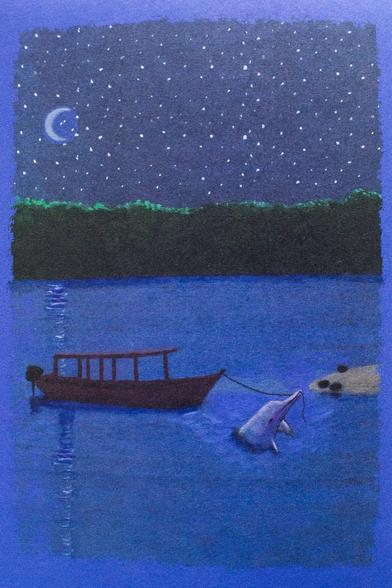
Mining incursions in the Amazon jungle. Maned Three-toed Sloth Bradypus torquatusThe Dolphin and the gold miners’ boat at twilight, from my children’s book series- Amazon Rainforest Magic, the adventures of Meromi, a Yanomami girl

The future well-being of people in the West will be determined by how soon we realise that we must respect nature and not take more than we need, just as indigenous peoples do.

“If we continue to treat nature as a commodity, all the living world, including us, will suffer”

~ Barbara Crane Navarro

Every effort, even the smallest effort, is important

I can’t predict the outcome, but I believe that we have to fight every day in order to mitigate the damage we’re doing.

Did you know that #gold #mining #palmoil and cattle grazing is destroying the last great swathes of the Amazon jungle? This land belongs to #Indigenous people! So #BoycottGold4Yanomami and #Boycottpalmoil @BarbaraNavarro

Tweet

“I was born in 1950 and we are no longer living in the world that I knew when I was young”

I was 20 when humans began using more resources every year than the earth could replenish.

~ Barbara Crane Navarro

“It has been heart wrenching to witness the decline of nature
and to grieve for what has disappeared.”

Barbara Crane Navarro

[Before] The pristine Amazon rainforest. [After] Absolute devastation following gold mining in the Yanomami territory at the border of Venezuela and Brazil.

There are many rainforest animals that I love that make the Amazon rainforest absolutely enchanting. The monkeys, pink river dolphins, giant river otters, capybaras, tapirs, macaws and so many birds and butterflies are some of my favourites.

Here are a few of the 1000’s of animals disappearing forever due to out-of-control extractive mining, palm oil and meat deforestation in the Amazon jungle

Southern Pudu Pudu puda

Keep reading

Blonde Capuchin Sapajus flavius

Keep reading

Savage’s Glass Frog Centrolene savagei

Keep reading

Andean condor Vultur gryphus

Keep reading

Brazilian three-banded armadillo Tolypeutes tricinctus

Keep reading

Orange-breasted Falcon Falco deiroleucus

Keep reading

Glaucous Macaw Anodorhynchus glaucus

Keep reading

Nancy Ma’s Night Monkey Aotus nancymaae

Keep reading

Maned Wolf Chrysocyon brachyurus

Keep reading

Sloth Bear Melursus ursinus

Keep reading

Andean Mountain Cat Leopardus jacobita

Keep reading

Bush Dog Speothos venaticus

Keep reading

Marsh Deer Blastocerus dichotomus

Keep reading

Alta Floresta titi monkey Plecturocebus grovesi

Keep reading

Colombian Red Howler Monkey Alouatta seniculus

Keep reading

Margay Leopardus wiedii

Keep reading

Northern Muriqui Brachyteles hypoxanthus

Keep reading

Brown Howler Monkey Alouatta guariba

Keep reading

Andean Night Monkey Aotus miconax

Keep reading

Spiny-headed Tree Frog Triprion spinosus

Keep reading

White-Nosed Saki Chiropotes albinasus

Keep reading

Amazon River Dolphin Inia geoffrensis

Keep reading

Buffy-tufted-ear Marmoset Callithrix aurita

Keep reading

Spectacled Bear Tremarctos ornatus

Keep reading

If you want to make a difference to the lives of Indigenous people in the Amazon, there are some NGOs to avoid, and others that are really making a difference…

Some NGOS such as Survival claim to be helping indigenous people are great pretenders. They spread awareness but don’t offer practical on the ground support for people like the Yanomami.

These NGOS that allegedly work for Indigenous Rights simply lobby to governments to recognise indigenous land rights. They write and talk about issues affecting Indigenous peoples without having any real, tangible impact.

I donate as often as possible to a Brazilian NGO, APIB: The Articulation of Indigenous Peoples of Brazil.

APIB on the other hand are taking the Brazilian government to court! They have an emergency campaign now concerning gold mining, deforestation and Covid.

Please donate to APIB:

With the funds they will take the Brazilian government to court for this disgraceful ecocide and genocide!

Donate

Help the Yanomami

Photography, Art: Barbara Crane Navarro, PxFuel, Creative Commons, Wikipedia, Greenpeace, Sean Weston, Igarapé Institute.

Words: Barbara Crane Navarro

I welcome you to connect with me, you can find me here on Twitter @BarbaraNavarro

https://twitter.com/BarbaraNavarro/status/1457330048181186564?s=20

https://twitter.com/BarbaraNavarro/status/1429423517070766086?s=20

https://twitter.com/BarbaraNavarro/status/1463827100738236420?s=20

https://twitter.com/BarbaraNavarro/status/1445658455713349632?s=20

#BoycottGold4Yanomami

Buy vintage jewellery instead

Find out more

Image: ‘llegal gold that undermines forests and lives in the Amazon’ by Igarapé Institute

#Amazon #animals #art #BarbaraCraneNavarro #Boycott4wildlife #BoycottGold4Yanomami #BoycottPalmOil #Brazil #Christmas #Climate #ClimateEmergency #corruption #CreativesForCoolCreatures #deforestation #ecocide #gold #goldMining #greenwashing #indigenous #IndigenousActivism #indigenousRights #investigativeJournalism #jewellery #mining #palmoil #rainforestConservation #slavery #Valentine #Venezuela #Yanomami
Marine Biologist and Illustrator Emily Underwood

Emily Underwood is a Sussex-based illustrator with a degree in Marine Biology and an MA in Illustration. Combining her scientific background with her creative talents, she is passionate about highlighting lesser-known endangered species through her art. Inspired by her travels and encounters with extraordinary wildlife, Emily’s work celebrates these creatures while raising awareness of their challenges. Her commitment to wild animals is at the heart of her illustrations, with ceramics soon joining her offerings.

Marine #Biologist and #illustrator Emily Underwood creates beautiful #art 🎨🖼️❤️ about obscure beautiful #creatures 🦋🐢🐘 so that people pay more attention. She strongly supports the #BoycottPalmOil 🌴🪔🙊⛔️#Boycott4Wildlife. Read her inspiring story https://wp.me/pcFhgU-a0T

Share to BlueSky Share to Twitter

Talented #artist, #biologist and #animalrights advocate Emily Underwood makes stunning #art 🖼️🎨showcasing #animals like the Temminck #Pangolin 🐳 #whales #turtles 🐢 and many more. Learn why she is so committed to saving #wildlife 🌴🪔 ⛔️#Boycott4Wildlife https://wp.me/pcFhgU-a0T

Share to BlueSky Share to Twitter

I studied Marine Biology and got an MA in Illustration to share animal stories through my art

Both my parents and my grandad are wildlife-obsessed, and our family has always prioritised experiences, like exploring the world, over material possessions. Seeing and hearing about the importance of wildlife, both within my family and globally—through maintaining ecosystems, cultural connections, and understanding how animals can be mistreated—has deeply influenced my love for animals. This eventually led me to study Marine Biology and now pursue my MA in Illustration to share their stories through art.

These experiences helped me to expand my knowledge and learn more about the natural world! I also hoped it would open up opportunities to travel, though COVID disrupted that part of the plan. I’m a certified diver (PADI), and my love for diving was another reason I gravitated toward Marine Biology.

Visit Emily’s website and browse her art

100% I characterise my art as a form of ‘artivism’

Growing up, I was always torn between science and art, feeling like I had to choose one or the other. Over time, I realised I could combine the two to make a meaningful impact. During my Marine Biology degree, we kept notebooks to document experiments and fieldwork. This process was very visual for me, and it struck me that visual storytelling could be a powerful way to educate others. That was my “aha” moment.

Doing what you love will keep you motivated and make your work more impactful

My advice is to embrace all the things you enjoy and find ways to combine them. Also, start small! I used to feel discouraged that I couldn’t change everyone’s views, but even influencing a handful of people is a success. Small actions can have a ripple effect.

The protection of species at risk before it’s too late is my top priority

My plan is to continue adding to the Endangered Voices series. I’d love to focus on a UK-based series, featuring animals like the red squirrel and dormouse, inspired by photos I’ve taken. I started doing pottery during the COVID lockdown with my grandad, and I’d like to experiment with adding my yellow snail trail design and animal drawings onto pinch pots. I’m currently building a small studio for both ceramics and illustration, which I plan to document on Instagram to bring the project to life.

It’s easy to feel defeated, but every effort counts

My advice is to mirror what I mentioned earlier—start small and remember that influencing even a few people is meaningful.

I support the boycott of palm oil and the #Boycott4Wildlife

Yes, 100%. Deforestation for palm oil is deeply linked to the destruction of habitats and the endangerment of countless species, some of which are still undiscovered.

Visit Emily’s shop and buy her art

Learn more

Learn about other animals endangered by palm oil and other agriculture

Global South America S.E. Asia India Africa West Papua & PNG

Southern Pudu Pudu puda

Keep reading

Blue-streaked Lory Eos reticulata

Keep reading

Blonde Capuchin Sapajus flavius

Keep reading

Savage’s Glass Frog Centrolene savagei

Keep reading

Pesquets Parrot Psittrichas fulgidus

Keep reading

Tanimbar Eclectus Parrot Eclectus riedeli

Keep reading

Learn about “sustainable” palm oil greenwashing

Read more about RSPO greenwashing

Lying Fake labels Indigenous Land-grabbing Human rights abuses Deforestation Human health hazards

A 2019 World Health Organisation (WHO) report into the palm oil industry and RSPO finds extensive greenwashing of palm oil deforestation and the murder of endangered animals (i.e. biodiversity loss)

Read more

Take Action in Five Ways

1. Join the #Boycott4Wildlife on social media and subscribe to stay in the loop: Share posts from this website to your own network on Twitter, Mastadon, Instagram, Facebook and Youtube using the hashtags #Boycottpalmoil #Boycott4Wildlife.

✓ Subscribed

2. Contribute stories: Academics, conservationists, scientists, indigenous rights advocates and animal rights advocates working to expose the corruption of the palm oil industry or to save animals can contribute stories to the website.

Wildlife Artist Juanchi Pérez

Read more

Mel Lumby: Dedicated Devotee to Borneo’s Living Beings

Read more

Anthropologist and Author Dr Sophie Chao

Read more

Health Physician Dr Evan Allen

Read more

The World’s Most Loved Cup: A Social, Ethical & Environmental History of Coffee by Aviary Doert

Read more

How do we stop the world’s ecosystems from going into a death spiral? A #SteadyState Economy

Read more

3. Supermarket sleuthing: Next time you’re in the supermarket, take photos of products containing palm oil. Share these to social media along with the hashtags to call out the greenwashing and ecocide of the brands who use palm oil. You can also take photos of palm oil free products and congratulate brands when they go palm oil free.

https://twitter.com/CuriousApe4/status/1526136783557529600?s=20

https://twitter.com/PhillDixon1/status/1749010345555788144?s=20

https://twitter.com/mugabe139/status/1678027567977078784?s=20

4. Take to the streets: Get in touch with Palm Oil Detectives to find out more.

5. Donate: Make a one-off or monthly donation to Palm Oil Detectives as a way of saying thank you and to help pay for ongoing running costs of the website and social media campaigns. Donate here

Pledge your support

#animalBehaviour #AnimalBiodiversityNews #animalCommunication #animalCruelty #animalExtinction #animalIntelligence #animalRights #animalrights #animals #art #Artist #artistcommunity #Artivism #artivist #biodiversity #Biologist #Boycott4wildlife #BoycottPalmOil #CreativesForCoolCreatures #creatures #deforestation #illustrator #PalmOil #palmOilDeforestation #pangolin #turtles #whales #wildlife

Wildlife Artist Juanchi Pérez

Juanchi Perez

Wildlife Artist, Illustrator, Animal Rights and Indigenous Rights Advocate

Juanchi Pérez is a #wildlife artist and #animalrights advocate from #Ecuador who uses his paintbrush to fight 4 #Ecuador’s animals against #palmoil and #gold mining. Here is his inspiring story @ZIGZE #Boycottpalmoil #Boycott4Wildlife

Tweet

Juanchi Pérez is a #vegan #animalrights advocate and #wildlife artist who paints species of #Peru #Ecuador in his exquisite art. He discusses why #animals should matter more to us all than #greed @ZIGZE #Boycottpalmoil #Boycott4Wildlife

Tweet

Bio: Juanchi Pérez

Juanchi Pérez is a talented and well-established designer, illustrator and artist from Ecuador who captures the soulful presence of rare rainforest animals near his home.

He is passionate about sharing the magnificent animals and plants of his bountiful homeland with the world. Together with his beautiful wife and daughter, he founded Zigze several years ago. They create eco-friendly homewares and clothing in Ecuador. This features Juanchi’s signature illustrations of plants and animals. In this way, Juanchi shares the emotional lives of animals and plants in one of the most biodiverse hotspots on our planet. After seeing the devastation of palm oil firsthand in his country, Juanchi is a passionate advocate for the #Boycottpalmoil #Boycott4Wildlife.

Palm Oil Detectives is honoured to interview to Juanchi Pérez about his beautiful, powerful and impactful art featuring animals on the knife-edge of survival in South America.

Juanchi Pérez

I admire the beauty in all creatures. There are fascinating worlds in all scales, from the minuscule to the enormous

It would be very hard to choose only one or a few favourites. It is mind-blowing to watch nature’s creativity, there isn’t a single creature who does not possess an inherent beauty, it depends on humans to see it, or not.

Pionus chalcopterus detalle by Juanchi Pérez

We are often so immersed in our lives that we don’t take the time to appreciate nature

It is kind of sad to see how many of us have forgotten to appreciate or just to contemplate the beauty all around us.

Diversity of the jungle by Juanchi Pérez

My principal motivation to paint is nature and the love I have for it. I love all the magnificent creatures we have in this amazing planet we live in and which is our only home.

I paint animals to make them visible

I have always been attracted to drawing and painting animals. To show them to the world and hopefully change the way we should see nature- as a part of ourselves rather than apart from it.

I believe that all species deserve the same rights to exist

Humankind has lost it’s values. Sadly money is the only driving force nowadays. 

We are destroying our own planet and the only place that we call home.

This isn’t just a problem with big companies, but also with our personal choices regarding our consumption habits – what we buy as consumers.

Science has shown that tuna and other big fish populations have decreased more than 90% in many cases

Yet many people still choose to ignore this fact and eat fish rapaciously. If we don’t intervene, in a few years everything will be lost forever.

We should stop eating sentient beings

So yes, right now it’s every person’s responsibility and duty to critically analyse our food choices and to stop eating the sentient beings who deserve to have a life of their own and who do not have a voice.

You can purchase my art through my brand Zigze.com

My art can be found through my brand Zigze http://www.zigze.com or you can visit @zigze_arte_salvaje , or my other more  personal IG @juanchi_illustration

In Ecuador where I live, palm oil has replaced vast areas of rainforest

Just like in other parts of the world, palm oil companies exist to make money. They won’t stop with their endless expansion, because corporate greed doesn’t care for anything other than profits. 

Andean Night Monkey Andus miconax threatene by palm oil deforestation #Boycottpalmoil #Boycott4Wildlife

A recent report by Insight Crime revealed that the major driver for deforestation in Ecuador is palm oil

Most forest loss in Ecuador’s Amazon results from land being cleared for palm oil cultivation. Meanwhile, Venezuela’s, Suriname’s, and Guyana’s forests are most affected by gold mining.

Palm Oil and Land Grabs in Ecuador

As in Bolivia, deforestation in Ecuador’s Amazon is mainly driven by agroindustrial interests. Sixty-five percent of land use across Ecuador’s Amazon is designated for pasture, according to the United Nations Development Programme (UNDP). A lack of economic incentives for farmers discourages them from being sustainable and efficient in their practices, according to the UNDP. Meanwhile, the expansion of industrial agriculture has reduced possibilities for small-scale agriculture. As access to land has become scarce, the illegal grabbing of small plots has ramped up.

Agricultural interests often drive the unconstitutional eviction of communities from territories that have belonged to them for centuries. In many cases, intimidation and falsified documents are used to expel them from their homes. Otherwise, agricultural activities linked to land grabbing are fomented by judicial decisions and rulings issued by authorities.

Extracted from: ‘Insight Crime: Fueling Forest Loss: Motors of Deforestation in the Amazon’, published November 8, 2022.

Huge biodiverse parts of Ecuadorian coastal areas have been replaced by this devastating monoculture

Now huge areas of the Ecuadorian rainforest are suffering the same fate. For a cheap and crappy ingredient in supermarket products, we are losing our greatest treasure of Ecuador – our biodiversity.

It is doubtful that any palm oil company or palm oil investor can see the value of conserving this richness. Instead, they are creating a barren and dead land where no other species can thrive. They are disrupting all of the natural balancing systems that have supported humankind and animalkind for many millennia. 

Palm oil companies are blind. There is no worst kind of blind person than those who refuse to see!

There is no sustainable way to produce palm oil. When you visit a palm oil plantation, the only thing you are guaranteed to find is kilometres and kilometres stretching far beyond the horizon or palms, palms and more palms.

https://twitter.com/GeorgeW78246413/status/1606809821528866816?s=20

Recently I had the opportunity to visit a palm oil plantation in Ecuador

“It surprised me to see vast expanses of dead palms. At first I though perhaps they were in the process of being replaced. However, I later discovered that they were dying from some strange disease. The owners didn’t have a clue what was killing them.”

Inside I rejoiced because this was nature fighting back!

As the forgotten father of environmentalism Alexander von Humboldt advised us more than 200 years ago when he glimpsed nature’s vulnerability and the devastating environmental effects of colonial cash crop cultivation:

Monoculture and deforestation made the land barren, washed away soil and drained lakes and rivers.

Alexander von Humbolt as quoted in Los Angeles Times “Op-Ed: Alexander von Humboldt: The man who made nature modern“.

I support the boycott of palm oil and the #Boycott4Wildlife

I believe that our personal choices or actions regarding our consumer habits have way more effect than our words. We as consumers can drive the companies toward better habits.

I support any boycott that will bring greedy companies to their senses and to help stop the devastation of rainforests in Ecuador and other parts of South America and the world.

As a conscientious person, I have become aware of my choices. As far as it is possible, I choose to refrain from purchasing things with palm oil and to buy products with as light environmental footprint as possible.

I admire environmental activists so much

If I could speak to them directly, I would encourage them to keep persevering with their work.

Insight Crime: Fueling Forest Loss: Motors of Deforestation in the Amazon’, published November 8, 2022.Spoiled Fruit: landgrabbing, violence and slavery for “sustainable” palm oil

In Ecuador and in many other parts of South America, being an activist carries the risk of being killed

More than 1700 activists have been killed over the past decade. In Ecuador we hear more and more frequently about activists being murdered.

https://twitter.com/GI_TOC_esp/status/1653135090614935568?s=20

https://twitter.com/tajagroproducts/status/1642092223050268672?s=20

https://twitter.com/DVIINGENIERIA/status/1495631891189288960?s=20

I encourage journalists, activists and leaders to use every tool at their disposal to show what is happening

The voracious companies in Ecuador are devastating our nature and environment. If I could speak to the CEO’s of these companies I would tell them to take their blindfolds off. Their greed and stupidity is no excuse for what they are doing to all life on our planet.

Greenwashing example: Activists place washing machines in front of the Deutsche Bank headquarters to protest against greenwashing during Deutsche Bank AG Annual Shareholders Meeting in Frankfurt, Germany, May 2022. REUTERS

Learn how to boycott palm oil this Halloween in America, the UK and Australia

Read more

PepsiCo

Read more

Procter & Gamble

Read more

PZ Cussons

Read more

Danone

Read more

Brands Using Deforestation Palm Oil

Read more

Kelloggs/Kellanova

Read more

Mondelēz

Read more

Johnson & Johnson

Read more

L’Oreal

Read more

Nestlé

Read more

Colgate-Palmolive

Read more

Unilever

Read more

What corporations do for industrial-scale food today will make all of us hungry tomorrow

All systems are collapsing at an alarming rate, mainly because of multi-national corporations and their reckless way of exploiting the natural world. They need to heed the science, logic and their own hearts instead of their bank balances. They need to stop pretending that their actions are not harmful.

Colgate-Palmolive greewashing in the supermarket to assuage consumer guilt but not actually preventing palm oil deforestation associated with their brand Inhumans of Late Stage Capitalism – Brand ABCs consumerism

All of the fortunes in the world won’t serve us anymore if the earth’s support systems collapse

Money won’t serve any purpose if we can’t breathe and don’t have clean water to drink. What these people will discover is that we can’t eat and drink money and we will see them in hell!

The fight is an unfair one

Palm oil giants, allied with the governments have infinite resources, if you compare this with the resources of indigenous peoples.

https://youtu.be/4BxzqbwHgS0

It is a David and Goliath battle.

An orangutan against a bulldozer

A single person against the machinery of death

Reason against  stupidity

Love against hatred

Communities against the egos

Reason against madness

In defence of nature it will take a brave and valiant effort to resist this sort of power. We should support these activists and demand that their voices are heard throughout the entire planet.

https://news.mongabay.com/2022/02/community-in-ecuador-punished-for-trying-to-stop-alleged-palm-oil-pollution

https://news.mongabay.com/2022/02/polluting-with-impunity-palm-oil-companies-flout-regulations-in-ecuador

ENDS

Learn more about animals endangered by palm oil in South America

Mountain Cuscus Phalanger carmelitae

Read more

Andean condor Vultur gryphus

Read more

Brazilian three-banded armadillo Tolypeutes tricinctus

Read more

Orange-breasted Falcon Falco deiroleucus

Read more

Glaucous Macaw Anodorhynchus glaucus

Read more

Nancy Ma’s Night Monkey Aotus nancymaae

Read more

Maned Wolf Chrysocyon brachyurus

Read more

Sloth Bear Melursus ursinus

Read more

Andean Mountain Cat Leopardus jacobita

Read more

Bush Dog Speothos venaticus

Read more

Marsh Deer Blastocerus dichotomus

Read more

Alta Floresta titi monkey Plecturocebus grovesi

Read more

Colombian Red Howler Monkey Alouatta seniculus

Read more

Margay Leopardus wiedii

Read more

Northern Muriqui Brachyteles hypoxanthus

Read more

Load more posts

Something went wrong. Please refresh the page and/or try again.

Take Action in Five Ways

1. Join the #Boycott4Wildlife on social media and subscribe to stay in the loop: Share posts from this website to your own network on Twitter, Mastadon, Instagram, Facebook and Youtube using the hashtags #Boycottpalmoil #Boycott4Wildlife.

Enter your email address

Sign Up

Join 1,392 other subscribers

2. Contribute stories: Academics, conservationists, scientists, indigenous rights advocates and animal rights advocates working to expose the corruption of the palm oil industry or to save animals can contribute stories to the website.

Mel Lumby: Dedicated Devotee to Borneo’s Living Beings

Read more

Anthropologist and Author Dr Sophie Chao

Read more

Health Physician Dr Evan Allen

Read more

The World’s Most Loved Cup: A Social, Ethical & Environmental History of Coffee by Aviary Doert

Read more

How do we stop the world’s ecosystems from going into a death spiral? A #SteadyState Economy

Read more

Artist and Indigenous Rights Advocate Barbara Crane Navarro

Read more

3. Supermarket sleuthing: Next time you’re in the supermarket, take photos of products containing palm oil. Share these to social media along with the hashtags to call out the greenwashing and ecocide of the brands who use palm oil. You can also take photos of palm oil free products and congratulate brands when they go palm oil free.

https://twitter.com/CuriousApe4/status/1526136783557529600?s=20

https://twitter.com/PhillDixon1/status/1749010345555788144?s=20

https://twitter.com/mugabe139/status/1678027567977078784?s=20

4. Take to the streets: Get in touch with Palm Oil Detectives to find out more.

5. Donate: Make a one-off or monthly donation to Palm Oil Detectives as a way of saying thank you and to help pay for ongoing running costs of the website and social media campaigns. Donate here

Pledge your support

#animalrights #animals #Boycott4wildlife #BoycottPalmOil #CreativesForCoolCreatures #Ecuador #gold #greed #JuanchiPerez #palmoil #Peru #vegan #wildlife #wildlifeActivism #wildlifeArt

Mel Lumby: Dedicated Devotee to Borneo’s Living Beings

Retired Horticulturalist Mel Lumby: In Her Own Words

The beautiful begonias of Borneo and beyond deserve our love and protection

Bio: Mel Lumby

Hello, I’m Melody Lumby from the US state of Oregon. Throughout my career and life (over 50 years) I have been a passionate devotee of plants and a horticulturalist. Prior to retiring, I was a horticultural buyer for a retail nursery business and a lab technician in a horticultural laboratory, testing soil amendments and soil media for quality assurance.

I have always loved Begonias. I have loved them since falling for them at age 16 when I joined the American Begonia Society in Portland, Oregon – I am still a member!

When I first joined, it was me and a bevvy of sweet grannies and together we gathered to discuss and marvel over these plants.

Now after 50 years of living with, working with and loving begonias – I’m the one with the grey hair!

I’ve seen begonias go in and out of fashion over this time.

“Oh, yes. Begonias are a little old lady plant,” they used to say….now look at them!

Begonias are no longer citizens of Dorkville. They are coveted and collected by the hip and ‘planty’

Begonias are greatly coveted by hobbyists and are shown off on social media by hip and ‘planty’ enthusiasts.

I used to pay around $3.99 USD for certain begonias. Now? Some folks will pay $399 USD for unusual and desirable species of Begonia. Sometimes it can be even more expensive than that.

Begonias have been with me through the decades, a lovely silent friend to come home to after work, during life’s trials and joys, a beautiful accompaniment to a happy life.

~ Mel Lumby

Hidden in the jungles of SE Asia, scientists estimate that there are undiscovered begonia species to the tune of three to five hundred new species on Papua New Guinea. They occupy shady forest floors and limestone cliffs, without any name given by human kind. Horticultural commerce hasn’t had a glimpse of them yet.

On Borneo, it is estimated that 400 possibly even more species of Begonia exist – primarily in the under surveyed Kalimantan district.

Begonias, along with orangutans and many other rainforest inhabitants are in danger now. Will these precious jewels of the jungle be located by scientists, described, eventually named and shared, so that people can love and marvel at their incredible beauty? Or will the bulldozer get there first, destroying where they live, making way to plant oil palm plantations for cheap palm oil?

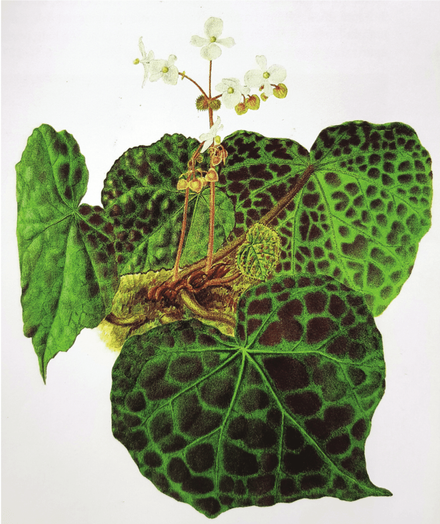
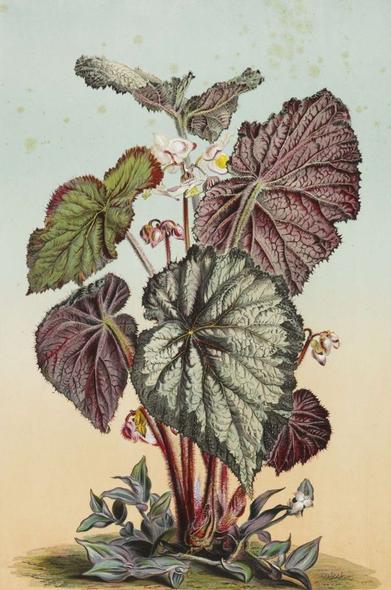
[Pictured] Begonia Rex, National Gallery of Canada (1868)

Come on an enchanting and curious journey into of the world’s most beautiful, medicinal and endangered plants of the rainforest: #Begonias with retired horticulturalist Mel Lumby @Norska11 #Boycott4Wildlife #Boycottpalmoil

Tweet

Will exquisite #begonias become historical relics…no longer found in real life #rainforests? Not if Begonia lover Mel Lumby @Norska11 has anything to do with it! Help her fight for rare plants #Boycottpalmoil #Boycott4Wildlife

Tweet

Beautiful #begonias are the unsung heroes of #rainforests. Their supreme beauty dazzles us. Their medicine protects us. Yet #corporate greed threatens them. By Horticulturalist Mel Lumby @Norska11 #Boycottpalmoil #Boycott4Wildlife

Tweet

Download image Download printable PDF View interactive HTML

We buy inexpensive products that contain palm oil now. It is a cheap, useful, oil that manufacturers like to use. Cookies, crackers, frozen pizza, shampoo, face lotion.

We buy these products without realising that we are contributing to rainforest destruction. Those rainforest shady places where beautiful Begonias grow are vulnerable to deforestation for palmoil.

“We are destroying swathes of rainforest containing beautiful, jewel-like, treasures. I cannot sit by quietly, while our beautiful earth burns. I must act!”

“I thought that I would quietly retire at the beach, grow a flower garden and happily live out my days with my chickens. I have done this. But I cannot be silent. I am now adding my voice to many others who are trying to save the animals and plants we love from mass extinction. I am only one person, but I can do something.”

Mel lumby

Mel Lumby on Instagram: More begonias being carefully, lovingly grownMel Lumby’s Begonia moysesii in bloom Mel Lumby’s Instagram: Evey Big Buff and Eloise Little Miss, two of my buddies hanging out in the garden bed.

Photos: Mel Lumby on Instagram @spock_like_object

“I am able to help fight against the greed of palm oil. This feels so good!”

This issue has been on my mind for quite some time now.

It really bothers me that there are beautiful undiscovered begonias that took millions of years to evolve.

We won’t even get to know about them because of dumb old palm oil!

Nobody even asked for this in our food, etc. The Palm Oil Detectives gal is really a cool person – it is an honour to try to help her.

~ Mel Lumby

Palm Oil and Pollution by Jo Frederiks

Deforestation for agriculture is a clear and present threat to tropical rainforests. Especially in Indonesia and Malaysia, economic growth has come at an enormous cost to its unique plants, wild animals and indigenous peoples.

In Indonesia, 10 million hectares of primary forest was lost over the past two decades. A 2019 study identified palm oil plantations to be responsible for 23% (the single largest proportion) of the deforestation in Indonesia between 2001 and 2016.

Over 3 million hectares of the forest estate in 2019 were allocated to palm oil production, which was in strict violation of national forestry law. 

It is gut-wrenching and soul-destroying to see. Now palm oil threatens plants, animals and indigenous peoples in South America, India, Papua and Africa as well.

Learn how to help

Fast facts about Borneo & plant diversity

Borneo is home to more than 15,000 plant species

A diversity that rivals the African continent. This may be the highest number of plants of any region on Earth.

  • There are 931 Begonia species in Southeast Asia
  • Currently, there are 216 species and one subspecies of Begonia in Borneo.
  • In Sarawak alone there are 96 species, with an average of at least 10 species described per year over the past 7 years.
  • In Borneo, there are also 3,000 species of trees, 1,700 species of orchids and 50 carnivorous pitcher plant species.

The natural habitat of begonias is cool, moist forests and tropical rainforests, but some begonias are adapted to drier climates

[Pictured] Begonia socotrana grows in between the shady cracks in rock formations on the arid island of Socotra, Yemen.

Fast facts about the family Begoniaceae

They grow in the deeply shaded forest understory from the lowlands to mountain tops and on all rock types including granite, limestone, sandstone and ultramafic rocks.

A Guide to Begonias of Borneo by Ruth Kiew et. al.

  • The Begonia was named after a French botanist in the 17th century.
  • There are over 2,000 known species of family Begoniaceae – one of the largest genera of flowering plants. New species are being discovered almost on a monthly basis.
  • They are mostly terrestrial and are either herbs or undershrubs, but occasionally may be grown from air (ephiphytic).
  • They thrive in moist tropical and subtropical climates of South and Central America, Africa and southern Asia.
  • Their leaves are often large, vividly marked and are they are assymetrical and unequal-sided, giving each plant unique beauty.
  • They are popular ornamental plants for conservatories. Currently, begonias are incredibly trendy and are coveted and admired by house plant lovers all over the world.

[Pictured] Begonia Rex, National Gallery of Canada (1868)

The world’s tiniest begonia was recently discovered Begonia elachista.

They exist at the mouth of a limestone cave in central Peru and nowhere else in the world.

Then there is a newly described giant begonia from Tibet, tall enough to tower over a person: Begonia giganticaulis.

The pretty Florist’s Reiger Begonia comes in a fantastic array of colours including pinks, peaches, oranges, reds, yellows, white.

We cannot forget the lovely tuberous begonias that we plant in the shady reaches of our yards.

To plant large flowerbeds full of Wax begonias in summertime is a sheer delight.

During drought periods, Begonia socotrana drop their pretty, round, leaves and survive as a tuber.

Many years ago, Begonia socotrana was used as one of the parent plants to eventually create Florist’s Reiger Begonia mentioned above.

Mel Lumby

Exceptionally beautiful begonia paintings from history

Those lovely plants are there, for now, surrounded by tropical bird call and orangutan hoots. They often live in very small stretches of area, sometimes only existing on one hillside and nowhere else in the world. Plants can’t run away if that bulldozer comes, they are sessile, fixed in one place.

If a bulldozer razes everything and scrapes that Begonia inhabited hillside bare, that’s it – that particular begonia will be lost, gone forever from our earth in the wild. Millions of years of evolution, gone. All that beauty, gone.

Mel Lumby

[Pictured] ‘Diversity of Species in the Rainforest by Oro Verde – the Rainforest Foundation (2009).

Scientists are constantly discovering new Begonia species in Indonesia

Indonesia has one of the largest concentrations of of begonia species diversity, especially in Southeast Asia with 243 species. In 2022 alone, at least a dozen new species were discovered, here in this article below, seven are mentioned.

  • Hoya batutikarensis
  • Hoya buntokensis
  • Dendrobium dedeksantosoi
  • Rigiolepis argentii
  • Begonia robii
  • Begonia willemii
  • Etlingera comosa

Read the full story: ‘Indonesian researchers discover seven new species of ornamental plants,’ Indonesian Window.

Indonesia is an archipelago consisting of approximately 17,508 islands and is covered by tropical rain forest, seasonal forest, mountain vegetation, subalpine shrub vegetation, swamp and coastal vegetation. With its reflective mixture of Asian and Australian native species,
Indonesia is said to possess the second largest biodiversity
in the world, with around 40,000 endemic plant species
including 6,000 medicinal plants

Nugraha, Ari S, et. al (2011) . ‘Revealing Indigenous Indonesian Traditional Medicine: Anti-infective Agents’, Natural Product Communications. https://journals.sagepub.com/doi/pdf/10.1177/1934578X110060124

We may be losing plants with medicinal purposes and cures as yet unknown which will help humankind

If we bulldoze Borneo, plow down Papua New Guinea, annihilate the Amazon, we wipe out incredibly beautiful plants that haven’t yet been discovered!

It isn’t just Begonias. It’s orchids and all sorts of fascinating tropical plant species. Nepenthes, the pitcher plant species. Aroids – the wonderful Philodendron relatives of Begonias that are also popular now.

Mel Lumby

Newly discovered Begonia medicinalis has cancer-fighting properties

Begonia medicinalis was discovered only recently in 2019 by scientists. This incredible species of begonia native to Sulawesi has been used as a medicinal plant by Indigenous peoples for 1000’s of years. Now this plant has been shown to have the potential to fight cancer!

Begonia medicinalis is known as benalu batu in Bahasa Indonesia is a herbal plant that is locally used for traditional medicines. The secondary metabolites such as flavonoids, alkaloids, steroids, and terpenoids have been reported to be found in these plant extracts. The content of flavonoids can lead to anti-cancer abilities while heat-sensitive flavonoid compounds can be extracted by the Ultrasound-assisted Extraction (UAE) method.

In this study, the anticancer potential of B. medicinalis extracts from the leaves (leaves extract/LE) and stem (stem extract/SE) in three cell lines (Hela, MDA-MB, HT-29) have been performed.

The anticancer potential was obtained from cytotoxic measurements by the MTT method on 3 types of cancer cells incubated with the extract for 24 hours. The value of total flavonoid content (TFC) in the LE was higher than that of SE extracts. Both extracts have the potential as a remedy for the treatment of cancer.

Prihardina & S Fatmawati; (2021); ‘Cytotoxicity of Begonia medicinalis aqueous extract in three cancer cell line,’: IOP Conf. Ser.: Earth Environ. Sci. 913 012084. https://iopscience.iop.org/article/10.1088/1755-1315/913/1/012084/pdf 

Begonia isoptera is used by indigenous peoples in Borneo and has profoundly important medicinal properties

This Begonia species found in Borneo has been used by indigenous peoples for aeons for medicinal purposes. A study from 2011 has found that this begonia species has positive antimicrobial and antibacterial effects on the human body.

[Pictured] Begonia Isoptera in Hiroshima Botanical Gardens 2008

Read more: Nugraha, Ari S, et. al (2011) . ‘Revealing Indigenous Indonesian Traditional Medicine: Anti-infective Agents’, Natural Product Communications. https://journals.sagepub.com/doi/pdf/10.1177/1934578X110060124

Indonesia’s native plants: A medicine cabinet of powerful drugs growing in the rainforest

Indigenous peoples in Indonesia have been using native medicinal plants from their medicine cabinet – the rainforest for 1000’s of years. These medicines are influenced by Indian Ayurveda since Hinduism spread from India to Asia. 

[Pictured]: Dyak/Dayak peoples in Borneo have a rich knowledge of ancient plant medicine that is recognised by western science. Images from PxFuel, creative commons.

Indigenous treatments using plants involve a combination of physical and spiritual aspects to form a holistic approach to healing.

The inclusion of indigenous medicinal plants not found in India enhanced Indigenous Indonesian medication. This was further enriched by the influence of Chinese and Arabian traders to the islands. 

Dayak indigenous peoples of Borneo are knowledge-keepers of ancient indigenous medicine and treatment from plants. This knowledge is passed down from generation to generation. Now western medicine is realising just how important it is to keep these plants from going extinct. Research shows that these plants may hold the key to unlocking fatal diseases like dementia and cancer, as well as being useful for treating common illnesses and injuries.

Most of this indigenous knowledge of medicine is not recorded. It is passed down verbally in stories from generation to generation and healer to healer. 

Dayak Indigenous Ethnographer Dr Setia Budhi: In His Own Words

“For Dayak peoples in Borneo, the land is mother, where they plant fruit, vegetables and grains for their families. The soil is mother where trees grow and develop.

“From these trees they harvest an abundance of creeping rattan for medicine, food and crafts.

“The forest has a ritual function, a medicinal function and a family protection function.”

Dr Setia Budhi, Dayak Ethnographer.

Interview with Dr Budhi Short story by Dr Budhi

Historically, Dutch colonialists of Indonesia incorporated elements of indigenous medicine into their treatments, due to lack of availability of western medicine from the 17th to the 19th centuries. Medical texts from this period show that physicians found traditional medicines to be legitimate and effective in treating common illnesses. These publications include: 

  • De medicina Indorum by Bontius in 1642 
  • The Ambonese herbal by Rumphius in 1741
  • Materia Indica by van der Burg in 1885 
  • De nuttige planten van Nederlansch Indie by Heyne in 1927 
  • Select Indonesian medicinal plants by Steenis Kruseman in 1953 
  • The Medical Journal of the Dutch East-Indies (1894- 1925)

[Pictured] Dutch colonialists overseeing the local workers in a warehouse in Deli Medan North Sumatra, 1897. www.nationaalarchief.nl

Since the 1970’s, the use of lab-based equipment, technology and computational modelling has revealed the remarkable properties of Indonesian rainforest plants, which have anti-viral, anti-malarial, anti-bacterial and anti-fungal agents within them. 

Read more

The wonder drugs of the rainforest: Nugraha, Ari S, et. al (2011) . ‘Revealing Indigenous Indonesian Traditional Medicine: Anti-infective Agents’, Natural Product Communications.

Professor Budiman Minasny; ‘The dark history of slavery and racism in Indonesia during the Dutch colonial period’ (2020), University of Sydney, The Conversation.

This is what stands to be lost if more rainforests are destroyed for timber and palm oil in SE Asia, Papua, Africa and South America

“I can’t only be a begonia collector/grower anymore. Boycotts work to shift brands to act when governments fail to act” ~ Mel Lumby

Please join me and a growing number of people around the world who love nature, rainforests, animals and plants and who make an effort daily to push back against the corrupt and greedy people funded by the palm oil industry to spread greenwashing misinformation about “sustainable” palm oil.

Together we can use our wallets as weapons, #Boycottpalmoil and #Boycott4Wildlife” ~ Mel Lumby

Join the #Boycott4Wildlife

Begonias in blossom by Freepix

Borneo is in great danger of being destroyed by deforestation to plant palm oil plantations.

Other places as well: Papua New Guinea, The Amazon, African countries like Guinea. You have seen the news. Our world is in trouble.

There are places with undiscovered endemic plant species with very limited habitats being bulldozed, burned and cut down. Science hasn’t even found these plants! We chop down their only habitat before they get discovered!

Amazing new Begonia species are being discovered all the time in Borneo: Begonia baik, Begonia darthvaderiana, Begonia nothobarimensis. And on and on. Scientists are still finding new and wonderful species there.

It’s super easy to get into a nihilist mindset these days

“It is a struggle and depressing when one realises how everything in the natural world is set up to be used, abused and destroyed – simply for profit!

“We have all been through ‘some things’ these last few years, that’s for sure! I just focus, concentrate and keep going. When it all gets too much, I take a couple of days to chill. Then I begin again with campaigning against tropical deforestation and against palm oil.”

Mel Lumby

The regal and rare Begonia rajah

Begonia rajah is a species of flowering plant in the family Begoniaceae, native to  Peninsular Malaysia. They typically have striking bronze leaves and contrasting green veins, and are best suited for terrariums.

Watercolour painting of Begonia rajah of an original wild-collected plant grown in the Botanic Gardens, Singapore via Singapore Botanic Gardens.

Begonia coriacea is a species native to Indonesia

Begonia coriacea – Hooker – Curtis Botanical Magazine Bot. Mag. 78 t. 4676 (1852)

Stinky meat flowers of Borneo: Rafflesia arnoldii & Rafflesia pricei

Borneo is also home to the largest flower in the world, Rafflesia arnoldii. They along with their relatives, are parasites, living their entire lives inside of tropical vines. These amazing plants only ever emerge when it is time to flower and flower they do! Their superficial resemblance to a rotting carcass goes much deeper than looks alone. These flowers give off a fetid odour of rotting flesh that is proportional to their size, but not to their visual beauty. This aroma has earned them the nickname “carrion flowers.”

Rafflesia pricei by Rimbawan on Getty Images Rafflesia arnoldsii by Boris 25 on Getty Images

12 new species of begonia were found on Sarawak in 2022

Twelve new species and one new record of Begonia (Begoniaceae) from Sarawak, Malaysia, are described. All species belong to Begonia sect. Petermannia. Three species are recorded from Totally Protected Areas, one species occurs both within and outside Totally Protected Areas, and eight species occur only outside Totally Protected Areas.

Edinburgh Journal of Botany, Begonia special issue, Article 410: 1–46 (2022). https://doi.org/10.24823/EJB.2022.410.

Different species of Begonia by Botanicus http://www.botanicus.org

“Polka-dotted. Striped. Furry. Shiny. Bumpy. Ferny. Maple-shaped. Elm-shaped. Grass-shaped. Black, silver, pink, mossy green and bright apple green leaf colors. Reds and oranges, too. Some will shine in the deep forest, with a beautiful blue sheen. The variety of Begonias is incredible!”

Mel Lumby

If you can successfully grow a Darth Vader Begonia – consider yourself a badass

Begonia darthvaderiana

  • Discovered in 2013 by C.W. Lin, S.W. Chung and C.I. Peng and found in Sarawak, Borneo and found in shaded valleys, streams and slopes.
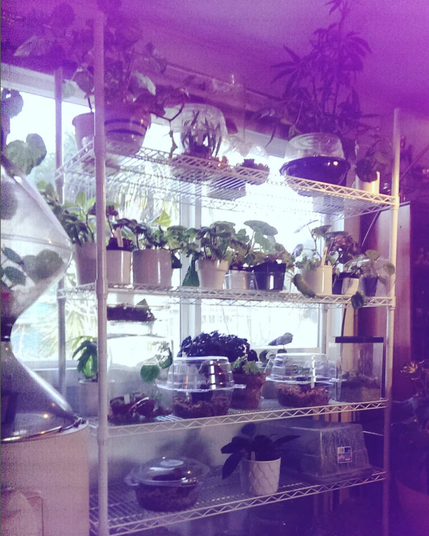
  • Not a beginners begonia, this one is challenging to grow. They need a humid terrarium environment. Even then, their leaves are prone to ‘melting’ if temperatures, humidity waver too much from what they like.
  • This beautiful species has a cane-like habit, olive black leaves and red colouring underneath, with a white to lime green edging.

[Pictured] Begonia Darthvaderiana By Lya Solis Blog

Begonia amphioxus: Polka-dotted princess

  • Begonia amphioxus was discovered in 1984 growing on a limestone hill of Batu Punggul in Sabah, Borneo.
  • Their red polka dots, bizarre and narrow leaves and pointed at both ends give this species an unusual look.
  • This delicate looking begonia not only has aesthetic appeal but also commercial value and are highly collectable by plant hobbyists.
  • They love high humidity and require a terrarium to grow. Once happy they will produce tiny white flowers.
  • Threats in the wild include timber logging, palm oil, mining and quarrying for limestone and marble. Fires, droughts and extreme weather due to climate change along with tourist activities.

[Pictured] Begonia amphioxus by Lya Solis Blog

Every animal species in Borneo relies on native plants, including humans! So it’s about time we look after Borneo’s plants – because they look after us all!

Without direct intervention in Borneo’s national parks to protect plants and animals: Everyone from orchids and orangutans, begonias and binturongs will go extinct!

[Pictured] A critically endangered Sumatran orangutan by Craig Jones Wildlife Photography

When wildlife photographer and photojournalist Craig Jones visited Sumatra, Indonesia he found protected rainforests being destroyed by multinational palm oil companies – under the greenwashing guise of “sustainable” RSPO palm oil.

Craig Jones in his own words Eyewitness: Orangutans are rescued from an RSPO plantation

Here are some other ways you can help by using your wallet as a weapon and joining the #Boycott4Wildlife

What is greenwashing?

Read more

Why join the #Boycott4Wildlife?

Read more

Greenwashing Tactic #4: Fake Labels

Read more

The Counterpunch: Consumer Solutions To Fight Extinction

Read more

Contribute to my Ko-Fi

Did you enjoy visiting this website?

Palm Oil Detectives is 100% self-funded

Palm Oil Detectives is completely self-funded by its creator. All hosting and website fees and investigations into brands are self-funded by the creator of this online movement. If you like what I am doing, you and would like me to help meet costs, please send Palm Oil Detectives a thanks on Ko-Fi.

Say thanks on Ko-Fi

Photography: Craig Jones Wildlife Photography, Wikipedia, Getty Images, PXFuel.

Words: Mel Lumby, Palm Oil Detectives, Dr Setia Budhi, Craig Jones.

Contribute to my Ko-Fi

Did you enjoy visiting this website?

Palm Oil Detectives is 100% self-funded

Palm Oil Detectives is completely self-funded by its creator. All hosting and website fees and investigations into brands are self-funded by the creator of this online movement. If you like what I am doing, you and would like me to help meet costs, please send Palm Oil Detectives a thanks on Ko-Fi.

Say thanks on Ko-Fi

#Borneo #Botany #conservation #CreativesForCoolCreatures #Dayak #deforestation #endangeredPlants #flora #indigenousMedicine #indigenousRights #investigativeJournalism #journalism #Malaysia #PalmOil #palmOilDeforestation #plants #wildlife #wildlifeActivism

Anthropologist and Author Dr Sophie Chao

Dr Sophie Chao: In Her Own Words

Anthropologist, Scholar, Writer, Indigenous & Multispecies Rights Advocate

Bio: Dr Sophie Chao

Dr Sophie Chao is an environmental anthropologist and environmental humanities scholar interested in the intersections of capitalism, ecology, Indigeneity, health, and justice in the Pacific.

Her theoretical thinking is inspired by interdisciplinary currents including Science and Technology Studies, political ecology, and Indigenous, Postcolonial, and Critical Race Studies.

Dr Chao is currently a Discovery Early Career Research Award (DECRA) Fellow and Lecturer in Anthropology at the University of Sydney. Prior to her academic career, she worked for the international Indigenous rights organisation Forest Peoples Programme in the United Kingdom and Indonesia.

She has also undertaken consultancies for the United Nations Food and Agriculture Organisation and the United Nations Working Group on the Issue of Human Rights and Transnational Corporations. She is currently Secretary on the Executive Committee of the Australian Anthropological Society (AAS) and Co-Convenor of the Australian Food, Society, and Culture Network (AFSCN).

In 2022, Dr Chao released her much anticipated book In the Shadow of the Palms: More-Than-Human Becomings in West Papua, which examines the multispecies entanglements of oil palm plantations in West Papua, showing how Indigenous Marind communities understand and navigate the social, political, and environmental demands of palm oil. Her book won the inaugural Duke University Press Scholars of Colour First Book Award.

Dr Chao is keen to forge meaningful collaborations and conversations with Indigenous and decolonial academics, artists, and activists in Australia and beyond, and to move towards a better understanding of morethanhuman worlds. 

Palm Oil Detectives is honoured to interview to Dr Sophie Chao about her research into the impacts of palm oil on the daily lives of Marind people and other sentient beings in West Papua.

Read the introduction Order the book

https://youtu.be/zy2CV-0bbP4

“I want the world to understand how #deforestation and industrial #palmoil expansion undermine #Indigenous ways of being in #WestPapua” ~ Dr Sophie Chao #PapuanLivesMatter #Together4Forests #Boycott4Wildlife 

Tweet

“#Indigenous #Marind of #WestPapua consider plants and animals NOT as passive objects of exploitation, but as other-than-human relatives. Subjects of #interspecies #justice in their own right” ~ Dr Sophie Chao #Boycott4Wildlife 

Tweet

“I want to see the #palmoil industry/governments try to understand the desires of #Papuan people THEMSELVES instead of pre-conceived notions of what counts as progress” ~ Dr Sophie Chao #PapuanLivesMatter #Together4Forests 

Tweet

“#Governments/ #corporates must accept that some #Indigenous communities may decide to withhold consent to #palmoil projects. Their right to say NO MUST be respected” ~ Dr Sophie Chao   #PapuanLivesMatter #Boycott4Wildlife 

Tweet

Anthropologist and author of ‘In the Shadow of the Palms’ Dr Sophie Chao: In Her Own Words

​Little previous research had been done into how indigenous peoples themselves experience, interpret, and contest oil palm developments.

In particular, there is not much research done into how indigenous peoples relate to vulnerable, non-human beings such as native plants, animals, and elements, with whom many indigenous peoples entertain intimate and ancestral relations of kinship and care.

“Many people know that oil palm is devastating on tropical ecosystems and biodiversity. Much less is known about the impacts of this proliferating cash crop on the peoples who are being displaced, dispossessed, and disempowered in its wake.”

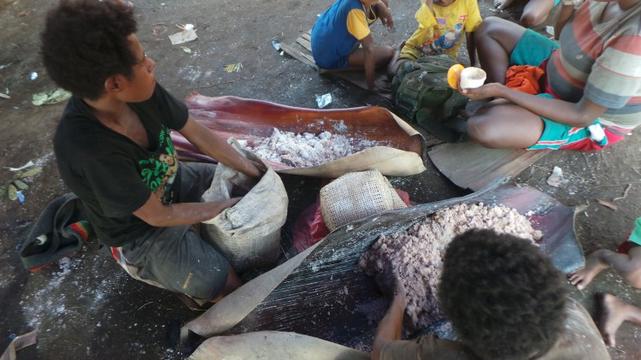
Pictured: A group of Marind women preparing sago starch that has been freshly rasped from the sago grove. Photo: Dr Sophie Chao

​I wrote this book because I wanted the world to understand how deforestation and industrial oil palm expansion are undermining Indigenous ways of being in West Papua.

​My book seeks to bring to life the worlds of people who live in the teeth of settler-colonial capitalism

Dr Sophie Chao

​Living with Marind transformed how I think about what it means to be “human”

And also what it means to coexist in mutually beneficial ways with other-than-human beings.

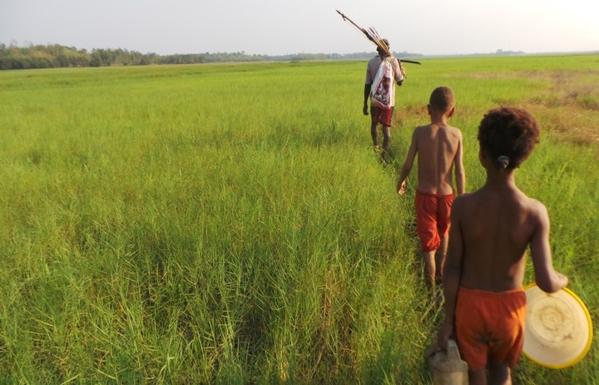
Pictured: A Marind man rests near the banks of the Bian River after a fishing trip. Photo: Dr Sophie ChaoPictured: Dr Sophie Chao researched the life of the Marind-Anim tribe in Merauke for three years. Her doctoral dissertation on the impact of oil palm plantations on the lives of the tribe won the 2019 best thesis award in Australia in the field of Asian Studies. Photo: ABC News Indonesia

​The Marind think of plants and animals as not simply passive objects of human exploitation

Instead, these other-than-human beings are considered to be agents, persons, relatives, and subjects of justice in their own right.

This was a completely different way of thinking to the anthropocentric and individualistic logic of the Westernised parts of the world where I had lived, studied, and worked.

https://youtu.be/U0n1dbxUa1k

Read the introduction Order the book

​Indigenous Marind enriched my world by inviting me to think beyond nature-culture divides

Humans share the planet with a whole array of different creatures. These creatures matter in the making of more sustainable, collective futures.

​“More-than-human becomings” is in the subtitle of the book because it is an invitation to think beyond the human and also beyond categories. Instead, the reader is invited to think about non-human beings and transforming worlds.

Marind are “More-than-human” because they consider themselves as beings within a lively and diverse ecology of life

This includes native plants and animals like cassowaries, birds of paradise, and sago palms, but also introduced – and sometimes dangerous – organisms like industrial oil palm.

“Becomings” was a way of getting readers to think about life beyond the static notion of “being.” To “become” is a constant transformation, unfolding differently across bodies, places, and time. Becoming, in some ways, never really ends.

​The ‘good life’, according to Marind, stems from the willingness of humans to consider non-human beings as subjects of dignity and justice

This good life is best achieved by immersing oneself in the more-than-human environment. Non-human beings are considered to be participants in the making of shared worlds, and also as subjects of harm and violence.

The “good life” is deeply intergenerational for Marind. They often talked about nurturing the forest, as a way of becoming good ancestors and how they can transmit traditional ecological knowledge to future Marind generations

​Time for Marind is not linear, it is spiralic

What you do now matters in terms of how you will be remembered. What you do now matters in terms of what you will be able to pass on to human and other-than-human beings to come.

There is a wisdom and responsibility that comes with this sense of time that I think is critical to heed in this age of planetary destruction.

A Marind family journeying to a sacred ceremonial site to pay respects to their ancestral spirits. Photo: Dr Sophie Chao

Many of my Marind companions talk about conservation and capitalism as being “two sides of the same coin”

This is because they now find themselves excluded from both industrial oil palm plantations and from the conservation areas that are intended to off-set deforestation.

Images: Palm oil plantations and environmental destruction, Getty Images.

Both of these activities entrench a nature-culture divide that is alien to many Marind. Both undervalue the fact that Marind have always coexisted harmoniously with their environments.

These new “conservation zones” are the very same places where Marind fish, forage, and hunt. It is where they go to visit ancestral graveyards and sacred sites. It is where they walk with their families and friends to encounter their kindred sago palms, wild boards, possums, and gaharu trees.

Pictured: Forest foods, like sago starch, are considered nourishing by Marind because they derive from revered plants and animals. Sophie Chao, Author provided. Via The Conversation Pictured: A tool for processing Sago. Papua New Guinea. Getty Images

For Marind, conservation and capitalism violate their territorial sovereignty and access to food and resources. Both types of activity are imposed by outside actors through top-down decision-making process that they are not party to.

​Human rights and environmental abuses in West Papua are made invisible in Australia, their closest neighbour, mainly for geopolitical reasons

Racism may have something to do with it – but I think geopolitical interests are a big part of the story

West Papua is incredibly rich in natural resources – from gold, copper, and coal, to timber and oil palm. Economic and political interests tend to trump human and environmental rights, in West Papua and elsewhere.

There are pockets of activism and advocacy in Australia, including by West Papuan diaspora and political exiles – but the movement hasn’t caught the public’s attention in the way other political causes have.

Accessing West Papua is difficult for non-Indonesian individuals and organisations. There is heightened militarisation of the region. This contributes to an ongoing invisibilisation of what is happening at the ground level, among Papuan people and across Papuan ecosystems.

​The demilitarisation of West Papua is absolutely vital if Papuans are to feel that they have a free voice in matters affecting them and their lands – including oil palm developments

Image: Andrew Gal for Getty Images

​Indigenous ways of being and thinking (although radically different from neoliberal capitalist and colonialist logics), should be central to decision-making

I would like to see the palm oil industry, together with the Indonesian government, try to understand the views, aspirations, desires, beliefs, and hopes of Papuan peoples themselves instead of entering with pre-conceived notions of what counts as progress, the good life, and wellbeing.

Government and corporate actors should engaging with Indigenous Papuans through a transparent, iterative, and trust-based process of consent-seeking, before any oil palm projects are designed or implemented.

This consent should be sought freely, well ahead of time, and only when communities have been given access to comprehensive and impartial information on the benefits and risks of oil palm developments.

Pictured: Marind man and child in Merauke by Nanang Sujana

Most importantly, government and corporate actors need to accept that some communities may, following lengthy consultations, still decide to withhold their consent to oil palm projects. This right to say NO to oil palm must imperatively be respected.

​Violence as a multispecies act: Marind describe oil palm as a colonising, killing and occupying plant beings

Oil palm, they often told me, does not want to share time and space with native plants, people, and animals.

It spreads uniformly across vast swaths of land, yet grows alone in monocrop form

This plant’s introduction has been accompanied by intensified military and corporate surveillance, community harassment and intimidation and exploitative labour conditions.

To think about violence in multispecies terms, brings us to consider situations where humans are not the only culprits, and non-humans not the only victims.

Oil palm’s acts of violence invite us to think about non-human beings as drivers and perpetrators of harm – even as they themselves are also subject to human and technological manipulations and exploitation.

Pictured: Fire in a rainforest – Getty Images

Paraquat, a deadly herbicide, trickled down from rusty canisters strapped to the women’s backs, the blue-green venom seeping into their exposed skin.

Banned in many countries because of its toxic effects, no antidote exists for this lethal chemical. I thought of babies never to come. The faces of my friends, huddled in the bed of the truck, were caked in dust and watched the landscape unfurl, weeping.

Infants retched from the stench of mill effluents as we jolted down dirt roads without stopping so as to avoid attracting the attention of military men employed by the companies to guard their plantations. Bunches of oil palm fruit lay strewn along roadsides, piles of moldering blood-red and coal-black, shot through with razor-sharp thorns.

Bulldozers and chainsaws ripped through isolated patches of the remaining vegetation. Silhouetted against the bleary sun, pesticide-spraying helicopters zigzagged back and forth above us, spreading a milky veil of hazy toxins.

~ Dr Sophie Chao, excerpt from the prologue of ‘In the Shadow of the Palms.’

Image 1: Untouched rainforest (Getty Images). Image 2: Marind community on land destroyed for the million hectare Meruake Integrated Food and Energy Estate, known as MIFEE (Nanang Sujana)

The day that MIFEE came

On August 11th 2010, a delegation of government representatives from Jakarta, led by the then minister of agriculture Ir. H Suswono launched the Merauke Integrated Food and Energy Estate (MIFEE). A $5 billion USD agribusiness scheme to promote the country’s self-sufficiency in basic foodstuffs and to make Indonesia a net food-exporting nation. Papuans from across the region were invited to the event including Marind community members from the upper Bian river. Paulus Mahuze, Marind clan leader recalls the arrival of MIFEE and how everything changed dramatically afterwards for his people. 

~ Dr Sophie Chao, excerpt from her book ‘In the Shadow of the Palms.’

“It was a hot day. There was dust (abu) everywhere, raised by the government convoys and military trucks. The dust stung our eyes and made our children cry. The government brought oil palm (sawit) company bosses with them from pusat (‘the centre,’ or Jakarta). They gave us instant noodles, pens, bottles of water. They also gave us cigarettes – the expensive kind. They talked a lot about MIFEE. MIFEE this, MIFEE that…but we didn’t understand what MIFEE was. We did not know what palm oil was because oil palm does not live in our forests. Then, the government officials and the oil palm bosses left. They never returned to the village. 
They promised us money and jobs. They said MIFEE would provide us with food. I thought that they would plant yams, vegetables and fruit trees. Instead they planted oil palm. They planted oil palm everywhere they could. They turned the whole forest into oil palm. They cut down all the sago to plant oil palm. This is what happened. Since then, everything is abu-abu (‘grey’ or ‘uncertain’).  

~ Paulus Mahuze, marind clan leader (as told to dr sophie chao in her book: In the shadow of the palms).

​Abu-abu means both “grey” and “uncertain”. For Marind, the future, hope and multispecies relations were all abu-abu and under siege

Pictured: Oil palm plantations in Merauke have contributed to unprecedented levels of deforestation, and water/soil contamination. Photo credit: Dr Sophie Chao.

The concept of abu-abu is one that many of my Marind friends would use to describe the worlds that they inhabit

Abu-abu communicates the sense of ambiguity, opacity, and strangeness that life on the palm oil frontier entails. Greyness manifests in the polluted waters of local rivers, and in the smoke-filled skies following forest burning.

Greyness also manifests in the dull and irritated skin of malnourished infants, poisoned fish, and pesticide-wielding workers

To live in a world of murk and uncertainty is violent and unsettling – but it is also a way of rejecting the possibility of any kind of radical divide between oneself and that murk. That’s why I approach abu-abu not just as a condition of suffering, but also as a stance of refusal.

What would or might come next for Marind and their other-than-human kin was unknown – and often feared.

This sense of greyness, or uncertainty is also metaphorical. For Marind the world is grey in that the future, hope, social and multispecies relations are all under siege.

Pictured: Dead fish, creative commons image, Pxfuel.

At the same time, abu-abu was a form of resistance in the way it refused fixed classifications, categories, or boundaries between things, ideas, and actions

Pictured: Marind child in Merauke West Papua by Nanang Sujana

​Whether “sustainable” palm oil can be achieved in practice demands a radical rethinking of the capitalist logic – the logic of endless growth

Careless profit-making, and externally imposed “development” and “progress” rhetorics. And that is a huge task. These kinds of rhetorics are deeply entrenched. Their origins are often unquestioned. Their impacts are often silenced.

Pictured: Common supermarket brands that are RSPO members are linked to deforestation and human rights abusesPictured: Pollution run-off in an RSPO member palm oil plantation in Sumatra. Craig Jones Wildlife PhotographyReport: Environmental Investigation Agency: Sustainable palm oil is a con

​At the end of the day, I think the most important thing to ask ourselves about “sustainability” is – sustainability for whom?

Who gets to have a say over what happens to lands and forests? Who gets to be involved in decision-making processes surrounding oil palm projects? Is there scope to reconsider the scale at which these projects are being developed?

These are questions that have to be crafted and considered together with the Indigenous peoples most directly and indirectly affected by agribusiness expansion.

That, for me, is the beginning of any kind of conversation around sustainability – sustainability for people, plants, animals, and for all the other beings implicated in one way or another in the palm oil nexus.

The rationale for additional Food Estates in Papua and Indonesia is scrutinised in this 2022 report

“The rationale behind Food Estates, that they are an effective way to rapidly increase national food production, does not stand up to scrutiny.

“Over the years, previous attempts to launch Food Estates have failed, with little if any extra food produced. The various iterations of the Merauke Food Estate (MIFEE) are a good example of this.

“For these reasons, it is legitimate to call into question the real motivation behind the plans. With corruption still rampant in Indonesia, there is a significant risk that Food Estates will present new opportunities for profit by those in government and their associates.”

Quote from: Pandemic Power Grabs: Who benefits from Food Estates in West Papua, a report by AwasMIFEE and TAPOL (2022).

Download report

Pictured: Dr Sophie Chao researched the life of the Marind-Anim tribe in Merauke for three years. Her doctoral dissertation on the impact of oil palm plantations on the lives of the tribe won the 2019 best thesis award in Australia in the field of Asian Studies. Photo: ABC News Indonesia

https://twitter.com/Sophie_MH_Chao/status/1554625068906336256?s=20&t=KQOGXlMflLDymRCC19ppTw

https://twitter.com/DukePress/status/1553002952293584898?s=20&t=8y_Ry_oAL7Ef8cdQv5KBQA

https://twitter.com/eben_kirksey/status/1554656376982364160?s=20&t=8y_Ry_oAL7Ef8cdQv5KBQA

Images: Getty Images, Dr Sophie Chao, Nanang Sujana, Craig Jones Wildlife Photography, ABC News Indonesia.

Words: Dr Sophie Chao

Further Reading

‘In West Papua, oil palm expansion undermines the relations of indigenous Marind people to forest plants and animals’ by Dr Sophie Chao for The Conversation.

After 75 years of independence, Indigenous Peoples in Indonesia still struggling for equality by Dr Sophie Chao for The Conversation.

‘Kelapa Sawit Membunuh Sagu’: Sophie Chao Meraih Tesis Terbaik di Australia Setelah Meneliti Suku di Papua by Farid M. Ibrahim for ABC Indonesia.

In the plantations there is hunger and loneliness: The cultural dimensions of food insecurity in Papua (commentary)’ by Dr Sophie Chao for Mongabay.

The sky has no corners: My journey to a new understanding of nature, an essay by Dr Sophie Chao for Five Media.

Read and watch more stories about indigenous justice, land-grabbing and deforestation on Palm Oil Detectives

Mama Malind su Hilang (Our Land is Gone) by filmmaker Nanang Sujana

Image: Marind children in Merauke West Papua by Nanang Sujana

Mama Malind su Hilang (Our Land Has Gone) is a powerful documentary by celebrated and renowned filmmaker and photographer Nanang Sujana. His images and film tells the story of the Malind Anim tribe living in Zanegi village. They were dispossessed from their land which was given over to global palm oil corporations, in its place was Merauke Integrated Food and Energy Estate (MIFEE).

https://youtu.be/RqYoRh1aApg

The Forest is the father, land is the mother and rivers are blood

“That’s the spirituality of most Dayak people in Kalimantan. They understand the interdependent nature of everything in nature.”

~ Dr Setia Budhi : Dayak Ethnographer

Read Dr Budhi’s story Read ‘The Orangutan with the Golden Hair’

Image: Rainforest in Sumatra by Craig Jones Wildlife Photography

The people versus Feronia: Fighting palm oil agrocolonialism in the Congo

Read more

by Palm Oil Detectives

Organised Crime: A Top Driver of Global Deforestation

Read more

by Palm Oil Detectives

Promise, Divide, Intimidate and Coerce: 12 tactics used by palm oil companies intent on land-grabbing

Read more

by Palm Oil Detectives

Palm Oil Lobbyists Getting Caught Lying Orangutan Land Trust and Agropalma

Read more

by Palm Oil Detectives

13 Reasons To Boycott Gold for Yanomami

Read more

by Palm Oil Detectives

Treespiracy: Forests are being destroyed against a background of corruption, illegality and apathy

Read more

by Palm Oil Detectives

Palm Oil Detectives is 100% self-funded

Palm Oil Detectives is completely self-funded by its creator. All hosting and website fees and investigations into brands are self-funded by the creator of this online movement. If you like what I am doing, you and would like me to help meet costs, please send Palm Oil Detectives a thanks on Ko-Fi.

Say thanks on Ko-Fi

#animalExtinction #animalRights #animals #Anthropology #Boycott4wildlife #conservation #corporates #CreativesForCoolCreatures #deforestation #indigenous #IndigenousActivism #indigenousRights #interspecies #justice #landRights #landgrabbing #Malind #Marind #PalmOil #palmOilDeforestation #palmoil #PapuaNewGuinea #Papuan #PapuanLivesMatter #rainforestConservation #research #Together4Forests #WestPapua #WestPapua

How do we stop the world’s ecosystems from going into a death spiral? A #SteadyState Economy

Steady State Economics:

An Interview with Martin Tye

Australasian Regional Representative, Centre for Advancement of Steady State Economics (CASSE)

What is a Steady State Economy?

A Steady State Economy is a mildly fluctuating economy that does not exceed ecological and planetary limits.

A Steady State Economy is not an alternative economic ideology that is centred on endless GDP growth. It is neither capitalism nor communism.

Economic growth, with all of its downsides, is clearly unsustainable in the 21st century.  Long-term recession is no panacea either.  A steady state economy is the sustainable alternative to perpetual economic growth.

Economic growth was never a magic bullet; it is simply an increase in the production and consumption of goods and services–it can’t possibly lead to a sustainable outcome.  In contrast, the steady state economy provides the means for present and future generations to achieve a high quality of life. 

In this interview, Palm Oil Detectives speaks with Martin Tye, a representative of the Center for the Advancement of the Steady State Economy (CASSE) in Regional Australia. Martin studies ecological economics and history and passionate about improving the quality of life for current and future generations and restoring wildlife.

The Center for the Advancement of the Steady State Economy (CASSE) was formed in 2003 by conservation biologist, author, speaker and media commentator Brian Czech.

How do we stop the world’s ecosystems from going into a death spiral? A #SteadyState Economy. An interview with @SteadyStateEcon’s Australasian leader @MartinRev21

Tweet

palm oil on fire After a forest fire in Sumatra – Craig Jones Wildlife Photography Say no to palm oil biodiesel

“Somehow, we have come to think the whole purpose of the economy is to grow, yet growth is not a goal or purpose. The pursuit of endless growth is suicidal.”

David Suzuki

The goal of Steady State Economics is to substitute the model of endless GDP growth with a stable and mildly fluctuating economy

The term often refers to a national economy, but ‘Steady State’ economics also be applied to a local, regional, or global economy.

An economy can reach a steady state after a period of growth or after a period of downsizing or degrowth.

#SteadyState Economics calls for everyone to demand a shift from a model of endless GDP growth towards a mildly fluctuating economy that exists in harmony with animals and ecosystems @steadystateecon @martinrev21 #Boycott4Wildlife

Tweet

Economic growth A.K.A. GDP growth encourages wasteful overconsumption and #ecocide. Be a part of the solution, push for a #SteadyState economy and #Boycott4Wildlife the global brands destroying the world @steadystateecon @martinrev21

Tweet

In a #SteadyState economy people would choose to consume materials responsibly, conserving, economising, and recycling where appropriate. This movement is aligned to the #Boycott4Wildlife find out more @steadystateecon @martinrev21

Tweet

A steady state economy may not exceed ecological limits

Photos: Craig Jones Wildlife Photography

A steady state economy entails a population growth and per capita consumption that is stabilised and balanced.

GDP is a solid indicator of economic activity and environmental impact – not well-being. All else equal, the steady state economy is indicated by stabilised, or mildly fluctuating GDP.

Gross Domestic Product (GDP) is not a good indicator of well-being

Economic growth, otherwise known as GDP growth, encourages wasteful overconsumption

In a steady state economy, people consume enough to meet their needs and lead meaningful, joyful lives without undermining the life-support systems of the planet

With a Steady State economy, conspicuous consumption becomes a thing of the past

People choose to consume energy and materials responsibly, conserving, economising, and recycling where appropriate.

Citizens (yes citizens, not consumers) recognise that the culture of materialism as a bankrupt ideology and a poor path to happiness.

People forget about trying to accumulate evermore stuff, instead focusing on more worthwhile pursuits.

Personal and societal decisions about how much to consume take into account sustainability principles and the needs of future generations.

If the world continues on its current trajectory, in 20 years what will happen doesn’t bear thinking about. Things will get very ugly!

Industrial scale food agriculture is a necessary support to growing economies- all part and parcel of the package, in particular their demand for growing populations (consumers- who need to be fed, so they can buy).

A growing economy consumes natural resources and produces wastes. This results in biodiversity loss, air and water pollution, climate destabilisation, and other major environmental threats.

GDP growth metrics fails to consider the ecological impacts of production, or recognise ecological limits to growth. So ecological pressures continue unabated.

Photos: Craig Jones Wildlife Photography

What would steady state global agriculture look like?

Just as a growth economy tends to impart industrial characteristics to its agricultural systems, a steady state economy tends to impart sustainable characteristics to its agricultural systems.

~ Agriculture in a Steady State Economy

A fixed quantity of food

Such an economy requires a fixed quantity of food. There is no need for constantly increasing the amount of food produced, and there is a calming effect on the landscape – not as much land needs to be in crop-production mode.

Low throughput of energy and materials

In addition to stable population and consumption, a steady state economy features stable and relatively low throughput of energy and materials, a characteristic that applies to the agricultural sector.

Decentralised and local

The best way to achieve sustainable throughput in agricultural systems is to decentralize. Inputs, especially fossil fuel inputs, can be reduced by shifting to local systems of production, distribution and consumption. Agriculture in a Steady State Economy

If the world adopts Steady State model now, in 20 years significant improvements will be visible in the world

Guided by a dashboard of ecological, social and economic progress indicators (GPI’s) we will have begun to re-shape the world.

Ecosystems would have started their recovery, economies would be progressing towards a restructured smaller local and sustainable scale.

As resource pressures ease, so too will international and regional tensions

People will see improved life satisfaction as “well-being” replaces “growth” as a goal.

In this version of the future, the world would be a much happier and positive place than it is today. In this state, human achievement and potential will be maximised.

The Steady State economics model offers goals like sustainability and fairness with the least amount of impingement on individual freedoms.

Cargill – Animal Utopia by Hartmut Kiewurt https://hartmutkiewert.de/werk/animal-utopia/

A steady state economy has four basic principles:

1. Maintain the health of ecosystems and the life-support services they provide.

2. Extract renewable resources like fish and timber at a rate no faster than they can be regenerated.

3. Consume non-renewable resources like fossil fuels and minerals at a rate no faster than they can be replaced by the discovery of renewable substitutes.

4. Deposit wastes in the environment at a rate no faster than they can be safely assimilated.

The Steady Stater Podcast

To explain the concepts of the Steady State Economy, CASSE created a podcast in 2021.

https://open.spotify.com/episode/7gywdCKiTyluVQhD5iKJW8?si=RXS_kBKeSQ2IZS1brECEzQ

A steady state: The only kind of economy that’s sustainable in the long term

It is an economy that meets people’s needs without undermining the life-support services of the planet.

This will paint a more realistic picture of the state of things, better inform policy and guide the changes they need to make.

The strongest move policy-makers can make is to adopt new performance indicators to replace GDP

People need to understand that “economic growth” is propping up short sighted economic parasites

Cop26 deforestation

We see resistance to change in the fossil fuel lobby, the palm oil lobby, meat agriculture, property developers, retail chains etc. Before universally smoking was frowned upon, we saw resistance from the tobacco industry. Before this, slave holders also resisted change.

Martin Tye

Photos: Craig Jones Wildlife Photography

People power is needed to change the system. The steady state economic model provides the only real solution

Research: Boycotts Are Worthwhile and Effective

Despite sustained and vigorous attempts by corporates and industry certification schemes like RSPO, MSC and FSC to downplay the impact and effectiveness of consumer boycotts, it turns out that boycotts are impactful and drive social change. They force profit-first and greedy corporations to change their ways and do better. They also create a tangible sense…

by Palm Oil DetectivesSeptember 11, 2021November 5, 2024

Simplicity and non-violence are obviously closely related

As physical resources are limited, people satisfying their needs by means of a modest use of resources are obviously less likely to be at each other’s throats than people depending upon a high rate of use. Equally, people who live in highly self-sufficient local communities are less likely to get involved in large-scale violence than people whose existence depends on world-wide systems of trade. ~ Buddhist Economics By E. F. Schumacher

Activists can take individual action and collective action to effect change

A good example of a collective of researchers, economists, conservationists and activists pushing for change is CASSE: The Centre for Advancement of Steady State Economics.

Good examples of grass-roots, bottom-up collectives include: the #Boycott4Wildlife, Extinction Rebellion, Fridays for Future and the Vegan Land Movement.

The Counterpunch: Consumer Solutions To Fight Extinction

Read more

February 7, 2021July 7, 2024

What is greenwashing?

Read more

October 15, 2021December 28, 2024

Why join the #Boycott4Wildlife?

Read more

Follow the Steady State Economy on Twitter

@Martinrev21

@SteadyState

Photos: Craig Jones Wildlife Photography

https://twitter.com/martinrev21/status/1479876834258927621?s=20

https://twitter.com/R_Degrowth/status/1304304484261257216?s=20

https://twitter.com/SteadyStateEcon/status/1478404103051132954?s=20

https://twitter.com/martinrev21/status/1479347269300211715?s=20

https://twitter.com/SteadyStateEcon/status/1478769259182497793?s=20

https://twitter.com/martinrev21/status/1479187700657782789?s=20

https://twitter.com/SteadyStateEcon/status/1478483375430250496?s=20

Photography, Art: Craig Jones, PxFuel. CASSE, Pixabay

Words: Martin Tye, CASSE.

Pledge your support to the Steady State Economy

Find out more

Further reading

Czech, B., and H. Daly. 2004. The steady state economy: what it is, entails, and connotes. Wildlife Society Bulletin 32(2):598-605.

Czech, B. 2019. The trophic theory of money: principles, corollaries, and policy implications. Journal and Proceedings of the Royal Society of New South Wales 152(1):66-81.

Czech, B. 2006. Steady state economy. Encyclopedia of Earth. Eds. Tom Tietenberg et al., National Council for Science and the Environment, Washington, DC.

Czech, B. 2009. Ecological economics, in Encyclopaedia of Life Support Systems. Developed under the auspices of UNESCO-EOLSS Publishers, Oxford, UK (copy compliments of UNESCO).

Czech, B. 2009. The self-sufficient services fallacy. Frontiers in Ecology and the Environment 7(5):240-241.

Czech, B. 2008. Prospects for reconciling the conflict between economic growth and biodiversity conservation with technological progress. Conservation Biology 22(6):1389-1398.

Hardin, Garrett. 1968. “Tragedy of the Commons.Science, volume 162, pages 1243-1248.

Mill, John Stuart. 1848. “Of the Stationary State,” Book IV, Chapter VI in Principles of Political Economy: With Some of Their Applications to Social Philosophy, J.W. Parker, London, England.

Schumacher, E.F. 1966. “Buddhist Economics” in Guy Wint (ed.), Asia: A Handbook, Anthony Blond Ltd., London, U.K.

#Boycott4wildlife #boycotting #CASSE #CentreForAdvancementOfSteadyStateEconomics #community #conservation #CreativesForCoolCreatures #deforestation #degrowth #ecocide #ecology #economics #ecosystem #fossilfuel #MartinTye #PalmOil #palmOilDeforestation #politics #populations #rainforestConservation #research #SteadyState

Wildlife Vet Dr Richard K Ssuna

Dr Richard K Ssuna: In His Own Words

Wildlife and Domestic Animal Vet, Conservationist, Animal Advocate

Bio: Dr Richard K. Ssuna

Dr Richard K. Ssuna has been caring for (wild and domesticated) animals as a Veterinarian for over 20 years. In the past he’s worked for the Uganda Society for the Protection and Care of Animals (USPCA), the Jane Goodall Institute and Chimpanzee Sanctuary, Wildlife Conservation Trust on Ngamba Island Chimpanzee Sanctuary and the Lilongwe Wildlife Centre. Dr Ssuna also established the Lilongwe Society and Protection of Animals (LSPCA) and also worked as the technical advisor for the Second Chance Chimpanzee Refuge in Liberia. He is currently the Founder of All Creatures Animal Welfare Trust in Malawi, Lesotho and Uganda.

Over the years, Dr Ssuna has received many awards for animal welfare, and veterinary practice including:

  • The William Wilberforce Award in 2012.
  • The Africa Animal Advocate Award by Humane Society International (HSI) in 2014.
  • Special Recognition for Outstanding Leadership for Ngamba Island in 2018.
  • World Animal Day Ambassador for Malawi.

Along with a veterinary degree, Dr Ssuna holds a Masters of Science in Wild Animal Health (Royal Veterinary College, University of London) and a Masters of International Animal Welfare Ethics & Law (Royal School of Veterinary Studies, University of Edinburgh).

Dr Ssuna is an absolute inspiration to animal lovers and conservationists all over the world. It is an honour to showcase his work and stories on Palm Oil Detectives.

Respected #wildlife and #pet #vet @RichardSsuna talks about @africacreatures saving #animals in #Uganda #Lesotho #Malawi and also #palmoil #landgrabbing #animalrights and the #Boycott4Wildlife #Africa

Tweet

Respected #wildlife and #pet #vet @RichardSsuna talks about @africacreatures saving #animals in #Uganda #Lesotho #Malawi and also #palmoil #landgrabbing #animalrights and the #Boycott4Wildlife #Africa

Tweet

‘Foreign #palmoil companies (RSPO members) have claimed the Kalangala Islands, Uganda for #palmoil. The locals have lost their food sources. I support the #Boycottpalmoil #Boycott4Wildlife#Wildlife and #Pet Vet @RichardSsuna

Tweet

“In my view product certifications like @RSPOtweets when their operations adversely affect people, they are designed to cover-up an already messed-up industry.” #Wildlife #vet @RichardSsuna #Boycottpalmoil #Boycott4Wildlife

Tweet

The public has been hoodwinked into believing that @RSPOtweets #palmoil #certification equates to a sustainable product and as result, companies fetch even more cash for it” #Wildlife #vet @RichardSsuna #Boycottpalmoil #Boycott4Wildlife

Tweet

‘Please support All Creatures Animal Welfare Trust so we can help domestic and wild animals’ #wildlife and #pet #vet @RichardSsuna of @africacreatures #Boycott4Wildlife

Tweet

Chimps are very curious and they pay attention to detail

This is how it all started many years ago! Here I am examining one of the baby chimps at a sanctuary. Did you know that chimps appreciate veterinary care? Via Dr Richard Ssuna on Twitter

The beauty with being a wildlife-vet, is that you get to treat all sorts of animals

This leopard developed arthritis from a previous injury. This was her annual general health check. #Wildlife #Animals #AnimalWelfare #Africa @TheWildlifeHost @bigcatscom @Lupita_Nyongo

Originally tweeted by Richard Ssuna (@RichardSsuna) on August 16, 2021.

I used to be the Field Programs Officer and Veterinarian for the Jane Goodall Institute

This project was located in the richly forested areas of Bushenyi (Kalinzu) Hoima (Bulindi, Kitooba, Kaisotonya), Masindi and Kibaale (Kanyanchu).

dr richard ssuna

My organisation All Creatures Animal Welfare helps to keep animals and communities safe…

All Creatures was initially set up in Lilongwe in Malawi in 2016, we now have new sites in Lesotho and Uganda

We specialise in:

  • Mass rabies vaccinations: Rabies is a critical public health concern in Africa and has severe animal welfare and human health consequences.
  • Animal kindness education: We teach in schools and communities about the connection between animal welfare, environmental protection and human wellbeing.
  • Community Veterinary Services: Our free vet services including spaying and neutering, surgery and wildlife interventions.
  • Saving animals from disasters: Animals are often forgotten in natural disasters and pandemics and we are well equipped to save distressed and abandoned animals.
  • Animal Rescue Centre: We have a shelter in Lilongwe and care for abandoned and neglected dogs and other animals.

“We have successfully vaccinated 75% of all dogs against rabies in Mzuzu, and vaccinated and sterilised more than 80% dogs in Chintenche, Northern Malawi.”

When Malawi was hit with floods in 2019, we rescued, treated and vaccinated many animals

Photo: The Conversation Arjan van de Merwe/UNDP/Flickr

“We have rescued and treated many different species wildlife, for example: Vervet Monkeys, Bush Babies, Common Duikers and Olive Baboons.”

Dr Ssuna helping an injured bush baby.

All Creatures Animal Welfare Trust was set up to care not only for domestic pets, but wildlife too…

This has unfortunately been difficult to implement due to funding and the insurmountable challenges of animal welfare issues for domestic animals. You can help us to help more animals by donating…

Donate via Paypal

Photo by Dalida Innes Wildlife Photography

I helped to rescue baby chimps who have lost their mothers to traps laid by cocoa farmers in Kitooba

Chimpanzee Pan troglodytesDr Ssuna helps some chimp orphans

I’ve seen first-hand the poaching of baby chimps and the destruction of chimp habitat for cocoa while I was working at The Jane Goodall Institute

~ Dr Richard Ssuna

Indiscriminate traps were usually intended for bush pigs and yellow baboons and laid by local farmers. They are a common affliction to wild chimp populations in West Uganda. The chimps use private forest patches as movement corridors to access their natural habitats. This below was Masindi, 20 years ago!

Originally tweeted by Richard Ssuna (@RichardSsuna) on August 12, 2021.

The other culprit was British American Tobacco

They invested heavily in communities and tobacco farmers planted on deforested forest patches! Both activities adversely affected chimps, as their travel routes through community forests were cut off and some small unviable groups were isolated in small forest fragments.

Globally, deforestation of equatorial forests for palm oil has affected carbon sinks and has resulted in more global warming

~ Dr Richard Ssuna

Kalangala Islands, Uganda

“Foreign companies and RSPO members have claimed the land for palm oil. The local inhabitants of the island suffered from the brute destruction of the island’s forests and their loss of livelihood and food sources.

“This can easily be extrapolated to inform similar misdeeds elsewhere on the African continent. This also affected peoples livelihoods and many of these people became landless.”

The Kalangala Islands are a renowned birders destination. Now, with forest destruction, this pristine bird-haven has been adversely affected and destabilised. All in the interest of a few greedy businessmen!

~ Dr Richard Ssuna

[Before] Forested area in Uganda, PxFuel. [After] Fire on a palm oil plantation, Greenpeace.

The global impact of palm oil on various facets of our lives is immoral

Palm oil is driven primarily by greed and profit at the expense of both mankind, the animal kingdom and our planet.

https://twitter.com/RichardSsuna/status/1427171099595390978?s=20

https://twitter.com/RichardSsuna/status/1426669428977160195?s=20

https://twitter.com/RichardSsuna/status/1427365295249772577?s=20

https://twitter.com/RichardSsuna/status/1424973222454382592?s=20

https://twitter.com/RichardSsuna/status/1385716733340758020?s=20

Excerpt, The Guardian UK: Ugandan farmers take on palm oil giant Wilmar over land grab claims

Before the bulldozers came, Magdalena Nakamya harvested coffee, cassava, avocado and jackfruit on her three-hectare (seven-acre) plot on Kalangala, an island in Lake Victoria.

But on a July morning in 2011, Nakamya, 64, awoke to find yellow machines churning up her land and razing the crops she had grown in a bid to make way for palm oil plantations.

“No one came to talk to me before they destroyed my crops,” says Nakamya. “I heard that some people were given money, but I didn’t receive anything.”

Read more: The Guardian UK

https://twitter.com/nbstv/status/1523006629280874496?s=20&t=Q5GqJQOdD1hOEnS_0rNR2g

https://twitter.com/DvOijen/status/1513496609514045448?s=20&t=bqpCdBf0IQ6JeOo3MBnfIw

Landgrabbing for palm oil in Uganda by ‘If Not Us Then Who?’

https://www.youtube.com/watch?v=Wm3FW1nTRMs

In my view all or most product certifications especially whose operations adversely affect people, are designed to cover-up an already messed-up palm oil industry.

Dr Richard Ssuna

“In my view product certifications like @RSPOtweets when their operations adversely affect people, they are designed to cover-up an already messed-up industry.” #Wildlife #vet @RichardSsuna #Boycottpalmoil #Boycott4Wildlife

Tweet

https://youtu.be/17QxF61PVC4

Read more: Friends of the Earth and ‘If Not Us, Then Who?’

I think the real hope sits with governments

The political will of governments – provided they are not compromised by kickbacks or other financial interests from global brands, provides the best opportunity to address this problem of deforestation for food, at least on a national level.

“In a real sense, the public has been hoodwinked into believing that a palm oil certification equates to a more sustainable product and as result, companies fetch even more cash for it”

~ Dr Richard Ssuna

The public has been hoodwinked into believing that @RSPOtweets #palmoil #certification equates to a sustainable product and as result, companies fetch even more cash for it” #Wildlife #vet @RichardSsuna #Boycottpalmoil #Boycott4Wildlife

Tweet

In ten years there will be no more African animals. All gone. Extinct. The window for transformation of our food system is closing rapidly!

Four things consumers can do to stop deforestation for food ingredients…

1. Raise awareness of brands that are using greenwashing to sell products and are destroying the environment and causing tropical deforestation or emptying our oceans.

2. Consume alternative products, made locally and not coming from deforestation.

3. Publicly condemn these brands causing deforestation, whenever and wherever there is a platform, with family and friends and even on social media.

4. Make reference to this issue and to the #Boycott4Wildlife movement, whenever any adverse climatic changes are suffered as a result of deforestation for food.

Please support All Creatures Animal Welfare Trust so we can help domestic and wild animals

We have faced insurmountable challenges in recent years. Your donation will support us to help more animals

Donate via Paypal

Join the #Boycott4Wildlife on supermarket brands causing palm oil deforestation

Find out more

#Africa #animalrights #animals #AnimalWelfare #Boycott4wildlife #BoycottPalmOil #certification #ChimpanzeePanTroglodytes #conservation #CreativesForCoolCreatures #DrRichardSsuna #investigativeJournalism #journalism #landgrabbing #Lesotho #Malawi #PalmOil #palmoil #pet #Uganda #vet #wildlife #wildlifeVet

Eyewitness by Craig Jones: A mother and baby orangutan are rescued from an RSPO palm oil plantation in Sumatra

Craig Jones: Eyewitness

Wildlife Photographer and Conservationist

Bio: Craig Jones

One of Britain’s finest wildlife photographers, Craig Jones is also one of the most humble and down-to-earth guys you will ever meet. His photography and stories capture the lives of endangered rainforest animals that we hold so dearly to our hearts: Sumatran orangutans, Sumatran tigers, Sumatran elephants, Siamangs and more. His work has featured in BBC News, BBC Wildlife Magazine and National Geographic magazine. He has also appeared for Nat Geo WILD discussing Sumatra as part of the “Paradise Islands & Photo Ark” Nat Geo series. He has spoken at the UK Green Party Conference about the disastrous effects of palm oil in South East Asia, that he seen with his own eyes.

In this story, Craig uses his own words to bear witness to the awesome love and intelligence of orangutans, and also shares stories of the immense suffering of orangutans and other species within RSPO member palm oil plantations. Craig is an absolute inspiration to photographers, animal lovers and conservationists. It is an honour to showcase his work and stories on Palm Oil Detectives.

His work appears in:

My name is Craig Jones, I’m a #wildlife photographer. Here is my eyewitness account of rescuing an #orangutan mother and baby from an #RSPO “sustainable” #palmoil plantation in #Sumatra. We #BoycottPalmOil #Boycott4Wildlife 🌴🔥🛢️⛔ @palmoildetect.bsky.social https://wp.me/pcFhgU-1wJ

Share to BlueSky

“The most beautiful rainforest in the world is turned into a souless landscape of palm oil within weeks, with brutal efficiency. Anything in its way gets crushed, killed and discarded.” #Wildlife #photographer Craig Jones @CraigJones17 #Boycott4Wildlife

Tweet

“That scream I can still hear now, the tone went through me, the pitch could have broken a glass, it was so high and shocking to hear.“ @CraigJones17 recalls rescuing a mum and baby #orangutan from an @RSPOtweets #palmoil plantation

Tweet

#Wildlife #photographer Craig Jones @CraigJones17 uses his heart and camera to capture spectacular animals of Asia even in settings of absolute cruelty and #palmoil #deforestation he tells his story! #Boycott4Wildlife #Boycottpalmoil

Tweet

“Sustainable palm oil is a con. #Palmoil is all about #wealth and it’s killing us and the planet. So mother nature will have the last laugh. It’s all corruption. #Boycottpalmoil #Boycott4Wildlife#Wildlife photographer @CraigJones17

Tweet

“I kept hearing from locals that the government fails to protect national parks and #endangered species. The same government hands out #palmoil licences letting these companies play god” #Boycottpalmoil #Boycott4Wildlife @CraigJones17

Tweet

“Those with a vested interest in sustainable #palmoil are linked in some way. How can anyone say sustainable is OK when it is grow in the ashes of the dead wildlife and burnt forests?” #Boycottpalmoil #Boycott4Wildlife#Wildlife photographer @CraigJones17

Tweet

A mother and baby are rescued from an RSPO certified palm oil plantation

From the moment we received the rescue call, the days plans changed instantly.  I really didn’t know what was waiting for me, as we drove north to the providence of Ache.  All I knew was that a mother and her baby were trapped, and we were heading in that direction as fast as will could. When we arrived all I saw was mile upon mile of this horrific landscape.

When we arrived all I saw was mile upon mile of this horrific landscape…

“Walking through a tattered landscape of barren red earth and alien palm oil trees, where once one of the finest rain forests in the world stood, is just impossible for me to describe. 

“They take the best rain forest in the world and change it into a souless landscape of palm oil within a matter of weeks, with brutal efficiency. Anything in its way gets crushed, killed and discarded.”

Spotlight Sumatra – The Final Chapter by Craig Jones

We started desperately searching for the mother and her baby orangutan and eventually we found them. Once we managed to tranquilise the mother, her basic instinct was to protect her child, fueling her to just hang on and not give into the tranquilizer.

It was heartbreaking. I was praying she’d just let go so they could receive help. She had a strong will and this went on for around fifteen minutes. By this time it was almost too hard to watch, the team was moving below her and watching them both, just to make sure the net was in the right place, as she could fall at any time.

After a while, you could see she was becoming slightly clumsy, missing branches that she was trying to hold onto. Then she went to just one arm, and then she just fell into the waiting net below.

The team scrambled up the steep hillside. They try to take the baby away from the unconscious mother at the first available chance. I managed to capture that incredibly moving moment with this image, as the mother is carried off in the net she fell into, while one of the team give the signal to where they have to go.

As I took images of the mother, the baby was being held by one of the team, as it’s safer for the baby this way. While mother and baby were apart, the baby struggled, trying to bite and screaming.

“That scream I can still hear now, the tone went through me, the pitch could have broken a glass, it was so high and shocking to hear.

Craig Jones

We had about 40 minutes before the sedative wore off. A good chunk of that time the orangutan had fought, hanging in the tree. Time was tight. The vet took blood, checked her teeth, bum area and general health. It was so sad to see but I knew these guys were helping her.

A mother and baby orangutan are rescued from an RSPO member palm oil plantation. Craig Jones Wildlife Photography

I carried on taking images so that I could capture this story no matter what.

The mother looking straight at me with an indescribable emotional stare, and in the background the little baby was screaming.

Craig Jones

An RSPO palm oil plantation where an orangutan mother and baby were found struggling to stay alive in Sumatra. By Craig Jones Wildlife Photography

The mother was slightly underweight but she was fine otherwise. The vet gave her the antidote which brings the Orangutan around by counter-acting the tranquilizer. At that point fresh leaves were put in the cage we’d brought for her. She was placed inside the cage and the baby was reunited with his mother. We loaded the mother and baby into the back of our vehicle then drove to the release site which is part of the national park. After this we released them and within a few minutes they had vanished into the dense forest.

Mother and baby Sumatran orangutans are rescued from an RSPO member palm oil plantation. Craig Jones Wildlife Photography Orangutan baby named Craig, rescued from an RSPO certified palm oil plantation in Sumatra. By Craig Jones Wildlife Photography

“The team named the baby ‘Craig’ after me, which was a great honour and very touching.
“I hope he keeps that fight in his belly that he displayed when he was separated from his mother as this will stand him in good stead for the uncertain future that awaits these Sumatran Orangutans.”

craig jones

Orangutans are us and we are them in so many ways…

Palm oil companies play god and play with fire in Sumatra…

Rainforest is quickly changed to dead land throughout the world by palm oil.

“One of the main things I kept hearing from locals was that the government fails to protect national parks, areas that contain so many endangered flagship species of wildlife. The same government that hands out licensees to palm oil companies letting them play god with some of the richest forests on earth.”

Craig jones

Sustainable palm oil is a con

“@RSPOtweets #sustainable #palmoil is a con. How can anyone say sustainable is OK when it’s grown in the ashes of dead #wildlife #ecocide #deforestation?” @craigjones17 #Boycottpalmoil #Boycott4Wildlife

Tweet

“Sustainable palm oil is a con. Palm oil is all about wealth and it’s killing us and the planet. So mother nature will have the last laugh. It’s all corruption. Those with a vested interest in this sustainable nonsense are linked in someway you mark my words because how could anyone say sustainable is OK when it’s grow in the ashes of the dead wildlife and burnt forests. This saddens me”. ~ Craig Jones

If consumers at the supermarket were able to see what their purchase destroyed in its production then there might be more change. Cheap, calorific foods are killing the planet and us in the process. Companies need to give back to nature not take more. @BorisJohnson @PalmOilDetect pic.twitter.com/O2RTh9a2YN

— Craig Jones (@CraigJones17) July 4, 2021

I have loved these enduring animals since childhood and now as an adult helping them is a blessing for me…

I witnessed so much in Sumatra, it has been an emotional roller coaster. I feel there is so much we still don’t know about these great apes. For as long as I walk this earth I will do my best to help them, alongside every other creature we share this planet with, by using my camera and my own voice to help them. Without direct intervention in the national parks the Orangutans along with other forest-dependant wildlife- like the Sumatran Tigers and Elephants will become progressively scarcer until their populations are no longer viable.

Their peaceful mannerisms and intelligence is just remarkable…

Photography: Craig Jones

Words: Craig Jones

Join the #Boycott4Wildlife on supermarket brands causing palm oil deforestation

Find out more

#ArtistProfile #Artivism #Boycott4wildlife #BoycottPalmOil #conservation #CraigJonesWildlifePhotography #CreativesForCoolCreatures #deforestation #ecocide #endangered #orangutan #palmoil #Photographer #photography #Primate #RSPO #Sumatra #SumatranOrangutanPongoAbelii #sustainable #wealth #wildlife #wildlifeActivism #wildlifePhotography

Wildlife Photojournalist and Animal Advocate Dalida Innes

Dalida Innes

Wildlife Photographer and Portrait Photographer

“If I could tell animal activists and conservationists something, I would say: Never give up! Once a species is gone that is a terrible loss to us all! #Boycott4Wildlife #Boycottpalmoil” #Wildlife Photographer @dainnes67

Tweet

Dalida Innes @dainnes67 specialises in #wildlifephotography and #portrait #photography. She captures rare intimate moments with animals in all of their emotional complexity. Read more about her and her incredible photos

Tweet

“I am against all supermarket brands that have deforestation in their supply chain. I am a vegan for the animals and I #boycottpalmoil #Boycott4Wildlife” Wildlife Photographer Dalida Innes @dainnes67

Tweet

My name is Dalida Innes, I am from France originally and I live in Sydney, Australia. I love wildlife, landscape, travel photography and everything between. I travel as often as I can and try to make the most of it. Encounters with nature have taken me to incredible places and I have met fantastic people. 

I am self-taught with a sincere passion for all things photographic

Adventurous spirit with camera in hand, I try to capture moments of wonder and serenity. For me, capturing images is like freezing the time and I can go back to it whenever I want. Trying to get that precise moment that your eye doesn’t have time to memorise or to remember.

I love witnessing special moments between animals

You never know what’s going to happen. Everyday is a new adventure when you’re photographing wildlife. No two days are exactly the same.

We can learn so much just from watching animals

I have always worked with animals. I just love watching them, observing their behaviour is something I am fascinated by. I have learnt so much from them and I want to share all of the beauty that I have witnessed with the world.

Buy Dalida’s photographic prints

When I was a child, I used to play with a broken camera

I dreamt that as an adult I would become a filmmaker and make animal documentaries, as I loved watching these shows as a child. Later when I started to work, initially I bought my first video camera but I quickly realised that this wasn’t for me. So instead I started doing photography and it all accelerated from there.

Never give up the fight to save wild animals!

If I could tell animal activists and conservationists something, I would say: Never give up! Once a species is gone that is a terrible loss to us all!

Always respect a wild animal’s personal space

To wildlife photographers just starting out, I would say that it’s important to respect the animals’ personal space. Don’t try and encroach on the animals too much, as they will feel uncomfortable and won’t behave naturally. Always be prepared for the unexpected, it may not happen, but if it does, be ready for it.

Morning Glory by Dalida Innes Wildlife Photography

I am against all supermarket brands that have deforestation in their supply chain

Less trees means less habitat for wild animals. Not only this, today with so much advanced research and technology there should be other ways, other methods of producing palm oil and other commodities. They have the technology to make anything they want. So I still don’t understand why they don’t just do that instead of destroying forests!

I welcome you to connect with me on social media and visit my shop to buy prints

Visit my website #Africa #ArtistProfile #Artivism #Boycott4wildlife #BoycottPalmOil #conservation #CreativesForCoolCreatures #MountainGorilla #Photographer #photography #portrait #Primate #TigerPantheraTigris #wildlife #wildlifeActivism #wildlifePhotography #wildlifephotography

Animal Rights Advocate and Artist Jo Frederiks

Jo Frederiks

Artist and Animal Rights Activist

Jo Frederiks is a passionate animal rights advocate, speaking through her art to create awareness and inspire change to a vegan way of life. She is a full-time practising artist, exposing the well-hidden plight of animals we enslave, exploit and needlessly use for food, clothing, entertainment and research. Working in varying mediums, Frederiks favours graphite and oil paint. She has previously studied at The Arts Academy in Brisbane, graduating with Honours.

She has had many solo, joint, and group exhibitions throughout the years, and her work is in private collections in numerous countries across the world. Her drawings are sensitive, exquisite and beautifully detailed, portraying the unique character of each individual being.

Frederiks grew up on a million-acre cattle station in central Queensland, Australia. It was this environment that not only nurtured her connection to nonhuman animals but highlighted their immense vulnerability at the hands of humankind.

Buy Jo’s art

Jo Frederiks @JoFrederiks is a passionate animal rights advocate and vegan #artivist from #Australia making provocative and haunting #art about animals endangered by meat #agriculture See more #art on my website #Boycott4Wildlife

Tweet

#Agriculture #art #Artist #ArtistProfile #Artivism #artivist #Australia #conservation #CreativesForCoolCreatures #JoFrederiks #vegan #wildlifeActivism