Nanny State: Joshua Rosenberg on the UK Palestine Action ban and the politics of criminalising dissent!

Joshua Rosenberg’s attack on Palestine Action, published yesterday in the Law Society Gazette, gets one thing badly wrong from the start: it treats the state’s label as if it were the law itself. If the UK government calls disruptive protest “terrorism,” that does not make it so. The real legal question is whether the conduct fits the statute, whether the response is proportionate, and whether terrorism law is being stretched to protect political power rather than the public.¹

The label is not the law

Rosenberg’s article relies on a simple but powerful move: call the group dangerous, then present the ban as self-justifying. That is not legal analysis. It is a conclusion dressed up as common sense.

The state already has ordinary criminal offences for damage, trespass, obstruction, and conspiracy. What needs justification is the leap from protest-related wrongdoing to terrorism law.²

Gaza is the moral centre

The Gaza context is not background noise. It is the reason many people feel so strongly about these protests.

The International Court of Justice has indicated provisional measures in the genocide case and later reaffirmed them. The International Criminal Court has issued arrest warrants for Benjamin Netanyahu and Yoav Gallant on allegations including starvation as a method of warfare and crimes against humanity.³ UN experts have also warned that arms transfers to Israel that may be used in Gaza are likely to violate international humanitarian law and should stop immediately.⁴

That does not mean UK law currently permits criminal damage as a defence. It does not. But, it does mean the law should be honest about the moral urgency behind the protest instead of flattening it into vandalism.⁵

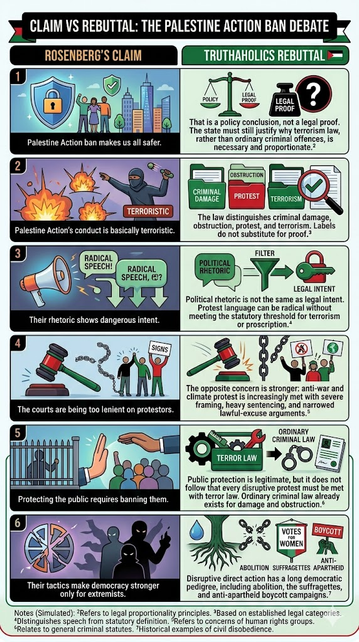
Rosenberg’s claimTRUTHAHOLICS rebuttalThe ban makes us all safer.That is a policy conclusion, not a legal proof. The state must still justify why terrorism law, rather than ordinary criminal offences, is necessary and proportionate.²Palestine Action’s conduct is basically terroristic.The law distinguishes criminal damage, obstruction, protest, and terrorism. Labels do not substitute for proof.³Their rhetoric shows dangerous intent.Political rhetoric is not the same as legal intent. Protest language can be radical without meeting the statutory threshold for terrorism or proscription.⁴The courts are being too lenient on protestors.The opposite concern is stronger: anti-war and climate protest is increasingly met with severe framing, heavy sentencing, and narrowed lawful-excuse arguments.⁵Protecting the public requires banning them.Public protection is legitimate, but it does not follow that every disruptive protest must be met with terror law. Ordinary criminal law already exists for damage and obstruction.⁶Their tactics make democracy stronger only for extremists.Disruptive direct action has a long democratic pedigree, including abolition, the suffragettes, and anti-apartheid boycott campaigns.⁷

Direct action has a democratic pedigree

Rosenberg’s article also misses a basic historical truth: direct action has always played a major role in democratic reform. The abolition of slavery did not happen because people politely waited. The suffragettes did not win votes by being “reasonable” in the narrow, state-approved sense. Trade union and civil-rights movements, too, relied on pressure, disruption, and refusal.⁶

The same is true of the campaign to isolate apartheid South Africa, where boycotts, divestment, and sanctions helped force a political reckoning. That history matters because it shows that disruptive action is not automatically anti-democratic. Sometimes it is the route by which democracy forces power to listen.⁷ The idea that protest is only acceptable when it does not disrupt anything is not a principle of freedom; it is a principle of managed dissent.⁸

The double standard

The broader argument, developed in earlier Truthaholics posts, is that the UK state increasingly punishes anti-war dissent while shielding power-aligned interests.⁹ That concern becomes sharper when compared with the way climate protest and Just Stop Oil are usually charged under ordinary offences like criminal damage or obstruction, while anti-war direct action is pushed toward the language of extremism and terror.¹⁰

That is not consistency. It is selective severity.

HRA 1998 and ECHR rights

The Human Rights Act 1998 brings Convention rights into domestic law, especially Articles 10 and 11 on expression and peaceful assembly.¹¹ Those rights are qualified, so proportionality matters. In protest cases, courts have sometimes had to ask whether conviction is a justified interference with those rights.¹²

But this is where the current doctrine is uneven. After DPP v Ziegler, Article 10 and 11 analysis matters in some protest settings, especially where the offence itself turns on obstruction and the interference is non-violent.¹³ By contrast, the Court of Appeal’s 2024 criminal-damage ruling sharply narrows the room for using beliefs, urgency, or moral importance as a lawful excuse.¹⁴

That creates a real tension. The law recognises that disruptive protest can still fall within Convention protection, but it often refuses to let that protection do any serious work where criminal damage is concerned. A serious legal system should at least admit that this is a narrowing choice, not a neutral inevitability.¹⁵

What should change

A better legal approach would not create a blanket excuse for criminal damage. It would simply stop the state from using terrorism law where ordinary criminal law is enough. It would also force the system to distinguish properly between vandalism, civil disobedience, and genuine terrorism.¹⁶

That is the real issue Rosenberg’s article avoids. It assumes the conclusion it wants to prove: that state suppression equals public safety. But the legal and moral picture is more complicated than that.

Bottom line

If the law is to remain credible, it must be able to distinguish between protest, criminal damage, and terror. Rosenberg’s article blurs those lines. The law should not.

If the law is to retain any credibility, it must stop confusing protest with terror and inconvenience with danger. Palestine Action may be controversial and unlawful, but that is not the same as terrorism. The real scandal is not that people are protesting Gaza too loudly; it is that the state is reaching for the most draconian label available to protect itself from accountability. That is not the rule of law. It is the rule of power.

When a state calls dissent “terrorism” to protect its own complicity, the problem is no longer the protest movement — it is the political system itself.

Footnotes

  • Attorney General’s Reference on a Point of Law No 1 of 2023; & Terrorism Act 2000, s 1.
  • Attorney General’s Reference on a Point of Law No 1 of 2023; & Criminal Damage Act 1971, ss 1 and 5.
  • ICJ, Application of the Convention on the Prevention and Punishment of the Crime of Genocide in the Gaza Strip (South Africa v Israel), Provisional Measures Order (26 January 2024); & ICC, Situation in the State of Palestine (21 November 2024).
  • OHCHR, ‘Arms exports to Israel must stop immediately: UN experts’ (23 February 2024).
  • Attorney General’s Reference on a Point of Law No 1 of 2023; Criminal Damage Act 1971, s 5(2)(a).
  • Truthaholics, ‘An Exploration of Arguable Routes of Appeal against the Outrageous Filton Trial Sentences & Criminalisation of Direct Action as Terrorism!’ (13 June 2026).
  • Truthaholics, ‘Drawing the Line: Why the Palestine Action Case Matters for the Future of British Dissent & Direct Action!’ (15 June 2026).
  • Truthaholics, ‘Asymmetry of UK State Impunity: Great Israeli Real Estate Event & the Constitutional Case Against Palestine Action Proscription!’ (16 June 2026).
  • Truthaholics, ‘Criminalising Direct Action? Why the UK Supreme Court Should Reverse the Court of Appeal!’ (15 June 2026).
  • The Guardian, ‘Climate protesters in England and Wales lose criminal damage defence’ (18 March 2024).
  • Human Rights Act 1998, ss 2–3, 6; & European Convention on Human Rights, arts 10, 11.
  • DPP v Ziegler UKSC 23.
  • ibid.
  • Attorney General’s Reference on a Point of Law No 1 of 2023.
  • Human Rights Act 1998, s 3;DPP v Ziegler; & Attorney General’s Reference on a Point of Law No 1 of 2023.
  • Attorney General’s Reference on a Point of Law No 1 of 2023; & Terrorism Act 2000, s 1.
  • #accountability #directAction #EthnicCleansing #freedom #Gaza #genocide #impunity #InternationalLaw #Israel #justice #landTheft #nannyState #news #Palestine #politics #warCrimes

    "A VPN ban could be on the table as part of the ongoing internet safety crackdown, which has already seen the Government announce a social media ban for under-16s.On Monday, Technology Secretary Liz Kendall announced a law change, set to be put in place by 2027, which will ban children from social media and AI chatbots as well as introduce ‘curfews’ to stop ‘doomscrolling’.

    The ban was announced in response to concerns that social media is unsafe, making children miserable, and could cause lasting damage to their mental health. On Tuesday morning, Ms Kendall hinted that further restrictions could be introduced on Virtual Private Networks (VPNs).

    VPNs have become increasingly popular in the UK since the Online Safety Act was enacted. Often used by employers to create a network to share resources, VPNs can also be used to spoof or hide your browsing location, thereby sidestepping geographical restrictions. A VPN is a system which connects somebody’s device – normally a computer or smartphone – to a server in a different location. This means that the websites that person visits cannot see their IP address.

    It is used by many people for privacy or to get around restrictions that websites place on who can visit a page. It can also be useful for allowing people to work from home and still access their workplace’s resources."

    https://www.express.co.uk/news/uk/2217934/vpn-ban-table-july-labour

    #UK #VPNs #Privacy #NannyState #Surveillance #BigBrother #AgeVerification #DigitalID

    VPN ban on table in July as Labour confirm 'further statement'

    VPNs could face restrictions following the social media ban announced on Monday.

    Daily Express
    The UK’s Teen Social Media Ban Is Political Theater, Not Child Safety Policy

    UK Prime Minister Keir Starmer is not having a particularly good time of being the UK’s leader. Basically everyone thinks he’s doing a terrible job and it seems unlikely that he’l…

    Techdirt

    ""Every failed attempt to make children safer online is followed by more surveillance and censorship," he said. "Children have rights too and these policies will harm their free expression and privacy rights, and push them into less regulated spaces. Meanwhile the business models driving harms are untouched."

    Others questioned whether the measures can realistically be enforced. Mark Jones, an online harms specialist and partner at law firm Payne Hicks Beach, noted that the consultation closed only weeks ago and warned that determined teenagers have a habit of finding ways around restrictions.

    "A social media ban only helps if it is genuinely enforceable," Jones said. "If large numbers of young people simply circumvent the restrictions, parents will just lose visibility into where their children are actually spending time online rather than reclaiming any control."

    The political case for the crackdown appears relatively straightforward, but the practical one is less so. The government now has to persuade social media companies to enforce the rules and teenagers not to find ways around them."

    https://www.theregister.com/personal-tech/2026/06/15/britain-plots-digital-bedtime-after-kicking-under-16s-off-social-media/5255341

    #UK #AgeVerification #NannyState #Surveillance #Oligopolies #Censorship #BigBrother #BigTech #Privacy #Anonymity

    Britain plots digital bedtime after kicking under-16s off social media

    UK plans to go further than Australia, while also targeting stranger contact, livestreaming, and addictive platform features

    theregister

    Given the ineptitude of Starmer and his ill considered rules on social media this made me smile immensely.

    https://diamondgeezer.blogspot.com/2026/06/new-social-media-restrictions.html

    #nannystate

    diamond geezer

    Driver Aids Have Ruined Driving: How Far Will This Go?

    https://www.youtube.com/watch?v=f-S76WEl25k

    ...an examination of the #UX of the current Toyota Prius which segues into an epic rant from #Driving4Answers which is definitely on-topic for the Surfhosting orbit.

    #Cars #UXfail #NannyTech #NannyState #Safety #Technology #Unpredictability #Control

    Deleting Humanity in the Name of Safety

    YouTube

    From ‘Living life online’ to ‘Being respectful and responsible’ https://www.bbc.co.uk/bitesize/topics/zx24xg8/articles/znv4dnb#zfbkjfr

    What better defence of the ‘Nanny State’ in support of billionaire fascist techno creeps could you possibly get?

    Let’s face it, it didn’t take bad and evil actors long to realise the internet was fertile ground for intelligence, surveillance, scamming, espionage, expropriation of resources, sex traffickers, money laundering, troll farms, bots, racketeering and spawning fascist cults, by amplifying grievance and hate towards minorities. Just to add, who have had their Nations repeatedly decimated by Empires. The argument that people are too apathetic to care or take responsibilities for their interests is perhaps the most spurious ever conceived. Nevertheless if you accept the people have been sucker punched into accepting an unbelievably diabolical shit show, it has popular support. It is possible that the fascist creeps can hold onto their cherished inequality and injustice and avoid revolution, but they are begging for it. How else to end it, the contagion of their Hydra then by giving diverse interests democratic rights? #RepublicSovereignty #PeoplePower #NannyState #EndingCorporateEvil #Foundation #Ethics #Philosophy #DialecticPrinciple
    #TheFederation #SovereignRepublics

    What does being respectful and responsible online look like? - BBC Bitesize

    Learn how to be respectful and responsible online with this KS2 primary computing guide from BBC Bitesize for years 5 and 6

    BBC Bitesize
    Again, to involve the government in culture wars is gratuitous when we consider that it is supposed to settle disputes, not pick winners and losers. The free speech-restricting FCC's attempted power grab regulating gender content surely looks like the agency playing the parent. https://reason.com/2026/05/31/the-fcc-wants-warning-labels-for-shows-with-transgender-content/
    #FCC #censorship #cultureWars #FirstAmendment #freeSpeech #LGBTQ #moralPanic #nannyState #trans
    The FCC wants warning labels for shows with 'transgender' content

    But free speech advocates are pushing back.

    Reason.com

    Deutschland: 100.000 Regeln – und niemand fühlt sich frei

    26. Mai 2026 Timo Rieg

    Immer neue Regeln sollen Konflikte lösen – und machen Demokratie zugleich komplizierter. Warum Freiheit und Gesetzgebung neu verhandelt werden müssen.

    Wer in die Freiheit eines anderen eingreifen will, muss dies mit ihm aushandeln. Es verhandeln also nur Anspruchsteller und Betroffene miteinander, so wie das im Zivilrecht üblich ist.

    Da viele Wünsche nach Eingriffen in die Freiheit anderer allgegenwärtig sind, immer wieder auftreten und deshalb wohl irgendwie zum menschlichen Zusammenleben gehören, gibt es ein schier unüberschaubares Dickicht an normativen Regeln, also Gesetzen, Verordnungen, Satzungen und dergleichen.

    Dagegen ist nichts einzuwenden - wenn zwei Voraussetzungen erfüllt sind. Ersten: Bei der grundsätzlichen Regelung waren "die Betroffenen" eingebunden und konnten ihre (abstrakte) Zustimmung unter den vereinbarten Bedingungen geben. Und zweitens: Individuell darf jeder von einer Grundsatzregel abweichen, soweit sich die Beteiligten eben auf etwas anderes verständigen können.

    Betroffene Bürger an Gesetzgebung kaum beteiligt
    Der erste Punkt wird in deutschen Gesetzgebungsverfahren zumeist durch Anhörungen in den jeweiligen Parlamentsausschüssen berücksichtigt. Potentiell Betroffene kommen dabei jedoch nicht persönlich, sondern durch Lobbyverbände zu Wort. Ob dabei alle relevanten Positionen berücksichtigt werden, ist im Einzelfall zu prüfen. Angehört werden aber auch regelmäßig Experten, die gerade nicht betroffen sind, sondern von außen auf die Regelung schauen.

    In der Schweiz ist die Beteiligung wesentlich breiter angelegt, allerdings nur bei Regelungen, die für besonders wichtig erachtet werden. Im sogenannten "Vernehmlassungsverfahren" kann sich nach Artikel 4 VlG jeder einbringen. Einen Anspruch auf Berücksichtigung gibt es freilich nicht.

    Mehrheit ist Macht – nicht unbedingt Demokratie

    Abweichung von der Norm unzulässig
    Der zweite Punkt ist meist nicht vorgesehen. Wenn individuelle Abweichungen möglich sein sollen, wird dies wiederum explizit geregelt, wie beispielsweise eine mögliche "Grunddienstbarkeit" (§ 1018 BGB). Ansonsten aber gelten staatlich oder kommunal aufgestellte Regeln abstrakt – ohne Vertragsfreiheit.

    Denkt man einmal kurz außerhalb der Dichotomie Staat auf der einen Seite, Bürger auf der anderen Seite, dann sind alle Verkehrsregeln Vereinbarungen der Betroffenen untereinander. Um nicht bei jedem Aufeinandertreffen von zwei Verkehrsteilnehmern ein individuelles Aushandeln zu verlangen (mit der oft schwierigen Frage, wer gerade eigentlich von wem etwas will), einigt man sich auf Grundlagen wie Rechts vor Links, Halt bei roter Ampel etc.

    Abstrakte Regeln gelten ausnahmslos
    Solche Regeln gelten auch, wenn niemand anwesend ist, der diese Regel für sich beanspruchen möchte. Beispiel Fußgängerampel: Zeigt sie dem Straßenverkehr Rot, muss ein Fahrzeug stehenbleiben, auch wenn weit und breit sonst niemand zugegen ist, wie das Bayerische Oberste Landesgericht (1 ObOWi 58/03) entschieden hat.

    Über solch abstrakte Regelungen hat zwar schon Kurt Tucholsky 1929 gespottet, doch die Anzahl von immer gültigen Ge- und Verboten hat sich seit seiner Zeit vervielfacht. Allein auf Bundesebene gelten derzeit etwa 100.000 Einzelnormen.

    Die trotz aller Proklamationen zum Bürokratieabbau zunehmenden Regelungen führen nicht nur zu einer praktischen Unüberschaubarkeit mit der Folge, dass sich kaum jemand sicher sein kann, stets rechtskonform zu leben, sie sind letztlich auch ein Offenbarungseid der Politik.

    Vom Speziellen zum Allgemeinen
    Denn wo immer eine neue Spezialregel gesetzt wird, zeigt sich in Wahrheit, dass eine Grundfrage nicht geklärt ist. Der richtige, nämlich an individueller Freiheit orientierte und Willkür vermeidende Weg ist stets, von Detailregelungen zu Grundregeln zu kommen. Wo dies nicht gelingt, drücken sich Gesellschaft oder wenigstens Politiker davor, den Kern zu verhandeln.

    Die zehn Gebote kamen noch mit dem einen Satz aus: Du sollst (bzw. nach dem Original eher "wirst") nicht töten. Vielleicht müsste man dem noch eine Ausnahme hinzufügen der Art: außer in Notwehr. Aber das deutsche Strafrecht unterscheidet hier zig Fallkonstellationen, und im Kriegsfalle ist ohnehin alles anders.

    Die Weigerung, sich auf nachvollziehbare Grundregeln zu verständigen, zeigt aktuell die Diskussion um weitere Detailvorgaben im Sexualstrafrecht. Von Deepfake bis "nur Ja heißt Ja" werden immer neu "Strafbarkeitslücken" ausgemacht, die weitere Einzelnormen verlangen sollen.

    Kein Ende neuer Regelungen in Sicht
    Bei diesem Weg ist klar: Gut geregelt sein wird das Land nie. Es wird immer weitere Ge- und Verbote brauchen, niemals wird der Punkt kommen, an dem Politiker (und Bürger) sagen: nun ist alles klar, Danke, mehr ist nicht zu tun.

    Was eben umgekehrt bedeuten muss: bisher sind unsere Regeln ungenügend, trotz bald 80 Jahren bundesrepublikanischem Geschraube an ihnen.

    In einer "Demokratie der Freiheit" wären also dringend große Konsultationen angesagt. Bürokratieabbau ist kein Selbstzweck, sondern die logische Folge eindeutiger und konsensfähiger Regelungen.

    Groß müssten diese Konsultationen sein, weil von Strafgesetzen alle betroffen sind. Nicht, dass sich jeder als potentiellen Straftäter sehen müsste, aber Urteile ergehen "im Namen des Volkes", mithin muss dieses Volk die entsprechenden Strafnormen grundsätzlich gefordert haben.

    Im Zivilrecht sind hingegen längst nicht alle von jeder Regelung potentiell betroffen, doch die Kreise, die miteinander zu verhandeln hätten, wären immer noch sehr groß.

    Grundeigentum und Demokratie:
    Warum wir über Boden verhandeln müssten

    Volksentscheid nicht in Sicht
    Doch solche Konsultationen sind bisher nicht vorgesehen. Die Versuche dazu mit Bürgerräten (Pro und Contra diskutiert in drei Teilen) stoßen vor allem bei Konservativen auf Ablehnung. Das Instrument des Volksentscheids gibt es auf Bundesebene in Deutschland nicht - und wird wohl auch nicht kommen (denn es stand schon in verschiedensten Wahlprogrammen).

    Und eine große zivilgesellschaftliche Debatte ist auch nicht in Sicht, zumal jede Verständigung auf einfache Grundregeln immer auch den Verzicht auf Ausnahmen zu eigenen Gunsten einschließt. Ein übermächtiger Staat wird zwar gerne kritisiert; doch sobald es um die eigenen Pfründen geht, wollen sich viele doch lieber auf eine Detailregelung der Politik berufen, als eigenständig mit dem Nachbarn zu verhandeln.

    Vorrang für lokale Regelungen
    Einen Ausweg böte eine andere Normenhierarchie, die auf den ersten Blick als Widerspruch zum Vorrang von Grundregeln vor Detailregeln gesehen werden könnte, nämlich nicht von möglichst weit oben, sondern stets von so weit wie möglich unten her etwas zu regeln.

    Aber vom Ansatz her, dass nur Anspruchsteller und Betroffene miteinander zu verhandeln haben, ist es einfacher und gerechter, lokale Unterschiede zu akzeptieren, als alles mindestens bundesweit, inzwischen ja oft EU-weit gleichermaßen vorzuschreiben.

    Das bedeutet noch nicht, dass jedes Dorf, jeder Kiez, jeder Wohnblock machen kann, was er mag, solange er sich darauf geeinigt hat. Denn wo immer Externe Betroffen sind, sind sie eben in die Aushandlung einzubeziehen. Die Rauchgase aus dem heimischen Kamin verbleiben eben nicht vor Ort - der Lärm eines Straßenfestes aber schon.

    Vielfalt ist keine Kleinstaaterei
    Den Kommunen, vor allem aber auch den Einwohnern selbst hier deutlich mehr Selbstbestimmung zuzugestehen, wäre ein fundamentaler Schritt zu mehr Freiheit. Und auf diesen überschaubaren Ebenen lassen sich Aushandlungen der Betroffenen miteinander auch relativ einfach organisieren.

    "Kleinstaaterei" wird es hier schallen. Dabei möchte doch fast jeder wenigstens hinter seiner Wohnungstür von Vorschriften, die irgendwelche Nicht-Betroffenen kraft ihres Amtes ersonnen haben oder gerade ersinnen, verschont bleiben.

    Und eine "Opt-Out"-Erlaubnis wäre ja längst keine Pflicht, überall das Rad neu zu erfinden. Aber es wäre die Chance, Demokratie als Selbstbestimmung deutlich mehr Raum zu geben.

    Quelle: https://www.telepolis.de/article/Deutschland-100-000-Regeln-und-niemand-fuehlt-sich-frei-11305862.html

    #telepolis #freiheit #regulierung #überregulierung #demokratie #nannystate #nannystatementality

    Deutschland: 100.000 Regeln – und niemand fühlt sich frei

    Immer neue Regeln sollen Konflikte lösen – und machen Demokratie zugleich komplizierter. Warum Freiheit und Gesetzgebung neu verhandelt werden müssen.

    heise online
    Just because it's a Zyn doesn't mean that it's a crime (but I'm sure the sententious moralists in power will all disagree). https://reason.com/2026/05/26/france-is-banning-zyn-and-threatening-to-jail-people-for-5-years/
    #France #harmReduction #morality #nannyState #nicotine #nicotinePouches #puns
    France is banning Zyn and threatening to jail people for 5 years

    Zyn users can be punished with up to 5 years in prison and a fine of almost half a million dollars.

    Reason.com