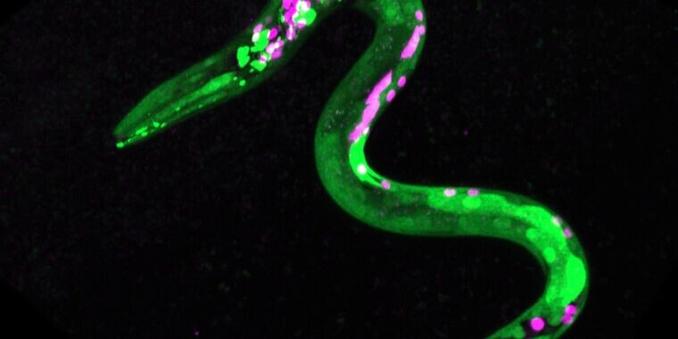
#Roundworms discovered in Great Salt Lake are new to science https://phys.org/news/2025-12-roundworms-great-salt-lake-science.html

"#Nematodes are ubiquitous on Earth... Yet none had been positively detected in #GreatSaltLake until 2022, when expeditions by kayak and bike led by Julie Jung recovered nematodes in the lake's microbialites, the lithified mounds covering parts of the lakebed... nematodes became just the 3rd metazoan taxon known to inhabit the lake's highly saline waters, the other #animals being brine #shrimp and brine #flies"

Rare #fossil embryos show early #Ecdysozoa development in #Cambrian era https://phys.org/news/2024-12-rare-fossil-embryos-early-ecdysozoa.html paper: https://www.sciencedirect.com/science/article/abs/pii/S0031018224006242

"it suggests a bag-shaped body is likely primitive for #ecdysozoans (a diverse group of #animals including #roundworms, velvet #worms, #insects, and #crabs), while a vermiform body, characteristic of crown-group ecdysozoans, evolved later."

Rare fossil embryos show early Ecdysozoa development in Cambrian era

An international research team has made a notable discovery of fossil embryos belonging to Ecdysozoa, a diverse group of animals including roundworms, velvet worms, insects, and crabs. These fossils, dated to approximately 535 million years ago, were found in the early Cambrian Kuanchuanpu biota in southern Shaanxi Province, China.

Phys.org

The Hidden World of Electrostatic Ecology https://www.quantamagazine.org/the-hidden-world-of-electrostatic-ecology-20240930/

"Invisibly to us, #insects and other tiny creatures use #StaticElectricity to travel, avoid predators, collect pollen and more... #ticks and #roundworms hitch rides on electric fields generated by larger animal hosts. In a behavior known as ballooning, #spiders take flight by extending a silk thread to catch charges in the sky... static attracts #pollen to #butterflies and #moths, and may help #caterpillars to evade predators"

The Hidden World of Electrostatic Ecology | Quanta Magazine

Invisibly to us, insects and other tiny creatures use static electricity to travel, avoid predators, collect pollen and more. New experiments explore how evolution may have influenced this phenomenon.

Quanta Magazine

Tiny #roundworms carve out unique parasitic niche inside #pseudoscorpion's protective covering https://phys.org/news/2024-06-tiny-roundworms-unique-parasitic-niche.html

Ectoparasitic nematodes developing in the integument of a Baltic amber pseudoscorpion https://www.tandfonline.com/doi/full/10.1080/08912963.2024.2341848

"In a parasitic first, a Baltic #amber specimen has revealed that millions of years ago, tiny worms known as #nematodes were living inside of and feeding on the outer protective layer of #pseudoscorpions."

Tiny roundworms carve out unique parasitic niche inside pseudoscorpion's protective covering

The early worm gets the arachnid, fossil research by an Oregon State University scientist has shown. In a parasitic first, a Baltic amber specimen has revealed that millions of years ago, tiny worms known as nematodes were living inside of and feeding on the outer protective layer of pseudoscorpions.

Phys.org

With discovery of #roundworms, Great Salt Lake's imperiled ecosystem gets more interesting
https://phys.org/news/2024-03-discovery-roundworms-great-salt-lake.html

Newly identified #nematodes from the #GreatSaltLake are associated with #microbialites and specially adapted to #hypersaline conditions: Julie Jung et al. https://royalsocietypublishing.org/doi/10.1098/rspb.2023.2653

"they discovered thousands of tiny #worms in the lake's microbialites, those reef-like structures that cover about a fifth of the lakebed."

With discovery of roundworms, Great Salt Lake's imperiled ecosystem gets more interesting

Scientists have long suspected that nematodes—commonly known as roundworms—inhabit Utah's Great Salt Lake sediments, but until recently, no one had actually recovered any there.

Phys.org

Funnel web spiders, box jellyfish, and now I read this:
https://www.theguardian.com/australia-news/2023/aug/28/live-worm-living-womans-brain-australia-depression-forgetfulness

I think I might be too scared to visit Australia!

#Australia #roundworms

‘Oh my god’: live worm found in Australian woman’s brain in world-first discovery

Woman complained of forgetfulness and depression before doctors pulled out an 8cm roundworm normally found in pythons

The Guardian

#Amber reveals #evolution of #parasitism of nematodes https://phys.org/news/2023-07-amber-reveals-evolution-parasitism-nematodes.html

Widespread mermithid nematode parasitism of Cretaceous #insects https://elifesciences.org/articles/86283

"#Nematodes (#roundworms) are distributed worldwide in almost all habitats. The #Mermithidae, a family of nematodes larger than others, are obligate #invertebrate #parasites... 16 new #mermithids associated with their #insect hosts were described, including nine new species, which triples the diversity of #Cretaceous Mermithidae"

Amber reveals evolution of parasitism of nematodes

Nematodes (roundworms) are distributed worldwide in almost all habitats. The Mermithidae, a family of nematodes larger than others, are obligate invertebrate parasites which occur in insects, millipedes, crustaceans, spiders, mollusks and earthworms. They can affect the morphology, physiology, and even the behavior of their hosts.

Phys.org
A new tool called TARDIS could help researchers build larger and more diverse populations of genetically modified #roundworms and potentially other laboratory animals. https://elifesciences.org/digests/84831/editing-the-genome-with-tardis?utm_source=mastodon&utm_medium=social&utm_campaign=organic
Editing the genome with TARDIS

A new tool called TARDIS could help researchers build larger and more diverse populations of genetically modified roundworms and potentially other laboratory animals.

eLife Sciences Publications, Ltd
Give #roundworms some weed and they’ll get the munchies, study finds
Work could further our understanding of #endocannabinoid system, help drug development.
C. elegans, also experiences the munchies when dosed with #cannabinoids, according to a new paper published in the journal Current Biology. We suspect it's not a coincidence that the paper was released on April 20.
https://arstechnica.com/science/2023/04/give-a-roundworm-some-weed-and-hell-get-the-munchies-study-finds/
Give roundworms some weed and they’ll get the munchies, study finds

Work could further our understanding of endocannabinoid system, help drug development.

Ars Technica