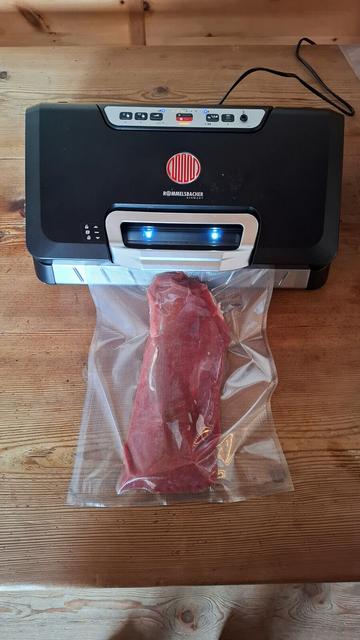
The diner smacked his lips. "This #fillet steak is marvellous." He raised his voice. "Well done, in the kitchen!"
The chef stormed out. "Idiot! Boor! It was perfectly rare."
The #MastoPrompt for Monday 28 July 2025 is:
The poem or story can include the prompt word or be about the prompt word.
@ me, if you like, or just include the #MastoPrompt tag (to allow people to follow or filter their feeds), or keep your work to yourself - all the options are good as long as you're writing.
If you're including an image please do include alt-text if you’re able to.
#Writing #SmallPoem #Poetry #Fiction #MicroFiction #SmallStories
The second step to improving the aerodynamics of the glider's external 'shark fin' antennae...add fillets to the mounting base.
This reduces interference drag.
After the low density filler cures (epoxy resin with glass microspheres mixed in), I'll sand things smooth. (The piece of wood is covered with transparent packing tape that was lightly waxed. The antennae should come off easily.)
This is a follow-on to:
https://universeodon.com/@KrajciTom/114836322219112991
#AvGeek #Aviation #ElectricAircraft #ExperimentalAviation #Homebuilt #Glider #DIY #Aerodynamics #Antenna #Fillet
The bottom 1/3 of the #columnShaft for an #IonicColumn is a perfect cylinder. So the line below point B is a straight line. In https://pixelfed.social/p/Splines/791723063470910081, we blended the bottom end of the 60° arc and the top end of the long interpolated curve between points J and K. Now blend the bottom end of the interpolated curve and the top end of the straight line between points B and C to obtain the 3rd and final #NURBS segment for the #primaryProfileCurve of the shaft. Just like there's a #cavetto and #fillet near the #neck of the shaft, there is a fillet and cavetto near the foot of the shaft. However, there is a subtle difference between the two. The cavetto near the neck is tangential to the blended #NURBS curve that is not a straight line. The profile curve for the cavetto near the foot is tangential to a straight line. There is a special name for a cavetto that is tangential to a straight line or flat surface, like the two cavetto moldings in the #dado of the #pedestal. It's called a #conge. Another alternate name for the cavetto molding is #cove, which is evocative of "cave" because of its concave profile curve. Above the neck is a fillet 8 units tall and an #astragal 16 units tall that #Scarlata puts in braces in the column shaft section within his tables of #VignolaProportions, with a note saying they are not counted as part of the shaft but are accounted for as part of the #capital. I decided to include the top fillet as part of the shaft and keep the astragal with the capital. It does not change the design or alter the proportions in any way, but the inclusion of the fillet makes it more practical for #3DPrinting and #CNCMilling of the neck. This concludes the profile curve for the shaft with a height of 291 parts or 2328 units + 8 for fillet. The column shaft is tapered in the upper 2/3 due to #entasis whose purpose is to make optical corrections to the shape of the column which, without correction, appeared concave near the top.
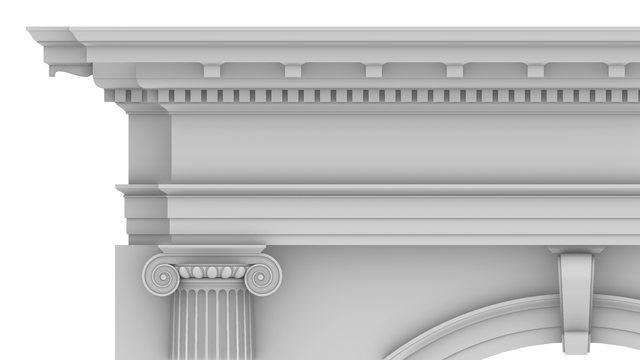
#Arch with #Ionic #Entablature and #Keystone Detail The #dentils arrangement we saw in https://pixelfed.social/p/Splines/791013152244518907 goes well with the classic entablature #profile we saw in https://pixelfed.social/p/Splines/790888454384861893, and they both go well with #simpleIntercolumniation, also known as #architravato. However, with arches, the entablature profile has to be adjusted a bit so that the dentils arrangement is as shown here. The shape, size, and gap between individual dentils remains the same, but a crucial difference is that the dentils at the #outer corners touch each other. As I mentioned in https://pixelfed.social/p/Splines/803615973439041638, in #arcadeIntercolumniation, the entablature is repeated on the wall behind the half-column. It doesn't end at the columns and has two "outside" corners and one "inside" corner. While the dentils at the outer corners touch each other, there is a single dentil in the inside corner that is shared by both walls. A bedrock principle of dentils (like that with #flutes and with eggs in the #EggsAndDarts motif) is that when viewed directly from the front or the sides, a dentil must be centered on the column axis. It is this principle that forces us to adjust the profile of the entablature in arcade intercolumniation giving us the arrangement shown here. The image also shows the detail of the decoration in front of the #keystone. The most easily recognizable component of that is the large #volute, which is the exact same size as the ones on the #capital. The smaller volute is exactly half the size of the larger one. It is mirrored, rotated and put within a bounding rectangle whose height is exactly 2µ (288 units). The channels of both volutes are bridged with #sinusoids derived from half turn of #helix curves that have been flattened. This motif in the keystone, where volutes of different sizes are combined with sinusoids is very common. It will be seen in the #modillions of the #modernEntablature.
Side View of a #Peripteral (#Sexastyle) #Colonnade with #IonicColumns arranged in #Eustyle #intercolumniation. In my previous post at https://pixelfed.social/p/Splines/803076419096100108, I mentioned that the consensus sweet spot for inter-column spacing was 2.25 diameters (4.5µ) between column shafts at the bottom (6.5µ axis-to-axis), except for the two middle columns where the spacing was 3 column diameters (8µ from axis-to-axis). This variable intercolumniation is only for #colonnades in the front and back. The spacing between columns on the sides is uniform as shown in the image here. Something worth noting in this image is the number of columns on each side. In a peripteral (sexastyle) building, there are 6 columns in the front (and back) with 5 intercolumniations between them. On the sides, it is an error to double the number of columns on the sides. Instead, the number of intercolumniations is doubled — in this case from 5 to 10, giving us 11 columns. So, the number of columns is always even in the front, and always odd on the sides (one less than twice the number of columns in the front). On the topic of even and odd, also note that the number of steps leading up to the base of the colonnade is always odd. #Vitruvious suggested keeping the rise between 9" - 12" and the run twice that, or between 18" - 24". Note that these measurements are in physical units — a marked departure from the abstract µ = 144 units we have been using all along. The rules for intercolumniation presented so far are known as #simpleIntercolumniation. When the Romans introduced #arches and combined them with #halfColumns to produce #arcades, the rules were adapted for the new design. Because the arches distributed the load from the beams above, it allowed for wider intercolumniation. With the addition of #pedestals, the gap was made even wider still, and the look of the complete edifice is just majestic! With half-columns and arches, we will see some new architectural elements.
#Braids #3StrandBraids #MulticoloredBraids To preserve the ability to print different strands in different colors when #3DPrinting, we must keep them separate. When #CNCMilling a block of wood or other material, we don't need to keep the strands separate. To accommodate both kinds of output, I suggest that you keep the strands separate until the very end, and perform a #booleanUnion at the last possible stage after making a copy of the separate strands. The topmost part of the diagram shows what the strands look like after a boolean union. Much of the internal structure is absorbed in the channel block, and overlapping parts of individual strands are eliminated. The magenta curve from https://pixelfed.social/p/Splines/798252244743520392 is also shown here. Note that the location of the red cutting planes has changed slightly — Instead of 40 units from the origin, the first cutting plane is located at 39 because I ran into another limit that we must avoid. Also, we need two blocks 120 units and 32 units long (not 24 units as was erroneously mentioned earlier). Turns out that cutting the strands at 32 units from the first cut puts us at 71 units from origin, and we run into another limit that destroys the #airtight properties of the cut solids. To get around that, we place the second cutting plane at 72 from origin to get a block 33 units long. The last cutting plane is at 159 units from origin, and when used with the first cutting plane it gives us a block 120 units long. The lower portion of the diagram shows individual strands cut using the cutting planes as described above. Depending on precision, you might or might not see a #nonmanifoldEdge on the second strand when cutting a length of 33 units. With precision set to 1/10 micron, which is ~100 times finer than current high-end #3DPrinters, I got a non-manifold edge. Sometimes the fix is easy — Just #explode the solid, and rejoin the tiny surface fragments. Experiment with different precision settings.
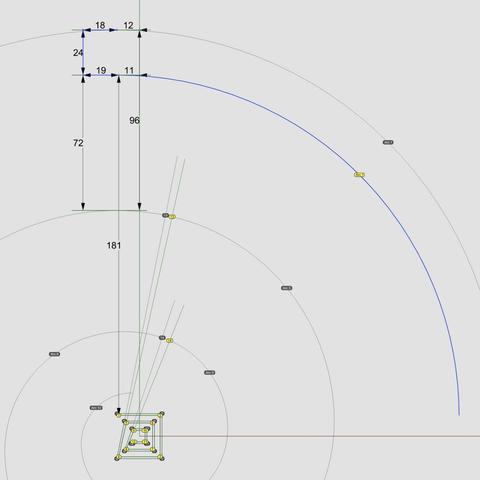
Refer to https://pixelfed.social/p/Splines/792499765146596723 for Step 1 in #IonicVolute construction. Remember that we are temporarily scaling up by 3x. Connect points 4 and 5 and extend it to a length approximately 144 units. Connect points 8 and 9 and extend to approximately 72 units. These are #transitionRays that we use to transition from one turn of the spiral to the next. The volute is constructed in discrete steps using 13 arcs numbered zero to 12 in the figure. The arcs are centered on numbered vertices of the 3 concentric squares we made in the previous post. The center for arc 1 is point 1, for arc 2 it is point 2, and so on. Point 4 is special — I call it #groundZero. It is the center for Arc Zero as well as the circle that encloses the volute. Neither the circle, nor arc zero are used in the volute, but a portion of arc zero is used in constructing the #scroll surface. You can throw away the outer circle or use it to create a #medallion around the volute in other unrelated designs. With 3x measurements, start arc 0 at ground zero, or point 4 with radius 228 and stop after 90° clockwise sweep. Start arc 1 where previous arc ended using point 1 as center and sweep clockwise 90°. Start and end arcs 2 and 3 similarly using points 2 and 3 as their centers. For arc 4, continue sweeping past 90° until it meets the first transition ray. For the 2nd turn of the spiral, start at point 5 with a radius equal to the distance between point 5 and point 13. The angles for arc 4 and arc 5 are #supplementary — They total 180°. So arc 5 ends on a horizontal axis. Continue with 90° arcs centered at points 6 and 7. For arc 8, continue sweeping past 90° until it meets the second transition ray. For the final turn of the spiral, start at point 9 with a radius equal to the distance between point 9 and point 14. The angles for arc 8 and arc 9 are #supplementary — They total 180°. So arc 9 ends on a horizontal axis. Continue with 90° arcs centered at points 10, 11, and 12.
The bottom 1/3 of the #columnShaft for an #IonicColumn is a perfect cylinder. So the line below point B is a straight line. In https://pixelfed.social/p/Splines/791723063470910081, we blended the bottom end of the 60° arc and the top end of the long interpolated curve between points J and K. Now blend the bottom end of the interpolated curve and the top end of the straight line between points B and C to obtain the 3rd and final #NURBS segment for the #primaryProfileCurve of the shaft. Just like there's a #cavetto and #fillet near the #neck of the shaft, there is a fillet and cavetto near the foot of the shaft. However, there is a subtle difference between the two. The cavetto near the neck is tangential to the blended #NURBS curve that is not a straight line. The profile curve for the cavetto near the foot is tangential to a straight line. There is a special name for a cavetto that is tangential to a straight line or flat surface, like the two cavetto moldings in the #dado of the #pedestal. It's called a #conge. Another alternate name for the cavetto molding is #cove, which is evocative of "cave" because of its concave profile curve. Above the neck is a fillet 8 units tall and an #astragal 16 units tall that #Scarlata puts in braces in the column shaft section within his tables of #VignolaProportions, with a note saying they are not counted as part of the shaft but are accounted for as part of the #capital. I decided to include the top fillet as part of the shaft and keep the astragal with the capital. It does not change the design or alter the proportions in any way, but the inclusion of the fillet makes it more practical for #3DPrinting and #CNCMilling of the neck. This concludes the profile curve for the shaft with a height of 291 parts or 2328 units + 8 for fillet. The column shaft is tapered in the upper 2/3 due to #entasis whose purpose is to make optical corrections to the shape of the column which, without correction, appeared concave near the top.