First of all, Happy New Year 2026! This year is designated in the Chinese Calendar as the Year of the Fire Horse (starting on February 17.). The year 2026 brings not only tremendous energy to AI development but also, in my humble opinion, many breakthroughs in the field. Although there have been many small steps…...
#agenticsystems #BayesianInference #LLM #PromptEngineering #rag #RightforWrongReason #VibeCoding #VLJEPA
https://foojay.io/today/jc-ai-newsletter-12/
foojay – a place for friends of OpenJDK

foojay is the place for all OpenJDK Update Release Information. Learn More.

foojay
✨ Ah, yes, the pinnacle of modern intellectual thought: a webpage that demands JavaScript and cookies before granting you the privilege of knowing how attention is like Bayesian inference. 🔐 Because nothing screams cutting-edge theory like a digital bouncer! 📊🍪
https://medium.com/@vishalmisra/attention-is-bayesian-inference-578c25db4501 #modernthought #digitalprivacy #attentiontheory #Bayesianinference #JavaScriptcookies #HackerNews #ngated

Fast Bayesian inference is great… until you’re babysitting convergence.

Alex Andorra is joined by Martin Ingram to explore DADVI a more predictable, less noisy approach to variational inference that makes trade-offs explicit instead of mysterious

🎧 https://lnkd.in/gAX2iaHz

#bayesianinference

New Bayesian method boosts quantum dot charge detection—faster, smarter quantum tech is here. #QuantumComputing #BayesianInference #NanoTech

https://geekoo.news/bayesian-breakthrough-in-quantum-dot-charge-detection/

Bayesian Breakthrough in Quantum Dot Charge Detection | Geekoo

Researchers from Tohoku University have developed a Bayesian inference-based method that vastly improves charge state detection in quantum dots, a breakthrough poised to enhance quantum computing and nanoscale sensor technologies.

Geekoo

Developing Bayesian inference methods for complex scientific problems?

#EuroSciPy2025 is seeking original work on Hamiltonian Monte Carlo, variational inference, and statistical modeling in #Python.

Submit your innovations: https://pretalx.com/euroscipy-2025/cfp #CfP

#BayesianStatistics #ScientificPython #BayesianInference #PyMC #PyStan #EuroSciPy

EuroSciPy 2025

Schedule, talks and talk submissions for EuroSciPy 2025

Weekly Update at the Open Journal of Astrophysics – 08/03/2025

Time for the weekly Saturday morning update of papers published at the Open Journal of Astrophysics. Since the last update we have published four new papers, which brings the number in Volume 8 (2025) up to 25 and the total so far published by OJAp up to 260.

In chronological order of publication, the four papers published this week, with their overlays, are as follows. You can click on the images of the overlays to make them larger should you wish to do so.

The first paper to report is “Partition function approach to non-Gaussian likelihoods: information theory and state variables for Bayesian inference” by Rebecca Maria Kuntz, Heinrich von Campe, Tobias Röspel, Maximilian Philipp Herzog, and Björn Malte Schäfer, all from the University of Heidelberg (Germany). It was published on Wednesday March 5th 2025 in the folder Cosmology and NonGalactic Astrophysics and it discusses the relationship between information theory and thermodynamics with applications to Bayesian inference in the context of cosmological data sets.


You can read the officially accepted version of this paper on arXiv here.

The second paper of the week  is “The Cosmological Population of Gamma-Ray Bursts from the Disks of Active Galactic Nuclei” by Hoyoung D. Kang & Rosalba Perna (Stony Brook), Davide Lazzati (Oregon State), and Yi-Han Wang (U. Nevada), all based in the USA. It was published on Thursday 6th March 2025 in the folder High-Energy Astrophysical Phenomena. The authors use models for GRB electromagnetic emission to simulate the cosmological occurrence and observational detectability of both long and short GRBs within AGN disks

You can find the officially accepted version of this paper on arXiv here.

The next two papers were published on Friday 7th March 2025.

The distribution of misalignment angles in multipolar planetary nebulae” by Ido Avitan and Noam Soker (Technion, Haifa, Israel) analyzes the statistics of measured misalignment angles in multipolar planetary nebulae implies a random three-dimensional angle distribution limited to <60 degrees. It is in the folder Solar and Stellar Astrophysics.

Here is the overlay:


The official published version can be found on the arXiv here.

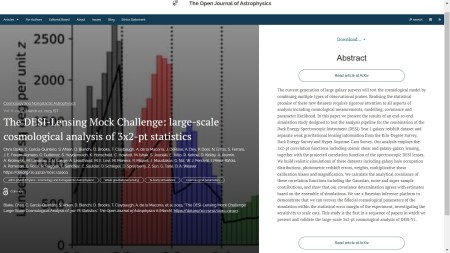
The last paper to report this week is “The DESI-Lensing Mock Challenge: large-scale cosmological analysis of 3×2-pt statistics” by Chris Blake (Swinburne, Australia) and 43 others; this is a large international collaboration and I apologize for not being able to list all the authors here!

This one is in the folder marked Cosmology and NonGalactic Astrophysics; it presents an end-to-end simulation study designed to test the analysis pipeline for the Dark Energy Spectroscopic Instrument (DESI) Year 1 galaxy redshift dataset combined with weak gravitational lensing from other surveys.

The overlay is here:


You can find the “final” version on arXiv here.

That’s all for this week. It’s good to see such an interesting variety of topics. I’ll do another update next Saturday

#3x2ptAnalysis #ActiveGalacticNuclei #arXiv241113625v2 #arXiv241212548v2 #arXiv241217714v2 #arXiv250104549v2 #BayesianInference #Cosmology #CosmologyAndNonGalacticAstrophysics #DESI #DiamondOpenAccess #DiamondOpenAccessPublishing #entropy #GammaRayBursts #HighEnergyAstrophysicalPhenomena #InformationTheory #numericalSimulations #planetaryNebulae #SolarAndStellarAstrophysics #StatisticalMechanics #WeakLensing
The Open Journal of Astrophysics

The Open Journal of Astrophysics is an arXiv overlay journal providing open access to peer-reviewed research in astrophysics and cosmology.

I'm explaining Hamiltonian Monte Carlo in my grad-level stats class tomorrow, so I put together this animation illustrating HMC in one dimension. I find it very soothing.

#bayesian #BayesianInference #posterior #stats #r #rlang #statistics #MCMC

I'm teaching my first lecture at the new job today, about probabilistic logic programming, probabilistic inference, and (weighted) model counting.

Some of the required reading is a paper (https://eccc.weizmann.ac.il/eccc-reports/2003/TR03-003/index.html) that was written by a great mentor of mine, prof. dr. Fahiem Bacchus. He passed away just over 2 years ago, and I am honoured to keep his memory alive by teaching his ideas to a new generation of students. Hope to do him proud. 🌱

Please send good vibes? 🥺

#AcademicChatter #AcademicLife #AcademicMastodon #Teaching #Probability #ProbabilisticInference #Probabilities #Logic #LogicProgramming #PropositionalModelCounting #ProbabilisticLogicProgramming #ModelCounting #PropositionalLogic #WeightedModelCounting #DPLL #BayesianProbability #BayesNets #BasianStatistics #BayesianInference #BayesianNetworks #KnowledgeCompilation #DecisionDiagrams #BinaryDecisionDiagrams

ECCC - TR03-003

Homepage of the Electronic Colloquium on Computational Complexity located at the Weizmann Institute of Science, Israel

Two New Publications at the Open Journal of Astrophysics

It’s Saturday morning again so here’s another report on activity at the  Open Journal of Astrophysics.  Since the last update we have published two more papers, taking  the count in Volume 7 (2024) up to 95 and the total published by OJAp up to 210.  We’ve still got a few in the pipeline waiting for the final versions to appear on arXiv so I expect we’ll reach the 100 mark for 2024 in the next couple of weeks.

The first paper of the most recent pair, published on October 22 2024,  and in the folder marked Astrophysics of Galaxies, is “Cloud Collision Signatures in the Central Molecular Zone”  by Rees A. Barnes and Felix D. Priestley (Cardiff University, UK) .  This paper presents an analysis of combined hydrodynamical, chemical and radiative transfer simulations of cloud collisions in the Galactic disk and Central Molecular Zone (CMZ).

Here is a screen grab of the overlay which includes the abstract:


You can click on the image of the overlay to make it larger should you wish to do so.  You can find the officially accepted version of this paper on the arXiv here.

The second paper has the title “Partition function approach to non-Gaussian likelihoods: macrocanonical partitions and replicating Markov-chains” and was published October 25th 2024. The authors are Maximilian Philipp Herzog, Heinrich von Campe, Rebecca Maria Kuntz, Lennart Röver and Björn Malte Schäfe (all of Heidelberg University, Germany). This paper, which is in  the folder marked Cosmology and NonGalactic Astrophysics, describes a method of macrocanonical sampling for Bayesian statistical inference, based on the macrocanonical partition function, with applications to cosmology.

Here is a screen grab of the overlay which includes the abstract:


You can click on the image of the overlay to make it larger should you wish to do so. You can find the officially accepted version of the paper on the arXiv here.

That concludes this week’s update. More  next week!

#arXiv231116218v3 #arXiv240721575v2 #AstrophysicsOfGalaxies #BayesianInference #CosmologyAndNonGalacticAstrophysics #likelihoods #MarkovChains #MolecularCouds #PartitionFunction #starFormation #thermodynamics

Six New Publications at the Open Journal of Astrophysics

As last week there are six papers to announce, bringing the count in Volume 7 (2024) up to 93 and the total altogether up to 208.

In the Dark

It’s Saturday morning again so here’s another report on activity at the  Open Journal of Astrophysics.  Since the last update we have published two more papers, taking  the count in Volume 7 (2024) up to 73 and the total published by OJAp up to 188.  We’ve still got a few in the pipeline waiting for the final versions to appear on arXiv so I expect we’ll reach the 200 mark fairly soon.

The first paper of the most recent pair, published on September 4th 2024,  and in the folder marked Astrophysics of Galaxies, is “Massive Black Hole Seeds”  by John Regan of the Department of Theoretical Physics at Maynooth University and Marta Volonteri (Sorbonne Université, Paris, France). This article presents a discussion of the pathways to the formation of massive black holes, including both light and heavy initial seeds.

Here is a screen grab of the overlay which includes the abstract:


You can click on the image of the overlay to make it larger should you wish to do so. Those of you who are paying attention will see that there is a bit of a glitch on the left hand side where software has thrown a line break in between the two author names. I have no idea what caused this so I raised a ticket with Scholastica and no doubt it will soon be fixed.  (Update: it is now fixed, 12th September 2024). You can find the officially accepted version of this paper on the arXiv here.

The second paper has the title “The future of cosmological likelihood-based inference: accelerated high-dimensional parameter estimation and model comparison” and was published on 5th September 2024. The authors are Davide Piras (Université de Genève), Alicja Polanska (MSSL) , Alessio Spurio Mancini (Royal Holloway, London), Matthew A. Price(UCL) & Jason D. McEwen (UCL); the latter four are all based in the UK. This paper, which is in  the folder marked Cosmology and NonGalactic Astrophysics, describes an accelerated approach to Bayesian inference in higher-dimensional settings, as required for cosmology, based on recent developments in machine learning and its underlying technology.

Here is a screen grab of the overlay which includes the abstract:


You can click on the image of the overlay to make it larger should you wish to do so. You can find the officially accepted version of the paper on the arXiv here.

That concludes this week’s update. More  next week!

https://telescoper.blog/2024/09/07/two-new-publications-at-the-open-journal-of-astrophysics-15/

#arXiv240512965v2 #AstrophysicsOfGalaxies #BayesianInference #BlackHoleSeeds #blackHoles #CosmologyAndNonGalacticAstrophysics #DiamondOpenAccess #likelihoodBasedInference #OpenJournalOfAstrophysics #TheOpenJournalOfAstrophysics

Two New Publications at the Open Journal of Astrophysics

I am back in circulation after my little break and, since it’s Saturday, I will resume blogging with another report on   Open Journal of Astrophysics.  Since the last update we have published…

In the Dark