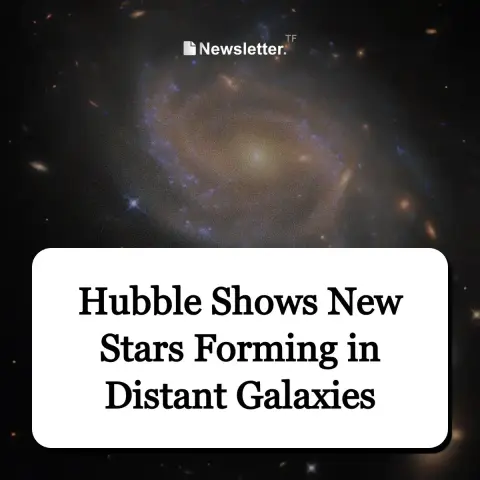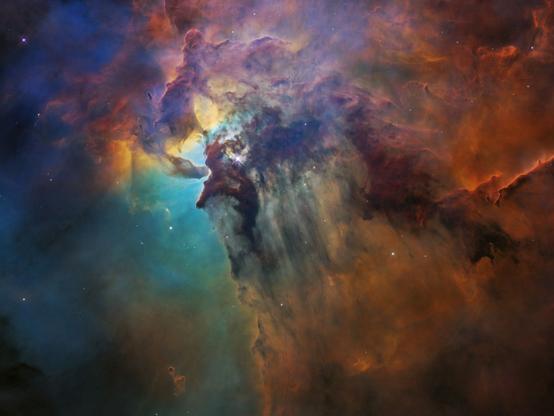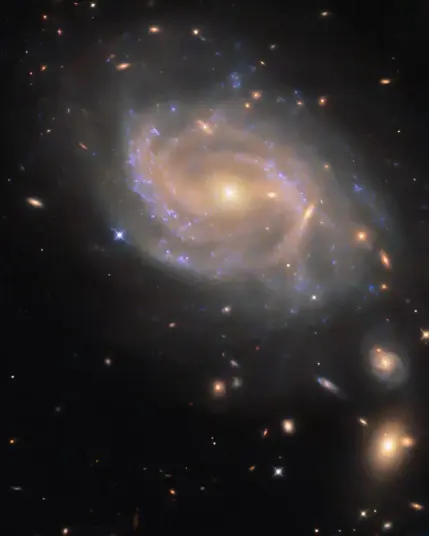
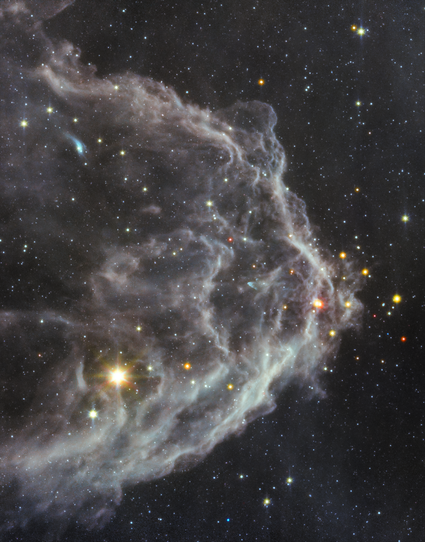
JWST plonge dans W51 et dévoile une fabrique d’étoiles comme jamais vue, un vrai rappel qu’on comprend encore mal l’univers
https://www.notebookcheck.biz/Webb-revele-des-details-uniques-sur-la-fabrique-d-etoiles-W51.1264286.0.html
#Space #Science #Innovation #Astrophysics #JWSTData #StarFormation #DeepSpace
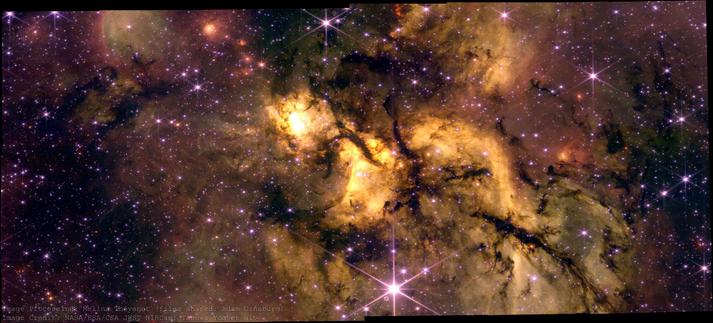
Webb révèle des détails uniques sur la fabrique d'étoiles W51

Les astronomes ont observé W51 à l'aide du télescope spatial James Webb et ont découvert de nouvelles étoiles ainsi que des détails sur leur formation. Mais d'autres études sont nécessaires pour percer tous les mystères de cette structure.

Notebookcheck

W51A with JWST NIRCam

program: 6151 https://www.stsci.edu/jwst-program-info/program/?program=6151

PI: Taehwa Yoo

FITS-files were shared with me by co-PI Adam Ginsburg

Filters: F140M, F182M, F210M

I created this image with SAO Image DS9, Photoshop Elements and G'MIC filter "banding denoise" (Authors: Ian Fergusson and David Tschumperlé)

Image is 50% original resolution. Full-resolution image (cropped) here: https://commons.wikimedia.org/wiki/File:W51A_JWST_NIRCam_(short_wavelength).jpg
#astronomy #space #starformation #jwst #stars #science

god made a mistake! a serious mistake! she should have tested this gravity thing a litte more before applying it to his cloud scenario ...

RE: https://mastodon.org.uk/@mkwadee/116267249396498270
god made a mistake! a serious mistake! she should have tested this gravity thing a litte more before applying it to her cloud scenario ...

RE: https://mastodon.org.uk/@mkwadee/116267249396498270

ALMA Maps Cold Gas Filaments in the Milky Way’s Central Region

📰 Original title: ALMA captures the most detailed image ever of the Milky Way’s turbulent core

🤖 IA: It's not clickbait ✅
👥 Usuarios: It's not clickbait ✅

View full AI summary: https://killbait.com/en/alma-maps-cold-gas-filaments-in-the-milky-ways-central-region/?redirpost=da9e1515-6cc9-4779-85aa-f5b086b4501c

#astronomy #milkyway #alma #starformation

ALMA Maps Cold Gas Filaments in the Milky Way’s Central Region

Astronomers using the Atacama Large Millimeter/submillimeter Array (ALMA) have created the most detailed image yet of the Milky Way’s central region, known as the Central Molecular Zone (CMZ).

KillBait Archive

James Webb Telescope Discovers Distant Jellyfish Galaxy with Star Formation

📰 Original title: James Webb spots a galaxy with tentacles in deep space

🤖 IA: It's not clickbait ✅
👥 Usuarios: It's not clickbait ✅

View full AI summary: https://killbait.com/en/james-webb-telescope-discovers-distant-jellyfish-galaxy-with-star-formation/?redirpost=af50d0a1-7360-45ad-bb7d-b25a804f8abb

#astronomy #jellyfishgalaxy #jwst #starformation

James Webb Telescope Discovers Distant Jellyfish Galaxy with Star Formation

Astronomers using the James Webb Space Telescope (JWST) have identified the most distant jellyfish galaxy ever observed. This galaxy, located 8.5 billion light-years away, exhibits long…

KillBait Archive

Weekly Update from the Open Journal of Astrophysics – 07/02/2026

It’s Saturday once more so time for another update of activity at the Open Journal of Astrophysics. Since the last update we have published a further six papers, bringing the number in Volume 9 (2026) to 24 and the total so far published by OJAp up to 472.

I will continue to include the posts made on our Mastodon account (on Fediscience) to encourage you to visit it. Mastodon is a really excellent service, and a more than adequate replacement for X/Twitter which nobody should be using; these announcement also show the DOI for each paper.

The first paper to report this week is “The Impact of Star Formation and Feedback Recipes on the Stellar Mass and Interstellar Medium of High-Redshift Galaxies” by Harley Katz (U. Chicago, USA), Martin P. Rey (U. Oxford, UK), Corentin Cadiou (Lund U., Sweden) Taysun Kimm (Yonsei U., Korea) and Oscar Agertz (Lund). This paper was published on Monday 2nd February 2026 in the folder Astrophysics of Galaxies. It introduces MEGATRON, a new model for galaxy formation simulations, highlighting that feedback energy controls star formation at high redshift and highlighting the importance of the interstellar medium.

The overlay is here:

You can find the officially accepted version on arXiv here and the announcement on Fediverse here:

https://fediscience.org/@OJ_Astro/116000695648050758

The second paper is “Photometric Redshifts in JWST Deep Fields: A Pixel-Based Alternative with DeepDISC” by Grant Merz (U. Illinois at Urbana-Champaign) and 6 others, all based in the USA. This paper was published on Monday February 2nd 2026 in the folder Instrumentation and Methods for Astrophysics. This paper explores the effectiveness of the DeepDISC machine learning algorithm in estimating photometric redshifts from near-infrared data, demonstrating its potential for larger image volumes and spectroscopic samples

The overlay for this one is here:

The official version of the paper can be found on arXiv here and the Fediverse announcement here:

https://fediscience.org/@OJ_Astro/116000777572439111

Next, published on Wednesday 4th February in the folder Astrophysics of Galaxies, is “Inferring Interstellar Medium Density, Temperature, and Metallicity from Turbulent H II Regions” by Larrance Xing (U. Chicago, USA), Nicholas Choustikov (U. Oxford, UK), Harley Katz (U. Chicago) and Alex J. Cameron (DAWN, Denmark). This paper argues that supersonic turbulenc affects the interpretation of H II region properties, potentially impacting inferred metallicity, ionization, and excitation from in nebular emission lines, motivating more extensive modelling.

The overlay is here:

The official version can be found on arXiv here and the Fediverse announcement is here:

https://fediscience.org/@OJ_Astro/116011384659092223

The fourth paper this week, also published on Wednesday 4th February, but in the folder Solar and Stellar Astrophysics, is “A Systematic Search for Big Dippers in ASAS-SN” by B. JoHantgen, D. M. Rowan, R. Forés-Toribio, C. S. Kochanek, & K. Z. Stanek (Ohio State University, USA), B. J. Shappee (U. Hawaii, USA), Subo Dong (Peking University), J. L. Prieto Universidad Diego Portales, Chile) and Todd A. Thompson (Ohio State). This study identifies 4 new dipper stars and 15 long-period eclipsing binary candidates using ASAS-SN light curves and multi-wavelength data, categorizing them based on their characteristics.

Here is the overlay:

The official version can be found on arXiv here and the Fediverse announcement is here:

https://fediscience.org/@OJ_Astro/116011460612040834

Fifth, and next to last this week we have “Unveiling the drivers of the Baryon Cycles with Interpretable Multi-step Machine Learning and Simulations” by Mst Shamima Khanom, Benjamin W. Keller and Javier Ignacio Saavedra Moreno (U. Memphis, USA). This paper was published on Thursday 5th February 2026 in the folder Astrophysics of Galaxies. This study uses machine learning methods to understand how galaxies lose or retain baryons, highlighting the relationship between baryon fraction and various galactic measurements.

The overlay is here:

The accepted version can be found on arXiv here, and the fediverse announcement is here:

https://fediscience.org/@OJ_Astro/116016883984380622

Finally for this week we have “The Bispectrum of Intrinsic Alignments: II. Precision Comparison Against Dark Matter Simulations” by Thomas Bakx (Utrecht U., Netherlands), Toshiki Kurita (MPA Garching, Germany), Alexander Eggemeier (U. Bonn, Germany), Nora Elisa Chisari (Utrecht) and Zvonimir Vlah (Ruđer Bošković Institute, Croatia). This paper was accepted in December, but publication got delayed by the Christmas effect so was published on February 6th 2026, in the folder Cosmology and Nongalactic Astrophysics. This study uses N-body simulations to accurately measure three-dimensional bispectra of halo intrinsic alignments and dark matter overdensities, providing a method to determine higher order shape bias parameters.

The overlay is here:

You can find the published version of the article here, and the Mastodon announcement is here:

https://fediscience.org/@OJ_Astro/116022562915557971

And that concludes this week’s update. I will do another next Saturday.

#arXiv241107282v2 #arXiv250409744v3 #arXiv250706818v3 #arXiv250719594v2 #arXiv251027032v2 #arXiv260202949v1 #ASASSN #AstridSimulations #AstrophysicsOfGalaxies #bispectrum #CosmologyAndNonGalacticAstrophysics #DEEPDisc #DiamondOpenAccess #DiamondOpenAccessPublishing #dipperStars #galaxyClusters #galaxyFormation #galaxyHaloes #HighEnergyAstrophysicalPhenomena #HIIRegions #InstrumentationAndMethodsForAstrophysics #InterstellarMedium #intrinsicAlignments #JWST #largeScaleStructureOfTheUniverse #MachineLearning #MEGATRON #NebularEmission #OpenAccess #OpenAccessPublishing #OpenJournalOfAstrophysics #PhotometricRedshifts #SolarAndStellarAstrophysics #starFormation #TheOpenJournalOfAstrophysics #Turbulence

Weekly Update from the Open Journal of Astrophysics – 31/01/2026

It’s Saturday once more so time for another update of activity at the Open Journal of Astrophysics. Since the last update we have published a further three papers, bringing the number in Volume 9 (2026) to 18 and the total so far published by OJAp up to 466.

I will continue to include the posts made on our Mastodon account (on Fediscience) to encourage you to visit it. Mastodon is a really excellent service, and a more than adequate replacement for X/Twitter which nobody should be using; these announcement also show the DOI for each paper.

The first paper to report this week is “Probing Stellar Kinematics with the Time-Asymmetric Hanbury Brown and Twiss Effect” by Lucijana Stanic (University of Zurich, Switzerland) and 13 others based in Zurich, Lausanne and Geneva (all in Switzerland). This was published on Monday 26th January 2026 in the folder Instrumentation and Methods for Astrophysics. This research demonstrates that intensity interferometry can reveal internal stellar kinematics, providing a new way to observe stellar dynamics with high time resolution.

The overlay is here:

You can find the officially accepted version on arXiv here and the announcement on Fediverse here:

https://fediscience.org/@OJ_Astro/115961234375736584

The second paper is “DIPLODOCUS I: Framework for the evaluation of relativistic transport equations with continuous forcing and discrete particle interactions” by Christopher N Everett & Garret Cotter (University of Oxford, UK). This was published on Tuesday January 27th 2026 in the folder High-Energy Astrophysical Phenomena. DIPLODOCUS is a new framework for mesoscopic modelling of astrophysical systems, using an integral formulation of relativistic transport equations and a discretisation procedure for particle distributions.

The overlay for this one is here:

The official version of the paper can be found on arXiv here and the Fediverse announcement here:

https://fediscience.org/@OJ_Astro/115966199181415094

Next, also published on Tuesday January 27th but in the folder Cosmology and Nongalactic Astrophysics we have “The Atacama Cosmology Telescope: DR6 Sunyaev-Zel’dovich Selected Galaxy Clusters Catalog” by M. Aguena et al. (101 authors altogether), on behalf of the ACT-DES-HSC Collaboration. This article reports on the discovery of 10,040 galaxy clusters in the Atacama Cosmology Telescope data, including 1,180 clusters at high redshifts, using the Sunyaev-Zel’dovich effect.

The overlay is here:

The official version can be found on arXiv here and the Fediverse announcement is here:

https://fediscience.org/@OJ_Astro/115966458299870033

And finally for this week we have a paper published yesterday, Friday 30th January 2026, in the folder Astrophysics of Galaxies. This is the paper I blogged about yesterday: “A Cosmic Miracle: A Remarkably Luminous Galaxy at zspec = 14.44 Confirmed with JWST” by Rohan Naidu (MIT Kavli Institute) and an international cast of 45 others. This article reports on the discovery by the James Webb Space Telescope (JWST) of a bright galaxy, MoM-z14, located 280 million years post-Big Bang, that challenges models of galaxy formation and the star-formation history of early galaxies.

The overlay is here:

The accepted version can be found on arXiv here, and the fediverse announcement is here:

https://fediscience.org/@OJ_Astro/115982837486159819

And that concludes the update for this week. I will do another next Saturday.

#ACTDESHSCCollaboration #arXiv250511263v2 #arXiv250721459v3 #arXiv250813296v4 #arXiv250913152v2 #AstridSimulations #AstrophysicsOfGalaxies #CosmologyAndNonGalacticAstrophysics #DiamondOpenAccess #DiamondOpenAccessPublishing #DIPLODOCUS #galaxyClusters #galaxyFormation #HanburyBrownAndTwiss #HighEnergyAstrophysicalPhenomena #InstrumentationAndMethodsForAstrophysics #JWST #largeScaleStructureOfTheUniverse #MoMZ14 #OpenAccess #OpenAccessPublishing #OpenJournalOfAstrophysics #PlasmaPhysics #relativisticTransportEquations #starFormation #StellarKinematics #SunyaevZeDovichEffect #TheOpenJournalOfAstrophysics

⭐ Every star that lights the night once faced an impossible challenge: transforming from a cold, dark cloud into nuclear fire. The universe demands precise conditions most clouds never achieve.

✍️ Discover what separates failed attempts from blazing success 🌟: https://TPC8.short.gy/WeAxAQoa

🌌 In cosmic depths, gravity whispers secrets of stellar birth

#Astrophysics #StarFormation #StellarEvolution #Astronomy #SciComm #Physics #Space #TPC8

The Cosmic Recipe: Understanding the Physical Criteria for Star Formation 🌟

Discover the 4 essential criteria for star formation: mass, temperature, pressure & hydrogen. Learn how stars are born from cosmic dust clouds.