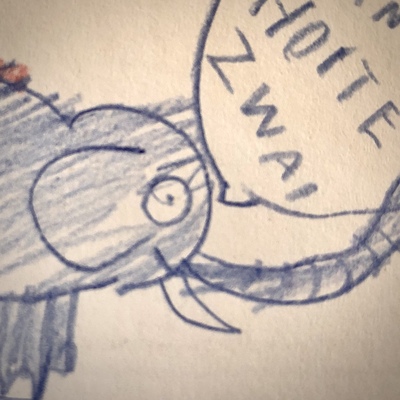
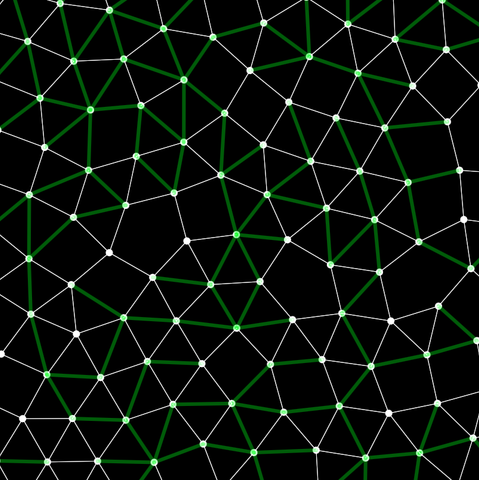
It looks like but it's no poisson distribution.
Here I developed a remesh algorithm at first in two dimensions:

Random points are moved more and more in the middle of their neighbours to avoid bulks of points (vertices) and create a base mesh that can be implemented in 3D to remesh sculpted objects.

Currently I also work on a 3D example which has not reached the state to post it.

Which remesher do you use if you work in 3D? And what could be a nice feature to implement in my algorithm?

#art #remesh #b3d #blender3d #zbrush #mastoart #fediart #noai #code #artwork #minimalism #creativecoding #random #arts #artistsonmastodon #3d #algorithm #p5js #plugin #triangle #vertices
My #Sega #Dreamcast #programming #book is divided into 4 volumes, each covering a major area of discussion. The first volume is "Foundational knowledge," stuff not strictly about the Dreamcast, but things relevant. I.e. Matrix math, or bits and bytes. So when we're talking later about bitpacking an #FPU register to transform #polygon #vertices, people aren't lost. This was one of the hardest parts of the entire book to write, but it's finally "done" and ready:

It wound up being 122 pages long.

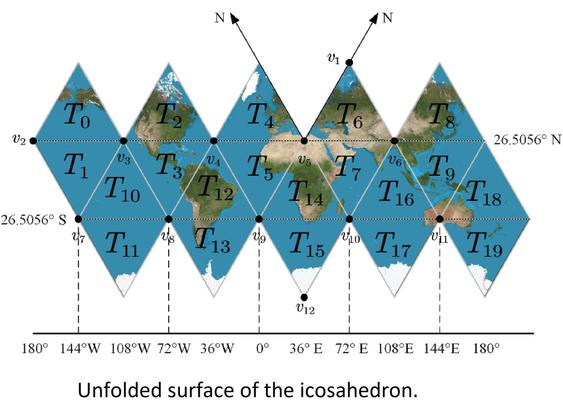
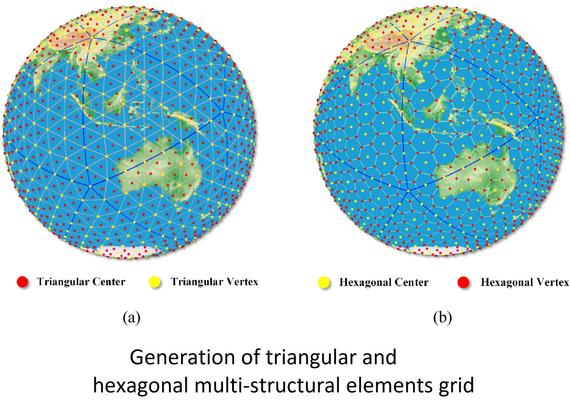
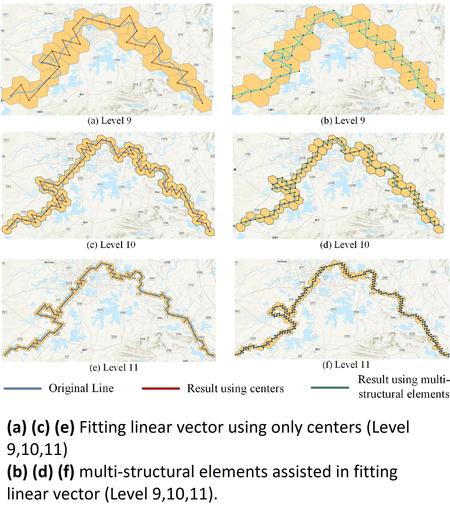
Advancing Digital Earth Modeling - Hexagonal Multi-Structural Elements In Icosahedral DGGS For Enhanced Geospatial Data Processing
--
https://doi.org/10.1016/j.envsoft.2023.105922 <-- shared paper
--
https://en.wikipedia.org/wiki/Discrete_global_grid <-- DGD wiki page
--
[the math is way over my head, hence the wiki page leak, but a good read nonetheless]
“HIGHLIGHTS:
• Hexagonal multi-structural elements enhance Earth's surface modeling precision.
• Integration of indexing and conversion rules improves geospatial data computation.
• DGGRID implementation shows increased precision in raster and vector data modeling.
• Addresses limitations in existing software for Earth observation data.
• Pioneering approach expands geospatial data processing applications…"
#GIS #spatial #mapping #DiscreteGlobalGrid #DGG #DGGS #indexing #conversion #rules #computation #Hexagonal #DGGRID #raster #vector #data #model #modeling #earthobservation #remotesensing #grid #vertices #edges #icosahedral #projections #coordinates #representation
Hi again, friends of #visual #shaders! This time, we'll finally get to a no less important function, which is responsible for modifying #vertices and subsequently deforming the entire texture that the #shader is applied to. As an example, I chose the implementation of a flag that ripples in the wind. #GodotEngine #Godot #Godot4 #GodotTips
https://www.youtube.com/watch?v=tbHwDX06AGw
Godot 4: Vertex manipulation with a visual shader (tutorial)

YouTube

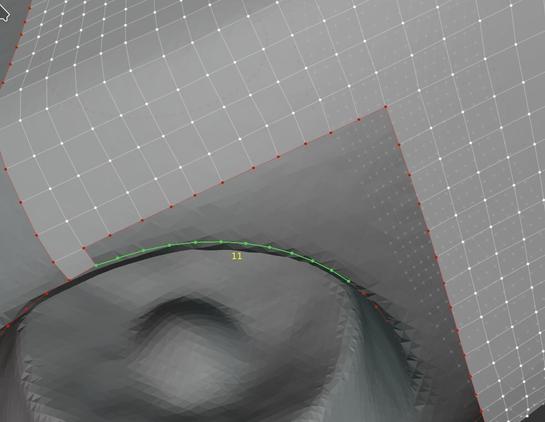
Working on retopology along the snout. Hit the length of muzzle where the valve holes go.

One objective of retopologizing is to get a lower resolution model, for the sake of optimizing the model. Do i have to add more edge loops along the horizontal? (so I can connect the circle)?

#Blender #RetopoFlow #vertices #EdgeMapping #3DModeling

#GenerativeArt #CreativeCoding #XQuery #SVG

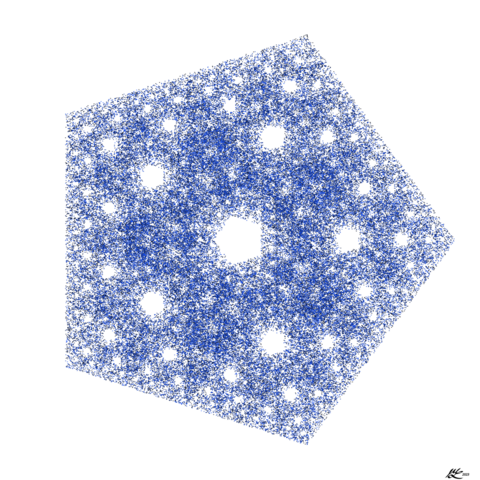
The basic chaos game uses random vertex selection, perhaps constrained (e.g."don't pick the same vertex twice in a row").

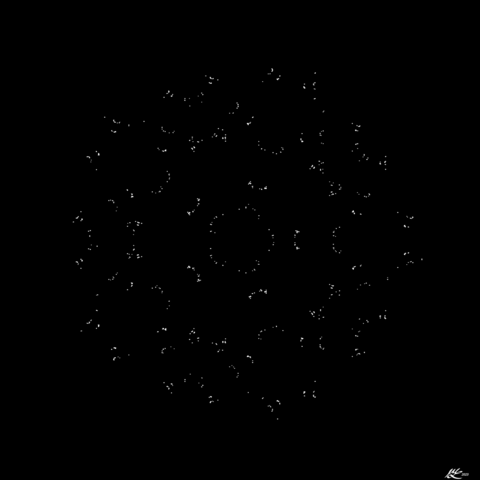
I experimented w. integer sequences of various sorts, e.g. the Fibonacci, which you take mod the #vertices. If you just use the first N numbers of this sequence repeated, and N < #points, interestingly, you only get N distinct points plotted!

1/φ, regular pentagon: inventory, Recaman

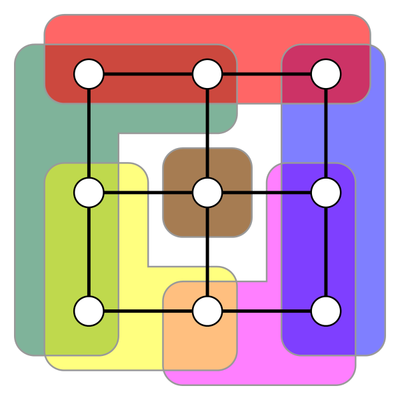
@christianp The number of trees you need for a graph is called its arboricity — see https://en.wikipedia.org/wiki/Arboricity

It always equals the maximum, over subgraphs, of #edges(subgraph)/(#vertices(subgraph)-1), and can be computed in polynomial time.

Arboricity - Wikipedia