 Chadwick Rye
BRECK: Dead Delivery — Chapter 14: The Small Thing
Daily writing prompt What’s a simple pleasure in life that brings you joy? View all responsesBRECK: Dead Delivery — Chapter Fourteen
The Small Thing
This is Chapter 14 of BRECK: Dead Delivery, a serialized noble dark fantasy story by Chadwick Rye, set in the world of Lumenvale. New chapters post daily at noon Eastern.
The Story So Far
Breck is a veteran courier — 6’5″, 285 pounds, former Crystal Wars special operations — who arrived in Crestfall on a routine delivery and found a town quietly strangled by a corrupt magistrate named Voss. He has spent twelve days building a case from the inside: a hidden ledger from a dead miller’s widow, a chalk map from a twelve-year-old boy named Pell, a gap in the patrol created by a young enforcer named Jorin. Last night he went through the unlatched side door at half past the eighth bell, retrieved the original documents from the magistrate’s storage room, and walked back out through a dark corridor where Drav was waiting. Drav stepped aside. One step. Just enough. The documents are now against Breck’s chest alongside the copy kept warm for fourteen months beside a hearthstone. Voss will discover the empty box at the second bell this morning. The north road is waiting. Breck has until then.
← Chapter Thirteen — The First Time | Chapter Fifteen — Coming Tomorrow →
Chapter Fourteen: The Small Thing
This chapter explores the simple pleasures that make a life worth living — and what it means to finally let yourself have one.
He was downstairs before Maret.
That had not happened before. In four mornings at The River’s Rest, the innkeeper had always been ahead of him — the fire already built, the bread already past its first warmth, the particular quality of a space that had been tended before he arrived in it. This morning the common room was cold and dark and entirely his own, and he stood in it for a moment with the oilskin packet and the retrieved documents against his chest and let the silence of the place settle around him.
Then he built the fire himself.
He knew how — had known since childhood, since the farm on the Lumenvale outskirts where the morning fire was the first task and the last task and the task that bracketed everything in between. You started with the coal-bed if there was one, or with kindling arranged in the particular geometry that caught and held rather than flared and failed, and you fed it with the patience of someone who understood that a fire could not be rushed into existence, only invited. He worked the hearthstone with the methodical attention he brought to most things, feeding the kindling in careful increments, watching the catch spread from one piece to the next with the unhurried satisfaction of a process unfolding correctly.
The fire took.
He sat back on his heels and watched it establish itself — the tentative early flame giving way to something more committed, more certain, the warmth beginning its slow radius outward into the cold room. There was no more purely simple pleasure than this, he thought. A fire built by your own hands in a cold room. The particular satisfaction of it had nothing to do with scale or significance. It was complete in itself — a small act done well, yielding a result you could feel against your face.
He’d thought about this more than usual in the past few days. About small pleasures. About what made a day worth the living of it, stripped of everything exceptional and left with only what remained when the exceptional was gone.
The stone house. The south-facing light. A dog.
He thought about bread, too — the specific pleasure of bread eaten when you were genuinely hungry after genuine work, the way it tasted like more than it was, the way simple food taken at the right moment carried a satisfaction that elaborate food served at the wrong one never could. He thought about the sound of rain on a roof when you were inside and dry. About the first cup of something hot in the morning, held with both hands, the warmth working its way from the palms inward.
About a bracelet made from grain stalks by small hands, given without calculation, because the giving was what there was to give.
He heard Maret on the stairs before she reached the bottom — not because she made noise, but because he had been in her building long enough to know the particular creak of the third step from the bottom and had begun, without deciding to, to listen for it.
She stopped in the doorway of the common room. Looked at the fire. Looked at him, crouched before the hearthstone with the fire built and his hands resting on his knees.
Something moved across her face — brief, private, filed away quickly in the manner of a woman who had learned to process things internally rather than display them. She came to the bar and began her morning routine without commenting on the fire or on his presence before her, which was the courtesy of someone who understood that some things were more fully honored by silence than by acknowledgment.
He took his usual stool. She put the herbs in the water without being asked.
They sat in the companionable quiet of people who had shared enough mornings to have no need to fill them.
“He’ll find the room empty at the second bell,” Breck said eventually.
“I know.”
“He’ll send for Drav before the third.”
Maret’s hands were still around her cup. “And Drav?”
Breck looked at the fire. “Drav will take his time getting there.”
She absorbed this with the particular stillness of a woman filing a piece of information that changed the shape of several other pieces she already held.
“How much time do you need?”
“I’ll be on the north road before the second bell.” He paused. “The documents go to the Regional Adjudicator in Millhaven. Three days’ ride. His jurisdiction covers river trade disputes and local governance — Voss’s operation falls squarely inside it.” He reached into the satchel’s secondary pouch and set a sealed letter on the bar. “This goes with the documents. It explains the ledger, the methodology, the collection scheme. I’ve cross-referenced the copy against the originals.” He looked at her. “I need someone to carry it.”
Maret looked at the letter. Then at him. “You trust me with that.”
It was not quite a question.
“You’ve kept this building running for twenty years under conditions that would have broken most people,” he said. “Yes.”
She picked up the letter and held it in her hands for a moment — feeling its weight, the way she felt the weight of most things before deciding what to do with them.
“There’s a grain merchant named Foswick who runs the Millhaven road twice a month,” she said. “He leaves this Friday. He owes me a considerable favor from three winters ago and has the discretion of a man who understands that discretion is a business advantage.” She set the letter on the bar with the careful placement of a decision made. “He’ll deliver it.”
Breck nodded.
The fire had fully established itself now, filling the hearth with the steady, generous warmth of something that had been properly built and was doing exactly what it was built for. The room smelled of burning oak and the herbs in his cup and the particular early-morning smell of a building that had been tended by the same hands for two decades and carried that tending in its stones.
“Sela,” he said. “The miller’s wife. She should be told before I leave.”
“I’ll go this morning.” Maret’s voice was even, but something moved underneath it — the quality of a person absorbing the full weight of what they were agreeing to do, not flinching from it. “Before the second bell.”
He looked at her across the bar, across the fire’s warmth and the steam rising from two cups and the letter between them that contained fourteen months of a dead man’s careful work.
“After this,” he said, “Crestfall will need someone to help it remember what it was.”
Maret was quiet for a moment. The fire worked. The morning pressed against the window.
“Crestfall has always known what it was,” she said finally. “It just needed someone to make it safe to say so again.”
He went upstairs one last time.
The room was as he’d kept it — spare, functional, the narrow bed made with military precision because old habits didn’t require intention to maintain themselves. He stood in the center of it for a moment, looking at the four square feet of bare floor where he’d inventoried his possessions four mornings ago, and felt the particular quality of a space that had briefly been inhabited and was already beginning the process of becoming unoccupied again.
He packed with the efficiency of a man who had been packing and unpacking in small rooms all his adult life. Everything in its place. Everything earning its weight. The oilskin copy of the ledger went back inside his shirt. The original documents went into the satchel’s document sleeve, sealed and protected. The compass. The straight-edge. The chalk, shorter now. The money pouch. The knife. The flint. The waxed cord. The tin of salve for the heel that was finally healing properly after four days of not being on the road.
He picked up the satchel and settled the strap across his chest.
Moved the bracelet from the table — where it had spent the night, beside the two documents, keeping something like company with a dead man’s handwriting — back to the strap. Wound it twice. Felt it settle in its familiar place.
Pale. Small. Saying nothing.
He thought about the fire he had just built downstairs, already doing its quiet work in the cold room without him. About a cup of hot water held with both hands. About bread at the right moment and rain on a roof and the small things that carried the weight of everything worth carrying.
About a girl who had given a man a thing made of grain stalks and roof grass because it was what she had, and because the giving was what there was to do, and because sometimes the small thing is the whole thing, and there is no larger version of it anywhere.
He picked up the satchel. Walked to the door. Stopped with his hand on the frame and looked back at the empty room once — the way he always looked back at places he’d been, not from sentiment but from the habit of a man who liked to leave places the way he’d found them, and liked to know he had.
Then he went downstairs, and Maret was still at the hearth, and he said what needed saying, and she said what needed saying, and then he walked out of The River’s Rest and into the dark pre-dawn street and turned his boots toward the north road.
Behind him, the inn’s window showed a warm rectangle of firelight against the dark.
He had built that fire.
It would keep going without him.
This is Chapter 14 of BRECK: Dead Delivery, a serialized noble dark fantasy story by Chadwick Rye, set in the world of Lumenvale. Breck is a veteran courier — a man who can’t walk past certain things — moving through a medieval world one delivery at a time. New chapters post daily at noon Eastern.
← Chapter Thirteen — The First Time | Chapter Fifteen — Coming Tomorrow →
#adventure #BRECKDeadDelivery #ChadwickRye #dailyprompt #dailyprompt2766 #DarkFantasy #EpicFantasy #fantasy #FantasyFiction #fantasyThriller #fiction #FreeFantasyFiction #freeFantasyFictionOnline #FreeStory #HighFantasy #lowFantasy #Lumenvale #nobleDarkFantasy #serializedFiction #stories #thriller #writing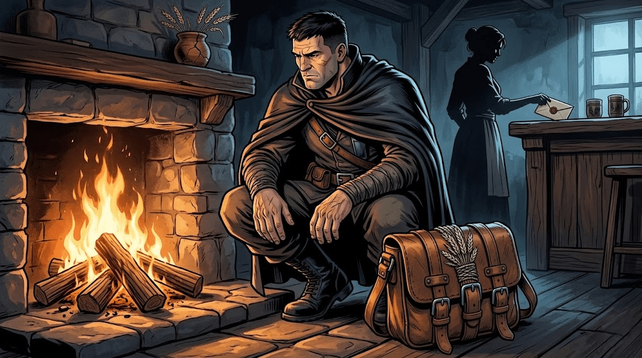
 Douglas Gantenbein
 WPS News

 Patrick W. Marsh
 Wolfgang Palloks