
BRECK: Dead Delivery — Chapter 13: The First Time

Daily writing prompt If you could erase one movie from your memory and watch it again for the first time, which one would it be? View all responses

BRECK: Dead Delivery — Chapter Thirteen

The First Time

This is Chapter 13 of BRECK: Dead Delivery, a serialized noble dark fantasy story written by Chadwick Rye, set in the world of Lumenvale. BRECK follows Breck, a veteran courier and former Crystal Wars special operations soldier, as he moves through a medieval world one delivery at a time — and can’t always walk away from what he finds. New chapters post daily at noon Eastern on chadwickrye.wordpress.com.

The Story So Far

Breck is a veteran courier — 6’5″, 285 pounds, former Crystal Wars special operations — who arrived in Crestfall on a routine delivery and found a town quietly strangled by a corrupt magistrate named Voss. Over twelve days he has built a case from the inside out: the hidden ledger kept by a dead miller’s widow, the chalk map drawn by a twelve-year-old boy named Pell who has been watching this town come apart from a cooperage step, the gap in the magistrate’s patrol created by a young enforcer named Jorin who moved his post eight feet west every night for four months on the silent hope it would matter. Last night, Breck dismantled Pelk — Voss’s collection enforcer — in four seconds in an alley behind the granary. This morning, Drav sat two stools down at the inn bar and asked which side of the war Breck had been on. Breck told him. Tonight, the side door is unlatched. Tonight, the gap opens between the eighth bell and the ninth. Tonight, everything Breck has been building comes due.

← Chapter Twelve — The Learning Curve | Chapter Fourteen — Coming Tomorrow →

Chapter Thirteen: The First Time

This chapter explores what it feels like to see something for the first time — and what it costs when you can’t go back.

Chapter 13 Summary: Breck executes the plan that twelve days of groundwork made possible — slipping through the unlatched side door of the civic building between the eighth and ninth bells, retrieving the original documents stolen from miller Aldric Moss fourteen months ago, and exiting the way he came. In the corridor of the inn, he finds Drav waiting. They say almost nothing. Drav steps aside. Breck goes upstairs with the documents and the evidence he has been carrying, and counts the ninth bell.

He went in through the side door at half past the eighth bell.

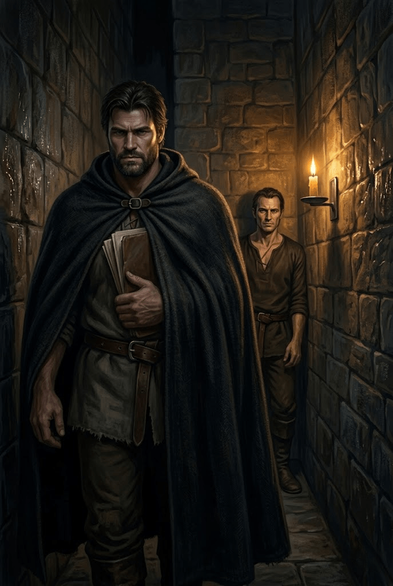
Maret had left it unlatched exactly as he’d asked — the hinges oiled at some point in the recent past, because they made no sound, which was either coincidence or the innkeeper’s particular brand of thorough preparation, and Breck suspected coincidence had very little to do with how Maret ran her building. He eased the door open the width of his shoulders — considerable — and stepped into the narrow service corridor that ran between the inn’s rear wall and the magistrate’s stable yard next door.

The corridor smelled of horse and wet straw and the particular cold that collected in spaces between buildings, the cold that had nowhere to go and simply accumulated. A single tallow stub burned in a tin holder on a wall bracket, throwing just enough light to move by and not enough to be seen from either end of the corridor. He stood still for thirty seconds, listening to the night.

Crestfall at the eighth bell had its own specific silence — not the silence of an empty place but the silence of a populated place that had learned to hold its breath on schedule. The market square would be clear. The few remaining vendors who hadn’t packed before the third bell would have packed before the sixth. The streets would hold nothing but the magistrate’s men on their routes and the particular quality of dark that accumulated in a town that had learned not to put lights in windows after sundown if it could be helped.

He moved down the corridor toward the stable yard.

Jorin’s gap ran from the eighth bell to the ninth on the west face of the magistrate’s building — a forty-foot section of wall where the coverage went thin because Jorin had been moving his patrol point eight feet west over the course of four months, one measured increment at a time, building the gap so gradually that no one with oversight responsibility had noticed the pattern. Breck had stood across from that wall in daylight and in rain and had counted the windows and the distances between them and had built the picture of what lay inside from the outside in, the way he’d always built pictures during the war.

Three rooms on the ground floor facing the stable yard. The leftmost would be the clerk’s office — he’d confirmed this from the shadow pattern through the shutters during business hours, the particular stillness of a room occupied by someone who sat at a desk. The middle room was storage — the shadow pattern showed no movement and the smell coming through the gap in the shutters on his third observation pass had been the dry, papery smell of documents and sealed boxes. The rightmost would be Voss’s private office — the room with the heaviest shutters, the room that showed light longest into the evening, the room from which a thin thread of pipe smoke drifted at the end of the working day, suggesting a man who sat with his accounts after the clerks had gone.

It was the middle room he wanted.

Not because of what was there now. Because of what had been put there fourteen months ago — documents taken from a miller’s office in the night along with his correspondence and a deed to river land his father had left him, taken and filed away in the place where taken things went in a town run by a man like Voss. Aldric Moss had been careful enough to make a copy. Breck had that copy against his ribs in the oilskin packet. But the originals would have more weight with whatever authority came after this — and Breck intended there to be an authority that came after this.

The storage room window had a single iron latch that he’d felt through the gap in the shutters on his second observation pass, running his fingers along it in the dark with the particular careful attention of a blind man reading. Standard construction. Nothing complicated. The kind of latch that had been adequate for fourteen years and had never been asked to be more than adequate.

He asked it to be more than adequate now.

It held for approximately three seconds.

The room was exactly what the shadow pattern and the smell had suggested — shelves along three walls, floor to ceiling, carrying the accumulated administrative weight of Voss’s three years in office. Ledger books. Correspondence boxes, each labeled in the neat hand of the clerk who’d processed them. Rolled documents in wooden tubes, sealed and dated. The particular archaeology of a corrupt administration, layered like sediment, oldest at the bottom and working toward the present.

He didn’t light a candle. He worked by the thin thread of the tallow stub’s light through the open window, and by the older light of his own spatial memory, which was a map he’d built of this room from the outside and was now confirming from the inside. They matched. They generally did, if you paid the right kind of attention.

He found what he was looking for in the third box on the second shelf from the bottom, where documents from fourteen months prior had been filed in the methodical, chronological order of a clerk who had no particular feelings about what he was archiving and was simply doing the work. A miller’s license. A deed to river land. A bound collection of correspondence in a hand he recognized from the oilskin packet against his ribs — the same neat, architectural handwriting, the same careful precision of a man who had understood exactly what he was building.

Aldric Moss had been thorough in everything.

Breck placed the documents inside his cloak, against his chest, alongside the copy that had been kept warm beside a hearthstone for fourteen months by a woman who had learned to hope in very small, very careful amounts. Then he stood still for a moment in the dark room, among the filed evidence of three years of quiet theft, and let the weight of it settle.

The first time he’d broken into an enemy position — a Karithian supply cache, second year of the Crystal Wars, a river crossing that had taken three attempts to cross — he had felt afterward something he hadn’t expected and hadn’t been able to name until much later. Not triumph. Not relief. Something more like the specific grief of a man who has seen, for the first time, clearly, the shape of what he is capable of — and understands that having seen it, he can never quite see himself the previous way again.

He felt something adjacent to that now.

Not grief exactly. But the awareness of a threshold crossed. The documents in Aldric Moss’s hand, filed in a box labeled with the date of a night when three men had come and taken them along with the miller himself — those documents existed now in a different place than they had existed this morning. The case had been built. The copy was the argument. The originals were the proof.

Whatever came next, this had happened. That was the nature of certain kinds of action. They existed in the past tense from the moment they were completed, permanent and unalterable, the way a thing seen for the first time could not be unseen.

He crossed back to the window. Eased it open. Stepped out into the corridor and pulled it closed behind him, feeling the latch seat itself back in its frame with a small, final sound.

He heard Drav before he saw him.

Not because Drav made a sound — he didn’t. Because the quality of the silence at the far end of the corridor changed in the specific way that silence changed when it was occupied by someone who had learned, the same way Breck had learned, not to announce themselves.

Breck stopped.

The corridor held them both, twenty feet apart, in the thin light of the tallow stub. Drav stood at the corridor’s entrance to the stable yard, in the plain dark clothing he always wore, his hands at his sides. The scar caught the faint light. His expression was the expression he’d had at the bar that morning — old and complicated and stripped of everything that wasn’t strictly necessary.

He looked at the shape of Breck’s cloak. At the place where it sat differently than it had on any previous day — the bulk of documents against his chest, invisible but present.

He didn’t say anything.

Breck didn’t say anything.

The tallow stub burned its patient fraction lower. Somewhere in the stable yard a horse shifted its weight and blew through its nose in the mild, unconcerned way of animals uninvested in human complications.

Then Drav stepped aside.

Not a wide step. Just enough. The corridor was adequate for a large man to pass if both parties were willing to be in it simultaneously without incident. Drav’s positioning made it clear that he was willing.

Breck walked past him.

At the corridor’s end, at the door that opened back into the inn’s rear passage, he stopped without turning around.

“The north road,” Drav said quietly, from behind him. His voice was the same as it had been at the bar. Low. Stripped. “Tomorrow morning. Before the bells.”

“I know,” Breck said.

“He’ll know by the second bell. When the clerk opens the room.”

“I know that too.”

A pause that contained several things that neither of them was going to say.

“Drav,” Breck said.

“Don’t.”

He didn’t. He opened the door and stepped back into the warmth of the inn, and the door closed behind him, and in the corridor Drav stood alone in the thin tallow light for a moment before the silence resettled over everything.

Breck went upstairs. Set the documents on the table beside the oilskin packet and looked at them together in the candlelight — the copy and the originals, the evidence kept in hope and the evidence filed in certainty, reunited after fourteen months in the dark.

He sat on the edge of the bed and looked at them for a long time.

Then he moved the bracelet from his wrist to the satchel strap, the nighttime version of the habit, and lay down on the narrow bed and stared at the ceiling and thought about a man seeing something clearly for the first time, and the specific irreversibility of that.

Outside, the ninth bell rang across Crestfall’s quiet rooftops.

Right on schedule.

BRECK: Dead Delivery is a serialized noble dark fantasy story written by Chadwick Rye, published free on chadwickrye.wordpress.com. Set in the world of Lumenvale, it follows Breck — a veteran courier and former Crystal Wars special operations soldier — as he moves through a medieval world one delivery at a time, and can’t always walk past what he finds. New chapters post daily at noon Eastern. Chapter 13: The First Time — Breck retrieves stolen documents from the magistrate’s archive and crosses paths with Drav in the corridor.

← Chapter Twelve — The Learning Curve | Chapter Fourteen — Coming Tomorrow →

#adventure #books #BRECKDeadDelivery #ChadwickRye #dailyprompt #dailyprompt2765 #DarkFantasy #EpicFantasy #fantasy #FantasyFiction #fantasyThriller #fiction #FreeFantasyFiction #freeFantasyFictionOnline #FreeStory #lowFantasy #Lumenvale #nobleDarkFantasy #serializedFantasy #shortStory #thriller #writing
Wings Unfurled — A Lumenvale Story

The chains lay coiled at Lysander’s feet like dead serpents, their iron links catching the dawn light that filtered through the high windows of the tower chamber. Seven years they had bound his wrists and ankles, their weight as familiar as his own heartbeat. Now they rested on the smooth stone floor, inert and powerless, while he stood unencumbered for the first time since his sixteenth naming day.

“You may go wherever you wish,” Archmagister Thorne said, her voice a controlled melody that betrayed nothing of what she might feel about his release. “The gates of the Academy will open for you, as will the archives and garden labyrinths that were previously forbidden. Your sentence is complete.”

Lysander flexed his fingers, feeling the absence of weight more profoundly than he had ever felt its presence. The enchanted manacles had permitted him to perform the necessary gestures for basic spellcraft while preventing the channeling of power beyond strictly regulated parameters. Now, magic coursed through his veins like springwater finding new channels after a winter thaw—unfamiliar in its abundance, almost frightening in its potential.

“And if I wished to leave Lumenvale entirely?” he asked, the question emerging unbidden from some deep place he hadn’t known existed within himself.

The Archmagister’s face remained impassive, though something flickered in the depths of her amber eyes—concern, perhaps, or simple curiosity. “That too is your right. Though I would counsel patience. Freedom long-constrained can be as disorienting as sudden blindness might be to one who has always seen.”

She gestured toward the eastern wall where his few possessions had been arranged: clothing that no longer fit his frame, books he had read until their spines had cracked, a small wooden box containing the only remnants of his life before imprisonment. “Take the day to consider your path. The world beyond these walls has changed in ways you cannot anticipate.”

With that cryptic warning, she departed, her indigo robes whispering against ancient stone as the heavy oak door closed behind her. Lysander stood motionless in the sudden solitude, paralyzed not by restriction but by its absence. The entirety of existence lay open before him, a vast, unmapped territory after years confined to carefully delineated spaces and rigorously controlled interactions.

Seven years ago, he had been a willful, reckless apprentice who believed freedom meant acting without consideration of consequence—channeling forbidden magics simply because he could, breaking boundaries established by generations of practitioners who understood what he did not: that power unconstrained destroys its wielder as surely as anything it touches. The fire that had engulfed the western library and claimed the lives of two elder mages had not been intentional, but intention meant little against outcome.

Now, at twenty-three, he stood on the threshold of a liberty he no longer knew how to inhabit.

Sunlight inched across the floor as morning deepened, the pattern of light and shadow marking time with the same inexorable rhythm that had structured his days of confinement. Lysander moved to the narrow window and pressed his palms against the cool glass, a barrier he had never been permitted to touch, let alone pass through. Beyond lay the sprawling Academy grounds—emerald gardens where white-robed novices gathered in clusters of animated discussion, ancient oak trees beneath which masters taught small circles of advanced students, cobblestone paths winding between buildings whose architecture spanned twelve centuries of magical tradition.

And beyond that, the city of Silverkeep spread like an intricate tapestry beneath the mountain that housed the Academy: thousands of lives intertwined in patterns he could barely comprehend after years of isolation. Markets and taverns, guildhalls and theaters, docks where ships arrived bearing goods and stories from realms he had only read about in the limited texts permitted during his confinement.

What did freedom mean now, when its very concept had transformed from something he had taken for granted into an almost sacred state, at once tantalizing and terrifying?

The question accompanied him as he finally stirred himself to action, exchanging his prisoner’s gray tunic for one of deep blue that had been provided—a scholar’s garment, neither novice white nor master’s indigo, but something between. The fabric felt impossibly soft against skin accustomed to coarse cloth, another small liberty that threatened to overwhelm his senses.

Begin simply, he told himself, a phrase his first mentor had repeated during early lessons in elemental manipulation. Complexity builds from mastered foundations.

And so he began with a single step beyond the chamber that had been both prison and sanctuary. The stone corridor stretched before him, no longer bounded by the invisible barriers that had limited his movements to specific paths at appointed times. He could turn left toward the great library, right toward the meditation gardens, or continue straight to the grand staircase that descended to the Academy’s main halls. No guard watched his choice; no hidden ward monitored his passage.

He chose the gardens.

The air changed as he emerged from the tower’s confined atmosphere—not just fresher but alive with scents his memory had preserved but diluted over years of absence: jasmine and cedar, fresh-turned earth and sun-warmed stone. Spring had painted the formal beds with colors so vibrant they almost hurt his eyes after years of muted grays and browns. White blooms like fallen stars nestled among emerald foliage; crimson blossoms reached toward the sky with the intensity of flame.

A small gray bird alighted on the path before him, head tilted in curious assessment before it resumed pecking at something invisible between the cobblestones. The creature’s perfect liberty—its ability to come and go, to rise above walls and barriers with a simple movement of wings—struck Lysander with unexpected poignancy.

“Remarkable, isn’t it?” came a voice from behind him, startling in its proximity. “How they never recognize the freedom they possess.”

He turned to find a woman seated on a stone bench half-hidden by a flowering quince. Her hair fell in silver waves despite a face too young for such coloring, and her eyes—a particular shade of violet rare among Lumenvale’s population—regarded him with undisguised interest. Not a student, given her age and the absence of Academy garb, nor any master he recognized.

“Forgive me,” she continued when he failed to respond. “I’ve intruded on what must be a significant moment. First taste of open air without supervision?”

The accuracy of her assessment unnerved him. “How did you—”

“The way you’re breathing,” she explained, rising from the bench with fluid grace. “Like someone surfacing after too long underwater. And the look in your eyes—cataloging everything as both familiar and strange simultaneously.” She extended a hand in formal greeting. “Lysira Nightsong, Keeper of Records for the Council of Nine.”

The name registered immediately—one of the most powerful political positions in Silverkeep, responsible for maintaining the historical and legal archives that governed relations between magical practitioners and mundane society. That such a person would be present on his first day of freedom seemed beyond coincidence.

“Your release was discussed at some length,” she acknowledged, confirming his suspicion. “Some believed the traditional seven-year binding insufficient for the particular nature of your… indiscretion.”

“And you?” he found himself asking. “What did you believe?”

She considered him with those unsettling violet eyes that seemed to perceive layers beneath his visible self. “I believe that freedom without understanding is merely the opportunity to make new mistakes rather than repeat old ones.” She gestured to the path ahead. “Walk with me, Lysander Thorne. The gardens extend farther than they did during your apprenticeship.”

He fell into step beside her, noting that she had used his full name—acknowledging his relation to the Archmagister despite the estrangement that had preceded his crime. They followed winding paths through sections of the garden he remembered and others entirely new: a meditation labyrinth of silver-leafed herbs, a pool where water flowed upward in defiance of natural law, a grove of trees whose trunks had been shaped over decades to form living archways.

“The Council requires assurance that your understanding of power and its responsible application has matured,” Lysira continued as they walked. “Seven years of restriction may have taught discipline, but has it taught wisdom?”

“And you’ve been assigned to make that determination?” Lysander asked, unable to entirely keep bitterness from his tone.

Her laughter surprised him—genuine amusement rather than the condescension he had anticipated. “I volunteered. Your case interests me particularly.”

“Because of my relation to the Archmagister?”

“Because of what you represent,” she corrected. “A gifted practitioner whose abilities exceeded his judgment. The most dangerous combination in our profession, and unfortunately, not uncommon.”

They paused beneath an ancient oak whose branches had been trained to create a living ceiling, leaves rustling in patterns that seemed almost deliberate, as though the tree itself participated in their conversation. Filtered sunlight dappled the ground in ever-changing constellations of light and shadow.

“What does freedom mean to you, Lysander?” Lysira asked, the direct question catching him unprepared. “Not as an abstract concept, but as you understand it now, having experienced its absence?”

The question echoed his own internal deliberations so precisely that he wondered momentarily if she possessed mind-reading abilities—not impossible for someone of her rank, though generally considered an unconscionable invasion of privacy.

“I don’t know,” he admitted, finding unexpected relief in acknowledging his uncertainty. “Before my sentencing, I would have said freedom meant doing whatever I wished, constrained only by the limits of my ability. Now…”

He trailed off, attention caught by a golden butterfly that had alighted on a nearby flowering bush. Its wings opened and closed with languid precision, each movement revealing intricate patterns that shifted with the changing angle of light.

“Now I suspect freedom might be more complex than the absence of constraint,” he continued, watching as the butterfly rose on an invisible current of air, its path appearing random yet somehow purposeful. “Perhaps it involves understanding the natural boundaries that exist regardless of external restriction—the limits inherent in being human, in being part of an interconnected system.”

Lysira nodded, her expression revealing nothing of whether she found his answer satisfactory. “An interesting evolution of thought. Though still theoretical. You’ve had seven years to contemplate such philosophical distinctions while bound by enchanted iron. The true test comes with choice and consequence.”

“You don’t believe people can change through reflection alone?” he challenged.

“I believe reflection provides the map, but the journey must still be walked.” She gestured toward the path ahead, which divided into three distinct routes. “Speaking of journeys and choices—one path leads to the Academy’s main hall, another to the outer gates, and the third to a section of garden few students ever discover. Which would you choose?”

Lysander studied the diverging paths, aware that this seemingly casual question likely carried significant weight in her assessment. The main hall represented reintegration into the academic community he had damaged through his actions. The gates offered immediate escape from an environment that still held painful memories. The third unknown path…

“The unexplored garden,” he decided, surprising himself with the certainty of his choice.

Lysira’s expression remained neutral, though a subtle shift in her posture suggested approval. “Then let us see what awaits us there.”

The third path narrowed as they followed it, stone giving way to packed earth, formal beds yielding to what appeared to be deliberate wildness—an orchestrated chaos of growth that mimicked natural patterns while subtly guiding the visitor’s experience. Flowers he had never encountered in any botanical text grew alongside common dandelions. Massive trees with luminescent bark stood sentinel over delicate ferns that quivered with each passing breeze.

They emerged into a circular clearing where seven stone benches surrounded a pool of water so still it perfectly mirrored the sky above. At the pool’s center stood a sculpture unlike any Lysander had seen within the Academy’s grounds—a human figure neither male nor female, its form composed of thousands of tiny metal links forged into the semblance of flesh. Though motionless, the sculpture conveyed such a powerful sense of movement that it seemed about to step from its pedestal into the waiting water.

“The Bound One Who Walks,” Lysira said, naming the artwork that had captured his attention. “Created by Magister Elindra three centuries ago, after her own period of restriction for forbidden research into time manipulation.”

Lysander approached the pool’s edge, studying the figure’s face—serene despite the chains that both formed and constrained it. “It’s beautiful,” he said. “And disturbing.”

“As the best art should be,” Lysira agreed, joining him at the water’s edge. “Elindra created it after her release, when she discovered something unexpected about the nature of constraint and liberation.”

“What did she discover?”

“That she had never been truly free before her binding,” Lysira replied. “Because she had been enslaved by her own unexamined impulses, by the tyranny of momentary desire over considered choice.”

The water before them rippled suddenly, though no wind disturbed the clearing’s perfect stillness. The sculpture’s reflection fragmented into thousands of individual components—no longer a cohesive figure but a collection of separate links that somehow retained the suggestion of its original form.

“Freedom isn’t the absence of boundaries,” Lysira continued, her voice taking on the quality of formal instruction. “It’s the conscious navigation of necessary limitations—those imposed by natural law, by ethical consideration, by the legitimate needs of the communities in which we exist.”

Lysander knelt beside the pool, compelled by some instinct to touch its surface. As his fingers broke the water’s plane, the dispersed reflection of the sculpture began to reassemble, individual links reconnecting to form a new configuration—still recognizably the same figure, but with subtle alterations that suggested movement, progress, evolution.

“The true prisoner,” Lysira said softly, “is not the one bound by considered restriction, but the one who never questions the chains they forge for themselves through habitual action and unconsidered choice.”

The water stilled again, the sculpture’s reflection once more intact but somehow transformed by the momentary disintegration and reassembly. Lysander withdrew his hand, watching as droplets fell from his fingertips back into the pool, each creating concentric rings that expanded outward before gradually fading.

“I believed my sentence was about punishment,” he said, the realization crystallizing as he spoke. “Perhaps it was actually about education.”

For the first time, Lysira smiled—a genuine expression that transformed her serious countenance. “Now that,” she said, “is the beginning of wisdom.”

They remained by the pool as afternoon light gilded the clearing, speaking of smaller things—changes to the Academy curriculum during his absence, political developments in Silverkeep, advancements in theoretical approaches to elemental manipulation. Ordinary conversation that nonetheless represented a kind of freedom he had been denied for seven years: the liberty to exchange ideas beyond the strict confines of his restricted studies.

As shadows lengthened across the garden, Lysira rose from the stone bench they had shared. “The day grows late, and you have much to reacquaint yourself with. I’ve taken enough of your first hours of freedom.”

“You haven’t answered one question,” Lysander said, remaining seated. “Will you report to the Council that I’m fit to practice magic without restriction?”

She considered him thoughtfully. “I will report that you’ve begun a journey of understanding, the outcome of which remains to be determined. Freedom isn’t granted in a single moment, Lysander Thorne. It’s earned through continuous demonstration of the wisdom to wield it responsibly.”

With that ambiguous assessment, she departed along the same path they had entered, leaving him alone with the statue and its perfect reflection. As twilight descended, small lights awakened throughout the garden—bioluminescent plants responding to darkness with their own subtle illumination. The statue caught this gentle radiance, the metal links that formed its body appearing to shift and flow though no actual movement occurred.

What did freedom mean to him now? The question that had paralyzed him that morning had transformed, much as the statue’s reflection had changed after his touch disturbed the water’s surface. No longer a binary state of constraint versus liberation, but a continuous process of choosing within the context of natural limitation and ethical consideration.

True freedom, perhaps, lay not in the absence of boundaries but in the conscious recognition of which boundaries served legitimate purpose and which existed merely as artifacts of fear or unexamined tradition. Not unlike magic itself—most powerful when channeled through deliberate forms rather than released as raw, undirected energy.

As stars appeared in the darkening sky above, mirrored in the pool’s still surface, Lysander rose and began the walk back toward the Academy’s main buildings. Tomorrow would bring new choices, new opportunities to navigate the complex territory between license and restraint. For tonight, he carried with him the image of the Bound One Who Walks—a being composed of constraint yet embodying movement, progress, possibility.

Perhaps freedom, like the statue, was both journey and destination simultaneously—a continuous becoming rather than a fixed state of being. And perhaps, after seven years of enforced stillness, he was finally ready to begin that journey in earnest.

If you loved this story then please consider subscribing to my newsletter. In doing so you ensure that you will never miss any of my stories that i post daily. Please leave a comment about your favorite part. Or you can support my writing endeavors by joining my patreon. For 5 dollars a month you can help me quit my day job so that i can write more for you guys. If you join my patreon as a paid supporter you will get access to a new and patreon exclusive story called The Broken Shield. It is a new cozy fantasy series that I am working on featuring a were-moose barbarian that leaves his adventuring party and opens his own tavern in a small run down town. Here’s the link to my Patreon. https://www.patreon.com/c/ChadwickRye

Thanks for reading and God Bless.

#adventure #books #ChadwickRye #cozyFantasy #dailyprompt #dailyprompt1935 #DarkFantasy #EpicFantasy #fantasy #FantasyCharacters #FantasyFiction #fiction #freeFantasyFictionOnline #HighFantasy #lowFantasy #Lumenvale #mageFiction #redemptionFantasy #shortStory #writing