BRECK: Cold Harbor — Chapter Fifteen

The Key It’s In

Daily writing prompt What’s a song that always puts you in a good mood? View all responses

BRECK: Cold Harbor — Chapter Fifteen

The Key It’s In

This is Chapter 15 of BRECK: Cold Harbor, Book Two of the BRECK series — a serialized noble dark fantasy story by Chadwick Rye, set in the world of Lumenvale. New chapters post daily.

The Story So Far

BRECK arrived in Cold Harbor on a routine delivery and stayed. He has survived the alley. He reached Jorin Caswick before Solt’s deadline closed the window. The letter to Regional Adjudicator Harvel Caine is in transit, carrying Varrow’s treatise and Sela Rauth’s testimony. Solt is recalibrating. The escalation arc is open and neither man has found the edge of the other yet.

← Chapter Fourteen: Before the Window Closes | Chapter Sixteen →

Chapter Fifteen: The Key It’s In

This chapter holds what music actually carries — not its notes, but the specific emotional key that unlocks something in you without asking permission.

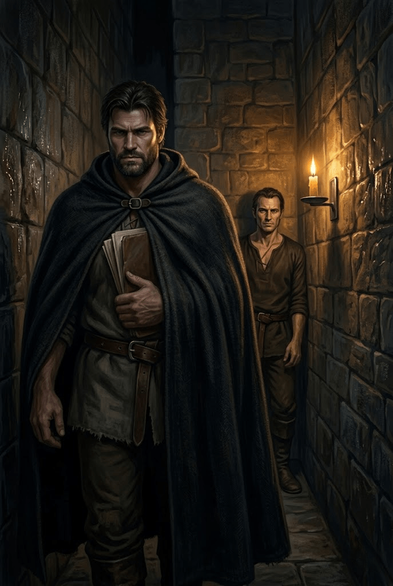
He heard it on the way back from Caswick’s salting house, the morning still grey and cold and smelling of brine and low tide, the harbor district gathering itself for the day’s work in the patient incremental way of places whose rhythms had been set long before anyone currently living was born.

A fisherman — old, barrel-chested, working alone at the far dock with a net spread across his knees and his hands moving through it with the automatic certainty of long practice — was singing.

Not performing. Not for Breck, not for anyone. Just singing the way people sang when the work and the hour and the quality of the morning aligned into something that required more than silence to contain it. An old harbor song — Breck didn’t know its name or its origin, had never heard it in quite this form, but recognized its bones immediately, the way you recognized the structure of something older than its current version, the melodic logic that had been in Lumenvale’s fishing towns for longer than the towns themselves had had names. A low, unhurried thing, built for open water and grey mornings and the kind of labor that gave the hands something to do while the mind settled into its own weather.

He stopped walking.

He could not have said why, precisely. He was not a sentimental man about music — had not been, particularly, even before the campaign had stripped most non-functional responses to a manageable minimum. But something in the song’s key, its particular position in the spectrum of sound between the minor and the not-quite-major, opened a door in him that he had not known was closed.

It was a Karithian fishermen’s variant, he realized after a moment. The coastal villages along the secondary theater had their own version — lighter in its upper notes, the rhythm slightly compressed for the narrower harbors, but the same bones underneath, the same emotional architecture. He had heard it in the third year of the campaign from a window while moving through an occupied coastal settlement at dusk, doing the kind of work that required absolute attention and offered no room for anything else, and it had gotten into him anyway — had found the gap between focused and human and lodged there, had stayed.

He had not thought of it in years. Had not known he still carried it until this grey harbor morning when an old man’s hands moved through a net and the key of the thing found him across thirty yards of salt-cold air and unlocked something that had been closed without his noticing.

Something lifted in him. Not joy — he was not running on the register that produced joy at this particular juncture — but its functional cousin, the specific buoyancy that arrived when the weight had been fully acknowledged and the body was given a moment to remember it was not only weight. He stood at the dock road’s edge and listened to the old man sing and let the harbor morning be what it was for a full thirty seconds, which was a luxury he did not generally afford himself and which the situation probably did not technically warrant.

Then the innkeeper’s boy found him.

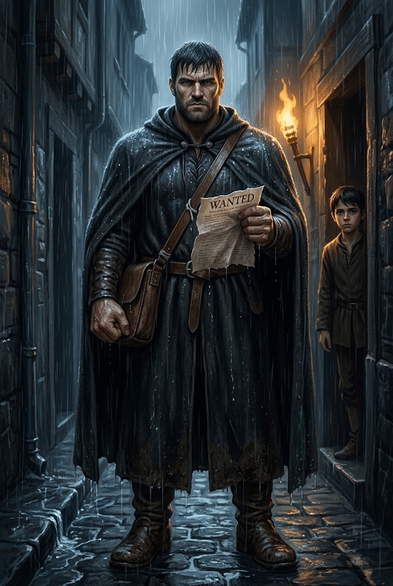
He was perhaps fourteen, the boy, with the loose-limbed urgent energy of someone running an errand that had been impressed upon him as important and who had taken the impression seriously. He carried a sealed envelope with the particular careful grip of someone who had been told the thing in his hands mattered, and he extended it to Breck with the solemnity of a boy who understood he was part of something larger than the delivery of one piece of mail.

Breck turned the envelope over. The seal was official — the Regional Adjudicator’s office, Harvel Caine’s personal mark pressed into grey-green wax, a color he recognized from the letter he’d been carrying in his document sleeve since Crestfall.

He broke it open.

Mr. Breck — Your correspondence arrived this morning by night rider from Cold Harbor. I have read what you sent and I have no doubt about what it describes. An inquiry team departs within three days. I require you to remain in Cold Harbor as material witness and I require the people who can confirm the accounts to be available for private statement. Do not move against Solt directly. The inquiry will be sufficient. Keep yourself intact. — H. Caine, Regional Adjudicator

He read it twice. The second time more slowly, letting each sentence do its specific work. I have no doubt about what it describes. Not I am considering the matter, not I will review the evidence — the unambiguous language of a man who had read forty pages of Varrow’s careful thinking and Sela Rauth’s exact testimony and had arrived at the same place Breck had arrived at from the inside of the situation.

Three days.

The fisherman was still singing, his hands still moving through the net, the harbor still assembling itself around the sound with the patient indifference of water.

Breck folded the letter. Put it in his document sleeve beside the space where Caine’s first letter had lived for weeks. Stood for a moment in the grey morning with the cold air on his face and the brine smell and the low unhurried music working its way through the registered frequencies of him.

He had not allowed himself, since arriving in Cold Harbor, to feel the weight lift. There had been too many open windows, too many unclosed angles, too many mornings where Solt’s next move was unknown and the situation’s momentum was not yet established enough to trust. He had operated in the register of necessary tension — not fear, but its functional equivalent, the sustained elevation of attention that kept the peripheral vision sharp and the body’s response architecture accessible.

Now, for the first time, the weight had a shape and a duration. Three days. An inquiry team. A man in an official office who had read the true account and had no doubt. The structure Breck had been building — Varrow’s pages, Sela’s testimony, Fenn’s night rider, Caswick’s refusal to sign — had arrived where it needed to arrive and had been received by the person who could do what Breck could not do: make it institutional, make it durable, make it the kind of change that outlasted the man who started it.

He thought about Ceth Varrow writing in the margins of his treatise at the outer edge of the page, pressing forty pages of careful observation and careful thinking into the world with the understanding that he would not be present to see what they produced. Tending something for a future he might not inhabit. The same impulse that turned garden beds for spring. The same impulse that braided grain stalks and pressed them into a soldier’s hand.

The song ended.

The old fisherman gathered the net with a practiced rolling motion, stood with the deliberate care of a man whose knees had decided years ago to participate only under protest, and moved back along the dock toward his vessel without acknowledgment of the morning, of the letter, of the large man standing at the road’s edge who had stopped walking to listen.

Breck watched him go. Thought about what music actually did — not the notes themselves, not the formal structure of it, but the specific function it served in the human machinery. It found the key you were in. Not the key you wanted to be in, not the key the occasion called for, but the one you were actually running on underneath the operational surface, and it named it, and the naming was the lifting, and the lifting was the reminder that the thing you were carrying had a bottom to it, that the weight was not infinite, that on the other side of the weight there was something else that was also true.

He was, he realized, in the key of something close to hope.

Not certainty. He was not built for certainty and did not trust people who were. Solt had three days to move before the inquiry team arrived, and Solt was precise and intelligent and not yet finished with the options available to him. Three days in Cold Harbor with the geometry declared and the accounts in official hands was three days in which something could still go badly wrong.

But Caine was coming. The letter existed. The true account was outside this harbor and in official hands and had been read by a man with authority who had no doubt about what it described.

He started walking.

The harbor road was waking around him — carts and voices and the smell of morning bread from the bakehouse two streets back, the accumulated ordinary texture of a town at the start of its day. Cold Harbor, going about its business. Orderly, quiet, functional — and underneath all of that, three days from the moment when the architecture of the last three years began to come apart.

The key it was in, Breck thought, was not triumph. It was not even relief. It was the specific emotional register of a man who had been moving through the dark for long enough that the first grey light on the horizon, barely visible, barely certain, was sufficient.

He passed the salting house. Looked at its dark timber roofline against the grey sky, at the salt-crystal haze that gave it its particular permanent appearance of having just emerged from the water.

Dara, he thought. Her name is Dara.

He walked on.

← Chapter Fourteen: Before the Window Closes | Chapter Sixteen →

BRECK: Cold Harbor is a serialized noble dark fantasy story by Chadwick Rye, set in Lumenvale. Chapter 15 of 20. New chapters post daily.

✦ Enjoyed this chapter? “The Key It’s In” is part of the BRECK series — cozy dark fantasy, moral weight, and a courier learning, slowly, that the weight has a bottom to it. Browse the full series, follow for daily chapters, or share this with a reader who knows what earned hope feels like.

#books #BRECKSeries #ChadwickRye #ColdHarbor #dailyprompt #dailyprompt2788 #darkFantasyNovel #fantasy #fantasyShortChapters #fiction #Lumenvale #nobleDarkFantasy #onlineFiction #serializedFantasy #shortStory #writing
BRECK: Cold Harbor — Chapter Seven

Straight Out of a Stor

Daily writing prompt What’s a moment in your life that felt like it was straight out of a movie? View all responses

BRECK: Cold Harbor — Chapter Seven

Straight Out of a Story

This is Chapter 7 of BRECK: Cold Harbor, Book Two of the BRECK series — a serialized noble dark fantasy story by Chadwick Rye, set in the world of Lumenvale. New chapters post daily.

The Story So Far

BRECK arrived in Cold Harbor on a routine delivery and stayed because of what he found. A scholar named Ceth Varrow wrote about illegitimate authority and vanished eight months ago. Davan Solt — salvage contractor, harbor-builder, peacemaker — runs this town from behind the architecture of genuine service. Breck has read Varrow’s treatise, met Solt face to face, and watched a child navigate the town’s invisible grammar with the practiced caution of someone who learned it young. He has decided to stay. He has not yet decided what shape that staying will take.

← Chapter Six: What Catches the Eye | Chapter Eight →

Chapter Seven: Straight Out of a Story

This chapter is the moment before everything changes — when a man understands, with perfect cinematic clarity, exactly what he has walked into.

The light in Cold Harbor at dusk was unlike light anywhere else Breck had been.

He had moved through enough towns, enough seasons, enough latitudes to have developed an unconscious catalogue of evening light — the dry gold of inland harvest towns, the bruised purple that settled over river deltas, the particular blued-silver of high mountain passes when the sun dropped behind the western face and left the eastern sky holding the last color longer than seemed geometrically possible. He noticed it the way he noticed door hinges and floor plans and the weight-shift of men deciding whether to act. Not deliberately. Just with the accumulated attention of someone who had spent twenty years reading environments for what they held.

Cold Harbor at dusk held something grey-green and ancient, the light coming off the water and mixing with the harbor fog in a way that softened everything it touched without warming it. The buildings in the lower district emerged from it like shapes in old illustrations — simultaneously present and half-dissolved, the specific made general, the familiar made strange. Walking those streets in the last of the evening light felt less like moving through a town than through the memory of one.

He had been thinking about that — about memory, about how places stored it in their materials the way timber stored water, invisibly and everywhere at once — when he became aware that he was not alone in the lane.

The man had come from a doorway, or from a cross-lane, or from the particular quality of shadow that gathered in the narrow spaces between buildings at this hour. He had simply arrived beside Breck the way men arrived when they were very good at it — not emerging, not approaching, just suddenly present, falling into step with the casual synchronization of someone who had done this often enough that it no longer required theater.

He was the narrow one from the smithy forecourt. Younger than Breck by perhaps ten years, with the economical build and the coiled-cable stillness of someone trained rather than naturally still. His hands were visible and empty. His face held a pleasant neutrality as practiced and precise as Solt’s own warmth — not a mask exactly, more a professional register, the expression of a man who had learned that the most effective communication left no surface to push against.

“Courier,” he said. The same word Solt had used. Perhaps it was the word they had settled on.

“Not anymore,” Breck said. He kept walking. The man kept pace.

“Mr. Solt appreciated your visit this morning.” A pause, light and unhurried as the fog itself. “He has a good memory for faces. People who pass through the harbor once, he forgets. People who ask questions in the lower district, take meetings with certain residents, stay longer than their delivery requires —” another pause, shorter, calibrated — “those he tends to remember.”

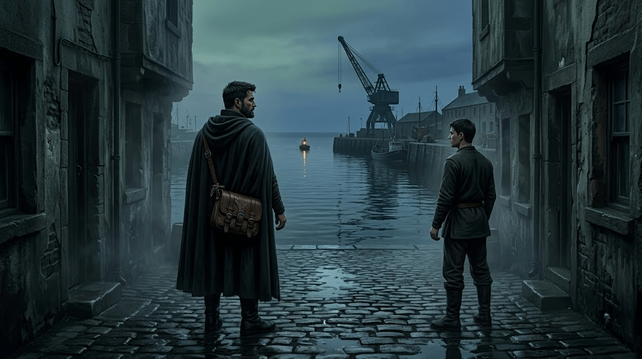
The lane was empty. Not suspiciously so — the lower district thinned naturally at dusk, the fishing families eating, the day’s work settling into evening’s rest. But empty enough. The green-grey light lay across the wet cobblestones and made everything in Breck’s peripheral vision look like it had been composed deliberately, every element placed for effect. The fog at the lane’s end. The dark-hulled boat visible between two buildings, its mast a black line against the fading sky. The careful distance between himself and the man who walked beside him.

He thought, with a clarity that would have been difficult to explain to anyone who hadn’t stood in the same kind of moment: this is the thing itself. Not a story about it. Not someone’s account of it. The thing.

“Mr. Solt is a careful man,” the man continued. “He built something good here. Something real. The channel work, the Accord — those aren’t performances. He’s proud of them. He’d like them to continue without disruption.” The pleasant neutrality didn’t alter by a shade. “Cold Harbor is quiet because people here understand that quiet is worth protecting. It’s not complicated. The fishermen fish. The merchants move goods. The dock union has fair terms. Everyone has what they need.”

“Except Varrow,” Breck said.

The man did not break stride. Did not look at him. Did not produce so much as a tremor in the smooth professional surface of the conversation. “Varrow had family in the north.”

The lane turned east toward the harbor. They turned with it. The water appeared at the lane’s end — that grey-green light heavier there, pooled and ancient, the harbor holding the last of the sky’s color the way a stone holds heat. The crane stood at the pier’s far end, its arm a dark geometry against the dusk.

“You seem like a man who knows what things cost,” the man said. “The courier work. The Karithian campaign, maybe — you have that look. You understand how the world actually functions.” A pause precise enough to be deliberate. “A man who understands that doesn’t come into a quiet harbor town and pay interest on someone else’s debt.”

Breck stopped walking.

The man stopped beside him, half a step back, unhurried, his hands still visible and empty and entirely beside the point given everything else about him.

The harbor lay before them both. The evening light on the water had gone from grey-green to something deeper, the color at the bottom of old glass. Three vessels at anchor. The distant moving lantern of a night fisherman already out beyond the harbor mouth. The crane. The new iron fittings holding the last of the dusk’s cold silver.

Breck looked at it for a long moment — the whole of it, the harbor Solt had rebuilt, the town that had needed rebuilding, the genuine thing underneath the other thing.

He had a sense, standing at the lane’s end with the fog coming in off the water and the man’s professional stillness a half-step behind him, of the scene’s completeness. As though the light and the water and the crane and the empty lane had arranged themselves around this moment with the unearned precision of a story that knew what it was doing. He had stood in enough real moments to recognize the quality of them — the way the actual never looked quite real, the way significance, when it arrived, always felt somehow staged.

He turned to look at the man directly.

“Tell Mr. Solt,” he said, “that I appreciate the courtesy.”

The man held his gaze. Behind the professional neutrality, deep and quiet and making no particular effort to hide itself, something assessed him with the flat instrumental attention of a man measuring a distance.

“He’ll be glad to hear it,” the man said.

He turned and walked back up the lane without hurry, his footsteps unhurried on the wet stone, and was absorbed back into the dusk the same way he had emerged from it — not disappearing exactly, just becoming, at some imprecise moment, no longer present.

Breck stayed at the lane’s end.

The harbor worked its evening sounds around him — water on pilings, chain on iron, the low creak of timber accepting the tide’s slow push. The night fisherman’s lantern had moved further out, a small warm point in the darkening water, the only warm thing in the whole cold harbor. He watched it for a while.

Solt had read him in a morning. Had assessed the situation, made a decision, and dispatched a consequence with the same careful precision he had applied to the channel survey and the Accord negotiations and every other problem this harbor had presented him. Not a threat — nothing so crude. An arrangement of information. A map of what the geography looked like from Solt’s position. An invitation to understand that the geometry was clear and the door was still open.

It was, Breck thought, the move of a man who had never yet encountered a problem his methodology couldn’t resolve. Who had such deep faith in the instrument of measured, patient pressure that the idea of a thing it couldn’t eventually move had perhaps never occurred to him.

He pressed his thumb against the bracelet. Held it there in the cold.

Then he turned from the water and walked back into Cold Harbor.

He had things to do before morning.

← Chapter Six: What Catches the Eye | Chapter Eight →

BRECK: Cold Harbor is a serialized noble dark fantasy story by Chadwick Rye, set in Lumenvale. Chapter 7 of 20. New chapters post daily.

✦ Enjoyed this chapter? “Straight Out of a Story” is part of the BRECK series — cozy dark fantasy, moral weight, and a courier who cannot walk past certain things. Browse the full series, follow for daily chapters, or share this with a fellow fantasy fiction fan.

#adventure #books #breckSeries #cozyFantasy #dailyFantasyChapters #dailyprompt #dailyprompt2810 #DarkFantasy #EpicFantasy #fantasy #FantasyFiction #fantasyThriller #fiction #HighFantasy #lowFantasy #Lumenvale #serialFiction #serializedBook #serializedFantasy #serializedFantasyFiction #serializedFiction #shortStory #writing

BRECK: Cold Harbor — Chapter Six

What Catches the Eye

Daily writing prompt Go on a walk today and share a photo of something that catches your eye. View all responses

BRECK: Cold Harbor — Chapter Six

What Catches the Eye

This is Chapter 6 of BRECK: Cold Harbor, Book Two of the BRECK series — a serialized noble dark fantasy story by Chadwick Rye, set in the world of Lumenvale. New chapters post daily.

The Story So Far

BRECK arrived in Cold Harbor on a routine delivery and stayed because of what he found. A scholar named Ceth Varrow wrote a treatise on illegitimate authority — and vanished. A salvage contractor named Davan Solt rebuilt the harbor, brokered a lasting peace between the merchant council and the dock union, and has been the most important man in Cold Harbor ever since. Breck carries Varrow’s unfinished book inside his cloak. He has met Solt — warm, precise, genuinely intelligent — and walked back out through the iron-hinged door with the cold harbor air stripping the fire’s warmth from his face. He is still deciding what to do with what he knows.

← Chapter Five: What You Can’t Unread | Chapter Seven →

Chapter Six: What Catches the Eye

This chapter asks what happens when you walk through a place without looking for anything — and find the thing you were trying not to see.

He walked without direction, which was how he processed things.

The town arranged itself around him in layers as he moved — the upper harbor with its ordered commerce and new timber and the quiet confidence of a place that believed in its own recent history, then the transition district where the buildings grew older and the streets found their own angles, then the lower district’s salt-dark lanes with their nets and their braziers and their older, weathered self-possession. He had been in enough towns to read the grammar of them — the way prosperity moved through a place, what it touched and what it left behind, the precise texture of streets that had been improved by outside money and streets that had improved themselves.

Cold Harbor read cleanly on the surface. That was the thing about it. Whatever Solt had built here, he had built it without the crudeness of most men who accumulated that kind of weight — no visible muscle at the door, no ostentatious display of resource or consequence. The harbor simply worked, and the streets were passably maintained, and the people moved through their days with the particular ease of a community that had been relieved of a long-standing pressure and had not yet fully registered what had replaced it.

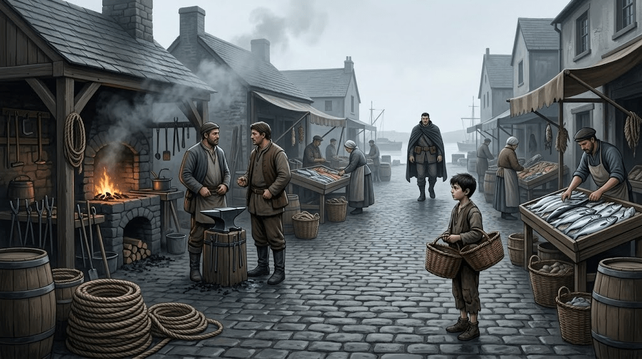
He was crossing the market lane — a short run of stalls between the lower district and the harbor road, fish and salt provisions and rope work and a small smithy that smelled of coal smoke and hot iron — when he saw the boy.

Perhaps nine years old. Slight, dark-haired, standing at the edge of the smithy’s forecourt with a basket of provisions over one arm that was slightly too heavy for him, listing to the left with the effort of it. That was not what caught Breck’s eye. Children carried heavy things; it was how they learned the weight of the world in increments their bodies could manage.

What caught his eye was the way the boy was standing still.

Not resting. Not looking at anything in particular. Just — stopped, in the way that children stopped when they were working out which direction was safe to move in. It was a posture Breck had seen before, in Karithian villages where the calculus of street movement had become something children absorbed before they learned to read. The careful assessment of open space. The peripheral attention to doorways. The particular quality of stillness that was not ease but its precise opposite — a wound spring wearing the shape of calm.

Two men stood outside the smithy, talking with the unhurried comfort of people who had nowhere else to be. They were not doing anything to the boy. They were not looking at him. They were simply there, occupying the forecourt with the easy proprietary comfort of men who had long since made their territorial understanding with every space in this district. One of them had the build of a dock worker, the calloused breadth of shoulder and the forward-leaning stance of someone whose body had been shaped by decades of moving heavy things. The other was younger, narrow, with a quality of stillness about him that was different from the boy’s — not fear but its professional cousin, the coiled watchfulness of someone deployed rather than threatened.

The boy waited. Calculated. Chose left, giving the forecourt a wide berth, the basket swinging awkward with the detour’s extra distance.

Neither man acknowledged him. Neither man needed to. The geometry of the thing was complete without words or gestures — a long-established spatial grammar that the boy had learned so thoroughly it had become instinct, written into the body like the knowledge of tides.

Breck watched the boy clear the forecourt, re-center himself on the lane, and walk on with the particular purposeful relief of a child who has navigated a thing successfully and wants to put distance between himself and the having-to-navigate-it.

He stood still in the middle of the market lane for a moment, the town moving around him.

The smithy’s coal smoke drifted on the harbor wind. The fish stalls smelled of brine and cold scales and the good honest labor of early morning. Somewhere down the lane a cart horse shifted its weight with a slow metallic jingling of harness. Cold Harbor in the grey morning, working and orderly and largely quiet, every surface of it reading as a town that had been helped.

Breck thought about a boy in Crestfall — Pell, twelve years old, who had known which doors to knock on and which streets to cross and which silences to keep, whose body had learned the grammar of a compromised town the way this boy’s body had learned it here. He thought about how that knowledge settled into a child, how it became structural rather than situational, how it stopped being a response to a specific threat and became instead the permanent lens through which the world was read. He thought about what it cost. Not immediately. Not visibly. Just the slow compound interest of growing up in a place where the open street was a calculation rather than a given.

He looked at the two men outside the smithy. They had not moved. They were still talking, still unhurried, still entirely comfortable in the space they occupied.

He looked at the lane where the boy had gone, already around a corner, the basket-swing of his small overloaded silhouette absorbed back into the ordinary texture of the district.

The decision that had been forming in him since the pier — since Solt’s fire-warm office, since Varrow’s cold pages, since Fenn’s unfinished sentence in the Anchor’s Rest on the first evening — settled into place with the quiet finality of a last piece of a frame going in. Not a dramatic thing. Not a moment he would have been able to point to from the outside. Just the particular internal click of a man who has been carrying a question and has finally, without announcement, set it down and picked up its answer instead.

He was not leaving Cold Harbor. Not today. Not until he understood what the boy understood — the full shape of what had been built here, and who it served, and what it cost the people living inside it. And then, depending on what that shape turned out to be, something else.

He moved out of the center of the lane. Walked in the direction the boy had gone, not following — there was no purpose in following — but heading generally toward the lower district where the fishing families lived and the nets dried on the quay walls and the oldest parts of the town’s memory were still intact.

The bracelet pressed against the back of his hand through the fabric of his cloak as he walked.

He did not look back at the smithy. He had seen enough.

← Chapter Five: What You Can’t Unread | Chapter Seven →

BRECK: Cold Harbor is a serialized noble dark fantasy story by Chadwick Rye, set in Lumenvale. Chapter 6 of 20. New chapters post daily.

✦ Enjoyed this chapter? “What Catches the Eye” is part of the BRECK series — a world of cozy dark fantasy, working-class lives, and the cost of looking away. Browse the full series, follow for daily chapters, or share this with a fellow fantasy fiction fan who likes their stories to mean something.

#adventure #books #cozyFantasy #dailyprompt #dailyprompt2779 #DarkFantasy #fantasy #FantasyFiction #fantasyThriller #fiction #HighFantasy #lowFantasy #Lumenvale #serialFiction #serializedBook #serializedFantasy #serializedFantasyFiction #serializedFiction #shortStory #writing

BRECK: Dead Delivery: Chapter Twenty The Girl at the Gate

Daily writing prompt What’s a moment that made you question reality? View all responses

BRECK: Dead Delivery — Chapter Twenty

The Girl at the Gate

This is Chapter 20 of BRECK: Dead Delivery, a serialized noble dark fantasy story by Chadwick Rye, set in the world of Lumenvale. This is the final chapter of Book One. New stories begin with Book Two.

The Story So Far

Breck is a veteran courier — 6’5″, 285 pounds, former Crystal Wars special operations — who spent twelve days dismantling a corrupt magistrate’s operation in Crestfall and walked out into the north road carrying everything he came in with and one thing he didn’t expect: a letter from the Regional Adjudicator asking whether there were other towns in the valley where what he’d done in Crestfall needed doing. He picked up the Garnwick contract at the Aldenmere guild office and walked north into the winter. He has been carrying a faded cord bracelet on his satchel strap for years — too small for his wrist, woven from grain stalks and valley grass by a girl in an occupied village who told him it would bring him back. He came back. He was too late. He buried her by hand in the field behind her home and marked the grave with a flat river stone and has never put the bracelet down.

This is the last chapter of Dead Delivery.

← Chapter Nineteen — Better Than Expected

Chapter Twenty: The Girl at the Gate

This chapter explores the moment when reality becomes permeable — when the past and present occupy the same space simultaneously, and a man must decide what to do with what he sees.

The hill settlements above Garnwick sat at the edge of the high country where the valley’s agricultural plainness gave way to the older, more complicated terrain of the limestone ridges — a scattering of stone farmhouses and working outbuildings arranged along a single unpaved track that wound between fields still holding their frost in the flat winter light of late afternoon.

Breck had been walking since before second bell. Sixteen miles of north road and then the mill road turning off into the hill country, the terrain rising beneath his boots with the patient insistence of ground that had been shaped over centuries into exactly what it was and had no interest in accommodating speed. He moved through it with the adaptation he brought to all demanding terrain — adjusting his pace to the gradient, reading the frost-edged stone for the step that would hold and the step that wouldn’t, his body doing the calculations automatically while his mind moved in the loose, watchful freedom of the long road’s open hours.

He was thinking about the Adjudicator’s letter.

About the question folded in the document sleeve against his hip, patient as a thing that knows it will eventually be answered. About the valley below — its river towns and market squares and the particular architecture of the wrong things that happened when power went unaccountable long enough to forget that accountability had ever been the arrangement. About the specific skill that Crestfall had required of him — not strength, not speed, not the particular violence of the limestone cut — but the other thing, the older thing, the capacity to walk into a place and look at it until it told him what it was hiding.

He had been doing that his entire adult life without understanding it as a skill.

He was still thinking about it when he came around the last bend in the hill track and saw the gate.

It was an ordinary gate — iron-hinged timber, weathered to the particular silver-gray of outdoor wood that had cycled through enough seasons to have stopped caring about the distinction between old and new. It marked the entrance to the largest of the Garnwick hill farmsteads, the one listed on his contract slip as the delivery destination: a sealed documents packet from a land registry office in Aldenmere, routine correspondence, the kind of thing that moved between institutions and their outlying properties with the bureaucratic regularity of paperwork doing its necessary, unglamorous work.

The gate stood open.

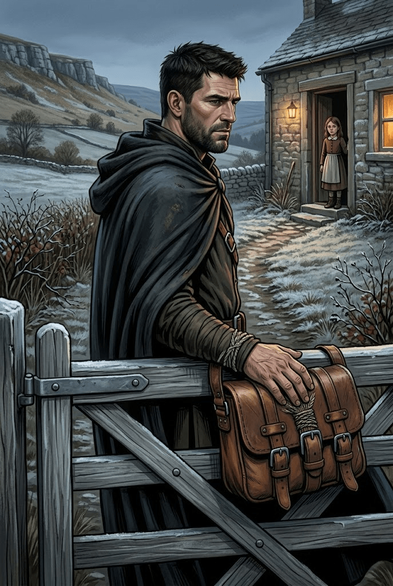
A child was sitting on it.

A girl — eight or nine years old, brown-haired, with the particular stillness of a child absorbed in private contemplation, her feet hooked through the lower bars and her hands loose on the upper rail, her face turned toward the last pale light sliding off the western hills with the focused, unhurried attention of someone who had come outside specifically to watch it and intended to watch it completely.

The world went very thin.

It was the only way Breck could describe what happened to the air in that moment — the sensation that the space between the past and the present had contracted to something near-transparent, that the hill track and the frost-touched fields and the silver gate existed simultaneously in two times, and that he was standing at the point where they overlapped. His body had stopped moving before his mind had registered the decision to stop. His hand had found the bracelet on the satchel strap — not deliberately, not consciously, the old reflex, the checking that lived below thought — and was resting against it with the particular pressure of a man holding onto the thing nearest to him when the ground moves.

The girl turned.

She had the serious eyes of a child who spent time looking at things other children looked past — the eyes that catalogued, that noticed, that held what they observed with a kind of quiet custody. She looked at Breck the way Pell had looked at him on the cooperage step — without flinching, without the reflexive appraisal of threat that most small people applied to something his size arriving at a gate. Just looking. Taking the measure.

“You’re very large,” she said. Her voice was matter-of-fact, a statement of observed fact offered without judgment.

“I am,” Breck said.

His own voice sounded distant to him. Slightly wrong, the way voices sounded when the body was doing something the mind was still arriving at — maintaining the surface of ordinary interaction while underneath, in the older and less manageable territories of a man’s interior life, something was cracking open along a seam he had thought was fused.

She was not the girl from the valley. He knew this. The rational, operational part of him — the part that had gotten him through four years of war and a decade of roads that didn’t care whether he made it — stated it clearly and without ambiguity: different girl, different province, different decade, ten years and two hundred miles from an occupied valley he had not allowed himself to name aloud since the morning he had left it with wet hands and a faded bracelet and the specific weight of a promise that had failed its only test.

She was not that girl.

But she had her eyes.

Not literally — the eyes were different in color, different in shape — but in quality. The quality of a child who had learned, at an age when most children were still learning what the world was, to pay attention to it with the gravity of someone who understood that attention was a form of care and care was not something to be distributed carelessly. That quality, that precise and particular quality, was the same.

And the world had gone thin, and he was standing at a gate in the hill country above Garnwick in the last of the winter afternoon light, and the bracelet was between his fingers, and he was — for the first time since the valley — not entirely certain where he was.

“Are you the delivery man?” the girl asked.

The question arrived like a hand extended. Simple. Practical. The kind of question that required only one thing from him: the answer.

He breathed.

Once. Slowly. The cold winter air filling his chest and moving through him with the honest, indifferent thoroughness of cold winter air, which did not care about the past or the present or the particular geography of a man’s grief and simply occupied the available space and did what it did.

He breathed out.

“I am,” he said.

She slid off the gate with the fluid ease of a child for whom heights were unconsidered, landing on the frost-hard ground with both feet and turning toward the farmhouse without ceremony.

“I’ll get my father,” she said, already moving. “He’s been expecting it.”

She walked up the path toward the farmhouse door — small, unhurried, her dark hair catching the last pale light in the way that dark hair caught pale light — and did not look back, because she had accomplished her task and had no particular reason to linger over it.

Breck stood at the open gate and watched her go.

He stood there for a long moment — long enough for the farmhouse door to open and close around her, long enough for the western light to finish its departure from the hills, long enough for the first suggestion of evening cold to arrive in earnest from the northeast with the serious intention of a temperature that had made its decision.

Then he reached into the satchel and withdrew the delivery packet — sealed, addressed, routine — and held it in his large hands and felt the ordinary weight of it.

He thought about a girl in a valley who had given a man everything she had because the giving was what there was to do. About small hands and grain stalks and roof grass and the particular faithfulness of a thing made from whatever was available.

He thought about Crestfall. About Pell on the cooperage step and Sela behind the hearthstone and Maret at the bar with her book and the question in the document sleeve and all the towns in the valley where the specific shape of wrong things had been given enough time to look like the ordinary arrangement of the world.

He thought about arriving in time.

About the particular power of presence — not the supernatural kind, not the kind drawn from crystal wells or gifted by ancient bloodlines or purchased through sacrifice and transformation — but the ordinary, irreplaceable, entirely human power of being somewhere before something went wrong. Of walking down a hill road into a hollow market square and noticing, with the patient and committed attention of a man who had decided that noticing was the job, that something was wrong and needed the specific application of someone who would not look away.

He thought about a question folded in a document sleeve.

Other towns in the valley.

The farmhouse door opened.

A man emerged — middle-aged, broad-shouldered in the working way of men who had farmed the same ground for decades, his face weathered with the kind of open weathering that came from honest outdoor work rather than hard living. Behind him, at the doorway, the girl reappeared — leaning against the frame with her arms folded and her serious eyes tracking the stranger at the gate with the focused attention she brought to everything.

“Courier?” the farmer called.

“Delivery from the land registry,” Breck said. “Sealed documents, contract number — ” he recited it from memory, having read the slip enough times that the number had settled into the part of his mind that held such things automatically — “require your signature on receipt.”

The farmer came down the path, pulling a coat across his shoulders, and took the packet with the matter-of-fact acceptance of a man who had been expecting exactly this. He signed the receipt in the plain, functional hand of someone who had learned to write for the purpose of signing things and had never needed it to be anything more.

He handed the receipt back. Looked at Breck with the brief, assessing directness of a man measuring a stranger on his property.

“Long walk from Aldenmere,” he said.

“Sixteen miles,” Breck said. “Road was good.”

The farmer nodded. The transaction was complete. The ordinary machinery of delivery and receipt and departure had done its work and was now waiting for Breck to do the last part of it — to turn, and walk back down the hill track to the mill road, and from there south to the Aldenmere waystation where he could sleep in a bed and eat a meal and take stock of the next contract and the next road and the next town on the other end of it.

He did not immediately turn.

He looked at the girl in the doorway one more time.

She looked back at him with her serious, cataloguing eyes — taking his measure, filing the result, present in the moment with the full and undefended attention of a child who had not yet learned to be guarded about the things she noticed.

“Safe roads,” she said. It came out with the solemn, considered gravity of a phrase she had heard adults use and had adopted because it seemed to her like the correct thing to say to a man who was about to walk away into the dark.

Something moved through Breck — slow and deep, like water finding its level in a space that had been waiting for it, like the specific settling of a thing returning after long absence to the place it had always occupied. Not grief. Not its absence. Something that held both and was neither — the particular quality of a wound that had healed as much as wounds of its kind healed, which was not completely, which was never completely, but which had healed enough to carry without collapse.

He looked at the bracelet on the satchel strap.

Pale as old light. Small as a child’s hope. Wound twice around the worn leather in the place it had always been.

He touched it once — not the reflex, not the checking, but something deliberate, something that acknowledged rather than merely confirmed — and let his fingers rest against it for the length of one breath.

Then he straightened to his full height, the hill country cold and wide and darkening around him, the valley below invisible in the dusk, Crestfall folded into the distance with its fire burning in an inn hearth and its sealed letter moving toward a resolution that would take months and cost Voss everything and give the town back to itself by degrees, the slow way, the way things were given back.

“Safe roads,” he said.

He turned.

He walked down the hill track toward the mill road, the darkness gathering in the fields around him and the first stars arriving above the limestone ridge in their ancient, indifferent positions, and the cold working its patient arithmetic on everything the day had held.

Behind him, in the farmhouse doorway, a girl with serious eyes watched him go until the hill track took him around the bend and the dark closed over the place where he had been.

Ahead, the road continued. Wide and pale in the last light. Patient as all roads were patient — going where it went regardless of whether anyone chose to follow, opening ahead of the man who walked it with the steady, faithful offer it always made.

He followed it.

The bracelet moved with him, pale against the leather, carrying its small and irreducible weight through the winter dark toward whatever came next — the next town, the next hollow market square, the next wrong thing that would reveal its shape to a man who had learned to look until the looking told him what needed doing.

Toward all the towns in the valley where what he had done in Crestfall needed doing.

He walked, and the road held him, and the stars above the limestone ridge burned with the cold, clean light of things that had always been there and would always be there, indifferent to the brief and extraordinary passage of the people who moved beneath them — and he walked through it all with his satchel across his chest and his bracelet on the strap and the Adjudicator’s question folded against his hip, and the road did what roads did, and the dark did what dark did, and somewhere ahead the next delivery was waiting with the patient, faithful certainty of work that did not expire.

It always was.

BRECK: Dead Delivery — Complete.

This has been Book One of the BRECK series — a serialized noble dark fantasy story by Chadwick Rye, set in the world of Lumenvale. Breck is a veteran courier moving through a medieval world one delivery at a time, arriving in places that need what he carries, staying longer than he planned, leaving things different than he found them.

Book Two begins soon. Follow Chadwick Rye on Royal Road, WordPress, and Patreon to be there when the road opens again.

Chapter Nineteen — Better Than Expected

Dead Delivery is complete. Twenty chapters. One town. One courier who couldn’t walk away from the things he noticed. If this story found you at the right moment — if Breck, or Pell, or Maret, or the bracelet landed somewhere real — follow Chadwick Rye and be there when Book Two begins. Browse more stories from Lumenvale, or share this one with a fellow fantasy fiction fan who deserves to meet Breck from the beginning.

BRECK: Dead Delivery — Chapter Index

Chapter One — The Only Power Worth Having
Chapter Two — The Best Thing To Do
Chapter Three — The Best Night of the Year
Chapter Four — What a Good Life Looks Like
Chapter Five — The Burning of the Ledger
Chapter Six — What Boys Are Made Of
Chapter Seven — The Weight of Less
Chapter Eight — The Forgotten Ones
Chapter Nine — The Story Everyone Told Wrong
Chapter Ten — The Discipline of Getting Up
Chapter Eleven — What You Don’t See Coming
Chapter Twelve — The Learning Curve
Chapter Thirteen — The First Time
Chapter Fourteen — The Small Thing
Chapter Fifteen — Stronger Than You Knew
Chapter Sixteen — The Road That Knows You
Chapter Seventeen — What a Man Tells Himself
Chapter Eighteen — What It’s For
Chapter Nineteen — Better Than Expected
Chapter Twenty — The Girl at the Gate (You are here)

☕ If you enjoyed Dead Delivery, consider supporting Chadwick Rye on Ko-fi. Every coffee helps keep the road open.

#Action #actionThriller #adventure #books #Breck #ChadwickRye #cozyFantasy #dailyprompt #dailyprompt2772 #DarkFantasy #EpicFantasy #fantasy #FantasyFiction #fantasyThriller #fiction #HighFantasy #lowFantasy #Lumenvale #MaleProtagonist #nobleDarkFantasy #serializedFiction #shortStory #StrongMaleLead #writing

BRECK: Dead Delivery:Chapter Sixteen: The Road That Knows You

Daily writing prompt How do you plan the perfect road trip? View all responses

BRECK: Dead Delivery — Chapter Sixteen

The Road That Knows You

This is Chapter 16 of BRECK: Dead Delivery, a serialized noble dark fantasy story by Chadwick Rye, set in the world of Lumenvale. New chapters post daily at noon Eastern.

The Story So Far

Breck is a veteran courier — 6’5″, 285 pounds, former Crystal Wars special operations — who arrived in Crestfall on a routine delivery and found a town quietly strangled by a corrupt magistrate named Voss. He built the case, retrieved the original documents, survived a well-planned ambush in a limestone cut two miles above Crestfall, and walked out onto the north road while the gray morning arrived without ceremony around him. The letter is in motion — a grain merchant named Foswick carrying it toward the Regional Adjudicator in Millhaven. The originals are against Breck’s chest. Drav has received Senne’s message. What happens in Crestfall now happens without Breck in it. He is on the road. The road is the only place he has ever fully understood.

← Chapter Fifteen — Stronger Than You Knew | Chapter Seventeen — Coming Tomorrow →

Chapter Sixteen: The Road That Knows You

This chapter explores what it means to move through the world with intention — and what the road gives back to a man who has learned to read it.

The north road opened after the limestone cut like a long exhale.

Breck felt it in his chest — the particular release of terrain that had been held and narrow becoming wide and possible, the road broadening from the single-cart width of the cut to the full double-track of a maintained trade route, the banks dropping away on either side to reveal the Lumenvale valley spreading itself across the mid-morning light like something that had been waiting patiently for him to arrive and look at it properly.

He stopped at the ridge’s crest and looked.

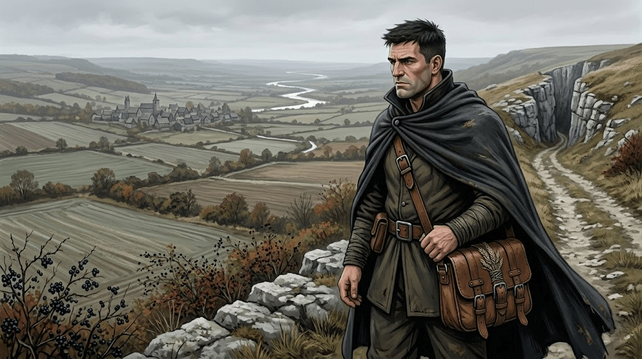
Below him the valley ran south and west in the particular luminous gray-green of late autumn, the fields stripped to their bones after harvest, the hedgerows thick with the last dark berries, the river — the Calwick’s upper fork — catching the weak sun in brief silver flashes between the tree lines. Crestfall was invisible from here, folded into the valley’s lower geography, its rooftops and its square and its eleven market stalls and its innkeeper standing at a cold hearth all compressed into the distance behind him into something too small to see.

He knew it was there. He knew it was different than it had been twelve days ago when he had come down the hill toward it in the flat colorless midday light and noted a market square with eleven stalls where there should have been thirty and a boy on a cooperage step with eyes too old for his face. He knew that Maret had gone to Sela this morning before the second bell, as she’d said she would. He knew that Pell was somewhere in that invisible town with a piece of chalk in his pocket and fourteen months of patient careful watching finally cashed in for something it had been worth.

He knew that somewhere in the valley below, a grain merchant named Foswick was on the Millhaven road with a sealed letter against his chest, carrying the weight of a dead man’s careful work toward the one authority in this part of Lumenvale with the jurisdiction and the obligation to act on it.

He knew that Drav was in Crestfall, receiving a message, making a calculation, standing at the edge of a choice that Breck could not make for him and would not have tried.

He adjusted the satchel strap across his chest, feeling the documents settle against his ribs, and turned his face north.

A man who spent his life on the roads of Lumenvale learned them the way a sailor learned water — not as static geography but as living systems, each route possessed of its own character, its own seasonal moods, its own particular demands and gifts. The north road from Crestfall to the valley junction ran twenty-two miles of mixed terrain: the limestone ridge country first, sharp and cold and demanding precise footwork on the frost-edged stone, then the descent into the broad agricultural plain that fed the river towns, then the long flat miles of farm road between harvested fields where the wind came in off the eastern hills without obstruction and a man either made friends with it or spent the day fighting it.

Breck made friends with it.

He had learned this on his first long posting after the war — a six-day route between two river settlements that ran entirely across open ground with no shelter and wind that came from three directions simultaneously, seemingly without regard for meteorological convention. He had spent the first two days fighting it, leaning into it, exhausting himself against it, arriving at the waystation at the end of each day with less in reserve than he should have had. On the third day, from some combination of depletion and accumulated wisdom, he had simply stopped fighting and started moving with it instead — adjusting his angle, reading its shifts, letting it carry him when it moved in his direction and conserving himself when it didn’t.

He had arrived at the end of the third day with something left.

The road taught you things, if you paid attention. It taught you the difference between terrain that demanded your full engagement and terrain that rewarded a kind of loose, watchful ease — the difference between the limestone cut, where every footfall required deliberate placement, and the farm road, where the ground was even and the miles accumulated without insisting on being counted. It taught you when to eat and when to wait, when to push and when to simply move, when the body’s complaints were worth heeding and when they were simply the body’s habit of complaint, which was different from actual limitation and worth distinguishing carefully.

It taught you, most fundamentally, that a road was not a problem to be solved. It was a relationship to be maintained. The routes that gave him the most — the cleanest arrivals, the fullest reserves, the particular quiet satisfaction of a day’s travel concluded at the right pace — were the routes he had run enough times to know well, to anticipate, to meet not as obstacles but as familiar territories with their own specific requirements and rewards.

He had run parts of this road before. Not this exact stretch, but adjacent ones, the connected network of Lumenvale’s north-valley routes that he had accumulated over three years of post-war courier work into a comprehensive interior map — not the paper kind, though he could draw those too, but the bodily kind, the kind that lived in the feet and the legs and the particular calibration of effort that came from knowing exactly what was ahead and how much it would cost.

He knew, for instance, that the descent from the ridge to the plain took forty minutes at his pace and rewarded aggressive walking — the gradient was sufficient to generate momentum if you committed to it, and the footing was good enough on this route to trust that commitment. He knew that the farm road section was where he could let his mind move freely, because the body could handle the terrain without his full attention, and that this freedom was one of the genuine gifts of the long road — the hours when the legs did their reliable work and the mind was left entirely to itself.

He thought, in those hours, about Crestfall.

Not with anxiety — the plan was in motion, the variables were what they were, the things that could be controlled had been controlled and the things that couldn’t had been left to the nature of things that couldn’t be controlled. He thought about it with the particular quality of attention he brought to completed work — the backward look that wasn’t regret and wasn’t nostalgia but something more like assessment, the honest accounting of what had been done and how, the filing away of lessons for the next time.

He thought about Pell, who had been paying attention for years before anyone gave him a reason to. About Sela, who had kept a copy warm beside a hearthstone for fourteen months on the slim and faithful hope that someday someone useful would arrive. About Maret, who had run a building for twenty years in a town that had been slowly made worse, and had done it without bitterness, which was harder than it looked.

He thought about Jorin, somewhere on the road to Brackfen with two silver coins and the specific relief of a burden that had finally found its purpose.

He thought about Drav. Stood for a long moment in the middle of the farm road with the eastern wind moving past him and thought about a man in a river town tavern three years ago, choosing structure over dissolution, loyalty over nothing, the only identity available to him over the absence of any identity at all. About whether that man, standing now in Crestfall with Senne’s message in his ear and Voss’s orders in his hands, would make a different calculation.

He did not know. He had given Drav the only thing he had to give — the truth about which side of the war they’d each been on, the acknowledgment that the roads they’d run had been the same roads from opposite directions, that the things done in that valley had been done by men with the same training and the same fears and the same impossible arithmetic of orders and conscience. Whether that was enough to tip the balance of a choice Breck couldn’t make for him — that was not something the road could tell him.

He let it go. Filed it in the category of things that were no longer in his hands, which was its own skill, the one that took the longest to learn and never became fully automatic.

The farm road ran between its stripped fields, gray and wide and patient. The eastern wind moved along with him in its indifferent, useful way. Somewhere ahead the valley junction waited — the waystation, the hot meal, the next job, the next road, the next town that would ask something of him he hadn’t planned to give.

He thought about the stone house. South-facing. A dog. Work that stayed finished.

He thought about the bracelet on the satchel strap — pale as grain stalks, small as a child’s hope, wound twice around the leather in the way it had always been wound.

He thought about a girl who had understood, at eight or nine years old, that the giving was what there was to do.

He walked into the wind.

This is Chapter 16 of BRECK: Dead Delivery, a serialized noble dark fantasy story by Chadwick Rye, set in the world of Lumenvale. Breck is a veteran courier — a man who can’t walk past certain things — moving through a medieval world one delivery at a time. New chapters post daily at noon Eastern.

← Chapter Fifteen — Stronger Than You Knew | Chapter Seventeen — Coming Tomorrow →

Enjoyed this story? Writing Lumenvale is how I pay my bills. If these stories are worth something to you, a $1 Ko-fi keeps the forge burning — and tells me this world is worth continuing. 👉 Buy Chadwick a coffee

#Action #actionThriller #adventure #bible #books #BRECKDeadDelivery #ChadwickRye #dailyprompt #dailyprompt2768 #DarkFantasy #EpicFantasy #fantasy #FantasyFiction #fantasyThriller #fiction #FreeFantasyFiction #freeFantasyFictionOnline #FreeStory #god #HighFantasy #lowFantasy #Lumenvale #nobleDarkFantasy #serializedFantasyFiction #thriller #veteranCourierFantasy #writing

BRECK: Dead Delivery: Chapter Fifteen: Stronger Than You Knew

Daily writing prompt What’s a moment that made you realize you were stronger than you thought? View all responses

BRECK: Dead Delivery — Chapter Fifteen

Stronger Than You Knew

This is Chapter 15 of BRECK: Dead Delivery, a serialized noble dark fantasy story by Chadwick Rye, set in the world of Lumenvale. New chapters post daily at noon Eastern.

The Story So Far

Breck is a veteran courier — 6’5″, 285 pounds, former Crystal Wars special operations — who arrived in Crestfall on a routine delivery and found a town quietly strangled by a corrupt magistrate named Voss. He built the case from the inside: the hidden ledger, the chalk map, the patrol gap. Last night he retrieved the original documents from Voss’s storage room and walked back through a dark corridor where Drav was waiting. Drav stepped aside. This morning, before dawn, Breck built the fire, gave Maret the sealed letter for the Regional Adjudicator in Millhaven, said what needed saying, and walked out into the dark before the second bell. He is on the north road now — the documents against his chest, the bracelet on the satchel strap, Crestfall behind him. But Voss discovered the empty room at the second bell. And Drav received his orders at the third.

← Chapter Fourteen — The Small Thing | Chapter Sixteen — Coming Tomorrow →

Chapter Fifteen: Stronger Than You Knew

This chapter explores the moment when you discover what you are made of — not in triumph, but in the testing.

The ambush was well-planned.

Breck gave it that. In the ten seconds between recognizing it and responding to it, he registered its architecture with the detached professional appreciation of a man who had spent four years designing exactly this kind of thing from the other side — the terrain selected for limited sightlines, the timing calculated for the gray half-light of early morning when eyes were still adjusting, three men positioned to create overlapping fields of engagement so that moving away from one moved you toward another.

Senne had planned it. The quiet one, the watchful one — the most dangerous of Drav’s remaining men after Pelk’s education in the alley behind the granary. Breck had tracked Senne’s movements for four days and had built a picture of a man who thought before he acted and acted without hesitation once the thinking was done. The ambush confirmed the picture. It was the work of someone who understood geometry and patience and the particular advantage of opponents who didn’t know they were being studied.

The problem — for Senne — was that Breck had spent four years being studied by men considerably better resourced than a regional enforcer with three weeks of preparation time, and he was still here.

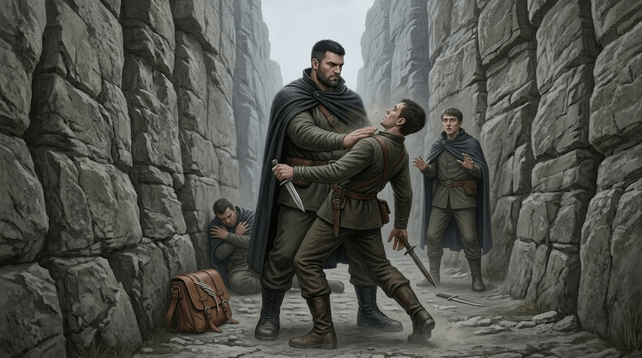
The north road ran through a cut in the limestone ridge two miles above Crestfall, where the banks rose on both sides and the road narrowed to accommodate a single cart. Senne had positioned himself at the far end of the cut, where the road widened again — the blocking position, intended to halt forward movement. The two others were on the banks above, one to each side, staggered so that their angles of descent didn’t interfere with each other.

Textbook. Clean. Competent.

Breck had identified the cut on his third evening in Crestfall, while walking the approaches to the north road under the guise of checking his horse at the waystation. He had noted it as the single unavoidable piece of terrain between Crestfall and the first junction, which meant it was the single unavoidable decision point for anyone who wanted to intercept someone leaving by the north road. He had filed it under problems that might require attention.

He had entered the cut at a walk, hands loose at his sides, satchel settled across his chest, because changing his pace or his posture in the approach would have communicated the wrong thing and he had no interest in communicating anything useful to people positioned to ambush him.

He had also entered it with his right hand already adjusted on the satchel strap — not reaching for anything, just repositioned, the way a man shifted his grip during a long walk — so that when the moment came, the movement required to do what needed doing was already half-completed.

The moment came at the cut’s midpoint.

Senne stepped out from behind a limestone shelf at the far end. Unhurried. Controlled. His right hand held a short blade — not a sword, practical choice, close quarters and limited swing room — and his expression was the expression Breck had been watching for four days: watchful, assessing, stripped of everything that wasn’t operationally relevant.

“Leave the satchel,” Senne said. His voice was level. “Walk back the way you came. That’s the whole transaction.”

The two on the banks hadn’t moved yet. They were holding their positions, which was correct — movement too early would break the geometry, and Senne was giving the verbal option its fair chance before escalating. Professional. Breck respected that.

He looked at Senne for a long moment. At the blade, the positioning, the gap between them — eighteen feet, enough for Senne to close before Breck could reach him but not enough to be comfortable about it. At the banks, where the two others were still and dark against the gray limestone.

He thought about the documents against his chest. About Aldric Moss’s neat architectural handwriting, preserved through fourteen months of darkness beside a hearthstone, finally in the light.

He thought about a girl in a valley who had given him everything she had to give and had received nothing adequate in return. About the specific weight of a debt that couldn’t be paid backward — only forward, in kind, to other people in other places, carried on the road from one town to the next with the same patient, aching, insufficient faithfulness.

He thought about the fire he had built this morning in a cold room, already burning without him.

He thought — briefly, with the compressed economy of a man who had long practice thinking quickly in narrow spaces — about what he was made of.

Not what he had been made of in the war. Not what the war had required of him, which had sometimes been things he did not choose to revisit in the daylight hours. But what he was made of beneath that — the original material, the grain-farm boy who had learned to read rivers, who had understood at ten years old that water found paths around obstacles by the simple application of patience and consistent pressure, not by force, not by declaration, just by continuing to move.

He had been continuing to move for a very long time.

“No,” he said.

Senne came forward the way Breck had expected — fast, low, direct, no wasted theater. He was good. Considerably better than Pelk, considerably better than the two in the alley, and the blade was an honest tool in his hand rather than a prop. The two on the banks came down simultaneously, which was the correct response to Breck declining the verbal option — both flanks activating together to prevent the obvious counter of engaging one before the other arrived.

The obvious counter was not what Breck had in mind.

He moved toward Senne rather than away — inside the blade’s effective reach, which negated its primary advantage and converted the distance between them from Senne’s asset to his own. His left forearm intercepted the blade arm above the wrist, pinning it, redirecting rather than blocking — he’d learned early that blocking a committed strike was a losing proposition against a man who meant it — and his right hand drove a precise open-palm strike into Senne’s sternum, not the hardest blow he could throw but accurately placed and sharply timed, targeting the body’s central nerve cluster.

Senne folded at the diaphragm. Not out — the man had iron in him — but compromised, the wind gone, the blade still in his hand but the hand no longer receiving reliable instructions from the rest of him.

The first bank man reached Breck’s left side three seconds later and found that Breck had already rotated — using Senne’s compromised body as a partial barrier, forcing the bank man to commit to an angle that took him away from his partner — and the elbow that met his forward momentum was not something he had been adequately prepared for. He went down hard. Stayed there, contributing the specific vocal expressions of someone whose collarbone had received new and unwelcome information.

The second bank man stopped.

He was six feet away, on Breck’s right, and he had seen the previous four seconds with full clarity, and he was performing the mathematics that the situation presented with the rapid, honest attention of a young man who had perhaps not fully modeled all the variables before signing on for this particular assignment.

His name, Pell’s map had noted, was Torven. He was nineteen years old. He had a mother in the lower town who mended sails for the river merchants and a younger brother who helped her on the days her hands ached.

“Torven,” Breck said. His breathing was elevated but controlled. “Put it down.”

The young man looked at him. At Senne on one knee in the road, blade dropped, both hands pressed to his sternum. At his partner on the ground with his collarbone. At Breck — at the size of him, at the quality of stillness that had descended over him in the aftermath of the preceding four seconds, the combat stillness, the particular absolute calm of a man who had found and settled into the thing he was made of and was standing in it without apology or performance.

Torven put the blade down.

It made a small sound on the limestone road. A very small sound, in the quiet of the gray morning, the limestone walls on either side and the sky overhead just beginning to consider the possibility of light.

Breck looked at him for a moment longer. Then at Senne, still on one knee, working his breathing back toward functional with the focused determination of a man who had been hurt before and understood the process.

“Tell Drav,” Breck said to Senne, “that the letter is already on its way. The documents too. It’s done. Whatever he does now — ” he paused, looking at the road that ran ahead between the limestone banks toward the first junction and the north road beyond — “doesn’t change what’s already been set in motion.”

Senne looked up at him. His eyes were steady and old even in their discomfort, the eyes of a man absorbing information and filing it with the professional rigor of someone who would deliver it accurately regardless of how it had been received.

He nodded once.

Breck picked up his satchel — he’d set it against the limestone wall before any of it started, because the job didn’t get damaged — settled the strap across his chest, touched the bracelet once.

Then he walked out of the cut and onto the north road and didn’t look back.

The sky had made its decision about the light by then. It was arriving, gray and thin and honest, the way mornings arrived in Lumenvale in late autumn — without ceremony, without announcement, simply present, simply real.

He walked into it.

This is Chapter 15 of BRECK: Dead Delivery, a serialized noble dark fantasy story by Chadwick Rye, set in the world of Lumenvale. Breck is a veteran courier — a man who can’t walk past certain things — moving through a medieval world one delivery at a time. New chapters post daily at noon Eastern.

← Chapter Fourteen — The Small Thing | Chapter Sixteen — Coming Tomorrow →

#Action #actionThriller #adventure #books #cozyFantasy #Crestfall #dailyprompt #dailyprompt2767 #DarkFantasy #EpicFantasy #fantasy #FantasyAdventure #FantasyFiction #fantasyThriller #fiction #FreeFantasyFiction #freeFantasyFictionOnline #FreeStory #HighFantasy #lowFantasy #Lumenvale #Millhaven #writing

BRECK: Dead Delivery — Chapter 14: The Small Thing

Daily writing prompt What’s a simple pleasure in life that brings you joy? View all responses

BRECK: Dead Delivery — Chapter Fourteen

The Small Thing

This is Chapter 14 of BRECK: Dead Delivery, a serialized noble dark fantasy story by Chadwick Rye, set in the world of Lumenvale. New chapters post daily at noon Eastern.

The Story So Far

Breck is a veteran courier — 6’5″, 285 pounds, former Crystal Wars special operations — who arrived in Crestfall on a routine delivery and found a town quietly strangled by a corrupt magistrate named Voss. He has spent twelve days building a case from the inside: a hidden ledger from a dead miller’s widow, a chalk map from a twelve-year-old boy named Pell, a gap in the patrol created by a young enforcer named Jorin. Last night he went through the unlatched side door at half past the eighth bell, retrieved the original documents from the magistrate’s storage room, and walked back out through a dark corridor where Drav was waiting. Drav stepped aside. One step. Just enough. The documents are now against Breck’s chest alongside the copy kept warm for fourteen months beside a hearthstone. Voss will discover the empty box at the second bell this morning. The north road is waiting. Breck has until then.

← Chapter Thirteen — The First Time | Chapter Fifteen — Coming Tomorrow →

Chapter Fourteen: The Small Thing

This chapter explores the simple pleasures that make a life worth living — and what it means to finally let yourself have one.

He was downstairs before Maret.

That had not happened before. In four mornings at The River’s Rest, the innkeeper had always been ahead of him — the fire already built, the bread already past its first warmth, the particular quality of a space that had been tended before he arrived in it. This morning the common room was cold and dark and entirely his own, and he stood in it for a moment with the oilskin packet and the retrieved documents against his chest and let the silence of the place settle around him.

Then he built the fire himself.

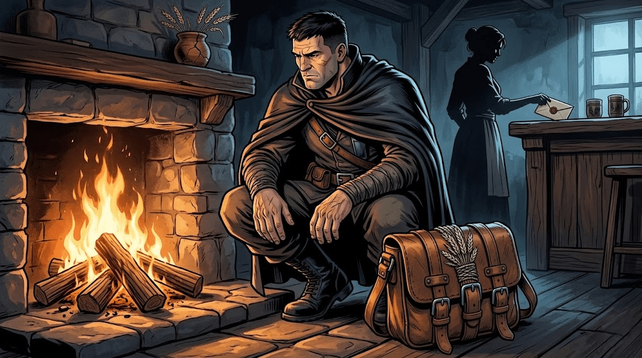
He knew how — had known since childhood, since the farm on the Lumenvale outskirts where the morning fire was the first task and the last task and the task that bracketed everything in between. You started with the coal-bed if there was one, or with kindling arranged in the particular geometry that caught and held rather than flared and failed, and you fed it with the patience of someone who understood that a fire could not be rushed into existence, only invited. He worked the hearthstone with the methodical attention he brought to most things, feeding the kindling in careful increments, watching the catch spread from one piece to the next with the unhurried satisfaction of a process unfolding correctly.

The fire took.

He sat back on his heels and watched it establish itself — the tentative early flame giving way to something more committed, more certain, the warmth beginning its slow radius outward into the cold room. There was no more purely simple pleasure than this, he thought. A fire built by your own hands in a cold room. The particular satisfaction of it had nothing to do with scale or significance. It was complete in itself — a small act done well, yielding a result you could feel against your face.

He’d thought about this more than usual in the past few days. About small pleasures. About what made a day worth the living of it, stripped of everything exceptional and left with only what remained when the exceptional was gone.

The stone house. The south-facing light. A dog.

He thought about bread, too — the specific pleasure of bread eaten when you were genuinely hungry after genuine work, the way it tasted like more than it was, the way simple food taken at the right moment carried a satisfaction that elaborate food served at the wrong one never could. He thought about the sound of rain on a roof when you were inside and dry. About the first cup of something hot in the morning, held with both hands, the warmth working its way from the palms inward.

About a bracelet made from grain stalks by small hands, given without calculation, because the giving was what there was to give.

He heard Maret on the stairs before she reached the bottom — not because she made noise, but because he had been in her building long enough to know the particular creak of the third step from the bottom and had begun, without deciding to, to listen for it.

She stopped in the doorway of the common room. Looked at the fire. Looked at him, crouched before the hearthstone with the fire built and his hands resting on his knees.

Something moved across her face — brief, private, filed away quickly in the manner of a woman who had learned to process things internally rather than display them. She came to the bar and began her morning routine without commenting on the fire or on his presence before her, which was the courtesy of someone who understood that some things were more fully honored by silence than by acknowledgment.

He took his usual stool. She put the herbs in the water without being asked.

They sat in the companionable quiet of people who had shared enough mornings to have no need to fill them.

“He’ll find the room empty at the second bell,” Breck said eventually.

“I know.”

“He’ll send for Drav before the third.”

Maret’s hands were still around her cup. “And Drav?”

Breck looked at the fire. “Drav will take his time getting there.”

She absorbed this with the particular stillness of a woman filing a piece of information that changed the shape of several other pieces she already held.

“How much time do you need?”

“I’ll be on the north road before the second bell.” He paused. “The documents go to the Regional Adjudicator in Millhaven. Three days’ ride. His jurisdiction covers river trade disputes and local governance — Voss’s operation falls squarely inside it.” He reached into the satchel’s secondary pouch and set a sealed letter on the bar. “This goes with the documents. It explains the ledger, the methodology, the collection scheme. I’ve cross-referenced the copy against the originals.” He looked at her. “I need someone to carry it.”

Maret looked at the letter. Then at him. “You trust me with that.”

It was not quite a question.

“You’ve kept this building running for twenty years under conditions that would have broken most people,” he said. “Yes.”

She picked up the letter and held it in her hands for a moment — feeling its weight, the way she felt the weight of most things before deciding what to do with them.

“There’s a grain merchant named Foswick who runs the Millhaven road twice a month,” she said. “He leaves this Friday. He owes me a considerable favor from three winters ago and has the discretion of a man who understands that discretion is a business advantage.” She set the letter on the bar with the careful placement of a decision made. “He’ll deliver it.”

Breck nodded.

The fire had fully established itself now, filling the hearth with the steady, generous warmth of something that had been properly built and was doing exactly what it was built for. The room smelled of burning oak and the herbs in his cup and the particular early-morning smell of a building that had been tended by the same hands for two decades and carried that tending in its stones.

“Sela,” he said. “The miller’s wife. She should be told before I leave.”

“I’ll go this morning.” Maret’s voice was even, but something moved underneath it — the quality of a person absorbing the full weight of what they were agreeing to do, not flinching from it. “Before the second bell.”

He looked at her across the bar, across the fire’s warmth and the steam rising from two cups and the letter between them that contained fourteen months of a dead man’s careful work.

“After this,” he said, “Crestfall will need someone to help it remember what it was.”

Maret was quiet for a moment. The fire worked. The morning pressed against the window.

“Crestfall has always known what it was,” she said finally. “It just needed someone to make it safe to say so again.”

He went upstairs one last time.

The room was as he’d kept it — spare, functional, the narrow bed made with military precision because old habits didn’t require intention to maintain themselves. He stood in the center of it for a moment, looking at the four square feet of bare floor where he’d inventoried his possessions four mornings ago, and felt the particular quality of a space that had briefly been inhabited and was already beginning the process of becoming unoccupied again.

He packed with the efficiency of a man who had been packing and unpacking in small rooms all his adult life. Everything in its place. Everything earning its weight. The oilskin copy of the ledger went back inside his shirt. The original documents went into the satchel’s document sleeve, sealed and protected. The compass. The straight-edge. The chalk, shorter now. The money pouch. The knife. The flint. The waxed cord. The tin of salve for the heel that was finally healing properly after four days of not being on the road.

He picked up the satchel and settled the strap across his chest.

Moved the bracelet from the table — where it had spent the night, beside the two documents, keeping something like company with a dead man’s handwriting — back to the strap. Wound it twice. Felt it settle in its familiar place.

Pale. Small. Saying nothing.

He thought about the fire he had just built downstairs, already doing its quiet work in the cold room without him. About a cup of hot water held with both hands. About bread at the right moment and rain on a roof and the small things that carried the weight of everything worth carrying.

About a girl who had given a man a thing made of grain stalks and roof grass because it was what she had, and because the giving was what there was to do, and because sometimes the small thing is the whole thing, and there is no larger version of it anywhere.

He picked up the satchel. Walked to the door. Stopped with his hand on the frame and looked back at the empty room once — the way he always looked back at places he’d been, not from sentiment but from the habit of a man who liked to leave places the way he’d found them, and liked to know he had.

Then he went downstairs, and Maret was still at the hearth, and he said what needed saying, and she said what needed saying, and then he walked out of The River’s Rest and into the dark pre-dawn street and turned his boots toward the north road.

Behind him, the inn’s window showed a warm rectangle of firelight against the dark.

He had built that fire.

It would keep going without him.

This is Chapter 14 of BRECK: Dead Delivery, a serialized noble dark fantasy story by Chadwick Rye, set in the world of Lumenvale. Breck is a veteran courier — a man who can’t walk past certain things — moving through a medieval world one delivery at a time. New chapters post daily at noon Eastern.

← Chapter Thirteen — The First Time | Chapter Fifteen — Coming Tomorrow →

#adventure #BRECKDeadDelivery #ChadwickRye #dailyprompt #dailyprompt2766 #DarkFantasy #EpicFantasy #fantasy #FantasyFiction #fantasyThriller #fiction #FreeFantasyFiction #freeFantasyFictionOnline #FreeStory #HighFantasy #lowFantasy #Lumenvale #nobleDarkFantasy #serializedFiction #stories #thriller #writing

BRECK: Dead Delivery — Chapter 13: The First Time

Daily writing prompt If you could erase one movie from your memory and watch it again for the first time, which one would it be? View all responses

BRECK: Dead Delivery — Chapter Thirteen

The First Time

This is Chapter 13 of BRECK: Dead Delivery, a serialized noble dark fantasy story written by Chadwick Rye, set in the world of Lumenvale. BRECK follows Breck, a veteran courier and former Crystal Wars special operations soldier, as he moves through a medieval world one delivery at a time — and can’t always walk away from what he finds. New chapters post daily at noon Eastern on chadwickrye.wordpress.com.

The Story So Far

Breck is a veteran courier — 6’5″, 285 pounds, former Crystal Wars special operations — who arrived in Crestfall on a routine delivery and found a town quietly strangled by a corrupt magistrate named Voss. Over twelve days he has built a case from the inside out: the hidden ledger kept by a dead miller’s widow, the chalk map drawn by a twelve-year-old boy named Pell who has been watching this town come apart from a cooperage step, the gap in the magistrate’s patrol created by a young enforcer named Jorin who moved his post eight feet west every night for four months on the silent hope it would matter. Last night, Breck dismantled Pelk — Voss’s collection enforcer — in four seconds in an alley behind the granary. This morning, Drav sat two stools down at the inn bar and asked which side of the war Breck had been on. Breck told him. Tonight, the side door is unlatched. Tonight, the gap opens between the eighth bell and the ninth. Tonight, everything Breck has been building comes due.

← Chapter Twelve — The Learning Curve | Chapter Fourteen — Coming Tomorrow →

Chapter Thirteen: The First Time

This chapter explores what it feels like to see something for the first time — and what it costs when you can’t go back.

Chapter 13 Summary: Breck executes the plan that twelve days of groundwork made possible — slipping through the unlatched side door of the civic building between the eighth and ninth bells, retrieving the original documents stolen from miller Aldric Moss fourteen months ago, and exiting the way he came. In the corridor of the inn, he finds Drav waiting. They say almost nothing. Drav steps aside. Breck goes upstairs with the documents and the evidence he has been carrying, and counts the ninth bell.

He went in through the side door at half past the eighth bell.

Maret had left it unlatched exactly as he’d asked — the hinges oiled at some point in the recent past, because they made no sound, which was either coincidence or the innkeeper’s particular brand of thorough preparation, and Breck suspected coincidence had very little to do with how Maret ran her building. He eased the door open the width of his shoulders — considerable — and stepped into the narrow service corridor that ran between the inn’s rear wall and the magistrate’s stable yard next door.

The corridor smelled of horse and wet straw and the particular cold that collected in spaces between buildings, the cold that had nowhere to go and simply accumulated. A single tallow stub burned in a tin holder on a wall bracket, throwing just enough light to move by and not enough to be seen from either end of the corridor. He stood still for thirty seconds, listening to the night.

Crestfall at the eighth bell had its own specific silence — not the silence of an empty place but the silence of a populated place that had learned to hold its breath on schedule. The market square would be clear. The few remaining vendors who hadn’t packed before the third bell would have packed before the sixth. The streets would hold nothing but the magistrate’s men on their routes and the particular quality of dark that accumulated in a town that had learned not to put lights in windows after sundown if it could be helped.

He moved down the corridor toward the stable yard.

Jorin’s gap ran from the eighth bell to the ninth on the west face of the magistrate’s building — a forty-foot section of wall where the coverage went thin because Jorin had been moving his patrol point eight feet west over the course of four months, one measured increment at a time, building the gap so gradually that no one with oversight responsibility had noticed the pattern. Breck had stood across from that wall in daylight and in rain and had counted the windows and the distances between them and had built the picture of what lay inside from the outside in, the way he’d always built pictures during the war.

Three rooms on the ground floor facing the stable yard. The leftmost would be the clerk’s office — he’d confirmed this from the shadow pattern through the shutters during business hours, the particular stillness of a room occupied by someone who sat at a desk. The middle room was storage — the shadow pattern showed no movement and the smell coming through the gap in the shutters on his third observation pass had been the dry, papery smell of documents and sealed boxes. The rightmost would be Voss’s private office — the room with the heaviest shutters, the room that showed light longest into the evening, the room from which a thin thread of pipe smoke drifted at the end of the working day, suggesting a man who sat with his accounts after the clerks had gone.

It was the middle room he wanted.

Not because of what was there now. Because of what had been put there fourteen months ago — documents taken from a miller’s office in the night along with his correspondence and a deed to river land his father had left him, taken and filed away in the place where taken things went in a town run by a man like Voss. Aldric Moss had been careful enough to make a copy. Breck had that copy against his ribs in the oilskin packet. But the originals would have more weight with whatever authority came after this — and Breck intended there to be an authority that came after this.

The storage room window had a single iron latch that he’d felt through the gap in the shutters on his second observation pass, running his fingers along it in the dark with the particular careful attention of a blind man reading. Standard construction. Nothing complicated. The kind of latch that had been adequate for fourteen years and had never been asked to be more than adequate.

He asked it to be more than adequate now.

It held for approximately three seconds.

The room was exactly what the shadow pattern and the smell had suggested — shelves along three walls, floor to ceiling, carrying the accumulated administrative weight of Voss’s three years in office. Ledger books. Correspondence boxes, each labeled in the neat hand of the clerk who’d processed them. Rolled documents in wooden tubes, sealed and dated. The particular archaeology of a corrupt administration, layered like sediment, oldest at the bottom and working toward the present.

He didn’t light a candle. He worked by the thin thread of the tallow stub’s light through the open window, and by the older light of his own spatial memory, which was a map he’d built of this room from the outside and was now confirming from the inside. They matched. They generally did, if you paid the right kind of attention.

He found what he was looking for in the third box on the second shelf from the bottom, where documents from fourteen months prior had been filed in the methodical, chronological order of a clerk who had no particular feelings about what he was archiving and was simply doing the work. A miller’s license. A deed to river land. A bound collection of correspondence in a hand he recognized from the oilskin packet against his ribs — the same neat, architectural handwriting, the same careful precision of a man who had understood exactly what he was building.

Aldric Moss had been thorough in everything.

Breck placed the documents inside his cloak, against his chest, alongside the copy that had been kept warm beside a hearthstone for fourteen months by a woman who had learned to hope in very small, very careful amounts. Then he stood still for a moment in the dark room, among the filed evidence of three years of quiet theft, and let the weight of it settle.

The first time he’d broken into an enemy position — a Karithian supply cache, second year of the Crystal Wars, a river crossing that had taken three attempts to cross — he had felt afterward something he hadn’t expected and hadn’t been able to name until much later. Not triumph. Not relief. Something more like the specific grief of a man who has seen, for the first time, clearly, the shape of what he is capable of — and understands that having seen it, he can never quite see himself the previous way again.

He felt something adjacent to that now.

Not grief exactly. But the awareness of a threshold crossed. The documents in Aldric Moss’s hand, filed in a box labeled with the date of a night when three men had come and taken them along with the miller himself — those documents existed now in a different place than they had existed this morning. The case had been built. The copy was the argument. The originals were the proof.

Whatever came next, this had happened. That was the nature of certain kinds of action. They existed in the past tense from the moment they were completed, permanent and unalterable, the way a thing seen for the first time could not be unseen.

He crossed back to the window. Eased it open. Stepped out into the corridor and pulled it closed behind him, feeling the latch seat itself back in its frame with a small, final sound.

He heard Drav before he saw him.

Not because Drav made a sound — he didn’t. Because the quality of the silence at the far end of the corridor changed in the specific way that silence changed when it was occupied by someone who had learned, the same way Breck had learned, not to announce themselves.

Breck stopped.

The corridor held them both, twenty feet apart, in the thin light of the tallow stub. Drav stood at the corridor’s entrance to the stable yard, in the plain dark clothing he always wore, his hands at his sides. The scar caught the faint light. His expression was the expression he’d had at the bar that morning — old and complicated and stripped of everything that wasn’t strictly necessary.

He looked at the shape of Breck’s cloak. At the place where it sat differently than it had on any previous day — the bulk of documents against his chest, invisible but present.

He didn’t say anything.

Breck didn’t say anything.

The tallow stub burned its patient fraction lower. Somewhere in the stable yard a horse shifted its weight and blew through its nose in the mild, unconcerned way of animals uninvested in human complications.

Then Drav stepped aside.

Not a wide step. Just enough. The corridor was adequate for a large man to pass if both parties were willing to be in it simultaneously without incident. Drav’s positioning made it clear that he was willing.

Breck walked past him.

At the corridor’s end, at the door that opened back into the inn’s rear passage, he stopped without turning around.

“The north road,” Drav said quietly, from behind him. His voice was the same as it had been at the bar. Low. Stripped. “Tomorrow morning. Before the bells.”

“I know,” Breck said.

“He’ll know by the second bell. When the clerk opens the room.”

“I know that too.”

A pause that contained several things that neither of them was going to say.

“Drav,” Breck said.

“Don’t.”

He didn’t. He opened the door and stepped back into the warmth of the inn, and the door closed behind him, and in the corridor Drav stood alone in the thin tallow light for a moment before the silence resettled over everything.

Breck went upstairs. Set the documents on the table beside the oilskin packet and looked at them together in the candlelight — the copy and the originals, the evidence kept in hope and the evidence filed in certainty, reunited after fourteen months in the dark.

He sat on the edge of the bed and looked at them for a long time.

Then he moved the bracelet from his wrist to the satchel strap, the nighttime version of the habit, and lay down on the narrow bed and stared at the ceiling and thought about a man seeing something clearly for the first time, and the specific irreversibility of that.

Outside, the ninth bell rang across Crestfall’s quiet rooftops.

Right on schedule.

BRECK: Dead Delivery is a serialized noble dark fantasy story written by Chadwick Rye, published free on chadwickrye.wordpress.com. Set in the world of Lumenvale, it follows Breck — a veteran courier and former Crystal Wars special operations soldier — as he moves through a medieval world one delivery at a time, and can’t always walk past what he finds. New chapters post daily at noon Eastern. Chapter 13: The First Time — Breck retrieves stolen documents from the magistrate’s archive and crosses paths with Drav in the corridor.

← Chapter Twelve — The Learning Curve | Chapter Fourteen — Coming Tomorrow →

#adventure #books #BRECKDeadDelivery #ChadwickRye #dailyprompt #dailyprompt2765 #DarkFantasy #EpicFantasy #fantasy #FantasyFiction #fantasyThriller #fiction #FreeFantasyFiction #freeFantasyFictionOnline #FreeStory #lowFantasy #Lumenvale #nobleDarkFantasy #serializedFantasy #shortStory #thriller #writing

BRECK: Dead Delivery Chapter Twelve

Daily writing prompt How do you stay motivated when learning something new? View all responses

BRECK: Dead Delivery

Chapter Twelve — The Learning Curve

Daily prompt: How do you stay motivated when learning something new? — This chapter explores that question through Breck and Pell: what it means to learn something because you can’t stop, versus being told to.

About this series: BRECK: Dead Delivery is a serialized fantasy story set in the world of Lumenvale — a slow-burn noir about Breck, a former soldier turned reluctant courier navigating the corrupt town of Crestfall. Each chapter is a self-contained scene advancing an overarching mystery. This is Chapter Twelve. Read from the beginning →

Pell found him first.

The boy materialized from the narrow gap between the cooperage and the adjoining leather-worker’s shed the way he materialized from everywhere — without announcement, without the preliminary scuff of boots on stone that preceded most people’s arrivals, as though he had learned to move through Crestfall’s geography the way water moved through cracks: finding the path of least resistance, arriving exactly where pressure required him to be.

He fell into step beside Breck without preamble, his stride adjusted to Breck’s considerably longer one in the unconscious, practiced way of someone who had spent considerable time walking beside adults whose legs covered more ground than his own.

“You talked to Jorin,” Pell said.

It was not a question. The boy’s intelligence-gathering apparatus in this town had long since rendered questions largely redundant.

“I did.”

“He looked different at the third bell. When he took his post.” Pell’s eyes moved across the street ahead of them in his habitual scanning pattern — doorways, windows, the roofline, the place where the alley behind the grain merchant opened onto the main road. “Less like a man carrying something heavy. More like a man who knows what the heavy thing is finally for.”

Breck glanced at him sidelong. The boy was twelve years old and read people with the accuracy of someone who had learned young that accurate reading was a survival skill rather than a social grace. It was the kind of intelligence that didn’t come from instruction — it came from sustained, motivated observation, from years of watching a town compress itself under the weight of something wrong and cataloguing every effect of that compression with the patient thoroughness of a natural scientist.

“How did you learn to do that?” Breck said.

Pell considered the question with the seriousness it deserved, which was the way he considered most things.

“I didn’t know I was learning it,” he said finally. “I just kept watching because I couldn’t stop being interested. And then one morning I realized I could read the whole square from the cooperage step — who was afraid, who was performing, who was carrying something they hadn’t told anyone about.” He paused, his boots finding the dry center of a puddled stretch of cobblestone with the automatic precision of long familiarity. “My father says I should find something useful to do instead of sitting and watching all day.”

“Your father is wrong,” Breck said.

Pell looked at him with an expression that contained several emotions in rapid succession — surprise, then a flicker of something warmer, then the careful return to his habitual equanimity, the guard coming back up with the practiced ease of long habit.

“He taught me cooperage,” Pell said. “I wasn’t good at it.”

“Were you interested in it?”

A silence that was answer enough.

“The things you’re good at,” Breck said, “are usually the things you couldn’t stop doing when no one was watching. Not the things someone handed you and said — here, learn this, it’s useful.” He adjusted the satchel strap across his chest, feeling the familiar weight of it settle. “The motivation isn’t something you manufacture. It’s something you follow.”

They turned off the main road onto the narrower street that ran behind the market stalls, the one that gave a clear sightline to the magistrate’s office rear entrance without requiring proximity to it. Breck had walked this route three times in the past two days, at different hours, in different weather, building the three-dimensional picture that existed now in his memory with the clean detail of a well-drawn map.

He had learned to do this in the war.

Not from a manual or a commanding officer’s instruction — from necessity, and from the recognition that the alternative to thorough prior knowledge was improvisation under pressure, and that improvisation under pressure had a consistent and unacceptable cost. He had been afraid, in those first months of courier work, that he would make a mistake that could not be corrected. That fear had been the most effective teacher he’d ever had. It had made him pay attention with a quality of attention he hadn’t known he possessed until it was required of him.

The fear had faded over time, replaced by something quieter and more durable: the simple deep satisfaction of a thing done well. Of a route memorized completely, a plan built without gaps, the particular pleasure of arriving at the moment of action and finding that the preparation had been sufficient. That satisfaction was its own motivation. It compounded — each completed thing making the next one more desirable, the skill curve becoming its own reward once you were far enough along it to feel the difference between knowing something partially and knowing it completely.

“Tonight,” Pell said. Not a question, not a statement — something between the two, calibrated for confirmation.

“Tonight.”

The boy nodded once, with the gravity of someone absorbing a scheduled event rather than an uncertainty.

“What do you need me to do?”

“Nothing,” Breck said.

Pell looked at him. The look contained a precise and articulate objection delivered without words.

“I need you somewhere safe,” Breck said, with the slightly different inflection he used for things that were not negotiable. “What happens tonight is not something a twelve-year-old participates in. You’ve already done your part. The map was your part. It was essential and it’s done.”

The boy was quiet for three full strides — enough distance for Breck to understand that the quiet was not acceptance but processing, the argument being constructed rather than abandoned.

“He took the cooperage,” Pell said finally. His voice had changed register — lower, stripped of the careful equanimity, the actual thing showing through the way actual things showed through in people when they finally got to the real sentence. “Not just the income. My father sits in the back room now and stares at the tools and doesn’t pick them up. My mother pretends she doesn’t see it.” He looked straight ahead at the wet cobblestones. “Aldric Moss asked questions and disappeared. My father stopped asking questions and disappeared anyway. Just — differently.”

The street was empty around them. Rain had begun again in its fine, persistent way, darkening the stone and collecting in the low places and running in thin clear rivers along the gutter toward the Calwick somewhere below and behind the rear yards.

Breck stopped walking.

Pell stopped too, a half-step later, and looked up at him with the rain beginning to collect in his dark hair and the real thing still showing in his face, the careful equanimity down.

“I know,” Breck said.

Two words. No elaboration. Not because elaboration wasn’t available, but because Pell was twelve years old and intelligent enough to understand that two words from a man who didn’t waste them carried more weight than a paragraph from someone who did.

The boy held his gaze for a moment, checking the words for the thing that sometimes hid behind them — for the patronizing or the performative or the comfortable lie dressed as acknowledgment. He found none of those things, which was the only reason he accepted the words at all.

He nodded. A single motion. The real thing went back behind the equanimity, but differently than before — not suppressed, just carried more deliberately, the way you carried something once you understood it had a name.

“Go home after dark,” Breck said. “Keep your mother inside. Don’t come to the square regardless of what you hear.”

“And tomorrow?”

Breck looked at him — at the serious face and the rain-darkened hair and the intelligence behind the eyes that had been paying attention to this town since before it had given him any reason to stop.

“Tomorrow,” he said, “is a different lesson.”

He turned and walked back toward the inn, and the rain continued its patient work on the stones around him, and somewhere across the square the magistrate’s office sat with its fresh mortar and its town seal and the particular silence of something that did not yet know what was coming for it.

Behind him, Pell stood for a moment longer.

Then he turned and went home.

Chapter Eleven  |  All Chapters

Enjoyed this story? Writing Lumenvale is how I pay my bills. If these stories are worth something to you, a $1 Ko-fi keeps the forge burning — and tells me this world is worth continuing. 👉 Buy Chadwick a coffee

This is Chapter Twelve of BRECK: Dead Delivery, a serialized fantasy story by Chad Rye, set in the world of Lumenvale. New chapters posted regularly at chadwickrye.wordpress.com.

#adventure #books #Breck #Crestfall #dailyprompt #dailyprompt2764 #DarkFantasy #DeadDelivery #EpicFantasy #fantasy #FantasyFiction #fiction #FreeFantasyFiction #freeFantasyFictionOnline #FreeStory #lowFantasy #Lumenvale #MaleProtaginst #shortStory #StrongMaleLead #writing

BRECK: Dead Delivery Chapter Eleven

Daily writing prompt What’s a book that completely surprised you? View all responses

BRECK: Dead Delivery

Chapter Eleven — What You Don’t See Coming

Prompt: What’s a book that completely surprised you? Tags: dailyprompt | Breck | Crestfall | Dead Delivery | Lumenvale

The book was called The Weight of Small Things, and Breck had found it wedged between two loose stones in a courier waystation outside Aldenmere three years ago, left by some previous traveler in the wordless tradition of waystations everywhere — the understanding that what you no longer needed might be exactly what the next person required.

He hadn’t expected anything from it. The cover was water-damaged, the spine cracked and reglued badly, the title so deliberately humble it seemed almost designed to discourage reading. He’d picked it up because the rain had pinned him to the waystation for six hours and he’d exhausted his other options.

It had surprised him completely.

Not because it was grand — it wasn’t. It was a small book about a small life: a river-ferry operator in some unnamed valley town who crossed the same water every day for forty years, taking people from one bank to the other, watching the seasons turn and the faces change and the small human dramas of ordinary existence play out on both sides of a thirty-foot stretch of moving water. No wars. No magic. No destiny arriving to transform the ferryman into something larger than himself. Just a man and a rope and a current and forty years of paying attention.

What had surprised Breck was how much it contained.

He thought about that book now, moving through Crestfall’s midday streets with his satchel across his chest and Pell’s map alive in his memory, because the ferryman had understood something that most people spent their lives circling without quite reaching: that the texture of a thing was in its dailiness, not its exceptions. That the thirty-foot crossing was not preparation for some larger crossing that would eventually come and justify the smaller one. The thirty-foot crossing was the thing itself. Done with attention, it was enough.

Done with attention, almost anything was enough.

He found Jorin at the well.

The young man was drawing water in the particular way of someone performing a task they didn’t need to perform — the movements too deliberate, the focus too careful, the whole posture radiating the studied purposefulness of a person who needed to be somewhere with a reason. He was perhaps twenty-two, dark-haired, with a broad open face that had been designed by nature for uncomplicated emotions and had since been required to host considerably more complicated ones than it had been built for.

He heard Breck coming — the size of him announcing itself in advance the way it always did, the particular displacement of air and attention that preceded him into any space — and his hands tightened on the well rope before he made the deliberate choice to release them.

Breck stopped a few paces away. Close enough to speak quietly. Far enough to leave the young man room to breathe.

“Jorin,” he said.

The young man looked at him with eyes that had been doing difficult calculations for some time and hadn’t yet arrived at a sum they could live with.

“I know who you are,” Jorin said. His voice was carefully level. “I know what happened in the alley last night.”

“Word travels.”

“In Crestfall it does.” He looked back at the well, at the rope in his hands, at the cold water moving in the stone depths below. “Pelk is telling people he fell.”

“I know.”

“Nobody believes him.”

“I know that too.”

The midday light was flat and pale, the sun somewhere behind the overcast making its presence felt without committing to visibility. Around the square the ordinary business of Crestfall continued its careful, head-down rhythm — the eleven stalls, the vendors who moved quickly and spoke quietly and packed early, the architecture of a town that had learned to need very little from any given day.

“You were on the west side of the magistrate’s building,” Breck said. “The second watch. The gap in the coverage runs from the eighth bell to the ninth.”

Jorin said nothing. His jaw was tight.

“You’ve been moving the patrol point,” Breck continued, his voice carrying no judgment, no accusation — simply the flat, accurate quality of a man reading a map he hadn’t drawn. “Not far. Not enough to be noticed. Just enough that the gap is there consistently.”

The silence that followed had a specific texture — the texture of a person standing at the edge of something they had been approaching for a long time and were only now close enough to feel the drop.

“I didn’t know what it would be for,” Jorin said finally. The words came out compressed, as though they’d been held under pressure and he’d only opened a small valve. “When I started. I just — I couldn’t be the reason someone got hurt. So I moved the point. Just in case.” He looked at Breck with the eyes of a man confessing something he’d never expected to say aloud. “I’ve been doing it for four months.”

Four months of small daily choices. Four months of moving a patrol point eight feet west and hoping it mattered to someone, someday, without knowing who or how or whether anything would ever come of it.

The ferryman, Breck thought, crossing the same water every day.

“The miller,” Breck said. “Aldric Moss.”

Jorin’s face changed. Something cracked open in it — not dramatically, the way things cracked open in stories, but the way they cracked open in real life, quietly and with considerable effort, the way a stone cracked when the frost got into it and worked its patient seasonal arithmetic.

“I didn’t know they were going to — ” He stopped. Started again. “I was told it was a property dispute. That he’d be questioned and released.” His hands had found the well rope again and were gripping it the way a man gripped the thing nearest to him when the ground shifted. “By the time I understood what had actually happened, I was already — I’d already — “

“You were already in,” Breck said.

“Yes.”

A sparrow landed on the well’s stone rim between them, regarded the situation with the frank indifference of a creature with no stake in it, and departed.

Breck looked at the young man — at the broad open face carrying its freight of accumulated wrong turns, at the hands that had been moving a patrol point eight feet west for four months on the slim, unspoken hope that it might someday matter. He thought about a book found in a waystation that had no reason to be extraordinary and had been extraordinary anyway. He thought about small things and the weight they carried without announcing it.

“What I’m going to do tonight,” he said, “requires that gap to be there.”

Jorin looked at him. His breathing was shallow, his eyes moving across Breck’s face with the rapid, desperate attention of a man trying to read the full terms of a document he hadn’t expected to be offered.

“And afterward?” he said.

“Afterward you’ll need to not be in Crestfall for a while.” Breck paused, considering the honest version of what came next. “Maybe a long while. You have family south of here?”

“My mother. In Brackfen. Two days’ walk.”

“Go to Brackfen.” He reached into the satchel’s secondary pouch — not the oilskin packet, something else, the money pouch, which was lighter than he preferred but held enough. He set two silver coins on the well’s stone rim beside the sparrow’s abandoned spot. “Tonight, after the eighth bell. Don’t take the main road.”

Jorin looked at the coins. Looked at Breck. Something moved through his expression — the complex, reluctant movement of a young man accepting that the story he was in had reached a point where small choices were no longer available and only large ones remained.

He picked up the coins.

“The gap will be there,” he said.

Breck nodded once. Picked up his satchel. Adjusted the strap across his chest in the habitual, unconscious way, his thumb brushing the bracelet as it passed — not checking it exactly, just acknowledging it, the way a man acknowledged the weight of a thing he’d decided to carry without putting it down.

He walked back across the square toward the inn.

Behind him, Jorin stood at the well with his rope and his water and his two silver coins and the specific quality of relief that came not from a burden being lifted but from finally understanding what the burden had always been preparing you for.

The water in the well moved in its cold stone dark, indifferent and continuous, going nowhere and arriving everywhere, the way water always did.

Enjoyed this story? Writing Lumenvale is how I pay my bills. If these stories are worth something to you, a $1 Ko-fi keeps the forge burning — and tells me this world is worth continuing. 👉 Buy Chadwick a coffee

#adventure #books #Breck #Crestfall #dailyprompt #dailyprompt2763 #DarkFantasy #DeadDelivery #EpicFantasy #fantasy #FantasyFiction #fiction #Free #FreeFantasyFiction #freeFantasyFictionOnline #FreeStory #Lumenvale #shortStory #thriller #writing