 Chadwick Rye
BRECK: Dead Delivery:Chapter Sixteen: The Road That Knows You
Daily writing prompt How do you plan the perfect road trip? View all responsesBRECK: Dead Delivery — Chapter Sixteen
The Road That Knows You
This is Chapter 16 of BRECK: Dead Delivery, a serialized noble dark fantasy story by Chadwick Rye, set in the world of Lumenvale. New chapters post daily at noon Eastern.
The Story So Far
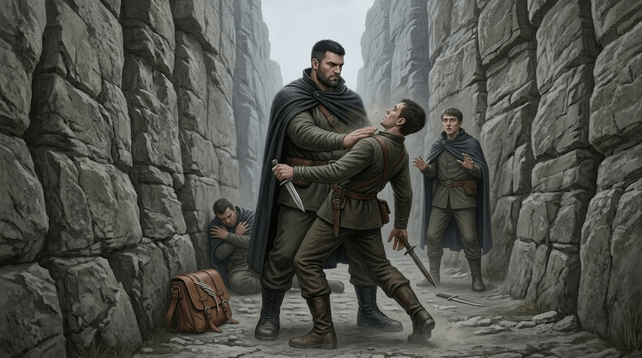
Breck is a veteran courier — 6’5″, 285 pounds, former Crystal Wars special operations — who arrived in Crestfall on a routine delivery and found a town quietly strangled by a corrupt magistrate named Voss. He built the case, retrieved the original documents, survived a well-planned ambush in a limestone cut two miles above Crestfall, and walked out onto the north road while the gray morning arrived without ceremony around him. The letter is in motion — a grain merchant named Foswick carrying it toward the Regional Adjudicator in Millhaven. The originals are against Breck’s chest. Drav has received Senne’s message. What happens in Crestfall now happens without Breck in it. He is on the road. The road is the only place he has ever fully understood.
← Chapter Fifteen — Stronger Than You Knew | Chapter Seventeen — Coming Tomorrow →
Chapter Sixteen: The Road That Knows You
This chapter explores what it means to move through the world with intention — and what the road gives back to a man who has learned to read it.
The north road opened after the limestone cut like a long exhale.
Breck felt it in his chest — the particular release of terrain that had been held and narrow becoming wide and possible, the road broadening from the single-cart width of the cut to the full double-track of a maintained trade route, the banks dropping away on either side to reveal the Lumenvale valley spreading itself across the mid-morning light like something that had been waiting patiently for him to arrive and look at it properly.
He stopped at the ridge’s crest and looked.
Below him the valley ran south and west in the particular luminous gray-green of late autumn, the fields stripped to their bones after harvest, the hedgerows thick with the last dark berries, the river — the Calwick’s upper fork — catching the weak sun in brief silver flashes between the tree lines. Crestfall was invisible from here, folded into the valley’s lower geography, its rooftops and its square and its eleven market stalls and its innkeeper standing at a cold hearth all compressed into the distance behind him into something too small to see.
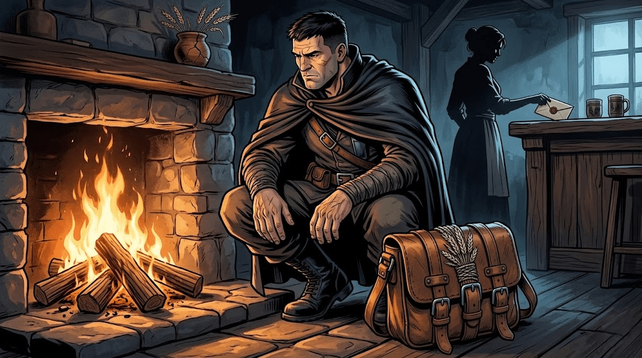
He knew it was there. He knew it was different than it had been twelve days ago when he had come down the hill toward it in the flat colorless midday light and noted a market square with eleven stalls where there should have been thirty and a boy on a cooperage step with eyes too old for his face. He knew that Maret had gone to Sela this morning before the second bell, as she’d said she would. He knew that Pell was somewhere in that invisible town with a piece of chalk in his pocket and fourteen months of patient careful watching finally cashed in for something it had been worth.
He knew that somewhere in the valley below, a grain merchant named Foswick was on the Millhaven road with a sealed letter against his chest, carrying the weight of a dead man’s careful work toward the one authority in this part of Lumenvale with the jurisdiction and the obligation to act on it.
He knew that Drav was in Crestfall, receiving a message, making a calculation, standing at the edge of a choice that Breck could not make for him and would not have tried.
He adjusted the satchel strap across his chest, feeling the documents settle against his ribs, and turned his face north.
A man who spent his life on the roads of Lumenvale learned them the way a sailor learned water — not as static geography but as living systems, each route possessed of its own character, its own seasonal moods, its own particular demands and gifts. The north road from Crestfall to the valley junction ran twenty-two miles of mixed terrain: the limestone ridge country first, sharp and cold and demanding precise footwork on the frost-edged stone, then the descent into the broad agricultural plain that fed the river towns, then the long flat miles of farm road between harvested fields where the wind came in off the eastern hills without obstruction and a man either made friends with it or spent the day fighting it.
Breck made friends with it.
He had learned this on his first long posting after the war — a six-day route between two river settlements that ran entirely across open ground with no shelter and wind that came from three directions simultaneously, seemingly without regard for meteorological convention. He had spent the first two days fighting it, leaning into it, exhausting himself against it, arriving at the waystation at the end of each day with less in reserve than he should have had. On the third day, from some combination of depletion and accumulated wisdom, he had simply stopped fighting and started moving with it instead — adjusting his angle, reading its shifts, letting it carry him when it moved in his direction and conserving himself when it didn’t.
He had arrived at the end of the third day with something left.
The road taught you things, if you paid attention. It taught you the difference between terrain that demanded your full engagement and terrain that rewarded a kind of loose, watchful ease — the difference between the limestone cut, where every footfall required deliberate placement, and the farm road, where the ground was even and the miles accumulated without insisting on being counted. It taught you when to eat and when to wait, when to push and when to simply move, when the body’s complaints were worth heeding and when they were simply the body’s habit of complaint, which was different from actual limitation and worth distinguishing carefully.
It taught you, most fundamentally, that a road was not a problem to be solved. It was a relationship to be maintained. The routes that gave him the most — the cleanest arrivals, the fullest reserves, the particular quiet satisfaction of a day’s travel concluded at the right pace — were the routes he had run enough times to know well, to anticipate, to meet not as obstacles but as familiar territories with their own specific requirements and rewards.
He had run parts of this road before. Not this exact stretch, but adjacent ones, the connected network of Lumenvale’s north-valley routes that he had accumulated over three years of post-war courier work into a comprehensive interior map — not the paper kind, though he could draw those too, but the bodily kind, the kind that lived in the feet and the legs and the particular calibration of effort that came from knowing exactly what was ahead and how much it would cost.
He knew, for instance, that the descent from the ridge to the plain took forty minutes at his pace and rewarded aggressive walking — the gradient was sufficient to generate momentum if you committed to it, and the footing was good enough on this route to trust that commitment. He knew that the farm road section was where he could let his mind move freely, because the body could handle the terrain without his full attention, and that this freedom was one of the genuine gifts of the long road — the hours when the legs did their reliable work and the mind was left entirely to itself.
He thought, in those hours, about Crestfall.
Not with anxiety — the plan was in motion, the variables were what they were, the things that could be controlled had been controlled and the things that couldn’t had been left to the nature of things that couldn’t be controlled. He thought about it with the particular quality of attention he brought to completed work — the backward look that wasn’t regret and wasn’t nostalgia but something more like assessment, the honest accounting of what had been done and how, the filing away of lessons for the next time.
He thought about Pell, who had been paying attention for years before anyone gave him a reason to. About Sela, who had kept a copy warm beside a hearthstone for fourteen months on the slim and faithful hope that someday someone useful would arrive. About Maret, who had run a building for twenty years in a town that had been slowly made worse, and had done it without bitterness, which was harder than it looked.
He thought about Jorin, somewhere on the road to Brackfen with two silver coins and the specific relief of a burden that had finally found its purpose.
He thought about Drav. Stood for a long moment in the middle of the farm road with the eastern wind moving past him and thought about a man in a river town tavern three years ago, choosing structure over dissolution, loyalty over nothing, the only identity available to him over the absence of any identity at all. About whether that man, standing now in Crestfall with Senne’s message in his ear and Voss’s orders in his hands, would make a different calculation.
He did not know. He had given Drav the only thing he had to give — the truth about which side of the war they’d each been on, the acknowledgment that the roads they’d run had been the same roads from opposite directions, that the things done in that valley had been done by men with the same training and the same fears and the same impossible arithmetic of orders and conscience. Whether that was enough to tip the balance of a choice Breck couldn’t make for him — that was not something the road could tell him.
He let it go. Filed it in the category of things that were no longer in his hands, which was its own skill, the one that took the longest to learn and never became fully automatic.
The farm road ran between its stripped fields, gray and wide and patient. The eastern wind moved along with him in its indifferent, useful way. Somewhere ahead the valley junction waited — the waystation, the hot meal, the next job, the next road, the next town that would ask something of him he hadn’t planned to give.
He thought about the stone house. South-facing. A dog. Work that stayed finished.
He thought about the bracelet on the satchel strap — pale as grain stalks, small as a child’s hope, wound twice around the leather in the way it had always been wound.
He thought about a girl who had understood, at eight or nine years old, that the giving was what there was to do.
He walked into the wind.
This is Chapter 16 of BRECK: Dead Delivery, a serialized noble dark fantasy story by Chadwick Rye, set in the world of Lumenvale. Breck is a veteran courier — a man who can’t walk past certain things — moving through a medieval world one delivery at a time. New chapters post daily at noon Eastern.
← Chapter Fifteen — Stronger Than You Knew | Chapter Seventeen — Coming Tomorrow →
☕ Enjoyed this story? Writing Lumenvale is how I pay my bills. If these stories are worth something to you, a $1 Ko-fi keeps the forge burning — and tells me this world is worth continuing. 👉 Buy Chadwick a coffee
#Action #actionThriller #adventure #bible #books #BRECKDeadDelivery #ChadwickRye #dailyprompt #dailyprompt2768 #DarkFantasy #EpicFantasy #fantasy #FantasyFiction #fantasyThriller #fiction #FreeFantasyFiction #freeFantasyFictionOnline #FreeStory #god #HighFantasy #lowFantasy #Lumenvale #nobleDarkFantasy #serializedFantasyFiction #thriller #veteranCourierFantasy #writing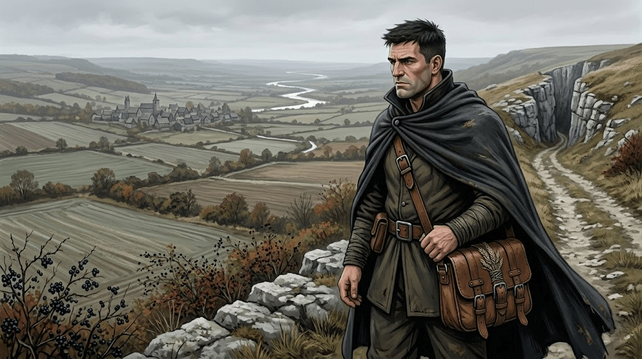
 Timo Kümmel



 Paul Semel