Today I join my #Siblings to wish My #mom a happy mother's day again
#esther #Bahdlexempire #bahdlex #Bahdlexblog #bahd #Lex #iamsilas #gplentylv #may #May10 #MAY10TH #mothersday #motherhood
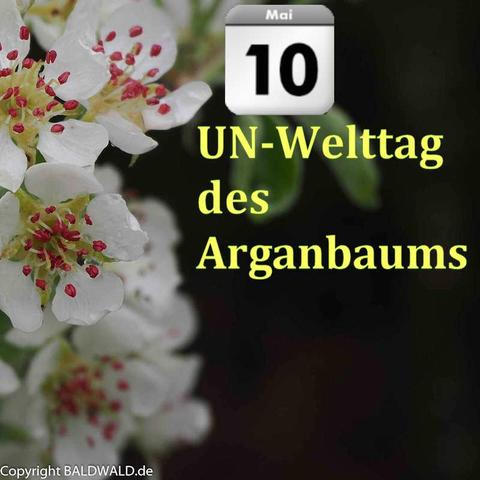
10. Mai ist der Welttag des Arganbaums.
➤ Etwas ungewöhnlich dass die UN eine einzelne Baumart ehrt; bisher erhielt diese Ehrung nur noch der Olivenbaum.
➤Der (relativ kleine) Arganbaum (Argania spinosa (L.)) ist ein uralte Art ("Tertiärrelikt") in Marokko und Algerien. Angesichts steigender Temperaturen gewinnt die Art an Bedeutung.
https://www.umwelttage.info/umwelttage-im-mai.html#0510c
__
#baum #arganbaum #Argania #marokko #algerien #umwelttage #baldwald #10mai #may10 #unitednations
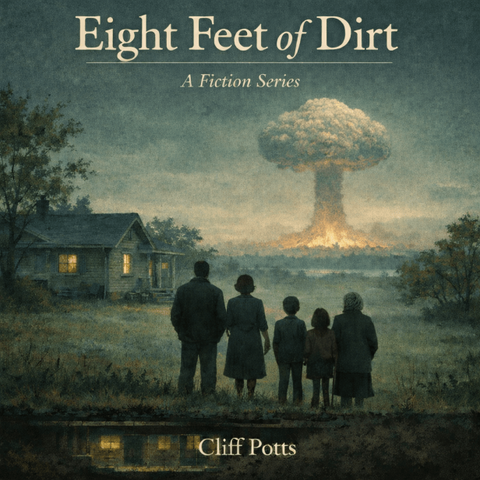
Eight Feet of Dirt
​A Fiction Series
Chapter 3: The Warning
By Cliff Potts
Lieutenant Colonel Mark Bragg stood over the scope, one hand braced on the console, the other hanging loose as the sweep came around again.
The returns held.
“Range one-nine-six nautical miles, sir,” First Lieutenant Carter said.
“Bearing?”
“Zero-zero-zero to one-eight-zero track. Due south.”
“Altitude?”
“Angels two-seven-point-five.”
A beat.
“Speed?”
“Four-eight-zero knots, steady, sir.”
Bragg nodded once.
That was enough to know.
“Interceptor status?”
“Air National Guard F-86s lifting out of O’Hare. Northern interceptors already vectoring in. Great Lakes Naval Air Station is scrambling everything flyable—Corsairs and Mustangs.”
Bragg glanced at him.
“Good.”
Another beat.
“Nike?”
“First Ajax battery ready.”
Bragg checked the clock.
“Let’s spend it.”
Out over Lake Michigan, the first formation came in level and tight, engines droning steady, contrails faint against the cold sky.
Below them, the lake stretched wide and empty.
Then the Americans arrived.
Sabres hit first.
Fast, cutting passes—.50 caliber bursts stitching across wings and engines. Tracers reached out and found metal, sparks and fragments peeling away into the air.
“Contact! Contact!”
A bomber took hits along its nacelle—fire blossomed, then spread. Another shuddered under impact, slipping out of formation, trailing smoke.
Then the prop fighters climbed into it.
Mustangs—lean, fast for what they were—sliding into firing angles the jets overshot. One tucked in behind a damaged bomber and opened up, steady hammering bursts walking across the fuselage.
The aircraft yawed, struggling.
A Corsair came in low and brutal, gull wings unmistakable, engine roaring. It fired long and hard into another bomber’s wing root.
Metal tore.
The bomber didn’t explode.
It just stopped holding together.
“Control, we’re in the middle of them—multiple hits!”
The sky fractured.
Nike Ajax missiles arrived a second later.
Sharp, violent bursts ripped through the formation. One bomber lost a wing outright. Another split under the pressure, fire trailing as both halves fell toward the lake.
The formation dissolved.
Not gone.
But broken.
In the kitchen, the radio was still playing.
That bothered Mike more than anything else.
The Chicago Sun-Times lay open on the table, unread.
Helen moved between sink and counter. Tommy stood near the basement door with a box. Carol watched the radio.
Margaret Kowalski watched Mike.
“They’re not saying anything,” she said.
Helen didn’t turn.
“They don’t know anything.”
Mike shook his head.
“They know something.”
The sirens began unevenly.
One.
Then another.
Then more, overlapping, rising into something unmistakable.
The radio cut mid-song.
Dead air.
Then:
“This is… Civil Defense… This is not a test… Repeat… not a test…”
Static swallowed the rest.
Mike stood.
“Tommy, downstairs. Now.”
Tommy moved.
“Carol, go.”
Helen hesitated a fraction.
“Mike—”
“We go now.”
That was enough.
Over the lake, a damaged bomber broke from the formation.
Something dropped from it.
Clean.
Wrong.
No chute.
No delay.
It fell fast.
Then—
The lake flashed.
A flattened bloom of light and water punched upward, a heavy shock rolling across the surface. Spray climbed high before collapsing back into the lake.
No towering cloud.
No clean shape.
Just violence in the wrong place.
“Control—” a pilot started.
There wasn’t a word that fit.
The house shuddered.
Not hard.
But enough.
Helen stopped.
“What was that?”
Mike didn’t answer.
He was already moving.
The shelter door closed.
Sealed.
The air changed.
Helen gathered the kids close. Tommy stood stiff, trying to hold himself together. Carol climbed onto a cot, pulling in tight. Margaret stood near the wall, steady.
Mike moved to the pipe along the outer wall.
He unscrewed the cap, fed the wire through the rubber grommets, and connected the radio.
The signal came in stronger.
Distant.
Broken.
“…take cover immediately… this is not a test…”
Then static.
Enough.
Back in the radar room:
“Second formation holding,” Carter said.
Bragg didn’t look away.
“Range?”
“One-six-five nautical miles.”
“Nike?”
“Reloading.”
“How long?”
A pause.
“Too long.”
Bragg nodded once.
The second formation came in tighter.
Lower.
They had seen what happened to the first.
They adjusted.
Sabres engaged immediately—fast passes, guns flashing. One bomber took hits and began to burn.
A Mustang slid in behind another, firing steady into its tail.
The bomber staggered.
But held.
A Corsair made a head-on pass, guns blazing.
Both aircraft survived the crossing.
Barely.
“Control, they’re still pushing through!”
The answer came thin.
“Understood.”
Nike batteries were still down.
Time was gone.
One bomber fell short, trailing fire.
Another broke off, losing altitude fast.
But three remained.
Three held formation.
Three kept coming.
Inside the shelter, the radio faded in and out.
Mike checked the water.
Still running.
For now.
Tommy looked at him.
“So what do we do?”
Mike looked up.
“At this point? We stay here.”
Helen tightened her grip on Carol.
Margaret stood quietly, hands folded.
Above them, the sirens wavered.
Then one cut out.
Then another.
The sound thinned.
Mike started counting without meaning to.
Not because it would help.
Because it was something.
Margaret closed her eyes for just a moment.
“And now we wait.”
#1950sAmerica #ChicagoSuburbs #civilDefense #ColdWarFiction #falloutShelter #May10 #nuclearWarStory #serializedFiction #survivalFictionThe Ross Bandstand: the thread about 170 years of squabbling over a public performance space

The much-debated Ross Bandstand found itself being discussed (yet again) today. But what is the Bandstand’s story? How did it come to be there and who was Ross? Let’s find out.
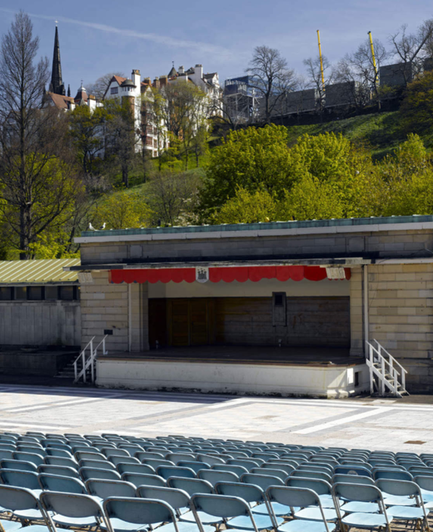
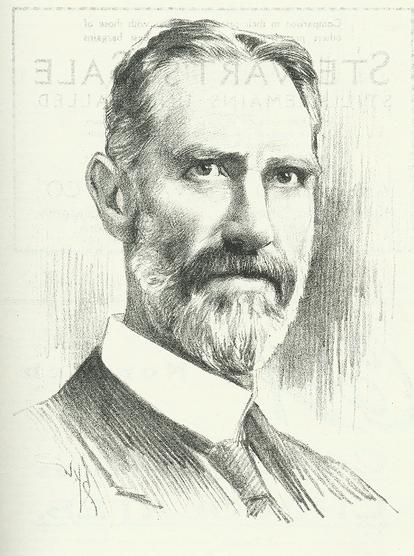
The Ross Bandstand in 2013. CC-by-SA 2.0 Daniel HallenThe Ross Bandstand was opened on the evening of Friday 10th May 1935, when an inaugural concert of “music in the parks” was attended by a crowd of at least 10,000 spectators. It was largely financed by a £5,000 (c. £300k in 2023) gift from William H. (Willie) Ross, after whom it is named. Ross was the Chairman of the Distillers Company Limited (usually just known as DCL or the Distillers Company) a company he had worked for since starting as a boy clerk out of school. He had risen through the ranks from the very bottom to the very top, taken over from the founding families and guided it through industrial and economic crises to become a British corporate stalwart.
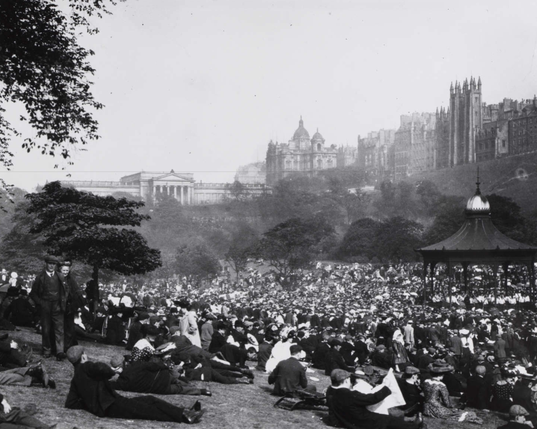
William H. Ross, chairman of the Distillers Company Limited. © Glasgow City Council Libraries, Mitchell Library, GC 052 BAIAs early as 1926, the old Victorian Bandstand in West Princes Street Gardens, while still a popular public attraction, was seen as out dated and in disrepair (sound familiar?). Inevitably, letters began appearing in The Scotsman suggesting its replacement. It would take 9 years to come to fruition – nothing concrete had happened for the 8 years until 1934 at which point Ross stepped in with his offer. He approached the Lord Provost Sir William Thomson in 1934 on his own initiative, after the previous attempts had failed due to squabbles over funding, location and a backdrop of economic troubles (sound familiar?!)
A concert at the old Bandstand, 1905. © Edinburgh City LibrariesThe City had only acquired West Princes Street Gardens in 1876 when the lease of the West Princes Street Proprietors expired; before then it had been a gated private garden for those residents and tenants along that section of that street. However they had been trying to acquire it since at least the 1850s. One of the most prominent voices for bringing the West gardens into public control had been the social reformer Rev. Dr James Begg of the Free Church. He spoke out against what the press called the “committee of shopkeeper” who were the proprietors and their champion Henry Cockburn, who felt the public lacked interest in the gardens. Begg countered that “public involvement was dependent on public rights, and shutting them out from public parks and gardens [had] gone far to destroy their public spirit“. Begg and the Scottish Association for the Suppression of Drunkenness managed to gain access to the public for the Gardens on Christmas and New Years Days “with a view to keeping parties out the dram shops“. Occasional public concerts in the gardens had to be stopped in both 1853 and again in 1875 when conditions descended into a near riot on account of “all denominations” of the citizenry trying to force their way into the Gardens to hear military bands, with “skirmishes” ensuing. They were supported in this by the Liberal and Reformist Lord Provost Duncan Mclaren. These arguments of public vs. private rights of access to the Gardens all sound very familiar, don’t they?
The first bandstand was built in 1872. When the West Princes Street Gardens organisation was wound up in 1879 it was found that they had substantial excess funds left and so these were used to construct a new bandstand in 1880 to the designs of Peddie & Kinnear. It quickly acquired an amphitheatre of seating on all sides.
The old bandstand, 1900. © Edinburgh City LibrariesIn 1897/98, in another one of Edinburgh’s interminable squabbles about the location and funding of concert halls, West Princes Street Gardens was mooted as a site for the potential Usher Hall. It was eventually built on Lothian Road, completed 16 years later.
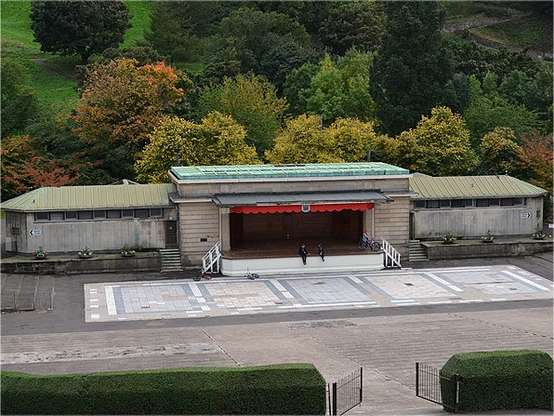
The new bandstand was designed by the City Architect, Ebenezer James Macrae, “the man who shaped modern Edinburgh“. It has a performance stage for bands of up to fifty members. A 40 feet wide concrete canopy projects 11 feet ahead of this, not just to keep the weather off the performers beneath but also to help direct the sound downwards and forwards to the audience. For the same purpose, the rear of the stage was constructed in the manner of a “sound mirror” and the stage was hollow, to act as a passive amplifier. A paved dance floor area was laid out between the stage and the seating. The opening programme for 1935 was a very martial affair – the schedule dominated by the bands of the Scots Guards, Irish Guards, Border Regiment, Royal Scots Greys and Gordon Highlanders (amongst others). However, in a break from military music, Councillor Stevenson of the Parks Committee made it known that they were investigating the potential for staging Shakespeare on the stage.
The Ross Bandstand in 2012 © Edinburgh City LibrariesOn Sunday 13th May, 1945, Winston Churchill’s VE Day Broadcast over the BBC was relayed to the Ross Bandstand, followed by a concert and Victory Dance performed by the band of the King’s Own Scottish Borderers. What would become the Edinburgh Military Tattoo started out at the Ross Bandstand in 1949, when 15,000 people attended a display of military drill and music from the band of the Highland Light Infantry under the direction of Colonel George Malcolm. The Royal Scots Greys provided a trumpet fanfare, the Royal Scots the pipes and drums, there was sword dancing, rifle drill, PT displays, a “Sixteen-some Reel” danced by the men of the Royal Scots and women of the Women’s Royal Army Corps and a general parade of service personnel.
VE dance in May 1945. Evening News photo, from “Living Memories” by Jennifer VeitchIn the 1950s, the Council organised a programme of entertainments at the bandstand throughout the season. In 1954 you could see dancing, displays of fly fishing, ballet, a parade of animals from Edinburgh Zoo and of course military bands (the Cameronians were in residence). From 1946, as part of a postwar “Holidays At Home” scheme, on Saturdays throughout the summer there was a “Children’s Hour” performed each Saturday at 1030AM. Music, sing-alongs, Punch & Judy, competitions, team quizzes and dancing all took place. These ran until 1961
The final Children’s Hour at the Ross Bandstand, 9th September 1961. Evening News photo.The bandstand began to fall out of favour in the 1960s, attendances dropped as public expectations changed. There were repeated letters to The Scotsman demanding the seating have a roof put over it “as a matter of desperation”. £10,000 was earmarked for this, but never spent. A temporary roof was eventually procured by Edinburgh District Council for the Bandstand’s seating area in 1986 at a cost of £180,000 for festival events. The 14 ton crane hired to erect it promptly cracked the concrete of the seating area and got stuck. When it came to re-erect the roof in 1987, the Conservative group on the council attempted to stop it at the Policy & Resources Committee. They wanted the whole bandstand gone on account of “the noise and cost to ratepayers”. It was “a scar on the landscape” said Cllr David Guestv
The crane stuck in the Ross Bandstand. The temporary roof tent and supporting structure can be seen behind it. Evening News Photo.The SNP precipitated local controversy in 1971 when they tried to book the Bandstand to host a public debate on party policy on the European Common Market. The very conservative Finance Committee came down hard on the line that it was strictly to be used only for “entertainment purposes”.
Headline – Lord Provost of Edinburgh Asked to Aid SNP CaseAlongside use as a semi-covered Festival venue, the institution that was the end-of-festival Fireworks concert helped to save the bandstand, as each year the Royal Scottish National Orchestra would play a concert choreographed to fireworks launched from the castle. However, because there is never anything new under the sun in Edinburgh local politics even in 1989 the District Council was accused of “fervour” for “low art” by trying to make it more accessible the public by staging popular events and the letters pages of The Scotsman once again overflowed with debates on the pros and cons of the festivals.
The most recent attempt at redevelopment started way back in 2016 when the City of Edinburgh Council consulted on the future of the bandstand, with US architects appointed in 2017 to design new proposals which came to be dubbed “The Hobbit House” on account of the curving, grassed canopy. This was part of an overall public / private “partnership” scheme called (for reasons opaque ) The Quaich Project. It eventually foundered in 2021 due to a combination of political squabbling, disagreements over the design, substantial dissatisfaction over the potential restriction of access to what is seen as a public space and the main funder pulling out. The interminable debates around the Ross Bandstand continues to go on to this day, as it has done for the last 170 years.
The 2017 “Hobbit House” design proposal. From Rossbandstand.orgNote to readers: unfortunately in April 2026, a third-party plug-in more than exceeded its authority and broke many of the image links on this site. No images were lost but I will have to restore them page-by-page, which may take some time. In the meantime please bear with me while I go about rectifying this issue.
If you have found this site useful, informative or amusing then you can help contribute towards its running costs by supporting me on ko-fi. This includes my commitment to keeping it 100% advert and AI free for all time coming, and in helping to find further unusual stories to bring you by acquiring books and paying for research.
Or please do just share this post on social media or amongst friends and like-minded people, sites like this thrive on being shared.
Explore Threadinburgh by map:
Travelers' Map is loading...These threads © 2017-2026, Andy Arthur.
NO AI TRAINING: Any use of the contents of this website to “train” generative artificial intelligence (AI) technologies to generate text is expressly prohibited. The author reserves all rights to license uses of this work for generative AI training and development of machine learning language models.
#Lochend #Logan #Restalrig #StMargaret5/10/2023
#May10 #FWakeMay10 #FWakeY2023
"UNDER NO CIRCUMSTANCES"
Social media machines have turned almost everyone into liars, manipulators, dishonest people - or people who ADMIRE and follow such leaders.
https://old.reddit.com/r/agedlikemilk/comments/1mcw9ag/under_no_circumstances_guys/
This day in history:
Births:
Deaths:
Holidays:
Random Article of the day:
Zaida Morales-MartĂnez is an American chemist and professor. She is currently professor emeritus of chemistry at Florida International University.
Preview : In The Works (May 2022)
a preview of some of the music in the works around this time 2 years ago…
🎬 · https://www.youtube.com/watch?v=NdXDYxg2z1M
#SymphonicRock #ProgressiveRock #ProgRock #prog #composers #youtube #musicvideo 🎧
#music #mastodonmusic #musiciansofmastodon #music_videos #videos
This day in history:
Births:
Deaths:
Holidays:
Random Article of the day:
#wikipedia #May10 #PasoRobles,California
Mistigram: the occasion observed today, #CleanUpYourRoom Day, might be in some tenuous way related to yesterday’s memorial for lost socks. (Hint: they’re under your bed!) This #ANSIart illustration by AdeptApril hammers the point home. (Well, the shelves are nice and clean!)