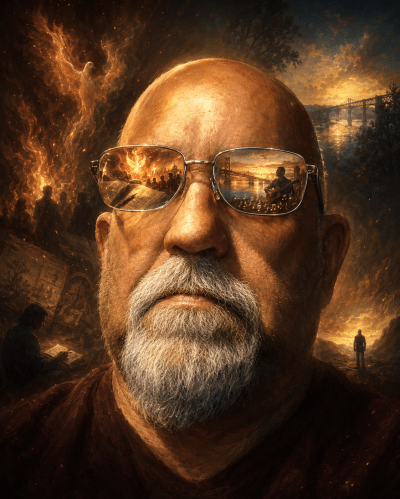
Fifty-Nine on Pentecost: Fire, Bridges, and a Heart Still Being Warmed

A Birthday Reflection — May 24, 2026

Today, I turn fifty-nine.

There is something strange about writing that number. Fifty-nine is not yet sixty, but it stands close enough to feel the gravity of that approaching threshold. It is a year poised at the edge of another decade, a number that invites a certain kind of honesty. Not the dramatic honesty that pretends everything has suddenly come into focus, but the quieter honesty of looking back over the terrain I have actually traveled: the things that have blossomed, the things that have hurt, the things still unfinished, and the signs of grace that keep appearing in the undergrowth.

I would like to say that I arrive at this birthday strong and full of energy, ready to gather every creative seed scattered through my life and bring it all into harvest. But that is not entirely true.

I have not been feeling well physically. My body has been reminding me that I am not simply a mind imagining world, a spirit dreaming visions, a pastor speaking words, or an artist shaping beauty. I am a body too—a body that tires, aches, worries, and longs to be well.

There is a particular sorrow in having so much one still wants to do while feeling uncertain about one’s strength to do it. There are stories pressing at the edges of my mind. There are songs waiting for breath. There are images, games, reflections, ministries, strange and beautiful worlds, and ideas of reconciliation and peace that I still want to offer. So much creative life has been stirring. So many sparks have appeared.

And alongside those sparks has been the quiet prayer:

Please, God, let me be well enough to tend the fire.

Perhaps that is why the date of this birthday feels especially meaningful.

Today, my birthday falls on Pentecost Sunday.

Pentecost is the day when frightened and uncertain disciples, people who had already known grief, bewilderment, failure, and hope beyond explanation, were gathered in one place. They were not standing at the height of their strength. They were waiting. They were living between what had been promised and what they could not yet see.

And into that waiting came breath and flame.

The Spirit descended. Words awakened. The scattered were gathered. The fearful found their voices.

I have often thought of creativity as something like that: a rushing wind through a room that has gone still; a flame resting upon an ordinary head; a language arriving that I did not fully know I knew. A story comes. A song arrives. An image forms. An idea for peacebuilding, a game, a sermon, a strange new country of the imagination appears as though someone has opened a window in a room that had grown close and airless.

Over this past year, windows have opened.

PeaceGrooves has continued to become more than an idea. It has become a gathering place for the things I most deeply care about: peace, creativity, imagination, justice, story, music, and the hope that human beings can learn to live differently with one another. I have imagined games that refuse the old assumption that conflict must end in domination. I have thought about creative peacebuilding not merely as an interesting phrase but as a calling: the possibility that art and story and play may become instruments of reconciliation.

I have continued to write strange, shadowed, luminous stories—stories emerging from history, disaster, forgotten figures, mystical places, wounded worlds, and the possibility that even within darkness there may yet be a voice calling toward mercy. I have made images and songs. I have watched one idea open into another and then another, like doors in an old house I did not know was so large.

And all the while I have continued to minister: to preach, to walk with people, to seek the goodness of God in the land of the living. I have continued to believe that reconciliation is not a decorative word for the church, but part of the very shape of the gospel: enemies becoming neighbors, strangers becoming companions, wounds becoming places where healing may begin.

Yet I can not pretend that this year has been only creative exhilaration.

There has also been weariness. There has been discouragement. There has been the familiar ache of wondering whether what I create will ever find the audience I hope for, whether the songs and stories and visions will reach beyond the small circle in which they first come to life. There has been the weight of inhabiting a body that does not always feel cooperative. There has been the fear that perhaps my energy will diminish before the fullest flowering of my gifts.

But Pentecost does not come only to the vigorous.

The Spirit does not descend only upon those who are untroubled, healthy, young, successful, or certain. The wind blows through closed rooms. The fire rests upon waiting people. The gift is not that the disciples suddenly become invulnerable; it is that they become alive with a life greater than their fear.

Today also carries another spiritual memory. On May 24, 1738, John Wesley went reluctantly to a meeting on Aldersgate Street. Reluctantly—that word matters to me. He was not triumphantly marching toward a spiritual experience. He went while troubled, still searching, still uncertain. And there, while hearing words about grace, he wrote that he felt his heart “strangely warmed.”

I find myself less interested now in a faith that demands I always appear strong and more drawn to the quiet mystery of a heart that can still be warmed.

At fifty-nine, I do not need to have everything solved. I do not need to prove that every dream has succeeded. I do not need to deny that I am tired or that I long for healing. Perhaps the deeper prayer is that my heart would remain warm: warm toward God, warm toward my wife, warm toward the people I serve, warm toward beauty, warm toward the wounds of the world, warm even toward my own imperfect and unfinished self.

It is possible for a person to grow cold over the years. Disappointment can do that. Illness can do that. Rejection can do that. The constant awareness of limits can make the spirit draw inward and protect itself.

But I do not want to live cold.

I would rather remain tender, even when tenderness hurts. I would rather keep imagining peace in a violent world. I would rather keep writing songs in a world of noise. I would rather keep dreaming of bridges while so many others are building walls.

For May 24 is also a day of bridges.

On this date in 1883, the Brooklyn Bridge opened after years of labor, loss, pain, and perseverance. Washington Roebling, who oversaw its construction, became physically incapacitated during the work, and the project continued in significant measure through the indispensable work of his wife, Emily. A bridge connecting divided shores came into being through vulnerability, endurance, and partnership.

That image speaks to me.

Perhaps a life is not measured only by towers raised or destinations reached. Perhaps it is also measured by the bridges one has helped build: between people, between faith and imagination, between sorrow and hope, between church and world, between creativity and reconciliation, between the person I once was and the person I am still becoming.

I do not know all the bridges my life may yet build. I know only that I want my remaining years to matter in that way. I want my ministry to help people cross from fear into love. I want my art to help people cross from numbness into wonder. I want PeaceGrooves to help people imagine forms of community, play, and storytelling that do not require enemies to be destroyed. I want my life to say, however imperfectly, that another way is possible.

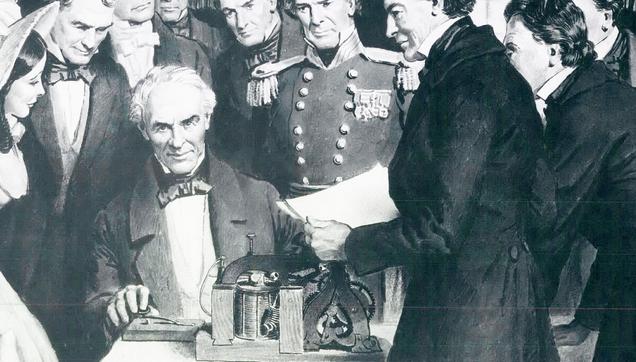
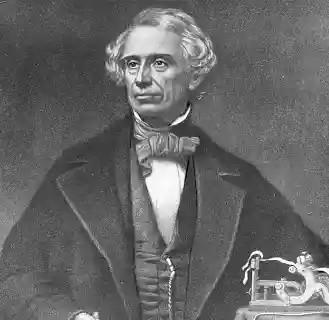
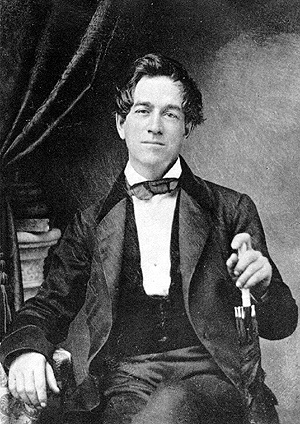
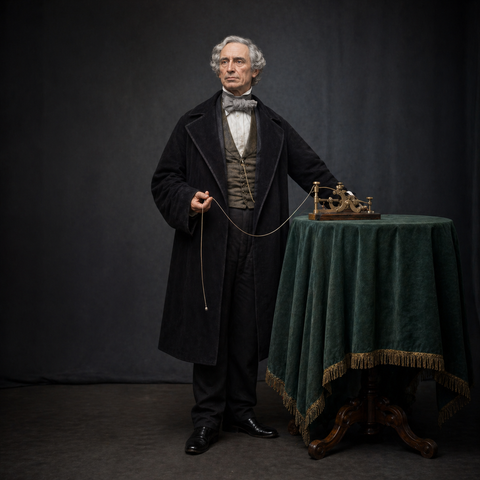
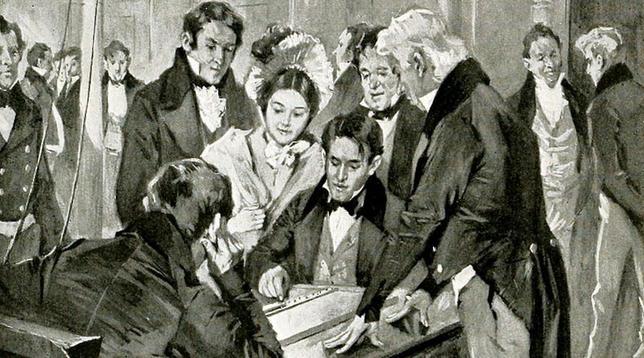
On May 24, 1844, Samuel Morse sent the first long-distance telegraph message:

“What hath God wrought.”

It is a phrase of astonishment. A phrase for standing before something new and scarcely believable. A phrase that looks backward and forward at the same time: marveling at what has come to be while wondering what it may make possible.

Today, on my fifty-ninth birthday, I find myself asking that question of my own life.

What has God wrought in fifty-nine years?

Not perfection.

Not a life without sorrow.

Not a straight line of accomplishment.

Not a body untouched by weakness or a soul untouched by struggle.

But there is love. There is a marriage and a shared ministry. There are songs. There are stories. There are carved and painted and imagined things. There are sermons preached and people accompanied. There is the stubborn conviction that peace is not naïve, that reconciliation is not weakness, that the imagination may yet become an instrument of healing.

There is joy that has somehow continued to rise through weariness.

There is beauty I have been permitted not only to see but sometimes to make.

And there is still more waiting.

Bob Dylan, born on May 24, shares this birthday. He is another reminder that creativity needs not stop at the borders of age. It may deepen. It may shift. It may become more weathered, more honest, and more necessary. Songs do not cease simply because the singer has traveled a long road. Sometimes, the road itself gives the song its voice.

I do not want this coming year merely to be a holding pattern before sixty.

I want it to be a living year.

I want health—not simply because I want relief, though I do; not simply because I want freedom from worry, though I do—but because I love this world and still want to participate in it. I want strength to preach and minister. I want strength to make music. I want strength to create strange and beautiful stories. I want strength to love my wife well, to be present to people, to follow the paths opening before me.

I want to be able to receive each day not merely as something to endure but as something in which grace may still take shape.

Yet even here I must be gentle with myself.

My worth does not depend upon how much I produce. My life is not validated only by completed books, successful songs, public recognition, flourishing projects, or the ability to do everything my imagination desires. Before I make anything, before I accomplish anything, before I am strong enough to do all I hope to do, I am loved.

Perhaps that is the warmth I need most.

At fifty-nine, standing in the firelight of Pentecost, I pray for the Spirit once again—not as spectacle, not as spiritual achievement, but as breath.

Breath for a tired body.

Fire for a creative heart.

Courage for a minister of reconciliation.

Comfort for the places in me that are afraid.

Patience for what is not yet finished.

Joy is not dependent upon perfect circumstances.

Healing, as healing may come.

And above all, the assurance that I remain held within the goodness of God.

Today, I am fifty-nine years old.

I do not know what this year will bring. I do not know what my body will require of me, or what new stories will be born, or what doors may open or close. But I know what I hope for.

I hope to remain awake.

I hope to remain tender.

I hope to remain creative.

I hope to keep making peace.

I hope to keep crossing bridges and building them for others.

I hope my heart is still capable of being strangely warmed.

And on this birthday of wind and fire, of messages carried across distance, of bridges spanning divided shores, of songs still being sung, I offer my unfinished life once more to the One who breathes over creation and says, even now, that it is good.

Come, Holy Spirit.
Breathe upon what is weary in me.
Warm what has grown discouraged.
Heal what is hurting.
Kindle, what is waiting.
And grant that the year ahead may become,
in ways I can not yet imagine,
another answer to the question:

What hath God wrought?
#Aging #AldersgateDay #birthdayReflection #BobDylan #bridges #BrooklynBridge #ChristianSpirituality #creativeCalling #Creativity #Faith #fireAndBreath #Grace #Healing #HolySpirit #Hope #illness #JohnWesley #lifeJourney #Ministry #Music #Peacebuilding #PeaceGrooves #Pentecost #PentecostSunday #personalReflection #Prayer #Reconciliation #SamuelMorse #SpiritualReflection #storytelling #strangelyWarmed #turningFiftyNine #WhatHathGodWrought
Fyra ord räckte. Den 24 maj 1844 sände konstnären som aldrig tänkte bli uppfinnare världens första telegram.#teknikhistoria #morse #samuelmorse
Morsning! Här skickas världens första telegram

Fyra ord räckte. Den 24 maj 1844 sände konstnären som aldrig tänkte bli uppfinnare världens första telegram.

nyteknik_teknikhistoria

#datocurioso

¿Sabían que Samuel Morse inventó el famoso telégrafo eléctrico debido al dolor de no haberse enterado a tiempo de la enfermedad y muerte de su esposa en el año 1825?

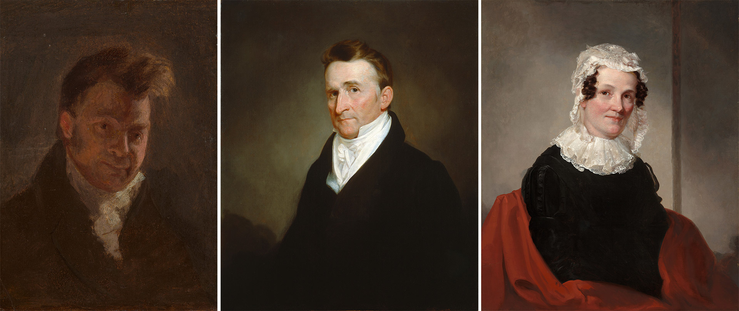
Antes de dedicarse por completo a los inventos de comunicación, Morse se ganaba la vida trabajando como un pintor de retratos en los Estados Unidos. En el mes de febrero de 1825, mientras él se encontraba en la ciudad de Washington pintando un cuadro del marqués de La Fayette, un mensajero a caballo le entregó una carta que había enviado su padre desde su hogar en New Haven, en el estado de Connecticut. El texto de la carta decía que su joven esposa, Lucretia, se encontraba muy enferma tras dar a luz a su tercer hijo, por lo que Morse guardó sus pinturas de inmediato y emprendió el viaje de regreso a casa.

Cuando el artista llegó a su hogar tras recorrer una distancia de más de 480 kilómetros, descubrió que su esposa no solo ya había fallecido, sino que su cuerpo ya había sido enterrado con anterioridad debido a los días que tardó en llegar el recado físico. Morse quedó destrozado por no haber podido despedirse de ella y por la lentitud de los sistemas de correo a caballo de esa época, lo que provocó que abandonara el mundo del arte y dedicara los siguientes 12 años de su vida a investigar una forma de mandar mensajes a largas distancias usando la electricidad por medio de cables, dando forma final al telégrafo y al código que hoy llevan su apellido.

— A. Eldritch, Periodista, Locutor, podcaster y bloger del fediverso

Alt text via @altbot y @TeLoDescribot

#SamuelMorse #Historia #Telégrafo #Inventos #Comunicaciones #CódigoMorse

 𝑺𝒂𝒎𝒖𝒆𝒍 𝑴𝒐𝒓𝒔𝒆  

Samuel Morse no empezó siendo inventor.
De hecho, su vida giraba alrededor del arte.
Era pintor, bastante reconocido en su época, y se movía entre retratos de personajes importantes y encargos que lo llevaban de un lado a otro.

En 1825 estaba trabajando en Washington cuando recibió una carta con una noticia urgente: su esposa, Lucretia, estaba muy enferma.
Él no alcanzó a reaccionar a tiempo.
Cuando consiguió volver a New Haven, ella ya había muerto y estaba enterrada.
No hubo despedida, ni última palabra, ni ese instante que uno siempre cree que va a tener.

Ese golpe le quedó clavado.

En una época en la que una noticia tardaba días o semanas en viajar, Morse entendió algo muy concreto: la distancia no solo separa lugares, también puede romper vidas sin que nadie lo vea venir.

Antes de ese episodio ya era un artista sólido.
Había fundado la Academia Nacional de Dibujo y retratado a figuras como John Adams, James Monroe o incluso el marqués de La Fayette.
Su obra más ambiciosa fue La Galería del Louvre, donde reprodujo decenas de pinturas europeas con una paciencia casi obsesiva.

Pero su rumbo empezó a cambiar.

Durante un viaje de regreso desde Europa en el barco Sully en 1832, escuchó hablar de los experimentos con electromagnetismo.
Esa idea, combinada con lo que había vivido, terminó encajando en su cabeza de una forma muy personal: si la información pudiera viajar rápido, quizá otras personas no perderían lo mismo que él perdió.

A partir de ahí empezó a trabajar en lo que sería el telégrafo eléctrico.

No lo hizo solo.
Alfred Vail fue clave en el desarrollo del sistema y en la simplificación del código.
Morse había ideado un sistema inicial basado en números que requerían un diccionario para traducirlos.
Vail lo transformó en lo que hoy conocemos: puntos y rayas, un lenguaje directo y mucho más práctico.

Cada señal representaba una letra, y las letras más comunes tenían los códigos más cortos.
Era simple, pero revolucionario.

El 24 de mayo de 1844 se envió el primer mensaje oficial entre Washington y Baltimore: “What hath God wrought”, una frase bíblica que marcó el inicio de una nueva era.

A partir de ahí, la comunicación dejó de depender únicamente de cartas lentas o viajes interminables.
El mundo empezó a hablar más rápido.

En lo personal, la vida de Morse también cambió.
Se casó dos veces.
Su primer matrimonio fue con Lucretia Pickering Walker en 1818, con quien tuvo tres hijos: Susan, Charles y James.
Ella murió en 1825 por complicaciones de salud tras su último parto.
Más tarde, ya con estabilidad económica gracias al telégrafo, se casó en 1848 con Sarah Elizabeth Griswold y tuvo cuatro hijos más: Samuel, Cornelia, William y Edward.

Nació el 27 de abril de 1791 en Charlestown, Massachusetts.
Creció en un entorno religioso y culto, hijo de Jedidiah Morse, geógrafo y pastor, y Elizabeth Ann Finley Breese.
Estudió en Phillips Academy, pasó por Yale a los 14 años, donde se graduó en 1810, y más tarde se formó en la Royal Academy de Londres, donde consolidó su carrera artística.

Murió el 2 de abril de 1872 en Nueva York a los 80 años, a causa de una neumonía.
Fue enterrado en el cementerio de Green-Wood, en Brooklyn, ya como una figura reconocida en todo el mundo.

Su historia deja una idea bastante clara: a veces los grandes cambios no nacen de la ambición, sino de una ausencia que no se puede arreglar.

▣▣▣▣▣▣▣▣▣▣▣▣▣▣▣▣▣▣

#samuelmorse #historia #telégrafo #codigomorse #inventores #historiadelaciencia #comunicación #sigloxix #biografía #curiosidadeshistóricas #arteyciencia #neoyork #historiareal

Happy 235th birthday to Samuel Morse, born April 27, 1791. 🎂

No dots and dashes → no telegraph → no radio → no us. It's a straight line.

This Amateur Radio History Month, we're grateful for every operator who carried that tradition forward — and for everyone still sending CW today. 📻🏳️‍🌈

#SamuelMorse #MorseCode #CW #HamRadio #AmateurRadio #AmateurRadioHistoryMonth #AllianceAmateurRadio

“It is impossible to win gracefully at chess. No man has yet said “Mate!” in a voice which failed to sound to his opponent bitter, boastful and malicious.”*…

… but perhaps the offense is muted if the call is remote.

Electronic gaming is huge– and growing, As Rolling Stone reports

The gaming industry, fueled by platforms like Twitch and YouTube, has surged into a multi-billion-dollar powerhouse, projected to exceed $207 billion in 2026. These platforms do more than showcase gameplay—they cultivate vibrant, interactive communities where fans engage in real time, from live chats to virtual watch parties. Games like League of Legends, Call of Duty, Counter-Strike and Fortnite have become a cultural phenomenon, drawing in over 2.6 billion gamers globally, a number that continues to climb each year. Mobile gaming, accounting for over 60% of global gaming revenue, plays a significant role in this growth, making gaming accessible to a broader audience than ever before…

But as Danny Robb explains, using tecnology to play games remotely has a long history…

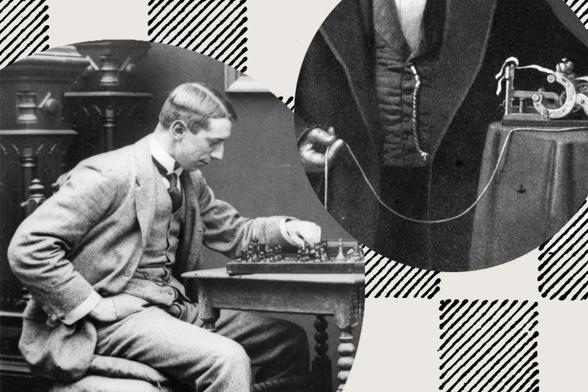
In 1897, the United States House of Representatives held a series of chess matches to find their most skilled players. The five winners were pitted against counterparts in the British House of Commons. But while the Americans sat down to play in Washington, D.C., their opponents sat in London. The players received moves by telegraph, and sent responses back over wires that crossed the Atlantic.

By this point, “cable chess” had been slowly evolving for decades. Historian Simone Müller-Pohl argues that this form of long-distance chess play offers insight into the cultural and political currents of the industrial era.

By the mid-nineteenth century, she explains, there was a growing sports culture in Europe and the US. Industrial technologies enabled more people to attend games and follow along from a distance. A growing middle class fostered this sporting culture, which came to include chess.

“Weekly,” Müller-Pohl explains, “the liberal and intellectual elites of the time assembled around chess boards in Paris, Berlin, Warsaw, Vienna, Moscow, Rome, and London.” Interest in the game spread, and chess clubs emerged. As clubs arranged tournaments and standardized chess rules, Müller-Pohl argues that chess “was gradually turned into a sport.”

Correspondence chess grew along with the game, in part thanks to cheap and efficient postal services. When the telegraph emerged on the scene, the application to chess was almost immediate.

“It was telegraphy’s fathers who pulled the strings behind the first schemes for cable chess,” Müller-Pohl explains. In 1844, inventor Samuel Morse arranged chess matches on a new telegraph line between Baltimore and Washington, D.C. “All of the 686 moves necessary for the seven games played were transmitted without mistake or interruption,” Müller-Pohl writes.

Not long after, in 1845, inventor Charles Wheatstone attended a demonstration in London. Chess legend Howard Staunton played against his rival George Walker over the South Western Railway line between Portsmouth and London. Müller-Pohl describes how witnesses found the match “rather tedious,” but it received a lot of press. This was partly the point—the matches demonstrated and advertised the capabilities and accuracy of the invention.

The Staunton match had another interesting aspect. Müller-Pohl points out that “the lines were still used for ordinary traffic during the games, allowing a group of chess players from Southampton to have every move telegraphed to them.” A bit like modern e-sports, spectators could observe the virtual match…

The early history of e-gaming– when telegraph cables let chess clubs stage matches across continents, linking players and spectators in a new kind of long-distance competition: “The First E-Sports? Chess by Telegraph,” from @inverting-vision.bsky.social in @jstordaily.bsky.social.

* A. A. Milne

###

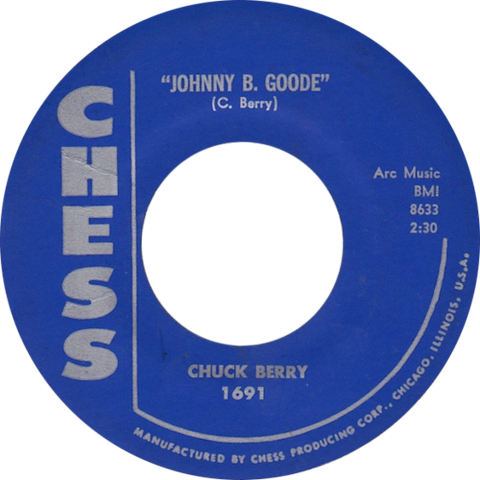
As we note that what’s old is new again, we might recall that it was on this date in 1958 that Chuck Berry’s “Johnny B. Goode” was released. It peaked at number two on the Hot R&B Sides chart and number eight on its pre-Billboard Hot 100 chart. Considered “the first rock & roll hit about rock & roll stardom”, it has been covered by many, many other artists and has received many, many honors and accolades, among them being ranked 33rd and 7th, respectively, on Rolling Stone’s 2021 and 2004 lists of 500 Greatest Songs of All Time. It was also included as one of the 27 songs on the Voyager Golden Record (a collection of music, images, and sounds designed to serve as an introduction and record of global humanity’s achievements, innovations and culture, to alien/otherworldly inhabitants).

Apropos the piece above, it was released by Chess Records.

source

https://youtu.be/6ROwVrF0Ceg?si=mn0aUbfgzyWtINVy

#chess #ChuckBerry #culture #eGaming #electronicGaming #gaming #history #mobileGaming #music #rock #rockAndRoll #SamuelMorse #Technology #telegraph #VoyagerGoldenRecord

Someone asked me about the difference between Morse code and Morse code. ;)
I remember receiving a book on Samuel Morse years ago when I was a teenager and the table confused me to no end until I learned the difference. ;)
It would have been so much less confusing had they labelled it Vail code but that's not what happened eh?

https://morsecodeconverter.net/american-morse-code-vs-international-morse-code/

#AmateurRadio #hamRadio #Morse #CW #Vail #MorseCode #AlfredVail #SamuelMorse

@StumpyTheMutt @qualia

I mean, how could #Beethoven have predicted that #MorseCode would make didididah mean V, which is the #RomanNumeral for 5?

(Or maybe #SamuelMorse was being cute.)

(Deleted & re-posted to fix typo.)

🗓️ Efeméride: 24 de mayo de 1844.

🌍 Samuel Morse envía el primer mensaje telegráfico entre Washington y Baltimore: “¿Qué ha hecho Dios?”. La comunicación humana acababa de dar un salto que acortaría el mundo sin mover un solo cuerpo.

#SamuelMorse #Telégrafo #Historia #Tecnología #Comunicación #Efeméride

No new sources, but a good account of Samuel Morse's momentous decision between art and technology.
Read about Samuel F. B. Morse's transition from an aspiring artist to the inventor of the telegraph. The article explores Morse's struggle with his art career and his ultimate shift to groundbreaking technology.
#ArtHistory #Technology #SamuelMorse https://journalpanorama.org/article/ex-artists-in-america/jilted-samuel-f-b-morse/
Jilted: Samuel F. B. Morse at Art’s End - Panorama

Panorama is a peer-reviewed, open-access, online publication dedicated to American art and visual culture (broadly defined). The journal is intended to provide a high-caliber international forum for disseminating original research and scholarship and for sustaining a lively engagement with intellectual developments and methodological debates in art history, visual and material cultural studies, and curatorial work.

Panorama