 Kristen Simonds
Migraine, Perception, and Creative Flow
Living Inside A Migraine
When pain, perception, and medication reshape daily life
I’ve been dealing with a migraine for nine days. This isn’t just a headache—it comes with aura, Alice in Wonderland syndrome, and persistent vertigo with nausea. My perception gets distorted, my thinking slows down, and basic tasks become difficult. The medication helps with the pain, but it brings its own side effects, and overall, it’s been hard to function.
In the middle of this, something unexpected happened.
A Brief Shift in State
Unexpected focus and creative flow during disruption
While I was heavily medicated, I had a period of intense creative focus. For a few hours, I was able to paint with a level of freedom that I don’t usually reach. It felt like my usual mental filters were lowered. I wasn’t second‑guessing decisions or holding back. I just worked.
The result was different from my normal work—more direct, less controlled, but also more expressive.
This raised a question for me: what actually changed in that moment?
Changes in Perception
How migraine and medication alter access, not ability
Triptans, the medication I use for acute migraine attacks, act on serotonin receptors. They’re not psychedelics, but they do affect how the brain processes signals. Combined with the migraine itself—especially aura, which already alters perception—the overall effect is a shift in how I experience space, color, and thought.
That shift isn’t comfortable. Most of it is disorienting and unpleasant. But within it, there was a brief window where my usual patterns loosened. And in that space, creative work felt easier.
Access, Not Creation
The work was already there—the conditions just changed
It’s important to be clear: the migraine didn’t “create” anything. The creativity was already there. What changed was how accessible it felt. The conditions removed some of the internal constraints I usually work within—habits, expectations, and self‑editing.
That’s not something I want to rely on. The cost is too high. But it does point to something useful.
If a change in mental state can affect how I access creativity, then there may be other ways to reach similar openness without the physical toll. It suggests that part of my creative process is limited not by ability, but by structure—how tightly I control the outcome, how much I filter while working.
There’s also a broader connection here. Decades ago, I had experiences with psychedelics that shifted how I saw the world and myself. Those experiences helped me let go of a lot of fear and rigidity. I don’t return to them now, but the perspective they opened up has stayed with me.
That perspective has been important in dealing with chronic migraine. The pain itself isn’t optional, but my response to it isn’t fixed. Over time, I’ve learned to manage the mental side of it—how much resistance I bring to it, how I interpret it, and how I move through it. That doesn’t eliminate suffering, but it changes its intensity and impact.
The recent experience fits into that same pattern. Even in a difficult state, there was a moment where something shifted—not into relief exactly, but into clarity of a different kind.
For me, the takeaway isn’t about the medication or the migraine. It’s about access.
The kind of creative flow I felt isn’t something external that I need to recreate through extreme conditions. It’s something internal that I was briefly able to reach under unusual circumstances.
Openness and Letting Go
When the boundary between experience and experiencer softens
There’s also a quality in that state that’s familiar from meditation. It’s a kind of openness where the usual sense of separation starts to fade. Instead of feeling like an observer acting on an experience, there’s just the experience itself—no clear boundary between the one perceiving and what’s being perceived. In that space, the need to control or interpret loosens, and the work unfolds more directly, without the usual distance between intention and action.
Working with Pain
Perspective, resistance, and what can shift
Another layer to this is perspective. The difference between being overwhelmed by the experience and moving through it often comes down to how it’s held. I wrote previously about the Four Noble Truths and the Eightfold Path as a framework for navigating chronic pain from migraine and lupus. What stands out to me now is how practical that framework is—not as philosophy, but as a way of adjusting perspective in real time.
When The Pain Takes Over
A reminder that practice isn’t always accessible
Pain is present. That part isn’t optional. But the added weight—resistance, fear, frustration—can shift depending on how tightly I hold the experience. That said, this isn’t always accessible. There are moments when the pain takes over completely. Last night was one of those times. I woke up in the middle of the night in severe pain after my first medication didn’t work. I couldn’t find my stronger medication, didn’t have my glasses, and ended up searching through cabinets, drawers, and bags in a panic. I knew that without it, I might end up in the ER—where the treatment helps, but comes with hours of discomfort and side effects. I was overwhelmed, in tears, and scared.
In moments like that, there isn’t much space for perspective or practice. But experiences like this also make something clear to me: without meditation, without the framework I’ve built from Buddhist practice, I would likely be living in that state of panic much more often. My commotion woke up my husband, who came in—calm, steady, not caught in the panic I was in. He found the medication, and he cleaned up the mess I had made searching as I went back to bed. That contrast stood out. It reminded me that while I can’t always access those tools in the moment, they still shape how I move through these experiences over time.
Returning to Openness
Creative flow, meditation, and another way of relating to experience
It’s not easy to stay open in the middle of persistent pain. In those moments, it’s hard to remember that the pain will pass—that it isn’t permanent. Pain forces attention into the present, but not calmly or intentionally. It can narrow everything down to urgency and survival. At the same time, it can act as a kind of teacher. It shows where resistance builds, where fear takes hold, and how quickly the mind tries to escape what’s happening. When I’m able to step back, even slightly, I can see it less as something to fight and more as something that reveals how I relate to experience.
What I keep coming back to is this: the experience changes depending on how I meet it. Not completely, not all at once, but enough to matter. And in those moments of openness, there is less separation—and a little more space for things to be as they are.
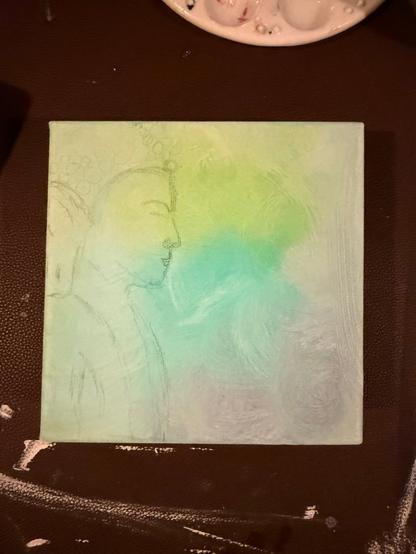
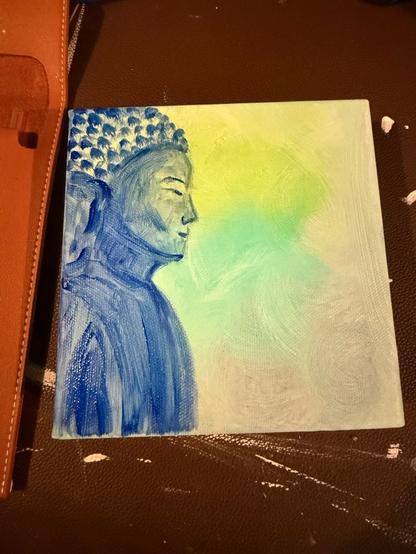
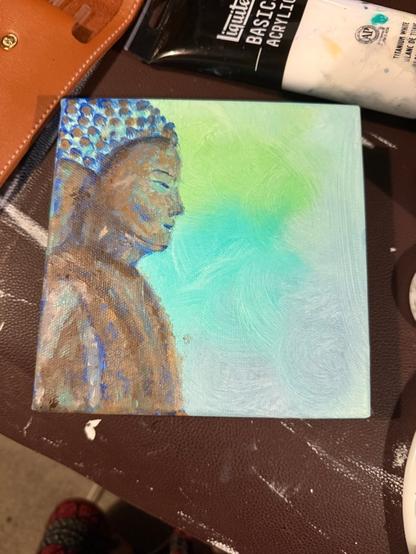
I painted this over six hours while medicated for a migraine, drifting in and out of focus. The haze loosened my usual self‑judgment, and the work shifted into something more fluid and intuitive. It’s not complete, but the evolution itself tells the story.
#acceptance #alteredStates #artisticFlow #awareness #BuddhistPhilosophy #chronicIllness #chronicPain #consciousness #creativeExpression #creativeProcess #creativity #eightfoldPath #flowState #fourNobleTruths #innerLandscape #innerWork #intuitiveArt #lettingGo #livedExperience #lupus #meditation #migraine #migraineAura #mindfulness #nondualAwareness #openness #painting #perception #personalEssay #perspectiveShift #presence #resilience #transformation
 SydneyJim
 anshul bohre
 Luxe Self
 Tim
Tim