I've seen recipes for #ChamisaAsh (#CulinaryAsh) that involve wood chips, mountain sage, #juniper, and epazote herbs, burned to fine white ashes. I also found this from a #Navajo recipe for Corn Ice (Da’yis tiin).

"A Note on Culinary Ash

Culinary ash dates back thousands of years and has been used by Native communities throughout the Americas for millennia. It is primarily made from shrubs and trees growing near or around the Native communities that use it. The Navajo primarily use juniper ash. Chef Walter Whitewater and his family have been using juniper ash in their traditional dishes since he was a little boy.

"Juanita Tiger Kavena, author of Hopi Cookery, who has since passed, talks in her cookbook about the #Hopi using the ash from #corncobs, #CornSilk, and #CornHusks, as well as the #FourWingSaltbush (#AtriplexCanescens), which is also called #chamisa. Her son, Wilmer Kavena Jr., whom I know as Chibbon (which is Creek for 'little boy'), says that the four-wing saltbush is the preferred bush for the Hopi but that ash can be made from burning any bushes. He prefers to make ash from the four-wing saltbush since these bushes are more #alkaline and work better with the #corn. And Brandon Baugh from San Felipe Pueblo, my student from the Indigenous Concepts of Native American Food class at the Institute of American Indian Arts, researched the use of ash in his community and at San Felipe Pueblo for his final paper and presentation, and found that in his community they use juniper, four-wing saltbush, and onion ash. Other Native communities all over the United States use various materials, including the ash from certain types of #wood.

Culinary ash can be sourced from Shimà of Navajoland and Blue Corn Custom Designs, among others."

https://www.ediblenm.com/graces-corn-ice-dayis-tiin/

#SolarPunkSunday #TraditionalFoods
#TraditionalRecipes #HopiRecipes
#NavajoRecipes #PlantAshes

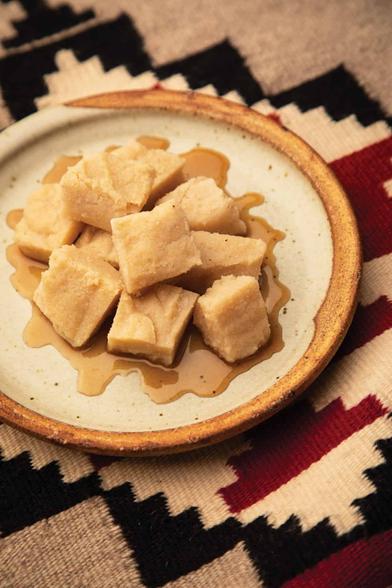
Grace’s Corn Ice (Da’yis tiin)

Plant-based Navajo cook Grace Tracy shared her version of this corn dish with me and said that it was a variation of a popsicle she likes.

Edible New Mexico

#Nixtamalization

From Wikipedia, the free encyclopedia

"Nixtamalization (/ˌnɪʃtəməlɪˈzeɪʃən, ˌnɪks-/ nish-tə-mə-lih-ZAY-shən) is a process for the preparation of maize (corn), or other grain, in which the grain is soaked and cooked in an alkaline solution, usually limewater (but sometimes aqueous alkali metal carbonates),washed, and then hulled. The term can also refer to the removal via an alkali process of the pericarp from other grains such as sorghum.

"#NixtamalizedCorn has several benefits over unprocessed grain: It is more easily ground, its nutritional value is increased, flavor and aroma are improved, and mycotoxins are reduced by up to 97–100% (for aflatoxins).

"Lime and #ash are highly alkaline: the alkalinity helps the dissolution of hemicellulose, the major glue-like component of the maize cell walls, and loosens the hulls from the kernels and softens the #maize. The tryptophan in corn proteins is made more available for human absorption, thus helping to prevent niacin deficiency (pellagra).  Tryptophan is the metabolic precursor of endogenous niacin (Vitamin B3).

"Some of the corn oil is broken down into emulsifying agents (monoglycerides and diglycerides), while bonding of the maize proteins to each other is also facilitated. The divalent calcium in lime acts as a cross-linking agent for protein and polysaccharide acidic side chains.

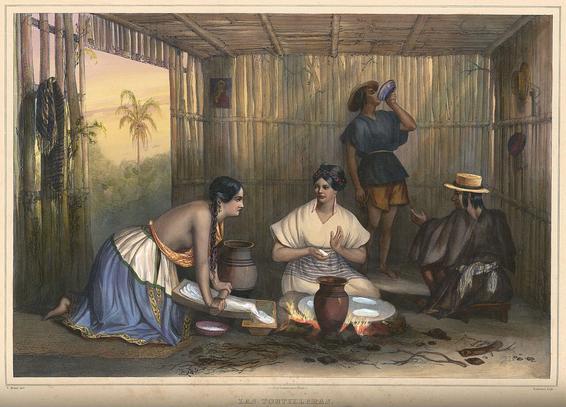
"While cornmeal made from untreated ground maize is unable by itself to form a dough on addition of water, nixtamalized cornmeal will form a dough, called #masa. These benefits make nixtamalization a crucial preliminary step for further processing of maize into food products, and the process is employed using both traditional and industrial methods in the production of #tortillas and #TortillaChips (but not corn chips), #tamales, #hominy, and many other foodstuffs.

Etymology

"In the #Aztec language Nahuatl, the word for the product of this procedure is #nixtamalli or #nextamalli (pronounced [niʃtaˈmalːi] or [neʃtaˈmalːi]), which in turn has yielded Mexican Spanish #nixtamal ([nistaˈmal]). The Nahuatl word is a compound of nextli "lime ashes" and tamalli "unformed/cooked corn dough, tamal". The term #nixtamalization can also be used to describe the removal of the pericarp from any grain by an #alkali process, including maize, #sorghum, and others. When the unaltered Spanish spelling nixtamalización is used in written English, however, it almost exclusively refers to maize.

"The labels on packages of commercially sold tortillas prepared with nixtamalized maize usually list corn treated with #lime as an ingredient in English, while the Spanish versions list maíz nixtamalizado.

Impact on health

"The primary nutritional benefits of nixtamalization arise from the alkaline processing involved. The processing renders the protein more digestible, allowing tryptophan to be absorbed by humans. Humans can convert tryptophan into niacin, thus helping to prevent pellagra. Other measures of protein quality are also improved.  It was originally thought that the anti-pellagra action stems from increased availability of niacin (compared to a hemicellulose-bound form called "niacytin"), but multiple experiments have disproven this theory.

"Secondary benefits can arise from the grain's absorption of minerals from the alkali used or from the vessels used in preparation. These effects can increase #calcium (by 750%, with 85% available for absorption), iron, copper, and zinc.[4]

"Nixtamalization significantly deactivates #mycotoxins which are putative carcinogens. #Aflatoxins are reduced by 90–94%. Fumonisins are reduced by 82%."

Source:
https://en.wikipedia.org/wiki/Nixtamalization

#SolarPunkSunday #NativeAmericanFoods #NativeAmericanHistory #Corn #BlueCorn #MesoAmerica #TraditionalFoods #CulinaryAsh #CalciumCarbonate #History #FoodHistory #Corn #PlantAshes

Nixtamalization - Wikipedia

More about #GladiatorGatorade

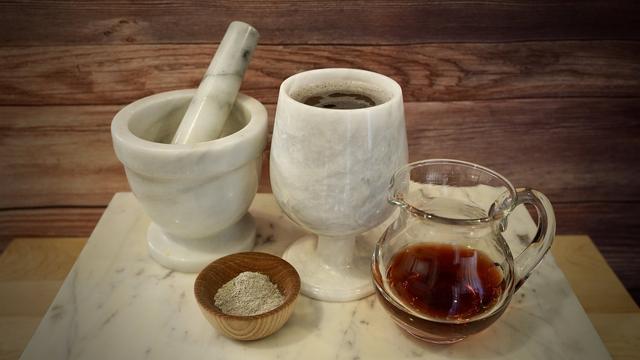
A refreshing, slightly smoky gladiator drink made with vinegar, honey, and culinary ash

"Pliny the Elder writes of gladiators drinking 'a lye of ashes' to refresh themselves after 'being disabled at the games'. They probably weren’t drinking actual #lye because that would do terrible things to your insides, but you can get #CulinaryAsh in place of that 'lye of ashes'. If you make this, use culinary ash to be on the safe side. I mixed mine into some #posca, a #VinegarHoney drink that was the #Gatorade of #AncientRome.

"This gladiator Gatorade is refreshing with a bit of sourness from the vinegar and sweetness from the honey, and the ash adds a bit of smokiness at the end. Was it good? Not really. Was it better than I thought it would be? Definitely.

'For convulsions or contusions of the viscera, let the hearth be your medicine-box; for a lye of ashes, taken from thence, mixed with your drink, will effect a cure. Witness the gladiators, for example, who, when disabled at the games, refresh themselves with this drink.'
— Pliny the Elder, Natural History, XXXVI.203

Ingredients:

- Water
- Wine vinegar
- Honey
- Culinary ash*

*It’s very important to use culinary ash.

Instructions:

- In a mixing glass, stir a small amount of honey and vinegar into the water. Taste and adjust the amounts to your liking.
- Add a small spoonful of the culinary ash and stir.
- Strain into a glass and serve it forth to a weary gladiator. "

Source:
https://www.tastinghistory.com/recipes/gladiatorgatorade

#SolarPunkSunday #PlantAshes #LowTech #BoneHealth #History #RecoveryDrink #Histodon #HistoricalRecipes #ThirstQuenching

Gladiator Gatorade — Tasting History

A refreshing, slightly smoky gladiator drink made with vinegar, honey, and culinary ash

Tasting History

Something both the #Hopi and #Romans (and other cultures) shared -- using plant-based ashes in food and medicine!

#GladiatorGatorade? Ancient Athletes Had A Recovery Drink, Too

by Maria Godoy, October 27, 2014

Excerpt: "#PlantAshes were evidently consumed to fortify the body after physical exertion, and to promote better bone healing,' Fabian Kanz, a forensic anthropologist at the Medical University of Vienna who led the research, said in a statement. 'Things were similar then to what we do today."

"Evidence for this ancient dietary supplement comes from a second-century cemetery for gladiators in what was once the great Roman city of Ephesus, in modern-day Turkey. Kanz and his colleagues have been studying the remains buried there to unravel how these athletes lived. To figure out what they ate, the researchers examined the remains of 22 gladiators using stable carbon and nitrogen isotope ratio analysis.

"Carbon can tell us about the plants these people ate, while nitrogen offers hints of their animal protein consumption. The gladiators were eating a pretty varied diet, the analysis showed. Some went heavier on the #grains and #greens; some ate more meat.

"When the same tests were run on the remains of 31 regular folks from that era and region, they found the same sorts of variation. In other words, gladiators seemed to be eating the same way as everyone else.

"But the researchers also decided to look at the trace elements of strontium and calcium in those old bones. And that's where a huge difference jumped out. Compared with the regular Joes, the gladiators had a much larger ratio of strontium to calcium.

" 'This is strong evidence that the gladiators were consuming something high in calcium to replenish their calcium stores that other people weren't and that didn't show up in the isotopes,' says Kristina Killgrove, a biological anthropologist at the University of West Florida who studies imperial Rome through ancient bones.

"The researchers wondered: If the gladiators weren't eating more meat than their contemporaries, then where was this calcium boost coming from? A nearly 2,000-year-old encyclopedia offered a tantalizing clue.

"In his #NaturalisHistoria, published in the first century, #PlinyTheElder wrote: 'Your #hearth should be your #MedicineChest. Drink #lye made from its ashes, and you will be cured. One can see how gladiators after a combat are helped by drinking this.'

"Using ash in food and medicine wasn't limited to the Romans. The #Hopis used ash from burned plant leaves and pea pods to prepare #BlueCornmeal foods like #PikiBread and #BivilvikiDumplings. The ash provided essential elements like #calcium, #manganese, #copper and #iron."

Read more:
https://www.npr.org/sections/thesalt/2014/10/27/357903336/gladiator-gatorade-ancient-athletes-also-had-a-recovery-drink

#SolarPunkSunday #LowTech
#BoneHealth #History #RecoveryDrink
#Histodon #HistoricalRecipes
#ThirstQuenching #BlueCorn #TraditionalRecipes #CulinaryAsh

And now we have the most basic of all Ash Yams from Elder Scrolls online. (there's a video on the IG link.)

#archaeology #Archaeogaming #food #yam #culinaryash #ash #ashyam #elderscrolls #geekeats

https://www.instagram.com/p/CKzd6ttrEEc/

What's cooking at the Geek Eats Cafe?

It's hot!

#ash #culinaryash #juniperberries

https://www.instagram.com/p/CKzZO0FLgyB/