Sea Turtle Identification Guide
A Guide to Identifying the Seven Sea Turtle Species
There are only seven recognized species of sea turtles worldwide. While they share a global range, distinguishing between them requires attention to detail. Identification relies on specific physical markers rather than general appearance.
To identify a sea turtle, you generally look at three key areas:
- The Head: Specifically the “Prefrontal Scales” between the eyes.
- The Carapace (Shell): The number and pattern of “scutes” (plates) on the back.
- The Plastron (Belly): In some species, pores on the belly scales are the giveaway.
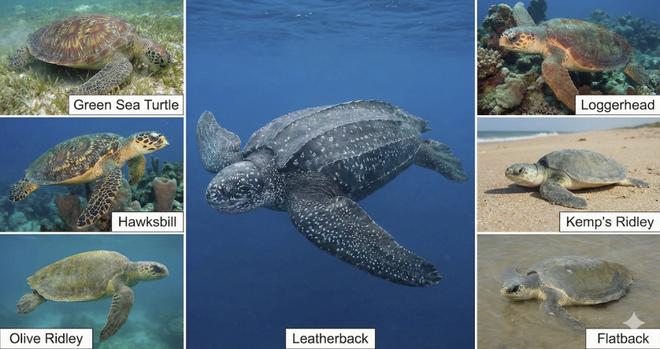
There are seven distinct species of sea turtles navigating our oceans. Use the chart below to identify them by their shell patterns and scales, then explore the detailed breakdowns further down the page.
Sea Turtle Identification Chart
Leatherback
Leathery shell. No scutes.
Hard Carapace
Hard shell with scutes.
4 Costal Scutes
First scute doesn’t touch neck.
Hawksbill
2 Pairs Scales.
1 Pair Scales
Between eyes.
Flatback
Upturned shell.
Green
Smooth shell.
5 or more Costal Scutes
First scute touches neck.
Circular Shell
Wide & Round.
Kemp’s Ridley
5 Scutes.
Olive Ridley
6+ Scutes.
Loggerhead
Elongated shell.
Quick ID Tip: Check the Map!
Location is the most efficient way to narrow the possibilities. Flatback turtles are endemic to the Australian continental shelf; sightings outside this region are statistically negligible. Similarly, Kemp’s Ridleys are concentrated in the Gulf of Mexico and the North Atlantic. Always apply geographical range as your first filter before counting scales.
Sea Turtle Shell Anatomy Reference
Species Profiles
Loggerhead Sea Turtle
Caretta caretta [youtube https://www.youtube.com/watch?v=o-rIEsPvT1Y] Average Size 3 ft long250–300 lbs Range Temperate & Tropical
(Atlantic, Pacific, Indian) Population Vulnerable
(Decreasing)
Identification Profile
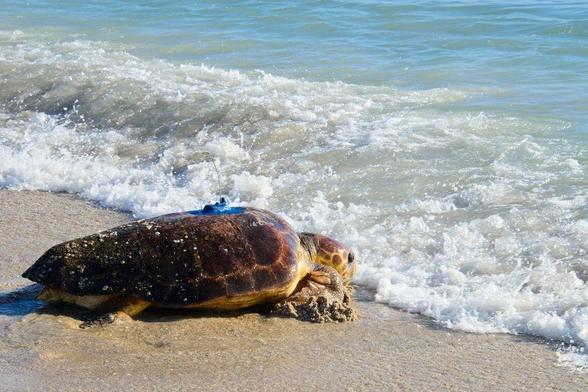
Distinguishing Features: Named for its massive, blocky head. The carapace is reddish-brown and elongated (tapering slightly at the rear).
Diet: Carnivores. Their massive jaws are designed for crushing hard-shelled prey like conch, crabs, and clams.
Green Sea Turtle
Chelonia mydas [youtube https://www.youtube.com/watch?v=FJTogxQRCtE] Average Size 3–4 ft long300–400 lbs Range Tropical & Subtropical
(Global) Population Endangered
(Decreasing)
Identification Profile
Distinguishing Features: Named for the color of its fat (not its shell). It has a smooth, oval carapace and a rounded head with only 1 pair of prefrontal scales between the eyes.
Diet: Herbivores (Adults). They are the only sea turtle species that feeds strictly on seagrass and algae, maintaining the health of seagrass beds through constant grazing.
Hawksbill Sea Turtle
Eretmochelys imbricata Average Size 2.5–3 ft long100–150 lbs Range Tropical Reefs
(Atlantic, Pacific, Indian) Population Critically Endangered
(Decreasing)
Identification Profile
Distinguishing Features: Named for its narrow, pointed beak. The shell has overlapping scutes (like roof shingles) and a serrated edge.
Diet: Spongivores. They feed almost exclusively on sponges found in coral reefs, helping to keep the reef healthy by preventing sponges from overgrowing corals.
Leatherback Sea Turtle
Dermochelys coriacea Average Size 6–7 ft long550–1,500 lbs Range Global Oceans
(Tropical to Sub-Polar) Population Vulnerable
(Decreasing)
Identification Profile
Distinguishing Features: The only sea turtle without a hard shell. Its carapace is leathery, inky blue-black, and flexible, with 7 distinct ridges running lengthwise.
Diet: Gelatinous feeders. They feed almost exclusively on jellyfish and salps, which helps control jellyfish populations in the oceans.
Flatback Sea Turtle
Natator depressus Average Size 3 ft long180–200 lbs Range Australia & PNG
(Continental Shelf) Population Vulnerable
(Data Deficient)
Identification Profile
Distinguishing Features: Has a very flat carapace with edges that curl upward (like the brim of a hat). It has thinner skin than other species, which can feel easily bruised.
Diet: Omnivores. They forage in shallow, murky waters for sea cucumbers, soft corals, jellyfish, and prawns.
Kemp’s Ridley Sea Turtle
Lepidochelys kempii Average Size 2 ft long75–100 lbs Range Gulf of Mexico
& US Atlantic Coast Population Critically Endangered
(The Rarest Species)
Identification Profile
Distinguishing Features: The smallest sea turtle. It has a very circular, light gray-green shell. It is the only species that nests primarily during the day.
Diet: Carnivores. They prefer swimming crabs, which is why they stay in shallower, muddy, or sandy coastal waters.
Olive Ridley Sea Turtle
Lepidochelys olivacea Average Size 2–2.5 ft long80–110 lbs Range Tropical Waters
(Pacific, Indian, South Atlantic) Population Vulnerable (Abundant but High Risk)
Identification Profile
Distinguishing Features: Famous for Arribadas (synchronized mass nesting). It has 6 to 9 costal scutes, which is unique (most other hard-shelled turtles have 4 or 5), and the number is often asymmetrical.
Diet: Omnivores. They eat crabs, shrimp, lobsters, urchins, jellyfish, algae, and fish.
The Cycle: A Game of Numbers
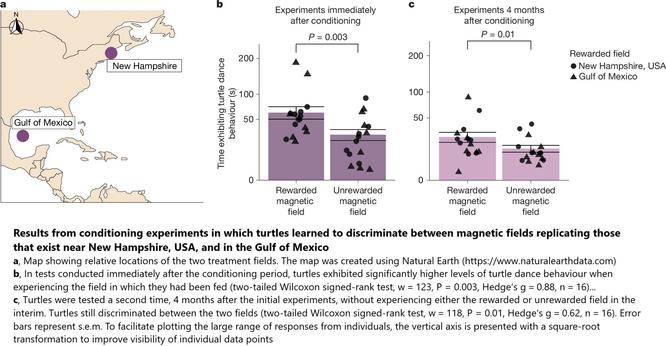
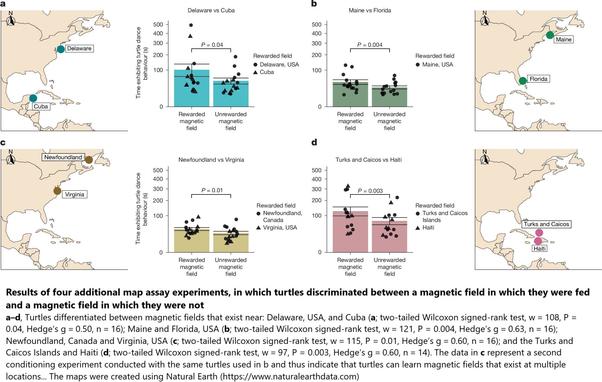
Sea turtle reproduction is defined by Natal Homing. Females possess the ability to imprint on the magnetic signature of their birth beach, returning decades later to lay their own clutches.
The process is high-risk. A female may lay hundreds of eggs in a season, but the survival rate is brutal. Biologists estimate that only 1 in 1,000 hatchlings survives to sexual maturity.
[youtube https://www.youtube.com/watch?v=QpWipBv2d0o]Hatchlings emerging in Laamu Atoll, Maldives
Temperature-Dependent Sex Determination (TSD): The sand temperature determines the sex of the hatchlings. Warmer sands produce females, while cooler sands produce males. This mechanism makes sea turtle populations particularly vulnerable to rising global temperatures.
Quick Comparison Table
Species Costal Scutes Prefrontal Scales Inframargin Scutes Key Feature Leatherback None None None Leathery shell with ridges Hawksbill 4 (no nuchal contact) 2 pairs 4 (no pores) Overlapping scutes, hawk beak Flatback 4 1 pair 4 (no pores) Flat shell, Australia only Green 4 1 pair 4 (no pores) Serrated lower jaw, herbivore Kemp's Ridley 5 (circular) More than 1 pair 4 (with pores) Smallest, nearly circular shell Olive Ridley 6+ (variable) More than 1 pair 4 (with pores) 6+ vertebral scutes, mass nesting Loggerhead 5 More than 1 pair 3 (no pores) Massive head, reddish-brownTerminology Guide
Costal (Lateral) Scutes: The large plates lining the sides of the carapace (top shell). Counting these is the primary method for distinguishing hard-shelled species. Prefrontal Scales: Scales located on the dorsal surface of the head, specifically the area between the eyes. Nuchal Scute: The solitary, central scute positioned at the leading edge of the carapace, directly behind the neck. Vertebral Scutes: The central column of plates running along the spine from front to rear. Inframarginal Scutes: The row of scutes located on the bridge connecting the plastron (belly) to the carapace. Pores: Distinct, small apertures found within the inframarginal scutes. Presence or absence is a diagnostic trait for Ridley species. #flatback #greenSeaTurtle #hawksbill #kempsRidley #loggerhead #oliveRidley #seaTurtleIdentification #seaTurtles #Turtles